JACKSONVILLE, Fla. – The diagnosis was Entamoeba histolytica, which is an infection caused by ingesting an amoeba that produces fatigue, abdominal pain, weight loss, and a few more symptoms you don’t want to have when you are more than 9,000 miles from home.
That’s where Christopher Trinidad happened to be during a visit to his parents’ homeland in the Philippines the summer before the eighth grade.
Born and raised in Jacksonville, Christopher’s immune system was not accustomed to some of the pathogens found in the local food. He had not built up a resistance like residents have. Lying in a hospital bed in the city of Bacolod, while the antibiotics did their thing, Christopher had this thought: “This has to be my science fair project.”
And so it was.
After returning home, Christopher ordered microorganisms online. “Safer organisms,” he said, than the one that waylaid him a few weeks earlier. He experimented with various items found in the kitchen pantry – ginger and garlic – mixed them with water and other ingredients and developed a solution that killed the organisms.
“What if,” Christopher thought, “we use these solutions on the actual thing? This can help so many people.”
His project finished first at a regional science fair.
“Impressive, right? Wait until you hear what he did his freshman year,” said Carla Chin, director of marketing and communications at Bishop Kenny High School in Jacksonville.
Christopher, a sophomore, attends the parochial Catholic school on a Florida education choice scholarship managed by Step Up For Students.
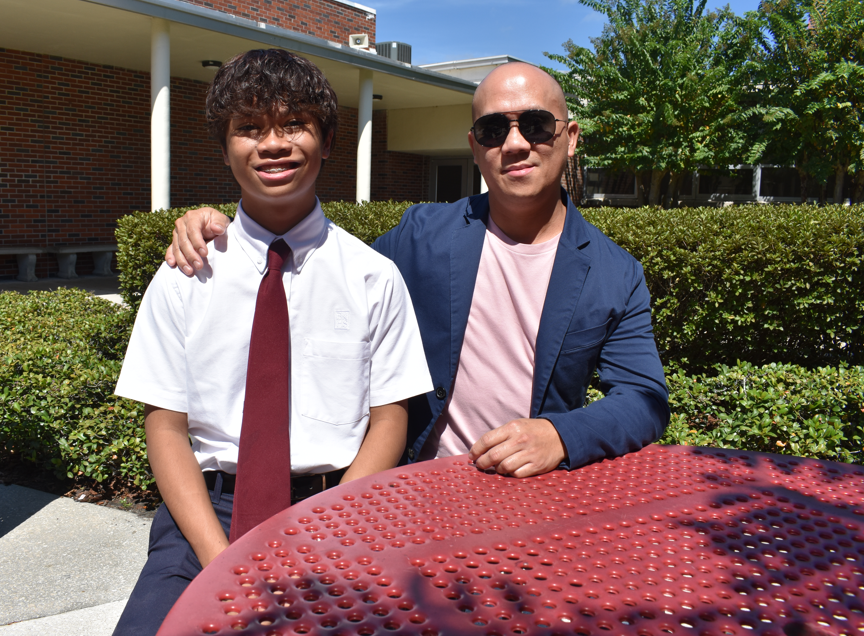
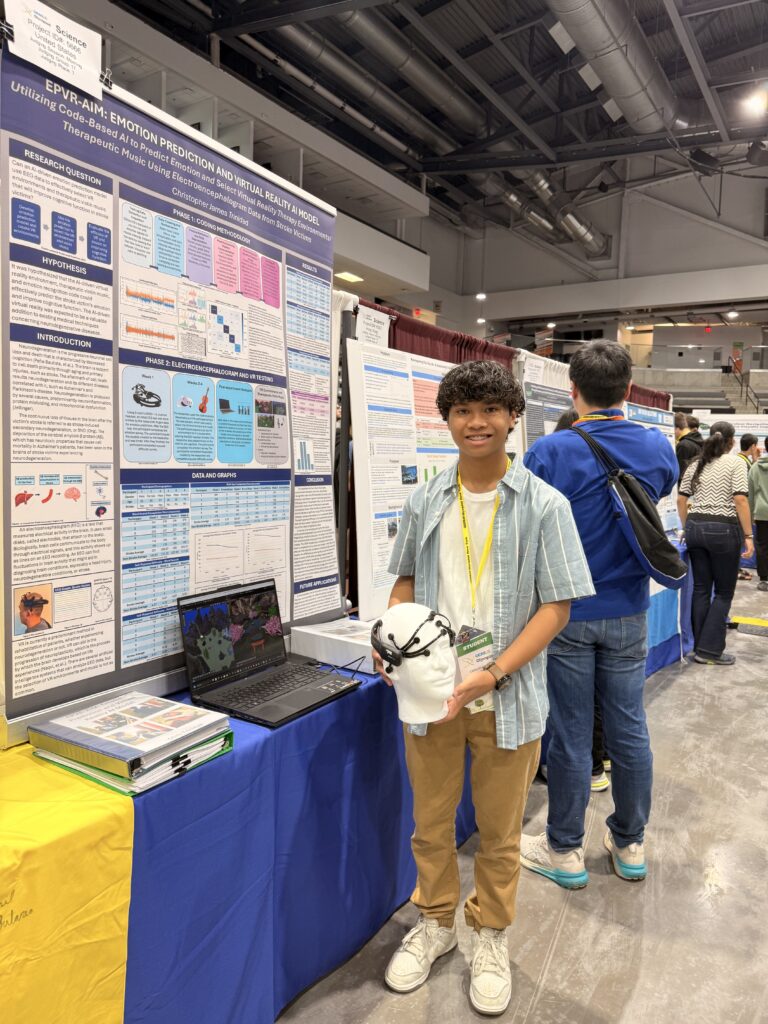
He sat in a chair inside Chin’s office. His father, Greg, sat in another and proudly listened as his son, with a mixture of pride and modesty, described the project that earned first place at a regional science fair and then a bronze medal at the Genius Olympiad and a $15,000 scholarship to the Rochester Institute of Technology at a global competition held in Rochester, New York.
Using an electroencephalogram (EEG), which measures electrical activity in the brain, artificial intelligence, virtual reality, and violin music, Christopher was able to predict the moods and emotions of stroke victims who are unable to speak, thus creating a line of communication with doctors.
“By using brain waves, doctors can know what their patients are feeling, which would lead to better decision-making,” he said.
Michael Broach is the Vice Principal at Bishop Kenny and the Director of Mission Integration, as well as the AP Capstone Department chair. He was responsible for approving Christopher’s science project.
“That was one of the most sophisticated projects, I think, that I've seen in my years of being here,” Broach said. “And just the way his mind works is well above his peers. Well above what you would expect of somebody of his age.”
Christopher is 15.
He wants to be a neurosurgeon.
“I’ve always been fascinated with the brain since I was little,” Christopher said. “It controls everything in our body. It’s really interesting, and going into surgery, fixing people's brains is really complex, and that's what I love about it.”
His parents – Greg and Shiela – are both nurses, so Christopher was raised around medical science. Their house is filled with textbooks related to their careers. Christopher has read them all.
The valedictorian of his middle school, Christopher has a 4.3 weighted GPA at Bishop Kenny. He chose to attend the Catholic high school because it aligns with his faith and has a high academic standard.
“It challenges me,” he said. “I know there are other people here I can talk to, and it gives me a greater experience.”
He’s not the only student at Bishop Kenny who knows what an electroencephalogram is and how it works.
While he spends a considerable amount of time working on his science fair projects (keep reading to learn about what his plans are for this year’s project), he’s very active at school. Christopher is a member of the Science Club, Medical Career Club, St. Vincent de Paul Society, campus ministry, and the Brain Brawl. He plays the piano at the monthly mass. He’s also first violin for the Jacksonville Symphony Youth Orchestra.
Listening to his son talk, Greg had one feeling. “Blessed,” he said. “He has a humble heart. We try to remind him always what’s hard.”
Greg understands hard.
Raised in a small town an hour’s plane ride from Manila, Greg’s childhood was humble at best. He went through elementary school with only two pairs of shoes. He caught rides to school on trucks headed to the sugarcane fields on days when his mom couldn’t afford bus fare.
“I didn’t have the opportunity to join the Boy Scouts,” Greg said. “My mom didn’t have the money.”
Greg understood the power of an education and where it could lead him. He became a teacher until, at age 26, he immigrated to the United States in search of the American Dream.
He worked odd jobs and became a certified nursing assistant. From there, he attended nursing school in St. Augustine. He now works as a traveling nurse in the cardiac catheterization labs in hospitals around North Florida. He became a traveling nurse for the pay because he and Sheila support three family members in the Philippines.
That’s why Christopher traveled to the Philippines the summer before eighth grade, to see where his parents’ stories began.
“I wanted him to see and feel the difference of being here in this world compared to a third-world country,” Greg said.
The lesson wasn’t lost on his son.
“I just feel really lucky that I'm here in America and I have more opportunities than some kids have in the Philippines, and I’m not going to let this go to waste,” Christopher said.
Greg said he is grateful for the Florida education choice scholarship that helps pay Christopher’s tuition at Kenny.
“In the Philippines,” he said, “if you don’t have money, you don’t go to school.
“He has this opportunity of having this scholarship, and I'm telling him, you're way more blessed than what other people have in other states. We're so thankful that all these opportunities are coming for our son.”
Christopher’s next opportunity is this year’s science fair, where he will take last year’s project a step further.
“I'm planning to build a rehabilitative exoskeleton so it can help people with movement disabilities,” he said. “I can also use an EEG in that, so they can think about what they're going to do with their exoskeleton, which basically helps them move. It would correlate to their actual thoughts. So, if they wanted to walk, they would be able to think it, then the exoskeleton would help them walk.”
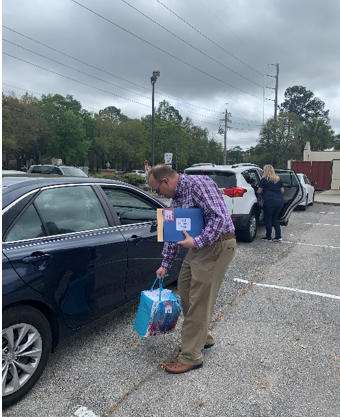
Diocese of St. Augustine superintendent Deacon Scott Conway helps load supplies in the carline at St. Joseph Catholic School as parents and students prepared to transition to an online learning environment from their homes.
Like all Florida public and private schools, Catholic schools, which educate about 1.8 million students nationwide and about 65,000 throughout the state, had mere days to move from in-person teaching to digital platforms once schools closed due to coronavirus.
As word of the closure came, National Catholic Education Association president Thomas Burnford offered encouraging words to Catholic school educators via a video on the NCEA website, acknowledging this would be a difficult time for them. But he also noted it would be an opportunity for Catholic schools to shine by connecting with students in creative ways.
Palmer Catholic Academy in Ponte Vedra Beach, about 22 miles southeast of Jacksonville, quickly rallied to the call. The school serves 449 children from PK4 through eighth grade, 22 of whom participate in the Florida Tax Credit Scholarship program administered by Step Up For Students, which hosts this blog. Five students participate in the Gardiner Scholarship program for children with unique abilities, also administered by Step Up For Students.
Notified by their superintendent on March 13 that they would be teaching remotely by March 19, administrators worked through the weekend to make sure they would be able to launch training for their teachers. They were ready March 17, two days ahead of schedule.
Each morning since then, teachers have been taking attendance and smoothly rolling into their online lessons. At the end of the day, they collect work online and grade it, entering the data in their gradebooks.
Kindergarteners through fifth-graders are using a platform called Class Dojo, an educational technology communication app and website that connects teachers, students and families and uses features such as a feed for photos and videos from the school day. Sixth- through eighth-graders are using Microsoft Teams, a communication and collaboration platform that combines chat and video meetings and file storage. Students who didn’t have access to an iPad at home were able to borrow one from the school.
“I’ve been brought to tears several times watching the teachers recite prayers while our children follow along, and watching as they virtually walk them through their math sheets,” said parent Kelly Nelson. “The passion these teachers have and their love for their students is just radiating through the computer screen.”
Monica Begeman, marketing, admissions and advancement director, said teachers are doing a great job adjusting to an online learning world.
“The implementation has been a huge team effort. All of our teachers are on board and excited to ensure their students can continue learning,” Begeman said. “Going distance is a huge on-taking for our teachers, it is exhausting. We are so thankful to them.”
While Palmer Catholic Academy was gearing up for online learning, St. Joseph Catholic School in Jacksonville was undergoing a similar process. St. Joseph serves 497 students, 109 of whom participate in the Tax Credit Scholarship program.
St. Joseph’s adventures with online learning began March 16 when parents came to the school in small groups to pick up their children’s books and supplies. Over three hours, school staff assisted 330 families and made arrangements for 15 that were unable to come by. Principal Robin Feccit reports that in a very short time, every family had the supplies it needed to facilitate learning from home.
Students in grades K-2 are completing worksheet packets, while teachers utilize Facebook and YouTube and email parents daily. Students in the higher grades are using Google Classroom, a free web service that allows for paperless lesson creation, distribution and grading. To make sure everyone stays connected, Feccit conducts a morning meeting on Facebook Live.
“Our faculty, staff, students, and families have handled this transition very well,” Feccit said. “The first day was a little challenging as we figured things out, but Day 2 started strong, and we have been doing great since. The teachers are working so hard to keep contact with their students and help support student learning as much as possible.”
Families have been pleased and impressed, writing to the school and posting comments on social media. Parent Joanne Berrios, who has been homeschooling several children over the past few weeks, raved about the one-page worksheet prepared by teacher kindergarten teacher Deanna Kersten.
“It was extremely easy to transition to the new environment,” Berrios said. “I have been so impressed with how much Michael has learned in the past 133 days of school. Now I understand.”
After an unexpected funding shortfall, Florida Catholic schools want state education leaders to review how one of the state’s biggest school districts distributed federal dollars earmarked for needy children in public and private schools.
 The request was made last week after Catholic schools in northeast Florida learned the Title I funds they rely on to provide services to low-income students throughout the school year will be gone by month’s end. The 125,000-student Duval County School District, the sixth-largest in Florida, is responsible for passing a portion of the funds on to private schools.
“We were pretty much caught off-guard,’’ Patricia Bronsard, schools superintendent for the Diocese of St. Augustine, which includes Duval, told redefinED Monday. “We serve a pretty diverse population … the very population that can’t afford to have this disruption.”
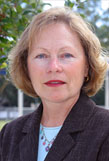
Patricia Bronsard
Now the diocese schools and other private schools – about 30 to 40 in all – are scrambling to shore up those services so children who count on additional tutoring and other programs won’t have to go without, Bronsard said.
Duval Superintendent Nikolai Vitti told the Florida Times-Union his district has done nothing wrong. He pointed to a change in how the funds were spent in district schools as the reason for the shortfall. He estimated the lost funds total about $580,000.
Vitti could not be reached Monday for comment.
Duval County School Board member Jason Fischer said he thought the timing of the notice was unfortunate, but he’s not sure who’s at fault and awaits an internal review.
“I do think we all have the obligation to work together,’’ he said of public and private schools. “I don’t know where the responsibility lies (for the late notice). Everybody should know at the beginning of the year what the expectations are.’’ (more…)

