Speculation swirled after the U.S. Supreme Court ruled yesterday that Missouri could not exclude private religious schools from a playground grant program.
Did justices signal they set their sights on a legal obstacle to school vouchers? Even informed legal scholars disagreed.
But the high court sent a much clearer signal this morning.
Justices granted a petition by the Douglas County, Colo. school board. The school district wanted the high court to review a ruling that hobbled its local voucher program. State courts argued vouchers violate the Blaine Amendment in Colorado's constitution, which bars public funding of religious institutions. (more…)
The Senate will no longer hold confirmation hearings on prospective Education Secretary Betsy DeVos Wednesday, but another hearing will have at least as much potential to rock the world of public education.
The U.S. Supreme Court will hear arguments in what could be a landmark special education case. And unlike confirmation hearings, marked by their predictable partisanship, the case has confounded the tribalism that typically marks America's education debate.
The nation's largest teachers union and the national charter school association have filed friend-of-the court briefs on the same side. The National Education Association is at odds with several associations of public-school administrators and districts.
Ironies abound. The school district in Douglas County, Colo. argues it shouldn't have to pay private school tuition for the family of a child with special needs. Yet the same school board is currently petitioning the high court to hear a separate case arguing its unique, district-created voucher program — which could help all students attend private schools at public expense — is constitutional.
At its core, Endrew F. v. Douglas County School District deals with bedrock questions about educators' obligation to help all children meet their potential.
It also highlights society’s evolution when it comes to educating children with special needs, and the ways the existing education system sometimes falls short of its ideals.
According to the Denver Post, Endrew's parents placed him in a private school that specialized in serving children with autism after he began to show serious behavior issues in the public school he attended.
The district, they argue, should reimburse them for tuition to fulfill its obligation to provide him with a Free Appropriate Public Education - a right spelled out in the Individuals with Disabilities Education Act, first passed in 1975. (more…)

The U.S. Supreme Court (Wikimedia Commons)
Four school choice advocacy groups are asking the U.S. Supreme Court to hear a case that found the the Douglas County, Colo., school voucher program unconstitutional.
The school district is looking to use the case to strike a blow against constitutional restrictions on school choice.
In an amicus brief filed this week, the Goldwater Institute, the Foundation for Excellence in Education, the Hispanic Council for Reform and Educational Options and the American Federation for Children are calling on justices to consider the district's arguments, which may help bring states' Blaine Amendments under scrutiny by the nation's highest court.
“The educational opportunities of millions of American schoolchildren are jeopardized by the Blaine amendments,” Clint Bolick, the vice president of litigation at the Goldwater Institute, said in a press release.
Blaine Amendments, which restrict the use of public funding for religious or "sectarian" institutions, are present in at least 37 state constitutions, and are currently being cited in cases seeking to terminate programs in Florida, Georgia, Oklahoma and Nevada. (more…)
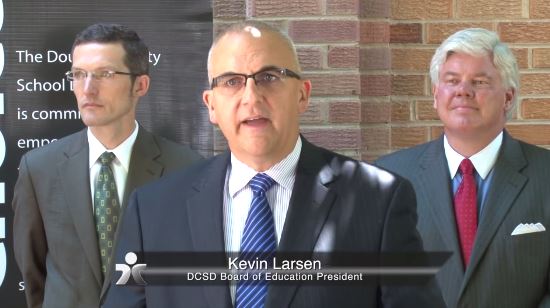
Douglas County school district officials announce their intent to defend a private school choice program at a press conference earlier this year. (Image via screencap).
A Colorado school district is trying to take the legal fight for its voucher program to the U.S. Supreme Court, in a case that could have implications for school choice programs all over the country.
Last week, the Douglas County school district formally appealed a ruling against its school voucher program. Officials hope the federal court will hear their case, and think a win could spare similar programs around the country from future challenges under so-called Blaine Amendments that ban state aid to religious institutions.
In their petition to the court, filed last Wednesday, lawyers for the school district ask:
“Can Colorado’s Blaine Amendment, which the unrebutted record plainly demonstrates was born of religious bigotry, be used to force state and local governments to discriminate against religious institutions without violating the Religion Clauses of the First Amendment and the Equal Protection Clause of the Fourteenth Amendment?”
Earlier this summer, a plurality of Colorado’s Supreme Court ruled the voucher program aided religious schools, in violation of the state’s constitution. (more…)
I head this week to Madrid for the annual meeting of OIDEL, a Geneva-based organization promoting educational freedom around the world. We advocate for policies that allow parents to decide to what school they entrust their children and that allow teachers to decide to which educational project they will dedicate their energy and their passion.
Some on the board are especially concerned about conditions that allow Catholic schools to flourish with integrity (I joke that it is as the "token evangelical" that I was made vice president), a reminder that, were it not for the Catholic Church's insistence on separate schools for its children, there would be no effective choice in many countries for either parents or teachers.
While today school choice on the basis of pedagogical emphasis is spreading, especially in the English-speaking world, the precedent for tolerating "structural pluralism" in education and thus making room for charter schools, academies, and other alternatives is the stubborn resistance of Catholics in scores of countries over many decades to the imposition of a single monopolistic system of education.
It is easy to forget how persuasive has been what I have called "the myth of the common school," the belief that only through sending all children to schools identical in their programs and underlying philosophies could social and national unity be achieved. Horace Mann and his allies were not unique in this conviction; it can be traced in every country that I have studied. In my book on education under communist regimes and in my recent Contrasting Models of State and School, I've shown how dangerous this program is to freedom of conscience and of political life.
Lately my historical research has focused on the conditions of opinion that led to Supreme Court decisions, after World War II, forbidding public funding of faith-based schools. This occurred at the very time when the United States was endorsing international human rights covenants asserting the right of parents to decide about the education of their children.
While my earlier work had shown how fears about the effects of immigration in the 19th century promoted anti-Catholic sentiment, the 1940s and 1950s were a low point in concerns about immigration in which, nevertheless, fears about Catholicism and about Catholic schooling flourished. Why was that?
To summarize what I will spell out in my next book, Challenging the American Model of State and School, American opinion leaders in that period saw the Catholic Church as the great enemy of educational and other dimensions of freedom. It is, on the surface, hard to see how to reconcile this belief with the long struggle by the Catholics for educational freedom, in the United States and in Europe.
Justices Rutledge and Black and other members of the American elite understood educational freedom in an individualistic dimension, as educational experiences that "freed" the student from family and from traditional beliefs and loyalties. The existence of schools answerable to parents rather than to Society, and dedicated to fostering alternatives to the prevailing secular worldview, was thus a threat to educational freedom rather than an expression of it.
Readers of Rousseau's Emile often ask how an education ostensibly designed to create a radically free individual could, instead, produce a young man totally dependent upon his teacher. We might well wonder, similarly, how those receiving an education designed to free them from all external commitments could find a secure footing in convictions, rather than be blown about by every cultural trend, every fashionable opinion.
Two understandings of educational freedom, then: one calls for policies providing for a diversity of schools competing on equal terms and reflecting the educational convictions of parents and the educators they trust. The other calls for a single model of schooling that promotes rootless individualism and calls it freedom.
Every day we see encouraging signs that the persuasive power of this model is waning. One of the most recent is the school board election in Douglas County, Colo., in which the board's policy of providing scholarships for hundreds of its students to attend non-public (including faith-based) schools was a central issue. With over 67,000 votes counted, the three winners were all supporters of the policy. Now we will see whether the appeal of the district court's decision against the policy will allow it to be continued - and set a precedent for real educational freedom.
Among the newest contributors to redefinED is Boston University professor Charles Glenn, an expert on educational history and comparative policy who last summer served as a witness in the court challenge to Douglas County's school voucher pilot. His testimony showcased not only the 19th-century American history of providing public educations funds to religious schools and institutions, it notably shined a spotlight on the attacks Catholics faced when Colorado adopted its Blaine Amendment.
In direct examination and in a chapter from his forthcoming book introduced as evidence, Glenn points to the perceived "Catholic menace" in Colorado as the state convened its Constitutional Convention in 1875. The scaremongering of that time led some Catholic leaders to call not only for a Catholic voice in the convention, but a voice for reason and deliberation. And no one made that plea more eloquently than Bishop Joseph Projectus Machebeuf.
Machebeuf, who insisted that Catholics would remain loyal to the State of Colorado and that their rights as citizens should be respected, sent a message to convention delegates urging them to let future legislatures deal with the question of "separate schools and denominational education," not engrave the answer into a constitutional clause. His reason: emotions were running too hot:
... the question itself has never been fully and dispassionately discussed in this country, and can not be said to have been discussed at all in Colorado. We have had, so far as I am informed, nothing said on our side of the question in your honorable body ... So far, both in this country at large and in Colorado, the language of passion has been more often uttered than that of reason ... The present is no time for the exposition of the arguments in favor of denominational schools. But we look forward hopefully to the future. A day shall at last dawn – surely it shall – when the passions of this hour will have subsided; when the exigencies of partisan politics will no longer stand in the way of right and justice, and political and religious equality shall again seem the heritage of the American citizen.
That day has not yet come. Indeed, the hearing during which Glenn testified resulted in a permanent injunction against the Douglas County voucher effort. Glenn writes, "Were he alive today, Bishop Machebeuf would no doubt be surprised and disappointed to learn that (unlike every other Western democracy) the United States still maintains barriers against reasoned deliberation about the merits of schooling that responds to the choices of parents. It is striking how, whether in Massachusetts, or Colorado, or in federal court litigation, opponents of making faith-based schooling available to parents without financial penalty seek to remove this issue from the sphere of democratic decision-making."
Editor's note: This entry comes from Charles Glenn, professor of educational leadership at Boston University and the former director of urban education and equity efforts for the Massachusetts Department of Education. He is the author of nine books, including The Myth of the Common School, and of more than 100 articles on educational history and comparative policy. He is an associate with the American Center for School Choice, which recently joined an alliance with redefinED.
While allowing parents to choose the schools that their children attend is on the agenda of many education reformers, the rationales that we advance vary considerably, even at times seeming to cancel each other out. The appeal to contrasting reasons for supporting policies to allow school choice without financial penalty makes it hard to persuade the general public to ignore warnings from the educational establishment that such policies will fatally undermine public schools, with its corollary that only schools operated by government can create loyal citizens and social harmony.
The oldest and still the prevailing rationale in Continental Europe is simply that freedom of conscience requires it. Belgium is the only country whose independence, in 1830, was in large part the result of demands for educational freedom, a principle enshrined in its Constitution, and political mobilization over this issue continued over subsequent decades in a dozen countries. Today, every country in Western Europe has well-established policies providing public support to parental choice, including on the basis of religious preferences, and educational freedom was incorporated as a basic human right into international covenants after World War II.
A second rationale seldom mentioned in discussions of parental choice on the Continent, where it tends to be dismissed as typically “Anglo-Saxon,” is that associated with Milton Friedman, and with Chubb and Moe’s Politics, Markets, and America’s Schools (1990). Competition among schools, it is argued, tends to make them more educationally effective. Strong empirical support has been provided recently by Ludger Woessmann and others in School Accountability, Autonomy and Choice around the World (2009), which uses data from more than a quarter of a million students in 37 countries to conclude that “rather than harming disadvantaged students, accountability, autonomy and choice appear to be tides that lift all boats ... In particular, the additional choice created by public funding for private schools is associated with a strong reduction in the dependence of student achievement on SES.”
This brings us to the third rationale, that of providing parents with limited resources the same opportunities to guide the education of their children that the rest of us take for granted. It was as a state official responsible for desegregation and equal opportunity that I came to support choice, after attempting to eliminate it through mandatory assignments in the 1974 Boston desegregation plan. The crisis we created in Boston led me and others to seek alternative ways of desegregating the schools in other Massachusetts cities, and eventually in Boston as well. Magnet schools and “controlled choice,” we found, also had the effect of creating better education and enhancing the professionalism of teachers as they designed schools intended to appeal to parents.
In general, the first two rationales have had only a modest effect on public policies in the United States: the concern to rescue students from unacceptable schools in Milwaukee, Cleveland, and elsewhere has provided the rationale for new arrangements. Thus when the school board of a suburban county near Denver took the highly unusual step of offering scholarships for five hundred of the pupils currently enrolled in its schools to attend private schools, mostly with a religious character, there was some ambivalence among choice advocates because the families involved were almost all middle class. How could this be reconciled with the priority of opportunity for poor children trapped in under-performing schools?
I agreed to serve as expert witness in support of the Douglas County scholarship program this summer because I was impressed that the plan had been developed in careful detail with appropriate safeguards, and because it seemed to me an opportunity to challenge a state constitutional provision discriminating on the basis of religion in making public funds available to schools. These state “Baby Blaines” are a major barrier to expanding parental choice, and it is important to the cause of educational freedom that they be challenged at the state level, as is occurring in Colorado.
But it is also important that the constituency in support of school choice be expanded to include as many parents and voters as possible. Surveys have shown repeatedly that this support is much stronger among urban black and Latino respondents than among white suburbanites, as one might expect given that the latter have exercised school choice through residential decisions and beyond that have little opportunity to do so. Programs like that in Douglas Country can bring the educational freedom rationale – and the interest of influential parents -- to the support of the equity rationale upon which previous initiatives have relied.
A judge in Colorado on Friday blocked the Douglas County school district's voucher experiment, insisting that allowing the program to move forward will lead to "real, immediate, and irreparable injury" to the plaintiffs and others who asked for the injunction.
Specifically, Judge Michael A. Martinez wrote in a 68-page ruling that the program provides aid to churches and faith-based schools and ignores safeguards that would ensure no public school funding would promote a participating school's "sectarian agenda." Further, Martinez said, there is "overwhelming evidence" to show that the voucher program violates Colorado's constitutional provisions which call for "uniform" funding of public education across the state.
Interestingly, Martinez wasn't persuaded by the ACLU's argument that the program also violated the constitutional demand for a thorough and uniform "system of free public education." A similar uniformity clause sunk the private school option in Florida's Opportunity Scholarship Program in 2006. Martinez, though, said the plaintiffs failed to show that the scholarship program prevented students "from otherwise obtaining a free public education in Douglas County."
Maddeningly, the judge acknowledged that the scholarship program "appears to be a well-intentioned effort to assist students in Douglas County," further stating that he agrees that the purpose of the school district was to help students and parents, "not sectarian institutions." The U.S. Supreme Court said the same when it came to a wholly different conclusion in the challenge to Cleveland's voucher program.
The Wall Street Journal hits the ground in Douglas County, Colo., with a report on the school district's pilot voucher program, highlighting that more affluent families will benefit from a policy that's largely targeted to more disadvantaged children in other states and municipalities. Also, The Denver Post gives readers a look at the last day of testimony in a court hearing that may decide whether the pilot program proceeds as the ACLU challenges its legality. Education News Colorado reports that Denver District Judge Michael A. Martinez will issue a ruling next week. Eddie has more at Ed is Watching.
From Education News Colorado:
With interest flourishing in the Douglas County voucher pilot, school district officials are working to create the funding mechanism that will allow public dollars to flow through parents to private schools.
Robert Ross, the district’s attorney, said the creation of a district charter school for voucher students is the most likely of three possible options that have been considered, largely because of the flexibility of the state’s charter laws.
“One of the guiding principles here is that we want to make sure that these students are going to be funded,” Ross said Friday. “In order for that to happen, they have to be public school students.”

