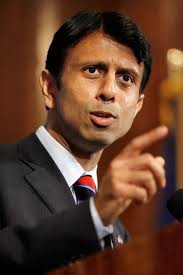
Gov. Jindal
A district judge ruled Friday that Louisiana's statewide voucher program is unconstitutional because of the mechanism it uses to send public funds to private entities, prompting groans from school choice supporters, cheers from teachers unions and promises of an appeal from Gov. Bobby Jindal.
"Today is really significant," said Steve Monaghan, president of the Louisiana Federation of Teachers, according to Reuters. "What the governor was doing was unprecedented and unconstitutional under Louisiana law."
The reaction from Jindal: "Today's ruling is wrong headed and a travesty for parents across Louisiana who want nothing more than for their children to have an equal opportunity at receiving a great education," he said in a statement reported by the New Orleans Times Picayune. "That opportunity is a chance that every child deserves and we will continue the fight to give it to them."
More coverage from Associated Press, Wall Street Journal, Washington Post, Baton Rouge Advocate, Houma Today, Alexandria Town Talk, Christian Science Monitor, Education Week.
Reaction from American Federation for Children, Friedman Foundation, Louisiana BAEO, Dropout Nation, Time-Picayune columnist Andre Perry and the Louisiana School Boards Association.
Editor's note: Blog stars is our occasional roundup of compelling, provocative or just downright good stuff from other ed blogs (although sometimes we throw in op-eds from newspapers and magazines, too). Enjoy.
Geoffrey Canada: Death to Education Reform
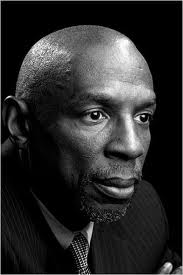
Canada
To know me is to know that no one feels more strongly than I do about the importance of transforming our current absurd, destructive educational system.
But the way education reform advocates are going about it is wrong. The problem is that you’re never going to get people motivated to be awesome teachers if they’re part of a giant bureaucracy. The only way you’re going to get people to be motivated to be awesome teachers is, yes, if you give them enough money, but also if they are part of a STRUCTURE and a CULTURE that breathes this kind of achievement and rewards it–rewards it not only financially, but also through an environment that encourages it every day. Why do small startups kick the ass of giant technology companies every day? It’s because, yes, these startups have payoffs, but anyone who knows them will tell you that what really makes them tick is the fact that they are small, tight-knit, and everyone is extremely focused. Information loops close really fast. It’s also what made Harlem Children’s Zone a success. It’s what makes neoliberal attempts to “reform” schools centrally via spreadsheet fail.
The only way you’re going to get good schools, in other words, is if you have a system where the people who have the biggest stake in the education, also have a very direct say in how things are run.
To put it another way, you need radical decentralization and a radical shift to power to parents and children in how schools are run. This can be accomplished through vouchers or through other means. (I actually have my misgivings about vouchers, for a bunch of complex reasons, but I’ve come to believe decentralization really is the key.) You could have a 100% public system if it was also structured so as to enable choice and competition. But the crucial thing is to let a thousand flowers bloom. Full post here. (Image from the thebestschools.org)
Andrew J. Coulson: Uh ... the 'Quality Controlled' Schools Are Worse
Sunday’s Washington Post ran a story titled “Quality controls lacking for D.C. schools accepting federal vouchers.” These are the particular failings chosen for the story’s lede:
schools that are unaccredited or are in unconventional settings, such as a family-run K-12 school operating out of a storefront, a Nation of Islam school based in a converted Deanwood residence, and a school built around the philosophy of a Bulgarian psychotherapist.
It is remarkable that more serious transgressions were omitted. Why not mention the schools in which current and former staff brawl in the parking lot, or students start vicious fights at sporting events? Why not discuss the schools spending nearly $30,000 per pupil annually and yet graduating barely half of their students on time?
The reason the WaPo didn’t mention them is that they are not voucher schools. (more…)
Editor's note: For those new to redefinED, "blog stars" is our occasional compilation of good stuff from other ed blogs (with a newspaper op-ed thrown in now and then, too).
 Huffington Post: In search of the elusive, reform-minded school board member
What most people don't understand is that managing failure is just as hard as managing success. And this is, I believe, part of the reason school boards don't improve schools. Stability and coherence are watchwords in both the high-achieving and low-achieving systems. Administrators want to keep their staff happy and their board at arm's length. In both successful and failing districts, "micromanaging" by the school board is considered a no-no. I recall a woman addressing our board not along ago. "We're not supposed to rock the boat," she said. "But the trouble is that the boat has tipped over and we're lashed to our seats." Rocking the boat is exactly what must be done to effect change -- change, one hopes, that leads to better student outcomes.
I spent most of the last 10 years, on and off the board, pushing for a rigorous curriculum, stopping the disproportionate disciplining of African-American students, and complaining about the over-identification of special ed students (almost a quarter of our student body). But, for the most part, no matter what I proposed -- a new bus route, a paint job for the flag pole, or a curriculum -- I was mostly ignored. In order to get a pile of old lumber and rusty nails removed from the edge of a playground I had to threaten to dump it in the superintendent's driveway! Full post here.
Dropout Nation: The NAACP should listen to Romney (and Obama) on school choice
By embracing an education traditionalist thinking and Zip Code Education, the NAACP is aiding and abetting the damage to black children that it is supposed to defend. By taking money from NEA and AFT affiliates (including the $16,200 picked up by its New York branch from the AFT’s Big Apple unit during the union’s 2010-2011 fiscal year), the association is also betraying its obligations as a civil rights group to oppose policies that promote the same denials of equal educational opportunities against which it supposedly fights. In the process, the NAACP refuses to be a much-needed public policy voice and activist on behalf of transforming a failed system, alienating the very school reformers and black families (especially in urban communities) who are looking to build schools that black children (and all kids) deserve. And by adhering to the thinking of aging members who have a vested interest in maintaining failed ideas about how schools should serve black children, the NAACP has also lost opportunities to gain support from a new generation of African-Americans who realize that education is the most-important key to achieving social and economic equality.
When both Romney and Obama share common cause on systemic reform and on expanding choice, it is clear that the NAACP is on the wrong side of history. Now it is time for it to do the right thing. Full post here. (more…)
At the Dropout Nation, editor RiShawn Biddle visited his archives and resurrected his examination of the school choice movement and his call for black churches to open their own schools. "They must embrace school reform and take the role that Catholic churches have done for so long and for so many," Biddle writes.
So it seemed appropriate for redefinED to visit its own archives and unearth this post from Doug Tuthill showing how publicly funded private school options have already helped black churches take the step that Biddle urges:
As the Florida coordinator of Democrats for Education Reform (DFER), I am frequently asked by Democrats in other states why so many elected Florida Democrats support all forms of school choice, including vouchers and tax credit scholarships, but not tenure and teacher pay reforms. The answer is black middle-class jobs and the rise of black-owned schools.
During the days of Jim Crow, school districts were the biggest employers of college educated African-Americans and even though other professions have opened up, school districts today remain a leading employer of college-educated African-Americans. Consequently, education reforms that are perceived as negatively impacting school districts are usually opposed by the black community. This is one reason former chancellor Michelle Rhee’s effort to reduce job protections for Washington, D.C. educators was so fiercely opposed by many district African-Americans, even though they knew black children were benefitting. Saying that school districts should put the needs of students above the concerns of adults ignores that adults feed, clothe and house students and meeting those needs is difficult without a job.
Every Florida black elected legislator opposed the early school choice programs, but the Florida Tax Credit Scholarship for low-income students and the McKay Scholarship for exceptional students have caused a change in attitude. These programs have enabled black churches and community groups to create financially viable schools, and as these schools have grown so has black political support for school choice. Black ministers are employing black teachers and administrators to work in their growing schools and are seeing the lives of black children turned around. These ministers, in turn, are pressuring black elected officials to support these scholarship programs, and they are responding.
Last spring, a majority of the Black Caucus supported legislation significantly strengthening the Tax Credit Scholarship program, while unanimously opposing legislation that reformed tenure and teacher pay in school districts. A respected minister from Fort Lauderdale, Rev. C.E. Glover of Mount Bethel Baptist Church and Christian Academy, even joined a coalition to challenge both gubernatorial candidates this fall to support the scholarship. “I have led this ministry for a quarter-century now, and I can tell you that nothing is more satisfying or more important than our mission to provide for the academic needs of children in our community,” Glover told reporters. “For those of us who have fought the historic battle against the indignities of racial discrimination in our nation, we understand the importance of providing educational opportunity to new generations.”
The lesson for DFER out of Florida is that school choice programs that enable local black and Hispanic communities to own and manage financially healthy schools are essential to expanding support for education reform within the Democratic Party. Black and Hispanic legislators will support school choice programs, including vouchers, if these programs allow their constituents to own schools and expand middle-class employment. Protests from school boards and teacher unions that minority-owned private schools drain market share from school districts do not resonate with black and Hispanic elected officials when they see minority-owned schools creating jobs and succeeding with children who were previously failing.
Over at Dropout Nation, RiShawn Biddle has explored how school choice activists, particularly those on the left, can re-energize the legal case for equity in education spending. He writes, "If choice activists and civil libertarian groups such as the American Civil Liberties Union successfully take up such moves, it would lead to another round of school choice efforts that would provide more poor and minority children with opportunities to get the high-quality education they deserve."
Biddle has done more than any journalist to highlight the egregious symptoms of what he calls zip code education, notably pointing to the criminal prosecution of a homeless mother in Connecticut and a low-income parent in Ohio who sent their children to schools outside their assigned districts. He sees relief in the very state constitutional provisions that give most choice advocates heartburn: the idea that states must provide uniform systems of public schools. The language differs depending on the state, but the same barriers exist for voucher or charter school expansions. Or do they?
"Practices that have led to zip code education, including the concept of zoned schools, are essentially unconstitutional; and thus, inter-district choice of the kind encouraged by otherwise foes of choice such as Richard Kahlenberg of the Century Foundation would be allowable," Biddle writes.
Before readers roll their eyes, they should know there is precedence in Biddle's contention, namely in two of the most stalwart advocates for equity, John E. Coons and Stephen D. Sugarman of the University of California at Berkeley. Coons and Sugarman first struck at the inequalities in school spending between rich districts and poor districts in the 40-year-old California case known as Serrano v. Priest. The case led the California Supreme Court in 1971 to establish the concept of "fiscal neutrality," which recognized that the quality of a child’s education should not be a function of a district’s wealth or poverty. The way to equalize education for rich and poor, Coons and Sugarman eventually argued, was to enact a system of choice.
A commitment to family choice in education, Coons would later write, "would maximize, equalize and dignify as no other remedy imaginable." And, notably, this comes from a progressive voice that Biddle believes is critical to this enterprise. While it's unlikely that any grassroots or parent-led effort can soon convince the ACLU to drop its opposition to the choice policies that Biddle and Coons would promote, Biddle is right to argue that it will take a left-of-center effort to quarterback this challenge.
This week, RiShawn Biddle's Dropout Nation features a plea from Gwen Samuel, the president of the Connecticut Parents Union, for families to demand greater accountability and choices for their children's education. Just as Ben Austin's California parents union has organized families to essentially take over a failing school, Samuel is shepherding a movement in Connecticut calling for an enhanced level of parental choice. "Quality-blind education will continue unless parents demand something different," she wrote (Samuel's union also is helping Tonya McDowell, the homeless Connecticut mother charged with larceny and ordered to pay $16,000 in restitution after authorities learned she enrolled her child in Norwalk schools when she should have sent him to Bridgeport):
If lawmakers and school leaders are not going to demand schools and their staffs to be fiscally and academically accountable for our children, then they should give us choice and attach each child with their per pupil amount. They can’t have it both ways. Either demand accountability of education leadership or give parents choice. If not, parents will take it. These are our babies and their lives are our responsibility.
Quality-blind education will continue until parents demand something different. We must demand access to excellent schools. That means, as parents, we can no longer have excuses for why we don’t visit our child’s school, or support them at home and in the community. If you can not support your child’s homework needs, let’s work together and find someone that can.
Parents want to be team players. We want to partner with educators, teachers, administrators, community and lawmakers to ensure better outcomes for all students. But the days of blind trust in what you do are over. We are learning to read and understand data, and learn and what high-quality schools should look like. Low performance will no longer be an acceptable option for our children. These are our children and we are responsible for their well-being!
Dropout Nation's RiShawn Biddle on anti-intellectualism in our debate over education reform:
For all the taxpayer-funded doctorates and graduate degrees that are found among the defenders of traditional public education, there is little going on among them other than closed-minded, sclerotic thinking. This lack of intellectual vigor — the ability to see the value of new concepts, the lack of understanding of economics and technology, and the rabid opposition to anyone outside of education arguing for reform — is one reason why American public education is mired in the kind of mediocrity that has fostered the nation’s education crisis.
And from Terry M. Moe and Paul T. Hill writing in Education Week on government, markets and the mixed model of education reform:
Stereotypes are alive and well in American education reform, and nowhere is this more evident than when school choice is being discussed. All too often, choice is characterized by its detractors as a “free market” solution that would “privatize” education. And all too often, this depiction is reinforced by its more libertarian supporters, who do indeed see choice in these terms and are stridently opposed to a government-run education system. The framing suggests an unbridgeable chasm. On the one side, markets. On the other side, government.
As is often true of stereotypes, this kind of either-or framing is not helpful. A more productive way to think about school choice—and about American education reform in general—is not in terms of markets vs. government, but rather in terms of markets and government.

