
Does Sen. Bullard, a teacher and local union rep, have a conflict of interest too?
I was a news reporter for 20 years. I appreciate what good journalists do. But I’m often perplexed by the selective scrutiny that permeates so much education coverage in Florida, particularly when it comes to school choice issues.
The latest example: An “investigation” by an Orlando TV station into the "cozy connections" between Florida state lawmakers and rapidly expanding charter schools. WFTV-Ch. 9 raised conflict-of-interest questions this week about lawmakers who work for charter schools and who have backed legislation that generally promotes charter expansion. It singled out incoming House Speaker Will Weatherford, R-Wesley Chapel; Rep. Erik Fresen, R-Miami; and John Legg, R-New Port Richey, a state rep headed to the state senate.
First off, this is old news. The ties between all three lawmakers and charter schools have been well publicized. In fact, they were among a bigger handful of lawmakers cited last December in a front-page Tampa Bay Times piece on the same issue. Curiously, the TV station kicked off its story with the same anecdotal lead as the Times did, one involving Legg and the Pasco County School Board.
More important, the station neglected to mention that a number of other lawmakers have strong if not direct ties to school districts. Sen. Bill Montford, D-Tallahassee, heads the state superintendents association. Former state rep and now Sen. Dwight Bullard, D-Miami, is a public school teacher and local union rep. Two newly elected Democratic state reps, Mark Danish in Tampa and Karen Castor Dentel in the Orlando area, also teach in district schools. Should teacher-lawmakers be voting on state budgets that could affect how much they’re paid? Should they vote on legislation that could impact how they’re evaluated? (more…)
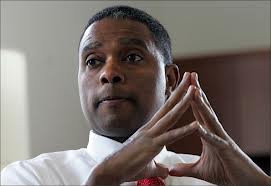 Florida education commissioner Gerard Robinson has made what appears to be an anguishing personal decision to return to his family in Virginia, because his wife, a law professor, has been unable to find a comparable position in Florida. And yet the announcement Tuesday was greeted with a level of vitriol that can only speak to the state’s nasty educational divide.
An anti-testing group released a statement deriding Robinson’s “so-called accomplishments” as tied to a testing system that “has been completely discredited.” A Democratic lawmaker called the departure “a clear indicator … that recent destructive education reform measures … are harmful to the morale and productivity of students and teachers.” A Florida School Boards Association leader accused Robinson of “doing the bidding” of the state Board of Education, as though she doesn’t expect the same of her own superintendent. Predictably, the Washington Post’s Valerie Strauss offered a conspiracy theory – that Robinson was being offered as a “scapegoat” to divert attention from the FCAT. A Democratic congresswoman who should know better actually called for a federal review of the FCAT.
You get the picture.
Now, it is certainly true that the Department of Education had issues with the FCAT writing test and bungled the initial release of school grades this year. And it is also true that much – maybe too much – rides on the performance of students on state testing. But nothing in Robinson’s 13 months on the job warrants such public venom, and you don’t have to defend him to recognize his convenience as a punching bag. So let’s call this another temperature check in the fever over educational accountability. (more…)

