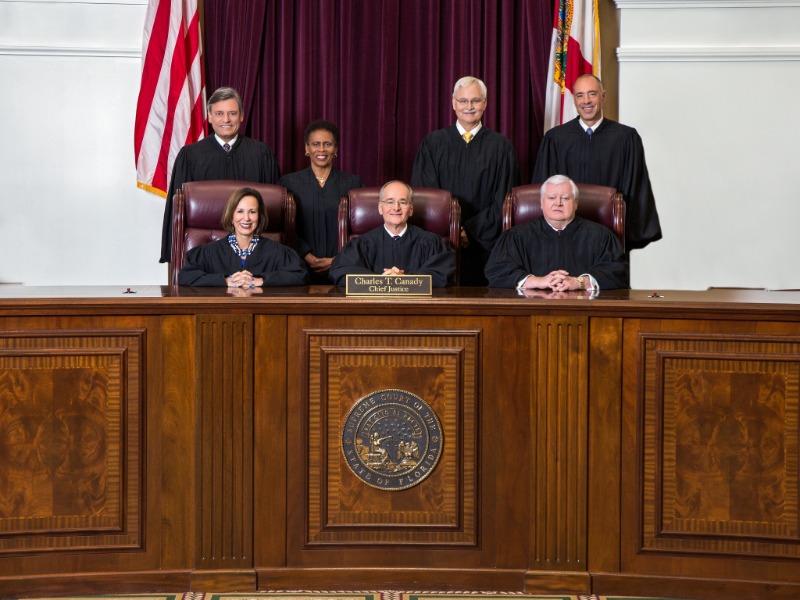
The Florida Supreme Court upheld lower-court rulings in rejecting the education adequacy lawsuit.
Jim Saunders / News Service of Florida
TALLAHASSEE --- A fiercely divided Florida Supreme Court on Friday rejected a nearly decade-long lawsuit that challenged whether the state has properly carried out a 1998 constitutional amendment that called for ensuring a “high quality” system of public schools.
The decision upheld lower-court rulings and focused heavily on the role of the judiciary in addressing sweeping issues such as the quality of public schools. A main opinion shared by Chief Justice Charles Canady, Justice Alan Lawson and Associate Justice Edward LaRose said plaintiffs in the case failed “to present any manageable standard by which to avoid judicial intrusion into the powers of the other branches of government.”
Canady, in a concurring opinion, was more pointed, saying the “manifest goal” of the plaintiffs and three dissenting justices “is to put educational funding and educational policy firmly under the control of the judiciary.”
“The judiciary is very good at making certain types of decisions --- that is, judicial decisions,” wrote Canady, who was joined by Lawson and LaRose in the concurring opinion. “But it lacks the institutional competence --- or the constitutional authority --- to make the monumental funding and policy decisions that the petitioners (the plaintiffs) and the dissenters seek to shift to the judicial branch. And there is not a hint of any manageable judicial standards to apply in making those decisions. Instead, if the petitioners and the dissenters had their way, judges would simply apply their own policy preferences.”
Justice Jorge Labarga sided with Canady, Lawson and LaRose but did not sign on to the main opinion or the concurring opinion. LaRose is a judge on the 2nd District Court of Appeal but was added to the case after Justice Ricky Polston recused himself.
Justices Barbara Pariente, R. Fred Lewis and Peggy Quince joined in two dissenting opinions, with Pariente writing that the court majority “eviscerates” the 1998 constitutional amendment, “contrary to the clear intent of the voters, and abdicates its responsibility to interpret this critical provision.”
“My friends and colleagues in the majority make a very grave and harmful mistake today,” Lewis wrote in another dissent. “Although I understand their good-faith and well-intentioned approach, only time will truly reveal the depth of the injury inflicted upon Florida’s children. The words describing the right to a high quality education and the constitutional concept of protecting that right ring hollow without a remedy to protect the right.”
The 1998 constitutional amendment said it is a "paramount duty of the state to make adequate provision for the education of all children residing within its borders." The amendment fleshed that out, in part, by saying adequate provision will be made for a "uniform, efficient, safe, secure, and high quality system" of public schools.
The group Citizens for Strong Schools and other plaintiffs filed the lawsuit in 2009, arguing that Florida has not properly complied with the constitutional amendment and pointing to issues such as many students not being able to read at grade level. After holding a trial, however, a Leon County circuit judge ruled against the plaintiffs in 2016.
The 1st District Court of Appeal upheld that ruling and said arguments about the state failing to adequately provide for public schools “raise political questions not subject to judicial review.” That prompted the plaintiffs to appeal to the Supreme Court.
During oral arguments in November, plaintiffs’ attorney Jodi Siegel said the case should be sent back to a circuit judge to apply standards that would properly determine whether the state is meeting the constitutional requirements.
“We have current standards and current measurements that are showing significant disparities,” Siegel said at the time. “We had 670,000 children that are failing reading. So this is not a child or two. This is a systemic failure.”
But Rocco Testani, an attorney for the state, told justices that the state has made changes since 1998 that have led to significant improvements in the public-school system.
“It has been successful, it has worked,” Testani said. “It is not a system that anyone should be concerned is broken.”
The opinions Friday shared by Canady, Lawson and LaRose focused on issues such as the separation of powers between courts and other branches of government and the difficulty for judges in deciding such a “blanket” challenge to the education system.
“There is no reason to believe that the judiciary is competent to make these complex and difficult policy choices,” Canady wrote in the concurring opinion. “And there is every reason to believe that arrogating such policy choices to the judiciary would do great violence to the separation of powers established in our Constitution.”
But in her dissent, which was joined by Lewis and Quince, Pariente wrote that, with Friday’s decision, “the majority of this (Supreme) Court fails to provide any judicial remedy for the students who are at the center of this lawsuit --- African American students, Hispanic students, economically disadvantaged students, and students who attend school in poorer school districts or attend persistently low-performing schools.”
“Certainly, I recognize that the task of making adequate provision for a high quality education is primarily for the Legislature. We are not legislators. We are justices charged with enforcing the rights set forth in Florida’s Constitution,” Pariente wrote. “That is why with (the part of the Constitution that includes the 1998 amendment), the citizens of this state intended for compliance --- or noncompliance --- with that provision to be adjudicated by the judiciary when properly brought to the court. Indeed, the task of construing the Constitution and determining whether the state is fulfilling its express obligations required by the Constitution --- and the citizens of this state who approved the relevant constitutional language --- is solely the judiciary’s task.”
The groups behind a wide-ranging lawsuit that argues Florida has violated its constitutional mandate to provide a high-quality education want to hit the reset button on the case.
In court papers filed Monday with the state Supreme Court, attorneys with Southern Legal Counsel argue a trial court erred when it dismissed their lawsuit on all counts. They also argued an appeals court erred when it ruled that declaring wide swaths of education funding and policy unconstitutional would encroach on the powers of other branches of government.
As a result, they argue, the high court should send the case back to the trial court for a new round of deliberations under different legal standards.
The plaintiffs in the adequacy lawsuit argue a constitutional amendment approved by voters in 1998 created legal standards that allowed citizens to sue the state if they felt it was under-funding or otherwise mismanaging its public education system. Several former members of the Constitution Revision Commission that crafted that amendment have asked to weigh in with the court in support of that argument. The state has pushed back. (more…)
News Service of Florida
Some members of Florida's 1998 Constitution Revision Commission are seeking to file a brief in the Florida Supreme Court as part of a legal battle about whether the state is meeting its constitutional duty to provide a high-quality system of public schools.
Describing themselves as the “framers” of a 1998 ballot measure that put the duty in the Constitution, the former commissioners filed a motion Tuesday asking for approval to file a friend-of-the-court brief. A footnote in the motion indicates 10 former commissioners want to join in the brief, including former Attorney General Bob Butterworth, former Supreme Court Justice Gerald Kogan and former House Speaker Jon Mills.
Mills represented the groups suing the state during earlier stages of the case. (more…)
Education activists hoped to put two decades of Florida education policy, and above all, funding, on trial. They will get their wish before the state Supreme Court.
The high court agreed today, in a 4-1 decision, to hear appeals in the so-called "adequacy lawsuit." Alan Lawson, a new appointee of Gov. Rick Scott, was the lone vote against hearing the case.
The suit, first filed by education activists in 2009, argues Florida's public schools are under-funded and hamstrung by policies like standardized testing, in violation of the state constitution.
In 2014, the scope of the case widened considerably, and the plaintiffs took aim at several school choice programs. Both the trial court and the First District Court of Appeal, however, held that school choice programs — including charter schools and the McKay Scholarship program for children with special needs — don't harm public education, and may help. And last year, the Supreme Court declined to re-examine an appeals court's decision that the statewide teachers union lacked legal standing to challenge Florida's tax credit scholarship program. (Step Up For Students, which publishes this blog, helps administer the scholarships.)
Lawyers for the state had repeatedly argued the adequacy case deals with "political questions" that aren't for courts to decide. They also highlighted positive student achievement trends, which received fresh credence in recent national test results.
Now, the case will unfold before the high court just as the 2018 gubernatorial and state legislative elections kick into gear. It will happen on an ambitious timetable. The first round of legal briefs from the plaintiffs is now expected by May 21.
Florida's school voucher program for special needs students is constitutional. If the state Supreme Court entertains arguments to the contrary, it will create an unnecessary "legal cloud" for thousands of families.
That's the argument lawyers defending the McKay Scholarship program made in court papers filed this week.
Late last year, a state court of appeal rejected a lawsuit that took aim at 20 years of Florida education policy and argued the state had systematically underfunded public schools. The plaintiffs in that case want the high court to hear their appeal.
The lawsuit also contended McKay Scholarships, vouchers that help the families roughly 30,000 special-needs children pay private school tuition, are unconstitutional. It's the last surviving legal attack on a Florida private school choice program after courts declined to hear lawsuits targeting tax credit scholarships
When the First District Court of Appeal upheld McKay Scholarships, it cited, of all things, a lawsuit that struck down a voucher program in 2006.
In that case, known as Bush v. Holmes, the Florida Supreme Court ruled the Opportunity Scholarship Program created an unconstitutional, "parallel" public education system. That's because the program allowed a theoretically unlimited number of students in low-performing public schools to take taxpayer money and attend private schools instead. (more…)
A three-judge panel on a Florida appellate court has tossed an 8-year-old lawsuit taking aim at 20 years of state education policy.
Today's ruling upholds an earlier trial court decision hailed as a victory for education reformers who defended school choice, testing and other policies targeted by the lawsuit.
It also adds to the ledger of lawsuits around the country that hit roadblocks trying to force states to increase public school funding.
The First District Court of Appeal's decision is noteworthy for another reason. It finds a 2006 state Supreme Court ruling that found private school vouchers violate the Florida constitution does not threaten vouchers for children with special needs.
Judge Bradford Thomas writes that when the high court struck down Opportunity Scholarships for private schools in Bush v. Holmes, justices left the door open to reach different conclusions about the constitutionality of other school choice programs.
And McKay Scholarships, he writes, are different. About 30,000 students with special needs, less than 1 percent of Florida's K-12 students, currently use the scholarships to attend private schools. (more…)
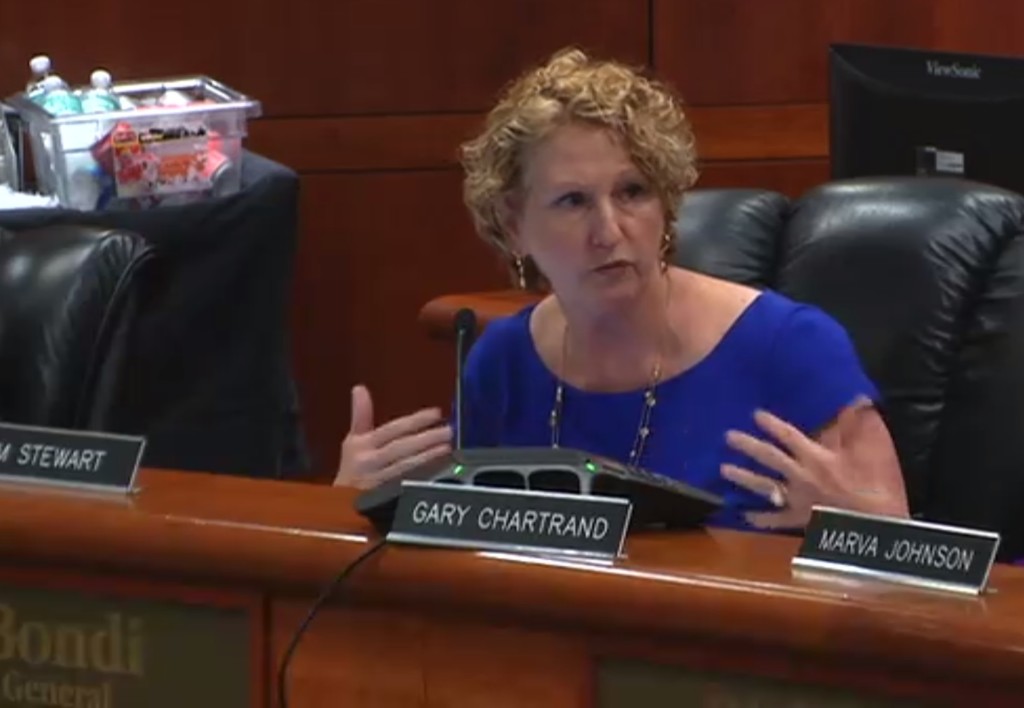
Education Commissioner Pam Stewart addresses the Florida Board of Education during a turnaround discussion Monday.
This spring, Florida's smallest school district launched an unprecedented turnaround effort led by a charter school organization.
But Jefferson County schools may not be alone for long.
On Monday the Florida Board of Education asked three North Florida school districts to revise plans to turn around long-struggling schools. It was the first batch of turnaround efforts the board reviewed under a sweeping new law.
The revised plans could soon bring charter school operators to other high-poverty rural communities.
Gov. Rick Scott signed HB 7069 last month. It overhauls the turnaround options available to schools that earn F's or multiple D's under the state's grading system. Districts now have less time to turn those schools around themselves. If they fall short, they have three options:
Most public schools avoided the new law's consequences. Stewart noted repeatedly that, of 42 schools that presented turnaround plans last year, 71 percent improved to C's or higher.
Monday's state board meeting offered a glimpse of what could be in store for the remaining 29 percent of persistently low-performing schools if they don't improve, quickly.
Charter could be coming to Gadsden (more…)
The Florida House's effort to create new "Schools of Hope" in struggling areas has rocketed to the top of education agenda in this year's legislative session.
Its backers may find support for charter school recruitment and aggressive school turnaround efforts in interesting places, like a "warning" flagged last year by a Leon County judge.
The legislative analysis of the House bill points to Ciruit Judge George Reynolds' ruling that dismissed a wide-ranging "adequacy" lawsuit, which took aim at a vast swath of education policies, from funding to high-stakes testing to school choice.
Reynolds tossed out the claims en masse in a sweeping ruling hailed by education reformers as a vindication. But legislative staff note the one issue where the judge seemed most sympathetic to the plaintiffs' claims that Florida was not meeting its constitutional oblication to provide a "high-quality" public education system.
He indicated the presence of schools that languish for years with low academic performance gave him pause. (more…)
The plaintiffs in a wide-ranging lawsuit challenging vast swaths of Florida's education policy have returned to press their case in appellate court.
Earlier this year, a trial court dismissed the "adequacy" lawsuit, a seven-year-old case arguing the state underfunded public schools and challenging 20 years of education reforms. Among other things, Leon Circuit Court Judge George Reynolds held the state of education in Florida was improving, achievement gaps were closing, and problems that remain didn't constitute a constitutional crisis that would trigger a judicial mandate.
The plaintiffs take issue with that ruling before the First District Court of Appeal. In new court filings, accepted late last week, they contend Florida courts should follow their counterparts in states like Washington and Connecticut, where judges have recently issued major rebukes on education funding and policy – and tangled with policymakers over potential remedies.
The new briefs no longer reference issues like pre-K, charter schools or teacher evaluations that surfaced when the case expanded to challenge a broader set of policies in 2014.
But the case still veers into the realm of school choice, taking direct aim at the nation's largest school voucher program for children with special needs.
Arguments on special needs vouchers
Last school year, Florida's McKay scholarship program helped more than 30,000 children with special needs pay private school tuition. The plaintiffs argue it's unconstitutional "for all the same reasons" the Florida Supreme Court struck down another voucher program in 2006.
Like the Opportunity Scholarship Program ruled unconstitutional in Bush v. Holmes, the plaintiffs argue, McKay scholarships are funded directly out of the state treasury and the private schools that children attend aren't subject to the same regulations as traditional public schools. (more…)
We're a bit slow to log this in, but Florida's First District Court of Appeal last week denied an attempt to fast-track a wide-ranging education lawsuit to the state Supreme Court.
It's worth noting what was at stake.
The groups behind the adequacy lawsuit argue elected officials have violated the Florida Constitution by under-funding public schools and saddling them with unworkable accountability rules. They also argue a range of school choice programs — including charter schools, tax credit scholarships for low-income students, and McKay Scholarships for special needs students — contribute to the problem.
In December, Judge George Reynolds ruled the plaintiffs did not have standing to challenge the tax credit scholarship program. Then, in May, he dismissed the rest of the lawsuit after finding Florida's public education system is not in such bad shape that it warrants judicial intervention. (more…)

