A recent interview by Tyler Cowen of John Arnold has been making the rounds in ed reform circles, see Michael Goldstein’s write up here. Here is a taste of the interview:
Tyler Cowen: There’s a common impression—both for start-ups and for philanthropy—that doing much with K–12 education or preschool just hasn’t mattered that much or hasn’t succeeded that much. Do you agree or disagree?
John Arnold: I agree. I think the ed reform movement has been, as a whole, a significant disappointment. I think there have been isolated pockets of excellence. It’s been very difficult to learn how to scale that. I think that’s largely true of many social programs or many programs that are delivered by people to people, that you can find a single site that works extraordinarily well because they have a fantastic leader, and that leader might be able to open up a few more sites. But then, when you start to scale it to 50 sites, and start to go across the nation, it all mean-reverts back to what the whole system is providing.
“We’re a dispirited rebel alliance of do-gooders,” Goldstein writes gloomily, but the underlying premises deserve scrutiny, as it strikes me as entirely too pessimistic. Let us for instance look at the academic growth rates for charter schools in Arnold’s home state of Texas as recorded by the Stanford Educational Opportunity Project. Each dot is a Texas charter school, and green dots on or above the zero line display an average rate of academic growth at or above having learned one grade level per year:

This chart deserves a bit of your time to marvel at. While receiving far less total taxpayer funding per student, the Texas charter sector has not only created a large number of schools with high academic growth, but they also place competitive pressure on nearby district schools to improve their academic outcomes. Texas charter schools have not cured the world’s pain, nor have they dried every tear from our eyes. It is hard for me, however, to view it as anything other than a tremendous academic success, and Texas is not alone. Here is the same chart for charter schools in Arizona:
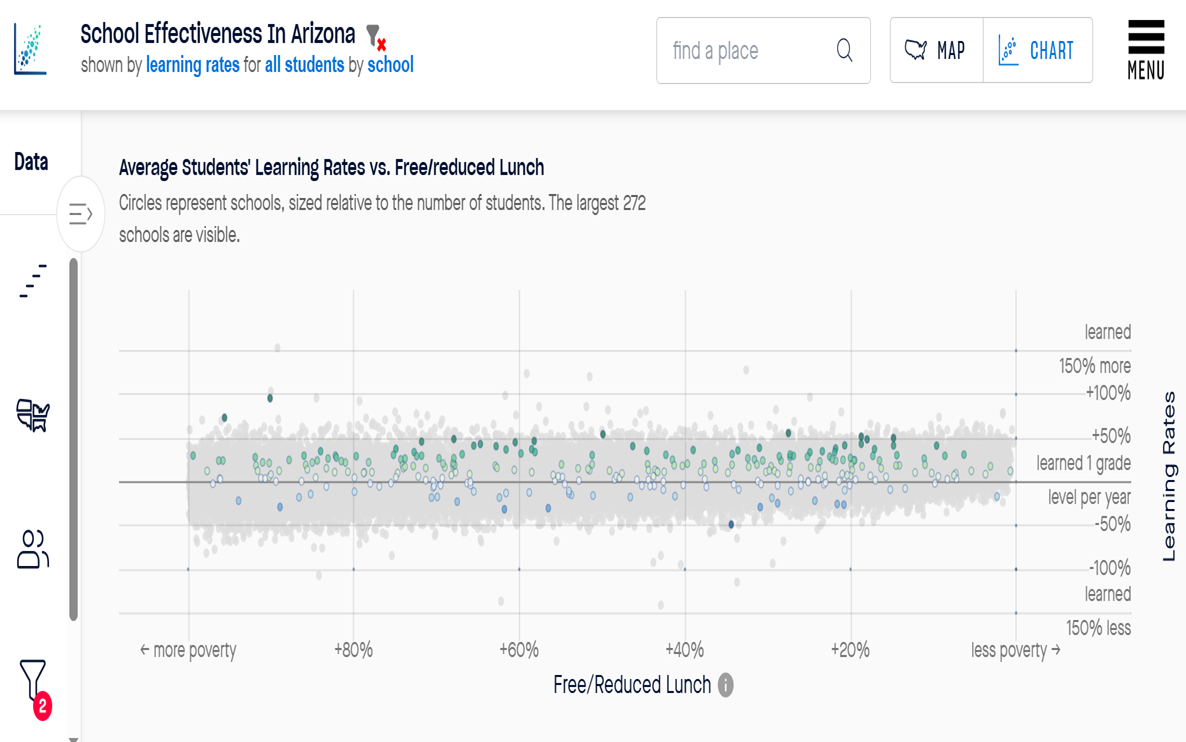
Again, we see far more high academic growth green-dot schools than low academic growth blue-dot schools. Once again, this sector is a bargain for taxpayers, and the sector placed competitive pressure on districts to improve. By the way, Arizona has a larger number of charter schools in low-poverty areas than Texas. That helped crack open high-demand district schools to open enrollment, which is why a real Fresh Prince can go to school in Scottsdale but not in Bel Air or Highland Park in Texas, which opened a vast new supply of choice seats in school districts. The do-gooder rebel alliance, it turns out, made a serious political and educational error when they effectively in a variety of ways excluded suburban areas.
You live and (hopefully) learn. Speaking of Bel Air, behold the magnificence of the academic growth of California’s charter school sector:

Oh, and then there is the 2024 NAEP to consider:

If you do not live in a state whose name starts and ends with the letter “o” you are likely to be happy with your charter sector’s performance vis-à-vis districts, which admittedly, is a low bar. Of course, all this data is messy and neither the growth measures developed by Stanford nor the NAEP proficiency data above capture long-term outcomes- such as do schools produce good and productive people who are well-prepared to exercise citizenship. We are looking through a glass darkly.
The do-gooder education reform alliance should indeed take stock of which efforts produced meaningful results, and which proved to be costly quagmires, and recalibrate their efforts accordingly. To paraphrase the Bard: the education reform movement has 99 problems, but the inability to scale success in choice programs ain’t one.
 The decade-old No Child Left Behind Act is the epitome of top-down ed reform, and in some ways it parallels Florida’s test-heavy accountability system for public schools. So it was noteworthy today when one of Florida’s top education leaders referred to it in less than glowing terms.
Florida Board of Education Chairman Gary Chartrand said when it comes to closing achievement gaps between white and minority students, No Child Left Behind has been a “colossal failure.”
Chartrand shared the sentiment during a workshop in Boca Raton where Gov. Rick Scott made a rare appearance. Chartrand did not go into detail, and we could not reach him for comment later. But he made the point during a brief discussion about the state’s race-based achievement goals.
Last month, the board unveiled a strategic plan that sets different achievement goals for students based, in part, on race and ethnicity. The plan sparked accusations of racism in Florida and beyond even though the goals included steeper rates of improvement for minority students.
Scott called for the board to revise the plan, saying it “must clearly and sincerely acknowledge that all students are capable of performing at grade level regardless of their race or background.”
“How are we going to close the achievement gap?’’ Chartrand asked the governor Monday. “We need to do things differently.’’ Maybe Florida students need longer school days, or maybe districts need to assign the best principals and the best teachers to the worst schools, he continued. Perhaps a change in culture, with more discipline and parental involvement would make a difference.
Scott, who attended the workshop to explain his education agenda, didn’t offer any specific suggestions. “We should have the same expectations for every child,’’ he said.
Scott also offered little detail about his new plans, which include the possibility of district-run charter schools.

