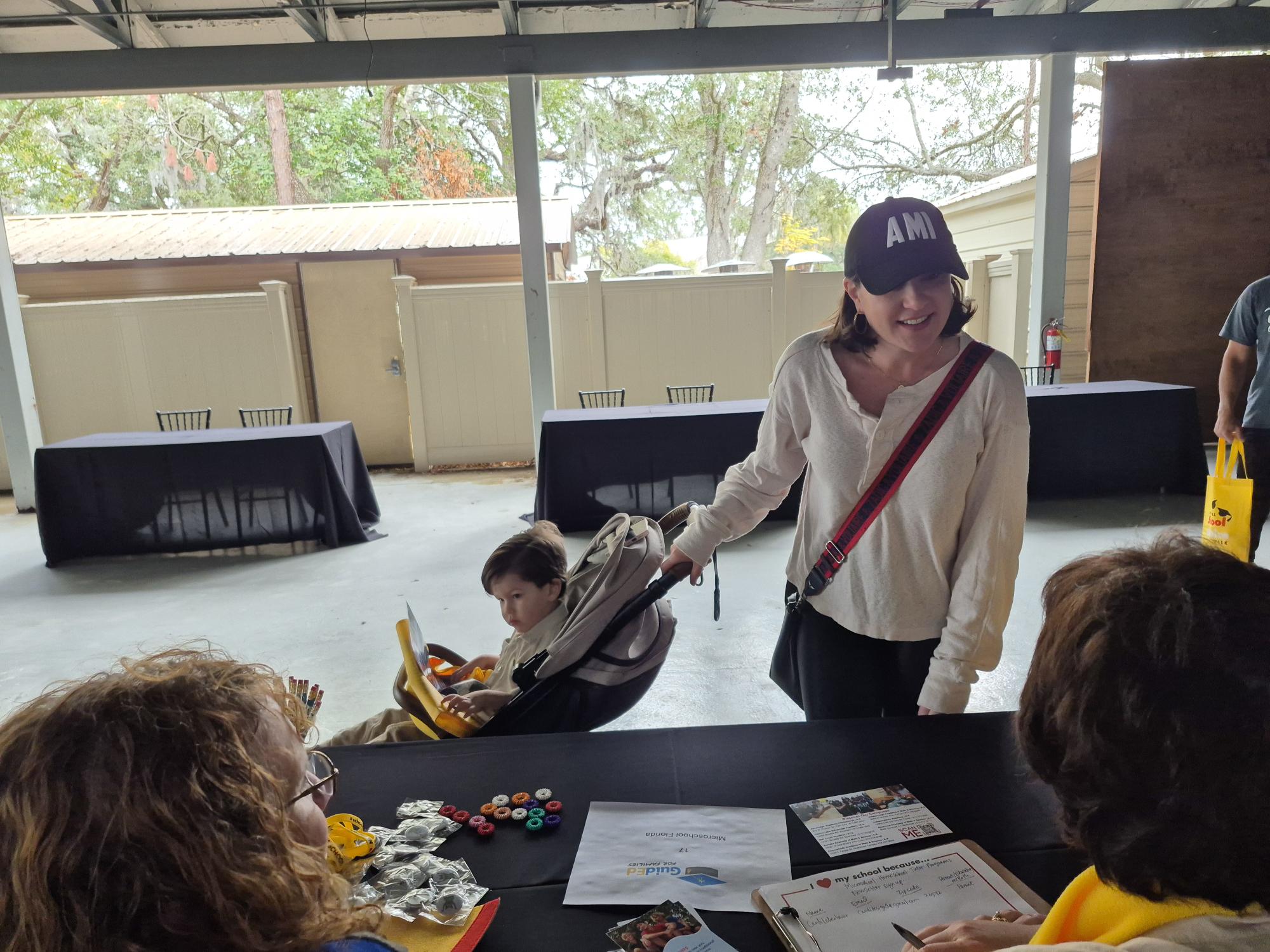
Gevrey Lajoie visited a School Choice Safari event to learn about options for her son, Elijah. The event was sponsored by GuidEd, one of the many organizations springing up in states that have granted parents the flexibility to choose the best educational fit for their children.
TAMPA, Fla. — Parents, many pushing babies in strollers with school-age children in tow, made their way through the covered pavilion as they surveyed the brightly decorated tables representing 28 local schools.
Their goal: To gather as much information as possible as they try to figure out the best educational fit for their children, either for the 2025-26 school year or beyond.
“We’re all over the place with which school,” said Gevrey Lajoie of South Tampa. Her son, Elijah, is only 3, but she said it’s not too early to begin looking at options. A mom friend told her about the School Choice Safari at ZooTampa at Lowry Park. It would give her a chance to check out many schools all in one place and learn about state scholarship programs.
Lajoie isn’t alone. For this generation of Florida families, gone are the days of simply attending whatever school they’re assigned based on where they live. Families actively shop for schools; schools actively court them, and districts perpetually create new programs.
And while the benefits are clear, some families end up feeling adrift in a sea of choices.
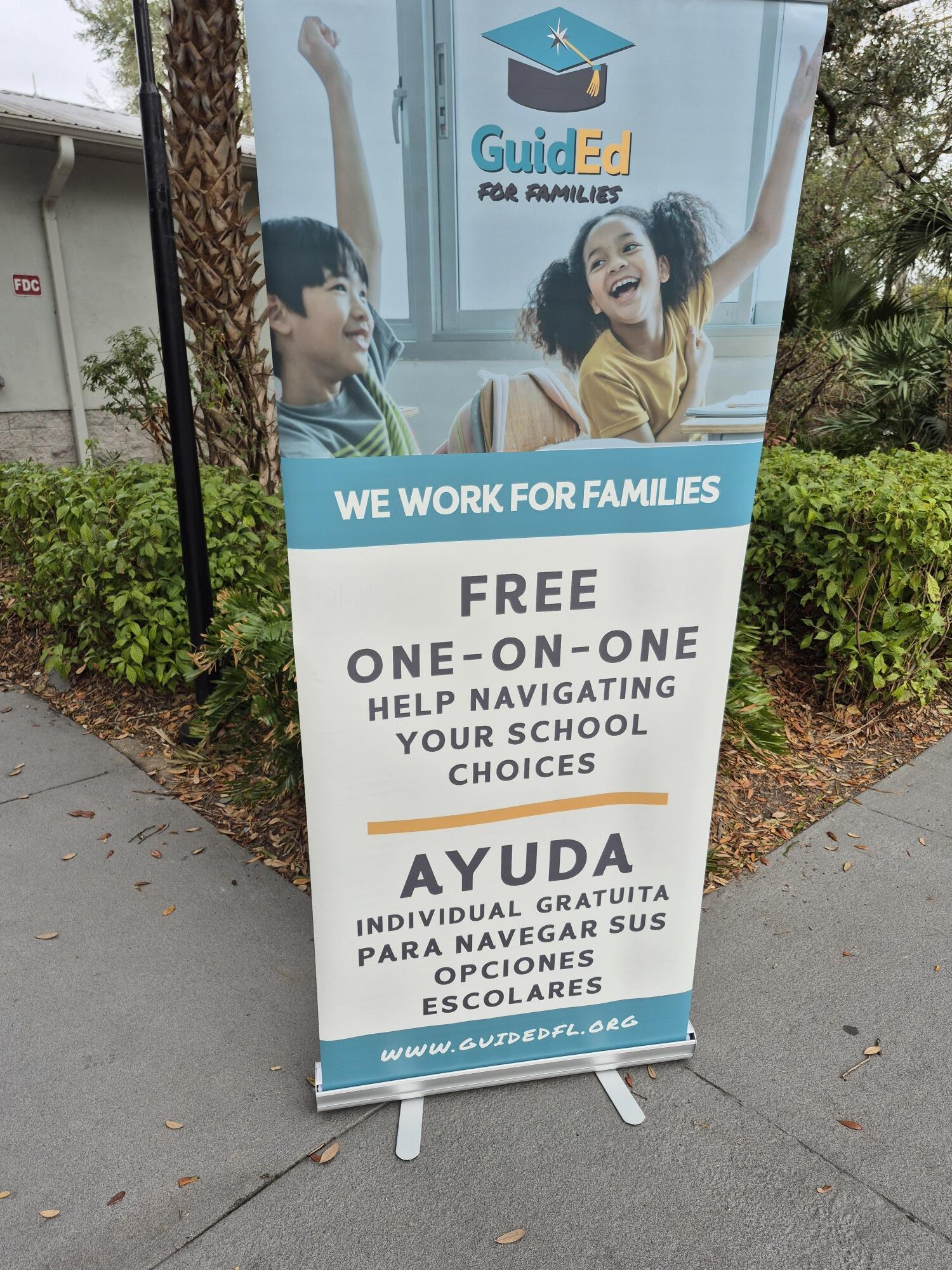 New organizations are springing up to help families find their way. "A variety of options are out there, and the number is growing, but families don’t know how to navigate them. There was no place for them to go to get help,” said Kelly Garcia, a former teacher who serves on Florida’s State Board of Education.
In 2023, the Tampa Bay area resident and her brother-in-law, Garrett Garcia, co-founded GuidEd, a nonprofit organization that provides free, impartial guidance to help families learn about available options so they can find the best fit for their children.
The organization hosts a bilingual call center where families can get information about all options in Hillsborough County, from district and magnet schools to charter schools, private schools, religious schools, online schools and even homeschooling. GuidEd also helps families sift through the various state K-12 scholarship options. The group also hosts live events, such as the School Choice Safari, to connect families and schools.
Organizations are cropping up all over the country, especially in areas with lots of choices. Their specific missions and business models vary, but they are united by a common theme: They help families navigate an evolving education system where they have the power to choose the best education for their children
Jenny Clark, a homeschool mom and education choice advocate, saw the need for a personal touch in 2019 when she launched Love Your School in Arizona.
“One of the most important aspects of our work is knowing how to listen, evaluate, and support parents who want to talk to another human about their child's education situation,” said Clark, who had seen parents struggle with the application process surrounding the state’s new education savings accounts program. The program has since expanded to West Virginia and Alabama.
Clark’s nonprofit provides personalized support through its Parent Concierge Service, which offers parents the opportunity for phone consultations with navigators. Love Your School also provides free online autism and dyslexia guides and details about the legal rights of students with disabilities, and it hosts an online community where parents can get support.
“Our services are unique because we pride ourselves in being experts in special education evaluations and processes, which are required for higher ESA funding, public school rights and open enrollment, experts in the ESA program law and approved expenses, and personalized school search and homeschool support,” Clark said.
Kelly Garcia, GuidEd’s regional director, has hosted several in-person events that feature free snacks, face painting, magicians, and prize giveaways in addition to booths staffed by schools and other education providers. During the recent event, parents could visit a booth to learn more about the state’s K-12 education choice scholarship programs.
Garcia, whose organization prioritizes neutral advice about all choices, including public schools, advises parents to start by assessing their child’s needs and then identifying learning options that would best serve them. GuidEd’s philosophy is to trust parents to determine the best environment for their kids.
At the School Choice Safari, families got to check out private schools, magnet schools and charter schools.
“There’s a school out there for everyone,” she said.
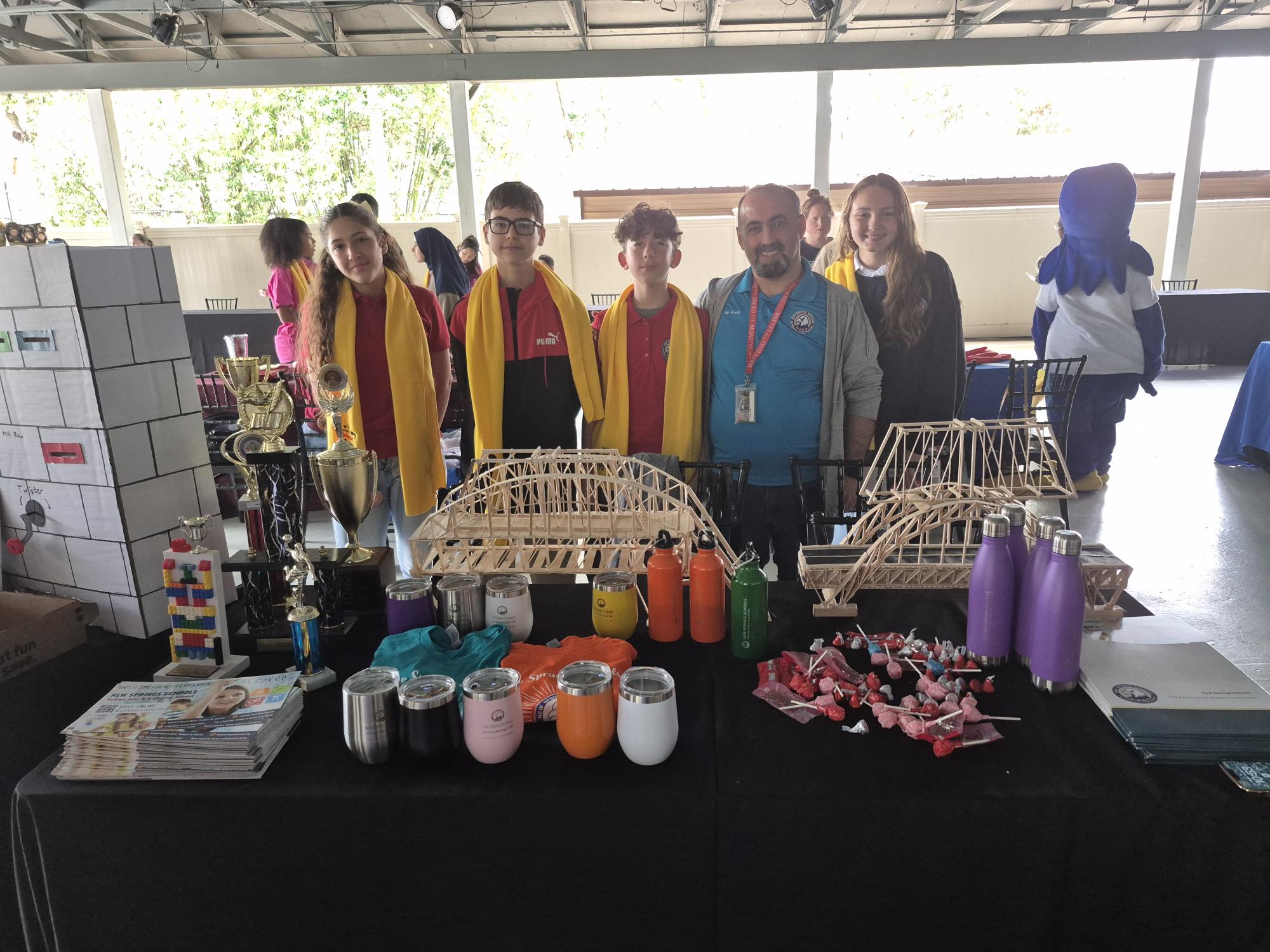
Students at New Springs Schools, a STEM charter school that serves students ages 5-14, show off some recent class projects at the School Choice Safari in Tampa.
During the zoo event, Garcia personally escorted parents with specific questions to the tables where they could get answers.
One of them, Hugo Navarro, recently moved to Tampa from Southern California to start a new job for a national investment firm. His wife, who had remained with their three kids in California, had already started researching schools online, but Navarro wanted to get an in-person look at providers and learn more about state education choice scholarships before their 7-year-old son starts school in August.
On his wish list: academic rigor, a focus on the basics, and a diverse student body.
“Academic ratings, that’s our number one thing,” he said.
A Catholic school that offers academic excellence was also a contender, though a secular school wouldn’t be a dealbreaker if it had a reputation for strong academics.
Garcia and Clark both said that as new generations of parents grow more comfortable selecting education options, they see the navigators’ role becoming more relevant, not less.
“Parents can use online tools like google to search for schools, but the depth of what parents actually want, and our highly trained knowledge of a variety of educational issues means that as choice programs grow, the need for our parent concierge services will continue to grow as well,” Clark said. “There are exciting times ahead for families, and those who support them.”
As the number of schools and a la carte learning options grows, Garcia said, families will need information to better customize learning for their children.
“This is a daunting task, even for the most seasoned parents,” she said. “At GuidEd, we see a growing need for unbiased education advisers to ensure a healthy and sophisticated market.”
Garcia compared the search for educational services to buying a home.
“A family is not likely to make a high-stakes decision, like buying a home, by relying on a simple Zillow search,” she said. “Instead, they use the Zillow search to help them understand their options and then rely on a Realtor to help guide them through the home- buying process, relying on their trusted, yet unbiased expertise. We see ourselves as the "Realtor" in the school choice or education freedom landscape.”
 Editor’s note: This commentary from Garrett Ballengee, executive director of the Cardinal Institute for West Virginia Policy and a reimaginED guest blogger, appears in the Spring 2023 issue of Education Next.
There is a common misconception among education reform advocates that passing universal choice legislation is akin to summiting Mount Everest. Upon universal choice’s enactment into law, it is done. Time to exhale and pop the champagne, for the mountain has been scaled.
Not so fast. What has actually been achieved, in mountaineering terms, is that a base camp has been established. When the governor puts pen to paper, planning must begin anew to ensure post-passage success.
West Virginia passed its path-to-universal education choice bill in March of 2021. At the time, it was the broadest education choice program in the country. It was subsequently held up in the courts for several months while its constitutionality was confirmed. If your state passes a universal education savings account bill, it too, will almost certainly be challenged in the courts and will likely find itself in front of your state’s highest court.
Since then, in West Virginia, implementation has been challenging in some obvious, and not-so-obvious, ways that can be grouped into five main categories: 1) supply/demand considerations, 2) evolving coalitions, 3) outreach, 4) public relations, and 5) case management.
Supply and Demand
Upon passage, demand for choice will likely surge for a bit, temper, then steadily increase as families become aware of the program and hear from neighbors, fellow church attendees, and other connections about their new options.
Education reformers who advocated for the legislation’s passage can play a key role in shaping the demand. How should the program be advertised and to whom? Where will deliver the most bang for each marketing buck? How will public awareness be generated?
There must be someone willing to build awareness around the new program. Many choice programs languish with public awareness levels that would make most reform advocates blush. Failure for an education choice program does not often come in the form of mistakes, fraud, or incompetence. More frequently, the problems are apathy and ignorance.
The flip side of demand is supply, built by expanding existing capacity, attracting providers from elsewhere, and cultivating new supply from within. Consider how your organization or coalition can engage on this level.
Shrewd advocates will begin working on solving the lack-of-supply problem before it becomes a problem. Make sure local private schools are aware of the legislation—believe it or not, many of them won’t be. Help them sign up.
Identify successful programs or schools across the country and reach out and let them know about new opportunities catalyzed by your new program. Be on the lookout for the edupreneurs in your state.
Who’s leading a successful education program? Who is building a new microschool? Who are the connectors within the nontraditional education ecosystem? Who simply needs a bit of help or encouragement to start something new? They are out there. Find ways to find them.
Coalitions, Outreach, Public Relations
A post-passage choice coalition will be different than what is required for pre-passage. Begin thinking about who needs to be involved and what role they can play. You won’t have control over this entire process. Coalitions will naturally and spontaneously evolve, but it doesn’t hurt to start thinking about whose role should now be expanded, who should take a back seat, and who should be welcomed into the effort.
What about outreach? The nexus of a successful choice program will shift somewhat from legislative considerations, lobbying, and bill design towards family outreach and relationship cultivation, specific government agency relationships, and broad marketing campaigns.
Let’s face it, your newly enacted program will have bumps, bruises, and will proceed with some fits and starts. Perfection is not of this world. Setbacks are to be expected with anything new, let alone something of the size and scope of a universal choice program.
Not everyone in the world is as happy as you that universal choice is now a reality. There are legions of entities, from the public education establishment to unions and union-friendly media, looking for any anecdote or half-truth to besmirch the new program.
Take a deep breath and begin planning for this reality.
Gather stories about successes—big and small—and cultivate relationships with storytellers who see the world you do. Be ready to tell the story many people not only don’t want to read themselves, but also do not want others to read: education choice is good and a moral necessity.
Case Management
Finally, one last push up Reform Everest.
You have to figure out how – not if – to help the families about to embark on this journey for the first time. Families are the reason you started out to base camp in the first place, so now is not the time to abandon them to the crevasses of uncertainty. You must figure out how to manage each “case” not only for the sake of the family and child but also for the overall health of the program.
There will be grandparents who have never used a computer now asked to upload a birth certificate on their grandchild’s behalf. There will be parents with limited education who know only one thing when it comes to navigating this fresh bureaucratic concoction: “My child needs something different.” Be sympathetic, but, more importantly, develop competence.
Learn the law and accompanying statutes backwards and forwards or find someone who does. You must have a path or contact for families to use. “I don’t know the answer, but I know someone who might” will become one of the most useful phrases in your reform handbook.
Set boundaries for engagement with families. Parents and legal guardians will, understandably, want an answer at all hours of the day, but be cautious, for this is where burnout lies. Be intentional about when, where, and how questions will be answered. Reasonable limits will ensure a process in which all parties are satisfied or put on the path to satisfaction.
Though the last few steps up the mountain are the steepest and most difficult, they are also closest to what we are looking for when we embark on our journey: helping children find their own path to their own personal summit.

