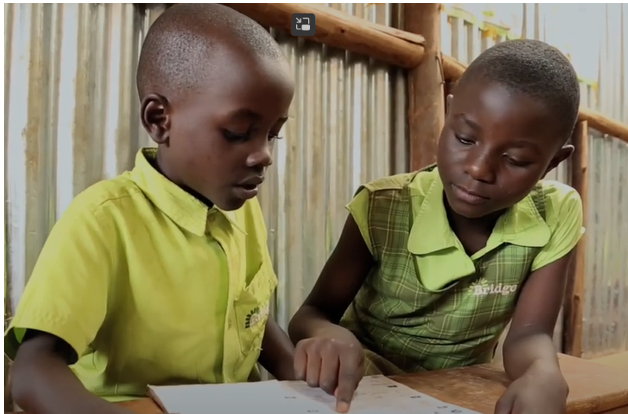
A new report on a network of private schools in Kenya shows there is no reason why customization and standardization must remain contradictions.
Henry Ford revolutionized the automobile market when he introduced the assembly line and standardized the tools and parts to construct a car. His innovation allowed vehicles to be built cheaper, faster and with a higher quality than ever before.
Flash forward more than a century, and dozens of successful industries have copied the concept of industry standardization, from burgers at McDonalds to our coffee at Starbucks.
A new report on a network of private schools in Kenya shows that standardizing education, from classrooms to curriculum, can produce impressive learning gains and help institutions scale while maintaining a high-quality education.
The report, “Can Education Be Standardized? Evidence from Kenya,” by Guthrie Gray-Lobe, Anthony Keats, Micael Kremer, Isaac Mbiti and Owen Ozier, uses a random assignment lottery to determine educational outcomes from attending Bridge International Academies in Kenya for two years on a government funded scholarship.
Bridge International Academies educates around 100,000 of the poorest primary school students in Kenya. Bridge International also operates in Nigeria, Uganda and India.
According to the researchers, the school model “features centrally-developed, highly detailed lesson plans … that are delivered to teachers using tablet computers.” The standardized day-to-day lesson plans, which the researchers described as “scripts,” are uniform between teachers and schools.
Head teachers are given their own scrips for classroom monitoring, observation and feedback. Schools also utilize standardized assessments up to seven times per year to “track student progress, inform in-service teacher training, and refine lesson guides.
Additionally, Bridge International provides a 10-day training session for teachers and headmasters on how to utilize the lesson plans, tablets and tests.
According to the report, primary school students enrolled at Bridge International had gained nearly three years’ worth of learning in just two years’ time.
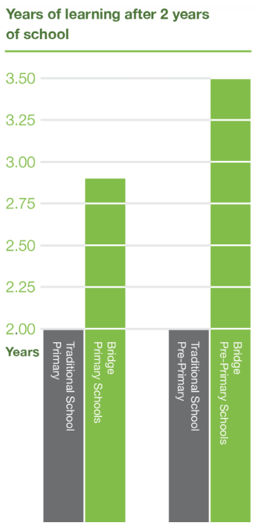 “The test score effects in this study are among the largest observed in the international education literature, particularly for a program that was already operating at scale,” wrote the researchers.
Researchers were also concerned that the school’s “highly-structured pedagogy” might negatively impact student creativity, but researchers found no difference between Bridge students and others.
Would such a model work in the United States, especially at a time when educators have been turned off from standardization and reformers are focused on customization?
There is no reason why customization and standardization must remain contradictions. Teachers can still customize education for students, and parents should still be able to choose among a menu of options. But why must teachers undertake the time-consuming effort to prepare their own unique day-to-day plans? Why can’t there be standardized scripts, prompts, quizzes and tests? Why can’t we use the data to inform future lessons?
Today we can order a Ford in many colors, powertrains, packages, and models. If we don’t want what Ford offers, we can buy from another manufacturer. Can we do the same with education?
Results from Kenya suggests it is a real possibility.
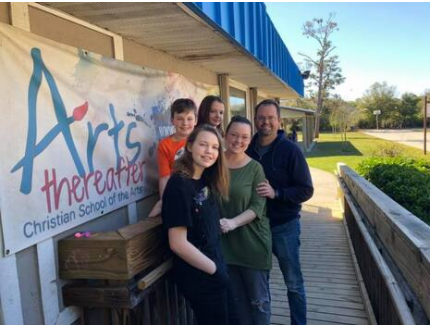
Arts Thereafter Christian in St. Cloud, Florida, is one of 11 Acton affiliates in the state. The school uses the latest technology in a self-paced learning environment designed to foster responsibility, goal-setting, and teamwork.
Editor’s note: You can read more about Jeff Sandefer’s success story here.
Every comic book superhero has an origin story – a narrative that informs his or her identity and motivation.
Orphaned science whiz Peter Parker became Spider-Man after being bitten by a radioactive spider. Russian assassin Natasha Romanoff, known as the Black Widow, defected to the United States and joined the Avengers.
Jeff Sandefer sold junk.
Though not of comic book fame, the Austin, Texas, billionaire entrepreneur is a real-world marvel with an equally fascinating origin story. As a kid, he ridded neighbors of their unwanted household items and held garage sales.
Jeff Sandefer
At 16, he formed his first company and increased productivity for his father’s oil company by hiring high school football coaches who were idle during the summer to take over the duties of hourly crews. By age 30, he had made a half-billion dollars developing oil wells that large companies rejected because they were too small.
Since 2009, Sandefer, who attended public schools in the small Texas town of Abilene, has been disrupting K-12 education.
The co-founder of Acton Academy, a worldwide network of 270 micro-schools that emphasize self-directed learning, Sandefer recalls the exact moment he and his wife, Laura, decided to turn education upside down.
Their two sons, Sam and Charlie, were aging out of their Montessori school in Austin. They wanted them to continue their education in the best possible environment. Sandefer asked an educator considered the best at a top tier school using a historically traditional model if he should enroll the boys there.
The teacher’s response stunned him.
“As soon as possible,” the teacher said, adding that once they’d been in an environment with the freedom of a Montessori school, they would “hate sitting at a desk and being talked at all day.’”
Sandefer tried to picture his two curious, lively, sons and blurted out, “I don’t blame them.” The teacher stared at the floor so long that Sandefer was worried he had offended him.
“When he looked up, he had tears in his eyes, and said ‘I don’t either,’” said Sandefer, who recounts the conversation in speeches including a 2011 TEDx Talk.
“Here’s someone known as the very best teacher, and he himself is telling me don’t send your boys (to his school.) It was a very clear message, don’t send them here because it will cost them their freedom. Charlie and Sam were so beautiful. It was really more me thinking of what natural learners they were. When he said that, it broke my heart.”
Sandefer talked the situation over with his wife, and the idea to start their own school was born.
Laura Sandefer, a former educator at the Oklahoma Arts Institute, set up the first Acton Academy in 2009 in a small, rented house in Austin with their sons and five other neighborhood kids using a stack of books and a few online resources.
The plan was to start a local school, not a worldwide network. But one family moved to California and wanted to take Acton with it, while a friend from Guatemala saw Acton during a visit and asked to start an affiliate. Things just took off naturally from there. Today, Acton refers to its network as “one-room schoolhouses for the 21st century.”
The Sandefers drew inspiration from several sources: the Montessori method of self-directed learning, the Socratic method of responding to questions with questions to inspire independent problem solving, and “just open curiosity” that led to more formal project-based learning.
The theme Sandefer says was most important was the concept that every student is “on a hero’s journey.”
“You’re on this earth for a special mission. That came out of a lot of the work I’d done at the graduate level,” said Sandefer, who also founded Acton School of Business. “We began to understand the power of story to help people shape their lives.”
Reaching the end of the story is important, Sandefer said. But what’s more important is the journey one takes to get there, and the maturation that occurs during the quest.
The Acton philosophy holds that every student is a hero, and that “everyone is a genius.”
“That doesn’t mean everyone has a 180 I.Q.,” Sandefer explained, “but that everyone has something they are great at.” He said one of Acton’s goals is to help each student find it and be the best at it they can be.
Sandefer compares the schools’ guiding principles to those of four disparate groups: Google (independent discovery); gaming (interactive learning); Alcoholics Anonymous (accountability); and the Boy Scouts (mastery-based learning in the form of merit badges).
In place of teachers, Acton employs “guides,” trained adults whose purpose is to create an environment for independent learning. Rather than responding to students’ questions with declarative sentences, guides ask students questions of their own to inspire thought and encourage students to find their own answers.
Owners and guides belong to online groups so they can share what works and what does not. All 270 affiliate schools are required to adhere to standards that surpass those of local traditional schools.
Classrooms are referred to as studios where self-directed and self-paced learning takes place. Students set goals and hold each other accountable. Age groups often are mixed.
“It’s like ‘Lord of the Flies’ some days, Sandefer said. “The society crumbles, and they have to rebuild it.”
Students can lose several weeks of progress in the process, but Sandifer believes great lessons come in the rebuilding. Setbacks are considered a source of growth rather than shame.
Acton students create portfolios of their work to show proof of mastery. They participate in exhibitions to show what they know, earning competency badges when they master a subject rather than receiving a grade. There are no tests, “black marks that stay on your record,” as Sandefer describes it.
For some students, the process takes longer, but that’s okay.
“Failure doesn’t mean ‘no,’” he said. “It means ‘not yet.’”
It’s not surprising that the Acton Academy network’s popularity has steadily increased, with more families expressing interest during the pandemic. Though 21 states enacted or expanded education choice last year and several legislatures are considering bills this year that include flexible education savings account, Sandefer chooses to stay out of legislative processes.
However, he admits that ESAs and other measures that increase choices are beneficial.
“Anything that results in more choices is a great thing,” he said.
He also believes that education should be accessible and affordable, pointing to Acton’s model, which relies more on students learning independently and from each other than on paid adult staff.
Though the model helps keep tuition low, that’s not the reason for using it, Sandefer said. “We don’t do it because it costs less; we do it because it works better.”
In Florida, where there are 11 Acton affiliates, including two schools that will open in August, annual tuition ranges from $6,500 to $13,000 a year and can be paid in monthly installments. Schools such as Arts Thereafter Christian in St. Cloud, Florida, participate in state scholarship programs administered by Step Up For Students, which hosts this blog, to assist families.
“Florida has the right kind of mindset,” Sandifer said.
One would think that Sandefer’s involvement with Acton Academy and its affiliates would keep him busy, but he has other projects that are thriving. One of them, the Children’s Business Fair, allows kid entrepreneurs to market and sell their own products. More than 50,000 children have participated in 1,000 fairs around the world, and at least 500 more fairs are planned for this year.
Another project, Next Great Adventure, helps adults find greater meaning in their lives through six weeks of experiential challenges to help them find their unique career, community and mentorship opportunities.
Meanwhile, Acton Academy is going strong, attracting 20,000 applications since 2009.
Sandefer’s two sons, who were 5 and 7 when the first Acton Academy opened, are in college now. He looks forward to seeing what his future grandchildren’s education will look like. In keeping with Acton Academy’s model, he won’t offer any advice.
“It’ll be fun to see what they do,” he said.
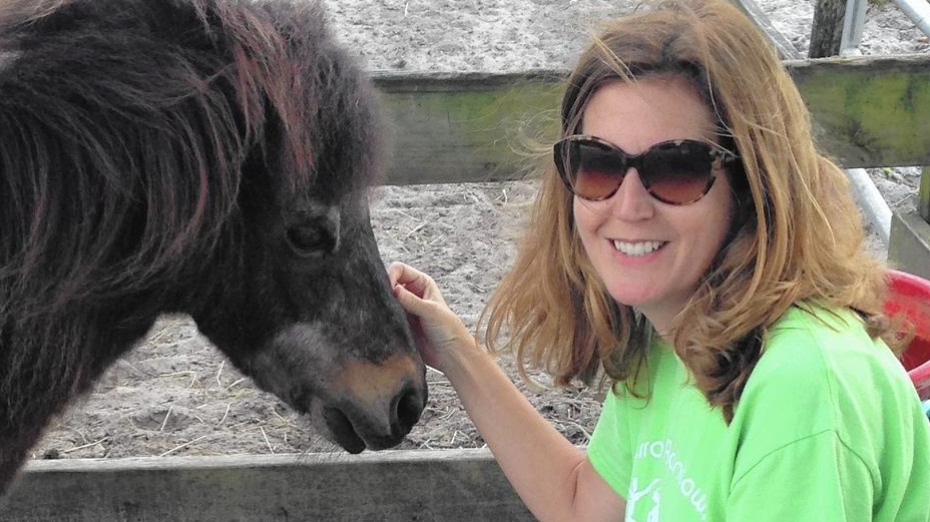
Christy Kian of Boca Raton discovered a new way to pursue her passion for teaching during the coronavirus shutdown.
Editor's note: reimaginED is proud to reintroduce to our readers our best content of 2021 such as this feature story from senior writer Lisa Buie.
 Christy Kian wasn’t sure what she was getting into last year when she agreed to help a parent struggling to educate her two children during the coronavirus pandemic.
The mom wasn’t satisfied with the distance learning plan her school had set up at the start of the shutdown, and things were still in flux for the coming school year. She asked Kian if she would be willing to teach her children at their home.
After nearly two decades of experience in traditional school settings, Kian had to think carefully. But in the end, the call to set off on a new adventure proved too tempting.
Those tentative steps into the unknown launched Kian’s tutoring business.
“It’s been magical,” said Kian, whose Boca Raton-based company, Launch Concierge Learning LLC, blasted off in mid-July. “It’s been better than I could have imagined.”
Kian spent the 2020-21 school year working exclusively with two pandemic pods, small groups that employ a teacher to instruct children in person at home. The pods became a national phenomenon last summer when school campuses in some states refused or were forbidden to reopen, spurring some parents to take matters into their own hands.
Within weeks, social media sites popped up across the country, matching teachers with families eager to try something new. Some families grouped to form micro-schools, which typically serve fewer than 10 students.
The Washington Post called the pods “the 2020 version of the one-room schoolhouse, privately funded.” Experts wrote essays and did research on the trend.
To prepare for her new adventure, Kian spent the summer of 2020 creating curriculum, designing lesson plans, and setting everything up on a spread sheet so that everything would run smoothly from Day 1.
She made the decision to teach the children mostly in person, with kindergarteners in one group and second graders in another. When one family traveled briefly out of state, she pivoted and taught them online.
All her students have thrived under the new learning model.
“I’m doing fractions in my kindergarten,” she said. “If you look at the regular curriculum for kindergarten, fractions are not a part of it.”
The students made such learning gains that Kian decided to introduce them to material early in hopes of giving them an edge when they return to the traditional classroom.
“By exposing them to it now, I hope it will kick in later,” she said.
A peek at her Facebook page offers a window into the classroom.
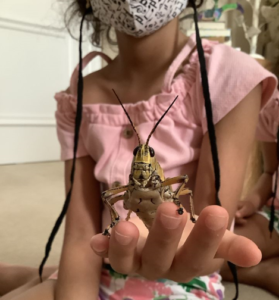 “Insect week! This Eastern Lubber Grasshopper was a wonderful sport in class. Now she is free again in my backyard. But not before teaching us to sing Head, Thorax, Abdomen.”
“Our second-graders wrote their own fairy tales!”
The students learned about scientists such as Jonas Salk and artists such as Claude Monet, experimented with stop motion animation, and read lots of books. Kian made so many trips to the public library that the staff came to know her by name.
Just before winter break, the students surprised Kian with a T-shirt with her logo – a rocket ship blasting off – on the front and “Commander Christy” emblazoned on the back. They all wore T-shirts that matched.
The show of school spirit touched her.
“It really felt wonderful to me that they took such ownership,” she said.
With the kindergarteners heading back to the traditional classroom in the fall, as their parents had planned from the start, Kian is focusing on her rising third graders, who will be returning to her for another year. She’ll spend this summer creating curriculum and lesson plans for them.
She also is considering picking up another group for fall but still hasn’t decided. In any case, she has no plans to return to traditional school.
Quoting a parent, she said, “This has been a terrible year, but we made lemonade.”
[Best_Wordpress_Gallery id="27" gal_title="Donna gallery 4.27"]
Just blocks from where waves roll in from the Atlantic, a well-traveled Toyota pickup stops every Friday around 9. Uli Frallicciardi lowers his tailgate and loads 15 green surfboards into the truck, enjoying the early morning tranquility at this Deerfield Beach surf shop just south of Boca Raton, Florida.
Surfboards aren’t the only boards on their way to a nearby spot in the sand.
Toni Frallicciardi has packed the back of her VW minivan with an array of white boards, the type you see in classrooms, each covered with meticulously hand-written notes. She’ll use the white boards for a class that’s part of a unique educational program she and her husband launched two years ago called Surf Skate Science.
The program is a novel endeavor for homeschoolers who thrive on the couple’s hands-on approach to learning math, science and design through the kid-friendly pursuits of surfing and skateboarding. It combines the couple’s shared sporting passions into a program that teaches STEM – science, technology, engineering and mathematics – with a twist: the addition of an “A” for art.
The result is a popular educational approach called STEAM.
“With architecture, science or any related pursuit, you have to be creative as well,” says Toni, who majored in ocean engineering at Florida Institute of Technology. “So, adding art to the equation is essential, because art and design are always present in some way. The main thing is we want to get kids excited about learning.”
Toni and Uli approach skate instruction the same way, meeting their students, who range from third graders to 10th graders, at a nearby skate park. Uli’s pickup is loaded down for those classes with extra skateboards, helmets and padding, while Toni totes school supplies and the white boards that contain her lesson points for the day.
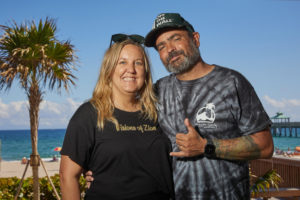
Toni and Uli Frallicciardi, owners of Surf Skate Science; PHOTO: Aluka Storytelling Photography
The Frallicciardis (pronounced Fra-litch-ee-ardi) got the idea for Surf Skate Science after seeing how their two older children benefitted from homeschooling. Among other perks, homeschooling allowed each of them to dual-enroll in high school and college. Their second child – a son, now 20, who helps with the program – developed a love of architecture by participating in a program that allowed him to compete with other ambitious students who were engaged in real-life projects and guided by mentors from local architecture and construction companies.
“That made us think that we could do something like that with surf and skate,” Toni said. “We could invite local marine biologists, local skateboard manufacturers, or skate park architects to come and talk to the kids about potential careers and get them involved with hands-on activities. We could have them learn through labs and get messy.”
From that initial idea several years ago, Toni and Uli – both of whom work full time at Island Water Sports in Deerfield Beach – began partnering with local organizations such as the Broward County Sea Turtle Conservation Program as well as Florida International University and Nova Southeastern University to bring in experts in science, math, the environment and design to speak with students.
But then, just as they were making plans to launch their program in February 2018, the nation was rocked by the mass shooting at Marjorie Stoneman Douglas High School in Parkland, just down the street from the Frallicciardis' south Florida home.
“A lot of the kids who skated at the local park went to school there, and we were very involved with the grief center after that,” Toni recalls. “My friends and I provided meals for the families involved, and made sure the grief center had food, or were just there for the students as they cried.”
She and Uli decided to pull their youngest child out of public middle school soon after that and begin homeschooling him, as did many parents in the area. The homeschool trend became a key building block for Surf Skate Science.
“During that time we thought, ‘What if we just met at the beach or the skate park to do science class?’” Toni said. “That’s kind of how it started, and it just kept growing from there.”
It began with a small group consisting of their youngest son and some of his friends. Toni developed the curriculum at her kitchen table, making sure it adhered to required grade standards. Classes were held weekly at the beach and at a nearby skate park, usually from 10:30 a.m. until noon, leading into a lunch hour that welcomed parents and siblings in a social environment.
The pandemic curtailed in-person activities last summer, but the program moved online with virtual lessons and guest speakers. Classes resumed in the fall with everyone safely social distancing.
At that point, an unintended bright spot appeared: More parents were turning to homeschooling as they became concerned about sending their children back to brick-and-mortar schools. Many discovered Surf Skate Science a welcome addition to their kids’ itineraries.
Today, class size ranges from 15 to 20 students. A standard science lesson – how to design and build a skateboard, the physics involved in staying balanced on a surfboard, an oceanography lesson taught from the vantage point of the ocean – lasts 45 minutes. Then comes another 45 minutes of surfing and skating instruction.
To Uli, learning comes easier if those involved are passionate about the subject being taught.
“I was that kid who didn’t get math,” he said. “But I was building this ramp, and it had to be perfect, and I realized that math is so important.”
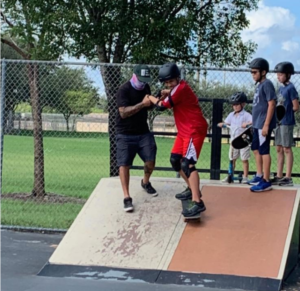
Michael Martin, 15, center, works on balance and coordination at Surf Skate Science. PHOTO: Aluka Storytelling Photography
The program has been a godsend for Rafaela Martin, whose 15-year-old son, Michael, is autistic and has benefitted enormously from the experience.
“It helps him socially, because he has the opportunity to see other kids and interact with them,” she said. “That has helped him learn how to handle different situations. He likes to do things hands on, so this has been great for him. This has helped him socially, academically and physically.”
For the Frallicciardis, the program mirrors their love of skateboarding, surfing and learning. Toni ran her own skate shop for three years after graduating from college. Uli, trained in physical therapy, met her at the shop and they married in 1998.
From 2003 to 2018, they worked together running a skate park, Ramp 48, while forming and running a nonprofit called Christian Skaters, helping to build skate parks in the United States and overseas. Now, their labor of love is Surf Skate Science.
“One of the parents recently told us that we make every kid feel important, and I think that’s whole reason we did it,” Toni said. “We really feel every kid has something to contribute. It’s just a matter of finding out how each learns and what they are passionate about and trying to harness that.”
By all accounts, they have done just that, helping kids learn to traverse waves and ramps and translating that into valuable lessons in science and life.
 Terry Gilliam’s 1985 film Brazil mixed Orwellian dystopia with Monty Python dark comedic absurdity. Sadly, it now appears to have been keenly prescient.
Robert de Niro’s character, Harry Tuttle, runs a guerrilla effort to fix people’s air conditioners due to the ineptitude of a bureaucracy known as Central Services. “This whole system of yours could be on fire and I couldn’t even turn on a kitchen tap without filling out a 27/B6,” Tuttle tells the protagonist as he makes illicit repairs. “Bloody paperwork!”
Central Services rewards Tuttle’s efforts to efficiently resolve people’s problems by attempting to execute him. Because of Central Service’s inefficiency, Tuttle survives, but police murder a citizen named Harry Buttle in his home due to a clerical error.
If only this were confined to film – but it is not.
Years later, and in the real world rather than on the silver screen, a group of Parisians known as UX, or Urban eXperiment, began using underground tunnels to break into museums to expertly restore and repair neglected works of art – a modern day Harry Tuttle scenario. UX set up workshops in the tunnels and always replaced the items they acquired, leaving them in better shape than they found them.
Wired featured the group’s efforts to restore the Pantheon’s 19th-century clock, which had not chimed since the 1960s.
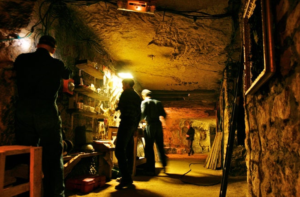 That September, Viot persuaded seven other UX members to join him in repairing the clock. They’d been contemplating the project for years, but now it seemed urgent: Oxidation had so crippled the works that they would soon become impossible to fix without re-creating, rather than restoring, almost every part.
“That wouldn’t be a restored clock, but a facsimile,” Kunstmann says. As the project began, it took on an almost mystical significance for the team. Paris, as they saw it, was the center of France and was once the center of Western civilization; the Latin Quarter was Paris’ historic intellectual center; the Pantheon stands in the Latin Quarter and is dedicated to the great men of French history, many of whose remains are housed within; and in its interior lay a clock, beating like a heart, until it suddenly was silenced.
Untergunther wanted to restart the heart of the world.
Predictably, French authorities attempted to have UX arrested and sued them in court. No good deed goes unpunished in this wicked and absurdly bureaucratic world.
The K–12 system suffered from these sorts of problems even before the pandemic. Teachers were frustrated, and students suffered growing levels of anxiety and depression. A 44-year veteran of classroom teaching told a radio host two years ago that the problem with education was not money, which he said, “has always been tough.” The problem, he said, was that “the joy has been strangled out of the profession.”
So, who are the Harry Tuttle/UX types of education today?
We’ve featured several small school leaders on redefinED who certainly would qualify; see here, here and here. I recently saw on Facebook an advertisement for a wandering teacher from Austin who is coming to the Phoenix area in May to teach kids a five-hour class on Bronze Age sword casting where the kids get to cast their own sword.
Greg Wenderski, the Sword Casting Guy, is a tinkerer, metal artist, sword historian, and former science teacher. He has built catapults, crossbows, fighting robots, and child-sized tandem bicycles with his students. Once, when his students were studying the Greeks in Ancient Civilizations class, and were fascinated by metallurgy, he built a casting foundry and began casting Bronze Age style swords with them.
He expanded his sword casting classes to audiences of all ages in Austin and all around the U.S. He teaches two types of hands-on sword making classes that enable participants to explore themes of archaeology, metallurgy, and physics in the process of making a Bronze Age sword.
You can watch Wenderski describe his class here.
Wenderski is engaging in disintermediation at its finest. He provides what looks like an awesome service, and he receives payment in a voluntary exchange. No bureaucracy, lots of fun, and no form 27B/6.
In May, some of the kids experiencing this educational opportunity to learn a mixture of history, archeology and metallurgy will forge a sword and pay for it with their Empowerment Scholarship Account.
A large majority of Arizona’s Empowerment Scholarship account are children with disabilities, children in D/F rated schools and children living on Native American land. Providing them the chance to learn from Wenderski along with those using their own funds promotes a greater level of equity than would otherwise exist.
That is cutting out the middleman at its finest.

