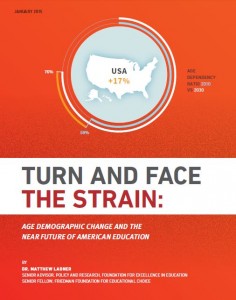
 Demographic changes are expected to place a greater strain on government services over the next two decades, a new study says, and that should lend urgency to calls for states to overhaul their education systems.
The report, “Turn and Face the Strain,” by Matthew Ladner, the Senior Advisor for Policy and Research with the Foundation for Excellence in Education and Senior Fellow with the Friedman Foundation for Educational Choice, warns about the problems associated with an increasing “age dependency ratio.” The report was co-released by the Foundation for Excellence in Education and the Friedman Foundation.
In short, the youth population is expected to continue growing, as is the elderly population. The number of adults aged 18-64 is not expected to keep up. As a result, by 2030, there will likely be more students and retirees depending on publicly funded education, pensions and medical care, without a proportional increase in the number of taxpayers to support those services.
“Broadly speaking, the age dependency ratio represents the number of people riding in the cart, compared to the number of people pushing the cart,” Ladner writes.
He has looked before at this issue and its implications for schools. The new report, released this morning, suggests the coming demographic squeeze he has predicted in Florida and elsewhere is likely to affect states all over the country. As a result, he argues, government programs, including education systems, will face increasing pressure to produce better results at a lower cost.
Between now and 2030, the United States will see 10,000 Baby Boomers retire each day. At the same time, the population of children in grades K-12 will continue to rise. Combined, these two growing populations increase the age dependency ratio.
Social Security, Medicare, Medicaid and education are some of the biggest expenses for state and federal governments, and the rapidly growing elderly and youth populations rely on them. Without raising taxes, cutting budgets, or implementing innovative cost-saving policies, one, or both, of these groups will lose out.
Sen. John Legg
One of Florida’s top education leaders offered a strong defense of Common Core Wednesday, saying while legitimate concerns exist “we cannot let political rhetoric and emotion impede us from implementing rigorous standards and high expectations for students.”
The comments from state Sen. John Legg, R-Lutz, the influential chair of the Senate Education Committee, came during a live chat here on the redefinED blog. It’s no surprise Legg supports Common Core. But his latest comments suggested that some of Florida’s key players on education policy – most of them Republicans – are standing firm on Common Core despite heated resistance from the party’s tea party wing.
Asked about how much pushback he had received, Legg wrote this: “When we isolate the discussion to the actual standards, I don’t feel much pushback. I have found that conservatives are passionate about their beliefs, myself included. Once we have a chance to lay out the facts and separate facts from anecdotes, most of my conservative colleagues embrace rigorous standards, accountability and school choice options for families. I like to paraphrase a quote I remember from Benjamin Franklin that goes something like, ‘Passion governs, and she rarely governs wisely.’ “
Legg also wrote that he does not think Common Core will undermine school choice: “I strongly believe our high, rigorous standards will challenge all students and schools to improve performance. If that does occur, there would be more pressure on our school choice providers to become more innovative in order to compete.”
Legg also answered questions from us and from readers about the PARCC exams tied to Common Core, charter schools and funding for the state’s voluntary pre-kindergarten program. To see the full transcript of questions and answers from the chat, just click into the program below.
As publicly-funded private schools have become more integrated into public education, the terms “publicly-funded education” and “public education” are becoming synonymous. I noticed the latest evidence of this semantic merger from Sara Mead earlier this month on her blog, Policy Notebook. Mead wrote that:
... charter schooling and publicly funded pre-kindergarten are both ultimately structural reforms that expand the boundaries of public education and create new spaces and opportunities for educators to serve children. Charter schools do this by allowing organizations other than school districts to operate public schools. Publicly funded pre-k does this by allowing districts and early childhood providers--both existing and new--to receive public funds to serve 4-year-olds.
She's correct. Publicly-funded providers are expanding the boundaries of public education. Public education today no longer means district schools only, but instead means all publicly-funded education, including charter schools, virtual schools, district schools and private schools receiving pre-K vouchers and tax credit scholarships. One reason I like this semantic and systemic integration is that it move us beyond the trite "private" versus "public" school debates. If all publicly-funded education is public education, then private schools receiving public funds are part of public education. School choice opponents can no longer argue that private schools receiving public funds are draining funds away from public education because these private schools are public education. And teacher unions can provide services to employees in publicly-funded private schools and still maintain their ideological and rhetorical commitment to public education.
Governors and legislatures in states as diverse as New Jersey, Indiana, Virginia, Pennsylvania and New Mexico are discussing legislation to provide families with more publicly-funded learning options via private providers, and many of these proposals will become law in 2011. The merger of public education and publicly-funded education is accelerating.

