 Russia’s reactionary former KGB officer-strongman launched a “special operation” to “de-nazify” the Ukraine, an independent nation whose president not only is Jewish but who lost relatives in the Holocaust. The Ukraine war represents (hopefully) the last gasp of the Cold War.
The school choice movement has much to learn from the Cold War.
The United States conducted a highest-stakes-possible multi-decade nuclear stand-off to contain the aggression of the Soviet Union. In furtherance of this goal, the United States created a broad system of free trade to secure military cooperation, which delightfully created the greatest reduction in global poverty in human history.
Cold War victory, however, hardly seemed inevitable while it was being conducted.
“Let every nation know, whether it wishes us well or ill, that we shall pay any price, bear any burden, meet any hardship, support any friend, oppose any foe to assure the survival and the success of liberty,” John F. Kennedy stirringly proclaimed in his inaugural address. “This much we pledge – and more.”
Did the United States have staying power to see this pledge through? It did not appear to be the case in the 1970s.
Cold War fatigue grew under the crushing weight of the effort. The United States suffered a divisive defeat in Vietnam, the economy was a stagflation-ridden mess, and national confidence ebbed. Ronald Reagan successfully rallied the United States to see the conflict through:
“I’d like to tell you of my theory of the Cold War,” Reagan said. “Some people think that I am simplistic, but there is a fundamental difference between being simplistic and having simple answers to complex questions. So, my theory of the Cold War is that we win, and they lose.
Reagan lived to see the dissolution of the Soviet Union; we won, and they lost.
The choice movement should take inspiration from Kennedy and Reagan. Lawmakers passed the oldest of the modern voucher programs 32 years ago, the first charter school law 31 years ago. It’s a long struggle. Fatigue sets in, and it is easy to get distracted.
The movement needs to either accept which states have swing votes and act accordingly or do the work necessary to change which states will have swing votes. (See my commentary on this here.)
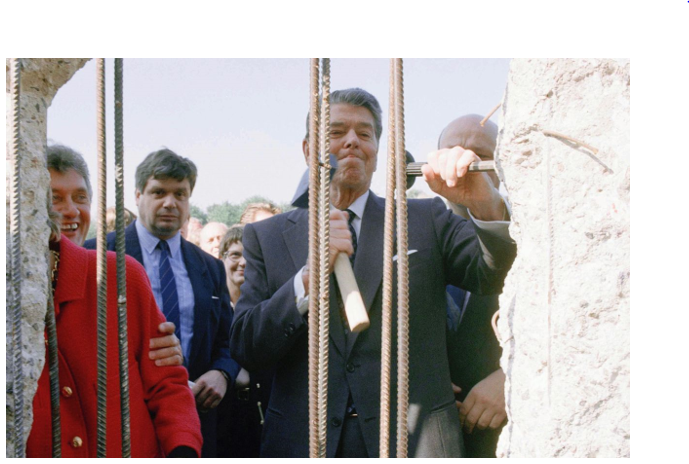
If social media virtue signaling had accomplished either of these goals, we would have chipped our trophy piece of the Berlin Wall away years ago.
Thomas Paine noted:
“Tyranny, like hell, is not easily conquered; yet we have this consolation with us, that the harder the conflict, the more glorious the triumph.”
In the end our theory should be: We win and the reactionaries lose, both in Ukraine and here at home.
As election day dawned this morning in Virginia, a new Cygnal poll of 800-plus likely voters shows Terry McAuliffe and Glen Youngkin are running neck-and-neck for the governor’s race.
As is the case in many states, education has become a key issue in Virginia, leading pollster Brent Buchanan to proclaim that independent voters and parents of K-12 students are “stampeding” to support Youngkin.
Meanwhile, results from a recent WFXR (Virginia) News/Emerson College poll show the issues that are most important to voters are education, jobs, COVID-19, healthcare, and taxes – in that order. When broken down by party, two issues make the top five for both Republicans and Democrats: education and jobs.
In the Virginia race, the candidates have starkly different positions on education.
In a candidates’ debate in late September, McAuliffe stated: "I don’t think parents should be telling schools what they should teach." In contrast, Youngkin is on record as being committed to keeping public schools open, making them better, and encouraging school choice that aims to create at least 20 new charter schools across the state.
While Virginia parents have choices, ranging from charters to a tax credit scholarship to attend private schools, these choices are limited, and the scholarship is not large enough to help the 1.2 million students attending public schools in Virginia.
The National Alliance for Public Charter Schools recently reported that there are only eight charter schools – free public schools that are exempt from some of the rules that apply to traditional public schools – in the state of Virginia.
When it comes to allowing low-income families to have access to private school options, only 4,498 students are participating in the tax credit scholarship, a life-changing program, given that the program funding is capped at $25 million per year for a population of over one million K-12 students.
While Virginia did well in the latest round of National Assessment of Educational Progress (NAEP) testing, Virginia parents clearly need options for reasons not necessarily based on test scores. Parents across the country have been showing up in droves to school board meetings to voice their discontent at what’s being taught in public schools. In Virginia, many are speaking out against the majority-white racial makeup of school boards, asking that minorities be given more support.
Hispanic and Black parents’ voices need to be heard. They need to be able to help their children succeed, but they continue to be underrepresented. According to a study released in April from Education Reform Now, Blacks and Hispanics account for 34% of Virginia's college-age population. Yet just three of Virginia's 15 four-year public universities have Black and Hispanic enrollment levels that match the population.
If the last year and a half taught us anything, it is that a one-size-fits-all education system does not work for families. A candidate for governor who says parents shouldn’t be telling schools what they should teach is sending the wrong message if he expects to win their votes on election day.
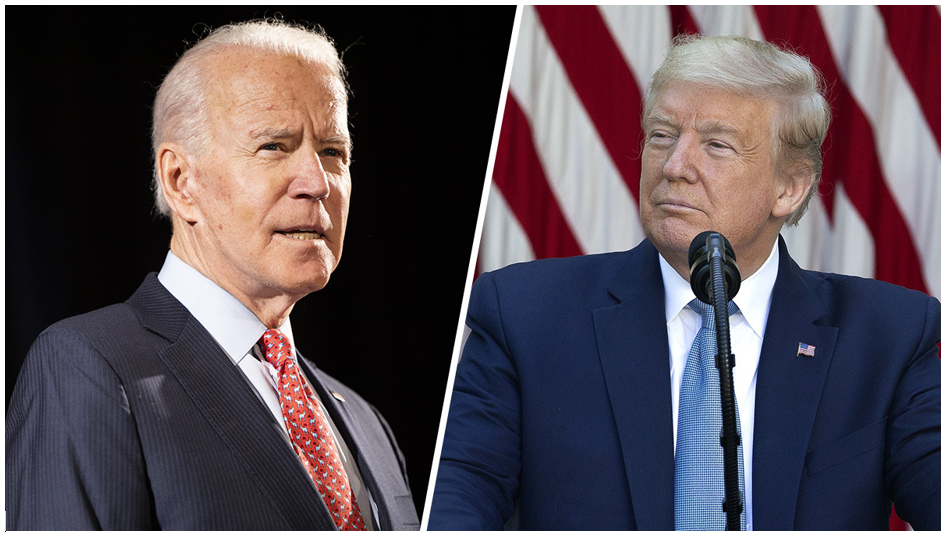 There is an election tomorrow, so go out and vote. But note that these elections were once far less apocalyptic in tone.
The 1920 presidential election, for instance, featured Warren Harding versus James M. Cox for all the presidential marbles, such as they were in those days. Cox survived a grueling contest against William Gibbs McAdoo and A. Mitchell Palmer to win the nomination of the Democratic Party on the 44th ballot.
If you haven’t heard of most of these people, don’t feel bad; you simply are engaging in rational ignorance. Harding defeated Cox and then died. He was succeeded by his vice president, Calvin Coolidge. Coolidge famously did and said very little as the nation’s economy boomed.
Presidential races were delightfully inconsequential back then compared to the modern end-of-days version where both major parties urgently assure us that tout est perdu if the other side wins. In reality, life goes on until the next Ragnarök election, and then the next. Some catastrophic policy mistakes made starting with Coolidge’s successor, however, are eerily reminiscent of the current K-12 calamity.
On the one hand, modern elections seem overblown. Matthew Ridley made the case in the Rational Optimist that one struggles to find a 10-year period of American life in which material conditions failed to improve despite our political follies. Take, for instance, the Great Depression, an era in which a bipartisan group of federally alleged Olympians made a whole series of catastrophic policy mistakes, including but not limited to the Republican Hoover Administration starting a global trade war.
The Federal Reserve tightened the money supply during the early years of the downturn. In addition, the non-stop administrative antics of the Democratic Roosevelt administration created enormous political and economic uncertainty. The country had experienced plenty of stock market crashes and downturns, but a decade-plus long depression? That took some truly misguided effort.
Sometimes the words “we’ve got to do something” can be the most dangerous phrase in the English language.
There was a lot of suffering due to these mistakes. Nevertheless, due to the normal improvement process of people grinding on problems and tinkering with products/services the average American was wealthier at the end of the 1930s than the beginning. Today, the average American lives far better than the richest person on the planet in 1920 in many aspects.
Education, however, has lacked a decentralized process whereby results continually improve, and thus stands out as a sore thumb against an overall trend of societal improvement. A tangled web of federal, state and local rules governs educators in an effort to standardize schools and outcomes. School district democracy is marked by low voter turnout, and thus high vulnerability to regulatory capture.
Spending was going up and scores down before the pandemic, and the pandemic has introduced a whole host of new problems.
Federal officials won’t be able to fix much of this regardless of who wins. The states face an enormous revenue shortfall, students have acquired learning gaps we are only beginning to measure, and an estimated 6% of students have received no instruction since the spring shutdowns. Women are leaving the workforce in unprecedented numbers which is going to hurt both family and government finances. White students currently have twice as much access to in-person instruction as students of color.
Never mind Baby Boomer teacher retirement; under typical state retirement rules, many Gen-X teachers are eligible to retire. Take, for instance, a teacher born in 1967 who began teaching in 1990. Under a “rule of 80” this now 53-year-old teacher with 30 years of experience became eligible for the typical state pension years ago. This wouldn’t be as much as a problem if college students were flocking into education training, but they have been shunning it.
This also would be less of a problem if the typical state retirement system had been properly capitalized, but it hasn’t.
A grand mess awaits whoever wins tomorrow, so good luck to them. The task of recovering from our education troubles and leading a broad reimagining of an antiquated K-12 system will primarily fall on our state and local leaders.
Keep them in your prayers, and God bless America.
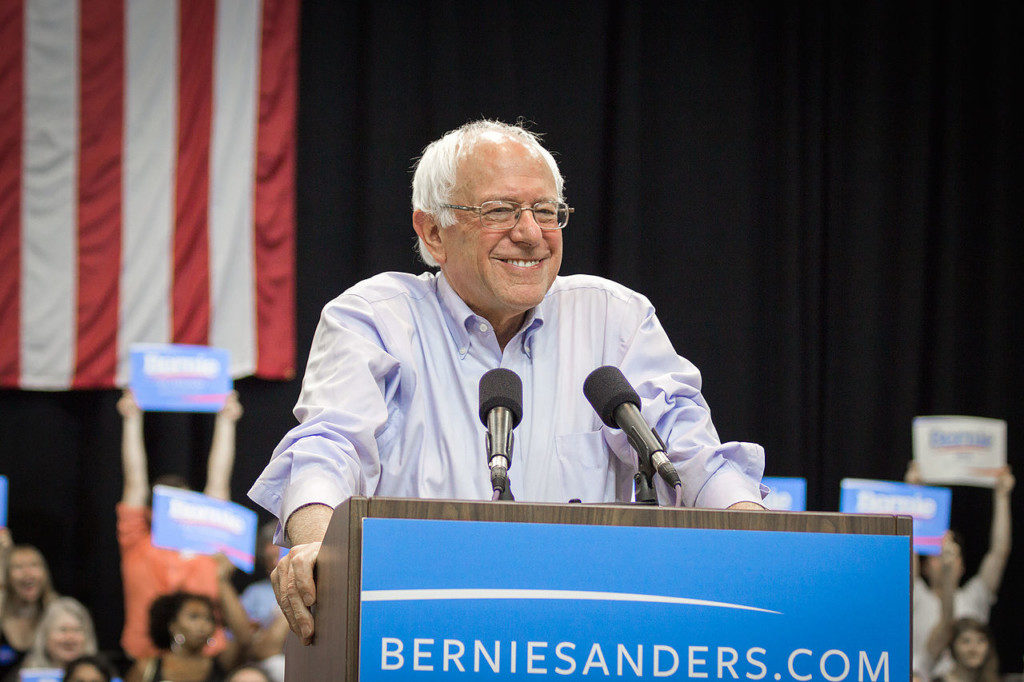
Democratic presidential nominee Bernie Sanders has called for a moratorium on federal funding for all charter schools and a ban on for-profit charters. Photo credit: Nick Solari/Wikimedia Commons
When Sen. Bernie Sanders, a Democratic candidate for president, recently revealed his education plan, most of the ensuing news coverage focused on his criticism of charter schools and his call for a moratorium on their expansion.
Cue the usual op-eds and pundits booing him, attacking socialism and railing against infringements on a “competitive free market.”
I’m here in Florida booing the usual pundits.
Don’t get me wrong. I’m a longtime Sanders supporter who was disappointed in his attacks on a movement bringing equity to public education.
He’s misguided and misinformed.
His opinion is baffling coming from someone who values “Medicare for All.” A single-payer system would allow patients to spend health care dollars on public or private hospitals and doctors of their own choosing.
He doesn’t see how funding for health care and education could be similar, allowing patients and students a level of freedom and equity of care they can’t get any other way.
Like I said, he’s misguided.
But I don’t blame him.
To those who want to roast Bernie Sanders: My Nana used to say, when you point a finger at someone, there are three more pointed right back at you.
Bernie Sanders is listening to one viewpoint regarding education choice because one viewpoint is all he can hear.
This isn’t his fault.
Those who support education choice don’t have a singular, strong, compelling voice. Most of the arguments for choice focus on conservative values. Free markets. Competition. Anti-union.
Not exactly a bipartisan point of view.
Choice supporters don’t have a central organization or rallying cry on a national scale, like the NEA or AFT, with a network in every state responding to attacks with a coordinated strategy.
We show up at rallies with coordinated shirts.
That’s all we’ve got.
No national organizing model.
No national mobilizing model.
Armies of parents and advocates scattered throughout the country with little or no direction.
Little or no united front.
What is our big picture goal?
Our opponents respond to strength. Our strength is in the sheer numbers of parents and teachers who understand that the current system fails children in need.
And yet we underutilize them at every turn.
We allow the teachers union, which does little to help actual teachers, to act as the compelling voice on this issue.
We allow President Trump and Secretary of Education Betsy DeVos to be the face of our movement, rather than the hundreds of thousands of families benefiting from choice.
We get together at annual summits and conferences and praise lawmakers -- mostly white, mostly conservative, mostly male -- and then wonder over expensive wine and cocktails why the left isn’t catching on.
We look the other way when Democrats and other liberal mouthpieces send their own children to private or elite schools, rather than shame them for denying low-income families that same privilege.
We’re too busy fighting amongst ourselves, allowing opponents to pit us against one another. Charter supporters opposing voucher supporters. Non-profits fighting for-profit management companies. Scholarship supporters railing against home or virtual schools.
We write mealy-mouthed editorials, all the while hoping that our opponents will like us if we ingratiate ourselves enough.
What does that really do?
It weakens support for and among all of us.
It tells parents, “You can choose, but only from this list of preferred options.”
It shouts, “We trust parents…to a point.”
Progressives like Bernie Sanders see themselves as rebels. The ones who support redefining everything from health care, drug laws, and college tuition costs to reforming prisons, campaign finance and gun control.
Yet only in education reform are the rebels and reformers deemed conservative.
Unreal.
And we continue to allow it.
We don’t cultivate leaders to run for office or give them proper political cover to take on the status quo.
We allow the message to be, “We don’t need two school systems,” when anyone with open eyes – and an open mind -- knows there are already two systems: one for those with means, and one for those without.
Opponents run with the nonsense that we “drain money from public schools.” We don’t raise our voices just as high to declare it’s cruel to allow the current system to thrive.
We aren’t bold.
We aren’t loud.
We aren’t compelling.
Blame Bernie all you want.
We’re the ones hiding meekly in the corner. In our absence the opposing arguments thrive.
If we fix that, Bernie – and all our misguided opponents – will finally understand the issue. And then figure out where they stand.
By Joy Smith-McCormick
Among the most important choices families must make, education commands our focus, as it is the foundation upon which high-functioning, productive citizens are developed. The education sector has been religious in its practices for centuries, but over the last 20 years more options to deliver education have emerged. Just as other sectors have responded to public demand to improve, school choice has evolved to meet families’ need for a higher-quality education.
At the core of the school choice debate is a personal choice parents must make about the educational model that works best for their children. Most parents will agree that having different options is preferable to a one-size-fits-all approach. Because children must live with the consequences of a school that is not the right fit, this decision should be a parental responsibility, not one made by a committee.
Consider the issue of school choice within the context of Article IX, Section 1 of the Florida Constitution. It states, in part, that “[t]he education of children is a fundamental value of the people of the state of Florida. It is, therefore, a paramount duty of the state to make provision for the education of all children residing within its borders. Adequate provision shall be made by law for a uniform, efficient, safe, secure, and high-quality system of free public schools that allows students to obtain a high quality education … ”
Nothing in this mandate excludes school choice. This provision seems to support the type of flexibility that now includes school choice options as part of an overall system to ensure a high-quality education for all students. Local district magnet schools, charter schools, virtual schools, or some hybrid of all these aid in that flexibility.
Dismissing education choice is most consequential for black and brown children, who suffer from an academic achievement gap with their white counterparts and are more likely to travel the pipeline to prison rather than the pathway to college or gainful employment. That should motivate all stakeholders to explore any and all options to reverse this course.
Charter schools have been a successful option for these students. The most recent annual charter school performance report compiled by the Florida Department of Education shows that charter school students outperformed traditional school students. The data reveal a lower achievement gap for black and brown students in charter schools, and that low-income students in charter schools performed better than low-income students in district-managed schools.
In some political circles, school choice might be taboo. But most parents don’t consider partisan politics when deciding about their children’s education. Choice parents, however, are taxpayers who deserve fair, fact-based representation. Choice parents are voters. Their experience shapes their voices on the issue and should not be ignored by politicians for the sake of upholding an anti-choice platform.
As a choice parent, an education lawyer, and the legal and compliance director for a company of non-profit charter schools, I am in a committed relationship with the law and facts about choice. Conversations among some stakeholders are not well-informed, and their views sometimes are steeped in political myths.
I propose a time out on the politics to appreciate the facts and the basic premise of choice. Parents own this choice. Parents should not be vilified if they do not toe the party line when the party just might be out of step. Political dictates and aspirations will never be more important than parents’ rights to choose what is best for their children’s education. We all must consider softening political absolutes to make room for the reality of people’s experience.
I encourage a movement to better educate all stakeholders and to dispel the myths around the issue of school choice. Whatever your politics, school choice is codified and a part of our public education system.
Joy Smith-McCormick is legal and compliance director and general counsel for Kid’s Community College Charter Schools (KCC). KCC's five not-for-profit, public charter school campuses serve more than 1,500 K-12 students in Hillsborough and Orange counties. As an active member of the Florida Bar, Joy serves as Education Law Committee chair and is a member of the Governmental and Public Policy Advocacy Committee. She has been practicing law for 17 years. Follow her on LinkedIn at https://www.linkedin.com/in/joy-smith-mccormick-esq-38829880 or on Twitter @joyisspeaking.

Robinson
Standardized test costs. They total about $1.7 billion a year nationwide, according to a new report from Brookings that includes state-by-state figures. Not much, concludes researcher Matt Chingos, who adds “perhaps we’re spending less than we should.” Coverage from Education Week and Huffington Post. Former Florida education commissioner Gerard Robinson tells the latter about test anxiety: “I won't pretend that tests don't matter and there's no anxiety -- but I also tell people there's anxiety with sex. There's anxiety with sex, but there isn't any talk about getting rid of that.”
And still more Jeb summit coverage. Politic365 on the “Florida Formula.” EdFly Blog on the crucial center. Rick Hess on "The Common Core Kool-Aid."
More protests from Hillsborough parents. They want better training for employees who work with special-needs children, StateImpact Florida reports. More from Tampa Bay Times.

