
A poll of more than 1,762 registered voters conducted earlier this month by RealClear Opinion Research shows that nearly three-quarters support school choice, with 16% opposed and 10% unsure.
The findings were consistent across party lines, with 83% of Republicans, 69% of Independents, and 70% of Democrats saying they strongly or somewhat support school choice.
Additionally, 66% of respondents said some or all the COVID funds the federal government set aside for K-12 education should be directed by parents. Most voters in both parties agreed parents should direct all or some of the funding.
The results represent a marked increase in support for school choice since similar polling was conducted in April 2020, with overall support increasing 10 percentage points. Support among public school parents has increased from 68 to 80%, while Democrat support has increased 59% to 70%.
American Federation for Children CEO observed that with public support for school choice at an all-time high, “a new story is unfolding” as the nation recovers from unprecedented nationwide school closures due to COVID-19.
“Parents are rising up and demanding the freedom to choose the best educational environment for their children,” Schultz said. “Thankfully, more and more lawmakers are listening. Already in 2021, 17 states have passed legislation to improve, expand, or create new school choice programs.”
Another nationwide poll conducted prior to the RealClear Opinion Research poll revealed similar results.
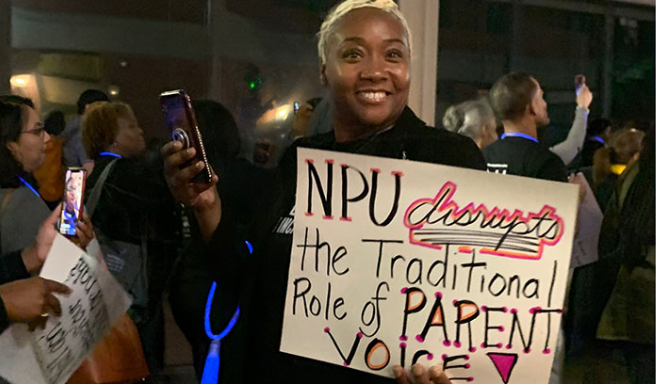
The ethnically, racially and political diverse National Parents Union, brainchild of two Latina mothers, represents 100 organizations in 50 states, the District of Columbia and Puerto Rico.
A new poll from a national grassroots education choice group indicates strong support among parents for schools to move away from a one-size-fits-all approach to education after a year of unprecedented disruption due to COVID-19.
Eighty-six percent of respondents to a survey launched by the National Parents Union agreed that schools should provide individualized learning plans for each student based on his or her specific needs.
The poll also found that parents want options for their child’s learning both this year and next year, with 58% saying they want the opportunity to choose between in-person and remote learning options for the remainder of the 2020-21 school year. Nearly as many – 56% – said they want that option for the next school year.
With release of the survey results, National Parents Union co-founder and president Keri Rodrigues underscored the organization’s mission to amplify the voices of individual parent groups and to push for changes in education nationwide.
“Throughout the pandemic, parents have been entrepreneurial in their approach to ensuring their children are educated, and it is long past due that schools begin reimagining their approach to education as well,” Rodrigues said. “However, the only way that will work, and the only way to move forward, is for parents to have a seat at the table, and not just any seat, but the seat at the head of the table.
More than three-quarters of survey participants expressed the desire for schools to provide more summer school programs in 2021 to counteract learning loss due to the pandemic. Interest also was high for after-school tutoring programs.
Opinions regarding the continuation of statewide testing were divided. Fifty-one percent of parents said testing should continue while 40% said there should be a break from statewide testing this year. Fifty-eight percent of parents said they will have their child take state tests if they are administered in their school.
The survey was conducted March 11-23 and included 1,029 parents of children in K-12 public schools.
 Two findings related to education savings accounts have emerged from a recent poll conducted by EdChoice as the education reform organization continues to track COVID-19-related trends.
The first: Support for ESAs, which allow parents to withdraw their children from public district or charter schools and receive a deposit of public funds in government-authorized savings accounts with restricted but multiple education uses, has remained steady throughout 2020.
The second: Support for ESAs among teachers in all education settings – district, charter and private – increases when information about ESAs is provided.
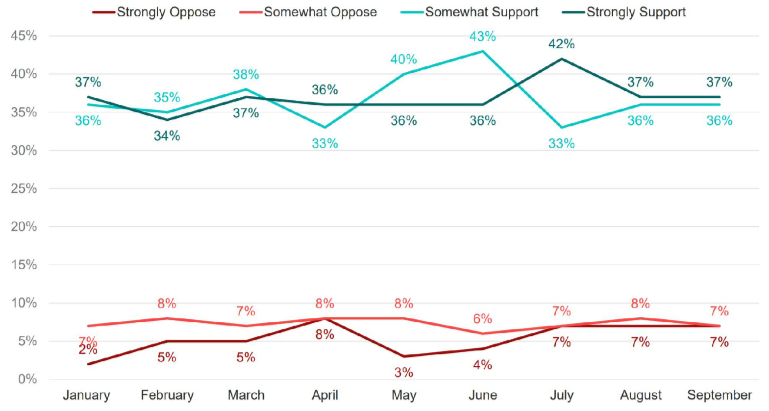
The number of parents indicating strong support for ESAs held steady at 36% through the spring and early summer, rose to 42% in July and tapered back to 37% as the new academic year got underway. The number who indicated some support for ESAs fluctuated between 33% and 40% in the spring, peaked at 43% in June and settled at 36% in September.
Since January, the number of parents who either strongly opposed or somewhat opposed ESAs has hovered between 2% and 8%.
Parental support for education savings accounts
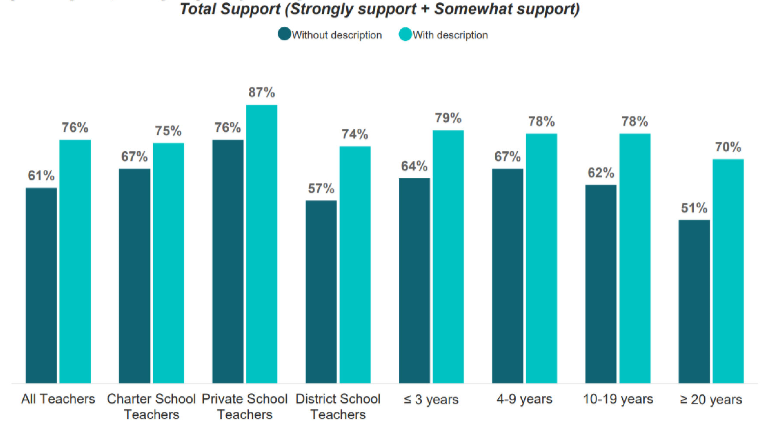
 When asked their opinion of ESAs in K-12 education based on what they know or have heard from others, 61% of teachers overall indicated support. That figure rose to 76% when a description of ESAs was provided. The level of ESA support among district teachers rose from 57% to 74% once a description was provided, while support among charter school teachers rose from 67% to 75%.
Private school teachers indicated the greatest level of support both before and after hearing a description of ESAs, 76% and 87%, respectively.
Teacher support for education savings accounts, before and after a description
 Other poll questions queried respondents on learning pods, teacher morale and in-person versus remote learning. Full results are available at https://www.edchoice.org/engage/edchoice-public-opinion-tracker-top-takeaways-september-2020/.

