Charter schools. Excel Leadership Academy in West Palm Beach makes its case to stay open before an administrative law judge, reports Extra Credit. The Daytona Beach News Journal looks at a struggling charter in Flagler.
 Virtual schools. The Palm Beach Post looks at the potential financial hit to Florida Virtual School from recent legislative changes. Education Week offers a short write-up on Florida's online expansion.
School rankings. Take some with a grain of salt, some with a truckload, writes Matt Di Carlo at the Shanker Blog. Three Marion high schools are among the best in U.S. News & World Report, reports the Ocala Star Banner.
School closures. Dozens rally against proposed closures in Brevard. Florida Today.
School spending. Increased funding from the Legislature still may not be enough to get Marion out of a hole, reports the Ocala Star Banner. The school board in financially troubled Manatee takes a closer-than-usual look at contracts and spending, reports the Bradenton Herald.
Teacher evals. The Quick & The Ed offers a legal analysis of the recently filed lawsuit. (more…)
Virtual schools. Lawmakers open online learning to more providers, including private interests, reports the Miami Herald. StateImpact Florida and the Florida Center for Investigative Reporting obtain internal emails and a recording of a K12 Inc. company meeting that they say shed light on questionable company practices involving teachers who are not properly certified.
Struggling schools. The Broward school district will overhaul five struggling schools by closing some and revamping others, reports the South Florida Sun Sentinel. Principals are key to turning around five struggling Pinellas schools, reports the Tampa Bay Times.
Tutors. The Tampa Bay Times looks at the last-minute legislative scrap over whether to continue state-mandated tutoring for low-income kids.
Private schools. Voters in Palmetto Bay will get to vote on whether a local Montessori can expand. Miami Herald.
Rick Scott. Teacher pay raise tour comes to an end, reports the Tampa Bay Times. Will it get him any votes? asks the Palm Beach Post. (more…)
Parent trigger. Joe Henderson from the Tampa Tribune on parent trigger: "In my opinion, it started from the flawed premise that it’s always the institution’s fault when a school fails." Tallahassee Democrat: "What we don’t need is to have for-profit corporations lobbying parents to shut down or privatize a public school." The Foundation for Florida's Future isn't giving up, reports StateImpact Florida.
 Bad teachers. Language regarding student placement with unsatisfactory teachers, which had been part of the parent trigger bill, is approved as part of a charter school bill. Times/Herald.
Teacher evals. Lawmakers tweak the new system to ensure teachers are only rated on students they teach. Gradebook.
Teacher merit pay. In a setback for the FEA, a circuit court judge rules that SB736 does not violate collective bargaining rights. Orlando Sentinel, Associated Press, News Service of Florida.
Superintendents. The Palm Beach County School Board should quit worrying about former Superintendent Art Johnson, editorializes the Palm Beach Post.
Mentors. The Sarasota Herald Tribune writes up the mentors who helped Take Stock in Children scholars in Manatee: "A mentor is a mirror. A guide to the big picture. Someone who has walked in someone's shoes and gotten to where they want to be."
AP results. Florida students rank No. 4 in the nation in the percentage of graduates passing an AP exam. redefinED. Tampa Bay Times. Miami Herald. Tallahassee Democrat. Orlando Sentinel. CBS Miami. Florida Today. Associated Press. Fort Myers News Press.
 Tutoring oversight. The Tampa Bay Times elevated a handful of bad actors to taint the overall tutoring effort in Florida and ridicules a program championed by the late Sen. Ted Kennedy to help low-income families, writes Steve Pines, executive director of the Education Industry Association, in an op-ed response to the Times series and editorial.
Teacher evals and school grades. Despite the concern of Education Commission Tony Bennett and others, the two systems are not meant to be in sync. Shanker Blog.
More conspiracy! Now in Education Week.
Class size flexibility. There's bipartisan support for a bill to provide that. StateImpact Florida.
Common Core. Florida Education Commissioner Tony Bennett talks more about the why's behind Plan B. Education Week. (more…)
 Words such as voucher, privatization, profit and corporation are often used as weapons by individuals and groups who oppose parental empowerment and school choice. Using words as weapons is especially common during periods of significant social change - we all do it - but the practice undermines civic discourse and makes finding common ground more difficult.
“Market” is another term school choice opponents use to connote evil, but our way of life is largely based on markets, and public education is increasingly embracing market processes as customized teaching and learning become more common. Our challenge moving forward is regulating public education markets in ways that maximizes their effectiveness and efficiency.
People access products and services in one of two ways. Either their government assigns them, or they choose for themselves. In the United States, we have historically allowed citizens to choose, and this system of provider and consumer choice is a “market.”
In a goods and services market, providers decide which goods and services they want to sell, and consumers choose those they want to buy. Markets, when implemented properly, are preferable to assignment systems because they better utilize people’s knowledge, skills and motivation. Citizens are allowed to use their own experiences and judgments when making selling and purchasing decisions, and this citizen empowerment maximizes the universe of ideas from which improvement and innovation derive.
When governments assign products and services to their citizens, they rely on a small group of people to decide what to offer. This top-down approach is less open, transparent and effective than the decision-making that occurs in markets, and it discourages creativity. This is why most improvements in goods and services emerge from market systems rather than government assignment systems.
Markets allow providers to learn from consumers. When governments dictate to consumers what goods and services they may have, their citizens’ true wants and needs are not fully considered. The voice of the customer is silent. But when consumers are empowered to choose for themselves, providers learn from these choices and adjust accordingly. In markets, this necessity to meet customers’ needs drives innovation and continuous improvement. (more…)
Ben Austin of Parent Revolution and Rick Hess of the American Enterprise Institute have been engaging in a civil dialogue on the merits of educators and parents being able to purchase instructional and management services from for-profit corporations. Austin opposes allowing parents and educators to have this option, while Hess is a supporter.

While Ben Austin (pictured here) is clearly well intentioned, his argument is based on ideology and politics, and not good public policy.
Austin’s advocacy of parental empowerment derives from his belief that public education too often puts adult needs over the needs of children. He thinks giving parents more influence over how their children are educated will move students to the center of educational decision-making. But Austin opposes allowing parents to contract with for-profit corporations because he thinks these companies will be more concerned with profit than children’s needs. A summary of Austin’s position was recently posted on the Parent Revolution blog: “Because we believe children need to be put first in every decision, it is far better to have non-profit organizations – accountable to parents, taxpayers and a stated mission – than a for-profit organization, which by definition is accountable first and foremost to investors and shareholders … ”
Hess argues that for-profit corporations already provide billions of dollars of products and services to school districts every year, and if parents decide a for-profit company can best meet their children’s needs, they should be allowed to work with it.
I agree with Hess. While Ben Austin is clearly well intentioned, his argument is based on ideology and politics, and not good public policy. Parents should be free to contract with providers that best meet their children’s needs.
The ad hominem aspect of Austin’s argument is troubling. While I was doing my holiday shopping this year, the gender, sexual orientation, race and ethnicity of the salespeople I talked to was irrelevant, as was their employer’s tax status. What was relevant was the quality and price of the products or services they were selling. I suspect Ben has these same priorities when he shops, and he likewise does not consider a corporation’s tax status when he purchases products and services for his family and friends. (more…)
 It does sound nefarious: The people who back accountability for Florida public schools, the argument goes, are really out to mine huge sums of money from their degradation and demise. In a weekend op-ed for the Orlando Sentinel, Florida teachers union president Andy Ford (pictured here) mashed the privatization button hard in panning the state’s “flawed and punitive” ed reforms. The accountability system, he wrote, has been “endlessly promoted by legislators who favor for-profit schools, and the Florida Chamber of Commerce.” The state’s standardized test has been “abused by politicians and those wanting to make a profit off public schools and students.” The job of state education commissioner has “devolved into one solely focused on implementing the marching orders of Jeb Bush and the corporate community.”
Yikes! But if all of those folks really were out to make public schools look awful (so profiteers could swoop to the rescue with charter schools and vouchers) they’ve done a miserable job. As we’ve noted before, one key indicator after another and one credible, independent report after another has found Florida’s public school students – especially its poor and minority students – have, over the past 10 to 15 years, improved as fast as students in just about any other state. Matthew Ladner, a researcher at the Foundation for Excellence in Education, has more on this point today at Jay P. Greene’s Blog:
Notice that the “good ole days” in Florida (pre-reform) were a disaster for low-income children. A whopping 37% of Florida’s low-income 4th graders had learned to read according to NAEP’s standards in 1998. A lack of transparency and accountability may have suited the FEA fine, but it was nothing less than catastrophic for Florida’s low-income children. Thirteen years into the “flawed” system, that figure was up to 62 percent. The goal of Florida policymakers should clearly be to accelerate this impressive progress rather than to go back to the failed practices of the past.
Put another way, if Mr. Ford considers this system “flawed” then Florida lawmakers should quickly implement something that he would judge to be “catastrophically flawed.”
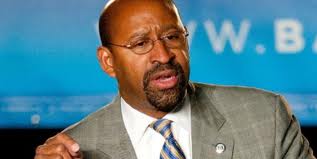 In Orlando back in June, Philadelphia Mayor Michael Nutter and other big-city Democratic mayors convinced the U.S. Conference of Mayors to unanimously endorse the idea of parent triggers - and were promptly savaged by critics. They were tools of ALEC, profiteers, enemies of public schools.
Nutter just spoke to the DNC a few minutes ago, and if he's a right-wing fringie out to gut public education, he's also got a bright future as an actor. Frankly, with tonight's script, he sounded a lot more like an establishment Democrat than a reform-minded one. But the point isn't to critique Nutter's positions on education policy. It's to note that some particularly vocal ed reform critics have become so rigid, they're disparaging - and potentially alienating - fair-minded people who actually agree with them much of the time.
Here are the prepared remarks for Nutter's speech:
I'm honored to serve as mayor of my hometown where our founders started America with three simple words: "We, the people." And when they said "people," they didn't mean "corporations."
I'm most honored to be the father of Christian and Olivia, and a proud parent of a public school student.
My wife, Lisa, and I know Olivia's education is central to everything she, and everyone in my city, wants to achieve. In Philadelphia, our public safety, poverty reduction, health and economic development all start with education. We can't grow the middle class if we don't give our kids the tools they need to innovate and invent.
But first we have to invest in them. That's what President Obama did, saving 400,000 educators' jobs and giving states the flexibility to shape their schools.
Mitt Romney doesn't get it. (more…)

