 Note from Matt Ladner: During the writing of a previous post I related a mistaken notion regarding pending Oklahoma charter legislation. The legislation consolidates virtual charters under a single board but does not do so for “brick and mortar” charter schools. I apologize for the error.
The legendary walls of Constantinople took nine years to build, were nearly 4 miles long, and were actually made of two walls with over 96 towers and a moat. But they very nearly fell early in their history, and only the power of competition saved them.
In the year 447, the Huns were busy rampaging through the Roman Empire when they received word that a series of earthquakes had destroyed the walls of Constantinople. Fifty-seven of the towers had been destroyed and the moat filled with debris.
Subsequent earthquakes furthered the damage. Sacking Constantinople, the wealthy capitol of the Eastern Roman Empire, represented the biggest potential score on the planet. Atilla eagerly moved his forces in for the kill.

In Constantinople, a desperate emperor appointed a man named Constantine Flavius to repair the walls as best as possible before the imminent Hun onslaught. Constantine Flavius got creative.
Constantinople had a very active sports culture revolving around chariot racing at the Hippodrome, a stadium which could seat 40,000 spectators. Constantine Flavius created a competition between fans of the Blue, Green, Red, and White racing factions to repair the wall.
If you can imagine huge teams of modern-day European soccer hooligans clearing out the pubs in order to compete for the glory of defending their city, it’s similar to what actually happened. As Heritage Today explained:
Each faction was tasked with a stretch of wall, working in competition to complete their section before the other, winning the honour of victory for their team. The “Blue” team worked the stretch of walls from the Gate of Blachernae to the Gate of Myriandrion, and the “Greens” from there to the Sea of Marmara. In just sixty days, the great walls of Constantinople were restored, and the defensive moat cleaned of debris.
Atilla and his forces arrived to find a set of walls too formidable to breach. Constantinople endured numerous future sieges over an additional thousand years plus. Why did Constantinople get the works?
Apparently, even when the Turks besieged the walls with cannon, the city ultimately failed because a careless group of troops left a gate unlocked, rather than having the walls breached.
America’s K-12 system is currently a bit of a ruin. We should take a page from the Byzantine playbook and use the power of competition to rebuild a demolished system to be stronger than ever. Like Constantine Flavius, we need to approach this task with the utmost dispatch.
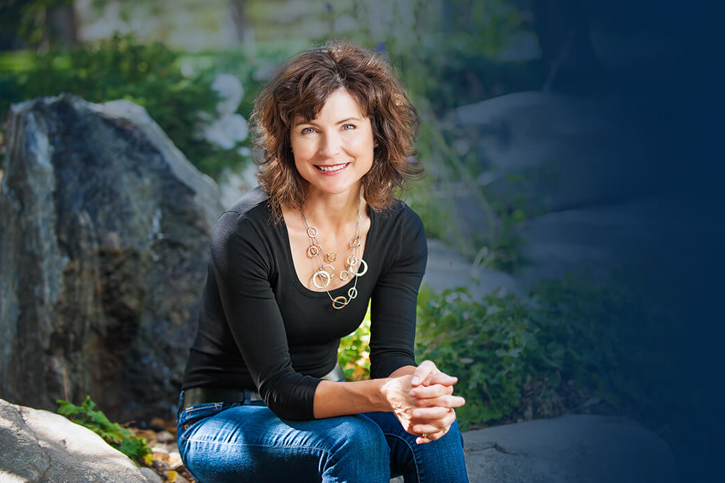
Nevada Sen. Heidi Seevers Gansert introduced SB 220, which would have expanded the state’s Opportunity Scholarship program and increased eligibility for 400% of the federal poverty line, children with disabilities and children o first responders.
This commentary from Valeria Gurr, a senior fellow for the American Federation for Children and a reimaginED guest blogger, appeared last week on thenevadaindependent.com.
During his State of the State address, Nevada Gov. Joe Lombardo pledged to increase funding and eligibility for Opportunity Scholarships, expand charter schools, create the Office of School Choice, and increase funding for public schools at a record number.
Legislators such as Sen. Heidi Seevers Gansert went to work introducing SB220, which would expand the Opportunity Scholarship program to serve approximately 6,000 students who cannot afford another educational option to attend schools of their choice if their current assigned public school is not working for them.
SB220 would also increase eligibility for 400% of the federal poverty line, children with disabilities and children of first responders. However, because Democrats in Nevada have control of both chambers and are vehemently against educational choice, SB220 was never set to get a hearing.
As a matter of fact, Democrats in the Silver State have continuously denied the Opportunity Scholarships a hearing and use education as a political pawn incessantly pointing at school choice as a way to defund public education — a talking point that could not be further from the truth.
Giving families 5% of options won’t defund public schools. Instead, it will bring opportunities to those who need them.
Enter Lombardo, a leader not afraid to go against the grain and willing to expend political capital for the children instead of accepting the status quo.
To continue reading, click here.

Texas Christian School in Houston, one of about 900 accredited private schools in Texas serving approximately 250,000 students, was established as a college preparatory school with an advanced curriculum to challenge eager minds based on a character development program.
Editor’s note: This article appeared Tuesday on Texas’ spectrumlocalnews.com.
With just about six weeks to go in the Texas legislative session, tensions are running high, and the gloves are coming off for two big issues dominating debate at the Capitol.
The House and Senate are split over how best to provide property tax relief to Texans and whether the state should use public money to let parents send their kids to private school.
During an interview on Capital Tonight Tuesday, Lt. Gov. Dan Patrick threatened to force a special session over the issues.
“I can’t call a special session, but I can create one by not passing a key bill that has to pass,” he said when asked about school vouchers. “If we don’t get some major priorities that people want us to pass because [the House] acted very slowly in the session, then I think we ought to finish the job. I’ll leave it at that.”
Only Gov. Greg Abbott can call a special session. But Abbott’s spent the past several months touring the state to build support for a voucher-like proposal.
The Senate passed legislation that would establish an education savings account program that would give parents up to $8,000 per student each year. The measure also makes an appeal to rural Republican lawmakers who have been reluctant to back vouchers since public schools are often the backbone of their community.
The Senate plan includes a provision for districts with fewer than 20,000 students to receive $10,000 each year for five years for every child who enrolls in the savings account program and leaves their district.
But the same day the Senate passed that measure, the House took a key vote during its budget debate to ban state funding for “school vouchers or other similar programs.” Still, a House committee has since considered proposals on the subject.
“I’m optimistic we’ll get a bill through. We’ll see what they send us,” Patrick said.
To continue reading, click here.
 Editor’s note: This commentary from Michael J. Petrilli, president of the Thomas B. Fordham Institute and a research fellow at Stanford University’s Hoover Institution, appeared Thursday on the Fordham Institute’s website.
Let me state at the outset that universal education savings accounts are not my cup of tea. I don’t love handing over taxpayer money to rich people who don’t need it. Like my colleague Chester Finn, I’m skeptical that states will exert effective quality control over the schools and vendors that participate in such programs.
I suspect that “hybrid homeschooling” and the like will remain a niche sector in American education, given how much work it creates for us (already overworked) parents. And I doubt the lowball amounts states are spending on these available-for-everyone ESAs will be enough to create a robust supply of high-quality options in the disadvantaged communities that need them most (and which I worry most about).
In my dream world, we’d instead take the school choice movement’s mojo and focus it on expanding high quality charter schools, bringing religious charter schools into the mix, and creating enrichment savings accounts with new money to help low-income and working-class families access afterschool and weekend opportunities for their kids, including intensive tutoring (along the lines of this federally-funded Ohio initiative).
Yet I’m still rooting for the universal ESA programs that are sweeping the nation. And that’s because I believe the odds are good that these initiatives will lead traditional public schools to improve.
If that logic sounds off, it’s because the “public school argument” is usually made to oppose such programs. The worry—and this is nothing new—is that such policies will enable the most advantaged students with the most clued-in parents to escape public schools, taking their tax dollars with them and leaving a more disadvantaged population of students behind in schools with fewer resources (financial and otherwise) than ever.
All of us should take such concerns seriously. Education is not a simple commodity, like a widget traded in the free market. What makes it complex, first and foremost, is the importance of students’ peers. Scholars have long found that “peer effects” matter—that kids learn more when certain types of students are in their classrooms and others are not.
We all understand this intuitively, too. It’s why we worry about segregation, celebrate “mainstreaming” students with disabilities whenever possible, and debate endlessly about various forms of grouping and tracking in our schools.
To continue reading, click here.
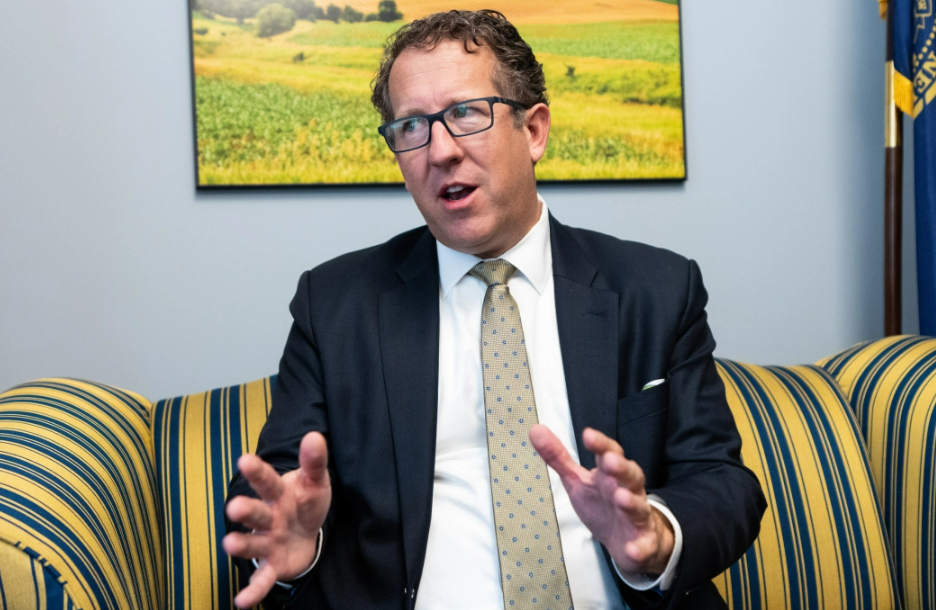
Rep. Adrian Smith, R-Nebraska, is a staunch supporter of the Educational Choice for Children Act, which would establish a tax credit scholarship program for students whose families make under 300% of their state’s median income.
Editor’s note: This article appeared Tuesday on edweek.org.
Republicans in Congress are pushing for school choice policies that allow parents to direct public funds to private schools, as education savings accounts, vouchers, and tax-credit scholarships gain momentum in GOP-dominated state legislatures.
Republican lawmakers in the U.S. House advocated for a slate of school choice policies throughout a two-hour Early Childhood, Elementary, and Secondary Education subcommittee hearing titled “School Choice: Expanding Educational Freedom For All” on April 18.
The push for expanded school choice goes hand in hand with a parallel Republican push for state and federal “parental rights” policies that allow parents a greater say in school curriculum, school library book selections, and more.
One of the policies touted at the hearing, the Educational Choice for Children Act, which Sen. Bill Cassidy, R-La., reintroduced in January alongside Reps. Adrian Smith, R-Neb., and Burgess Owens, R-Utah, would establish a tax credit scholarship program for students whose families make under 300 percent of their state’s median income.
The federal government would set aside $10 billion annually to fund tax credits for charitable donations to nonprofits that provide scholarships to K-12 students. That funding level would make it one of the largest federal education programs, behind Title I at $18.4 billion and special education at $15.5 billion.
Families could use the money to pay for private school tuition and tutoring programs, Smith said during the hearing.
“Parental involvement leads to better outcomes for students,” Smith said. “As legislators, we have a responsibility to encourage more parental involvement in education, not less. School choice is one way to do that.”
To continue reading, click here.
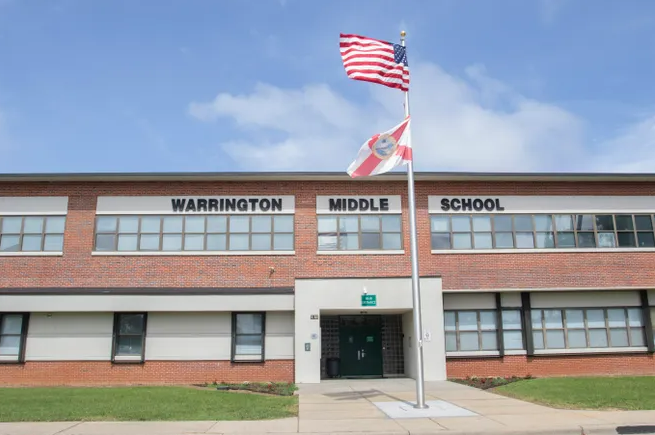
After years of failing grades, Warrington Middle School in Escambia County, Florida, received a D from the Florida Department of Education for the 2021-22 school year, leading the state Department of Education to issue an ultimatum to convert Warrington into a charter school.
Get it done. Now.
That was the firm directive that the Florida Board of Education gave Wednesday to Escambia County School District leaders who have yet to finalize a deal with a charter school company to take over struggling Warrington Middle School.
“I’m trying to contain the level of frustration that I have right now,” said Education Commissioner Manny Diaz Jr. “This school has been failing students for more than a decade, and it’s inexcusable that we’re still having adult conversations and not focusing on students.”
His comments followed an update showing that despite Warrington receiving D grades from the state since 2012, the Escambia County School District still has not finalized an agreement with Charter Schools USA to assume operations in 2023-24.
The state board said the school must be closed or turned over to a charter school partner if it did not receive at least a C grade. After a pandemic hiatus in grading, Warrington received a final grade of D in 2022. The state board then ordered the school closed or turned over to a charter for the 2023-24 school year.
District officials began negotiating in November with Charter Schools USA, which serves 75,000 students in five states. The 26-year-old charter school operator was the only organization to express interest in taking over the Title 1 school, where 80% to 90% of its approximately 600 students live below the federal poverty line.
The parties appeared to be headed toward a May 1 deadline to forge an agreement. However, negotiations hit a snag when district leaders said at an April 13 school board meeting that Charter Schools USA had sent a list of conditions for it to make a long-term commitment to the school.
Terms included a 15-year year contract between the district and Charter Schools USA and a 30-year contract with Charter Schools USA for control of the facility, with the charter organization paying the district $1 per year.
Additionally, new grade levels would be offered each year for the first four years under their control. Some of the grade levels would be zoned for the children living in the Warrington area, while others would be open to all students in the county. By the 2026-27 school year, Warrington would be a choice school for grades K-10, with no zoning.
School Board members expressed concern that a conversion to open enrollment would leave area students without a zoned neighborhood school, requiring them to be bused elsewhere.
Members also expressed concerns that handing over facility control for 30 years could put a future school board in a challenging position, especially because district school construction must meet state hurricane shelter standards. They further said they didn’t want to saddle a future board with debt if the charter company decides to leave.
Yet another concern was that Charter Schools USA had not submitted an application spelling out details of school operations.
Escambia Chairman Paul Fetsko assured state board members that the district is not anti-charter and sponsors nine “really good” charter schools.
“Our students are our number one priority,” he said. “We want them to learn wherever they can best be served. We want to work with Charter Schools USA, but the last-minute non-negotiables have been extremely difficult.”
However, Escambia school leaders garnered no sympathy from state officials, who called the concerns “excuses.”
Diaz said that as a state lawmaker, he included language in a bill that gave school districts flexibility from shelter requirements if the community already had enough shelter space so that should not be a concern.
State board Vice Chairman Ryan Petty criticized the district for expecting an application from Charter Schools USA, which it approved as a partner in the fall.
“So, you picked them and now you’re asking them to jump through bureaucratic hoops of an application? What’s the point?”
Petty said that during a tour of Warrington, he peeked into an eighth-grade classroom where algebra books sat on a shelf while a teacher’s lesson focused on basic arithmetic.
“You’ve been failing these students for over a decade,” he said.
Board member Esther Byrd said given the school’s poor performance, “Can you currently say to the parents of the children at Warrington Middle School that they’re succeeding, and they’re being taught because these numbers don’t say that. I don’t see how another option can be worse than what we have right now.
“This board has expressed a balance of urgency and grace, and I just want to say that as far as I’m concerned, we’re done with grace. So, we’ve got to get this done.”
Smith said the district is working hard to strike a deal.
“We’re not arguing; we’re not making excuses. What we’re saying is we need help getting this agreement across the finish line.”
State Board Chairman Ben Gibson called the repeated failure at Warrington “a bad dream” and said the district has little choice but to accept the terms.
“We’ve been desperate to get a charter operator in there,” he said. “Compromise is really the only option that we have. You don’t have a lot of negotiating power here.”
Charter Schools USA officials did not attend the state board meeting. However, Eddie Ruiz, the organization’s state superintendent, issued the following statement Wednesday to reimaginED:
“We were honored to be asked by the Escambia County School Board for help to turn around Warrington Middle School, which has been failing for decades. When we evaluated the significant problems at the school, we came up with a plan that points to the greatest opportunity for a successful turnaround.
“Unfortunately, the board found the terms to be unacceptable. We know what it takes to turn around failing schools, and we can implement those changes if we are given the ability to make them. One thing that is critical in this process is the cooperation and support of the authorizer, which we clearly do not have at this point.
“We believe all students deserve access to a high- quality education. At CSUSA, we have a relentless commitment to student greatness in school and in life.”
 Last week, I documented the sad decline of charter school laws passed since 2000 if you actually want laws to produce charter school seats. If you prefer to mostly go through the motions of having a “charter law” without many actual schools, or in Kentucky’s case any charter schools, then the post-2000 laws have been a rousing success.
Mistakes are not, however, limited to initial laws and a rediscovery of some guiding principles for charter schooling seems long overdue.
Adam Smith wrote: “People of the same trade seldom meet together, even for merriment and diversion, but the conversation ends in a conspiracy against the public, or in some contrivance to raise prices.”
He went on to explain that these conspiracies cannot succeed without the use of government. Thus, charter schooling fell under the sway of a Baptist and Bootlegger coalition and has been ailing ever since.

The Baptist and Bootlegger coalition aims not just to limit competition for district schools, but also competition for preexisting charter schools. Let’s simply observe that some charter organizations have a legal department to cut and paste sections of their last 800-page application into a new 800-page application. They can then assert, without any backing evidence mind you, that such an ability is an indicator of “quality.”
The charter movement, if vitality is to be regained, must rediscover a dedication to competition. Currently, parents are clamoring for new private school legislation and seem relatively indifferent to charter school legislation. Given that decades have passed since a state passed a charter law creating more than a mere smidge of charter school seats, one can hardly blame them.
Multiple sources of authorization constitute a key design feature of charter legislation, and one that charter advocates have inadequately communicated to legislators. For example, Oklahoma legislators are currently considering revamping their charter authorization practices. The legislation creates an alternative to school district authorization (which is good) but only creates one such alternative, which is not so good.
Oklahoma lawmakers will have to think deeper if they are to avoid the fate of lawmakers in Alabama, Kentucky, Mississippi, Washington and others who passed charter legislation only later to ask: Where’s the seats?
 Originally, the thought behind multiple authorizers was to stop the Baptists (in this case unions and their fellow travelers) from cutting off authorization. Now, charter advocates must guard against this and Bossy McBootleggerpants from undermining charter authorization.
It’s been two decades since a state passed a charter school law that managed to somewhat thwart the B/B coalition. Let’s hope Oklahoma will consider starting a new trend.
 Editor’s note: This analysis appeared Monday on the74million.org.
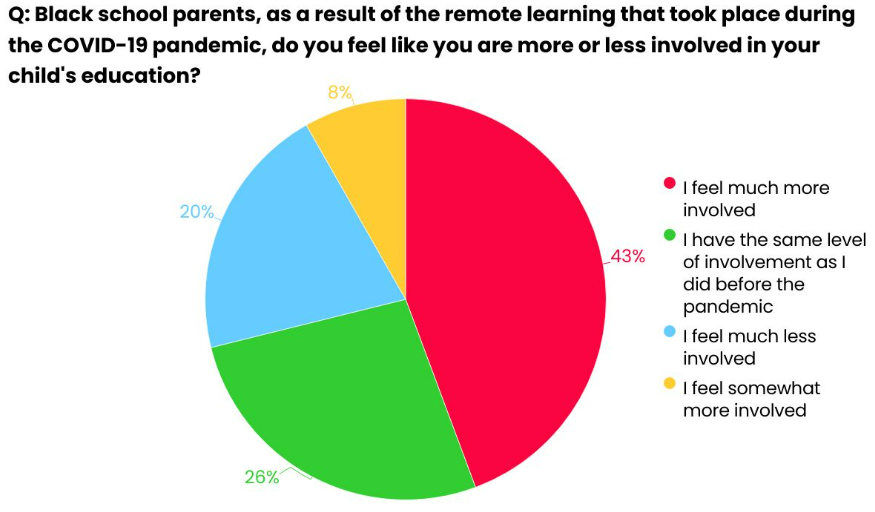
Black parents say they play a much more active role in their children’s education than they did before the pandemic, according to a new poll released this month. Large majorities look favorably on policies like private school vouchers and education savings accounts, and comparatively few want the K-12 experience to remain the same.
The results come from a survey of African American parents of school-aged children conducted by the research and polling company Morning Consult. Its findings, while capturing only a moment in time, may reflect educational preferences that have shifted significantly away from traditional public schools in the COVID era.
Morning Consult’s survey was administered to roughly 1,300 respondents across January and February on behalf of EdChoice, an Indianapolis-based advocacy group that backs school choice. During the pandemic, the organization has maintained tracking polls of parents and teachers on general perceptions of K–12 education. Black adults, including parents, have been included both in those ongoing efforts and in separate surveys as districts adjusted to the demands of remote instruction and virus mitigation.
Overall, 57% of respondents said they supported education savings accounts — a financial vehicle that offers families money to spend on educational costs of their choosing — even without being provided a description of their function. Even higher proportions supported school vouchers (62%), open enrollment of public schools (66%), and charter schools (68%).
Paul DiPerna, EdChoice’s vice president of research and innovation, said he found it notable that families’ attitudes toward such policies have remained “fairly stable” even as the circumstances surrounding schools have changed dramatically. In a similar poll conducted in the fall of 2021, for example, two-thirds of African American parents said that COVID had made them more open to the idea of homeschooling; 65% said they were supportive of homeschooling today.
“At the time [of the previous poll], the pandemic looked a lot different for parents and schools,” DiPerna said, invoking the Omicron wave that closed or severely disrupted schools in early 2022. “But some of these levels of support are still high for other modes of learning besides the traditional district school.”
To continue reading, click here.
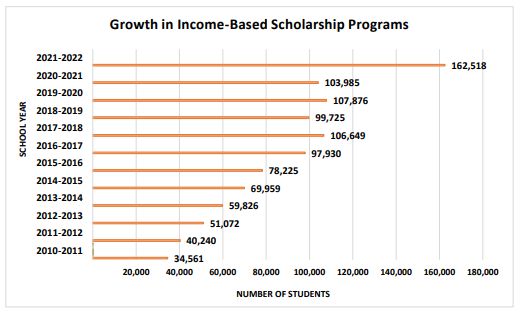 The number of Florida students participating in income-based scholarship programs served by Step Up For Students over the past 12 years has grown dramatically, from 34,561 in 2010-11, to 162,518 in 2021-22, according to a new report by Step Up For Students, the nonprofit scholarship funding organization that helps administer the scholarships and which hosts this blog.
The largest increase in Step Up students occurred between 2020-21 and 2021-22, however this was due to Step Up taking over stewardship of enrollment numbers of the Family Empowerment Scholarship for Education Options (FES-EO), a program that had previously been administered by the Florida Department of Education. Statewide enrollment for income-based scholarships increased from 142,716 to 162,518 when all sources of enrollment are included.
In the most recent year, a total of $1,715,159,524 was awarded to families from Step Up.
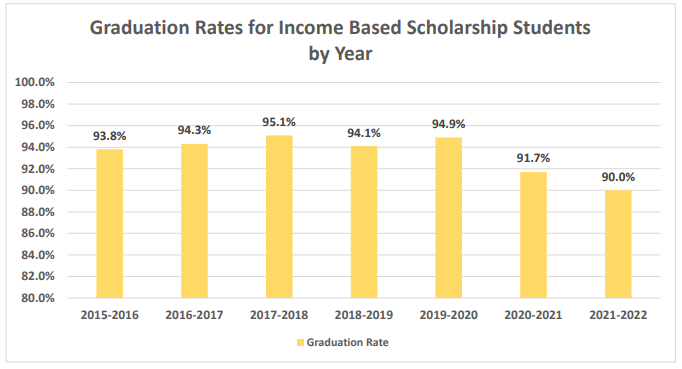
The annual end-of-year report looked at characteristics of private schools and enrolled students who received a Florida Tax Credit Scholarship or a Family Empowerment Scholarship for Educational Options through Step Up For Students, examining the distribution of private schools by various attributes and calculating graduation rates for 12th grade scholarship students enrolled in these schools.
Additionally, the report analyzed student demographics both in overall program enrollment and graduation rates.
Among the findings:
The graduation portion of the report was modeled after the National Center for Education Statistics’ biennial report, “Characteristics of Private Schools in the United States: Results from the 2019-2020 Private School Universe Survey.”
Data from the Florida Department of Education were utilized to examine these private schools along with data collected by Step Up For Students through school surveys. Data on religious affiliation were collected at the school level. Information about students’ gender, race/ethnicity, grade, single parent household status, poverty level, and graduation status were collected at the student level.
The survey received a 92.4% response rate.
*Edited to clarify that part of the growth in scholarships awarded by Step Up For Students was due to administrative changes in the FES-EO scholarship.

Renaissance Classical Christian Academy in Fayetteville, North Carolina, is one of 845 private schools in the state serving more than 123,000 students. Renaissance Classical Christian’s curriculum, known as the Trivium, is known for helping children learn and grow with measurable results comprised of three phases: the grammar stage, teaching young children knowledge; the logic stage, teaching teens understanding; and the rhetoric stage, teaching young adults wisdom.
Editor’s note: This article appeared Monday on carolinajournal.com.
Republicans have introduced a bill this session that would create education savings accounts in North Carolina. Here is a quick primer on what ESAs are, what other states are doing on this issue, and what could be on tap here in the Tar Heel State.
What are ESAs?
Education savings accounts are government-funded accounts controlled by parents that can be used for approved education expenses. ESAs shouldn’t be confused with a Coverdale ESA or a 529 account, both of which allow parents to fund education accounts using their own after-tax dollars and allow the investment to grow for tax-free withdrawals if the funds are used to pay for approved education expenses.
ESAs are one of the most ambitious forms of school choice because they exemplify the belief that education dollars should follow the child, not just fund a system.
What other states are doing
Six states have passed a universal ESA to date — Arizona, Arkansas, Iowa, Utah, West Virginia, and Florida. Here is more detail on the specifics of each ESA plan.
Arizona: This state’s Empowerment Scholarship Accounts are available to all students and are valued at around $7,000 each. Arizona became the first state to pass a universal ESA in 2022.
Arkansas: The Children’s Education Freedom Accounts were signed into law in March. The accounts will be phased in over two years until eventually becoming universally available to all students. The value of each account is based on 90% of the prior fiscal year’s per pupil allotment, which for the most recent year is around $6,600.
Iowa: This state’s ESAs became a reality in January and will fully kick in for all students by the 2025-2026 school year. The value is tied to the state’s per pupil allotment for public school students — around $7,400 for the current fiscal year.
Utah: The Fits All Scholarship account are valued around $8,000 per year. Although they are available to all students, priority is given to families to lower-income families before wealthier families have access to an account.
West Virginia: The Hope Scholarship is worth less than what other states offer — around $4,300 for the 2022-2023 school year.
Florida: The Sunshine State became the most recent state to enact a universal ESA after Gov. Ron DeSantis signed a bill into law in late March. Each ESA is worth around $8,700 a year, making Florida not only the largest state to enact an ESA, but also the most generous in the amount provided.
Several other states are either poised to pass ESAs or are on the cusp of expanding special-needs ESAs to all students.
To continue reading, click here.

