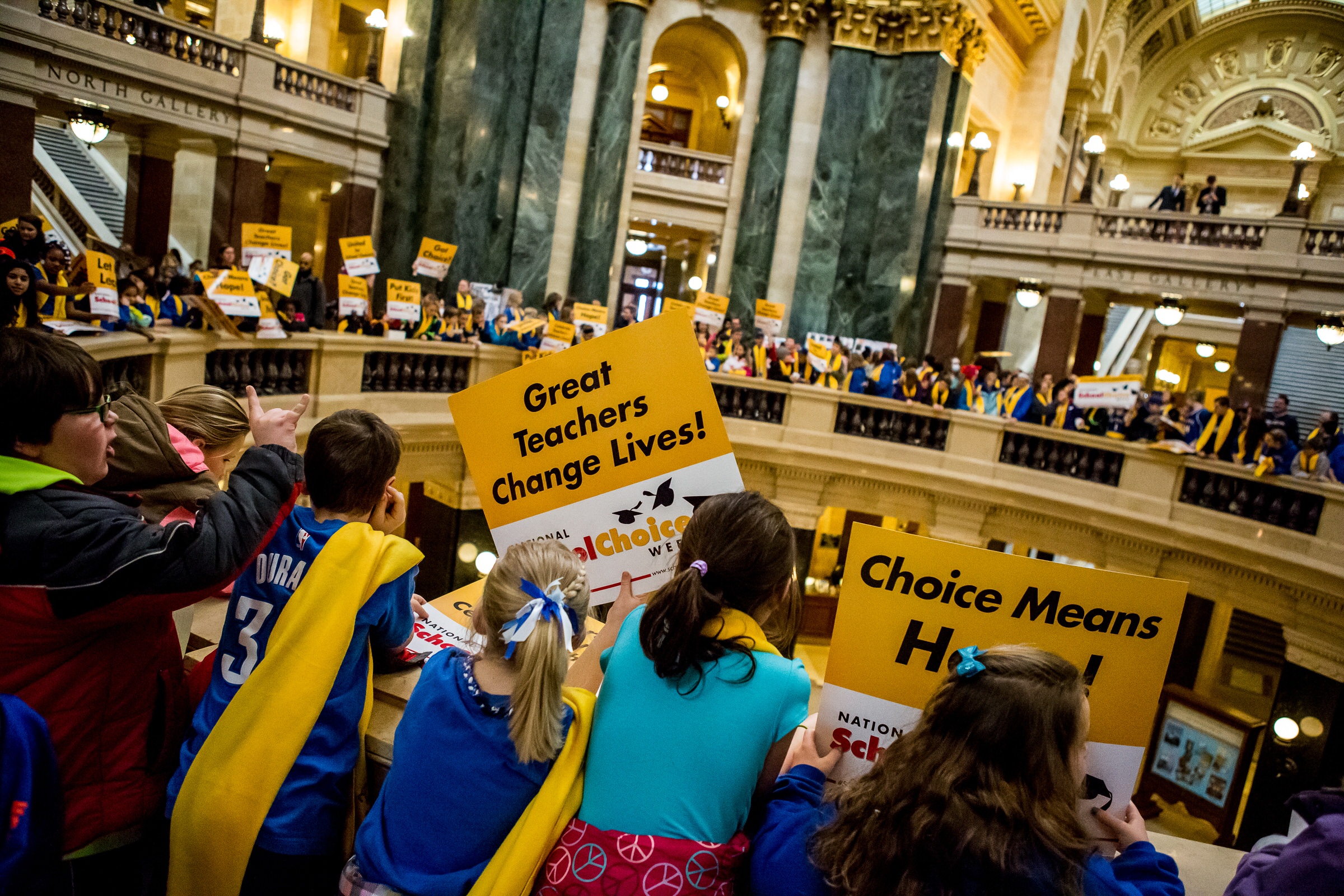
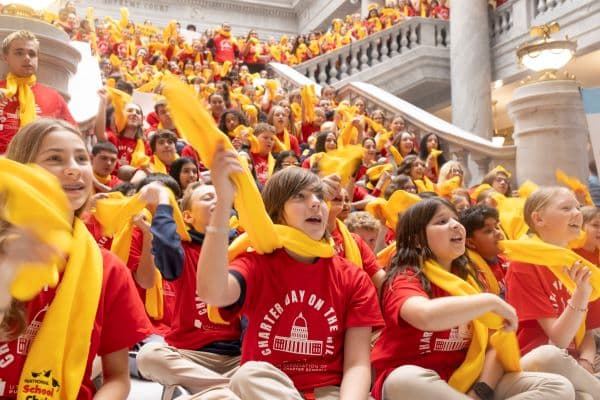
Wisconsin students celebrate National School Choice Week at the state capitol.
By George Mitchell
The parents of nearly 60,000 Wisconsin children choose to enroll them in one of the state’s private school choice programs.
Giving parents that choice is popular public policy. Polling shows voter support, across party lines, in all Wisconsin media markets.
Opposition is strong from the public education establishment and elected officials they support.
Exhibit A: Jill Underly, superintendent of the Department of Public Instruction (DPI). The Milwaukee Journal Sentinel reported earlier this year that “[S]he’d like to see the 35-year voucher program ultimately eliminated.”
Her position is directly at odds with the DPI’s ranking of schools. Official DPI Report Cards give the private schools higher marks despite funding at a fraction of public school levels,
A new analysis from School Choice Wisconsin (SCW) documents the striking productivity edge of private choice schools.
The SCW report relies solely on DPI data and uses conservative assumptions that negate possible school choice bias. For example, the report compares students from families with income eligibility limits with students from families of all incomes. Further, it understates a significant revenue advantage of traditional public schools by excluding federal aid.
The pioneering Milwaukee Parental Choice Program (MPCP) shows the greatest productivity advantage. While per pupil revenue in the Milwaukee Public Schools (MPS) is 38% higher than in MPCP schools, DPI’s Report Card ranking of MPS is 21% lower. See below.
| DPI Report Card Score (Scale 0-100) | Per Pupil Revenue | |
| MPCP* | 70.8 | $11,905 |
| MPS** | 55.7 | $16,442 |
* Eligibility limited to families at or below 300% of Federal Poverty Limit.
** MPS families of all income levels.
The following compares per pupil revenue and DPI Report Card scores for the Racine Parental Choice Program and the Racine Unified School District.
| DPI Report Card Score (Scale 0-100) | Per Pupil Revenue | |
| RPCP* | 72.7 | $11,905 |
| RUSD** | 61.3 | $14,629 |
* Eligibility limited to families at or below 300% of Federal Poverty Limit.
** RUSD families of all income levels.
Lastly, the following compares scores and revenue for the Wisconsin Parental Choice Program (students outside Milwaukee and Racine) with schools outside of Milwaukee and Racine.
| DPI Report Card Score (Scale 0-100) | Per Pupil Revenue | |
| WPCP* | 71.8 | $11,905 |
| Statewide Public** | 69.8 | $15,340 |
* Eligibility limited to families at or below 220% of Federal Poverty Limit.
** Families of all income levels. Excludes MPS and RUSD.
The SCW findings reinforce a 2019 study by Corey DeAngelis, Ph.D., a scholar whose research has appeared in: Social Science Quarterly; School Effectiveness and School Improvement; Educational Review; Peabody Journal of Education; Journal of School Choice; and Journal of Private Enterprise.
Separate scholarship, by Patrick Wolf, Ph.D., and DeAngelis, examined the effects of Milwaukee’s parental choice program on adult criminal activity and paternity suits. They found that “exposure to the program … is associated with a reduction of around 53 percent in drug convictions, 86 percent in property damage convictions, and 38 percent in paternity suits. The program effects tend to be largest for males and students with lower levels of academic achievement at baseline.”
A study for the Annenberg Institute at Brown University found: “As of 2018, [Milwaukee choice] students have spent more total years in a four-year college than their MPS peers. The MPCP students in the grade three through eight sample attained college degrees at rates that are statistically significantly higher than those of their matched MPS peers.”
George Mitchell is a School Choice Wisconsin volunteer.
References
DeAngelis, C.A. (2019, May 14). A wise investment: The productivity of public and private schools of choice in Wisconsin. School Choice Wisconsin. https://schoolchoicewi.org/news/research/return-on-investment/
DeAngelis, C.A., & Wolf, P.J. (2019, February 26). Private school choice and character: More evidence from Milwaukee. School Choice Wisconsin. https://schoolchoicewi.org/wp-content/uploads/2022/08/Private-School-Choice-and-Character-More-Evidence-from-Milwaukee.pdf
Meyerhofer, K. (2025, March 28). Wisconsin superintendent calls for cutting school choice. Her opponent is mum on program expansion. Journal Sentinel.https://www.jsonline.com/story/news/education/2025/03/28/wisconsin-superintendent-jill-underly-calls-for-cutting-school-choice/82652247007/
School Choice Wisconsin. (2023, August 30). The cost-effectiveness of Wisconsin’s private school choice programs. https://schoolchoicewi.org/wp-content/uploads/2023/08/The-Cost-Effectiveness-of-Wisconsins-Private-School-Choice-Programs.pdf
School Choice Wisconsin. (2025, August 12). Wisconsin’s Most Cost-Effective K-12 Platform. https://schoolchoicewi.org/wp-content/uploads/2025/08/Wisconsins-Most-Cost-Effective-K-12-Program.pdf
Wisconsin Department of Public Instruction. (2024, November 19). School & district report cards. https://apps2.dpi.wi.gov/reportcards/
Wolf, P.J., Witte, J.F., & Kisida, B. (2019, August 12). Do Vouchers Students Attain Higher Levels of Education? Extended Evidence from the Milwaukee Parental Choice Program. https://edworkingpapers.com/sites/default/files/ai19-115.pdf

**SPOILER ALERT! DO NOT READ IF YOU ARE UNDER THE AGE OF 8**
Western cultures, for some strange reason, involve rituals where we pretend that various “fairy creatures” exist, particularly with children: the Tooth Fairy, a jolly old elf with flying reindeer who brought me an awesome Big Wheel in 1973, egg and goody hiding rabbits, etc. When I became a parent, I played along with these rituals, but then at some point questioned why I was doing it. On the one hand, I didn’t want my children to be those killjoy types who went around bursting the bubbles of other kids. On the other hand, I did not want to train my children not to trust me. I decided to allow the “fun” to go on until they each reached a certain age, then to explain to them that these things are traditions and that it would be best to allow their friends to figure it out on their own.
So, dear reader, I assume that you have reached a certain age and that you are prepared to know the truth about the last fairy creature. Belief in this one tends to persist much longer than the others and is alas, more detrimental. Sorry to be a killjoy, but here goes:
Philosopher kings are not real.
This was my main thought upon reading Mike McShane’s recent entry in a debate about school choice regulation. Go read it. I’ll wait here.
Go on…
Okay, good. My favorite part involved the Gilded Age meat baron, but McShane made several crucial points. Local school boards, state governments and the federal government all regulate public schools in a very active fashion. I could produce multiple graphs from NAEP, PISA, etc., showing what a pig’s breakfast American academic achievement has become, but you have already seen them, so I will spare you. Why are American schools so wretched despite so much regulation? Oh well, that is simple: regulation is not made by philosopher-kings but rather by politics. Politics has an amazingly consistent record of fouling things up.
The philosopher-king fairies, invented by Plato, are a specially trained and educated aesthetic elite who, disinterested in fame or wealth, love only wisdom and justice. Having thus earned the right to rule over us lesser mortals, we proles should feel deferential and deeply grateful for their sacrifice. Again, sorry to burst your bubble, but these people do not exist in the real world. Out here in the real world, mere humans with all kinds of motivations (political and otherwise), limits to their knowledge, greed, stupidity and other normal human failings create regulations. Those of us fortunate enough to live in a democracy get the chance to throw the bums out when we’ve had enough. Just in case you haven’t noticed, a major subtext of politics these days involves bums that voters can’t throw out.
Politics, not philosopher-kings, runs regulation, and politics runs on self-interest far more than on benevolent technocratic wisdom. Choice programs must cope with powerful organized interests that yearn to use regulation as a tool to domesticate choice opportunities and find it in their self-interest to do so. The default position of choice supporters should therefore be to view the calls for regulation with a deep skepticism; it is not paranoia when people really are out to get you.
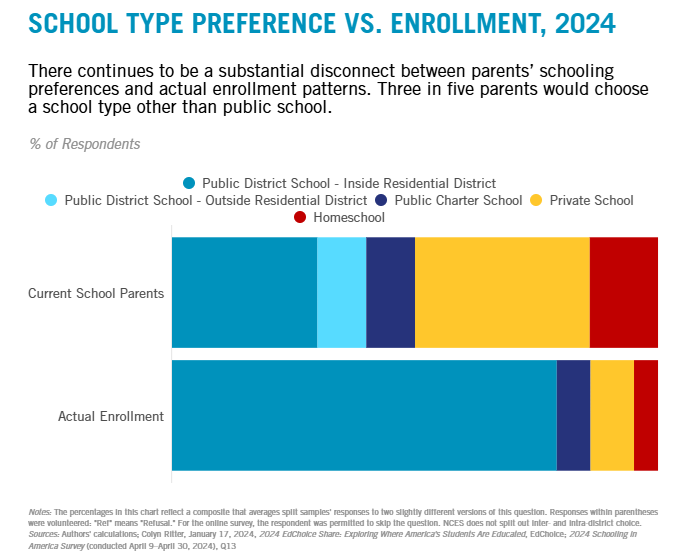
None of this is to say that it is possible to pass choice legislation without regulation; it is not. I am not aware of any program anywhere that operates without some degree of regulation. American parents, however, want a radically different K-12 system than the one government forces them to pay for (see above). The way forward is to allow families to partner with educators to sort through new schools and education methods. Heavily regulated choice systems might get to something close to the K-12 system parents want and deserve before the heat-death of the universe, but then again, they might not.
America’s founders fought a grueling war against the most powerful country in the world based upon what was then a radical idea, that people could live better without royalty to boss them around. The divine right of kings was another myth humanity needed to grow up and discard, and that should include philosopher-kings.

Last week, the Heritage Foundation released a study from yours-truly called From Mass Deception to Meaningful Accountability: A Brighter Future for K–12 Education. The basic argument: the good intentions of the No Child Left Behind era were completely undermined by opponents, who both defanged state rating systems and tamed charter school laws. On the first assertion, I offered charts like:

Ooof, and even worse this comparison between Arizona’s school grades in Maricopa County and GreatSchools private ratings for schools within 15 miles of Phoenix (the closest approximation on the GreatSchools site) after converting the GS 1-10 ratings onto a A-F scale:
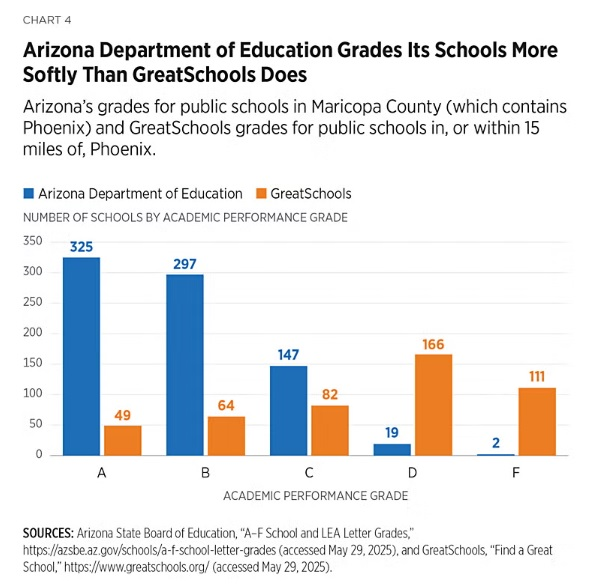
Charter schools always and everywhere had waitlists, ergo, accountability amounted to “trophies for everyone” state systems and charter school sectors that never matched demand with supply. Take a look at the above chart, however, and you’ll see that GreatSchools is a much, much tougher grader than the state of Arizona. The usual suspects have a much tougher time undermining private rating organizations, and they gather reviews (which research shows families value). Ergo the backgrounder makes the argument that we should not rely upon state rating systems in preference to the already superior, more trusted and versatile private efforts. Furthermore, we should expand rating systems into the broader universe of education service providers active in today’s ESA and robust personal use tax credit programs, specifically to gather reviews accessible to families for purposes of navigating the wide world of choice, which we need much more of.
Okay so a couple of reader requests. First, I was asked if I could create something like the Phoenix chart for a district in Florida. I chose Miami:

So not as much of a contrast as Arizona but…if I were looking for a school in Miami, I would look at GreatSchools.
Next, I received a request about this chart from Sandy Kress:

Putting the NAEP improvement numbers in context: In the 2024 NAEP, the total across the four mathematics and reading exams between the highest scoring state (MA) and the lowest scoring state (New Mexico) was 10%. So, the nation-leading 5% improvement in Mississippi scores should be seen as meaningful. Sandy asked me to look at an earlier period from the mid-1990s until 2011 rather than the 2003 to 2019 period, as his contention was that that period saw a lot more academic improvement before the federal law was defanged on a bipartisan basis during the Obama administration.
All states began taking NAEP in 2003, so stretching back to the 1990s loses a number of states. Also, 1996 didn’t include the two reading tests, so I substituted 1998. Nor can we automatically attribute the trends exclusively to standards and accountability (other things also going on), but Sandy is correct that NAEP showed a lot more academic improvement during those earlier years:
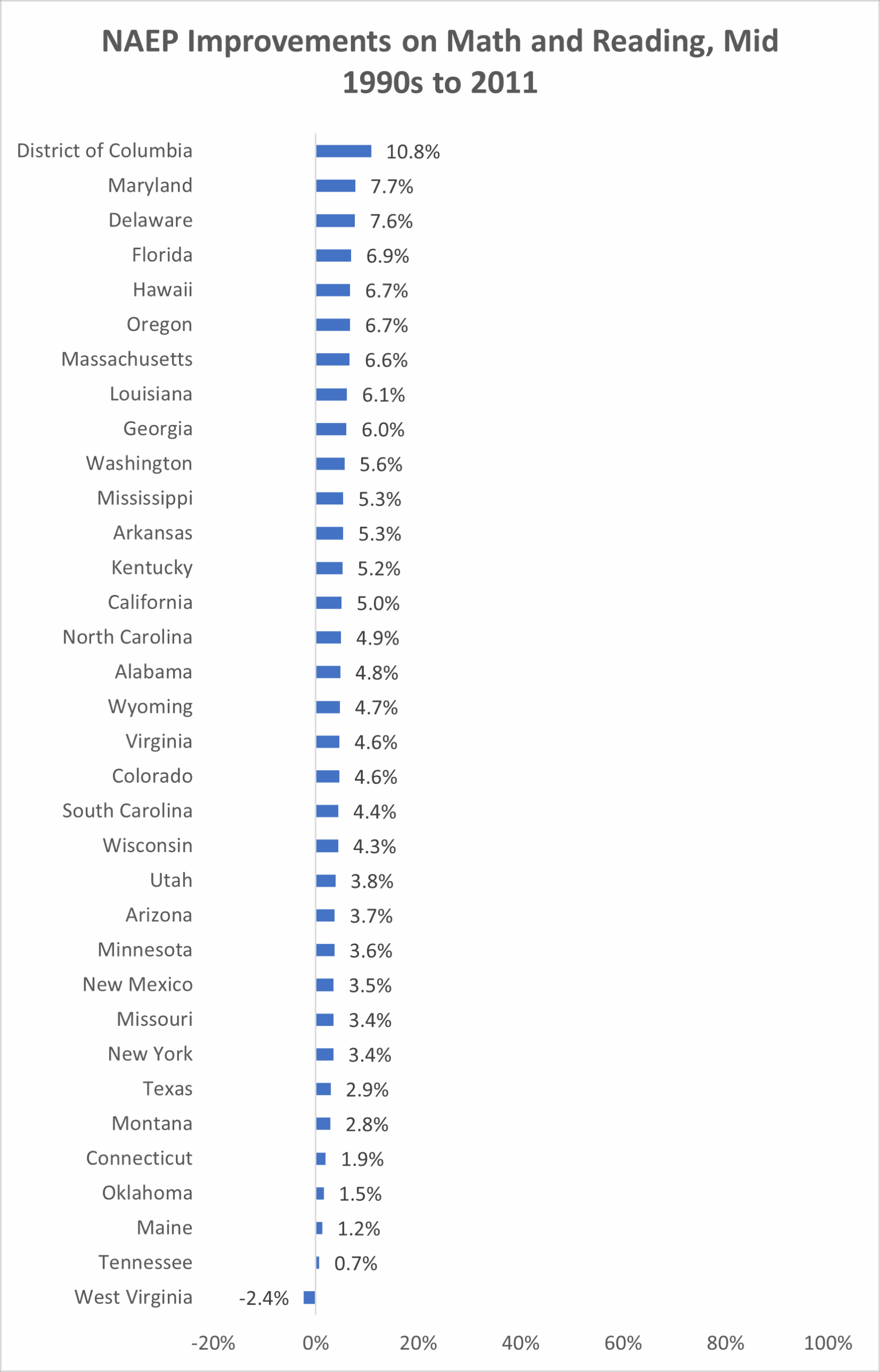
Accountability hawks/the federal government may have indeed coaxed more productivity out of the public school system. Then on a bipartisan basis, Congress removed federal pressure (passed the Senate 85-12 and the House 359-64). Subsequently a large majority if (perhaps?) not every single state merely went through the motions of “accountability” with trophies for (almost) everyone. Kress can justifiably look at these data to claim, “the juice is worth the squeeze” and I can look at the same data to say, “academic transparency is too important to leave to politicians and their appointees.”
Franklin Roosevelt noted ““It is common sense to take a method and try it. If it fails, admit it frankly and try another. But try something.” Every state in the union remains entirely free to adopt tough accountability practices, but apparently few if any have chosen to do so. The next something to try in my opinion are enhanced private rating systems and robust choice programs. Temporarily semi-tough accountability systems run by states and charter school waitlists ultimately proved to be a strategy with limited political sustainability.
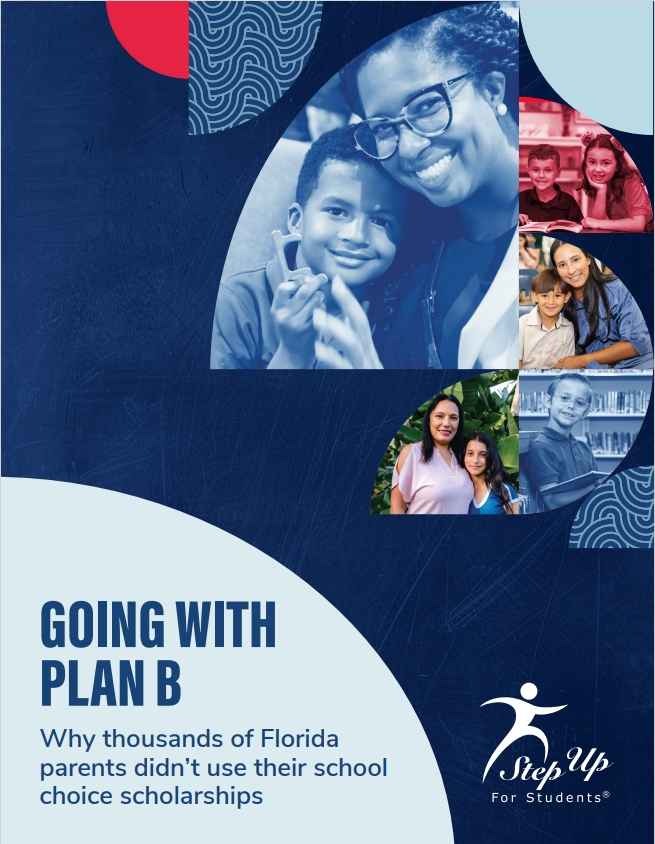
By Ron Matus and Dava Cherry
Florida’s choice-driven education system is the most dynamic and diverse in America, but it’s facing new tests. This year, 41,000 Florida students were awarded school choice scholarships but never used them.
We wanted to know why, so we surveyed their parents.
The 2,739 who responded had a lot to tell us. Not only about supply-side challenges, but about the extent to which families are migrating between different types of schools, and their expectations for finding just the right ones.
As education choice takes root across America, we thought other states could learn from these parents, which is why we boiled their responses down into a new report, “Going With Plan B.”
We saw three main takeaways:
A third of the respondents (34.7%) said there were no available seats at the school they wanted. This, even though the number of Florida private schools has grown 31% over the past 10 years. Meanwhile, a fifth of the respondents (19.7%) said the scholarship amount wasn’t enough to cover tuition and fees.
Even without scholarships, a third of the respondents (36.5%) switched school types (like going from a traditional public school to a charter school). And between their child’s prior school and the school they ended up in, more experienced a positive rather negative shift in satisfaction (20.4% to 10.5%). We didn’t see that coming.
Two thirds of the respondents said they’d apply for the scholarships again, including 63% of those who switched school types, and 55.5% of those who were satisfied after doing so.
Things got better, it seems, but not better enough.
Perhaps as choice has grown, so too have parents’ expectations.
See the full report here.
Dava Cherry is the former director of enterprise data and research at Step Up For Students, and a former public school teacher.
A recent interview by Tyler Cowen of John Arnold has been making the rounds in ed reform circles, see Michael Goldstein’s write up here. Here is a taste of the interview:
Tyler Cowen: There’s a common impression—both for start-ups and for philanthropy—that doing much with K–12 education or preschool just hasn’t mattered that much or hasn’t succeeded that much. Do you agree or disagree?
John Arnold: I agree. I think the ed reform movement has been, as a whole, a significant disappointment. I think there have been isolated pockets of excellence. It’s been very difficult to learn how to scale that. I think that’s largely true of many social programs or many programs that are delivered by people to people, that you can find a single site that works extraordinarily well because they have a fantastic leader, and that leader might be able to open up a few more sites. But then, when you start to scale it to 50 sites, and start to go across the nation, it all mean-reverts back to what the whole system is providing.
“We’re a dispirited rebel alliance of do-gooders,” Goldstein writes gloomily, but the underlying premises deserve scrutiny, as it strikes me as entirely too pessimistic. Let us for instance look at the academic growth rates for charter schools in Arnold’s home state of Texas as recorded by the Stanford Educational Opportunity Project. Each dot is a Texas charter school, and green dots on or above the zero line display an average rate of academic growth at or above having learned one grade level per year:

This chart deserves a bit of your time to marvel at. While receiving far less total taxpayer funding per student, the Texas charter sector has not only created a large number of schools with high academic growth, but they also place competitive pressure on nearby district schools to improve their academic outcomes. Texas charter schools have not cured the world’s pain, nor have they dried every tear from our eyes. It is hard for me, however, to view it as anything other than a tremendous academic success, and Texas is not alone. Here is the same chart for charter schools in Arizona:
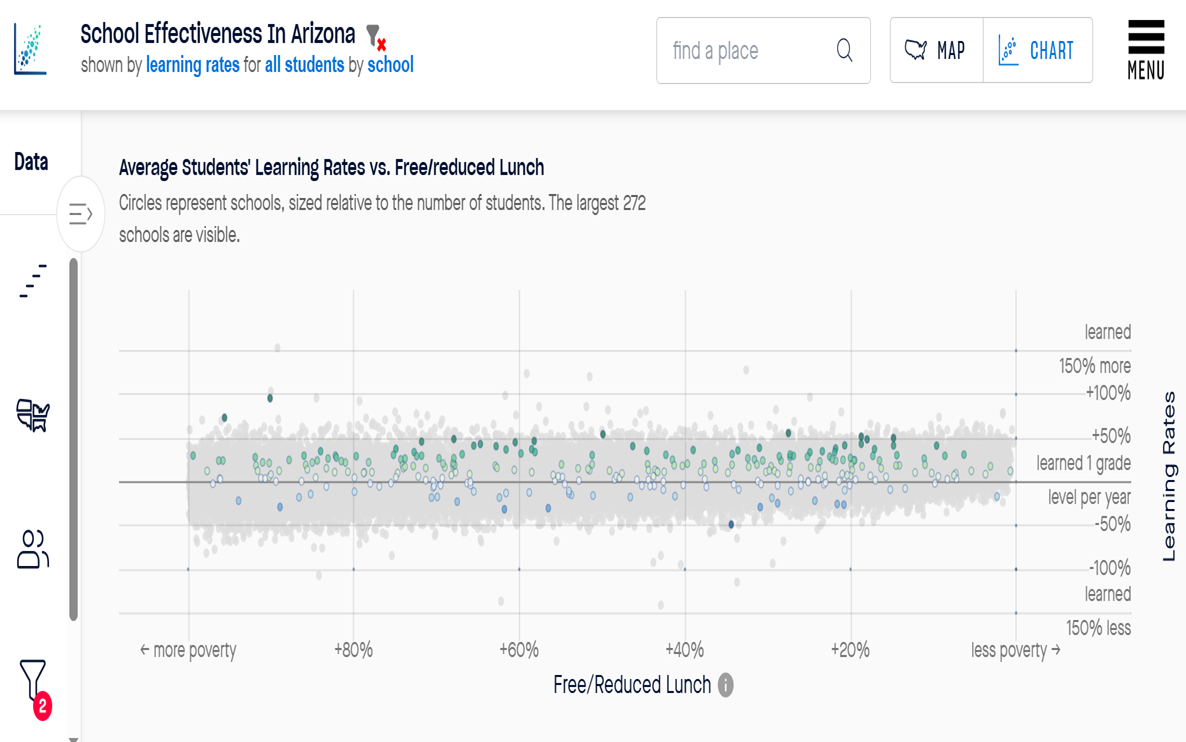
Again, we see far more high academic growth green-dot schools than low academic growth blue-dot schools. Once again, this sector is a bargain for taxpayers, and the sector placed competitive pressure on districts to improve. By the way, Arizona has a larger number of charter schools in low-poverty areas than Texas. That helped crack open high-demand district schools to open enrollment, which is why a real Fresh Prince can go to school in Scottsdale but not in Bel Air or Highland Park in Texas, which opened a vast new supply of choice seats in school districts. The do-gooder rebel alliance, it turns out, made a serious political and educational error when they effectively in a variety of ways excluded suburban areas.
You live and (hopefully) learn. Speaking of Bel Air, behold the magnificence of the academic growth of California’s charter school sector:

Oh, and then there is the 2024 NAEP to consider:

If you do not live in a state whose name starts and ends with the letter “o” you are likely to be happy with your charter sector’s performance vis-à-vis districts, which admittedly, is a low bar. Of course, all this data is messy and neither the growth measures developed by Stanford nor the NAEP proficiency data above capture long-term outcomes- such as do schools produce good and productive people who are well-prepared to exercise citizenship. We are looking through a glass darkly.
The do-gooder education reform alliance should indeed take stock of which efforts produced meaningful results, and which proved to be costly quagmires, and recalibrate their efforts accordingly. To paraphrase the Bard: the education reform movement has 99 problems, but the inability to scale success in choice programs ain’t one.
David Osborne recently predicted academic doom for red states having recently passed universal private choice programs. “This will accelerate the process of the rich getting richer while the poor fall further behind,” Osborne asserted. Osborne problematically ignored our nation’s actual experience with universal choice programs, making his column more a litany of faith than a clear-eyed analysis.
Osborne predicts a bleak future for states with universal private choice programs, with poor families left behind. Osborne prefers a charter school model of choice, keeping choice within the public realm of regulation and accountability:
"Is there an alternative, other than the status quo of struggling public school systems? Indeed there is. States and school districts could reduce bureaucratic controls, empower educators and increase choice, competition and accountability for performance within the public school system, through the spread of charter schools. Cities that have done so, including New Orleans, Washington, D.C., Denver and Indianapolis, have produced some of the nation’s most rapid improvements in student performance."
Arizona lawmakers created the first universal private choice program in 1997, the nation’s first scholarship tax credit program. Decades passed before another state enacted a private choice law with equally expansive eligibility. Three years earlier, in 1994, Arizona lawmakers had created two de facto public universal choice programs in the nation’s most robust charter school law and a statewide district open enrollment statute. “Large” and “relatively lightly regulated” would accurately describe Arizona choice programs, both public and private. Arizona lawmakers expanded and supplemented scholarship tax credits repeatedly; the Arizona charter sector became the largest among states, and open enrollment between and within districts dwarfed both in combination. Arizona created the nation’s first education savings account program in 2011 and expanded eligibility several times before making it universally available to Arizona K-12 students in 2022.
Given Osborne specifically cites four jurisdictions with the sort of choice programs of which he approves- Denver, Washington D.C., New Orleans, and Indianapolis, it seems in order. The Stanford Educational Opportunity Project provides academic growth data by jurisdiction (schools, counties, and states) and student subgroups for the 2009-2019 period. Comparing the rate of academic growth for low-income students in each of these four jurisdictions with those of Arizona counties in Figure 1:

Academic growth is a very important academic measure. While raw scores are very strongly correlated with student demographics, growth is much less so. Scholars widely view academic growth as the best measure of school quality. Many years into exposure to universal choice programs, Arizona’s low-income students seemed to be too busy learning to suffer Osborne’s predicted calamities. Greenlee County is a rural and remote area of Arizona with approximately 1,500 students and (alas) no charter or private schools during the period covered by the data. In this measure, a “zero” basically entails having learned a grade level worth of material per year on average, so the performances for Denver, DC and Orleans Parish are respectable, Marion County (host county of Indianapolis) less so.
The Stanford Educational Opportunity Project also measures the gap in learning rates by subgroup, which is measured by subtracting the learning rate of poor students from that of non-poor students. The four jurisdictions lauded by Osborne ranked first, second, third, and fifth in comparison to Arizona counties in terms of the amount of learning rate inequality between poor and non-poor students. There was exactly one state that had a positive rate of academic growth for both poor and non-poor students and had a faster rate of academic growth for poor students. It is the state marked “1” and spoiler alert…it is Arizona, the host of multiple universal choice programs.

Osborne’s hypothesis held that what some would regard as wild, lightly regulated “let it rip” choice programs would prove to be a disaster for low-income students, and conversely, well-regulated choice programs should advantage the poor. In practice, however, we find evidence to support the opposite conclusion. These results would not have surprised Milton Friedman in the least:

The results in the above figure also sit comfortably with the diagnosis of John Chub and Terry Moe, who identified politics as the central flaw of the American public school system. The American public school system does not do a terrific job on average in educating students, but it does a fantastic job in maximizing the political power and revenue of employee unions and their associated fellow travelers. Attempting to set up a governance structure of politically disinterested technocrats who will give families just the right amount of freedom and just the right amount of regulation comfortable for technocrats is an appealing theory. In practice, the most powerful and reactionary forces in modern American politics hijack the project easily unless a powerful, supportive constituency rises to defend the programs.

Keith Jacobs II, affectionately called "Deuce," with his parents, Keith and Xonjenese Jacobs. Photos courtesy of the Jacobs family
When our son Keith — affectionately known as “Deuce” — was diagnosed with autism spectrum disorder at age 3, we were told he might never speak beyond echolalia (the automatic repetition of words or phrases). Until age 5, echolalia was all we heard.
But Deuce found his voice, and with it, a unique way of seeing the world.
He needed to find the right learning environment, with the assistance of a Florida education choice scholarship.
Deuce spent his early academic years in a district public school, supported by an Individualized Education Plan (IEP). Despite the accommodations, learning remained a challenge. We realized that for some, a student’s success requires more than paperwork. It requires community, compassion, and collaboration with the parents.
Imagine having words in your head but lacking the ability to communicate when you need it most. That was Deuce’s experience in public school. His schools gave him limited exposure to social norms and rigor in the classroom. Additionally, through his IEP, he always needed therapy services throughout the school day, which limited his ability to take electives and courses he enjoyed.
His mother and I instilled the importance of having a strong moral compass and working hard toward his social and academic goals. Although we appreciated his time in public school, we knew a change was needed to prepare him for post-secondary education. We applied and were approved for the Family Empowerment Scholarship for Students with Unique Abilities.
Knowing the potential tradeoffs of leaving public school and the IEP structure behind, we chose to enroll Deuce at Bishop McLaughlin Catholic High School in Spring Hill, about 35 miles north of Tampa. We believed the nurturing, faith-based environment would help him thrive. It was the right decision.
Catholic school provided Deuce with the support he needed to maximize his potential. Despite his autism diagnosis, he was never limited at Bishop. He was accepted into their AP Capstone Program. This was particularly challenging, but Bishop was accommodating. The school provided him with an Exceptional Student Education (ESE) case manager dedicated to his success, and he received a student support plan tailored to his diagnosis and learning style. The school didn’t lower expectations; instead, it empowered him to take rigorous coursework with the right guidance.
Any transition for a child with autism will take time to adjust. On the first day, I received a call: Deuce had walked out of class. This was due to his biology teacher using a voice amplifier. The sound overwhelmed Deuce’s senses, and he began “stimming”— rapidly blinking and tapping his hands. Instead of punishing him or ignoring the issue, the staff immediately reached out.
Together, we crafted a Student Success Plan tailored to Deuce’s needs, drawing from his public school IEP without being bound by it. His plan included preferential seating, frequent breaks, verbal and nonverbal cueing, encouragement, and clear direction repetition. For testing, he was given extended time, one-on-one settings, and help understanding instructions.
These adjustments made all the difference.
Throughout high school, Deuce maintained a grade-point average of over 4.0 while taking honors, AP, and dual enrollment courses. Additionally, he was inducted into the National Honor Society and Mu Alpha Theta Math Honor Society while also playing varsity baseball. Because of his success at Bishop, he will continue his educational journey at Savannah State University, where he will major in accounting and continue to play baseball.

Deuce Jacobs earned an academic scholarship to Savannah State University, where he plans to major in accounting and continue playing baseball.
Catholic schools in Florida increasingly are accommodating students with special needs. The state’s education choice scholarship programs have been instrumental in making Catholic education available to more families. Over the past decade, during a time when Catholic school enrollment has declined across much of the nation and diocesan schools have been forced to close, no state has seen more growth than Florida.
At the same time, the number of students attending a Catholic school on a special-needs scholarship has nearly quadrupled, from 3,004 in 2014-15 to 11,326 in 2024-25. Clearly, many families are choosing the advantages of a private school education without an IEP versus a public school with an IEP.
So, I’m puzzled why federal legislation being considered in Congress, the Educational Choice for Children Act (ECCA), includes a mandate that that all private schools provide accommodations to students with special education needs, including those with IEPs.
Although more and more students with special needs are accessing private schools, not every school can accommodate every student’s unique needs (which is also true of public schools). And, as I learned with Deuce, some schools can accommodate students more effectively if they aren’t bound by rigid legal mandates and have the flexibility to collaborate with parents who choose to entrust them with their children’s education.
If the IEP mandate passes, it would prohibit many schools from accepting funds through a new 50-state scholarship program, undermining the worthy goal of extending educational choice options to more families. The U.S. Conference of Catholic Bishops has called it a “poison pill” that would “debilitate Catholic school participation.”
Bishop McLaughlin’s willingness to partner with me as a parent not only allowed Deuce to succeed academically but also gave him the dignity and respect every child deserves. IEPs work for many. For others, like Deuce, it takes something more like collaboration to build a path forward together.

Longtime NextSteps readers know that your humble author has been holding forth on the Baptist and Bootlegger problem that helped throttle the growth of the charter school movement. The term “Baptists and Bootleggers” comes from economics and references prohibition, which Baptists supported out of religious conviction, and bootleggers supported to limit competition in their manufacture and sale of alcohol. In the context of charter schools, it describes how elements of the charter school movement, in this case large charter management organizations, or CMOs, partnered with the anti-charter usual suspects to limit competition through 900-page applications and charter laws hewing closely to sponsored “model” bills that mysteriously produced few charter schools. This, of course, was not the only problem to afflict the charter movement in recent years; see Robert Pondiscio’s recent account for example.
In 2024, I sounded the alarm that the private school choice movement was far from immune to this danger. Alas, Bootleggers’ tactics have indeed appeared in recent school choice legislation. For example, Iowa’s “ESA” law requires students who choose to spend their funds on private school to attend an accredited one. The new Texas legislation makes only accredited private schools eligible, and in a late amendment, a provision was added that requires private schools to have been operating for two years before becoming eligible to participate. Competition is apparently good for Texas public schools, but not terribly desirable for established private schools in Texas. Sigh. Stay on the lookout; accredited Texas private schools that have been operating for more than two years might just start selling some illicit liquid products at their bake sales...

There are other examples, but you get the point. Why does this matter? Well, if you stimulate demand for a product but restrict the supply of new entrants, you hang a sign on your back that says:

Luckily, this does not need to be the case, but the devil is in the details of bill design. Some make the mistake of assuming any choice program will automatically lead to cost inflation, but this is not the case if supply can rise to meet expanded demand. EdChoice has a new study out on the supply side of school choice, in which they examined the purchasing data from Arizona’s ESA program for years one and two of universal eligibility. Arizona’s ESA program had a very large increase in participation during these years. Without a corresponding increase in schools and vendors, cost inflation could get underway.
Fortunately, Arizona’s program saw a healthy increase in the supply of new schools to accompany expanded eligibility:

Not only did the number of participating schools increase from 510 to 661, but Arizona also saw broad increases in the types of schools accessed by families, including large increases in private religious schools, non-religious private schools, special education focused schools, co-ops and post-secondary schools. Baptist and bootlegger anti-competitive provisions would have prevented this flourishing, but fortunately, Arizona lawmakers wisely avoided it. When the Goldwater Institute examined private school tuition trends after the universal expansion, they found no evidence of a demand induced inflationary spiral.
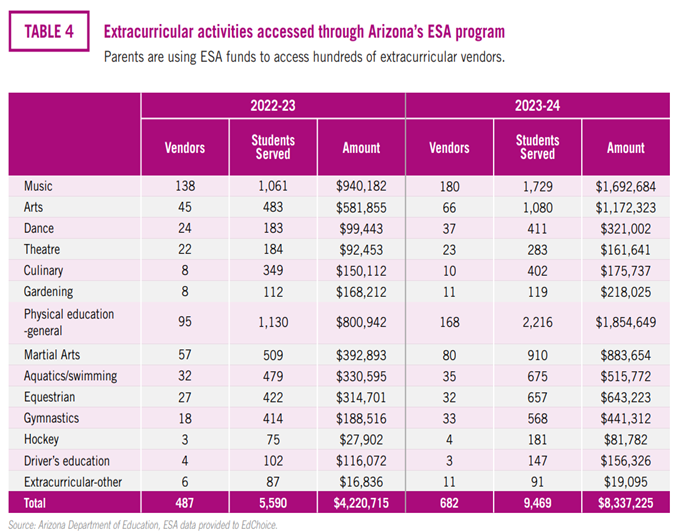
Arizona vendors other than schools also increased their participation in the program, increasing competition.
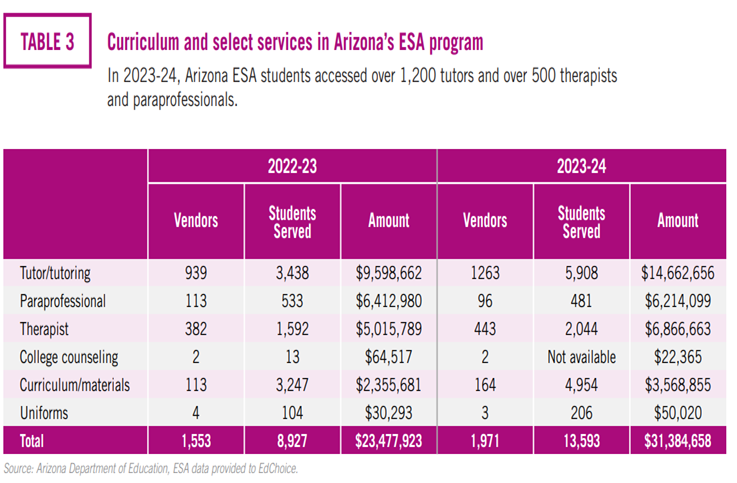
Don't look now, but dance and art studios, dojos and a whole lot more have entered the Arizona ESA chat:
Choice supporters with a vision beyond trying to fill a limited supply of empty seats and/or creating a tuition inflation spiral must create bills allowing supply to increase with demand.
Utah students celebrate National School Choice Week at the state capitol. Photo courtesy of National School Choice Week
In the 1949 Looney Tunes short “Mouse Wreckers,” two mind-manipulating rodents named Hubie and Bertie try to chase award-winning mouser Claude Cat out of his home by driving him crazy. They bang him on the head with a fireplace log, throw a stick of dynamite on Claude’s nap cushion, and even frame him for antagonizing a bulldog, who pummels him.
 The last straw is when the mice nail all the living room furniture to the floor while Claude is napping. Thinking he is stuck on the ceiling, he jumps up to what he thinks is the floor. When he opens a bottle of nerve tonic, all the liquid “rises” to what Claude thinks is the ceiling.
Similar confusion over ceilings and floors is at the heart of a legal battle in Utah, where a trial court judge ruled that the legislature figuratively bumped its head on the state constitution when it passed the Utah Fits All Scholarship Program in 2023.
Third District Judge Laura Scott wrote in her ruling that the state constitutional mandate that the Legislature establish and maintain a public education system is a ceiling. The state cannot create alternatives. If it were a floor, the legislature would have the authority to create other publicly funded education programs in addition to the public school system.
In separate appeals filed last week, the Utah Attorney General’s Office, along with two parents represented by the Institute for Justice and EdChoice Legal Advocates, each say that the judge erred in calling the constitution’s education clause a ceiling. They argue it is a floor.
“The legislature is already meeting its constitutional mandate to provide a free public education system devoid of sectarian control and open to all children. Plaintiffs do not argue otherwise,” the state’s appeal reads. “The district court recognized that Plaintiffs’ Article [X] claim fails as a matter of law if the educational provisions set a floor rather than a ceiling on legislative power.”
However, the lower court “created new limitations on the Legislature out of whole cloth,” according to the parents’ appeal.
The Utah Fits All Scholarship Program took effect in the fall of 2024 and gives eligible K-12 students up to $8,000 a year for private school tuition and other approved costs. In the first year, more than 27,000 students applied for 10,000 available scholarships. Unlike in South Carolina, where families were left scrambling last year after the state Supreme Court struck down its scholarship program, Utah families are allowed to continue using the program while the case is under appeal and will likely to be able to finish out the school year.
One of two cases that the judge relied on was Bush v. Holmes, which the parents’ attorneys called “the sole outlier” on the list of court decisions from other states.
The 1999 complaint challenged the Florida Opportunity Scholarship Program. In it, the Florida Supreme Court ruled in 2006 that the program violated the constitution’s provision requiring a “uniform” system of public schools for all students.
Scott wrote that the Florida provision “acts as a limitation on legislative power” and that in spelling out how something must be done, it effectively forbids it from being done differently.
The Utah parents’ attorneys called Florida’s provision “unique” and different from the broader language in the Utah Constitution.
“But even if Florida had analogous language to Utah’s Education Article — and it does not — Holmes is a singularly unpersuasive decision. One need only compare the majority and dissenting opinions to appreciate how flawed the majority’s reasoning was and how glaring are its many errors.”

Maria Ruiz and thousands of other families could lose their ability to choose schools that best fit their children’s educational needs if the Utah Supreme Court upholds a lower court ruling striking down the Utah Fits All ESA program. Photo courtesy of Institute for Justice
For the thousands of families who relied on the program, the stakes couldn’t be higher as they now find themselves under the shadow cast by the district court’s order just months before a new school year begins.
“In the interest of removing that shadow as soon as practicable so that Utah families can plan for their children’s upcoming academic year without disruption, Parents ask for this Court’s review,” the attorneys wrote in the parents’ appeal.
At the end of Mouse Wreckers, Claude races screaming from the house and clings, trembling, to a tree. The mice roast cheese and congratulate themselves.
“That upside-down room was the pièce de résistance,” Bertie says to a laughing Hubie.
Attorneys defending Utah’s scholarship families hope the state’s high court will flip the state constitution right-side up.

Opponents of education freedom, facing a series of legislative defeats, have responded by going off the deep end with conspiracy theories and crackpot fables. The formula works something like this: start with tortured and incomplete reading of the research on school choice which ignores a large majority of the findings and studies. Add a fabricated history of the K-12 choice movement that ignores the likes of Thomas Paine and John Stuart Mill, and that implicitly requires you to believe that such prominent left of center luminaries such as Daniel Patrick Moynihan, Jack Coons, Stephen Sugarman and Howard Fuller (among many others) were either knowingly or unknowingly part of a vast right-wing conspiracy. The bards singing this saga also want you to ignore the fact millions of Black and Hispanic families have voluntarily entrusted choice schools with the education of their children. This vast right-wing conspiracy is a racist vast right-wing conspiracy meant to destroy public education!
Quite appropriately, neither lawmakers nor teachers seem to be buying much of this double-plus good duck-speak. EdChoice and Morning Consult released conducted a national survey of K–12 teachers. In addition to hopeful signs of optimism regarding the teaching profession and some signs of improvement in student behavior and absenteeism, the survey found strong support for ESA policies:
 Public school teachers send their children to private schools at approximately twice the rate of the general public. Little surprise there, as they have a front row seat to district dysfunctionality. The Ed Choice survey also shows strong support for vouchers, charter schools and open-enrollment policies. Despite a non-stop agit-prop effort by unions, most teachers support families having options.

