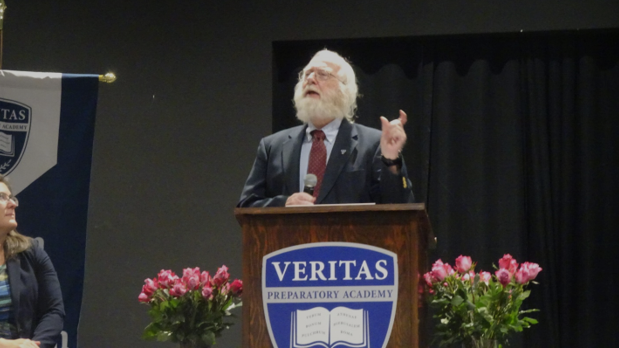
Mike Sullivan, who taught Classical Languages and Humane Letters at Veritas Preparatory Academy for 20 years, retires at the end of this school year. Before coming to Veritas, he was a private practice attorney and served the University of Minnesota in its Student Legal Services department after serving in the U.S. Army Intelligence corps as a translator and interpreter.
Veritas Preparatory Academy, a founding member of the prestigious Great Hearts Academy in the Phoenix metropolitan area, held a joyous retirement ceremony for one of its founding faculty members, Mike Sullivan, on May 20. Great Hearts recruited Sullivan, a 60-year-old attorney living in Wisconsin, to teach Latin and Greek.
Sullivan had enjoyed a career in the military followed by a legal career before finishing strong in the classroom for two decades. His most recent career holds a valuable lesson for policymakers.
Students, colleagues, and students who went on to became colleagues all related fond memories and valued lessons imparted by beloved sage-curmudgeon during the event. Veritas Prep’s first headmaster, Andrew Ellison, told of hosting the visiting Sullivan on a recruiting visit.
Ellison felt a growing sense of desperation over the course of the day, thinking he just had to have Sullivan join the faculty. Sullivan at one point told Ellison that he had been waiting all day for Ellison “to say something wrong” so he could get on a plane and go back to Wisconsin.
“But it hasn’t happened yet, and I don’t think it’s going to happen,” Sullivan said. Ellison described this as “the moment Veritas Prep was born.”
Policy decisions impact lives, sometimes in incredibly positive ways. It is worth noting that many states would not have allowed Mike Sullivan to launch his second career in teaching without jumping through a number of useless hoops. And, yes, I can demonstrate the uselessness of the hoops.
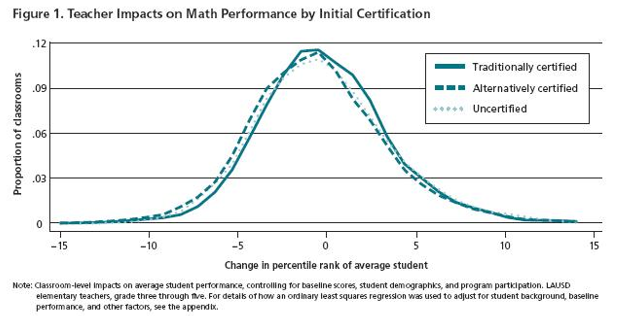 If you look very, very closely at this chart that comes from a study of student learning gains conducted by the Brookings Institution, you will see a dotted curve along with the line and dash curves. The three curves show the learning gains/declines from the students of traditionally certified teachers (the line curve), alternatively certified teachers (the dash curve), and finally from uncertified teachers (the dot curve).
Notice the lack of any meaningful difference in the overall curves; they all have highly effective teachers and highly ineffective teachers. But also note the difference between a right side of the bell-curve teacher and left-side is gigantic. As explained by the authors of the Brookings study:
Moving up (or down) 10 percentile points in one year is a massive impact. For some perspective, the black-white achievement gap nationally is roughly 34 percentile points. Therefore, if the effects were to accumulate, having a top-quartile teacher rather than a bottom-quartile teacher four years in a row would be enough to close the black-white test score gap.
Arizona lawmakers wisely gave charter school leaders the flexibility to recruit from any of the three curves in search of highly effective instructors. Ipsi prudenter elegerunt!
Veritas Prep found Mike Sullivan practicing law in a distant state and had the flexibility to coax him into a next great career. The adoration of Sullivan’s students and colleagues seems like a much greater compensation than any provided by a law firm.
More Sullivan-like instructors are likely awaiting discovery at some unexpected place. Find them and get them in the classroom!

Cornerstone Christian School outside Omaha, Nebraska, one of 228 private schools in the state serving more than 42,000 students, is a non-denominational Christian school that uses a biblical-based curriculum. Its mission is to equip children with “godly character and biblical truth.”
Editor's note: This commentary from Valeria Gurr, a Senior Fellow for the American Federation for Children and a reimaginED guest blogger, appeared Saturday on Nebraska's townhall.com.
Just a decade ago, there were only a couple dozen states in the U.S. with school choice programs. This week, Nebraska has made history as the 50th state in the nation to pass a school choice bill — a monumental win for families in the Cornhusker State.
This passage is not only a major victory for the school choice movement in Nebraska; it is also a testament to the advancement of educational freedom and opportunities nationwide for all children, regardless of color, race, or economic status.
Nebraska’s LB753, the Opportunity Scholarship Act, which just passed with a supermajority from the Unicameral Legislature, establishes a tax-credit scholarship that will help more than ten thousand students attend a non-public school of their choice.
Scholarships will average around $9,000 per student, depending on the needs of the family and tuition costs.
The Opportunity Scholarships Act will give first priority to students living in poverty, students with exceptional needs, those who experienced bullying, are in the foster system or are in military families, and children denied enrollment into another public school.
With the goal of empowering families, passing school choice in Nebraska was the right thing to do. As a Hispanic education advocate, I am fighting for my community to overcome inequality in education. A high-quality education is one of the only paths to success for children living in poverty.
A quality K-12 education is a path to economic progress and opportunity, preparing students for college and successful careers, and school choice will always be part of the solution since the traditional system of education will never fit all the individual needs of students and families.
To continue reading, click here.

East Texas Christian Academy in Tyler, Texas, is one of 2,037 private schools in the state serving more than 331,600 students. Founded in 1979, East Texas Christian provides a quality education in a loving, supportive environment with a dedicated faculty and staff who integrate the word of God in every subject.
Editor’s note: This commentary from Jonathan Butcher, Will Skillman senior fellow in education at The Heritage Foundation and a reimaginED guest blogger, and Mike Gonzalez, the foundation’s Angeles T. Arredondo E Pluribus Unum senior fellow, appeared Friday on houstonchronicle.com.
Will additional private education choices force a mass exodus from assigned schools in these areas? Or everywhere across the state?
The answer to the first question is no. As best as we can determine, private learning options implemented in states including Arizona and Florida have never resulted in a public school shutting down.
A proposal to create education savings accounts offers parents and students more than just a new school. The accounts are not vouchers, and the distinctions are important. Arizona courts emphasized the differences in a 2013 opinion and ultimately ruled that the accounts did not violate the state constitution.
With vouchers, or private school scholarships, parents can choose a new school for their child — a life-changing option for children who have been bullied, are falling behind in class, or for whom the assigned school has not met their needs.
With an account, after parents choose not to send their child to a public school, the state deposits a portion of a child’s funding from the state education formula into a bank-style account. (Under Abbott’s proposal, that would be $8,000 per year.) The parents can use the money to buy certain preapproved education products and services for their children.
Private school tuition is one option for parents, but not the only one. Parents who want to offer their children a course not available at a local public school can use an account to pay for the course online or at a local college. Or they can find personal tutors or education therapists suited to meet a child’s unique needs.
The education options that Abbott seeks will not change local high schools’ role as key parts of civic life. By our calculations, just 5% of Arizona students use education savings accounts, and 2% of children in Florida participate.
To continue reading, click here.
 Editor’s note: This commentary from Frederick Hess, director of education policy studies at the American Enterprise Institute, appeared today on washingtonexaminer.com.
The disruptions of the pandemic frayed familiar routines and fueled an appetite for more education options. As a result, more than two-thirds of people support school choice, according to recent polls, and states are expanding educational choice programs at an astounding rate.
This all seems rather innocuous and, well, predictable. Teacher union leaders, however, see in school choice the nefarious handiwork of a shadowy cabal. American Federation of Teachers President Randi Weingarten, for example, described the push for educational freedom as a “privatization movement” bent on “destroying public education.”
Given that U.S. public schools spend $17,000 per student and have added staff at many times the rate they’ve added students in recent decades, one might snarkily conclude that the privatizers are doing rather a poor job of it. But the school choice debate has featured plenty of snark.
So instead, as I point out in my book, “The Great School Rethink,” it’s perhaps more useful to appreciate why such complaints are misguided and misleading.
Over the past century or more, public schooling has been subject to a barrage of reforms: compulsory attendance, district consolidation, larger schools, smaller schools, magnet schools, standards, test-based accountability, merit pay, and more. Some of these ideas were good. Some weren’t. But in hindsight, it’s pretty clear that they weren’t “attacks” on public education; rather, they were attempts to improve it.
Public education can encompass a lot of approaches, and it can be organized in many different ways. Rather than blindly insist that “defending public schooling” requires clinging to outdated policies from decades (or centuries) past, we would do better to clarify principles, examine particulars, and then debate proposals.
Indeed, the pandemic was a stark reminder that there are lots of ways to deliver schooling, including innovations such as learning pods, microschools, virtual tutors, and education savings accounts. While these might stretch our notions of public education, that’s mostly because the hard-and-fast lines used to denote “public” are blurrier than we pretend.
To continue reading, click here.
 The map below shows states with either major school choice expansions or pending major expansions (green). I may be missing some green:
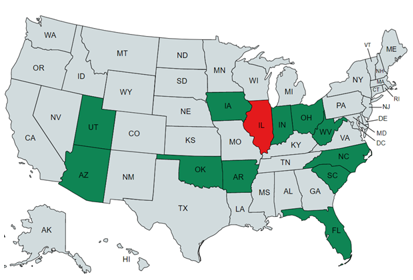 Sadly, the state of Illinois is in red, and seems poised to kill the Invest in Ed tax credit that provides 9,000 low-income Illinois children the opportunity to attend private schools. As the Wall Street Journal explains:
Unions want to kill the program because its popularity showcases the failure of the public schools. Invest in Kids had more than 31,000 applications last year, roughly five students for every scholarship it could provide. Every family lined up for a place at a private school is an indictment of a union monopoly that continues to prioritize its power over student learning.
Allowing the tax credit to sunset and forcing 9,000 students out of the school preferred by their families is, in a word, reprehensible.
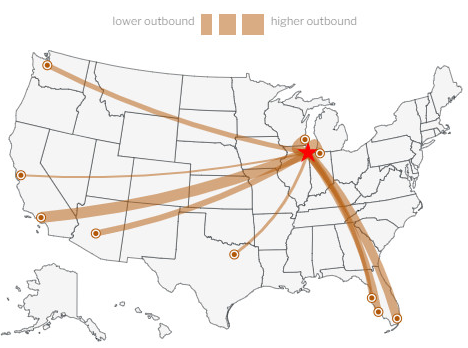
A remedy however is available for these families: leave Illinois. Your state lawmakers care much more about rent-seeking special interests than they care about your family or your children. Other states not only value you more; they have much better return on investment for your tax dollars. These families are, alas, living in the wrong state.
Options are plentiful, but they lie outside of this cruelly indifferent state. Let’s consider some options:
Wisconsin: The Badger State has not expanded its choice programs in 2023, but all 9,000 Invest in Ed students, and likely all 31,000 waitlisted students, will likely qualify for one of Wisconsin’s private choice program.
Note that Milwaukee is a train ride from Chicago, and Wisconsin is a state whose laws will provide K-12 options, lower taxes, and far more solvent public sector pensions. In other words, it is a far better governed state that is delightfully free from the need to imprison governors on a regular basis. Milwaukee is the new Chicago, check it out.
To Illinois’ immediate west lies Iowa, which delightfully just passed a universal private choice program. For decades, Iowa taxpayers have supported first-tier research universities only to watch many graduates move to Chicago. Chicago was once a great American city, but the smart money has already begun to leave. It’s time for Iowa to reverse the flow.
Even closer to Chicago lies Indiana. All the students who qualified for Invest in Ed will also qualify for the Indiana Choice Scholarship Program. Students with disabilities can qualify for the Indiana Education Scholarship Account Program.
Wisconsin, Iowa, and Indiana all constitute much, much better options for young families than Illinois, but this is not to say that they necessarily constitute the best option, which (obviously) lies in Arizona. Arizona not only has universal private choice, the nation’s strongest charter school sector and a low-and-flat income tax, and your Cubs have spring training here.
People having been moving from Chicagoland to Arizona for decades and Arizona has room for more! Did I mention that Arizona is delightful in the winter? Golfing in the winter looks like this:
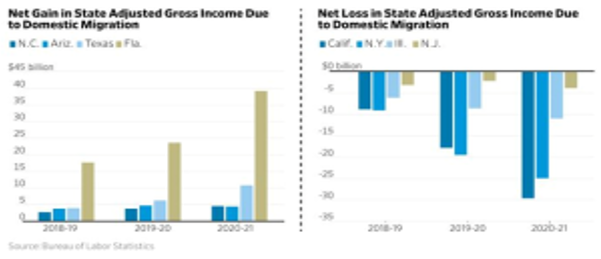
 Last but not least, Florida has become the migration colossus of the United States. Other states will need to bring their “A-game” if they want to compete.
 Feel free to make a case for your state in our blog’s comments.
The United States is gripped by a baby bust that began in 2008. Starting round about next year, this cohort will age into the working-age population. Young people are not just an increasingly scarce resource, they are the future for their states.
Illinois has over 2,000,000 students. Other states should try to rescue all of them.
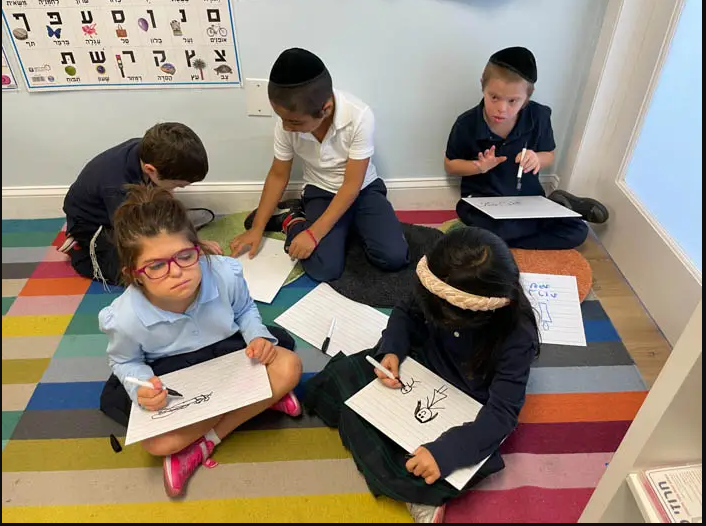
The hard work and determination of two South Florida mothers, along with support from Teach Florida, led to the launch of JEMS Academy in North Miami Beach. The school serves children with special needs, many of whom attend using Florida’s Family Empowerment Scholarship for Students with Unique Abilities.
Like many worthy endeavors, it started with two determined moms.
Both Avigayil Shaffren and Shoshana Jablon had children with unique abilities. Shaffren’s son was born with cerebral palsy, which affected his left side. Jablon’s son was born with Down Syndrome and later was diagnosed with attention deficit hyperactivity disorder.
Shaffren’s son attended a charter school for the first four years of his life. The program had its benefits, such as therapies and personal attention that she says he wouldn’t have received anywhere else. But when it came time to start kindergarten, she said, “it was awful.”
Despite her son being assigned a “shadow,” he made little progress. An evaluation turned up other diagnoses, which further complicated things. School officials gave Shaffren a choice: she could have her son repeat kindergarten or place him in a specialized school that would meet his educational needs.

JEMS students, whose unique abilities vary widely, frequently help each other with assignments.
The Shaffrens chose to have him repeat kindergarten, but Shaffren, who is Orthodox Jewish, was concerned about her son’s religious educational needs, especially as he got older. Shortly thereafter, she was laid off her job. Though three months of unemployment brought hardship, it also offered an opportunity.
Shaffren turned to her friend, Jablon, who is also Orthodox Jewish, and said, “That’s it; we’re done. We need to create this school, and we’re not done until we create it.”
Shaffren spent the time she would have devoted to a paying job researching Jewish special education programs, such as OROT, which is the Hebrew word for light. Based in the Philadelphia suburb of Melrose Park, OROT (pronounced OR-oh) partners with four Jewish day schools to provide an integrated education for diverse learners.
Another was SINAI Schools in New York, which is based on a similar model as well as JEWELS, or Jewish Education Where Every Learner Succeeds, a Baltimore program that incorporates therapies into the school day.
Shaffren and Jablon developed a business plan, which Shaffren felt at the time was “a house of cards that was falling apart.”
But, through hard work, determination and support from Teach Florida, they opened JEMS Academy in a building across the street from its umbrella school, Toras Chaim Toras Emes in North Miami Beach.
“It was a miracle,” Shaffren said about the process, which the women said they completed right before the new school year was about to begin.
Though Shaffren’s son was able to start first grade and continue in the umbrella school, she continued to support JEMS, which stands for Jewish Education Made Special. This past year, JEMS opened its doors with five students.
Of those, four received the Florida Family Empowerment Scholarship for students with Unique Abilities. The fifth student had applied but was on the waitlist. The founders say they expect that student to be awarded due to the additional funding and higher growth rates that state lawmakers allowed this year in HB 1.
According to Jablon and Shaffren, the students’ unique abilities vary widely. Staff members, who have advanced degrees in special education, personalize education to best fit each students’ needs. JEMS also provides onsite therapies. Jablon’s 10-year-old son, Nesanel, receives occupational and speech therapies there. The founders are seeking to add a Hebrew reading specialist and build a sensory room.
You can see a video of a typical day at JEMS here.
“It’s mushrooming, really growing,” Jablon said. “We just keep adding things as we see what the needs are.”
The program also includes a music program, which Jablon said serves as a type of therapy for students, some of whom experience anxiety or have autism. A staff member also brings a therapy dog.
“They really act as a cheering squad for one another,” she said. “If someone does something inappropriate, the whole class stops.”
She said it’s a real opportunity to develop social skills because they see how to act with one another.
But one of the biggest benefits to the arrangement has been the opportunity for students at both schools to interact and bond. On Fridays, JEMS students join the Toras Chaim Toras Emes students at an assembly to end the week.

JEMS students join their umbrella school classmates from Toras Chaim Toras Emes, located across the street, for recess.
Girls from the umbrella school also visit and engage the JEMS girls in educational games and performances. Boys from Toras Chaim Toras Emes help put on Bible studies and play games and sports with the JEMS boys. JEMS students also participate in recess at the umbrella school’s playground.
Those interactions have enriched both groups, the JEMS founders say.
Jablon said she hopes getting the word out about what JEMS offers will encourage more parents to consider enrolling their children.
“In general, with parents of students of special needs, moving kids from one school to another creates a lot of instability. So, parents keep their children in programs even if they’re not that great.”
Jablon said the Miami-Dade County School District has been helpful by issuing timely individual education plans for students seeking to go JEMS so they can qualify for the Florida Family Empowerment Scholarship for students with Unique Abilities.
JEMS already has opened a second classroom. The founders hope to expand the program at other Jewish day schools as the original students get older and need to attend single-gender classes as Orthodox Judaism requires. The founders also hope to be able to teach general life skills so the students can be as independent as possible as adults.
Says Jablon: “We want our kids to exist in the larger scheme of people and activities and potential jobs in any capacity they can muster.”
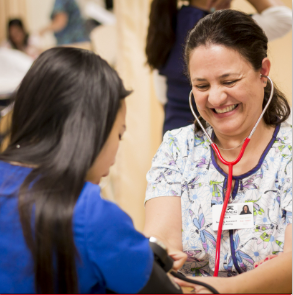
Blue River Career Programs in Shelbyville, Indiana, offers career training certification programs in construction, nursing, and child development.
Editor’s note: This article appeared Monday on in.chalkbeat.org.
Loriann Beckner can’t imagine the idea of going to nursing school without her internship. A senior at Southwestern High School in Shelbyville, Beckner interns at a hospital, Major Health Partners, through the work-based learning program at Blue River Career Programs.
Working with Blue River instructor Ray Schebler, she’s learned about financial literacy and career development skills that she says she would not have learned otherwise, in addition to what she learns at the hospital.
“He’s taught me how to do interviews and so [much] workplace learning stuff that my high school never would’ve taken the opportunity to teach me,” Beckner said. “I just think without my internship, I’d be super scared.”
But the future of Blue River — one of 52 career centers across the state that offers high schoolers academic credits, industry certifications, and more — has been thrown into doubt this year after Indiana lawmakers enacted a law that creates Career Scholarship Accounts.
These will provide funding for students to pay for internships and apprenticeships with local employers without necessarily relying on current career and technical education programs.
GOP lawmakers said the law, which Republicans said would be a top priority this year, will help “reinvent” high school in response to declining college enrollment and evolving employer needs. They also say the accounts will make career training more accessible.
Critics worry these new accounts will hurt programs like Blue River and the public schools that partner with them to provide career and technical training, without truly providing new or additional benefits.
The Career Scholarship Accounts are part of a push by state leaders to shift some authority and funding away from traditional public schools and educators to constituencies like parents and the business community.
To continue reading, click here.
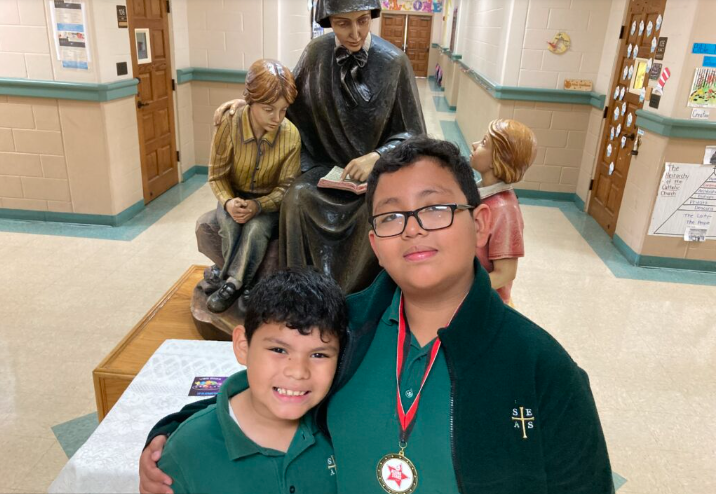
Jesus Martinez-Cruz, right, and his brother, Christian, receive the Family Empowerment Scholarship for Educational Options to attend Saint Elizabeth Ann Seton Catholic School in Palm Coast, Florida.
PALM COAST – Every school day at 7 a.m., a small bus rolls to a stop in front of the rectory of the Catholic church in Crescent City. Waiting to board are a handful of students, including Jesus Martinez-Cruz and his little brother, Christian.
They are headed on a 50-minute ride to Saint Elizabeth Ann Seaton Catholic School in Palm Coast.
Jesus and his schoolmates are part of the Rural Education Initiative, a program started during the 2020-21 school year by the Diocese of St. Augustine as a means of creating opportunities for a Catholic education to students who live in sparsely populated areas that cannot support a Catholic school.
Crescent City’s population is under 1,700, and St. John the Baptist Catholic Church, where Jesus and his friends catch the bus, does not have a Catholic school.
If not for the REI, these children would not receive a Catholic education. And if not for the scholarships managed by Step Up For Students, many of those families would not be able to attend a Catholic school.
Jesus, a sixth-grader, and Christian, a second-grader, receive the Family Empowerment Scholarship for Educational Options.
“To have the (Rural Education Initiative), for his parents to be able to choose a Catholic school that they want so much for their children and Jesus wants for himself, they would never have that opportunity without Step Up,” said Saint Elizabeth Ann Seaton Catholic School principal Barbara Kavanagh.
There have been days when the bus broke down and the boys’ parents had to drive them back and forth to school. That’s more than 90 minutes round trip, twice a day. As it is, the bus returns the students to Crescent City at 4 p.m.
But Elvira Cruz and her husband, Jesus Martinez-Puente, are not deterred by the distance and the drive from their home to their children’s school.
To continue reading, click here.

Established in 2001 as a ministry of Grace Covenant Church, Grace Covenant Academy in Cornelius, North Carolina, one of 844 private schools in the state serving more than 123,000 students, prides itself on excellence in Christian education, serving 3-year-olds through Grade 8.
Editor’s note: This commentary from John Hood, a board member at the John Locke Foundation, appeared Wednesday on carolinajournal.com.
The North Carolina General Assembly is about to make all children eligible for the state’s Opportunity Scholarship program. They won’t all receive the same amounts — poor and middle-income families will be eligible for vouchers in the range of $6,500 to $7,200 per student, while upper-income households will receive much less.
Nevertheless, both proponents and opponents are quite properly using the term “universal” to describe the policy, which will go into effect for the 2024-25 academic year.
School-choice advocates are ecstatic. Critics are despondent. Although my sympathies here are evident and longstanding, I think it would behoove both sides to temper their expectations a bit. There won’t be a gigantic exodus of children from district-run public schools in the fall of 2024.
For one thing, North Carolina’s current private schools don’t have the capacity to absorb such an enrollment boom. One of the best arguments for choice programs is their potential to foster entrepreneurship in education.
Just as the creation of charters gave educators, parents, and reformers the capacity to develop new models for public education, voucher expansion will give existing providers the capacity to add new grades and campuses while creating opportunities for new entrants to the K-12 space.
It can’t all happen in a year, though. It takes time to assemble teams, build or rent facilities, hire faculty, and develop content.
Furthermore, while some families will immediately take advantage of scholarships for which they’ll be newly eligible, many others will be intrigued but cautious. They’ll do their homework about what private options are already available, where new schools will open, and when they calculate the benefits of transferring their children will exceed the costs (which aren’t purely monetary, of course).
Still other families will have little interest in taking advantage of opportunity scholarships at all, either because they’re satisfied with the education their children are receiving in public schools — district or charter — or because they don’t like the private options available.
To continue reading, click here.
 Editor’s note: This commentary from Mike McShane, director of national research at EdChoice, appeared Wednesday on forbes.com.
The great scholar of deregulation and later Supreme Court Justice Stephen Breyer told a (possibly apocryphal) story of the late Sen. Ted Kennedy. During the 1970s, Kennedy held numerous hearings about deregulating the airline industry, a cause supported by everyone from Ralph Nader to Milton Friedman.
Kennedy, the story goes, was approached by one of his Boston constituents and asked, “Why are you holding hearings about airlines? I’ve never been able to fly.” To which Kennedy replied, “That’s why I’m holding the hearings.”
A decade ago, Derek Thompson, writing in the Atlantic, summed up the effects of airline deregulation. Airfares fell 50%. The per-mile cost of flying did too (even including fees). At the time, Kennedy’s constituent was complaining about what issues he was devoting his energy to, less than 20% of Americans had ever flown. By 2000, more than half of the country was taking at least one trip every year.
By breaking the vise-like grip that the federal government, through the Civil Aeronautics Board, had on controlling the prices and operations of airlines, air travel was democratized. Millions have benefited.
This year’s wave of school choice legislation has been about democratizing school choice. Historically, lots of people in America have had school choice if they have the money to purchase a house zoned to a good school, to pay for private school tuition, or to homeschool.
They also have been able to supplement their child’s traditional education with a host of other choices, from therapies to extracurriculars to tutors. Universal education savings accounts democratize both of those sets of opportunities, supporting families in their choices of schools and the surrounding services that they want for their child.
To continue reading, click here.

