Hess
Nothing gets critics of school choice and education reform more riled up than the specter of privatization. The response from Rick Hess: It’s complicated. For-profits in education can bring problems, he says. But they can also be a big help.
Hess, director of education policy studies at the American Enterprise Institute, is co-editor (along with Michael B. Horn of the Christensen Institute) of a new book on the subject, “Private Enterprise and Public Education.” He’ll be our guest next week, in a live chat, to talk about it.
“Of course, the record of private ventures in education, as in other sectors, is mixed. It’s no wiser to romanticize for-profit providers than to demonize them,” says the book’s introduction. But, it continues, “For-profit enterprises have brought innovative power to an array of sectors. Given sensible policies and quality-control mechanisms, the particular strengths of for-profits can make them an invaluable part of the education tapestry.”
The chat isn’t limited to the book. Among many other hats, Hess is executive editor of EducationNext and author of the “Straight Up” blog at Education Week. He frequently weighs in on a wide range of ed topics, and doesn’t fit neatly into anybody’s ed reform box. So, ask away.
It’ll help to send some questions in advance. You can post them here, or on the redefinED facebook page, or tweet them to us @redefinedonline.
To participate in the chat, just come back to the blog on Monday, Sept. 9 at 1:30 p.m. You’ll have a full hour to ask away.
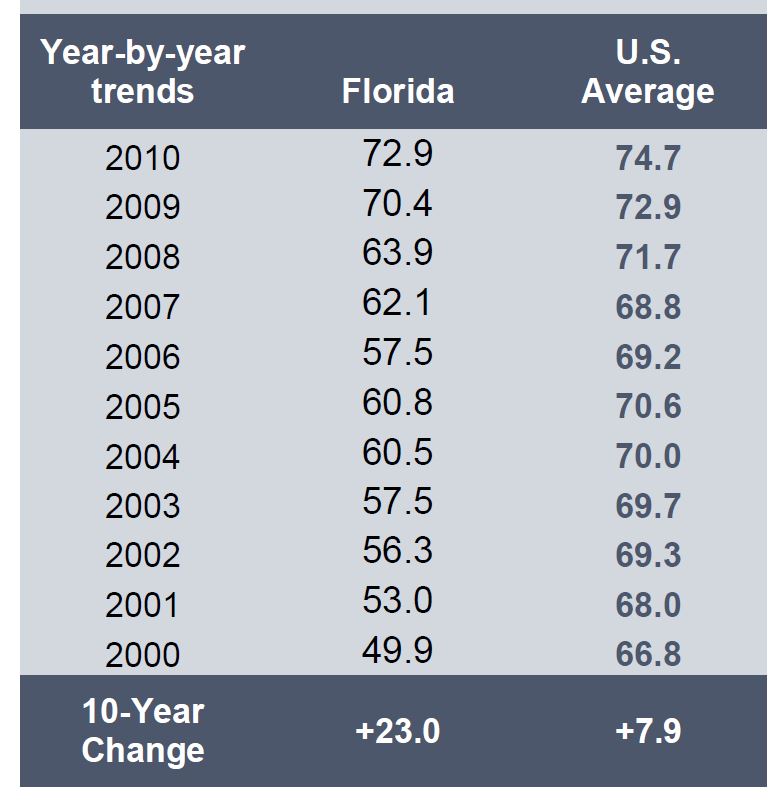
Florida’s high school graduation rate rocketed 23 percentage points to 72.9 percent between 2000 and 2010, putting the Sunshine State at No. 2 among states for progress over that span but still behind the national average, according to a new national report.
From Education Week
Only Tennessee did better, with a 31.5 percentage point gain, shows the annual Diplomas Count report from Education Week. The national rate was up 7.9 percent, to 74.7 percent.
Education Week, the country’s highly respected paper of record for education news, uses its own formula to calculate graduation rates.
Its findings are the latest in a stack from credible, independent sources that show Florida students and teachers are making some of the biggest academic gains in the country under a model distinguished by a tough, top-down accountability system and expanded parental school choice.
Florida ranks No. 44 in the percentage of students eligible for free- and reduced-price lunch (with the ranking going from lowest rate to highest), according to the latest federal figures. But the Education Week data puts it at No. 34 in graduation rates, ahead of states with less challenging student populations - and arguably better academic reputations - like Washington, North Carolina and Utah.
The gains also come despite tougher standards than other states. Among other things, Florida requires more academic credits to graduate than most states (24 to the national average of 21.1) and the passing of an exit exam (only 23 other states do). (more…)
It's National School Choice Week. SchoolZone and StateImpact Florida.
 Grade inflation? The Palm Beach Post writes there is less to Florida's No. 6 ranking in the latest Education Week Quality Counts report than education reform supporters suggest, and encourages teachers and politicians "to dig into the details."
Teacher evals. Despite concerns raised by Senate President Don Gaetz, the Shanker Blog says it wouldn't make sense if school grades and the new teacher ratings were too closely associated. The Tampa Bay Times interviews David Steele, who's in charge of the Gates-funded teacher evaluation project in Hillsborough.
Teacher pay. More on Democratic bills to raise teacher pay to the national average. Palm Beach Post.
School security. Bills are filed to use taxes from gun sales for guidance services, and to expand gun-free zones around schools, reports SchoolZone. The superintendents association releases a district-by-district SRO survey, reports the Northwest Florida Daily News.
Technology. StateImpact Florida writes up what to expect at the Florida Educational Technology Conference, where 10,000 educators will gather. Senate Education Committee Chairman John Legg says he's putting together a proposal that aggressively invests in new technology, reports Gradebook.
$10,000 degrees. All 23 state colleges accept Gov. Scott's challenge, reports the Associated Press. More from Miami Herald, Lakeland Ledger, Pensacola News Journal, Bradenton Herald, Sarasota Herald Tribune, Gradebook. (more…)

Bennett
Tony Bennett. On his first day on the job, he meets with superintendents and the Florida Association of District Administrators and says he is an “unapologetic advocate for school choice,” reports the Tallahassee Democrat. More from The Buzz. His first comments on the “Commissioner’s Blog” here. Interview with StateImpact Florida.
Charter school funding. More than 1,000 people turn out for a meeting called by Pembroke Pines charter parents to demand equal funding for charter schools, reports the South Florida Sun Sentinel.
School spending. If the Broward school district wants to get the money to repair old schools, it will have to restore trust with voters and overcome a “long and lousy history of stunningly bad behavior,” editorializes the Miami Herald: “The district has been plagued by cronyism, mismanagement and a culture of dishonesty. In a scathing grand jury report released almost two years ago, jurors said they found the district so thoroughly corrupt, so reckless in its spending of taxpayers’ money, they would have recommended abolishing the school board completely if the state Constitution didn’t require its existence.” In Manatee, a forensic audit finds “incompetency -- not criminal or illegal activity -- caused a $3.4 million budget deficit that rocked the public trust,” reports the Bradenton Herald. More from the Sarasota Herald Tribune.
School prayer law. “For the Satanists, it was a godsend,” writes Palm Beach Post columnist Frank Cerabino.
Cold water on the party. Former state Sen. Dan Gelber says there isn’t much for Florida to celebrate in the latest Education Week rankings. Florida Voices.
Murmurs. School administrators wanted to hear more from Gov. Rick Scott, writes Tampa Bay Times columnist Steve Bousquet.
Merit pay challenge. A hearing on the FEA’s challenge of SB 736 is set for Wednesday in Leon County Court. SchoolZone. (more…)
Bennett begins work today as Florida's new ed commissioner
Tony Bennett. The Orlando Sentinel hopes the new commissioner, who begins work today, “treads with discretion.” The Associated Press recalls his tenure in Indiana and ties to Jeb Bush.
Expand school choice now! Sort of. The Tampa Bay Times means options under district control: “The broader answer to improving public education in Pinellas is not a massive expansion of fundamental schools. It's raising the quality of all schools. But increasing the seats for fundamental schools and popular magnet programs to more closely match demand is a discussion district leaders should begin. Otherwise, they risk losing more families to charter schools and private schools — and further undermining broad support for public education.”
Slow down on charter schools. The Palm Beach Post says in one editorial that the Legislature should prioritize traditional public schools over charters. It says in another that the Palm Beach County district’s decision to transfer a troubled principal into administration will give lawmakers an excuse to continue favoring charters.
Checking out choice. In Alachua County, 600 middle school students turn out to see career academy options, reports the Gainesville Sun. In Duval, magnet students spread the word about their programs to prospective students, reports the Florida Times Union. In Miami-Dade, tens of thousands of parents are expected to apply for hundreds of magnet programs, reports the Miami-Herald. In Manatee, the Rock Your Robot Fair lets parents know about STEM options in public and private schools, reports the Bradenton Herald. (In Collier County, businesses urge students to explore STEM, reports the Naples Daily News.) The Tampa Bay Times annual school search section for Pinellas includes information about public and private options, including tax credit scholarships.
Amendment 8. The ACLU saw the proposed amendment, which despite perception had little to do with private school vouchers, as part of a "wide-ranging assault" on Floridians' rights last year by Gov. Rick Scott and the Republican-led Legislature, reports the Florida Current.
“Sagging schools.” Tampa Bay Times business columnist Robert Trigaux: “Beneath the top tier of students, our schools at all levels are struggling to educate our kids. Businesses need to help more. And the state needs to spend less time bragging about the educational system and admit it needs assistance.” (more…)
 Quality Counts. Florida ranks No. 6 this year in Education Week’s annual report. Coverage from redefinED, Associated Press, Miami Herald, Gradebook, Orlando Sentinel, StateImpact Florida, Fort Myers News Press, Naples Daily News, WCTV, News4Jax. More from Huffington Post.
Charter school access. SchoolZone takes a critical look at the first policy paper from the Center for School Options, a new think tank chaired by former Education Commissioner Jim Horne. It grades the 10 biggest districts in the state on charter school access. The Fort Myers News Press writes up Lee County's top grade.
Charter school attendance. Palm Beach district officials suggest tighter controls are needed after a Mavericks charter school overstated its attendance and received $160,000 more in per-pupil funding. Palm Beach Post.
Career and technical. Tampa Bay school officials are headed to Germany to learn more about programs there. Tampa Bay Times.
Suspension and grad rates. A Johns Hopkins University study of Florida ninth graders finds much higher graduation rates for those who were never suspended as freshmen versus those who were suspended even once or twice.Education Week.
Rick Scott. Visits Fort Lauderdale High School. South Florida Sun Sentinel.
Superintendent searches. Interim education commissioner Pam Stewart applies for the superintendent’s opening in Manatee County, reports Gradebook. St. Lucie County gears up to replace retiring Superintendent Michael Lannon, reports TCPalm.com.
School security. Hillsborough is going too far, editorializes the Tampa Bay Times. So is a Lake County School Board member who wants to arm teachers and principals, writes Orlando Sentinel columnist Lauren Ritchie.
Rezoning angst in Seminole. Orlando Sentinel.
At the EdFly Blog today, former Orlando Sentinel columnist Mike Thomas asks a reasonable question: Why isn't the Florida teachers union trumpeting the dramatic gains of Florida teachers? This morning's Education Week ranking is just the latest in a long string of credible reports that finds Florida making steady academic progress. Shouldn't Florida teachers, doing more with less and under enormous pressure to produce results, get credit from those who portray themselves as their biggest supporters? Here's Thomas:

FEA President Andy Ford
Florida scored another impressive victory with the state finishing sixth in the Education Week “Quality Counts’’ rankings.
This follows news from last month that Florida fourth graders finished second in the world on international reading assessments. In October, Miami-Dade won the prestigious Broad Prize for urban school districts because of progress in closing the achievement gap. Florida kids ranked second in the nation in learning gains dating back to the 1990s. I could go on.
Alas, Florida’s good news is not celebrated by all, even by its own teachers’ union. The Florida Education Association has been silent on all of the above, even though its teachers are on the front lines of these successes. Repentant reformer Diane Ravitch actually compared student achievement in Florida and Massachusetts. Of course Massachusetts kids perform better. Look at the student demographic and income data, Diane. Are you serious?
The reason for this denial is that Florida did not achieve its success by acceptable means. By that, I mean if the state had achieved these results by tripling education spending and eliminating its accountability provisions and school choice options, the above victories would have been trumpeted from the rooftops by the FEA and Diane as well.
Continue reading Thomas' post here.
Top 10 again. Education Week ranks Florida No. 6 this year in its annual Quality Counts report. redefinED. Orlando Sentinel. Associated Press.
Teacher evals. StateImpact Florida writes about the new Gates study on the best way to identify the best teachers. SchoolZone notes it. Jay P. Greene rips it. District officials in Palm Beach County don’t feel good about the new, state-mandated system, reports the South Florida Sun Sentinel.
Common Core. Reformers have to win the messaging battle, writes Mike Thomas at the EdFly Blog: “Our success in passing school reforms has had more to do with prevailing in legislative bodies than prevailing in the public arena. This has led to a dangerous neglect of the need for marketing. We now are paying the price for that as our opponents vigorously fight back, defining reform as an attack on public schools that is degrading the quality of education. That this isn’t true doesn’t matter. Sound bites often trump data.”
 Rezoning retreat. After affluent parents complain, Seminole district officials back away from plans to equalize the number of low-income students at each school. Orlando Sentinel.
Fire them. Hillsborough Superintendent MaryEllen Elia recommends firing two aides and demoting a principal and assistant principal in the aftermath of the drowning of a special needs student. Tampa Bay Times. Tampa Tribune.
More school safety. Tampa Bay Times. StateImpact Florida. Panama City News Herald. (more…)
For the fifth year in a row, Florida’s public school system ranks among the best in the country, according to the latest annual analysis by Education Week.
Released this morning, the highly anticipated “Quality Counts” report puts Florida at No. 6 among states this year, trailing only Maryland, Massachusetts, New York, Virginia and Arkansas. In the previous four years, Florida came in at No. 11, No. 8, No. 5 and No. 11, respectively.
"For Florida to be a global leader in job creation and economic growth, we have to provide our students with a quality education," Gov. Rick Scott said in a written statement. "Today's news that Florida has moved into the top ten in the nation for overall quality of education reinforces that we're taking the steps needed to ensure our students succeed."
The consistently strong showing is at odds with public perception and with steady criticism from those opposed to a series of far-reaching education changes spurred by former Gov. Jeb Bush. To be sure, it’s tough to determine which factors – including a heady expansion of parental school choice - have had the most impact. But the EdWeek reports are another credible sign that Florida students and teachers are no longer cramping at the back of the pack.
They’re also another sign that nobody should be satisfied. Florida earned a B- overall in the latest report. And in the category that matters the most – student achievement – it managed a C-.
Quality Counts looks at policy and performance in six broad categories with multiple indicators. Each year, the researchers behind the report update three of them. This year, they updated the school finance and “transitions and alignment” categories, and something called the Chance-for-Success Index.
Florida’s rank on the index is unchanged from 2011, coming in at No. 34. On transitions, it climbed from No. 14 to No. 4. On finance, it fell from No. 31 to 39 (and from C- to a D+). The reason for the latter: historic cuts in education spending that had yet to be tempered by 2010, which is the data year EdWeek uses for the new report. (more…)
 Tony Bennett has a tough, tough job ahead, and the way education in Florida is covered is not going to make it any easier. The big news last week is a case in point.
Besides Bennett’s selection as the state’s new education commissioner, the top story was how Florida fourth-graders scored on a respected international test called PIRLS , which stands for the Progress in International Reading Literacy Study. In case you missed it, Florida students ranked second in reading, behind only their peers in Hong Kong. Virtually none of the state’s major daily newspapers (the Orlando Sentinel being a notable exception) covered this development, but CNN did. It interviewed interim Education Commissioner Pam Stewart live, next to an all-caps headline that read, “FLORIDA STUDENTS SCORE BIG.”
This wasn’t a one-time oversight. Over the past 10 to 15 years, Florida students and teachers – its public school students and teachers - have made impressive academic gains, whether it’s on national math and reading tests, or on college-caliber Advanced Placement tests, or in graduation rates as determined by credible, independent experts. For four years running, Education Week, looking at both performance and progress, has ranked Florida among the leading states in K-12 achievement (to be specific, at No. 7, No. 7, No. 6 and No. 12 over that span). And yet, flattering reports about Florida’s progress rarely get more than passing mention, while those who oppose the state’s accountability and school choice initiatives are often allowed to deny that such progress even exists. Even stranger, the more outrageous their statements get, the more often they seem to get quoted. (more…)

