Editor's note: This story has been updated after President Donald Trump signed the bill.
Education choice, which has long been the domain of statehouses, is now enshrined in federal law.
President Donald Trump on Friday signed legislation that offers the nation's first national education choice scholarship program.
The signing comes a day after the U.S. House approved the Senate-backed version of the federal budget reconciliation package in time for an Independence Day signing ceremony. Within the bill is the Educational Choice for Children Act (ECCA), a groundbreaking federal education choice expansion.
ECCA creates a 100% federal income tax credit of up to $1,700 for individuals to donate to state-approved scholarship granting organizations. Those SGOs would in turn grant scholarships to K-12 students in the state where they operate.
ECCA has been moving through the Congressional budget process for months. The proposal was substantially revised last week in the Senate based on a ruling from the chamber parliamentarian that the language violated its Byrd Rule.
One of the significant changes was that individual states must “opt-in” to the program by “authorizing” SGOs to receive tax-credited donations. This will likely curtail the ability for families in states with leadership hostile to education choice to receive ECCA scholarships, as those states will potentially not participate.
The changes also include making the tax credit program permanent (removing a previous sunset clause) and removing any cap on the amount of $1,700 tax credits that can be raised (previous versions of ECCA proposed total program caps and a higher tax credit donation amount).
“For the first time in American history, the U.S. government will enshrine into law a federal tax credit for school choice," said U.S. Sen. Tim Scott, R-South Carolina, after the Senate passed its version of the bill. "This is an historic change in U.S. law that will favorably impact the school choice movement for the next 50 years.”
Tommy Schultz, CEO of the national school choice group American Federation for Children, called the passing of school choice “a historic moment for America’s families and students” and emphasized in a July 3 statement that his organization will “continue to fight to ensure that this tax credit scholarship mechanism is well implemented — and expanded as soon as possible.”
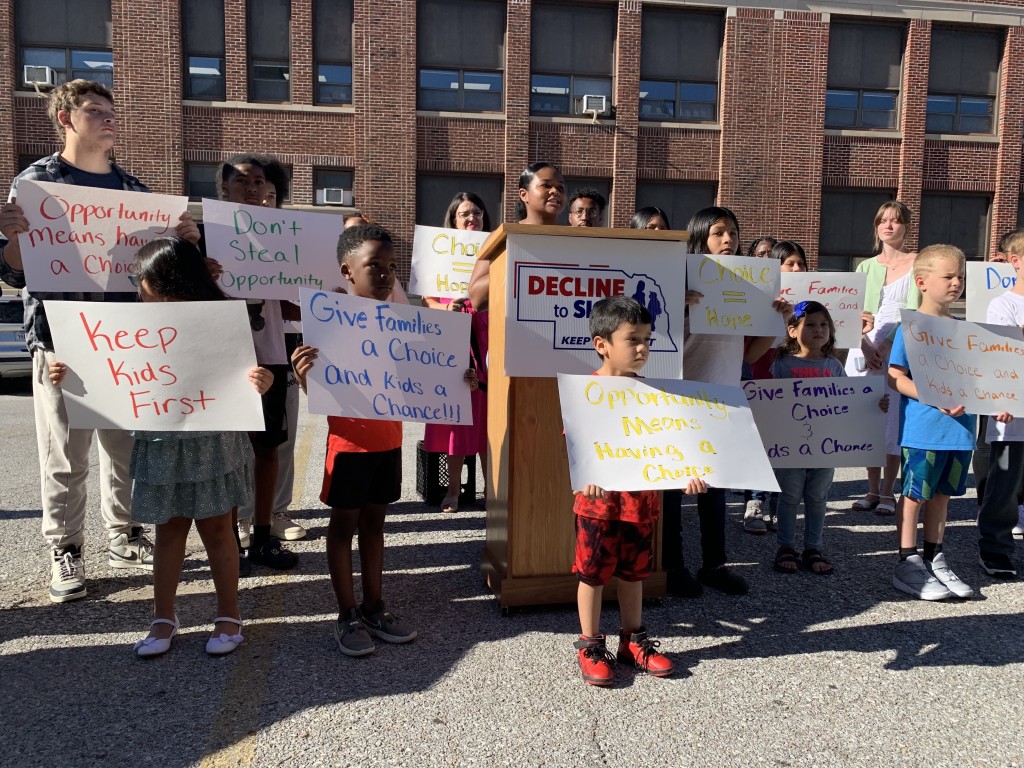
Jayleesha Cooper sat in her apartment at the University of Chicago and watched with hope as the election results rolled in.
The college senior from Omaha had marked her mail-in ballot to retain Nebraska Measure 435, upholding a $10 million tax credit Opportunity Scholarship program state lawmakers passed a year ago.
If the ballot referendum passed repealing the bill, families of 1,500 students would be forced to return to public schools next year or find enough funding to stay in their private school.
After a look at the Nebraska Secretary of State’s website, her hope turned to disappointment.

 “It was sad,” said Cooper, who was among a volunteer squad of young adult school choice alumni from the American Federation for Children who spent the summer of 2023 working to keep opponents from gathering the required number of signatures to get a previous scholarship bill put up for repeal. The college students reported being harassed by opponents, including some who photographed them and called in police.
Lawmakers repealed that bill and passed a new one to fend off a prior referendum attempt by the state teachers union. But opponents got enough signatures to put the new measure up for a veto referendum.
Choice opponents won on Election Day, with 57% of the vote compared with 43% who voted to continue the program.
Asked why the modest scholarship program drew such trenchant opposition, Cooper could only speculate.
“Maybe the people who were benefiting weren’t able to get out to vote,” she wondered. “Did the people who had to opportunity to vote – were they are aware of what they were repealing?”
National experts were stumped as to why choice initiatives in Nebraska, Colorado and Kentucky all suffered defeats. There is a long history of school choice measures failing at the ballot box in a wide range of states and political climates.
“The track record for school choice on the ballot has been so poor, but the poll numbers (for school choice) are always so strong,” said Ben DeGrow, senior policy director for ExcelinEd, a national education think tank founded by former Florida Gov. Jeb Bush.
DeGrow and others cited vague ballot language in Colorado that prompted a homeschooling group to oppose enshrining parental education rights in the state constitution. The group was concerned unclear wording might open the door to government regulation of homeschoolers.
In Kentucky, the “No” campaign outspent the “Yes” campaign more than three to one on a measure permit the creation of a future school choice program.
In the end, the unknowns proved to be too much, wrote Mike McShane, the director of national research at EdChoice. While the benefits of school choice may have seemed distant and hypothetical, the fears promoted by opponents about harms to public schools felt immediate and concrete.
For Cooper, the defeat in Nebraska felt deeply personal. A private donor scholarship made it possible for her to attend Duchesne Academy, an all-female Catholic school.
She credits that opportunity with ensuring she did not become a teen mom like many other girls she knew and for putting her on a path to a prestigious college. She is now applying to law schools and recently scored in the 92nd percentile on her LSAT.
She said she did her best to educate everyone she knew about the need to keep the Opportunity Scholarship program alive, including her 90-year-old grandmother, who cast a retention vote.
Despite the setback, Cooper says she won’t give up. She holds out hope that the new Republican majority in Washington will boost the chances of passing a federal education choice tax credit bill. That would offer some relief to families in states where the fate of parent-directed education continues to look grim.
Not that her home state should be let off the hook.
“It’s still important for Nebraska to keep working on a state program,” she said.
In the meantime, she promised to keep sharing the truth and debunking the myths about education choice.

