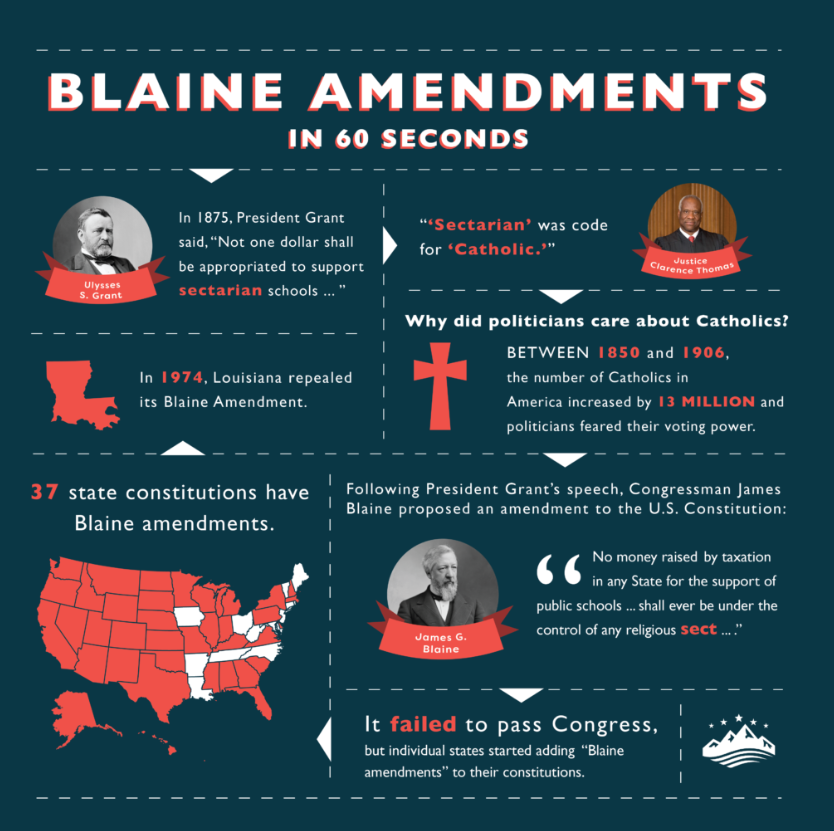
 It seems especially appropriate midway through National School Choice Week to ask:
Can the use of state “Blaine Amendments” to prohibit publicly available funds from being used by parents at religiously affiliated educational options be considered discriminatory? And if so, does that discrimination violate a family’s right guaranteed by the U.S. Constitution to equal protections under the law?
Those are questions education choice advocates have been asking for nearly two decades. The issue came to a head last week when the U.S. Supreme Court heard arguments in Espinoza v. Montana Department of Revenue.
Voucher opponents have managed to avoid these questions since 2006 when the Florida Supreme Court ducked the state’s “Blaine Amendment” arguments altogether in Bush v. Holmes. Opponents lucked out again when they seized the opportunity to pour millions into the Douglas County, Colorado, school board races to kill a voucher program that would have been a perfect test case for the U.S. Supreme court in 2017.
Voucher opponents may get lucky once again in 2020. It’s possible the U.S. Supreme Court will sidestep the issue and instead scold the Montana Supreme Court for thinking tax credits are functionally the same as direct tax dollars – a distinction the court already made in Arizona Christian School Tuition Organization v. Winn in 2011.
And while Espinoza is an important case, some commentators have overblown its possible impact. Ian Millhiser, writing for Vox, and Jay Michaelson, writing for the Daily Beast, incorrectly claim that a victory for school choice supporters would be a “mandate” for states to fund religious schools and “starve” public schools. David Dayen, executive editor for the American Prospect, elevates the case to conspiracy level “brought … to undermine public education” by corporations seeking to obtain tax breaks from their donations to religious schools.
There is no corporate conspiracy theory, nor will Espinoza result in the starvation of public education, dozens of new voucher programs, or even a mandate to fund private religious schools.
At best, the U.S. Supreme Court simply will provide some consistency, or at least some guidance, on how all the various state Blaine Amendments can or cannot be applied to education. Florida is a great example of how Blaine Amendments have been inconsistently applied.
In 2004, the First District Court of Appeal ruled the state’s first voucher program, the Opportunity Scholarship, unconstitutional because it violated the state’s constitutional ban on direct or indirect aid to religious institutions. But the ruling was unsatisfactory because it failed to address the dozens of examples raised by voucher supporters. Examples included several legal cases in which churches benefiting from state or local programs did not violate Blaine.
In Koerner v. Borck (1958), the Florida Supreme Court ruled that a portion of a last will and testament allowing for land donation to Orange County for use as a park as long as a local church be granted perpetual easement to access the lake was constitutional because the benefit to the church also was a benefit to the general public.
In Southside Estates Baptist Church v. Board of Trustees (1959), the Court ruled that the use of public schools to hold private religious meetings did not violate the “No Aid” clause.
In Johnson v. Presbyterian Homes of Synod of Florida (1970), the Court ruled that tax credits for retirement homes were constitutional even if the retirement home was owned and operated by a religious organization. The Court stated: "A state cannot pass a law to aid one religion or all religions, but state action to promote the general welfare of society, apart from any religious considerations, is valid, even though religious interests may be indirectly benefited."
In Nohrr v Brevard County Education Facilities Authority (1971), the Court ruled that the government could issue bonds for facilities at religiously affiliated schools.
And in City of Boca Raton v. Gidman (1983), a case that dealt with publicly funded daycare at a religiously affiliated program, the Court stated: "The beneficiaries of the city's contribution are the disadvantaged children. Any “benefit” received by the charitable organization itself is insignificant and cannot support a reasonable argument that this is the quality or quantity of benefit intended to be proscribed."
These cases strongly suggest that programs created to benefit the general public CAN be provided by religious organizations, and that any benefit derived from the program to the church is merely incidental.
Florida’s Opportunity Scholarship Program voucher also forbade private schools from admitting students based on their religion and prohibited private schools from requiring students to take religious courses or attend religious services. The scholarships themselves didn’t cover the full cost of tuition, though the private schools had to accept the voucher as full payment. In other words, the private schools educated each child at a loss compared to private pay students. Voucher supporters argued that all these facts made education at a private religiously affiliated school functionally no different, as far as the “No Aid” clause was concerned, than medical services provided at a religiously affiliated hospital.
And so another question comes to mind: Why is it possible for individuals to use public programs to pay for medical services at religious hospitals, but not use public funds to pay for education at religious affiliated schools? The First District Court of Appeal failed to address this example entirely.
Voucher supporters pointed to the McKay Scholarships for children with disabilities along with the Florida Private Student Assistance Grant Program and Bright Futures Scholarships, which could be used at one of 23 private religiously affiliated colleges in Florida. The state Attorney General noted that the Legislature appropriated nearly $9 million to private religious universities in Florida in 2002.
Other examples include rent paid to churches for use as polling places, subsidized childcare and prekindergarten education at churches and religious schools as well as public funds to churches for the preservation of historic structures. The First District Court of Appeal ignored these examples, too.
The First District Court of Appeal defined the “No Aid” clause as prohibiting any funds being taken directly from the treasury to be paid to a religious organization, regardless of how the money arrived, even indirectly through choices made by parents offered scholarships. This ruling threatened many existing programs in Florida highlighted by the lawyers for the state.
Even Judge James R. “Jim” Wolf, who wrote a concurring opinion, argued the ruling endangered other programs unless arbitrarily confined to K-12 education, stating: "In order to avoid catastrophic and absurd results which would occur if this inflexible approach was applied to areas other than public schools, the majority is forced to argue that the opinion is limited to public school funding and article 1, section 3 may not apply to other areas receiving public funding."
In other words, the court had to distinguish K-12 education as being uniquely prohibited by the “No Aid” clause compared with other aid programs. Florida is not unique when it comes to Blaine. Other states have treated K-12 education as being distinct from other government programs in which churches may participate or benefit.
What conclusion can we draw from all of this?
Don’t expect Espinoza to be a major game changer. State legislatures still must create voucher programs and families still must choose schools for their children. All we can hope for is that the U.S. Supreme Court will provide some clarity in how Blaine Amendments can or cannot be applied.
Hopefully, we’ll learn that distinguishing K-12 education from other publicly beneficial programs is arbitrary and in error.
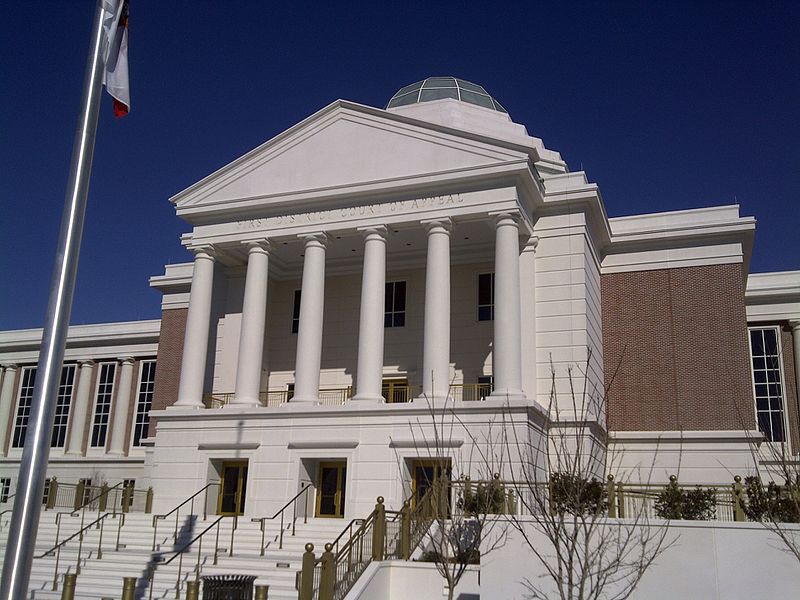
Florida's First District Court of Appeal
This is the second of two posts on the judicial history of Florida's Blaine Amendment with regard to public aid to private religious institutions. Part one can be read here. The U.S. Supreme Court is expected to weigh in on the constitutionality of state Blaine Amendments in 2020.
Lawyers defending Florida’s first school voucher program in Bush v. Holmes demonstrated the state historically allowed public funding to flow to many religious organizations providing public services, including through the McKay Scholarship for children with special needs. The First District Court of Appeal refused to acknowledge these programs.
Supporters of the Opportunity Scholarship program also cited several Florida Supreme Court cases which upheld aid to religious institutions as constitutional. But the appellate court found a way to ignore this precedent too.
Koerner v. Borck (1958) dealt with the last will and testament of Mrs. Lina Downey, who had donated a parcel of land to Orange County for use as a county park, but with the provision that Downey Memorial Church be granted a perpetual easement to access the lake for the privilege of baptizing members and swimming.
The court upheld the will, concluding,
“to hold that the Amendment is an absolute prohibition against such use of public waters would, in effect, prohibit many religious groups from carrying out the tenets of their faith; and, as stated in Everson v. Board of Education, supra, 67 S. Ct. 504, 505, "State power is no more to be used so as to handicap religions, than it is to favor them."
In 1959 the Florida Supreme Court heard Southside Estates Baptist Church v Board of Trustees, a case in which the court ruled religious institutions could use public buildings (in this case a public school) for religious meetings.
The court was not persuaded that minimal costs associated with the “wear and tear” of the building constituted aid from the public treasury, and concluded there was “no evidence here that one sect or denomination is being given a preference over any other.”
In Johnson v. Presbyterian Homes of Synod of Florida, Inc. (1970), tax collectors for Bradenton and Manatee County challenged a law that gave property tax exemptions to non-profits operating homes for the elderly after a religious organization applied. Presbyterian Homes of Synod, a religious non-profit operating homes for the elderly, maintained a religious atmosphere, offered religious services and employed an ordained Presbyterian minister who conducted services every day except Sunday. Most residents were even practicing Presbyterians.
The Florida Supreme Court determined the tax exemption benefit was available to all, not just Presbyterians, and ruled:
“A state cannot pass a law to aid one religion or all religions, but state action to promote the general welfare of society, apart from any religious considerations, is valid, even though religious interests may be indirectly benefited.”
Nohrr v. Brevard County Education Facilities Authority (1971) dealt with the issue of government issue bonds potentially being received by religious schools. The Florida Supreme Court found no problem here either.
In all four cases the Florida Supreme Court held the law did not violate the constitutional prohibition on direct or indirect aid to religious institutions. In all instances, the court examined who benefited from the aid, and required that the aid benefit the general public and/or required that no religious group be favored over the other.
The appellate court majority brushed aside these arguments, noting that the Opportunity Scholarship was different because the financial aid came directly from the state treasury, making the scholarship “distinguishable from the type of state aid found constitutional.” In fact, it appears the appellate court restricted Florida’s “no aid” provision to “payment of public monies,” though it failed to consider other similar programs such as McKay.
Having crafted itself exemptions to prior state Supreme Court precedent, the appellate court cited cases in Washington (2002), South Carolina (1971) and Virginia (1955) where state supreme courts held that direct subsidies to students were, in effect, benefits to religious schools.
This directly contradicted the U.S. Supreme Court decision in Zelman v. Simmons-Harris (2002), which determined the benefit to religious institutions from school vouchers were merely “incidental.”
The Florida Supreme Court had even weighed in on whether these benefits were direct or incidental during a 1983 case, City of Boca Raton v. Gilden, which upheld the city’s subsidy to a religiously affiliated daycare provider. The court declared:
“The beneficiaries of the city's contribution are the disadvantaged children. Any ’benefit‘ received by the charitable organization itself is insignificant and cannot support a reasonable argument that this is the quality or quantity of benefit intended to be proscribed.”
The appellate court in Bush v. Holmes failed to understand that the constitutional question hinged not on the method of aid, but who was the intended beneficiary of the aid. Though Florida’s constitutional language may appear clear, its longstanding history of neutrality in funding medical and educational services at secular and religious institutions, has muddied the waters.

