 Around the state: Some state school districts are teaching kids about artificial intelligence, a Pasco charity for students was displaced but found a new home, The Art Institute is closing its doors, club controversy continues in Alachua and Black history is being taught by community groups and churches. Here are details about those stories and other developments from the state’s districts, private schools, and colleges and universities:
Pasco: A Pasco charity that helps students look their best for school dances was displaced, with its founder worried she wouldn't be able to open in time for fall homecoming. Thanks to help from local businesses, Marjorie's Hope is again providing formal wear to teens. Debi Shackowsky founded the charity almost a decade ago in honor of her late sister, Marjorie, who was killed by a drunk driver in 1994. “When you see students stand before that mirror in their dress or the guys in their suits, it’s an ‘ah ha’ moment and there’s so many happy tears,” Shackowsky said. BayNews 9.
Flagler: The school board recently approved an audit of the Flagler Youth Orchestra, which reviewed all incoming and outgoing financial activity for fiscal years 2020-2022. The review was ordered by the board after questions arose about the fact that the orchestra had not been audited in its 18 years of existence. School board member Will Furry said that conducting this audit has "further strengthened" the strings program. The Daytona Beach News-Journal.
Alachua: School district officials here may soon have another legal issue to address after the creation of a controversial club called G.A.I.N. at Gainesville High that may have violated state and federal laws. In this instance, the argument involves the removal of an appeal letter that should have been added to the School Board's Sept. 19 agenda. The Gainesville Sun. Meanwhile, the Alachua Learning Academy was recognized by the U.S. Department of Education as a national Blue Ribbon Award of Education recipient. The public charter school is one of 353 schools recognized for 2023, and it is one of 14 schools in Florida and the only Alachua County public school to receive this recognition. The Gainesville Sun.
Art institutes close: Campuses for The Art Institute announced they would be closing campuses across the country. Some students say they received an email last week informing them about the closure. By Sept. 30, all eight of The Art Institutes remaining campuses will be closed. The Tampa campus had around 200 students with several dozen faculties. The school's website says it will help students coordinate transfers to other schools, and make sure credits already earned are accepted. "I was literally just walking into school to go study when I found out about it," said student Tony Audrey. NBC Miami. KHOU. Fox 13.
Artificial intelligence: Some school districts in the state are teaching students about artificial intelligence. One of them is Volusia County as part of a partnership University of Florida is spearheading with high schools to educate youth on the skills required for an AI-enabled workforce. The curriculum starts by teaching students how to identify and locate AI, learn how it can be applied across various fields and how to build AI applications. The Daytona Beach News-Journal.
Black history: Community groups and churches statewide are throwing themselves into efforts to teach Black history after state officials moved to reject AP African American Studies. Residents are uniting in churches, parks and homes to learn the history of Black Americans, including drawing material from books that have been removed from the shelves of schools. The Hill.
Attorney advice: Attorneys tasked with advising school boards and superintendents on subjects such as library book selection are also puzzled, according to email chains showing school board lawyers struggling to determine what could get districts in trouble. Miami Herald.
Student-athletes: Advancements are being made to keep student-athletes safe from concussions. ABC Action News.
Protected speech: An injunction filing argues that Florida's new law gags protected speech on college campuses. WWSB.
University and college news: Tenured faculty at the University of North Florida must undergo performance reviews every five years after the state Board of Trustees implemented a new state law. Trustees had to approve changes by Oct. 16 or face penalties. Union president Tobias Huning was the first to speak at the trustees meeting recently. “We find that the policy proposed here today is probably the most hostile and vile attack on faculty that many of us have seen in our entire careers,” he told the trustees. “And when we read the justifications for why this is happening and how it is happening, it really reminded me of why we have tenure in the first place — to protect ourselves from exactly that.” Jacksonville Today.
Opinions on schools: The nation's economic security will be won or lost based on the ability of elementary schools to energize science education. Jeanne McCarty, The 74th.
Book review process: The school board in Brevard spent nearly two weeks debating their public comment policy, prompted by concerns that parents may disregard the book review process to fast-track getting a book off school library shelves through a loophole created by a new law. No changes were made to the policy at Tuesday's meeting, but board members discovered that some challenged books had been banned due to the loophole. House Bill 1069, which dictates what can and cannot be taught in schools, says that parents must be allowed to read from challenged books. If a school board member stops them because the content is sexually explicit, the book must come out of all schools within five days. Florida Today. In Volusia, A total of 89 books were challenged in Volusia County Schools in the 2022-2023 school year, according to data released by the Florida Department of Education. Palm Coast Observer.
Unpaid school vouchers: Florida families are saying school vouchers have been unpaid. The first disbursements in the newly-expanded program were due on Sept. 1. Lawmakers lifted the eligibility requirements for the system, which led to a doubling of participation this fall to more than 400,000 children. The disruption appears to have affected thousands of students, leaving parents and school officials unable to get answers from those in charge of the voucher system.“This year it’s been the worst,” said Maria Preston, who runs Fort Lauderdale's Diverse Abilities Center. Tampa Bay Times.
Palm Beach: School Superintendent Mike Burke spoke about issues the school district is facing and priorities for the year in front of the League of Women Voters. Palm Beach County mother Monica Baber says knowing what’s going on with her children’s education is a big priority. That’s why she came to Mounts Botanical Garden to hear Burke talk Wednesday. “I want to know that they are getting taught to tackle further challenges that will come along in higher education, and I want to make sure they're going to be well rounded," said Baber. WPEC.
Brevard: The county school board moved toward a settlement in a lawsuit over a student with Down syndrome who came home with a mask tied to her face during a school mask mandate two years ago. The board prevailed earlier this year in a $100 million federal lawsuit filed by the family of then 7-year-old Sofia Bezerra, a special needs student at Ocean Breeze Elementary in Indian Harbour Beach. Florida Today.
Seminole: Moms for Liberty, the conservative group founded in Florida, aimed to get books pulled from Seminole County Public Schools libraries by reading aloud at a school board meeting this week passages they said amounted to pornography. The Seminole County School Board on Tuesday night listened without interruption as Moms for Liberty members and supporters read short book excerpts, in almost all cases without naming the book or the author. Orlando Sentinel.
Alachua: The school board here acknowledged at its meeting earlier this week that it is investigating a student club at Gainesville High School that limits participation to Black male students. Superintendent Shane Andrew disclosed that a parent of one of the students who attended the club submitted a complaint to the school district's human resources department. The parent's issue was with the information presented to students. WUFT. Gainesville Sun.
Veterans program: Over a year after the Florida Department of Education amended its teaching requirements to give military vets an easier pathway to become certified teachers, state figures show veteran participation hasn't been stellar. “It seems like there was a lot of fanfare around this program being a huge solution to a problem. Clearly, that's not the case,” said Andrew Spar, head of the Florida Education Association (FEA), the state’s largest teacher’s union. At the start of the school year, the FEA issued a press release saying the number of teacher vacancies in the state reached nearly 7,000, "the worst in state history." ABC Action News.
Advocacy for students: A small group of parents, students and residents voiced support for LBGTQ+ students earlier this week at a Hillsborough County School Board meeting. The message: Marginalized groups deserve respect and protection. A new program launched this year by Equality Florida called "Fall into Action" helped them share the message. Spokesperson Carlos Guillermo Smith said the initiative's goal is to give people the tools needed to sign up and speak out at local school board meetings in every district in the state. WUSF.
University and college news: Florida State University College of Medicine's Orlando regional campus is celebrating its 20th graduating class. WESH. Florida Atlantic University faculty want their interim president to become permanent amid a stalled search for president as the state investigates what it called "anomalies" in the search process. The hope is that interim President Dr. Stacy Volnick, who has been serving in the role since late last year, become's the university's permanent leader. WPTV. Ben Sasse, the new president at University of Florida, talked about ideas for changing campus culture and a possible tuition hike as he made the rounds on campus recently. Tampa Bay Times. Student and dads from Florida State University schools are participating in the Walking School Bus. WXTL.
 Broward: School employees here will be soon receiving bigger paychecks after the school board approved an agreement with workers unions. Under the deal, bus drivers, cafeteria workers, police officers and other school support staff will be paid 5.5% more, at least for the next four years. That's after the county's voters passed a tax referendum in 2022 to invest in high salaries, mental health resources and school safety. “This helps retain our staff and our employees to make sure that they know we respect them,” Broward Superintendent Peter Licata told reporters after the vote. WLRN. WSVN.
Duval: School officials here are ready to start construction on an estimated $120 million project that would replace Ribault High with a next-generation school financed largely by a voter-approved sales tax. “It’s going to be a sight to see,” School Board member Darryl Willie told a crowd at a groundbreaking. Florida Times-Union.
Sarasota: Two years after the school board here redrew boundaries for the areas represented by the panel's five members, the board started the process to revise district lines yet again. With a lone board member dissenting — Tom Edwards — the school board voted 4-1 to approve a $39,000 contract with a consultant to launch the redistricting effort. Sarasota Herald Tribune. Meanwhile, the school board also adopted a $1.5 billion budget at a special meeting on Monday, ending the district's yearly budget process. The board voted 4-1 to approve the budget, with only Chairwoman Bridget Ziegler dissenting. Sarasota Herald Tribune.
Flagler: The school board in Flagler has assigned fellow board member Will Furry to hire a labor attorney at the district's expense who will assist in firing Kristy Gavin, the board's attorney, without risking a lawsuit. Flagler Live.
Alachua: The school board here hosted a workshop on Wednesday covering transportation changes coming to the Alachua County Public Schools district. Those changes include the elimination of courtesy stops, reduction of magnet stops and re-evaluation of school start times. In the face of a bus driver shortage, students who ride the bus have been up to an hour late for school since the fall semester began. Main Street Daily News.
Blue Ribbon honors: In all, 14 schools in the state of Florida were named National Blue Ribbon schools, according to the U.S Department of Education. The program "recognizes public and private elementary, middle and high schools based on their overall academic excellence or their progress in closing achievement gaps among student subgroups," the department's website said. In all, about 350 schools were named National Blue Ribbon Schools for 2023. WKMG. Patch. WQCS.
University and college news: The U.S. Department of Education on Monday asked state officials to pump more funding into Florida Agriculture & Mechanical University, pointing to what the federal agency called "longstanding and ongoing underinvestment" by the state of Florida. Miguel Cardona, U.S. Secretary of Education, sent letters to Gov. Ron DeSantis and governors of 15 other states highlighting what he noticed as funding disparities between historically Black colleges and universities, or HBCU's, and their "non-HBCU land-grant peers" in the states. According to Cardona's letter, over the past three decades, FAMU has been shortchanged financially by $1.97 billion. “These funds could have supported infrastructure and student services and would have better positioned the university to compete for research grants,” Cardona wrote. WFSU. A study by Degreechoices revealed that the University of Florida is the third best school based on value for money. UF was one of more than 400 national universities and colleges analyzed by college return of investment staff at Degreechoices. Main Street Daily News. Pasco-Hernando State College announced Tuesday that Jesse Pisors was selected as the school's fifth president. Pisors has served as vice president at Texas AP&M University-San Antonio and the University of Houston-Victoria. He was one of four finalists for the job. “We have full confidence that Dr. Pisors will continue to uphold the college’s core values and will lead PHSC to further success in all future endeavors,” Lee Maggard, chairperson of the college’s board of trustees, said in a news release. Tampa Bay Times. The Florida State University System's Board of Governors discussed a proposal by the University of Central Florida to close three of its campuses. According to state officials, the proposal would close the university's South Orlando, Leesburg and Palm Bay campuses. WKMG. The Biden administration has requested a federal judge to dismiss Florida's lawsuit against the accreditation requirements for colleges and universities, citing constitutional challenges. Attorneys for the U.S. Department of Education filed a 40-page motion disputing Florida's arguments that the decades-old accreditation system gives too much power to private accrediting agencies. CBS 47. Action News Jax. Generative artificial intelligence is being integrated into higher education at Florida Gulf Coast University. WGCU.
Opinions on schools: Students must learn math. "Future of work" studies consistently underscore this point as analytical thinking and other math-rooted cognitive skills have become core to success in today's economy. Jeff Livingston, The 74th.
Palm Beach: The future of a West Palm Beach private school for students with special needs is uncertain after school officials say they have not received their allotted funding from the state for scholarship students. Mountaineer's School of Autism has been a cornerstone of the special needs community for years, but the owner says she can only operate for about two more weeks unless she receives money owed from the state's scholarship program. WPTV.
Hillsborough: Plant High school voted to keep a graphic novel in its library in response to the district's first book challenge of the school year. A Plant High parent brought up the objection against "Blankets" by author Craig Thompson. The seven-member review board, comprised of school staff and parents, unanimously voted to keep the book in the school's library collection. WUSF.
Pinellas: The school district in Pinellas has pulled five books from its shelves amid concerns that their content is inappropriate for minors. Tampa Bay Times. Meanwhile, support staff in Pinellas have asked the school district for better pay and living conditions during a recent bargaining session. Nelly Henjes, president of the Pinellas Educational Support Professional Association, said the union is asking the district to pay employees at least $18 per hour or to give them a 7.3% pay increase, depending on which is greater. The union is also asking for child care before and after school, and no increase in health insurance premiums. The two parties did not reach an agreement but plan to meet again on Sept. 28. WFTS.
Volusia: Some local school districts are looking for ways to stand out as they compete for teachers during a shortage and in the face of a population boom in the state. Forough Hosseini, founder of Homes Bring Hope, which is a non-profit that works to help make home ownership more affordable, made a pitch to school board members in Volusia during a recent workshop to turn vacant land into affordable housing for district staff. “As our community grows, the need for teachers and the need for school staff certainly grows,” Volusia County’s Deputy Superintendent Dr. Rachel Hazel said. “This is just one more incentive to come to Volusia County and work for our school system.” WKMG.
Alachua: Shane Andrew, superintendent of Alachua County Public Schools, is aiming to be impactful during the upcoming school year. “I don't know that I necessarily set out that this was my journey and my destiny,” Andrew said in an interview. “But definitely, when called to serve in our school district, I'm going to do whatever I can wherever I can.” Main Street Daily News.
More on book bans: State education officials released a list of books removed from public school libraries last year, and it turns out that South Florida is among the areas with the fewest book removals. A state law enacted last year allows parents or residents of the Florida counties to submit challenges to school books. WLRN.
Teacher pay: A lawmaker wants to raise teacher pay to a minimum salary of $65,000. Rep. Tae Edmonds of West Palm Beach is proposing the "Save Our Teachers Act" to bolster pay for the state's teachers closer to the national average. "This is just a minor step in the right direction to help our teachers," Edmonds said. Florida currently ranks 48th in the nation when it comes to average teacher pay, with the average teacher making about $51,000 per year, according to a report from the National Education Association. A previous education funding boost in 2022 increased base pay for teachers to a minimum of $47,500, but Edmonds think it isn't enough. If the bill is approved by legislators, it would go into effect in July. News 4 Jax.
Opinions on schools: To find out how students are doing in the aftermath of COVID-19, YouthTruth, a nonprofit that elevates voices to help schools improve, set out to answer that question by consulting the experts: students themselves. Jen Vorse Wilka, The 74th.
 Around the state: The teachers union in Lee filed a grievance against the school district, a proposal is being floated to set up cameras in some school zones to enforce speed limits and the state Board of Governors will consider a new regulation on Wednesday that would make it a fireable offense if a transgender employee at a state university uses a restroom that aligns with their gender identity. Here are details about those stories and other developments from the state’s districts, private schools, and colleges and universities:
Miami-Dade: Anthony Rodriguez, Miami-Dade commissioner, said his proposal to set up cameras to enforce speed limits in school zones and impose fines on violators will bolster the safety of tens of thousands of local schoolchildren. The proposal, which needs approval from the county commission, follows the passage of a new law earlier this year by the state Legislature that allows local governments to set up cameras to enforce speed limits in school zones. That law was passed nearly unanimously. The Florida Department of Transportation is figuring out how the new cameras should be implemented. A recent AAA study of Florida drivers found that 38% admitted speeding in an active school zone and 31% admitted using a cellphone in active school zones. Meanwhile, a concern among opponents is drivers ticketed for speeding in school zones when school is not in session — especially during the summer months. WLRN. South Florida Sun-Sentinel.
Palm Beach: The school district here approved a new program that will provide its dual language departments with pre-translated instructional materials. Until now, educators have had to translate the coursework and materials themselves. WPTV.
Hillsborough: As the population booms in this county, its public school enrollment remains flat. Meanwhile, the county's population is expected to have grown by 8.3% between 2021 and 2026 — a greater rate than the state, region or nation, according to the Tampa Bay Economic Development Council. But the school district's data is making it clear that the additional population is being offset by educational choices that families exercise outside of traditional school systems. Tampa Bay Times.
Duval: Widespread delays in the deliveries of school children on Friday afternoon was attributed to unexpected driver absences, with some delays lasting as much as an hour. A message sent to parents Friday assured them that “no matter how late your bus may be, your child will be held at school in a safe, supervised place until the bus arrives.” The Florida Times-Union.
Lee: The teachers union here has filed a grievance against the school district. School officials have seven days to respond to the grievance. “They’re doing additional work without additional compensation this year,” said Kerr Fazzone, director of the union, before a recent hearing. WINK.
Leon: Chiles High Principal Joe Burgess began a two-week suspension without pay on Sept. 11 after rounds of legal challenges failed. Burgess was accused of violating district policy for paying teachers for extra work without documentation. "I am aware of the Court's decision and am disappointed by then Superintendent's decision to still place me on suspension," Burgess said in a prepared statement shared by his lawyer. Tallahassee Democrat.
Citrus: Inverness City Council members will be setting the final millage rate and budget adoption for the fiscal year of 2023-24 when it convenes tonight. This year, the taxable value has increased, which is why the millage rate is recommended to remain unchanged. Citrus County Chronicle.
Flagler: Bunnell Elementary school's leadership that enabled a trio of teachers to hold assemblies targeting only Black students last month was oblivious to the optics of segregating Black students in the name of improving test scores, regardless of their academic standing, internal investigations reveal. Flagler Live.
University and college news: After the release of U.S. News & World Report's college rankings, it was noted that some Florida schools rose higher on the list while others fell. Four private Florida universities in the top 300 fell this year in what the publication called "the most significant methodological change in the rankings' history." The formula used to rate the schools this year "placed a greater emphasis on social mobility and outcomes for graduating college students," the outlet said in a news release. Florida schools saw improvement when it came to social mobility, with USF ranking No. 16 overall, UCF moving 24 spots to No. 35 and UF rising 28 spots to No. 37. Tampa Bay Times. The Palm Beach Post. Miami Herald. Florida Phoenix. Meanwhile, UF Health will be hosting two free seminars. Main Street Daily News.
Student loans: For more than three years, no one had to pay federal student loans. But payments are again due in October. Meanwhile, some borrowers are seeing debts eliminated. NPR.
Banned books: About 300 books were banned from school libraries in Florida last year. Of the state's 67 counties, 21 of them removed books in the 2022-23 school year. The list of banned books can be found here. WTVJ.
Bathroom law: The state board that makes decisions over the state's universities will consider a new regulation on Wednesday that would make it a fireable offense if a transgender employee at a state university uses a restroom that aligns with their gender identity. There is a public notice of intent to adopt regulation 14.010, or designation of restrooms and changing facilities, on the Board of Governors agenda. If approved, the board will vote to approve the rule at its November meeting. The rule would require students and employees to use bathrooms and changing facilities that correspond with their sex at birth, or use unisex facilities in accordance with HB 1521. Tallahassee Democrat.
Opinions on schools: According to the National Science Foundation, American no longer produces the most science and engineering research publications. The problem is not that the U.S. lack the universities to train future scientists or an economy capable of encouraging innovation. The problem originates much earlier: in our elementary and secondary schools. Mark Schneider, The 74th.
Bellwether Education Partners, a national nonprofit focused on changing education and life outcomes for underserved children, has published an interesting new presentation on education in the American South.
Although I now live in a distant and pleasant patch of western cactus, I grew up in the South (Texas). My parents and siblings attended a Southeastern Conference university – Ole Miss, which may not win every game, but has never lost a party. My parents, in fact, were students at Ole Miss when President John F. Kennedy sent in the National Guard to allow for the enrollment of the first African American student.
Color me interested in how things are going in the American South, and nerdy enough to read all 114 slides of the Bellwether presentation.
To this day, people have very different readings on southern history. Mine goes like this: The American South’s pervasive practice of slavery in the antebellum period, followed by a reckless and destructive decision to go to war against the United States followed by a largely botched Reconstruction, left the South as a poor backwater by the mid-20th century.
The industrial revolution took deeper hold in states open to the waves of 19th century immigrants who did not flock to the South at the prospect of becoming sharecroppers. White Southerners held too tenaciously to the past, replacing slavery with sharecropping and Jim Crow. In the process, the world passed them by as they desperately held on to the past.
The South continued to grow more cotton but found itself increasingly being left behind as the economy advanced. A brilliant strategy of non-violent resistance to Jim Crow during the 1950s and 1960s, however, set the stage for social and economic progress in the region.
Obviously, the scars of this difficult history run deep, and the legacy of slavery and racial discrimination remain, including in the K-12 results, as many of the Bellwether slides demonstrate. But the news is not all bad. By the early 1990s, the South as a region had pulled into rough income parity with the rest of the country once controlling for the cost of living.
Education results, however, have yet to catch up.
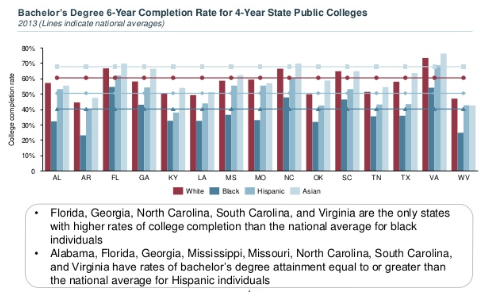
College completion rates for black and Hispanic students in the South are lower overall than national averages. Source: Chronicle of Higher Education
All of which leads to the above chart on six-year college competition rates. It’s difficult to read, but the chart shows college completion rates by ethnic subgroup (white, black, Hispanic and Asian) in the columns and compares those respective rates to the national average (the lines).
To keep from causing squint damage to your eyes, all four Florida subgroups exceed the national average for each subgroup in college completion. Stare long and hard at the chart and you’ll see some other interesting details: the six-year college graduation rate for Florida Hispanic students is higher than the national average for Anglo students. Florida’s black student graduation rate is not only above the national average for black students, it also is above the higher national average for Hispanic students. Florida’s black students have higher graduation rates than white students in Kentucky, Louisiana, Oklahoma, Tennessee and West Virginia.
More progress is needed, but …
Bellwether rightly gives credit to a “first wave” of K-12 reform-minded Democrat governors like Mark White, Bill Clinton and Jim Hunt. This, of course, also is the case with Florida. Shifting partisan allegiances brought in a Republican K-12 reform wave during the 1990s featuring George W. and Jeb Bush.
A new wave is needed, as the region remains a long way from providing globally competitive education.
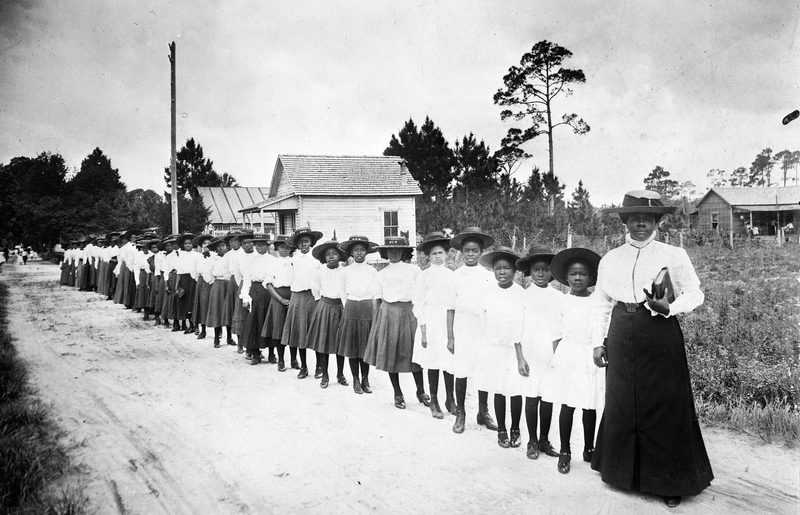
Editor’s note: This month, redefinED is revisiting the best examples of our Voucher Left series, which focuses on the center-left roots of school choice. Today’s post from June 2016 tells the story of civil rights activist and school choice pioneer Mary McLeod Bethune, who started a private, faith-based school for African-American girls in 1904 that became known as Bethune-Cookman University.
How fitting: The choiciest of school choice states may soon be represented in the U.S. Capitol by the statue of a school choice pioneer.
A state panel nominated three legendary Floridians for the National Statuary Hall last week, but the only unanimous choice was Mary McLeod Bethune. The civil rights activist and adviser to President Franklin D. Roosevelt is best known for founding the private, faith-based school that became Bethune-Cookman University.
Assuming the Florida Legislature gives the Bethune statue a thumbs up too, more people, including millions of tourists who visit the hall each year, may get to hear her remarkable story. And who knows? Maybe they’ll get a better sense of the threads that tie the fight to educational freedom in Bethune’s era to our own.
With $1.50 to her name, Bethune opened the Daytona Educational and Industrial Training School for Negro Girls in 1904. There were public schools for black students in early 1900s Florida, but they were far inferior to white schools.
Bethune’s vision for something better was shaped by her own educational experience.
She attended three private, faith-based schools as a student. She taught at three private, faith-based schools before building her own. In every case, support for those schools, financial and otherwise, came from private contributions, religious institutions – and the communities they served. Backers were motivated by the noble goal of expanding educational opportunity. Black parents ached for it. That’s why, in the early days of her school, Bethune rode around Daytona on a second-hand bicycle, knocking on doors to solicit donations. That’s why her students mashed sweet potatoes for fund-raiser pies, while Bethune rolled up the crust.
Failure was not an option, because failure would have meant no options.
Goodness knows, I’m no expert on Mary McLeod Bethune. But given what I do know, I think she’d be amazed at the freedom that today’s choice options offer to educators. More and more teachers, especially in choice-friendly states like Florida, are now able to work in or create schools that synch with their vision and values – and get state-supported funding to do it.
Bethune was forever hunting dollars to keep her school afloat, and it wore her down. In 1902, she asked Booker T. Washington for money. In 1915, she asked philanthropist and civil rights advocate Julius Rosenwald for money. In 1920, she made a pitch on the letters page of the New York Times. (All of this can be found in “Mary McLeod Bethune: Building a Better World,” a nice collection of Bethune’s writing.)
In 1941, Bethune even asked FDR. “I need not tell you what it has meant in Florida to try to build up a practical and cultural institution for my people,” she wrote to the president. “It has taken a wisdom and tact and patience and endurance that I cannot describe in words.”
“We are now in desperate need of funds,” she continued. “My nights are sleepless with this load upon my heart and mind.”
I can’t help but wonder what a superhero like Bethune could have done, had Florida had vouchers and tax credit scholarships a century ago. I don’t mean to dismiss the inequity in funding for choice programs – it’s real, and it deserves more attention – but inequity is relative. The funding streams available for low-income students today would have allowed Bethune to park the bike, forget the pie crust and focus on her core mission.
It would also have allowed her to rally more to the cause.
Bethune, who initially hoped to be a missionary, understood how much education and faith are intertwined for so many parents, and that it doesn’t make sense to pit public against private, or one school against another.
In 1932, she weighed in on a feud between state teacher colleges with an essay that foreshadows the all-hands-on-deck views of many of today’s choice supporters. She referenced the massive number of truant African American students and the “pitiful handful” that graduate from high school. “Unfriendly rivalry was never more needless, never more inexpedient among the schools of Florida than just now,” Bethune wrote.
The same could be said for K-12 education today.
Somehow, though, Bethune managed to end her essay on an up note, with an appeal to common ground:
Florida faces a new day in education. Grim as the picture appears today, it is not nearly so bad as it was just a few years hence, and the aspect is rapidly changing for the better; a veritable miracle is transpiring before the eye. The day for which many warriors now aging in the service have longed, the day for which they have prayed and sweat drops of blood – that new day of the hoped-for better things is approaching. With the scent of victory in the nostril, may every agency redouble its zeal; with jealousies forgotten, with the spirit of competition thrust aside, may every organization and individual unite under the banner of One Common Cause, the grim battle against ignorance and vice, and carry the issue to a glorious victory.
A few months ago, the latest results from the National Assessment of Educational Progress – the gold standard of standardized tests – showed Florida, again, made a national splash. This time, it notched the biggest gains in America.
Florida now ranks No. 1, No. 1, No. 3 and No. 8 on the four core tests on The Nation's Report Card, after adjusting for demographics.
You’d think the biggest gains in America would prompt applause from school boards, superintendents, teacher unions, and allied lawmakers. But no. In Florida, good news about public schools is increasingly ignored by public school groups; media coverage is mostly crickets (recent exception here); and alternative facts seed conspiracy theories.
No wonder, then, that plenty of candidates for political office are again vying to see who can flog the system the most. One gubernatorial candidate says “we are experiencing a true state of education emergency,” citing a single, obscure (at least in education circles) ranking, based on an especially crude set of indicators. Another says “Florida’s education reform has been a failure” while citing no evidence at all.
Deny and distort. Refuse to acknowledge progress. Demonize anybody who does. This is what “debate” over Florida education has come to.
Measures like NAEP scores continue to show the system is not only better than ever, but, in some ways, among the best in America. Yet to many, it’s still Flori-duh.
The tragic result is Florida teachers don’t get credit they deserve. And every day Floridians have no idea their public schools are on the rise.
Consider:
Civil rights activist Mary McLeod was a school choice pioneer, opening a private, faith-based school for African-American girls in Daytona in 1904. The state of Florida may honor her with a statue in the U.S. Capitol. (Image from Wikimedia Commons.)
This is the latest in our series on the center-left roots of school choice.
How fitting: The choiciest of school choice states may soon be represented in the U.S. Capitol by the statue of a school choice pioneer.
A state panel nominated three legendary Floridians for the National Statuary Hall last week, but the only unanimous choice was Mary McLeod Bethune. The civil rights activist and adviser to President Franklin D. Roosevelt is best known for founding the private, faith-based school that became Bethune-Cookman University.
Assuming the Florida Legislature gives the Bethune statue a thumbs up too, more people, including millions of tourists who visit the hall each year, may get to hear her remarkable story. And who knows? Maybe they’ll get a better sense of the threads that tie the fight to educational freedom in Bethune’s era to our own.
With $1.50 to her name, Bethune opened the Daytona Educational and Industrial Training School for Negro Girls in 1904. There were public schools for black students in early 1900s Florida, but they were far inferior to white schools.
Bethune’s vision for something better was shaped by her own educational experience.
She attended three private, faith-based schools as a student. She taught at three private, faith-based schools before building her own. In every case, support for those schools, financial and otherwise, came from private contributions, religious institutions – and the communities they served. Backers were motivated by the noble goal of expanding educational opportunity. Black parents ached for it. That’s why, in the early days of her school, Bethune rode around Daytona on a second-hand bicycle, knocking on doors to solicit donations. That’s why her students mashed sweet potatoes for fund-raiser pies, while Bethune rolled up the crust.
Failure was not an option, because failure would have meant no options.
Goodness knows, I’m no expert on Mary McLeod Bethune. But given what I do know, I think she’d be amazed at the freedom that today’s choice options offer to educators. More and more teachers, especially in choice-friendly states like Florida, are now able to work in or create schools that synch with their vision and values – and get state-supported funding to do it. (more…)

Student achievement is more equitable, and improving more quickly, than the national average, but still trails the rest of the country in absolute terms. Source: Education Week, 2016 Quality Counts
It might have been a rocky year for education policy in Florida. But the latest rankings from Education Week show when it comes to student achievement, things remain fairly steady.
 The 2016 “Quality Counts” report, released this morning, shows Florida continues to rank average to poor on many key academic indicators, but – with one notable exception – high in making progress and closing achievement gaps.
Overall, the state ranked No. 29 among 50 states (No. 30 with Washington D.C. in the mix), down from No. 28 last year. Gradewise, that’s a C-, compared to a C for the nation.
In K-12 achievement, Florida slipped from No. 7 to No. 11. It again posted a C. The nation again posted a C-. The top-ranked state, Massachusetts, earned the only B.
It wouldn’t be surprising if critics of Florida’s ed reform track point to the rankings as evidence of a slide, but so far the numbers don’t support the claim.
Between 2009 and 2013, Florida landed in or near the Top 10 every year in overall ranking. But after not giving grades in 2014, Education Week switched to a new matrix last year that cut the grading categories from six to three. The new formula nixed categories where Florida historically fared well, such as standards and accountability, and left two where it hasn’t: education spending and an EdWeek creation called the Chance-for-Success Index.
(For what it's worth, I find some of the sub-categories in the Chance-for-Success Index odd. Florida gets dinged, for example, because it has a lot of working-class folks who aren't college educated, or who don't speak English well. Yet evidence is strong that Florida's education system overcomes challenging demographics better than the vast majority of states.)
In the category that matters most, Florida has been on a roll.
Since 2009, it’s finished at No. 7, No. 7, No. 6, No. 12, No. 12, No. 7, No. 7 and now No. 11 in achievement. (more…)

