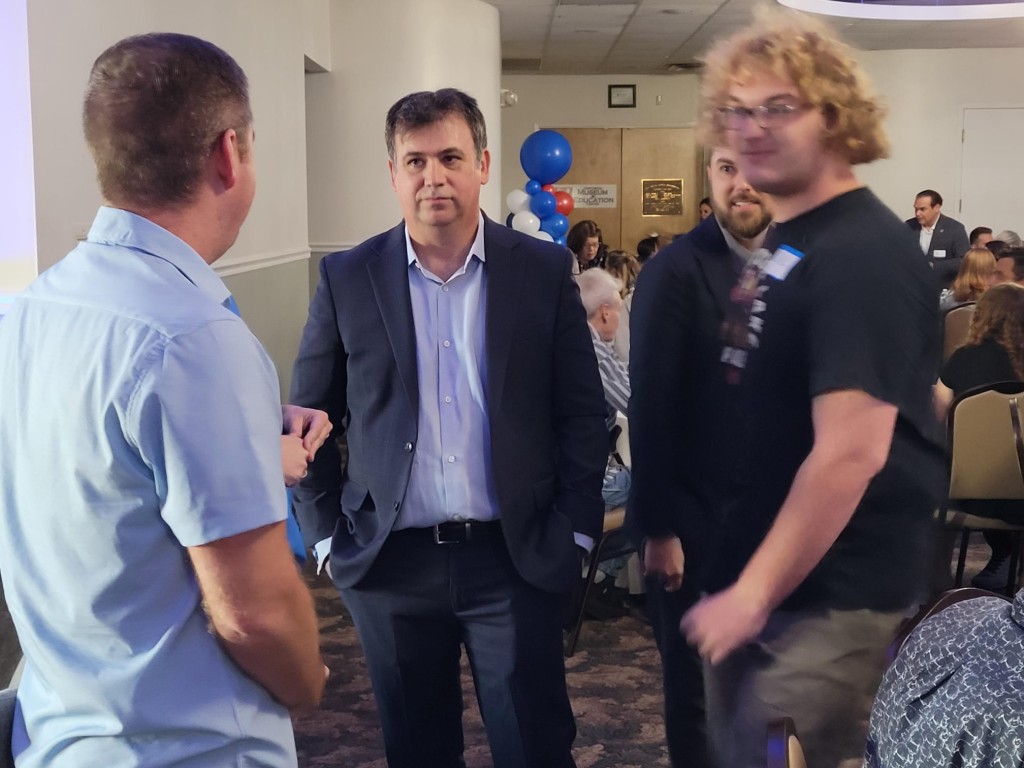
Some of the biggest names in Pasco County politics along with parents and other supporters were present April 20 as former Florida state lawmaker John Legg kicked off his campaign for Pasco County Schools superintendent at Phi Delta Kappa Hall in Odessa.
ODESSA, Florida —With the puck about an hour from dropping at a Tampa Bay Lightning playoff game, John Legg didn’t want to risk alienating his fellow hockey fans. He promised to talk fast and get everyone home on time so they could watch the game.
As the Bolts prepared to face a hostile crowd at the Toronto Maple Leafs’ Scotiabank Arena, the founder of Pasco County’s oldest charter school and a former state lawmaker found himself on home ice last week, surrounded by his most loyal fans, as he dropped the puck on his 2024 campaign for Pasco County superintendent of schools.
Unlike the Lightning, whose ultimate goal is to take home the Stanley Cup, Legg isn’t looking to take home a trophy.
“Our purpose is not to get me elected, because if the purpose is to get a person or a politician elected, we have failed,” Legg said. “Our purpose is to help the kids in Pasco County. It is to ensure that the baton is passed, and every child, no matter where they come from, no matter their income level, no matter what happens to them, they have an opportunity to succeed.”
Despite the display of humility, Legg is entering the race with a long list of wingers that include virtually all of the county’s – and some of the state’s – most powerful officials.
Three of five Pasco County School Board members, plus a former board member, showed up to the campaign kick-off. The board chairwoman, a former student and teacher at Dayspring Academy, the school Legg founded with his wife, Suzanne, gave the opening speech.
Other VIPs attending included the county sheriff, three county commissioners, the president of one of Florida’s state colleges, the public defender, the clerk of the circuit court, and the county tax collector, who once wielded tremendous power in Tallahassee as a House majority leader and Senate president pro tem.
(Legg, also, was a House speaker pro tem and chaired education committees in both chambers of the state legislature. You can see a complete political bio here. Additionally, he is a member of the governance board for Step Up For Students, which hosts this blog.)
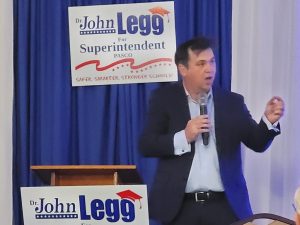
Legg shared his philosophy that parents have a critical role in their child’s education during the kickoff of his campaign for Pasco County Schools superintendent.
Though Legg didn’t delve deeply into policy at the event – this crowd already gets it – he and other speakers praised the principles behind education choice and parental empowerment.
“Dr. Legg is a champion for children and their families, the board chair, Megan Harding, said. “He has worked so hard to move the needle to ensure that all children receive the world-class education that they deserve.”
During his speech, Legg recalled his humble origins as a child growing up in Hudson, a community on Pasco County’s northwest coast, where the per capita income in 2022 was $30,567. In 2020, the school board closed the neighborhood elementary school after it received only one grade above a D in nine years.
Legg said his childhood experience drives his passion to extend opportunity to all children regardless of income.
“The idea of higher education and economic opportunity really wasn’t in our family’s background because we were low income,” said Legg, who holds a doctorate in education. “Kids like us didn’t go to higher education. Kids like us didn’t get post-secondary training. We didn’t even know what post-secondary training meant.”
Legg began his higher education journey at Pasco-Hernando State College, a two-year community institution at the time. A crusty volunteer tutor named Charles Whitehead helped him pass basic algebra. Whitehead and others, Legg said, inspired him to want to pay it forward.
In 2000, Legg, working as a legislative aide at the state Capitol, founded Dayspring. The school, less than 5 miles from struggling Hudson Elementary, serves students in pre-kindergarten through 12th grade across five campuses.
Dayspring has consistently earned an A rating from the state and maintains a waitlist of about 1,400 students, 43% of whom are classified as economically disadvantaged. Legg said allowing students to leave schools that are failing or simply not the best fit creates opportunities for everyone to have a chance to achieve success in life.
“Every child, every person, belongs to the parent and not the school system. Not the bureaucracy,” he said to audience applause. “Parents have a critical role in their child’s education and should be empowered to make choices.”
While that statement may seem bold to those who live in other places, it doesn’t break new ground in Pasco, which has a track record for expanding choice within the district and partnering with charter schools, including Dayspring, to accommodate the county’s rapid growth.
Last month, Magnet Schools of America selected current Pasco Superintendent Kurt Browning as its Superintendent of the Year. The school district has opened 26 new magnet schools and programs with topics and fields of study based on community need and student interest. Options have expanded to include fine arts, career and technical programs, early college, and computer science pathways.

Legg and his family are avid Tampa Bay Lightning fans.
Browning, whose announcement last summer that he would not seek a fourth term as superintendent prompted Legg to file his candidate paperwork the next day, consolidated all types of choice programs, which had previously operated separately, under a single district department.
"If we're going to compete, then we've got to provide what moms and dads are looking for," Browning told the Tampa Bay Times in 2015.
If elected, Legg would be the first person with a charter school background to take the helm of the county school district, the largest in the nation that still elects its superintendent. But he would not be the first charter school founder to take on a leading role governing public school districts.
John King Jr., who served as U.S. Secretary of Education under President Barack Obama, founded Roxbury Prep, a top charter middle school in Massachusetts, and later led Uncommon Schools, a network of nationally recognized charters. In 2011, the National Alliance for Public Charter Schools inducted King into the Charter School Hall of Fame. Last year, he became the 15th chancellor of State University of New York.
Even if Legg loses, education choice will be the winner in Pasco.
Chris Dunning, a longtime principal in the district, now leads Wendell Krinn Technical High School and is running as a no-party candidate. Krinn, the district’s first technical magnet high school, opened in 2018 and provides opportunities for students in 14 career areas including biomed, cybersecurity, pre-engineering, HVAC, and welding.
Dunning, who, like Legg, has a doctorate in education, has devoted a section of his campaign website to school choice and wants to add specialty programs across the district so that transportation to non-zoned schools is not an obstacle to those seeking access.
Regular school board attendee Michelle Mandarin, who calls herself “a Mama Bear fighting for better education” on her campaign website, also is running for the top seat. She has positioned herself as an education choice advocate, championing the need for more parental control in education decisions.
No Democrat has entered the race in Pasco, once a swing county that has since turned ruby red and where most local races are decided in GOP primaries. The last Democrat to hold countywide office was tax collector Mike Olson, who died less than a year after winning re-election and beginning his 33rd year in office.
Election day is 18 months away, a lifetime in politics. But if money is a predictor, Legg, who has $148,675 in his campaign fund compared with Dunning’s $6,320 and Mandarin’s $0, appears set to score on a power play.
Winning a third elected office, the superintendency, would give Legg the hat trick of his political career.
 Editor’s note: This commentary from Ben DeGrow, policy director of education choice at ExcelinEd, appeared Thursday on the ExcelinEd website.
Last month, the nation took notice as Florida fully opened the doors of education freedom to K-12 students in the Sunshine State by making all families eligible for an education scholarship account.
On July 1, Florida is set to become the third state in the nation to launch an ESA program with universal eligibility.
Budget negotiations, now underway, will determine the number of scholarships available in the upcoming school year. In recognizing program dollars would be limited, policymakers also ensured that the new law guarantees students from households at the lower end of the spectrum are near the front of the line.
An additional feature of the Sunshine State’s enhanced ESA program will soon benefit many families that receive a scholarship: choice navigation. Florida parents will have the option to use some of their ESA funds for a credentialed consultant, known as a choice navigator, who can help them choose the most effective curricula, academic programming or support services for their child.
Similarly, the state’s education department has been charged with developing an online portal that will be able to recommend specific schools and other resources based on a student’s needs and interests.
The wealth of options unlocked by ESAs can be a huge benefit. Yet a quick look at other states suggests this also can be overwhelming. Arizona’s universal ESA program has approved nearly 3,000 different service providers that parents can select from on the state’s digital direct pay platform. More than 1,000 options are for tutors alone.
In New Hampshire, the state’s Education Freedom Accounts—after less than two years in operation—enable participating families to use their funds at any of more than 650 schools, tutors, therapists, educational programs and retail vendors.
In some states, nonprofit organizations fill the valuable role of informing parents about their options in various school choice programs. Parents for Educational Freedom in North Carolina operates a website that lets users search and compare different kinds of schools. In Texas, Families Empowered is assisting parents of special-needs students who receive a $1,500 microgrant.
There’s also a private initiative created by the founders of the online course platform Outschool. The company’s nonprofit arm is focused on helping low-income and minority families navigate the nontraditional path of customized learning through an innovative approach called Outbridge.
In a partnership with the Engaged Detroit homeschool co-op, Outbridge provides a menu of community-based and virtual learning options for parents to purchase with pre-authorized debit cards. Early results show parents have diverse spending habits, but they tend to favor known local resources over remotely accessed providers.
With on-the-ground partner AmplifyGR, Outbridge has launched a parallel project in Grand Rapids, Michigan, for parents of district and charter school students to identify and purchase supplemental services.
In both of these communities, trained coaches also help to give further guidance to parents who struggle with their decisions. This has proven especially helpful to those long accustomed to having limited resources for their children. Outbridge has seen more parents make spending decisions immediately after holding in-person community events designed to provide more hands-on information.
Florida’s program administrators and prospective navigators may learn some helpful lessons from these pilot efforts to benefit families. Meanwhile, leaders in other states with expansive choice could embrace this kind of assistance as a priority. That’s one way to help ensure the promise of universal ESAs doesn’t leave anyone behind.
 Editor’s note: This commentary from Danny Aqua, executive director of Teach Florida, appeared Monday on sun-sentinel.com.
Last month, Gov. Ron DeSantis signed into law the largest expansion of school choice in U.S. history. The legislation, a top priority of House Speaker Paul Renner, expands the state’s scholarship program to all K-12 students in Florida. It’s nothing short of transformational.
But what does that mean for you and your family? The simple answer is: More options and more opportunities.
Beginning as early as this summer, every student in Florida will have the freedom to access a scholarship enabling them to attend a school that works best for them. If your child is one of the thousands of students with unique abilities or disabilities who were on a scholarship waitlist, there is now funding available to clear that waitlist.
Before discussing the technical details of applying, let’s talk about why this year’s legislative budget proposals benefit not just scholarship students, but everyone.
The House and Senate each proposed a record $2.1 billion in spending increases for K-12 education — the largest funding increase in Florida history. It’s so groundbreaking that both Republicans and Democrats spoke in support of the proposal. So did several school districts.
Students are the real winners, because these proposals simultaneously solidify Florida’s commitment to provide students with every possible option through school choice while also strengthening funding for public schools.
But how is this possible?
In Florida, we have a booming economy, healthy state reserves and revenue projections that continue to shatter expectations. It’s the result of years of smart decisions by elected officials to put us in a strong fiscal position. There is no need to make difficult trade-offs.
To continue reading, click here.
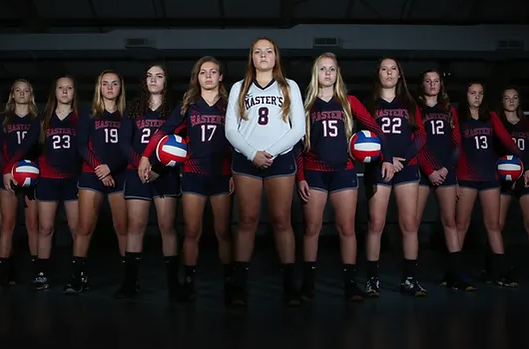
At Master’s Academy in Vero Beach, Florida, the volleyball program seeks to provide a competitive and successful opportunity that points players to Christ and builds the character of Christ within each student athlete.
One of several bills that would let charter school students play sports and participate in extra-curricular activities at willing private schools has cleared the Florida Legislature and awaits Gov. Ron DeSantis’s signature.
In a display of bipartisanship, all 116 of the House members who were present voted to approve SB 190, which was substituted for its companion, HB 225.
Both bills would allow charter school students to play on private school sports teams and participate in private school extra-curricular activities fi a private school agrees. Current law already allows homeschooled students to do this, and these bills would extend the same provisions to those who attend charter schools and Florida Virtual School.
The vote came nearly a month after the Florida Senate gave final approval in a 38-0 vote.
“We are just absolutely thrilled,” said Wayne Smith, head of school at Master’s Academy, a small private Christian school in Vero Beach that served as the inspiration for the bill. He said the outcome could be a good civics lesson for his students, who were demoralized when the Sunshine State Athletic Association disciplined the school for letting students at a nearby charter school to play on its varsity football team.
Under current law, if a specific program isn’t available at a charter school, the only option for those students is to sign up for it at their zoned district schools. The proposed legislation would let charter students choose between the district school and or a nearby private school through a special agreement.
However, the arrangement at Master’s Academy had been going on for years without controversy, based on an interpretation of the law that allowed the homeschoolers to play at private schools.
Last year, someone complained, and the Sunshine State Athletic Association forced the charter school students off the team in the middle of the season and stripped Master’s Academies of its victories up to that point.
Smith said the decision left the students heartbroken but motivated.
Members of school tennis and baseball teams stepped up to fill the vacancies on the football team. Despite the disciplinary action, the school ended up winning the championship.
News about the controversy got the attention of the community’s state senator. Sen. Erin Grall, a Republican whose district includes Vero Beach, responded by sponsoring SB 190.
“The parent makes the decision not to send their child to the public school they’re zoned for and instead chooses to send their child to a charter school,” she said during a committee meeting on the bill. “This lines up the homeschooling statute with the charter school statute … to fix it and make it more clear.”
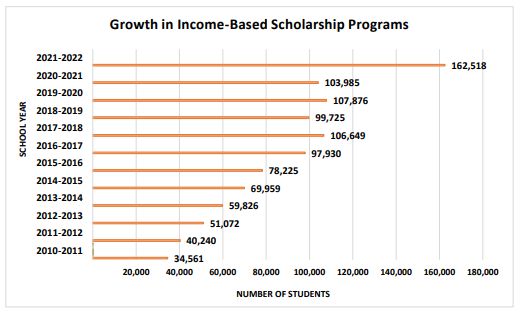 The number of Florida students participating in income-based scholarship programs served by Step Up For Students over the past 12 years has grown dramatically, from 34,561 in 2010-11, to 162,518 in 2021-22, according to a new report by Step Up For Students, the nonprofit scholarship funding organization that helps administer the scholarships and which hosts this blog.
The largest increase in Step Up students occurred between 2020-21 and 2021-22, however this was due to Step Up taking over stewardship of enrollment numbers of the Family Empowerment Scholarship for Education Options (FES-EO), a program that had previously been administered by the Florida Department of Education. Statewide enrollment for income-based scholarships increased from 142,716 to 162,518 when all sources of enrollment are included.
In the most recent year, a total of $1,715,159,524 was awarded to families from Step Up.
The annual end-of-year report looked at characteristics of private schools and enrolled students who received a Florida Tax Credit Scholarship or a Family Empowerment Scholarship for Educational Options through Step Up For Students, examining the distribution of private schools by various attributes and calculating graduation rates for 12th grade scholarship students enrolled in these schools.
Additionally, the report analyzed student demographics both in overall program enrollment and graduation rates.
Among the findings:
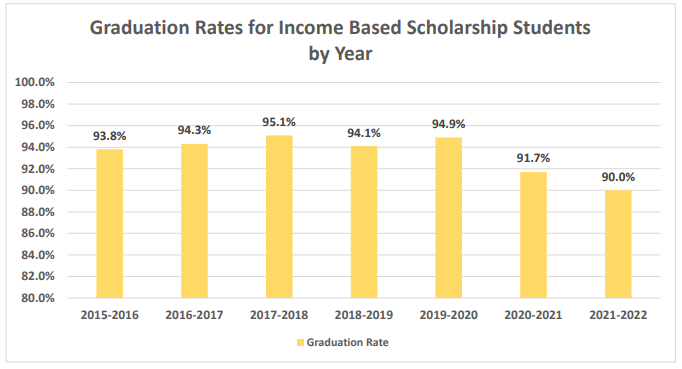
The graduation portion of the report was modeled after the National Center for Education Statistics’ biennial report, “Characteristics of Private Schools in the United States: Results from the 2019-2020 Private School Universe Survey.”
Data from the Florida Department of Education were utilized to examine these private schools along with data collected by Step Up For Students through school surveys. Data on religious affiliation were collected at the school level. Information about students’ gender, race/ethnicity, grade, single parent household status, poverty level, and graduation status were collected at the student level.
The survey received a 92.4% response rate.
*Edited to clarify that part of the growth in scholarships awarded by Step Up For Students was due to administrative changes in the FES-EO scholarship.
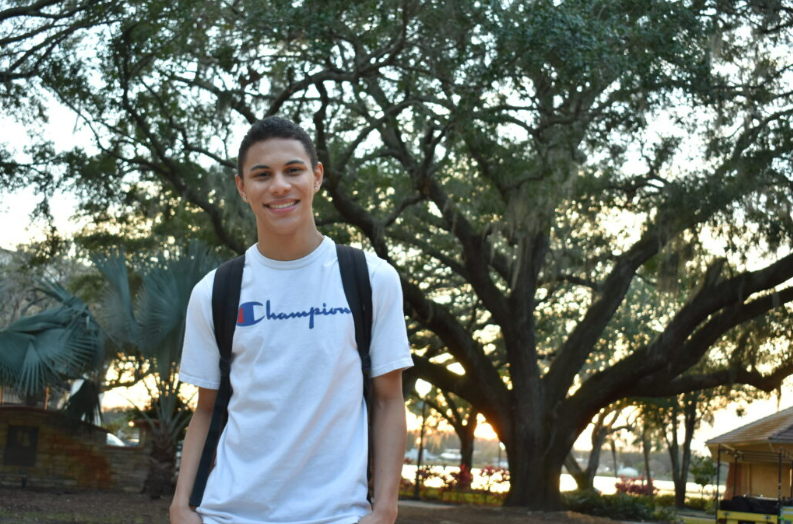
Jaylen Arnold, 22, has spoken to more than 300,000 students in 38 states and the United Kingdom and has educated many more online about Tourette Syndrome.
LAKELAND, FLA – Jaylen Arnold was 8 when he walked into his old elementary school to speak with two dozen or so former classmates, many of whom had recently taunted and physically bullied him.
Jaylen was scared. His mother, Robin, walking beside him, was proud.
The meeting was Jaylen’s idea. He wanted to explain what others saw as his unusual life.
Jaylen has Tourette Syndrome, a neurological disorder that causes sudden unwanted and uncontrolled rapid and repeated movements or vocal sounds called tics. He was an easy target, and the abuse from his peers sent his tics into overdrive.
He was classified as hospital homebound by his doctor and Robin removed him from the school.
Jaylen, now a senior at Southeastern University in Lakeland, has been an advocate for those with Tourette Syndrome and those who have been bullied for the last 14 years.
An education choice scholarship was about to change Jaylen’s life for the better.
It allowed him to attend a private school near his Lakeland home. There, Jaylen found schoolmates who looked past his Tourette’s, autism and obsessive-compulsive disorder and saw a likeable, intelligent and talented friend.
“He was accepted and loved,” Robin said.
It was acceptance and, if not love, at least tolerance that Jaylen wanted for others when he returned that day 14 years ago to his old school and met with his old classmates. He wanted to teach them about Tourette’s, hoping education would lead to understanding and that would reduce the bullying if not remove it completely.
“I wanted to go back and educate those who were tormenting me because who knows what kind of chain reaction that could have,” Jaylen, now 22, said.
There was a chain reaction, and it was nothing Jaylen or his mom envisioned.
To continue reading, click here.
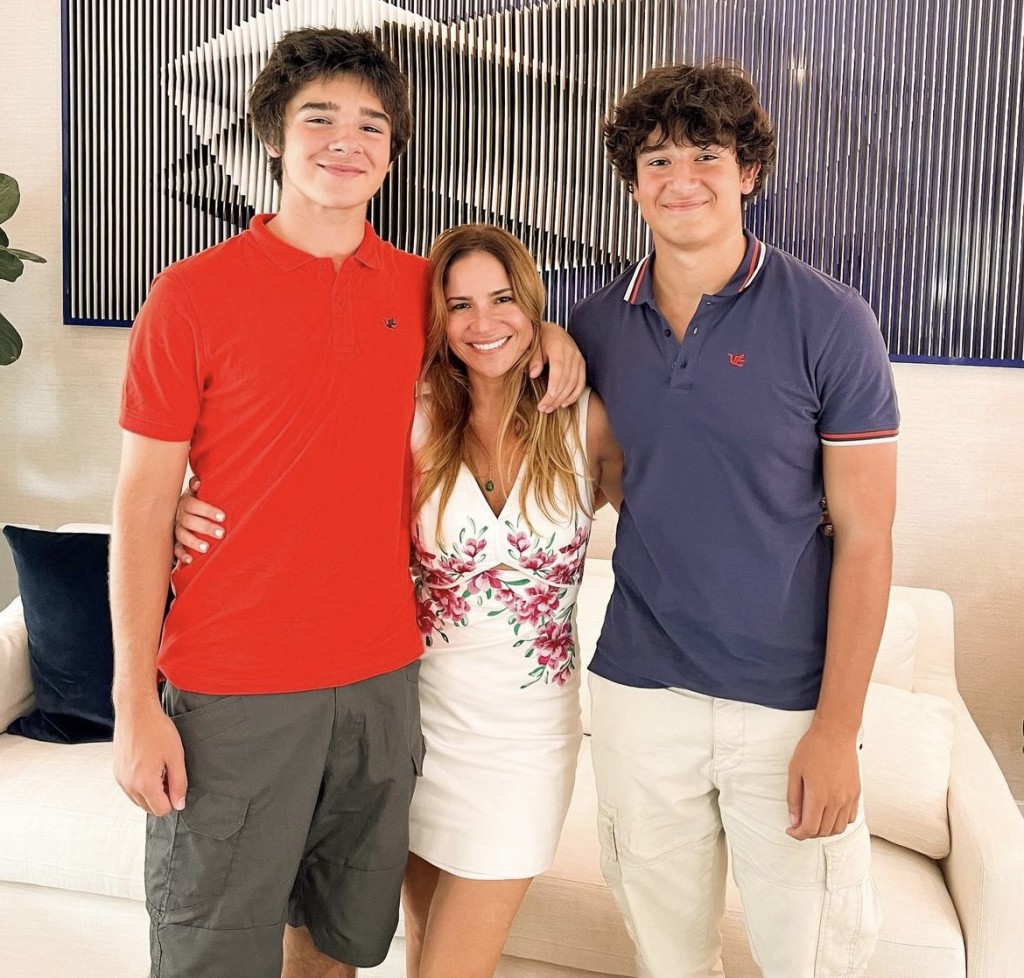
Aimee Uriarte and her two sons, 15-year-old Alejandro, left, and 17-year-old Sebastian, right.
On this episode, reimaginED senior writer Lisa Buie talks with Aimée Uriarte, a single parent whose two sons attend Christopher Columbus High School, an all-male Catholic school in Miami.
 Older son Sebastian, 17, receives a Family Empowerment Scholarship for Educational Options, while his brother, Alejandro, 15, attends on a Family Empowerment Scholarship for students with Unique Abilities.
A Costa Rica native, Uriarte moved to the United States but left in 2008 due to the Great Recession. One of the reasons she returned to Florida was to ensure her children received opportunities for an education that best fit their needs. Columbus High fills that bill and more, she said.
Uriarte, who was among the scholarship beneficiaries who spoke during the recent signing ceremony for HB1, a major education choice expansion bill, said she looks forward to the additional flexibility the legislation will bring to her family and others.
“The Columbus staff has come through, truly as a family, I never expected this compassion regarding our family's reality. Every family has different struggles … they are very hands on, all of them, and they’re very concerned about the wellbeing of each family.”
EPISODE DETAILS:
RELEVANT LINKS:
https://www.fldoe.org/schools/school-choice/k-12-scholarship-programs/fes/
 Editor’s note: This opinion piece from William Mattox, director of the J. Stanley Marshall Center for Educational Options at The James Madison Institute and a reimaginED guest blogger, appeared Monday on floridapolitics.com.
At a Miami education conference several years ago, I heard a comment every Florida legislator ought to hear — perhaps especially now that the House and Senate are wrangling over differences in their respective budgets.
The comment came from an anti-poverty expert from another state who had carefully studied Florida’s school choice policies. While he supported Florida’s K-12 scholarships for low-income students, he nevertheless argued for universal coverage for all families (regardless of income).
“Even if one is only concerned about helping the poor, universal is the way to go,” the anti-poverty advocate said. “Because universal coverage means the scholarships low-income children so desperately need will be broadly supported and widely usable.”
I was reminded of this counterintuitive observation recently when the House passed a budget that included changes to the Florida Education Funding Program (FEFP) formula. The changes read like the arcane fine print in a financial disclosure agreement, but they have important implications for Florida’s newly adopted universal K-12 scholarships.
Here’s why.
Under the House budget, all Florida families would be guaranteed funding for a K-12 scholarship just as they are guaranteed free public schooling. Under the Senate’s proposed budget, newly eligible families would only receive K-12 scholarships if there’s enough money available.
That description of the Senate’s plan probably sounds more ominous than it should. Because the Legislature has consistently increased scholarship funding any time a waiting list develops so that families aren’t denied help for years on end.
Still, there’s reason to strongly favor the House’s guaranteed-scholarship plan because it brings to the K-12 education marketplace something that has been sorely missing — certainty.
To continue reading, click here.
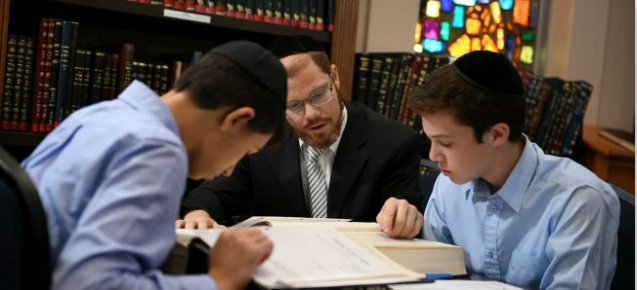
Students from junior pre-K through high school at Yeshiva Toras Chaim Toras Emes in North Miami Beach, Florida, receive education in Limudei Kodesh in conjunction with a rigorous secular studies program that focuses on building strong minds and strong characters in a warm, welcoming learning environment. Lessons are tailored to each student’s unique learning style and needs.
Editor’s note: This article appeared Tuesday on ou.org, the website of the Orthodox Union. You can read a story about Jewish day schools and education choice from reimaginED senior writer Lisa Buie here.
Leaders from six Jewish day schools in South Florida recently convened to discuss the historic school choice expansion that Gov. Ron DeSantis signed into law on March 27. The new law expands scholarships to all K-12 students in the state and will give approximately $8,000 per student.
This could bring as much as $40 million of new funds into Jewish day schools, which will help alleviate South Florida families who are struggling with the private school tuition crisis. One concern shared by many parents is that the influx of these funds will cause schools to raise tuition by $8,000, which would negate the affordability factor.
To address this issue, representatives from Jewish day schools met in a small focus group with staff members and the executive committee from Teach Florida, a project of the Orthodox Union, the nation’s largest Orthodox Jewish umbrella organization. The schools strongly affirmed that affordability is a critical component of their educational mission and will remain a key focus for them moving forward.
“Affordability is an important value of our schools,” says Teach Florida Engagement Director Melissa Glaser. “They don’t intend to take the state funds and then turn around and increase tuition by an equivalent amount. The schools recognize the value of affordability, and their goal is to support families receiving much-needed relief funds toward tuition, while providing a quality education to their students.”
Rabbi Bernstein of Toras Emes agrees, and says, “Over the last decade, we raised tuition very minimally as we value affordable education for our families. This year, before learning of the school choice bill, we made the decision to raise tuition due to incredible hiring challenges and inflationary costs.”
He adds, “We fully support the fact that school choice funds are intended as a relief for parents and will not be viewed as extra entitlement for the school.”
To continue reading, click here.

Lilly Bowden of Plant City, who is homeschooled by her mother, Debbie, receives funding for school supplies, including a computer and printer, books, a telescope and a microscope, through Florida’s Family Empowerment Scholarship for Students with Unique Abilities.
PLANT CITY – Lilly Bowden flipped through her sketch pad and proudly showed off her work. There’s a fox on one page and a cat on another. A giraffe from the neck up and a mountain range in all its purple majesty.
One drawing begins on one side of a page and ends on the other, forming a U-shape. A snake? An eel?
“I have no idea what that is,” Lilly said.
More pages, more drawings. An armadillo. A seahorse. A seashell. A leaf. One page has a pineapple, a watermelon, and some grapes.
“It’s a still life,” Lilly said. “Kind of abstract.”
Lilly, 12, wants to be an artist, and she’s taking her first steps with the “Drawing Lessons for Beginners” DVD purchased with her education savings account that comes with the Family Empowerment Scholarship for Students with Unique Abilities. Managed by Step Up For Students, (which hosts this blog) the ESA gives parents the ability to customize their child’s educational needs.
The money can be used for curriculum and education materials, therapies and medical specialists, tutors, and tuition to private schools.
“The scholarship has been such a blessing for us,” said Debbie Bowden, Lilly’s grandmother and legal guardian.
Lilly was born with pulmonary atresia with ventricular septal defect, a congenital heart disease that left her with one working ventricle. She’s had three reconstructive heart surgeries, one each year for three years beginning when she was 1.
When she was 5, a blood clot led to a stroke, which led to the diminished use of her right arm and hand.
She has a pacemaker. She has scoliosis and wears a back brace 20 hours a day. She has several allergies.
Because of Lily’s weakened heart, a minor cold can turn into pneumonia and land her in a hospital for two weeks. A growth spurt could place too much stress on her heart and prove deadly, Debbie said.
“With Lilly, we take it one day at a time. For everything that’s she’s got, she’s still a fighter. She’s lived a lot longer than they ever thought she would,” Debbie said.
To continue reading, click here.

