Washington: Supporters of a charter school ballot initiative raise $5 million in six weeks, including another $2 million from Bill Gates (Associated Press).
California: A judge rules that parents who won a parent trigger battle can open a charter school next fall (Los Angeles Times).
Florida: A new initiative to put more students into STEM fields taps students in traditional, magnet and charter schools (redefinED). A long-troubled Imagine charter school continues to test the patience of the school board in Pinellas County (Tampa Bay Times). In Palm Beach County, thousands of parents and students show up for a school choice showcase that includes magnet and charter schoools (Palm Beach Post).
Pennsylvania: Republican lawmakers postpone discussion on a proposed statewide authorizer for charter schools (Pittsburgh Post Gazette). The U.S. Department of Education questions how state education officials revised rules to gauge whether charter school met academic standards (Philadelphia Inquirer). A bill to toughen oversight of charter schools dies in the state House (Associated Press).
Georgia: State senate candidates are divided over charter schools and a charter school ballot initiative (Douglas County Sentinel).
New Jersey: Charter schools tied to the highly regarded KIPP network are gearing up to expand (NJSpotlight.com).
Louisiana: An effort to recall lawmakers who supported the state's new voucher program fizzles (Associated Press). (more…)

Paul Cottle
On his blog, Bridge to Tomorrow, Florida State University physics professor Paul Cottle laments that students aren’t getting the push they need from parents, guidance counselors and teachers to take tougher math and sciences classes in middle and high school.
The result: fewer students completing degrees in STEM fields, those high-tech, lucrative jobs in science, technology, engineering and math that both presidential candidates in Tuesday night’s debate deemed necessary to get the economy back on its feet and competitive with the rest of the world. So Cottle created what he calls the “antidote’’ - Future Physicists of Florida. And interestingly enough, the launching pad for his new program is built on traditional, magnet and charter schools.
Cottle said he doesn’t favor one type of school over another. The mix is really accidental. Once science teachers heard about the program, they reached out to him.
“We’re trying to find any way we can to get kids to take on these academic programs,’’ Cottle said. “I’m looking for great teachers anywhere.’’
And there are great teachers in all kinds of schools, he said.
Cottle’s program officially begins next month with an induction ceremony in Tallahassee. It will offer middle school students and their parents advice on which high school courses better prepare students for physical sciences and engineering majors in college.
“We know what students need to do to give them the best opportunities in STEM fields,’’ said Cottle, who was among the educators who helped craft Florida’s K-12 science standards.
He cites a 2007 University of South Florida study that found students who take physics in high school are twice as likely to earn a bachelor’s degree in a STEM field as those taking only chemistry. Such a degree will likely translate into a high-paying job upon graduation with some occupations, such as chemical engineering, commanding starting annual salaries of $70,000 or more.
Six public schools, including three charters, are taking part in the Future Physicists program. (more…)
Editor's note: We're going to try another something new on redefinED today - a brief, occasional and maybe even daily roundup of some of the latest education stories in Florida. We're based in Florida; many of our readers are in Florida; and so much is going on down here education-wise - so, we think it makes sense to compile and circulate the latest goings-on to our readers. We'll focus a lot on school choice coverage, but not exclusively. We might make a quick comment or add a complementary link, but often we'll just be logging in what the papers and blogs are reporting. So, here goes ...
 More trouble for an Imagine charter school. School board members in Pinellas County are running out of patience with the Imagine charter school in St. Petersburg, which has earned a string of D and F grades from the state, the Tampa Bay Times reports. We wrote about this Imagine school a couple months ago, after parents successfully pleaded with the school board to give the school one more chance.
Columnist skewers charter schools. Orlando Sentinel columnist Scott Maxwell takes charter schools to task because they "fail and close at an alarming rate."
Palm Beach County parents line up for choice. Thousands of parents and students in Palm Beach County flocked last night to a showcase for public school choice options, including magnet and charter schools, the Palm Beach Post reports. Said one parent: "I just hope I can get my kid in.”
Brevard schools see enrollment dip. The state's 10th biggest school district unexpectedly saw enrollment decline by 760 students this year, according to Florida Today. For what it's worth, according to our data, the number of students on tax-credit scholarships in Brevard climbed from 1,056 last year to 1,452 this year.
Sarasota County gets its 10th charter school. Story from the Sarasata Herald-Tribune here.
 Flap festers over achievement gaps goals. Both Gov. Rick Scott and Gary Chartrand, chair of the Florida Board of Education, issued statements yesterday in response to the board's decision last week to set different academic achievement targets for black, white, Hispanic and other subgroups. The targets incorporated steeper rates of improvement for groups with lower proficiency rates. Scott statement here. Chartrand statement here. Orlando Sentinel coverage here. Tallahassee Democrat story here.
 Florida’s next education commissioner will inherit a job that makes juggling chainsaws look easy. He or she must get under the hood of a complicated accountability system, ride herd on a historic shake-up of public education, dodge slings and arrows while walking a political tight rope and leap tall buildings in a single bound.
And yet, the job remains so compelling. Florida is the nation’s most promising bridge to an education system that can more fully give teachers and parents real power to help kids live out their dreams. In the last 10 to 15 years, no state has focused more on the low-income and minority students who are now a majority in Florida public schools. Simultaneously, no state has opened the door more to alternative learning options – options that have both empowered parents and multiplied the potential for educators to innovate. The result has been both dramatic and nowhere near enough. The next commissioner must find ways to continue the momentum.
To that end, we hope he or she can nimbly rotate hats long enough to also assume the role of explainer-in-chief. We know this won’t be easy; education reformers in Florida operate in an environment that is particularly tense and, in the past couple of years, has become downright ugly. But we can’t help but think that maybe, just maybe, the temperature will drop a few degrees if fair-minded people can be persuaded that not every education idea and not every education reform is a zero-sum proposition. Sometimes, they really can work in harmony with the other parts.
This is especially true with school choice. The sincere goal here isn’t “privatization,” it’s personalization. It’s about expanding options so more kids can be matched with settings that maximize their potential, and yes that includes private and faith-based options.
There’s no reason, and so far in Florida no demonstration, that these options have to come at the expense of traditional schools. It’s entirely possible – and many of us think it’s absolutely necessary – to support traditional public schools at the same time we push for additional options that, for individual students, may work better. (more…)
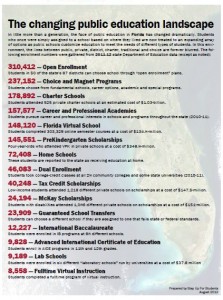 Though we know little about the parents who long have chosen their school through where they decide to live (or to pretend to live), Florida keeps count of those who no longer want their neighborhood school. And here's some data to chew on: In a state known for its breadth of learning options, that number last school year reached 1.2 million.
In other words, using a conservative approach with new 2011-12 enrollment records, 43 of every 100 students in Florida public education opted for something other than their zoned school.
This number is produced largely from state Department of Education surveys required of the 67 school districts and reflects, not surprisingly, surging growth for choice options. Though total public school enrollment grew by only 1 percent last year, reaching 2.7 million, charters grew by almost 16 percent, online by 21 percent, private scholarships for poor children by 17 percent. (See an enrollment compilation of 2011-12 options here.)
Granted, Florida is not like most other states in this regard. A combination of educational, budgetary and political factors, including the gubernatorial tenure of Jeb Bush, has put the Sunshine State on an accelerated path of parental empowerment. That said, it is a diverse, highly populous state with national political significance, and this kind of transformation is central to the new definition of public education.
The national education debate is still absorbed by adults who grew up with a pupil assignment plan built almost entirely on geography. Many of them went to the same schools as their parents and even their grandparents, and it’s natural they would define public education that way. That may help explain why parent activists or groups such as the PTA continue to oblige the teacher unions that pressure them to resist laws giving parents more options. The union message – that traditional public schools are endangered – plays to the parents’ natural fears.
That’s why these numbers are worthy of pause. (more…)
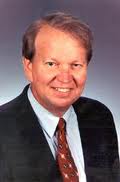 Former Florida House Speaker Jon Mills (pictured here) will now get his day in court, representing a group that has sued the state over both the funding and quality of public education. But the state Supreme Court’s decision on Tuesday to let the suit move forward also invites a more enticing legal debate: Does the constitutional requirement of “a uniform, efficient, safe, secure, and high quality system of free public schools” mean that every school must look the same?
That question may sound facetious, but unfortunately has judicial grounding. In 2006, the state high court invalidated Opportunity Scholarships by rejecting “separate private systems parallel to and in competition with the free public schools.” And the court didn’t stop there. It went further, arguing that “uniformity” calls for consistency in school accreditation, teacher certification and education qualifications, background screening for employees, academic standards, and curriculum in reading and history.
The question of school variety and choice might not sound like fodder for a case that’s primarily about money, but give Mills credit for being open to all interpretations of high quality. “The mission,” he said when the case was first filed in 2009, “is for students to have a good educational opportunity and to succeed, and it seems to me we need more options and not less.”
That is clearly the direction in which Florida is moving. (more…)
Editor's note: This op-ed was published today by Sunshine State News.
Teacher tenure, performance pay and standardized tests often drive the Florida public education debate, but the quietest revolution may well be the growing legion of parents who now choose their children’s schools.
The learning menu in Florida keeps expanding, and nowhere is that trend more compelling than in Miami-Dade, the nation’s fourth-largest school district. For superintendent Alberto Carvalho, parental choice has become an operational credo.
“We are now working in an educational environment that is driven by choice,” Carvalho recently told a television reporter. “I believe that is a good thing. We need to actually be engaged in that choice movement. So if you do not ride that wave, you will succumb to it. I choose not to.”
Dade is setting a blistering pace. The number of students it accepted into magnet and choice programs last year – 39,369 – was larger than the total enrollment in each of 46 other school districts. But that only scratches the surface. An even larger number – 42,367 students – attended charter schools that were approved by the district, and another 22,000 were allowed to choose other public schools through “open enrollment” options. Nearly 15,000 students with meager incomes or learning disabilities chose scholarships to private schools. Continue reading here.
It’s one thing to hear school choice stalwart Jeb Bush or a think tank researcher state the obvious about school choice in Florida – that it’s now a fundamental part of the education landscape. It’s quite another to hear it from the likes of Alberto Carvalho, the well-respected superintendent of the Miami-Dade school district.
A news video shows him saying this to a reporter after a recent education summit (his remarks start at about the 4:30 mark):
Change is going to accelerate. And you need to learn about what the change is, impose your own change just to survive. We are now working in an educational environment that is driven by choice. I believe that is a good thing. We need to actually be engaged in that choice movement. So if you do not ride that wave, you will succumb to it. I choose not to.
It would be noteworthy if any big-district superintendent in Florida – where school choice is both nearly mainstream and perpetually hot button - spoke as refreshingly as Carvalho. But it’s especially significant coming from the Miami-Dade schools chief because 1) no district in Florida has made bigger gains with its students over the past decade, and 2) among the state’s biggest districts, it has among the highest concentrations of enrollment in magnet schools, career academies, charter schools and in private schools via tax credit scholarships.
In other words, the parents in Miami-Dade are seeking out school choice options more than most; the proliferation of options hasn’t hurt student achievement; and the superintendent, rather than feeling besieged, is being proactive.
It would be wrong to suggest Carvalho is alone. Other school leaders in Florida have positively responded to change; sometimes, it even makes headlines. “We have never had to compete before,” Walt Griffin, the new superintendent in Seminole County, Fla., said in a recent story about expanded learning options – public options – in that district. “People who home-school or send their children to private or charter school might not know what we have to offer.”
Without a doubt, there are myriad areas where superintendents and school choice supporters disagree (just like there are plenty of areas where supporters themselves butt heads.) But Carvalho’s comments acknowledge that expanded parental choice is a dynamic that isn’t going away. Indeed, when hundreds of thousands of Florida parents have collectively selected magnet schools, career academies, charter schools, vouchers, virtual schools, etc., how can it? The most pressing debate is how the players involved, including school districts, can continue to expand options in the most efficient and effective ways.
Maybe I'm reading too much into a sound bite, but I think Carvalho’s comments also suggest he doesn’t see the “either/or” that has seeped into so much of the school choice debate. At its core, despite the boilerplate story line, this is really just about giving parents more options.
(Image from asiapac.com.au)
Editor’s note: Doug Tuthill responds today to a post I wrote yesterday about the failure of school districts and teachers unions to enact meaningful differential pay plans for teachers – and how that’s indicative of a bigger failure to help low-income students.
Ron, you raised some excellent points in your blog post about the unwillingness of the Pinellas County, Fla. school district to provide each student with equal access to a quality education. For nine years, I received supplemental pay to work in a magnet program that served the district’s academic elite, and for 11 years I was a leader in the local teachers union, which was complicit in the district’s refusal to provide equal opportunity. So your criticisms stung, but they were accurate.
This may be self-serving, but I’m convinced the cause of this leadership failure is not bad people, but an organizational structure and culture that favors the politically strong over the politically weak.
Growing up in Pinellas, I attended segregated public schools. When the federal courts finally forced the school district to desegregate, the focus was on ratios and not learning. The district closed most of the black neighborhood schools and bused those children to schools in the white neighborhoods because busing white students into black neighborhoods was too politically difficult. But white flight meant some forced busing of white students was necessary, so the district created a rotation system that bused low-income/working class white students every two years to schools where the black population approached 30 percent. (The court order said no Pinellas school could be more than 30 percent black.)
While working-class white neighborhoods lacked the political clout to prevent their children from being bused every two years, their protests were loud enough to force the school board to look for alternatives. In the early 1980s, the district started creating magnet programs to entice white families to voluntarily attend schools that were in danger of exceeding the 30 percent threshold.
These magnet programs were designed to provide white students with a superior education. Class sizes were small, textbook and materials budgets seemed unlimited, professional development opportunities were extraordinary and special pay supplements to attract the best teachers were impressive. In my case, when I quit my job as a college professor to teach in the International Baccalaureate (IB) at St. Petersburg High School (SPHS), my annual salary increased 28 percent.
The magnet strategy worked - especially the IB program. Affluent white families began voluntarily busing their children to attend our program, and in many cases students got on buses at 5 a.m. and rode over 50 miles per day to attend.
Unfortunately, desegregation via magnet schools increased the resource inequities that desegregation was suppose to reduce. (more…)
by Gerard Robinson
Florida has long been a national leader in the field of educational choice. From the introduction of charter schools and the Florida Virtual School in 1996 and 1997, to the creation of the McKay Scholarship program for students with disabilities and the Florida Tax Credit Scholarship program for low-income families in 1999 and 2001, Florida continues to offer its families more choices than ever.
While critics have argued that such programs are harmful to our traditional public school system, our experience in Florida shows the opposite is true. The effect of providing other educational options to our students has benefited not only the students who have participated in these choice programs, but the vast majority of students who have chosen to remain in our traditional public schools as well.
The positive effect of increased educational options is evident in the continuous upward surge in student performance in our public schools over the past 15 years. Although still only a small percentage of the population of our traditional public schools, the choice programs have created a healthy competitive environment that has contributed to the improvement of our traditional public schools’ existing educational programs. They have also helped motivate the introduction of new programs to meet the educational needs of public school students.
From magnet schools to career academies, controlled-open enrollment and Advanced Placement, Florida school districts have introduced numerous new programs and schools that provide unique learning opportunities tailored to the interests and aptitude of their students. In fact, the latest data provided by school districts indicates that of the 2,682,214 students who attend K-12 public schools, nearly 30 percent attend schools other than the one to which they were assigned.
But more than providing competition among the providers of education in our state, school choice is about giving parents, rather than geographic boundaries, control over their child's educational opportunities. School choice is not so much about one type of school being “better” than another as it is about empowering parents and helping them learn how to become active participants and decision-makers in finding the best educational environment for their child. While thousands of parents will continue to make the choice to keep their children in the public school to which they’ve been assigned, the very fact that they have a choice contributes to the type of parental engagement that is so important to the education of our children.
As the number of educational options available to Florida’s children continues to grow in both the public and private sector, there are two important goals that need to be at the forefront of how our state effectively manages this growth. (more…)