 New York has had the huge blessing of economic geography that people leveraged through tremendous effort to great advantage. Its location on the Atlantic and its proximity to the Hudson River gave it a reach deep into the country with the competition of the Erie Canal, and then out into the world. Meanwhile, the state’s highly favorable location for the transport of goods led to a clustering of firms specializing in finance.
Now locate this combination in a free-wheeling country with the world’s largest amount of arable land in the temperate zone, abundant natural resources and an unmatched zest for the industrial revolution. New York City became not only the nation’s cultural and financial capital, but the world’s financial and cultural capital, the center of enormous wealth. An Empire State in every sense.
Florida, however, has been gaining on New York – and leaving it behind – for decades. The Sunshine State seems very well positioned to accelerate this trend.
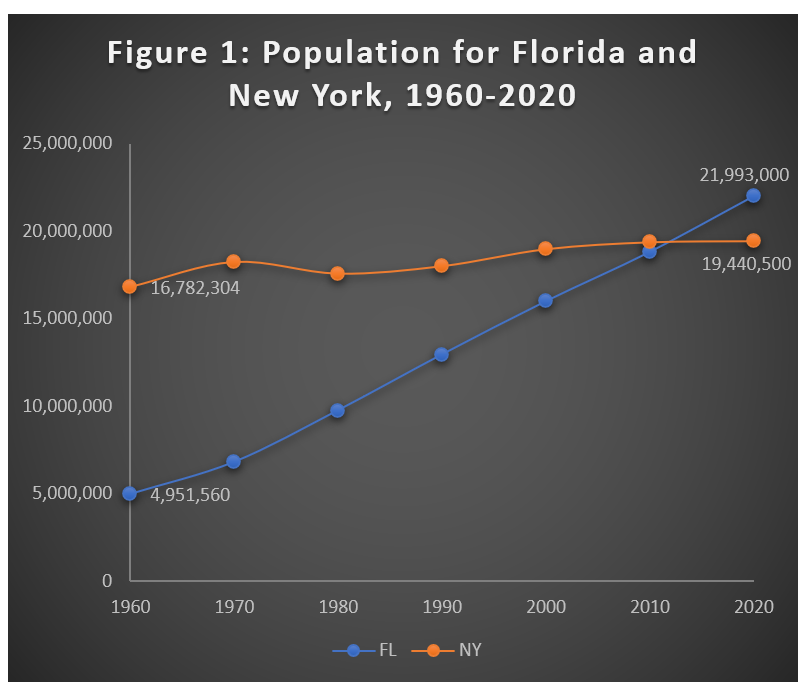
In December, reports began to circulate that New York-based finance titan Goldman Sachs is considering a move to Florida. Such a move would follow a long-established net migration pattern from New York to Florida.
Florida has displaced New York as the largest state on the Atlantic coast. Absent a large change in trends, it seems likely that either North Carolina or Georgia will be the second largest, with little likelihood that New York will move back into first place in our lifetimes.
Among other advantages, Florida has a very large edge over New York in providing better quality public services per public dollar invested, including in education. Florida policymakers can expand this advantage in 2021.
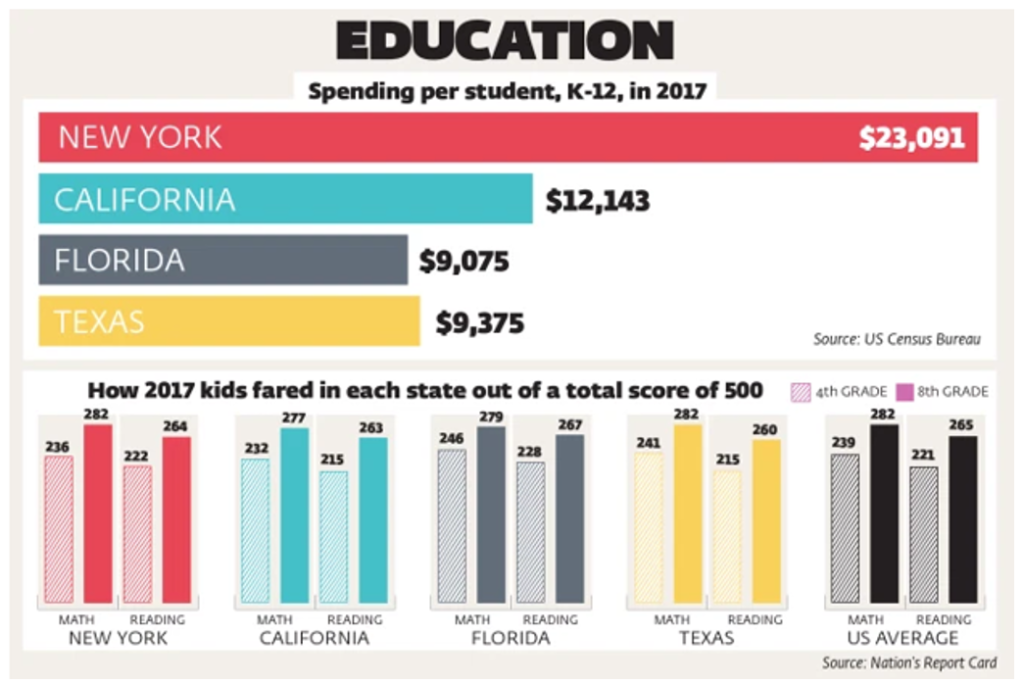
This graphic from the New York Post shows per-pupil spending in New York, California, Florida and Texas, along with NAEP math and reading scores. These comparisons look even more lopsided if broken down by subgroups and/or viewed over time.
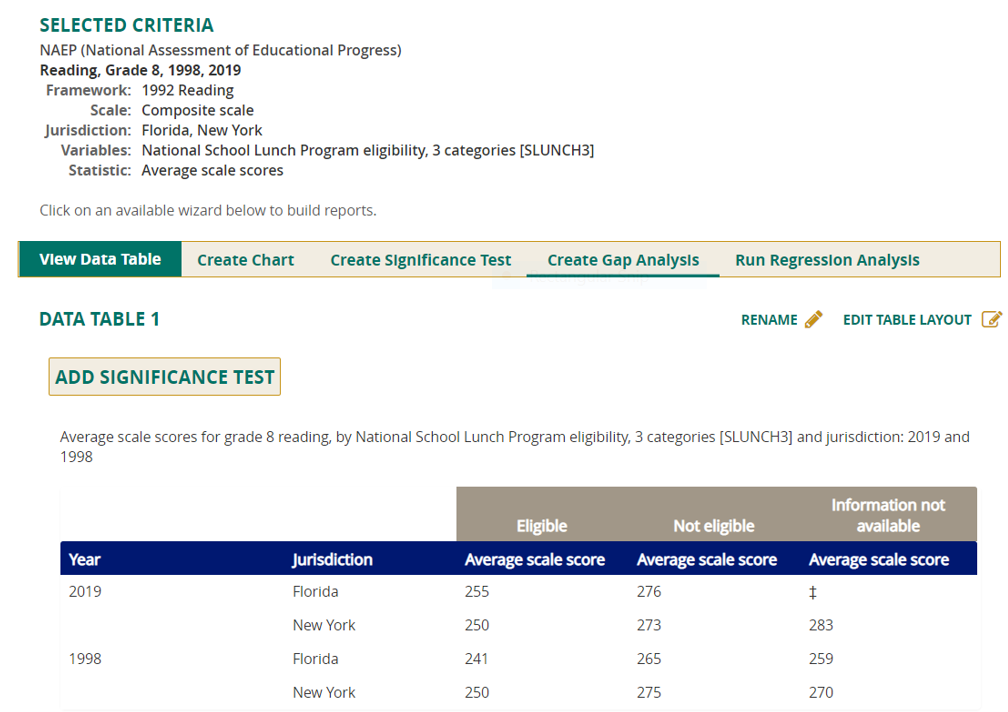
Back in the 1990s, New Yorkers at least could point to superior results in return for their higher spending, but this is no longer the case. For instance, NAEP’s eighth grade reading exam found both low-income and middle/high-income students reading about a grade level above their Florida peers. Now, Florida has the advantage, despite spending less.
While New York’s situation – sky-high taxes and poorly performing schools – may seem terrible for families, it looks like a “mission accomplished” for the state’s public sector unions. Getting an ever-increasing amount of money to achieve about the same or less may be a bad look, but it helps the organizational bottom line. Increased spending leads to increased hiring which leads to more people paying dues.
Note, however, that New York’s poor children scored no better in 2019 than in 1998 despite a 62% increase in inflation-adjusted spending per pupil between 1998 and 2016. That, ladies and gentlemen, represents truly shameless rent seeking.
Margaret Thatcher noted that the problem with this sort of thing is that you eventually run out of other people’s money. In New York’s case, there is a growing shortage of people willing to pay for it. Florida, by my way of thinking, has been doing well by doing good – allowing people to live better and freer lives by efficiently producing public services of improving quality.
Keep it up. Where Florida leads, others will surely follow.
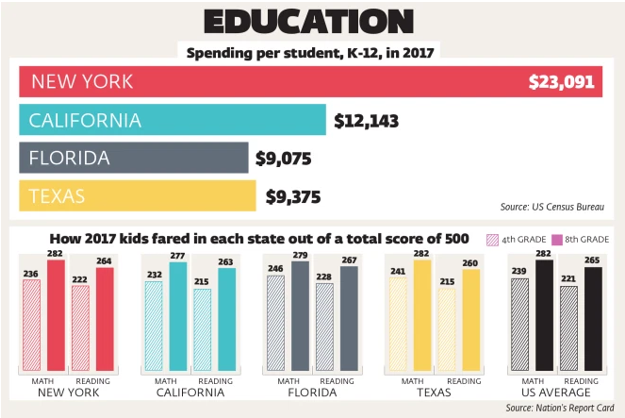 The New York Post recently delivered a rather devastating comparison of New York, California, Florida and Texas on education spending. Since this is a Florida-based education blog and many New Yorkers move to Florida annually, let’s focus on the Sunshine and Empire states.
If you are a New Yorker, what can you say in response to this news other than “Ouch!” Despite spending well over twice as much per pupil, Florida has higher NAEP scores in three out of four of the regularly given NAEP exams. Alas, New Yorkers, the outlook is even worse once you look at trends, specifically eighth-grade reading scores by race/ethnicity, as illustrated in this chart.
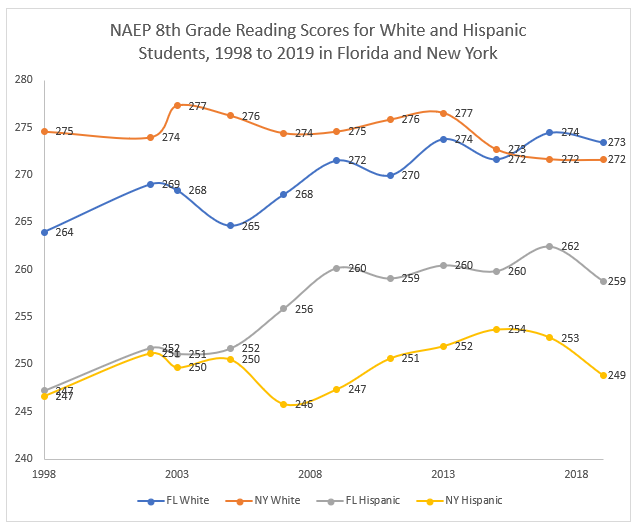
In 1998, white students in New York were almost a grade level ahead of white students in Florida. Based on the last two NAEP exams, however, Florida held a slight lead. Hispanic students in the two states were tied in 1998, but in 2019, Hispanic students in New York were about a grade level behind their peers in Florida.
The same trends, although not represented in this chart, are evident for black and Asian students. Black students in Florida closed the gap with their New York peers after being a grade level behind in 1998. Asian students in Florida basically were tied with their peers in New York in 1998, but took a significant lead in 2019.
Perhaps you are a New Yorker and you consider teaching students how to read as an important part of K-12 education. You may be feeling a little crushed by the fact that other states are getting that job done better and more efficiently. Perhaps you are among those who would like a wide variety of public and private school options as featured in Step Up For Students’ annual Education Landscape document to help you find the right fit for your child. Our founders wisely created a system of federalism that allows citizens to match their policy and cultural preferences. Perhaps you should consider moving to Florida.
While the large and probably growing number of New Yorkers who want to become Floridians is obvious, the more subtle point from what I gather is that there is a small but vocal number of Floridians who would prefer the New York policy mix. If, for instance, you imagine that states are in a contest to spend the most per pupil and you aren’t overly concerned with results, then New York would be a destination state for you. This seems odd to me, but to each their own.
Given the huge number of moving trucks leaving New York for Florida, it would appear it’s relatively inexpensive to rent one to haul belongings from Florida to New York. After all, they’ve got to get the trucks back to New York for the next escapee, err, person wanting to move to Florida. The marginal cost of putting your stuff in the truck will be low. Once you arrive in New York, you can immediately begin to enjoy the benefits of high-spending and academic stagnation if you’re into that sort of thing.
 Year-to-year student achievement will always fluctuate, but how does Florida stand in the larger picture? While results from the 2019 National Assessment of Educational Progress should concern everyone involved with K-12 education, Florida’s long-term trend is holding despite the recent score stagnation. And as we reported last week, Florida maintained high rankings when adjusting for demographics.
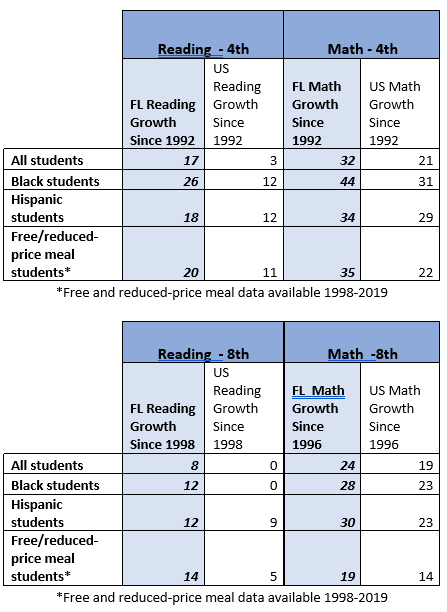 Among eighth-grade math students, Florida has improved 24 points compared to the national average of 19. Black students are up 28 points compared to 23 points nationally, and Hispanic students are up 30 points compared to 22 points nationally.
Eighth-grade reading, typically a sore spot for Florida given the tremendous success in the early years, is up 8 points compared to 21 years ago. But the situation is much worse for the national average, where there has been no improvement on eighth-grade reading scores since 1998.
Black eighth-graders in Florida, despite being down from last year, still have improved by 8 points since 1998. The average black student nationally has seen no improvement since 1998.
Hispanic students fare better on English reading, up 12 points in Florida and 9 points nationally since 1998.

Readers of Sean Reardon’s study on student learning gains between third and eighth grade should heed the advice from Douglas Adams’ classic sci-fi comedy novel “Hitchhiker’s Guide to the Galaxy”: DON’T PANIC.
Matt Ladner recently provided an excellent reason not to flip out: Florida’s long-term gains (such as high school and college graduation) are at or above the national average.
So like those thumbing a ride through the cosmos, find your towel, feel the warm, comforting embrace of its fibers, and remain calm, because here are three more reasons why you shouldn’t overreact because of one set of statistics.
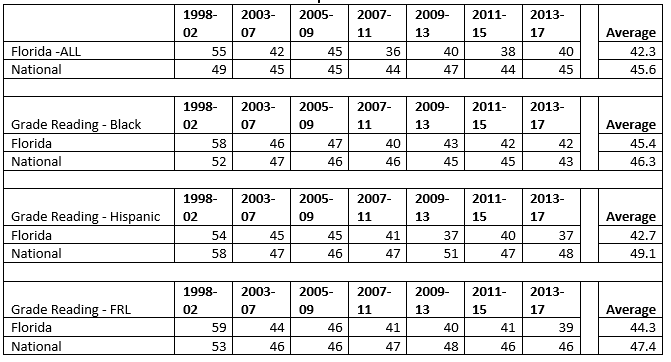
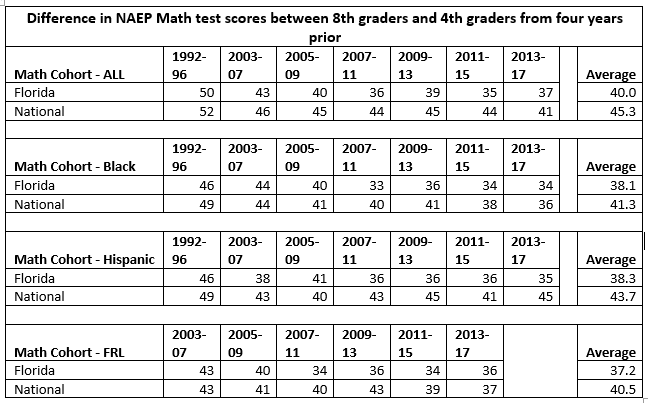
Reardon’s study compares the learning gains across diverse state tests for students in grades 3 through 8 during the 2009 through 2016 school years. The Nation’s Report Card allows us to do something similar with the fourth- through eighth-grade learning gains. To create a cohort, we look at students in fourth grade in 2011 and measure the difference with the eighth-grade scores four years later in 2015, and so on.
Just like Reardon’s data, we see Florida’s students learn less per year between fourth and eighth grades than the national average across the board, with the exception of the earliest years.
Difference in NAEP Reading test scores between eight-graders and fourth-graders from four years prior
 Difference in NAEP Math test scores between eighth-graders and fourth-graders from four years prior
Remember where you put your towel? Good. Here are the reasons why this measurement isn’t a singular statistic to judge all of Florida’s K-12 education system.
First, Florida’s overall results are still above average, and that’s saying something given the state’s majority-minority and below-average income demographics. Here’s a graph from the actual Stanford dataset showing average test scores by school district:
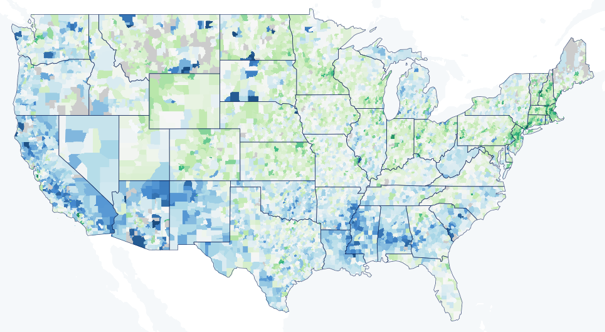
It shows Florida to be performing about average to above average. Adjusting for demographics, Florida’s results appear even better. This is why the Urban Institute ranks Florida first through eighth depending on the NAEP test, and Education Week’s “Quality Counts” report ranks Florida fourth.
Today, Florida’s fourth- and eighth-grade NAEP scores, especially for low-income and minority students, remain at or above the national average.
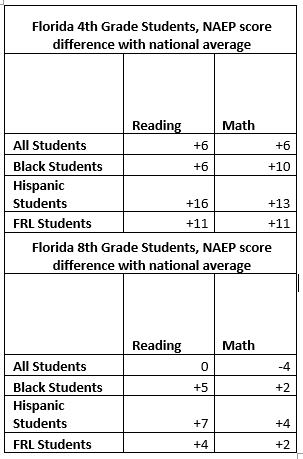
Florida’s fourth-grade results are far ahead of the national average. Florida’s push at early intervention -- which include pre-K vouchers, scholarships for low-income students, third-grade retention and increased funding for K-12 education, especially in earlier grades -- may have helped drive Florida’s fourth-grade achievement boom.
The reason Florida’s eighth-graders are near, or above, the national average despite slower growth since fourth-grade is precisely because they were so far ahead in fourth-grade already.
Second, despite Florida’s repeated lower-than-average annual learning gains in those specific grades, Florida’s students have seen more growth on NAEP reading and math than the national average. The following tables look at Florida’s data from the first time NAEP was given until now.
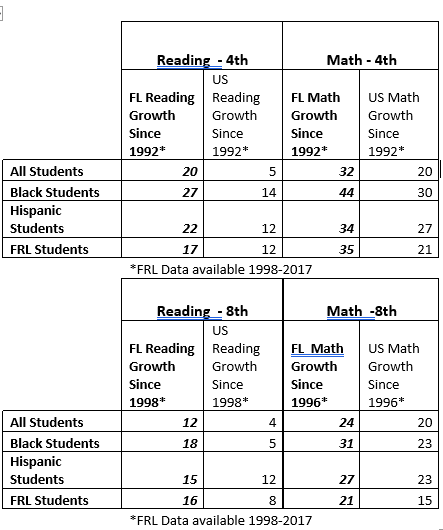
So how can Florida’s overall achievement and achievement growth be better across the board than the national average if the Stanford study shows third- through eighth-graders learning less per year?
It’s likely because the Stanford data covers only 2009-2016, a period of time AFTER Florida’s largest burst of achievement gains and DURING a time which included achievement stagnation. It’s hardly fair to condemn an entire system for seven years of data when 29 years of data show results are way up.
Finally, Florida’s largest fourth- through eighth-grade cohort gains occurred in the 1990s when achievement was at its lowest point.
Florida students averaged 55 points of growth in the 1998-2002 NAEP Reading Cohort, higher than the national average. Florida’s 2009-17 cohorts averaged just 39 points of growth, but remain more than a grade level ahead of where they were in 2002.
In math, the 1992-96 cohort gained 50 points of growth, but Florida averaged just 37 points between 2009-2017.
Nostalgic for the '90s and want to roll back time? Well, Florida’s eighth-grade math students today score a grade and a half higher today than they did in 1996.
Florida does an excellent job getting to students to learn the basics. The fact that students then coast from fourth to eighth grade, but still achieve better long-term outcomes, is nothing to panic about.
Critics denying the achievement gains of Florida’s K-12 students often do so after comparing state achievement with a whiter and wealthier national average. Only one critic has been bold enough to actually single out a whiter and wealthier state for comparison with the Sunshine State.
Lauren Ritchie, a columnist at the Orlando Sentinel, recently picked Connecticut, a state that spends more than $17,283 per pupil. She has a family friend in Norwalk whose daughter attends an IB program for 290 students, where they learn Arabic, Japanese or Mandarin Chinese. (Orange County, where Ritchie lives, has three high schools with IB programs and a total of 32 magnet schools. Students can also learn Mandarin Chinese, Arabic, Japanese, Portuguese and more.)
Ritchie said she chose Connecticut because it produces “some of the highest-performing students…because they genuinely care about education.”
To compare the two states, we must first understand their differences. According to the U.S. Department of Education, 54 percent of students in Connecticut are white compared to just 38 percent in Florida. Only six states have fewer white students than Florida.
Connecticut spends $17,283 per pupil, according to Education Week. Florida spent $9,737. Only four states spend more than Connecticut.
Connecticut’s median household income in 2017 was $74,168, whereas Florida’s was only $52,594. Only three states had higher incomes than Connecticut, while only nine states had lower incomes than Florida.
So what does Connecticut get with that $17,000 per-pupil? Not much, unless you’re one of the rich white kids learning Arabic in Norwalk.
In 2003, Connecticut was ahead of Florida on every math and reading metric. By 2017, Florida tied or beat Connecticut on reading and fourth-grade math. When examining achievement by subgroups, Connecticut can beat Florida only on white student achievement in eighth-grade reading and math.
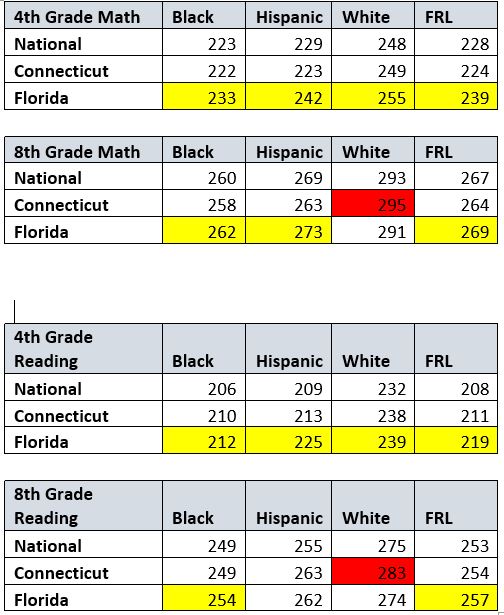
Black students are a full grade level ahead of black students in Connecticut on fourth-grade math. Hispanic students are two grade levels ahead. The difference shrinks to half a grade level ahead by eighth grade, but Florida remains ahead.
Fifty-six percent of low-income students in Florida score at grade level or higher on the NAEP eighth grade math test. Only 52 percent of low-income students in Connecticut do.
On eighth-grade reading, 69 percent of Florida’s low-income students score at grade level or better, while just 64 percent of low-income students in Connecticut do.
When adjusting for student race and income, the Urban Institute ranks Florida eighth on NAEP math. Connecticut ranks 29th.
Florida ranks third in the nation on eighth-grade reading, behind big spenders New Jersey and Massachusetts, but still ahead of ninth-ranked Connecticut.
Despite outspending every state in the Urban Institute’s Top Ten list on both tests, Connecticut just doesn’t have a lot to show for its extravagant spending.
 When The Fellowship of the Ring was released in 2001, I was in the subset of viewers who had not read J.R.R. Tolkien’s books. Yes, right, I know: Nerd demerit! It proved beneficial as a movie-going experience, as it shocked me: Wait, what? Sarumon is a bad guy??
The Gandalf vs. Saruman fight scene comes to mind when I see choice supporters who say they “support choice,” but only a particular type of choice. David Osborne’s piece in The 74 is a recent example of this genre. Osborne obviously is a sincere gentleman, but the scale of our challenges lies far beyond the ability of charter schools alone to address.
In the scene from the movie, Gandalf has gone to consult with a superior about how dire things are, only to have someone he thought was an ally inform him, “The hour is later than you think.” Come with me, dear reader, and I’ll do my best to convince you that the hour is later than we – or Osborne – thinks.
School Choice Week is an opportune time to reflect upon the enormity of our education challenges. Scholars who study educational enrichment spending, which can span Kumon/Mathnasium to club sports and drama, have produced charts like the one below. It’s well worth staring at for a good long while so it will haunt your dreams as you think through the implications.
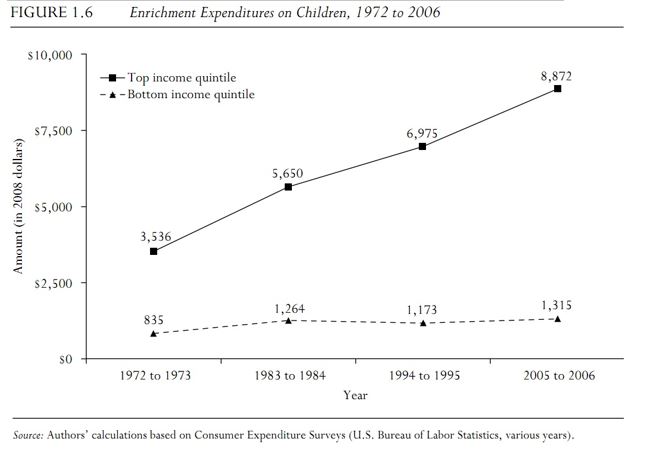
Wealthy parents not only are sending their kids to better funded schools in the leafy suburbs; it’s not just the fact that teachers have very little control over their pay under unionized “get old and get paid” scales, causing the more effective ones to gravitate to the suburbs for easier working conditions. On top of this, those same upper-income parents are supplementing the education of their children out of their own pocket – and have been doing more and more of this for decades. Moreover, all of this is seen as so utterly and unremarkably normal that we rarely even discuss it.
In his piece, Osborne says he opposes universal education savings accounts because he fears that wealthy parents will top up the funding. I agree this is an issue to discuss, but the answer is not to doggedly stick to charter schools because we imagine them to be more equitable. Following Osborne’s logic would require one to oppose the funding of a public-school system, as the scenario he fears happening with education savings accounts has in fact been ongoing for decades in the public schools. Parents can and do supplement charter school education as well.
When we view the status quo through the lens of equity, what we see is that not only do the suburban schools get more funding; not only do wealthy parents supplement their own children to a far greater degree than poor parents; not only do their schools have an associated advantage in attracting human capital. In addition, the funds provided for the education of low-income children tend to be spent ineffectively in urban school systems.
Against all this, Osborne wants to bring charter schools to bear. I want to bring charter schools as well, but limiting ourselves to charter schools would be like the U.S. Army storming the beaches at Normandy equipped only with sling shots in the face of Nazi rifles, machine guns and artillery.
Florida policymakers have accomplished a great deal related to choice, and the vast majority of what they’ve done is universally available. No one has ever had to fill out a Free Application for Federal Student Aid (FAFSA) form to forensically reveal their family income to attend a district school, a charter school or a magnet school or to enroll in Florida Virtual School. For that matter, no one ever has been denied access to a Florida college or university because his or her parents paid too much in taxes. All Floridians pay their taxes, all Floridians access publicly funded schooling options.
What, then, is to be done? We should recognize from the outset the limits of policy and aim to judge next moves not only against ideals but also against the status quo. Equity issues are very important, but let’s remember that it took everything in the second graphic above in addition to a lot of controversial non-choice related reforms and 20 years to get this in Florida:
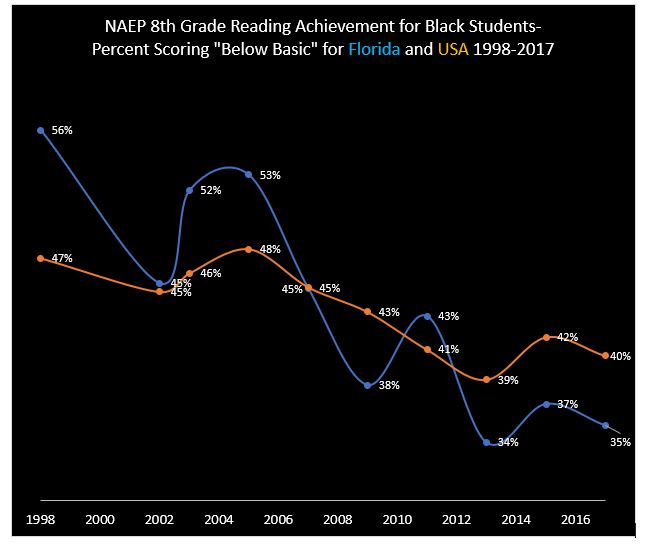
The above chart tracks the percentage of Black eighth-graders in the United States and Florida scoring “Below Basic” in reading. In 1998, this stood as a shockingly horrifying 47 percent nationally and a stunningly shameful, far beyond sickening 56 percent in Florida. There is a lot of work to be done both nationally and in Florida, but the drop was twice as large in Florida as nationally. It isn’t nearly enough, but Floridians should be encouraged by their success thus far to take still bolder steps. Anyone willing to look the 35 percent of Florida’s Black eight-grade students in the eye to ask them to patiently wait for a charter school to open should reacquaint themselves with A Letter from a Birmingham Jail in my humble opinion.
An education savings account program open to all with a significant financial weighting represents the best choice intervention for the disadvantaged. Osborne is correct in stating that high income families would supplement such a system, but they already supplement everything else, and most everything else gives their schools more money to boot.
An ESA system can give the most to the children who start with the least through weighting. Crucially, it also would give low-income parents the opportunity to make effective use of their funds and would strongly incentivize the most productive use of incumbent resources. The education system would shift to being centered around families with service providers competing to best suit their needs, with poor families possessing more rather than less in the way of public dollars.
There’s a huge amount of inequality today, but there also is some good, and it is worth fighting for. Reaching a consensus on these issues won’t be easy. During the ratification debates for the United States Constitution, perhaps the most rollicking and momentous dialectic in human history, James Madison summed up an argument conceding the radical nature of his enterprise by writing, “Upon this you must deliberate and decide.” Just so with you, Florida. Address equity issues in the most robust fashion possible and expand opportunity to maximum extent. These things need not be in conflict. Students poorly served today have nothing to lose but their chains, and a world of opportunity to gain.
After a brief stall, Florida students and teachers are again making nationally notable gains on a closely watched test.
Released Thursday, the latest results from the National Assessment of Educational Progress, better known as “the nation’s report card,” show Florida students making solid growth between 2011 and 2013 on three of four tests that are used to compare achievement from state to state.
The NAEP reading and math tests are given every other year to representative samples of fourth- and eighth-graders in all 50 states.
Fueled by the performance of low-income and minority students, Florida was one of only four states that made statistically significant score gains on both the eighth-grade reading and eighth-grade math tests. It was also one of only seven states that showed a statistically significant increase in the percentage of students scoring at or above the basic level on fourth-grade reading, with a jump from 71 to 75 percent. (See charts below for the Florida and U.S. trend lines.)
The improved scores are "an example of what can be accomplished when we focus on what is important," Florida Education Commissioner Pam Stewart said in a written statement.
The latest results will have academic repercussions in the Sunshine State, a national leader in ed reform for more than a decade, and, maybe, political and legal ones. For embattled ed reformers, they bring a sigh of relief. For critics, they bring more evidence, despite oft-repeated arguments, that Florida public schools continue to improve faster than schools just about anywhere.
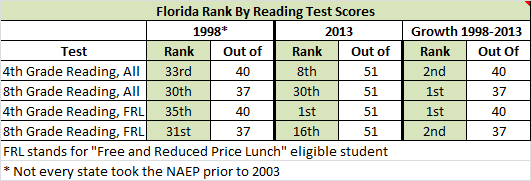
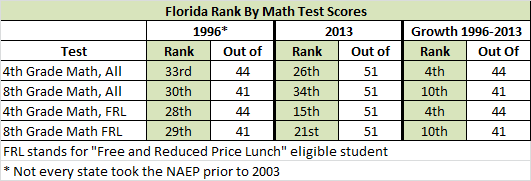
Here’s the context:
Between the late 1990s and 2009, Florida was arguably the national pacesetter on NAEP progress, moving from the bottom tier of states on all four core tests to the middle tier or better on three of them. It is impossible to sort out which factors led to rising trend lines, but Florida’s escape from the national cellar coincided with the sweeping policy changes ushered in by former Gov. Jeb Bush. Generally, the changes stressed higher standards, expanded school choice and top-down regulatory accountability. More specifically, they included school grades, private school vouchers, third-grade retention and an intense focus on literacy in early grades. Over the second half of that span, Florida also modestly shrunk class sizes and rolled out a popular, voluntary pre-kindergarten program, both prompted by voter-approved amendments to the state constitution.
Then came 2011. (more…)
 For the second time this week, a credible, independent analysis shows Florida students leading the pack in progress.
Between 1992 and 2011, Florida students made bigger gains than students in four other “mega states” in fourth- and eighth-grade reading and fourth-grade math, according to a report released Thursday by an arm of the U.S. Department of Education. In each case, they moved from below the national average to meeting or exceeding it. Low-income and minority students in particular showed traction.
“There is something real going on there,” said Jack Buckley, commissioner of the National Center for Education Statistics, according to Education Week.
The center’s comparison followed Wednesday’s College Board report that showed Florida continues to climb the charts on Advanced Placement exams. The Sunshine State now ranks fourth in the percentage of high school graduates passing AP exams. Over the past decade, it ranks second in progress.
Broken-record alert No. 1: Florida’s trend lines shouldn’t be a surprise, given reports like this, this, this, this and this in the past year alone. Yet there remains a lingering perception, cultivated by critics, that Florida’s public schools are sub par and stagnant.
For Thursday’s report, the center for the first time compared scores from Florida, California, Texas, New York and Illinois – the states with the biggest student populations and arguably the biggest challenges. It used results from the National Assessment of Educational Progress, a battery of tests better known as “The Nation’s Report Card” and considered the gold standard among standardized assessments.
In eighth-grade math, Florida students made gains but remain below the national average. Elsewhere in the report, they were singled out often. (more…)
Florida's status. Matt Reed, Florida Today's editorial page editor, takes a look at NAEP data and the most recent Education Week Quality Counts report and concludes: "We obviously have room to improve. But our system is neither starving, as educators always say. Nor is it “broken” or “failing,” as reformers keep telling us."
Florida's status, Part II. Diane Ravitch's latest take, after quoting a Florida teacher at length: "There is no Florida miracle. Education has only gotten worse over the past few years, no matter how schools, districts and the state itself game the system. And, contrary to what the media will tell you, it is NOT teachers’ fault, unions’ fault, and I won’t even blame it on the kids or their parents this time. It is the fault of education “reform” led by Jeb Bush et al."
Charter schools. The South Florida Sun Sentinel writes up the bill that would require school districts to share unused or underused facilities with charter schools. Bad idea, editorializes the Palm Beach Post.
Gays and lesbians. The Lake County School Board considers rules that would keep a Gay-Straight Alliance from forming at a middle school. Orlando Sentinel.
Teacher evaluations. Tampa Bay Times on one impact (or not) of the new system in Hillsborough: "After years of planning and training, observation and deliberation, the first wave of firings has begun under a teaching-improvement project funded by the Bill & Melinda Gates Foundation. The tally: Three teachers." (more…)
A “B” for teacher quality policies. That’s Florida’s grade, according to the National Center for Teacher Quality. That’s higher than any other state, notes the Gradebook.
 Bang for the buck. Florida students made some of the biggest gains in the nation on NAEP despite some of the smallest increases in ed funding, notes researcher Matthew Ladner at Jay P. Greene’s Blog.
Lawmakers’ ties to charter schools. WFTV in Orlando takes a look. The Tampa Bay Times did a similar but more detailed story last year.
Charter school facilities funding. The Fort Myers News Press takes a look at a task force’s recommendation to increase property taxes to pay for building construction and maintenance at charter schools. Redefined covers the Florida Charter Schools Conference where this was a topic yesterday.
Report on charter school growth. Miami Herald. StateImpact Florida. redefinED.
Promising charter on its way to Pinellas. With little comment, the Pinellas school board voted 7-0 Tuesday for a charter school application that dovetails with a legal settlement over black student achievement. Lots of history here; I wrote a bit about this earlier this week.
More questions in special needs student’s death. Tampa Bay Times.
(Image from simplystatedbusiness.com)

