Tiovanni Johnson squirms in his chair and lowers his head. His grandmother is telling a story about his kindness toward strangers, and he wishes she would stop. In fact, he asked her to stop.
“This is embarrassing,” he said.
She continued.
The previous day, Angela brought two Slim Jims with her when she picked up Tiovanni from school.
“I love Slim Jims,” he said.

Tiovanni enjoys the academic challenges of Academy Prep Center of St. Petersburg.
They stopped at a light on the ride home. Tiovanni noticed a man panhandling at the intersection. He appeared hungry, so Tiovanni leaned out the window and gave the man his favorite snack.
“He does this all the time no matter where he is,” Angela said. “He’s so thoughtful.”
At a skatepark a few days earlier, Tiovanni spent most of his time helping younger kids who had trouble staying on their skateboards.
Tiovanni appeared as if he would rather be anywhere else than in the conference room at his school, Academy Prep Center of St. Petersburg, listening to his grandmother brag about him.
But there are some things a boy can’t stop.
And when asked about the praise, Tiovanni reluctantly admitted, “It makes me feel good.”
Tiovanni, 12, is in the seventh grade at Academy Prep. This is his second year attending the grades 5-8 private school located three miles from the Gulfport home he shares with his aunt and uncle, Tricia and Ralph Huckeba. They became Tiovanni’s legal guardians after his mom, Deborah, died unexpectedly when he was 6.
Tiovanni attends Academy Prep on a Florida Tax Credit Scholarship, made possible by corporate donations to Step Up For Students.
Year 1 was a feel-good story for Tiovanni. He made the honor roll, joined Academy Prep’s swim team and began the 2024-25 school year with a 4.0 GPA for his work over the summer.
Tricia and Ralph, along with Angela, wanted Tiovanni to attend a school that would challenge him academically and help guide him through the tricky middle school years.
“Everybody here is so caring, truly caring,” Tricia said. “This school is very accommodating for the students, very loving, God-fearing people.”
Tiovanni tells his teachers that when he grows up, he wants to do something “magnificent.” He’s not quite sure what that means other than it will include a college education.
“I’m going to make sure I get straight A’s so I can go to college,” he said.
He’d like to study music, he said. He’d also like to learn to play the drums.
“They speak to me,” he said.
He wants to fly in a plane.
And learn to do an “ollie” with his skateboard. That’s the move where the rider jumps in the air with his feet still on the board but without using his hands. Tiovanni is working on it.
And he wants to travel.
Tiovanni wants to take Angela back to her birthplace, Cairano, a dot-on-the-map city in the mountains of Italy.
His life will be epic. Tiovanni is sure of that.
“I want to do something wonderful so my aunt and uncle don't have to work, so they can go on vacation somewhere,” he said.
He writes poetry.
I'm cool, but sometimes I act like a fool.
He described himself as “short” and “fast” and “energetic.”
“I can be a little annoying sometimes,” he added.
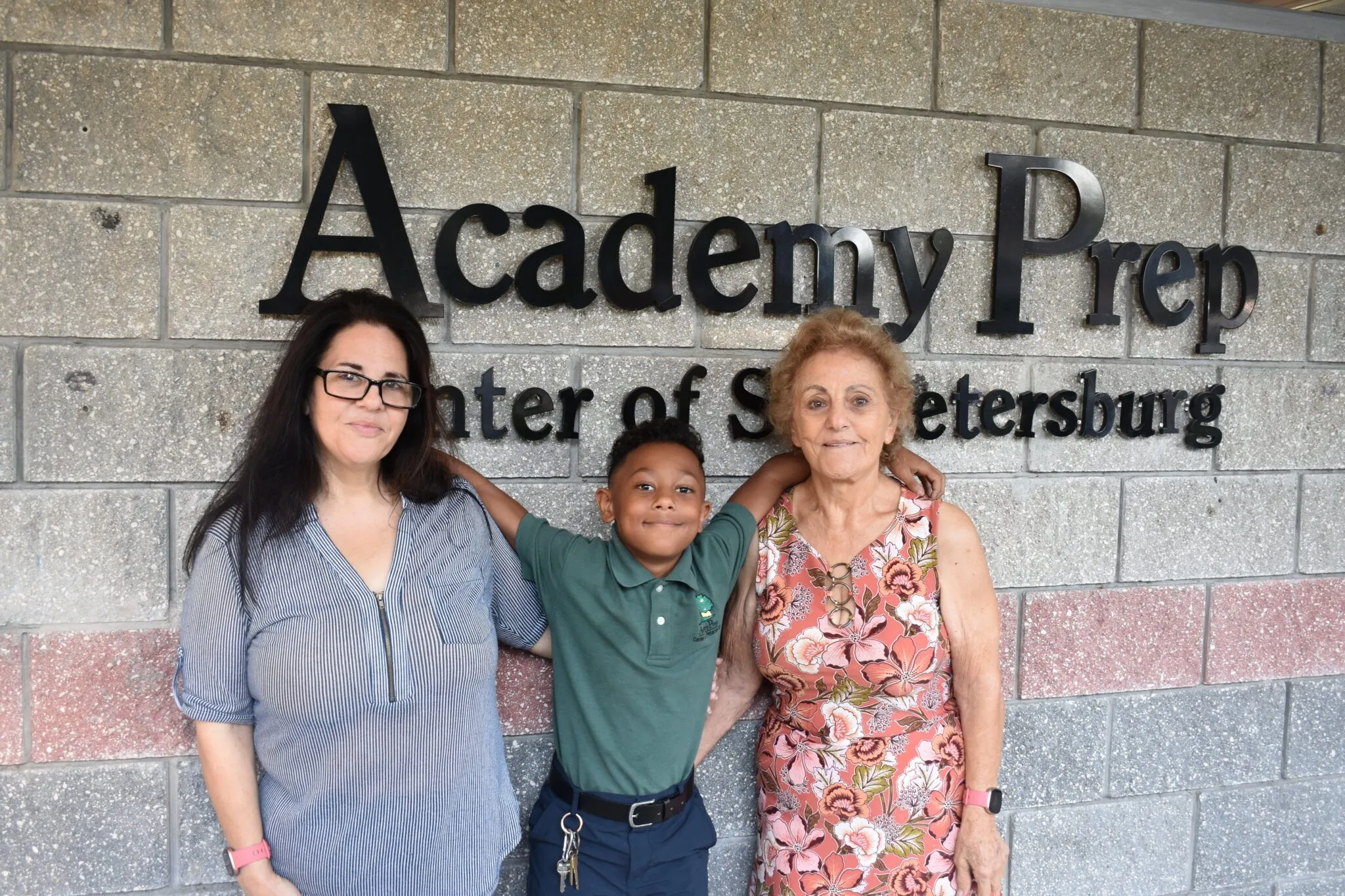
Tiovanni with his aunt Tricia, and grandmother Angela.
Tiovanni likes to be challenged academically, as evident by this year’s class schedule filled with honors courses. He’s in the right academic setting for that since Academy Prep is designed so students get the most of their educational opportunity.
He can also be more of a deep thinker than someone his age.
The family attends BridgePoint Church in St. Petersburg. Tiovanni often takes notes during the service and shares them with everyone at lunch afterwards. Tiovanni said he’s writing down “wisdom.”
“It’s just amazing some of the things that he thought about, because it would be his interpretation of what the pastor said,” Tricia said.
Tiovanni is reluctant to talk about his mom.
“That’s a sensitive topic,” he said.
It’s a sensitive topic for Angela, as well. She gets emotional when talking about her youngest daughter, who passed in 2019.
“She’s gone, but she left a special gift,” Angela said, nodding toward Tiovanni.
Brittany Dillard, Academy Prep’s Assistant Head of School, has known Tiovanni and his family since her son and Tiovanni were first-grade classmates. That was the year Tiovanni’s mom died and Tiovanni, whose father is not in his life, went to live with Angela. Dillard had the first-graders make cards for Tiovanni.
“Tiovanni has always just been spontaneous and optimistic and just a joy to be around,” Dillard said. “He's inquisitive. He asks a lot of questions, and he is just, honestly, a person that you want to have around if you're having a bad day, because he's going to find some way to cheer you up and just bring some sort of joy into your life.”
Like handing his afterschool snack to someone who looked hungry.
“I felt in my heart that that's what I needed to do,” Tiovanni said, “and that’s what I did.”
 Words such as voucher, privatization, profit and corporation are often used as weapons by individuals and groups who oppose parental empowerment and school choice. Using words as weapons is especially common during periods of significant social change - we all do it - but the practice undermines civic discourse and makes finding common ground more difficult.
“Market” is another term school choice opponents use to connote evil, but our way of life is largely based on markets, and public education is increasingly embracing market processes as customized teaching and learning become more common. Our challenge moving forward is regulating public education markets in ways that maximizes their effectiveness and efficiency.
People access products and services in one of two ways. Either their government assigns them, or they choose for themselves. In the United States, we have historically allowed citizens to choose, and this system of provider and consumer choice is a “market.”
In a goods and services market, providers decide which goods and services they want to sell, and consumers choose those they want to buy. Markets, when implemented properly, are preferable to assignment systems because they better utilize people’s knowledge, skills and motivation. Citizens are allowed to use their own experiences and judgments when making selling and purchasing decisions, and this citizen empowerment maximizes the universe of ideas from which improvement and innovation derive.
When governments assign products and services to their citizens, they rely on a small group of people to decide what to offer. This top-down approach is less open, transparent and effective than the decision-making that occurs in markets, and it discourages creativity. This is why most improvements in goods and services emerge from market systems rather than government assignment systems.
Markets allow providers to learn from consumers. When governments dictate to consumers what goods and services they may have, their citizens’ true wants and needs are not fully considered. The voice of the customer is silent. But when consumers are empowered to choose for themselves, providers learn from these choices and adjust accordingly. In markets, this necessity to meet customers’ needs drives innovation and continuous improvement. (more…)
Ladner
Call them Vouchers 2.0. In the age of customization, researcher Matthew Ladner sees education savings accounts as the tool for the times. Unlike vouchers or tax credit scholarships, ESAs would allow parents to use state funds to pay for a blend of K-12 educational options – schools, tutors, online programs, etc., in whatever combo works - and perhaps squirrel away some of those funds for college.
“We we like to say that ESAs are sort of school choice and parental control over education down to the last penny,” Ladner said in a podcast interview with redefinED. “What we really want to do is allow parents to customize the education for their child. Education shouldn’t be necessarily an all or nothing proposition - you’re either attending this school or that school. In fact, the whole definition of what a school is is being fairly rapidly changed by technology.”
Ladner is senior advisor of policy and research at the Foundation for Excellence in Education. He’s one of the creators of the ESA concept and its most diligent Johnny Appleseed. In October, the Friedman Foundation for Educational Choice published a report he authored about ESAs called, “The Way of the Future.” Ladner also was instrumental in creating the ESA program in Arizona, which to date is the only one in the country but was recently expanded.
A key feature of ESAs, Ladner said, is that it requires parents to make choices based on quality and price. That in turn will spur innovation and, at the same time, reign in costs that have risen steeply for decades with little improvement in academic outcomes. “If you want to reverse that, you have to do something that’s going to seem a little radical at first,” Ladner said. “But by giving parents complete control over the money and requiring them to consider possible alternative uses for that money, it really sets them up to be discriminating consumers.“
Florida lawmakers flirted with ESAs in 2011, with critics panning the idea as “universal vouchers” and “vouchers for all.” But Ladner said even if a state went “whole hog” with the idea, the vast majority of kids would remain in public schools, as the Florida experience has shown with McKay vouchers and tax credit scholarships. In his view, ESAs should also be designed for equity - with greater funding for students with greater needs.
Are people ready for ESAs? Maybe not just yet, Ladner said. But it took a while for people to catch on to Palm Pilots, too. “As a movement we always need to be taking a strong interest in the development of our product. And our product in this case is our methods to increasing the freedom and the effectiveness of parents the parents within the schooling system,” Ladner said. “I think there is work to be done. But I do think that when this work is done we will have a product that is clearly superior to the ones we have today.”
Frank
When people hear the term “school choice,” they usually don't think about it in a traditional public school setting, said Joy Frank, general counsel for the Florida Association of District School Superintendents. But public school districts offer students a growing array of choice programs, too, from online classes to career academies to International Baccalaureate programs.
“We have embraced choice,” Frank told members of the Florida House Choice & Innovation Subcommittee during its first meeting this week.
Frank’s comments are another sign of evolving perceptions regarding parental school choice. She and others who are grounded in the traditional public school camp may not embrace publicly funded private options such as vouchers and tax credit scholarships. But it wasn’t long ago that even public options such as IB and magnet schools were considered controversial. Implicit in her remarks is an acknowledgement that giving parents more choice for their children is a worthy goal.
Frank went on to tout public school choice programs across the state, including Polk County’s Central Florida Aerospace Academy, which has a high school at the Lakeland Regional Airport. She also lauded the phenomenal growth of school choice in Miami-Dade County, which opened its first magnet school in 1973 and now offers some 340 choice programs serving 43,000 students. (Coincidentally or not, the Miami-Dade school district also has among the highest rates of students enrolled in charter schools and private schools via tax credit scholarships.)
Traditional school leaders in Florida are increasingly making similar statements. (more…)
Editor's note: This op-ed ran in today's Orlando Sentinel.

This photo is from the St. Andrew Catholic School website.
Florida allocates five different scholarships from prekindergarten to college that allow students to attend faith-based schools. They don't violate the U.S. Constitution because students choose, and government doesn't coerce.
Both factors were why, in 2002, the U.S. Supreme Court ruled that a Cleveland school voucher did not violate the Establishment Clause, even as 96 percent of the students chose faith-based schools. To the court, in the landmark Zelman v. Simmons-Harris case, the program met three critical standards that also apply to Florida: The primary objective is education; students can choose among secular and sectarian schools; and parents exercise an independent choice that is not steered by government.
The article "Many church schools get tax cash" in Sunday's Orlando Sentinel did not mention the Zelman case or that the Florida Supreme Court specifically avoided religion in 2006, when it overturned the private-school portion of the Opportunity Scholarship program. Consequently, readers might have thought that these programs are constitutionally suspect, when they are not.
The tax-credit scholarship is one of Florida's five scholarships. It strives to give low-income students access to the same learning options now available to more affluent families, via a $4,335 scholarship. This program complements other choice programs, such as magnet and charter schools, and is built on the truism that students learn in different ways. Last year, parents placed more than 1.2 million public-education students in schools other than their assigned district school.
In this new world of customized learning, encouraging differentiated instruction while maintaining quality control is a challenge. The tax-credit scholarship does this, in part, by requiring nationally norm-referenced tests that show these students are achieving the same gains in reading and math as students of all income levels. (more…)
The latest official report on the Florida Tax Credit Scholarship places enrollment this fall at 48,938 students – a level that ranks the program among the nation’s top 100 largest school districts.
The scholarship is not a district, of course; it serves students in 1,298 different private schools across the state. The students are not economically diverse, either; the scholarship is only for those who qualify for free or reduced-price lunch and the average income last year was only 12 percent above poverty.
So these enrollment numbers speak only to parental interest, and the trend is strong. Enrollment has quadrupled in eight years, doubled in the past four. For the third consecutive year, the nonprofit that oversees the scholarship, Step Up For Students, was forced to close applications and place parents on a waiting list. Even with an increase of roughly 10,000 students this year, the organization has more than 11,000 who have signed up to be notified of more scholarships. In a year in which traditional public school enrollment is forecast to increase by only 1.2 percent, the scholarship program likely will grow by 25 percent.
Not surprisingly, some of the largest growth is coming in urban districts, with Miami-Dade adding nearly 2,500 more students and Orlando/Orange County adding close to 1,000. For the number crunchers, here is a spreadsheet of enrollment by district for the past eight years.
Florida reforms make an impression. They’re a model for other states and influenced the Obama administration, writes The Guardian.
Still working. A teacher who lost his job in the Pasco school district after sending inappropriate text messages to a female student lands in the Hillsborough district, where he has been put on leave for undisclosed reasons, the Tampa Bay Times reports.
More outrage over Orange County charter school. Tampa Bay Times columnist John Romano links the $500,000 payment to a failing charter schools’ principal to other issues with charters and suggests state leaders are hypocrites and fools for not offering more oversight. Charter school supporters are also upset by what happened, redefinED reports.
Revisit new teacher evals. Editorializes the Tampa Bay Times.
Rick Scott’s ed plan has merit. Editorializes the Daytona Beach New Journal.
School choice politics. Surfaces over a school board election flyer in Duval County (Florida Times Union), in a key state senate race in South Florida (South Florida Sun-Sentinel), in this piece about campaign spending by education interest groups (Orlando Sentinel).
School board splits on public school choice in Lee County. From Fox 4.
Florida’s teachers unions among the weakest. According to a new report from the Fordham Institute.

Students at the Florida Youth Challenge Academy.
Message from Florida. Skeptics in Louisiana shouldn’t fight expanded school choice and other reforms that boosted student achievement in Florida, writes Patricia Levesque, executive director of the Foundation for Excellence in Education. Some especially notable lines from her post on the new EdFly Blog: “No amount of regulatory compliance can hope to match a system of decentralized parental choice. Compliance models focus on school and grade-level average results, while empowered parents focus on the particular needs of their children.”
Ed reform group shuts down. Communities for Teaching Excellence, a group that supports the revamp of teacher evaluations and has a presence in Hillsborough County, is closing shop. The Los Angeles Times reports the Gates Foundation ended its financial support. It paraphrases Amy Wilkins, the group’s chairwoman, as saying CTE “was not hitting its marks in terms of generating press coverage and building community coalitions.”
Rick Scott tries to build bridges with teachers. Story from StateImpact Florida here.
High school meets boot camp. The Florida Times Union profiles an alternative school on the fringes of Jacksonville that gives at-risk teens a second chance with structure: “The cadets begin a highly regimented day at 4:45 a.m. with physical training then breakfast and inspection followed by classes starting at 8 a.m. The classes are segregated by gender except for special assemblies. They participate in tutoring, mentoring, counseling and do chores such as their own laundry or cleaning up the barracks and academy grounds. Lights out is 8:45 p.m.”
Superintendents put tax credit scholarships on list. The Tampa Bay Times Gradebook blog posts the ideas being considered by a committee of seven superintendents charged by Gov. Scott with finding ways to reduce red tape for teachers. Times reporter Jeff Solochek notes, “Many of the ideas under consideration have little to do with teachers and bureaucracy, though.” On the list: “Repeal of the state corporate tax credit scholarship program.”
Editor's note: We're going to try another something new on redefinED today - a brief, occasional and maybe even daily roundup of some of the latest education stories in Florida. We're based in Florida; many of our readers are in Florida; and so much is going on down here education-wise - so, we think it makes sense to compile and circulate the latest goings-on to our readers. We'll focus a lot on school choice coverage, but not exclusively. We might make a quick comment or add a complementary link, but often we'll just be logging in what the papers and blogs are reporting. So, here goes ...
 More trouble for an Imagine charter school. School board members in Pinellas County are running out of patience with the Imagine charter school in St. Petersburg, which has earned a string of D and F grades from the state, the Tampa Bay Times reports. We wrote about this Imagine school a couple months ago, after parents successfully pleaded with the school board to give the school one more chance.
Columnist skewers charter schools. Orlando Sentinel columnist Scott Maxwell takes charter schools to task because they "fail and close at an alarming rate."
Palm Beach County parents line up for choice. Thousands of parents and students in Palm Beach County flocked last night to a showcase for public school choice options, including magnet and charter schools, the Palm Beach Post reports. Said one parent: "I just hope I can get my kid in.”
Brevard schools see enrollment dip. The state's 10th biggest school district unexpectedly saw enrollment decline by 760 students this year, according to Florida Today. For what it's worth, according to our data, the number of students on tax-credit scholarships in Brevard climbed from 1,056 last year to 1,452 this year.
Sarasota County gets its 10th charter school. Story from the Sarasata Herald-Tribune here.
 Flap festers over achievement gaps goals. Both Gov. Rick Scott and Gary Chartrand, chair of the Florida Board of Education, issued statements yesterday in response to the board's decision last week to set different academic achievement targets for black, white, Hispanic and other subgroups. The targets incorporated steeper rates of improvement for groups with lower proficiency rates. Scott statement here. Chartrand statement here. Orlando Sentinel coverage here. Tallahassee Democrat story here.
Editor's note: This op-ed was published today by Sunshine State News.
Teacher tenure, performance pay and standardized tests often drive the Florida public education debate, but the quietest revolution may well be the growing legion of parents who now choose their children’s schools.
The learning menu in Florida keeps expanding, and nowhere is that trend more compelling than in Miami-Dade, the nation’s fourth-largest school district. For superintendent Alberto Carvalho, parental choice has become an operational credo.
“We are now working in an educational environment that is driven by choice,” Carvalho recently told a television reporter. “I believe that is a good thing. We need to actually be engaged in that choice movement. So if you do not ride that wave, you will succumb to it. I choose not to.”
Dade is setting a blistering pace. The number of students it accepted into magnet and choice programs last year – 39,369 – was larger than the total enrollment in each of 46 other school districts. But that only scratches the surface. An even larger number – 42,367 students – attended charter schools that were approved by the district, and another 22,000 were allowed to choose other public schools through “open enrollment” options. Nearly 15,000 students with meager incomes or learning disabilities chose scholarships to private schools. Continue reading here.

