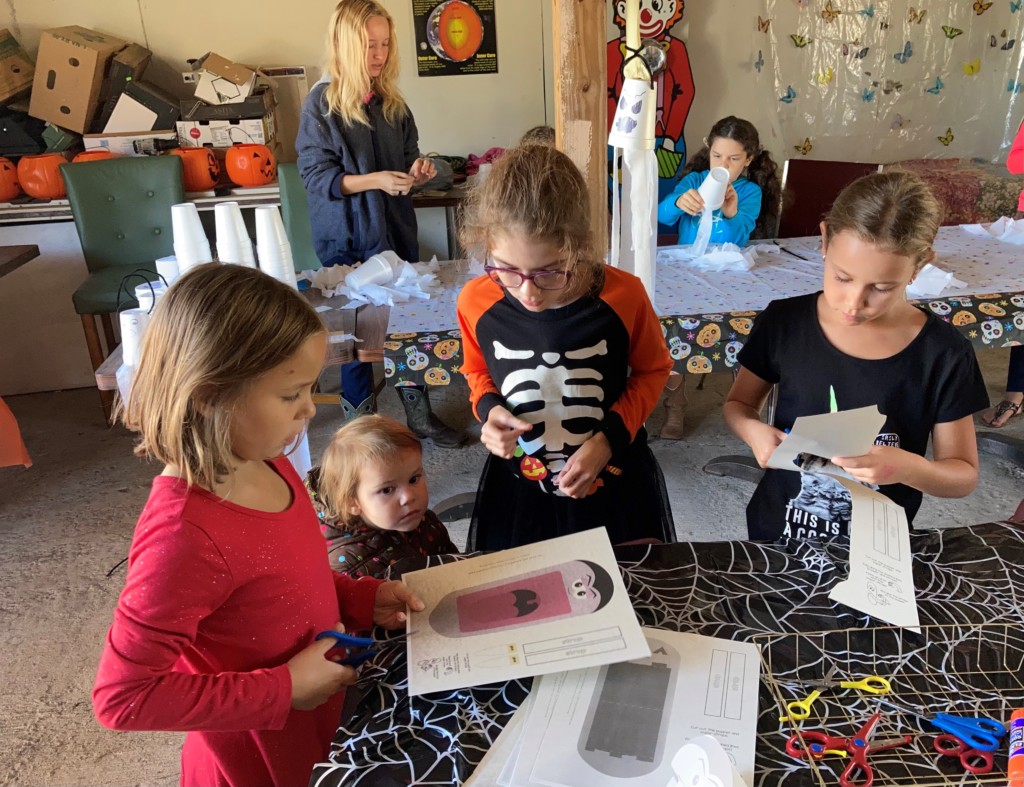
Kirby Family Farm launched as a homeschool co-op nearly three years ago with 10 students. More than 40 students, most of them elementary and middle school aged, attended during the past school year. More than half came from public schools.
Editor’s note: This article appeared Thursday on chronicleonline.com. You can read a reimaginED post about a homeschool co-op in North Central Florida here.
While students are returning to school this week, not all are going to be in a classroom.
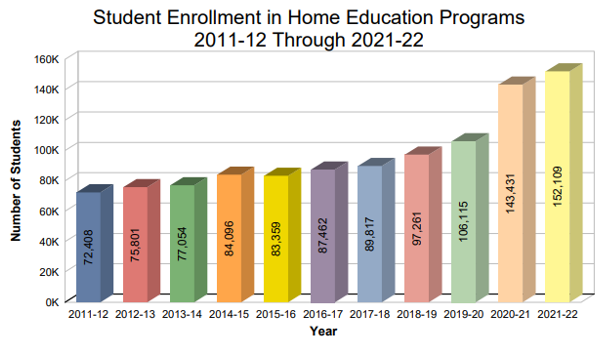
According to the Florida Department of Education, there were 152,109 homeschool students in the state for the 2021-22 academic year and an increase of 69% in the last five years. Numbers rise every year across the country, especially following the school shutdowns during the pandemic.
Parents who choose to homeschool do not have to go through it alone, with online courses, resources, and local groups. The kids are not alone, either, as many join co-ops or other programs.
Sherri Boggess Brice has been leading the Williston Christian Homeschool Group for 19 years. It currently has more than 90 members of all grade levels. The members share information and resources, as well as doing group parties and field trips.
Last year’s excursions included the Endangered Animal Rescue Sanctuary, Hoggetown Medieval Faire, Kanapaha Botanical Gardens and Cedar Key Historical Society, all geared toward older group members. The students also get together to do team sports and holiday parties.
“In my 23 years of homeschool adventures, homeschool kids still go to prom, participate in a graduation ceremony and receive a diploma,” Brice said. “My four daughters entered college straight from my homeschool program. Dual enrollment, college scholarships and Bright Futures all played a part in my children’s education at the upper level.”
“Homeschooling is one of the best alternatives for your child’s education,” she said. “Your child will learn life skills as well as the typical school subjects.”
To continue reading, click here.
Tampa Torah Academy, a private Orthodox Jewish school, will provide a challenging and well-rounded, age-appropriate curriculum emphasizing critical thinking, problem solving and independent research in diverse bodies of Judaic and general studies.
Abundant sunshine, greater opportunities for remote work, affordable housing, and school choice scholarships have attracted many young Jewish families from the Northeast to Florida. Now, a group from Queens, New York, is moving to the Tampa Bay area to open Tampa Torah Academy, a private Orthodox Jewish school.
The school will be led by Rabbis Ariel Wohlfarth and Yirmiyahu Rubenstein, who will serve as deans of the academy. The school will serve students in preschool through eighth grade, though leaders hope to add high school grades if enough parents express interest.
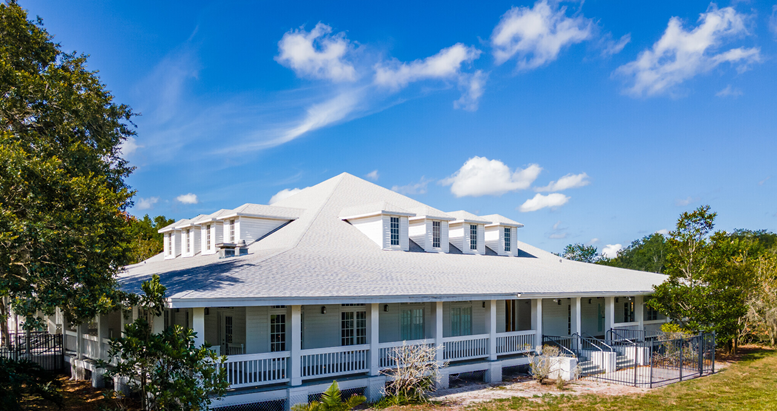
The school will be housed at 5209 Tampa Palms Blvd. in a rambling white building with dormer windows and an inviting wraparound porch that formerly served as a day care center. Renovations are nearly complete, and leaders expect to start classes by the end of this month.
The timing for the school is optimal, as more than 39,700 Jewish people live in the Tampa Bay counties of Hillsborough, Pinellas and Pasco, according to 2020 figures from the Public Religion Research Institute, a nonprofit, nonpartisan organization dedicated to independent research about the intersection of religion, culture and public policy.
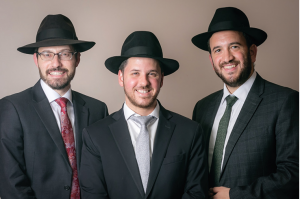
From left to right: Rabbi Ariel Wohlfarth, Rabbi Yirmiyahu Rubenstein, Rabbi Yossef Stulberger
Rubenstein explained that interest for the school came from parents in Tampa who contacted the Rabbinical Seminary of America, also called Yeshivas Chofetz Chaim, and Orthodox families seeking to leave New York for Florida. He said eight Orthodox families will be coming down from New York with him.
The school is part of the services provided by the Kollel, a group of dedicated Jewish families who live, learn, and teach in the community. The outreach center will also offer classes for adults on topics related to Judaism as well as community events.
Tampa Torah Academy is an affiliate of the Rabbinical Seminary of America, of which both Rubenstein and Wohlfarth are graduates. The organization is connected to similar Torah academies throughout the country, including in Orlando and South Florida.
Rubenstein said the school day will begin with religious education followed by secular studies such as math, reading, science and social studies in an Orthodox environment that will include kosher meals and a calendar that allows students and staff to observe Jewish holidays.
Rubenstein, a husband and father of four young children, explained that Jewish day schools are not luxuries for families, who need their children to receive Judaic education in addition to traditional academics and be raised in their culture.
“The Tampa Torah Academy is a response to the growing need of the Jewish community in Hillsborough County,” said Allan Jacob, a North Miami Beach nephrologist who also is chairman of Rabbinical Seminary of America. “There is a high probability that this effort will succeed in attracting more and more families of faith to the area to live and to the school for their children’s education. These families will contribute in a very positive way to the overall business and moral climate of the county.”
Jacob said the growth in the Tampa Bay area is replicating what happened in south Florida as more New York families seek refuge from that state’s high taxes, high housing costs and expensive private school tuition.
“We have seen similar expansion and growth in parts of south Florida as our communities grow,” he said. “All this is only possible because of the scholarships available through the Florida Family Empowerment Scholarship and Step Up For Students.”
(Step Up for Students, which hosts this blog, manages the Family Empowerment Scholarships for Educational Options and for students with Unique Abilities as well as the Florida Tax Credit Scholarship program, the New Worlds Reading Scholarship for struggling readers and the Hope Scholarship for students who have experienced bullying at their district schools.)
Figures from the Florida Department of Education show enrollment in Jewish day schools statewide grew in 2020 to 12,482 students from 10,623 in 2018. The number of such schools grew to 64 from 50 during that time.
Rubenstein thanked state leaders for approving the legislation that made the scholarship programs possible and enabled the school to open.
“We want to provide for these children and do all these great things, and obviously it costs money,” he said. “I feel it’s important for parents to have that choice, and the scholarships give them that choice.”
Once open, Tampa Torah Academy will be the third Jewish day school in Hillsborough County, joining Hillel Academy of Tampa and Hebrew Academy of Tampa Bay.
There is no Jewish day school In Pinellas County, but the Tampa Bay International School includes a Jewish studies program and receives support from the Jewish Federation of Florida’s Gulf Coast.
For more information about the school and an upcoming open house, call (813) 485-5817 or email [email protected].
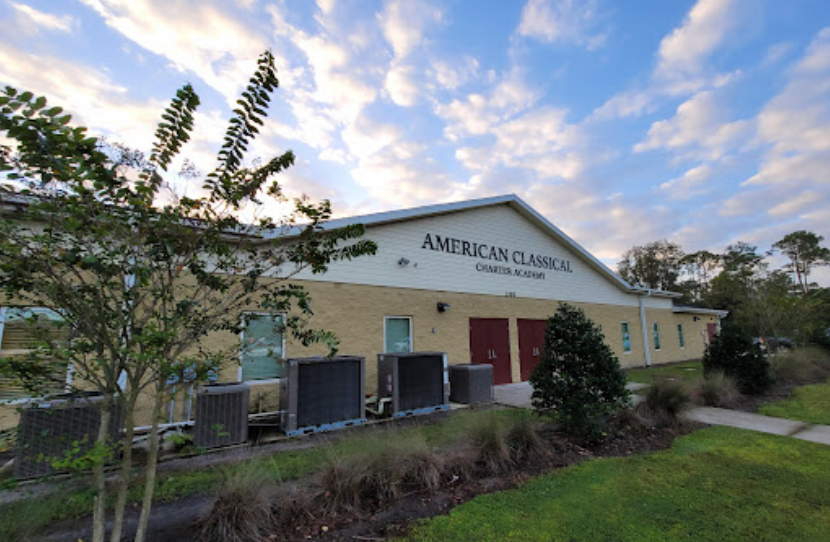
Osceola County School Board member Jon Arguello continues to defend American Classical Charter Academy in St. Cloud as a worthy example of school choice for families despite findings that the school is nearly $800,000 in debt, has failed to meet payroll and operating expenses, and is facing eviction.
A Florida charter school that closed after a judge upheld the school board’s decision to revoke its charter has found an unlikely ally – a school board member.
Osceola County School Board member Jon Arguello, whose vocal support for education choice sometimes puts him at odds with his fellow board members, was the only board member who voted against terminating the contract of American Classical Academy. He said the vote was hypocritical.
“If the roles were reversed, they’d be looking to close us,” he said after listening to a parade of parent testimonials about how their children had gone from struggling to thriving after moving to the charter school. “They’re outperforming our schools, and now we’re going to take away an option for parents who have a school that’s outperforming ours. It seems incredible that we’re bringing this up.”
School board members voted 4-1 on April 5 to revoke the charter upon the recommendation of Superintendent Debra Pace, who cited financial problems. In a letter to the board, she said expenditures at the end of 2021 were more than $600,000 in the red. The school also lost $178,000 in December, with the loss rising to more than $182,000, causing the school not to meet its obligations of funding payroll and operating expenses.
The school also was behind in its lease payments and already in the middle of an eviction process.
Pace said that even though the school would have 90 days to resolve the issues, the action had to be taken before the end of the 2021-22 school year to comply with state law.
“We don’t like to do a closure ever, but there’s a process that’s involved,” she said. “This was not a decision I took lightly, but I don’t want to wait until June and have an eviction go into place.”
Even before the vote was taken, school founder Mark Gotz prepared to file an appeal. Administrative Law Judge Lynne Quimby-Pennock sided with the school district.
"The clear and convincing evidence demonstrates that the school board had sufficient basis to move for the termination of ACCA’s (American Classical Charter Academy’s) charter pursuant (to a section of state law)," Quimby-Pennock wrote in a 65-page order.
As examples of the issues in the case, the judge wrote that only 10 of the school’s 28 teachers were certified and that students were not properly provided exceptional-student education services "because there was no certified ESE teacher providing instruction on campus for August and most of September 2021."
Leaders for the charter school have promised to appeal the judge’s decision.
“We believe that we shall prevail,” according to a statement on the website titled “Gross injustice dealt to the students of Osceola County.”
Meanwhile, the parents of the 330 students who attended the school have scrambled to find other options as district schools opened Wednesday. Several spoke in support of the charter school during the April 5 meeting.
“Please don’t shut us down; help give us a hand,” said Kathryn Leslie, whose five children attend the American Classical Charter Academy. She said she chose the school because she liked its classical approach to education.
“Our students matter, and the school is worth saving,” she said.
Arguello said he plans to write a letter to Florida Commissioner of Education Manny Diaz Jr., a former charter school employee and former state senator who supported education choice, to see if anything can be done to make it easier for charter schools like American Classical Charter Academy to stay open and offer choices to families.
“This school is providing a valuable service to the community,” Arguello said. “We need charter schools to survive.”
He said the school, which has been operating only three years, got hit by the coronavirus pandemic shortly after it opened. Pointing to staffing shortages and budget issues plaguing district schools in his county, he said the charter school is being penalized despite facing the same challenges.
He called school board members’ claims during the board meeting that the governing board members of the charter school are from out of state irrelevant.
“If we didn’t get money from the government, we could not have our doors open now,” he said. “We need some crusaders and some lawyers who are willing to stick their necks out for these kids.”
 Geography lies at the heart of New York’s success almost as much as it does for the United States as a whole.
With the completion of the Erie Canal, water transport of goods from deep into the interior of the United States could reach New York City via the Great Lakes, the canal and then the Hudson. From New York City, they could reach the world.
Of course, it took money to finance such activities, and New York City became at first a national center of the finance industry. By the mid-20th century, New York City had become a global capital of finance and culture, primus inter pares among cities.
These days, however, we are witness to the city’s sad decline; the K-12 education situation continues to nudge the city ever further from its glorious past.
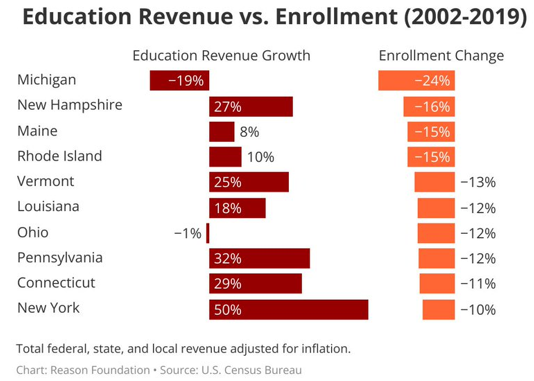 The decline started long before the pandemic. This chart from the Reason Foundation shows that New York’s statewide K-12 enrollment fell by 10% between 2002 and 2019, but inflation-adjusted K-12 spending increased by 50%. New Yorkers bore an ever-growing tax burden for a school system that enrolled fewer students over time.
This considerable increase in the tax burden might have paid dividends if the average quality of schooling in New York had improved. Instead, the long-standing migration destination for New Yorkers – Florida – improved its K-12 outcomes despite relatively constrained spending.
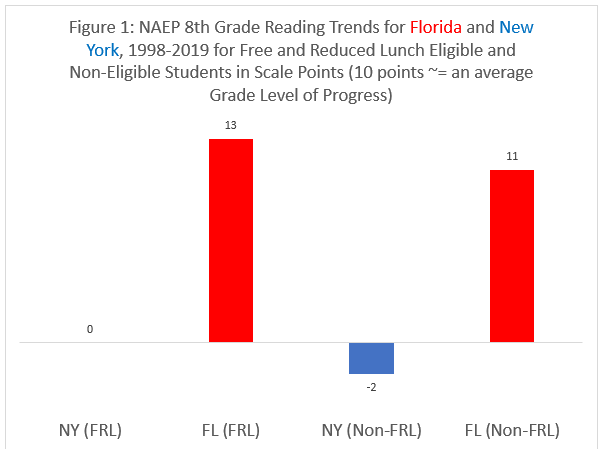
New York’s failure to improve eighth grade reading achievement was not an isolated failure. The state failed to show much improvement in outcomes in any of the main NAEP exams. Thus, New Yorkers had fewer students educated at a 50% higher fiscal burden with little to no improvement in education quality.
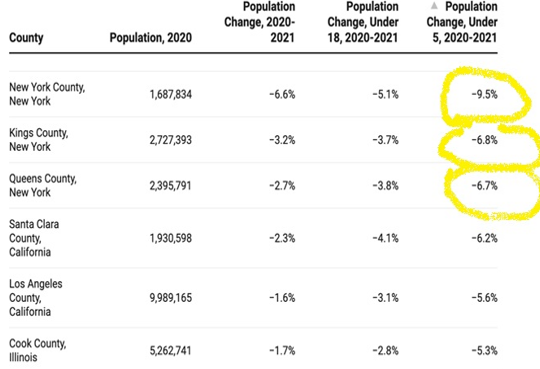
Strangely enough, people began finding better value propositions in other states, especially Florida. The COVID-19 pandemic accelerated many pre-existing trends, including the one where people noticed that it was not in their family’s best interest to live in New York.
James Q. Wilson in his 1975 book “Thinking About Crime” related how many American cities fell into a cycle of decline after the creation of the interstate highway system. As people gained the opportunity to work in a city but live in a suburb, the tax base, and perhaps just as crucial in Wilson’s view, the informal community policing practices that followed, caused cities to respond in two ways: they either raised tax rates to make up for the lost tax revenue or the cut services.
Regardless of the choice made, the effect was to alienate people and increase the lure of the suburbs. Many cities thus fell into a cycle of decline.
A third option and a path out of this dilemma went undiscussed by Wilson: Cities could innovate and provide better services for lower taxpayer costs. This, however, is precisely what the unions who play a powerful role in municipal elections wished to avoid at that time.
It is precisely what the American Federation of Teachers seeks to avoid in New York and elsewhere today. Perhaps New York will correct its course at some point, but in the meantime: Welcome to Florida!
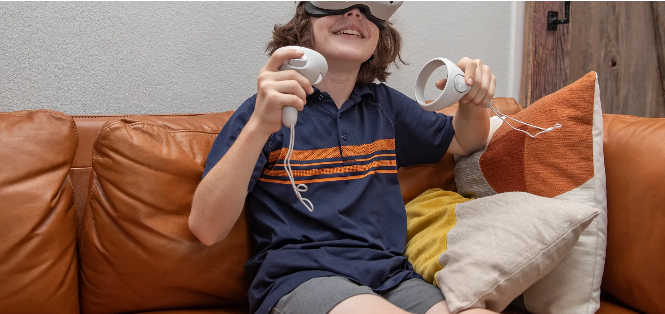
Optima Classical Academy, a tuition-free virtual reality public school for Florida students in grades 3-8, uses virtual reality technology to solve the challenges of disengaged, unsocialized scholars.
Editor’s note: You can read more about Optima Classical Academy here.
On this episode, Tuthill interviews former Collier County School Board member Donalds, who is president and CEO of the Optima Foundation, a network of charter schools serving more than 3,000 students. The organization is set to launch Optima Classical Academy this fall, the nation's first virtual reality charter school, for students in grades 3-8.
Tuthill and Donalds discuss how the pandemic sparked inspiration for the revolutionary new school that will offer a classical liberal arts curriculum and creative virtual “field trips” that will give students the opportunity to travel to outer space and under the sea.
They also provide a glimpse into how education savings accounts could play a critical role in giving greater access to families who want their children to experience the virtual reality academy via unbundling of educational services.
"It is really amazing the number of things that can be done and the creativity of our teachers ... They are over-the-moon excited about the possibility of teaching in virtual reality."
EPISODE DETAILS:
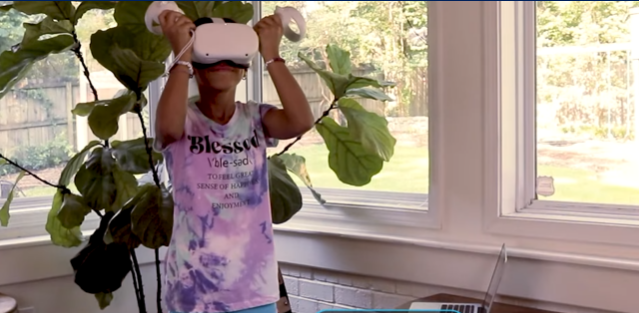
Billed by its founders as “the world’s first virtual reality charter school,” Optima Classical Academy is expected to open in August with 1,300 students in grades 3-8. The academy intends to expand classes up to 10th grade for the 2023-24 school year.
Editor’s note: Erika Donalds, education choice advocate and president and CEO of the Optima Foundation, spoke earlier this week with reporters at the Daily Signal about the intersection of virtual education and classical education. You can read reimaginED’s interview with Donalds here.
Classical education is a trusted model of learning. Virtual reality is a new technology still being fully developed. Despite the view of some that the two could be in conflict with each other, Erika Donalds disagrees.
“Classical education … is content-based, and [virtual reality] is the perfect way to deliver that content,” says Donalds, president and CEO of the Optima Foundation.
Donalds established the Optima Foundation, which has grown to be a network of charter schools, to give parents better education options for their children. After the pandemic, Donalds realized that some parents and students preferred an at-home model, but online education fell short of providing students with a strong education.
Virtual reality allows teachers and students to meet live in a virtual space from home, she says.
Through virtual reality, children “actually go to Mars, they go to the lunar landing, and they’re there when it happens in virtual reality,” Donalds says.
Donalds joins “The Daily Signal Podcast” to discuss the ways in which virtual reality can add to and expand classical education.
You can listen to the podcast here.
Editor’s note: This commentary from former Florida Gov. Jeb Bush appeared last week on miamiherald.com.
Like all parents, Jeni and Neal Schoenbach want the best for their children, and each year they assess how their children are doing and what type of school would serve them best. Their kids attend both private school and homeschool, and much of the cost of their education has to be paid out of pocket.
But Arizona’s expanded Empowerment Scholarship Program would allow the Schoenbach children to receive a publicly funded education regardless of whether they’re enrolled at the local public school, private school, or home school. Education savings accounts are a modern form of public education funding — but better. They are customizable, flexible and can pay for costs ranging from school tuition to tutoring, online courses and therapy.
Making these choices doesn’t categorically mean there’s anything wrong with their traditional school — just as it doesn’t mean there’s anything wrong with a private or charter school when parents choose the traditional option. It’s all about what the Schoenbach family fully understands: finding the best fit for each child.
That’s why it’s irresponsible and misleading to have the director of an Arizona organization opposed to school choice describe the state’s newly improved scholarship as a “nail in the coffin” for public schools. Separately, an Arizona Democrat opposed to the program said it was “designed to kill public education.”
Nonsense. It’s a false dichotomy to believe that using public funds for a child to attend a school other than a traditional public school is anti-public education.
The very point of public education funding is to fund every child’s education. It’s not to fund only one type of school and mandate that all children must enroll in that school, regardless of whether it serves their needs. Here’s where the reasonable argument for public funding of school choice gets ugly for those who oppose it. During the pandemic, it became increasingly clear that the one-size-fits-all school model failed.
Traditional systems simply did not have what it takes to serve all families. And the horrendous impact on student learning is becoming more and more evident.
To continue reading, click here.
 Families who chose home education during the pandemic not only liked the option, but may have told a few friends.
A new report from the Florida Department of Education shows last year’s record setting 35% in the number of Florida families homeschooling their children grew by another 6%.
According to the report, home education enrollment grew to 152,109 students during the 2021-22 school year, representing a 110% increase in enrollment since 2011-12.
The Department also reported that nearly 105,000 families, up from around 100,000, utilized home education options for their children last year.
School districts with the most home education enrollment were Hillsborough (13,641); Broward (10,412); and Palm Beach (9,687). Miami-Dade, Florida’s most populated school district, placed seventh with 5,859 homeschooled students.
Last year, the U.S. Census Bureau released a survey showing Florida’s enrollment growth in home education was fourth highest in the nation; only Alaska, Oklahoma and Montana had greater enrollment. The survey also showed that home education enrollment increased in every state except Iowa and Kentucky.
A survey by the National Center for Education Statistics revealed that 5.4% of American households reported enrolling at least one child in home education during the first year of the pandemic. Among the households, 6% of white families, 4.9% of Hispanic families, 4% of Black families, and 2.6% of Asian families reported home educating at least one child.
An “Other” racial category, which included Pacific Islanders, Native Americans, and mix-raced households, was 8.1%.
Home education was established by the Florida Legislature as a school choice option in 1985 and is defined by statute as “the sequentially progressive instruction of a student directed by his or her parent.” Parents who home educate their children can customize the curriculum to the needs of each child. Homeschooled students are required to annually undergo one of five academic evaluation options, the results of which must be submitted by the parent to the school district.
 Florida’s private school enrollment bounced back from the pandemic stronger and healthier than ever according to the Florida Department of Education’s latest annual report on private schools.
The report shows that after suffering the first enrollment declines in a decade, the number of students, staff and schools all increased significantly in the 2021-22 academic year. Last year’s staggering 33,500 student decline was erased as private school enrollment grew by more than 51,000 and reached 416,084 students, the largest private school enrollment reported by FLDOE in 30 years and likely the highest in Florida history.
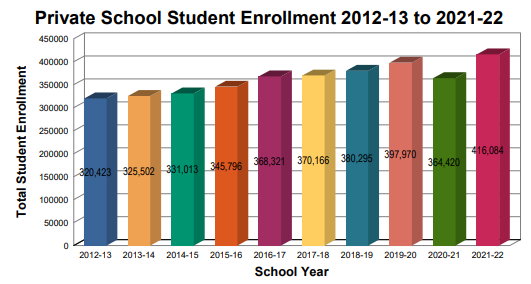
Private school enrollment grew by 14.2% this year, compared to 1.5% growth for public schools.
Private school students made up 12.8% of PK-12 students enrolled in public (including charter school and virtual schools) and private schools. This figure does not include students enrolled in home education.
Historic data show private school students made up 9.3% of PK-12 public and private school students in 1991-92 and peaked in 2002-03 at 12.9%.
The Department noted that private school enrollment exceeded 10% or more of public-private enrollment in 32 districts. The enrollment percentage was highest in Martin (40.6% of students), Jefferson (36% of students) and Miami-Dade (19.9% of students) and smallest in Calhoun (0%), Union (0.2%) and Sumter (1%).
Miami-Dade enrolled the most private school students (81,639), followed by Broward (45,493) and Orange (29,546).
Meanwhile, the Department reported private school employment increased from 43,553 instructional staff and administrators to 49,187, a growth of 12.9%.
The number of available private schools also bounced back, rising from 2,739 to 2,848 schools.
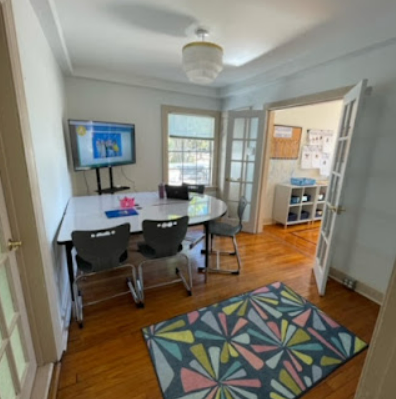
Apollo Academy, an Acton affiliate, is a self-described “single-room schoolhouse designed for the 21st century” for students in grades K-5. Opening this fall in Tampa, it will provide a framework and environment that prioritizes mastery of foundational curriculum while offering children the freedom to make their own decisions.
As the COVID-19 pandemic moved into its second year, school got more stressful for Monique Levy’s kids.
Six-year-old Sima could barely remember a time when COVID-19 wasn’t a threat. School safety measures made the girl who loves Sonic the Hedgehog and riding her bike fearful.
“She was quickly losing her love for school,” Levy said, noting that pre-COVID, when Sima was in kindergarten, she would wake on Saturday mornings wanting to join her classmates.
Meanwhile, 9-year-old Emet was anxious too, mostly in the evenings due to a heavy homework load that left him little free time to pursue passions like astronomy and marine life. The private school Sima and Emet attended was nurturing and supportive, but three years of operating in pandemic mode made Levy question whether her children were in the right place.
“It did not feel right to us,” Levy said. “There had to be another way.”
One day, she happened to drive past a “charming little house” with a sign out front that said Apollo Academy. She and her husband immediately arranged a visit to the Tampa school.
“We toured this unique building filled with modern studios for STEM, arts, reading, math, and even a library that just invited you to sit down and read, which Emet did almost immediately,” she said. “After we finished the tour, it was clear this was the place our children needed to be.”
The Levy kids are now among 20 learners from 12 families who will begin what Apollo calls a “hero’s journey” when the new private school opens Aug. 10. The school is accepting the state’s Family Empowerment Scholarship for Educational Options administered by Step Up For Students, which hosts this blog.
The private school is an affiliate of Acton Academy, a worldwide network of 270 microschools that promotes education as an adventure in autonomy. Founded by billionaire entrepreneur Jeff Sandefer and his wife, educator Laura Sandefer, Acton combines Montessori’s self-directed learning with the Socratic method of responding to questions with questions to inspire independent problem solving.
Acton does not have tests or homework. Students show skill mastery by building portfolios of their work. Failing is seen as a beneficial experience, an opportunity for students to learn at their own pace.
“We’ve seen overwhelming community support,” said Beth Ann Valavanis, who founded the school after being inspired by Laura Sandefer’s book, “Courage to Grow.” At the time, Valavanis was looking for the best learning options for her daughter, Emilia.
“So many people are rooting for us in a really fun way,” she says of Apollo. “We’re so excited with the growth of Tampa and all the families moving here, and we are excited they’ll have an option that’s different from traditional school.”
Valavanis is putting the finishing touches on her renovations, which include a new roof and interior improvements. She also has hired four “extremely dynamic” guides to support students with their learning.
Those guides include Florie Reber, an artist with 30 years of experience in non-traditional settings and the owner of Yellow Bird Art Studio; Kathleen Amirault, an environmental educator and naturalist; Tiarah Bentley, an educator with a background in Montessori learning; and Levy, who holds a master’s degree in special education and elementary education.
Valavanis said the first five weeks will be spent focusing on “Building Our Time” to allow students to get to know each other and learn about their new environment. That could mean unlearning some practices of traditional school.
“You can eat when you’re hungry and go the bathroom when your body tells you to,” she said.
The school also will pose a question of the year. For this inaugural year, the question will be: What is the purpose of school?
“We’re all going to transform ourselves in a new way, together,” Valavanis said.
Sima and Emet are excited to be embarking on a new adventure, Levy said, especially one that does not include traditional tests or homework. As a parent, she’s thrilled that children who attend Acton Academy schools usually advance two to three grade levels in a year, a fact that inspires confidence in the non-traditional model.
“I am very confident that both my children will find their place at Apollo,” Levy said. “I’m so excited to watch them find the courage to grow.”

