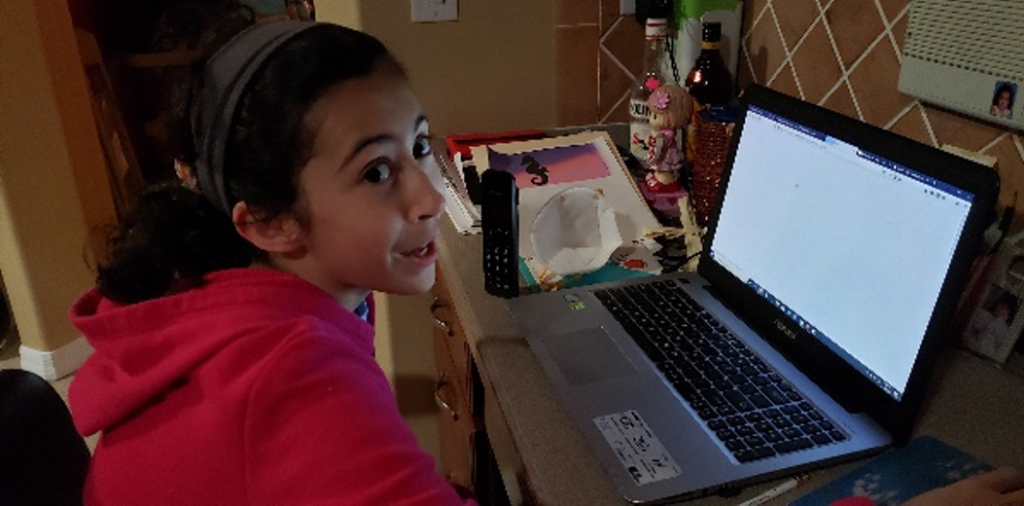
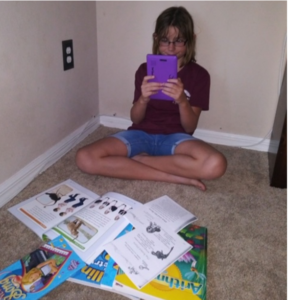
Berta DellaSalla, a seventh-grader at Bishop Larkin Catholic School, works on assignments online as her father, Gene, recovers slowly from coronavirus.
As schools continue to navigate their new reality in the face of coronavirus, a Catholic school in Port Richey is facing a challenge that goes beyond educating children and cuts to the heart of what it means to be a community.
On March 10, nearly a week before most brick-and-mortar schools closed, a parent at Bishop Larkin Catholic School tested positive for Covid-19. Administrators made the decision to shut the school down overnight, necessitating an immediate switch from in-person to online instruction.
“It was not a very difficult decision,” said principal Stacy Cervone. “Our priority was the safety of our students, staff and families, and finding the best way to keep everyone safe.”
Bishop Larkin Catholic School, accredited by the Florida Catholic Conference and a member of the National Catholic Education Association, serves 217 students in prekindergarten through eighth grade. Eighty-one students attend on a Florida Tax Credit Scholarship and two attend on a Gardiner Scholarship for students with unique abilities. (Step Up For Students, which hosts this blog, administers both scholarship programs.)
After receiving guidance from the Diocese of St. Petersburg, teachers began using an online platform called Educator Pages to post assignments. Students sign in each morning, then get started on four main assignments, which must be completed daily, covering core subjects like math and science that are presented as a live lesson, a recorded lesson or an interactive PowerPoint.
Students also engage in personal live learning time and choose one elective or resource class assignment to round out their day.
Cervone, a 22-year veteran educator who served as an assistant principal for Hillsborough County Public Schools before coming to Bishop Larkin a year ago, knew that her school needed to go above and beyond caring for students’ safety and educational needs. She considered it part of the school’s mission – working in partnership with parents and parish communities in a spirit of compassion, service and leadership – to aid the family directly affected by the virus.
Gene DellaSala, whose daughter, Berta, is a Bishop Larkin seventh grader, thought he was coming down with a cold in late February following a visit from a business associate who had recently traveled to China. In early March, Gene, 46, learned that his associate had tested positive for Covid-19.
Gene’s doctor diagnosed him with a cold and sinus infection, but his symptoms – a bad cough, stomach cramps and chills – worsened. His wife, Bertha, contacted the Pasco County Department of Health on March 9, and his doctor arranged for him to be tested for coronavirus. The next day, test results confirmed that Gene was the first person in Pasco County to contract the virus.
Bertha knew she had to contact Cervone.
“I felt terrible knowing that BLCS had to be shut down since our kids love it and appreciate the one-on-one relationships they have with everyone,” Bertha said. “But, on the other hand, we were relieved that no one else was going to be exposed to the virus and that they took the precautions to make sure (the school) was safe for everyone.”
For the past three weeks, Bishop Larkin parents and staff have been bringing the family take-out restaurant meals. They’ve picked up medications from the pharmacy. They call and text every day to check in. One parent offered to stop by the school to pick up books for Berta and deliver them to the house.
Bertha said the school’s support has been invaluable as Gene remains quarantined on one side of the house. She doesn’t drive, so help with grocery delivery has been a huge help. An online replication of school spirit days has been a morale booster.
But most of all, Bertha said, she’s appreciative her daughter has been able to continue learning. The educational continuity, in a virtual format, is helping Berta deal with her father’s illness and cope with the fact that she can’t be near him.
“She thrives on a routine, so it’s been hard to keep her motivated and engaged,” Bertha said, adding that the school counselor has called several times to make sure Berta is okay.
Meanwhile, Gene is recovering slowly but continues to test positive for coronavirus. Until he tests negative on two consecutive visits to the health department’s parking lot, where he is swabbed by a technician, he must remain in quarantine.
The school community has pledged to stand by the family for the duration.
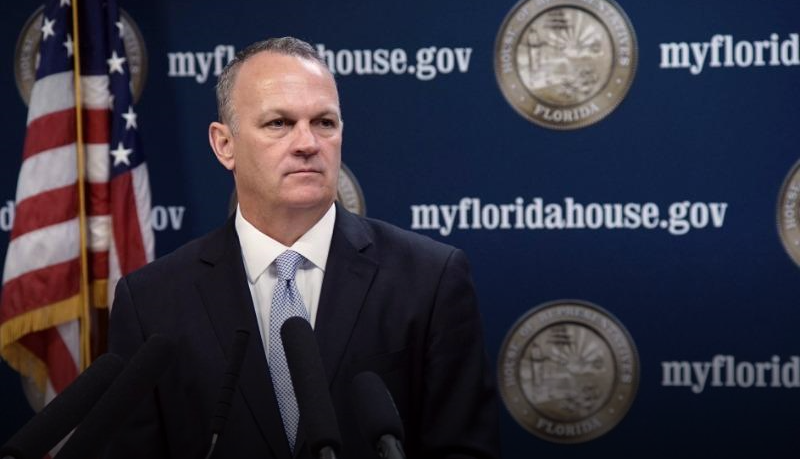
Passage of HB 7069, characterized by school boards as an unconstitutional infringement on their rights to operate public schools, was a priority of then-House Speaker Richard Corcoran.
Jim Saunders, News Service of Florida
TALLAHASSEE – Nearly three years after lawmakers passed a controversial measure that sought to bolster charter schools, the Florida Supreme Court on Tuesday turned down a constitutional challenge by county school boards.
The Supreme Court, as is common, did not explain its unanimous decision to decline to take up the case. But the decision effectively let stand an August ruling by the 1st District Court of Appeal and was a victory for the Florida Department of Education and the Republican-controlled Legislature.
School boards argued that the mammoth law, known in education circles by the shorthand HB 7069, was an unconstitutional infringement on their rights to operate public schools. Passage of the law in May 2017 was a priority of then-House Speaker Richard Corcoran, a Land O’ Lakes Republican who is now the state education commissioner.
Corcoran and other school-choice supporters used the measure to try to direct additional money to charter schools and to authorize “schools of hope,” a new type of charter school aimed at areas where children have been served by low-performing traditional public schools.
In a brief asking the Supreme Court to take up the case, attorneys for nine school boards argued that disputed parts of the law “unconstitutionally transfer control over operational decisions from local school boards to unelected Florida state employees” at the Department of Education. Also, they argued the law creates a “parallel system of public schools.”
As examples, the school boards pointed to parts of the law designed to provide more building funds and federal Title I money to charter schools. The building funds involved money raised through local property taxes for capital-improvement projects, while the Title I program provides money to schools that serve large numbers of low-income students.
The nine school boards who appealed to the Supreme Court were from Alachua, Bay, Broward, Hamilton, Lee, Orange, Polk, St. Lucie and Volusia counties.
“On the merits, this case concerns the constitutional balance between the state’s duty to provide for and supervise the system of public education and local school boards’ constitutional duty to operate, control, and supervise local schools,” the school boards’ brief, filed in October, said. “The First District ignored this balance, giving the state carte blanche to regulate what were previously considered local matters.”
But Department of Education attorneys, in a November brief, said the 1st District Court of Appeal had ruled correctly on the issues and that the Supreme Court should not hear the case.
“(The) First District’s decision applied existing decisions interpreting decades-old constitutional provisions,” the department’s attorneys wrote. “Petitioners disagree with those decisions and want this (Supreme) Court to ‘examine’ the interplay between those provisions. But those provisions have been considered, and harmonized, by this court and the district courts, and will continue to be. This court should reject petitioners’ invitation to contemplate a non-existent conflict.”
The Tallahassee-based appeals court rejected the arguments about the property-tax money and Title I funds. It also said school boards did not have legal standing to challenge other parts of the law, including the part establishing schools of hope. It cited court precedents and a legal doctrine that effectively limits the ability of public officials to challenge the constitutionality of state laws.
“The school boards’ constitutional challenge to HB 7069’s provisions represents their disagreement with new statutory duties enacted by the Legislature,” the appeals-court ruling said. “As the foregoing authority makes clear, however, the school boards must presume that the provisions at issue are constitutional.”
 In Mel Brooks’ “Young Frankenstein,” the doctor and Igor are robbing graves for monster parts. Dr. Frankenstein complains, and Igor optimistically notes that it could be worse, because it could be raining. Lightning, thunder and a torrential downpour instantly follow.
The coronavirus pandemic has educators scrambling to develop impromptu distance learning. We can safely predict the results will be uneven. Many educators are heroically struggling to expand access for students without home internet access. The Center for Reinventing Public Education, however, reviewed the efforts of 82 school districts educating more than 9 million students and found over half either were providing no online learning or simply were sharing links to publicly available websites.
Not surprisingly, many parents turned to educators with more experience with distance learning. This, however, is where that pesky politics and turf business got in the way again. The Wall Street Journal took the state of Oregon to task for restricting access to the state’s online schools, leaving 1,600 students stranded on the waitlist for a single cyber-school. But it could have been worse:
“The state Department of Education originally contemplated closing down virtual public charters along with the brick-and-mortar schools, according to a March 24 PowerPoint presentation reviewed by the newspaper Willamette Week. Even during a national crisis, unions would rather deprive students of an education than see their charter-school competitors succeed.”
Pennsylvania lawmakers also cut off access for additional students to attend online schools. Meanwhile, Florida Virtual School, the sunshine state’s largest online K-12 school, is seeking $4.3 million in technology upgrades that will boost its capacity from its current 170,000 students in district, charter and private schools to 470,000 students by April 17 – eventually expanding to 2.7 million students by May 4. That’s approximately the size of the Florida public school system’s total enrollment. Florida Virtual will offer up 100 courses.
So here is the part where this discussion goes Igor. Dr. Anthony Fauci, the nation’s top infectious disease official, expects a second COVID-19 surge in the fall. I know none of you wanted to read that last sentence, but the reality is that the current school shutdown may not be the last school shutdown.
Lots of things can change for the better between now and the fall – testing, treatments and vaccines, for example. Florida policymakers are wise, nevertheless, to expand the state’s capacity to deliver online instruction. Lawmakers in other states might want to stop worrying less about where students enroll and more about whether they have the opportunity to learn.
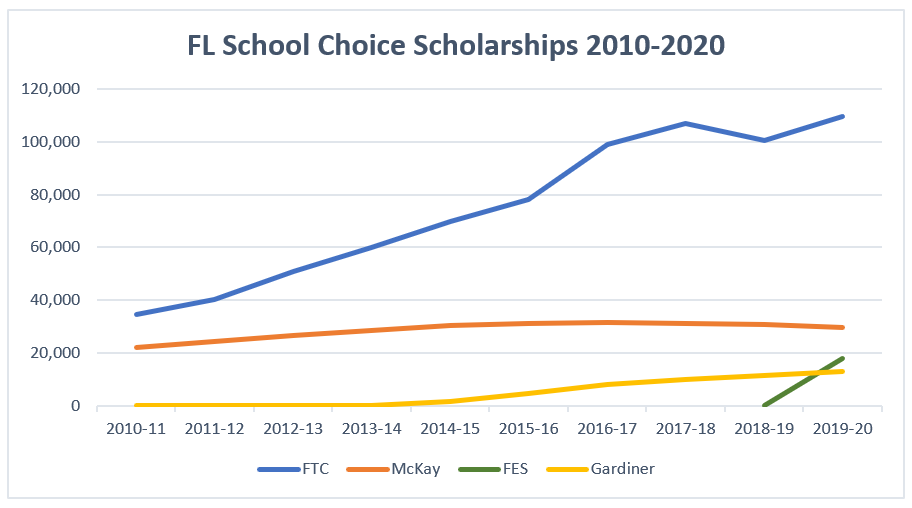 While Covid-19 likely will be responsible for the single largest increase in virtual education in Florida’s history, enrollment growth over time in another program that offers education choice, the Florida Tax Credit Scholarship program, is nevertheless impressive. From academic year 2015-16 to 2016-17, the program grew by 20,000 students.
Meanwhile, the Family Empowerment Scholarship, in its first year, ramped up to 18,000 students in a matter of months. The previous first-year enrollment record holder, the Florida Tax Credit Scholarship program, launched in 2002 with 15,585 students.
By comparison, the McKay Scholarship program for students with disabilities began in 2000 with 970 students. The Opportunity Scholarship program, created in 1999 and offered to students attending low-performing public schools, served just 57 students in its first year. (The Florida Supreme Court in 2006 declared that program unconstitutional after an epic legal battle.)
Enrollment in the Gardiner Scholarship program, created in 2014 for students with unique abilities, has shown steady, if less rapid growth, although that’s likely to change. The Florida Legislature appropriated an additional $23 million in funding for the program in 2019, pushing Gardiner funding to $147.9 million and allowing it to serve at least 2,000 more students. This year, the Legislature approved an additional $42 million increase for the program, which will make it available to still more families.
(Step Up For Students, which hosts this blog, administers the Florida Tax Credit Scholarship, Family Empowerment Scholarship and Gardiner Scholarship programs.)
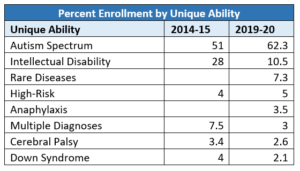 Data indicate that while the percentage of students diagnosed with autism participating in the program has grown, the number of students with other diagnoses has declined as a percentage of the total population amid an expansion in the list of eligibilities.
The percentage of minority students participating in the Florida Tax Credit program has remained remarkably stable. In 2010, non-white students made up 75 percent of the program and today comprise 73 percent. While the percentage of black students dropped from 36 percent to 30 percent, the number of Hispanic students increased from 27 percent to 38 percent. The percentage of white students participating increased from 25 percent to 27 percent.
The Florida Tax Credit program’s income eligibility requirements also have changed over time. Today, students can remain in the program if their household income does not exceed 260 percent of poverty. That threshold has increased from 185 percent, the eligibility requirement for the federal free and reduced-price lunch program.
The average student lives in a household earning $27,298 a year, just 13 percent above the poverty level.
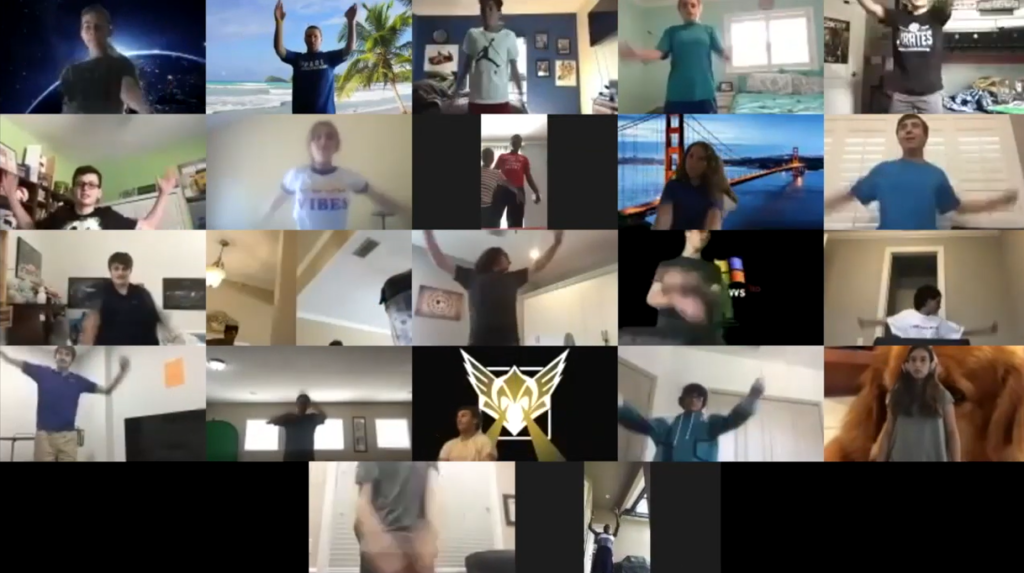
Pace Brantley head coach Evan Starcher leads his students in a virtual version of jumping jacks to keep them moving during the school day.
When teachers at a central Florida private school that strives to celebrate the uniqueness of each student learned they had only a few days to transition to remote learning, they vowed to get creative.
Really creative.
A math teacher devised a lesson plan using groceries from her pantry to show her students the difference between a polyhedral and a non-polyhedral. A physical education teacher designed a jumping jacks routine. A science teacher began mapping out a virtual tour of her farm.
Meanwhile, a social studies teacher laid out all the steps he takes to check the oil in his family's Honda Accord.
While many schools throughout the state and the nation are recording lessons for students to access on demand, Pace Brantley School in Longwood is delivering online learning as if it’s a regular school day – and doing it with a healthy dose of imagination. The media team compiled a video to show the myriad ways teachers have come together to serve their students while staying within the bounds of social distancing.
“The kids are seeing their academic teachers as if they were still here on a block schedule,” said head of school Pam Tapley. “We take attendance. Two guidance counselors are monitoring. We just have a lot of great people supporting the classroom.”
Founded in 1972 with 10 students and two teachers, Pace Brantley specializes in educating students from kindergarten through high school with special needs, including attention deficit hyperactivity disorder, autism spectrum disorder and other challenges that affect learning. The school serves 165 students, 47 of whom participate in the Gardiner Scholarship program for children with unique abilities. One student attends on a Florida Tax Credit Scholarship, which along with the Gardiner program is administered by Step Up For Students, which hosts this blog.
Despite advice from some education experts who have encouraged simplification of schedules during coronavirus-induced distance learning, staff at Pace Brantley decided to stick with a structured day because they know it’s what works best for their students. Parents were encouraged at the outset to set up a workspace for their children dedicated to their virtual school day. Students start the morning by reciting the Pledge of Allegiance followed by the school pledge, promising to treat everyone with fairness, kindness and respect, just as they did when they were reporting to their 9-acre campus.
The first half of each 90-minute period includes live lessons on Zoom. Students spend the second half working independently or in small groups. They also get one-on-one access to their teachers if they have questions.
“I’m getting overwhelming emails from parents,” Tapley said. “Our kids thrive on having their schedule.”
One of those parents is Ann Zanca, whose son, Ben, attends Pace Brantley on a Gardiner Scholarship. Born with CLOVES Syndrome, a rare disorder characterized by tissue overgrowth and complex vascular anomalies, he is susceptible to respiratory issues, which puts him at higher risk for Covid-19 complications.
“When they started shutting down the school, part of me, as the mom of a kid at risk, was happy,” Zanca said.
She reports that Ben hasn’t missed a beat since the transition, which is critical if the 17-year-old is to stay on his college prep track.
“He needs to have a reason to get up and take a shower in the morning,” Zanca said, adding that she’s been impressed with how quickly the school responded to delivering distance learning.
“They put a lot of thought into it and made it as much like school as possible,” she said. “I listen at his door, and he’s engaging, and he’s laughing and doing his work.”
Another Pace Brantley parent, Susan Sleboda, said the experience has been similar for her son, Ryan. The 18-year-old senior is class president and a lead anchor and editor on the school’s morning news show.
“They’ve done a stellar job at providing this online format where students are actually able to interact with their teachers,” Sleboda said.
She was unsure at first how Ryan, who is on the autism spectrum and didn’t speak until he was 7, would acclimate to the change. Sleboda said he has adapted well and was eager to work with his peers to produce a virtual news program.
“By Day 2, he was telling a student that he was filming in an area where he had too much light,” she said. “Every day I’ve seen him gaining confidence in the system.”
Ryan, who plans to study anthrozoology at Beacon College in Leesburg next year, said he and his classmates are making the best of the situation, finding it not that much different from how things operated at their brick-and-mortar school. Instead of showing a lesson on the white board, his teachers are sharing their screens. Instead of producing a scene from “The Little Mermaid” for a live production of the school’s Broadway Dinner Night, the crew will pivot to a virtual production.
“It feels really weird, but I’m going to get used to it,” Ryan said.
If head of school Tapley had any doubts about her students’ ability to rise to the occasion, those doubts disappeared this week.
She learned, via parent emails, that some of the students are getting up and putting on their school uniforms before taking their places at their online workstations.
 The Florida Board of Education earlier today unanimously approved Florida Virtual School’s request to spend $4.3 million to boost capacity, allowing it to serve 2.7 million students in district, charter and private schools. The vote came amid the need to expand online learning across the state in response to the Covid-19 pandemic.
The board, acting as the Florida Virtual School Board of Trustees, approved the request during a meeting held via conference call. The approval allows the public nonprofit organization to increase the value of existing technology contracts to upgrade its technology and expand capacity to serve 470,000 students in grades K-12 by April 17. Full expansion should be in place by May 4.
Current license subscriptions of $2.5 million will be expanded to $6.3 million, while funds available for servers and equipment will grow from $170,538 to $340,000. Money earmarked for data storage hardware will increase from $72,000 to $340,000, and the allotment for data collection services will grow from $341,760 to $495,000.
Florida Virtual School CEO Louis Algaze said 147 K-12 teachers already have completed training through the organization and an additional 3,417 are signed up for training. Additional resources are housed on a web page that serves as a “one-stop” shop for online education resources.
Florida education commissioner Richard Corcoran, in his report to the Florida Board of Education at that board’s conference call earlier in the day, described the transition to online learning as “the most massive pivot the educational world has ever seen,” noting that Florida Virtual School is making its investment “without asking for one dollar from the Legislature.”
In May, the Legislature dismantled the Florida Virtual School Board of Trustees and temporarily gave control to the Florida Board of Education while state officials conduct an audit and determine how the virtual school board should be run.
HUDSON, Fla. – All four of Patricia Larkin’s kids have special needs, and all were making good progress at HOPE Ranch Learning Academy, a private school known for its equine therapy program. So when the coronavirus pandemic forced the single grandma to briefly veer into homeschooling, she got a little panicky.
“My children have to be on a routine. And when our country came to a halt, we knew something was going to happen with the schooling,” said Larkin, 59, who is raising three grandchildren and a grandniece. “I tried as hard as I possibly could to do the routine, but I’m not a teacher.”
Two things came to Larkin’s rescue: School choice scholarships, which allowed her children to stay at HOPE even though she just got laid off as a property manager. And the school itself.
The HOPE Ranch staff of 43 rallied around a parent-shaped plan to tailor distance learning to their 150 K-12 students, most of them on the autism spectrum.
“We had to re-invent school in a week. Those were 18-hour days nonstop,” said Jose Suarez, the school’s founder and executive director. Given gaps with devices and connections, “We had to come up with a system that was low tech, that could be deployed regardless of whether there was a computer in the home or not, and could be deployed on a daily basis.”
The early result: Rave reviews from parents like Larkin, who called the plan “brilliant.” And high hopes for the next steps, including a virtual version of equine therapy, the school’s main draw.
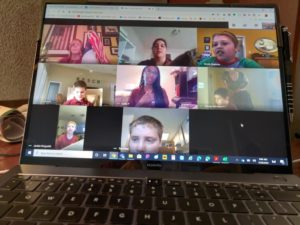
Lead teacher Ms. Terri, top left, connects with HOPE Ranch students each morning in an online ‘Social Group.’
A key question in the dash to distance learning is the impact on millions of students with special needs. Some school districts, fearful of being sued by parents of students with disabilities for not providing equitable services, have put a hold on learning for all students. Others are moving ahead, but in ways that aren’t making parents of students with disabilities happy. This is hard, tangled terrain.
In Florida, a national leader in education choice, it remains to be seen whether charter schools or private schools do any better. Those 2,600-plus schools, serving 700,000 students, aren’t getting much coverage. Even if they were, it’s risky to draw generalizations from a few schools, given how diverse those sectors are, and how varied the challenges for students with disabilities.
Florida, though, does present a unique window. It has long offered learning options to parents of students with disabilities. In 1999, it created the McKay Scholarship, a voucher for students with disabilities that now serves 30,000 students a year. In 2014, it created the Gardiner Scholarship, an education savings account for students with special needs that’s now serving more than 13,000 students. (It’s administered by nonprofits like Step Up For Students, which hosts this blog.)
Those scholarships help support a growing number of private schools that serve students with special needs, some of them exclusively. HOPE Ranch, nestled on an oaky stretch of sand hill an hour north of Tampa, is one of them.
Suarez said his team started discussions about remote learning in early March. But they kicked into high gear on March 13, when Gov. Ron DeSantis essentially ordered all public schools in the state to close. Staff quickly surveyed parents about digital capacity, and while not every family had enough computers or tablets for every child, they had phones that could suffice in the short term.
HOPE also asked parents to list their biggest concerns, and the parents were clear. We don’t want our kids falling behind, academically or socially. We don’t want them on computers all day. We don’t want to be their teachers.
The HOPE staff fashioned their plan on that input. Individualized learning packets would be distributed every week. Parents would be given a general schedule with deadlines, but with enough flexibility to figure out the best track for their kids. Using Google Hangouts, teachers would do a half-hour visual chat with each student at a set time every day.
The vast majority of Florida students returned to “school” on Monday, March 30. On Thursday and Friday of the prior week, HOPE teachers did trial runs with the chat platform. By Sunday night, Larkin’s kids were giddy. “They were, ‘I can’t wait! I can’t wait!’,” she said. “They knew they were going to see their teachers.”
HOPE Ranch student Nicole connects with her teacher during a half-hour visual chat they have every morning.
Larkin’s boys – Chad, 12, and Jordan, 7 – are both autistic. Her girls – Bryanna, 10, and Nicole, 10 – are both diagnosed with ADHD and PTSD. All four struggled in public schools. But at HOPE, Larkin said, their teachers know their specific challenges, and work diligently on specific remedies. Jordan, for example, used to avoid “circle time” with classmates because of extreme shyness. But rather than trying to force him to conform, his teachers let him stay back until he felt comfortable. Eventually, he joined on his own.
Bryanna has struggled with maintaining focus. So how sweet it was, Larkin said, that on her first chat on her first day back, Bryanna stayed locked in. “I thought I was in the Twilight Zone,” Larkin said. “They engaged like they were person to person in front of each other.”
HOPE teacher Kevin Trevithick said for his 13 high school students, the quick shift to distance learning has been a lesson unto itself.
“It’s time to adapt and move forward,” he said. “That’s the biggest thing I’ve tried to convey to them.”
One student is resisting the chats, said Trevithick, a former public school teacher, but the others are having fun with the novelty of the situation and the new technology. One told him he’s not a morning person, and now that he can set his own schedule, he’s getting more done.
Can this new way of “school” work for long? Trevithick said some students may get tired of being cooped up. But “people are incredibly adaptable,” he said. “If it’s something where this is the way it has to be, then I do think the majority of them will do just fine.”
The can-do attitude is infectious. Parents like Larkin are having to quickly navigate platforms and apps they never heard of, like Calendly and Adobe Scan. But when they learn they can do it, she said, the next challenge looks a little less daunting.
In the meantime, more programming is coming. On Friday, HOPE is rolling out “virtual chapel” and a virtual social skills class, which will allow the students to stay connected and interact. On Monday, it will begin online speech, occupational and ABA therapy, led by local district employees assigned to the school.
Monday is also the kickoff for the “Virtual and Interactive Horsemanship” class. HOPE students learn to ride, groom and care for a stable of horses. Along the way, they learn teamwork, resourcefulness, problem solving – and get some boosts for their self-esteem. Larkin said the horses helped Jordan, her youngest, come out of his shell. “He mounts those horses … and he’s beaming,” she said. But can it possibly work wonders when it’s online?
It’s working with her kids in the other settings, Larkin said.
So why not?
Lead photo: Bryce, a student at HOPE Ranch, connects with his teacher, Ms. Suzanne, and his parents who joined from remote locations.
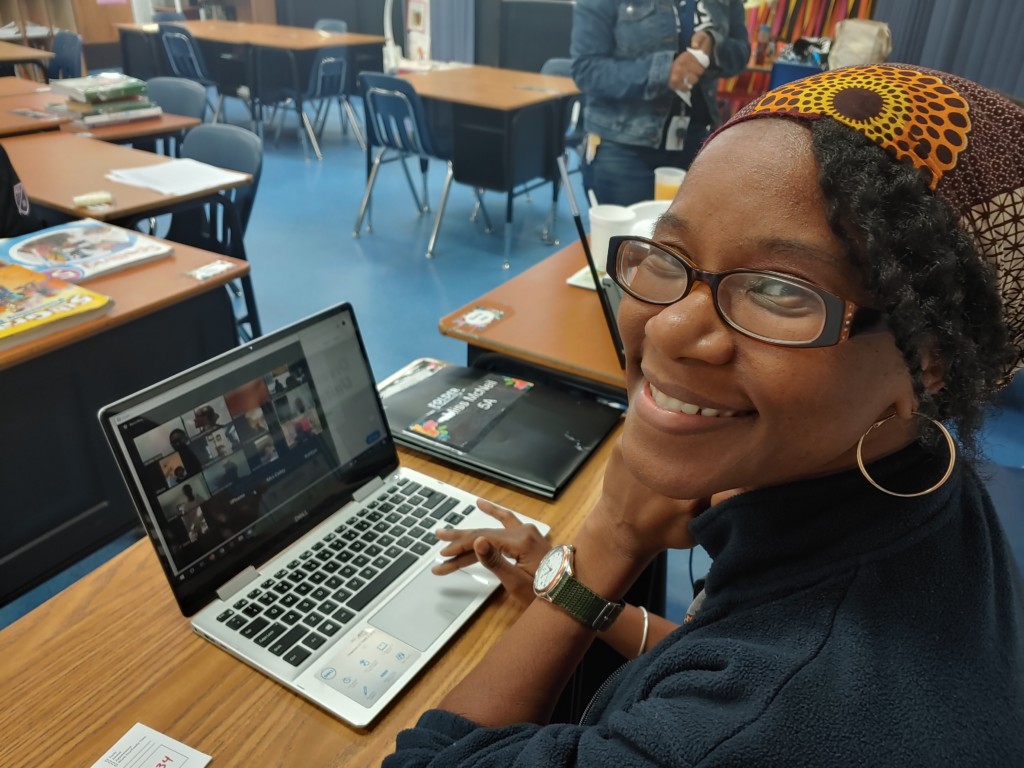
Patricia McNeil, a fifth-grade teacher at Abundant Life Christian Academy in Margate, engages her students in an online dialogue to make sure they're paying attention.
Stacy Angier figured it was only a matter of time.
Three days before the announcement of a statewide school shutdown, the principal of Abundant Life Christian Academy had been privy to updates on how Covid-19 was ravaging Broward County through her volunteer position as a commissioner for the North Broward Hospital District.
Determined that no virus was going to stop learning at Abundant Life, Angier made a decision. At the next morning’s faculty meeting, she dropped the bombshell: Teachers would transition to virtual education and they had two days to learn how.
“I said, ‘It’s up to you to keep your job, and it’s your job to teach your kids,’ ” Angier recalled.
Fourth-grade teacher Jasmine White and third-grade teacher Sharon Nugent teamed up to learn how to deliver virtual instruction to their students at Abundant Life Christian Academy.
A couple of teachers were familiar with Google Classroom, a free service that allows educators to virtually create, distribute and grade assignments. The platform also streamlines file sharing between teachers and students. They helped train their colleagues at the school, which educates 462 students in preschool through 11th grade in Margate, a community about 15 miles northwest of Fort Lauderdale.
“A lot of teachers were excited,” said Patricia McNeil, a fifth-grade teacher. “We do have a few who were not as tech savvy, but we all came together. We discussed apps we had used and we started learning together.”
A father who worked at an online university provided additional training, and soon, Abundant Life faculty felt confident about making the transition. School officials let families know they could come by to pick up their child’s textbooks and supplies. They issued their supply of Google Chromebooks to those who lacked appropriate electronic devices and ordered 30 more.
One day later, students and teachers embarked on their virtual education journey.
“I love this!” parent Rachel Allen wrote on the school’s social media page. Just two hours into her daughter’s remote learning, Allen said she was amazed at how “awesome and organized” everything was.
Annick Joseph, whose kindergartener and third-grader attend Abundant Life, also offered rave reviews.
“It is moments like these that confirm I made the right decision to become part of the (Abundant Life) family,” Joseph posted.
Not that there weren’t a few hiccups. At first, teachers providing enrichment programs, such as art, were fully participating. Some parents found that overwhelming, so the administration decided to limit online offerings to core subjects – math, English, history and science. For now, enrichment is optional, offered as a way for kids to have fun in an environment that could feel like quarantine.
Abundant Life teachers Sarah Hennebery and Carmen Mondesir conduct an end-of-week lesson in the new virtual format.
Some teachers who teach older students are using Google Zoom to conduct live lessons. All lessons are recorded for children who can’t make the scheduled time because they are sharing the device with siblings or who need to review the lesson.
“It allows the students to interact with their classmates and their teachers,” said McNeil, who engages her students in a dialogue to ensure they pay attention during her twice-weekly lessons. She said the students are enjoying the interaction.
“Some are already logged on before I am,” she said.
Angier said one class sang “Happy Birthday” to a student whose party was canceled due to Covid-19.
“I think we made a mama cry,” she said.
Angier said she’s proud of her staff for adapting so quickly during stressful circumstances. Because of their hard work, student progress remains uninterrupted. She expects spring break, which begins today, will give everyone time to work through any additional challenges.
“We have to learn how to live differently in the midst of what we’re going through,” Angier said. “It would be tragic if it were a wasted year.”
 Florida Department of Education guidelines issued in a memo Thursday encouraging public and private schools to utilize remote learning also are expected to prevent financial disaster for hundreds of private schools accepting scholarships.
While the Department has recommended private schools close their campuses through April 15, as it has mandated public schools, it does not have the power to close them. Still, many private schools have closed voluntarily.
The new guidelines make remote learning a viable option for all traditional brick-and-mortar schools. Under them, public and private schools may continue to educate students under certain conditions. Students can be educated through non-classroom means, including online learning, educational packets provided to parents with teacher assistance, or a combination of both methods. Schools will be required to document how they conduct daily attendance.
State law regulating the scholarship program requires private schools to verify student attendance at the school’s physical location each quarter. Schools had been concerned that closures during the pandemic may jeopardize their scholarship funds.
The Department of Education’s memo ensures that scholarship payments for the Florida Empowerment Scholarship, McKay Scholarship, Florida Tax Credit Scholarship, Gardiner Scholarship and Hope Scholarship will continue uninterrupted. However, parents still will be required to endorse the checks as required by law.
The Department also is considering suspending national norm-referenced testing for scholarship students this year. No decision has been made regarding testing at this time.
Click here for more information from the DOE on coronavirus-related issues.
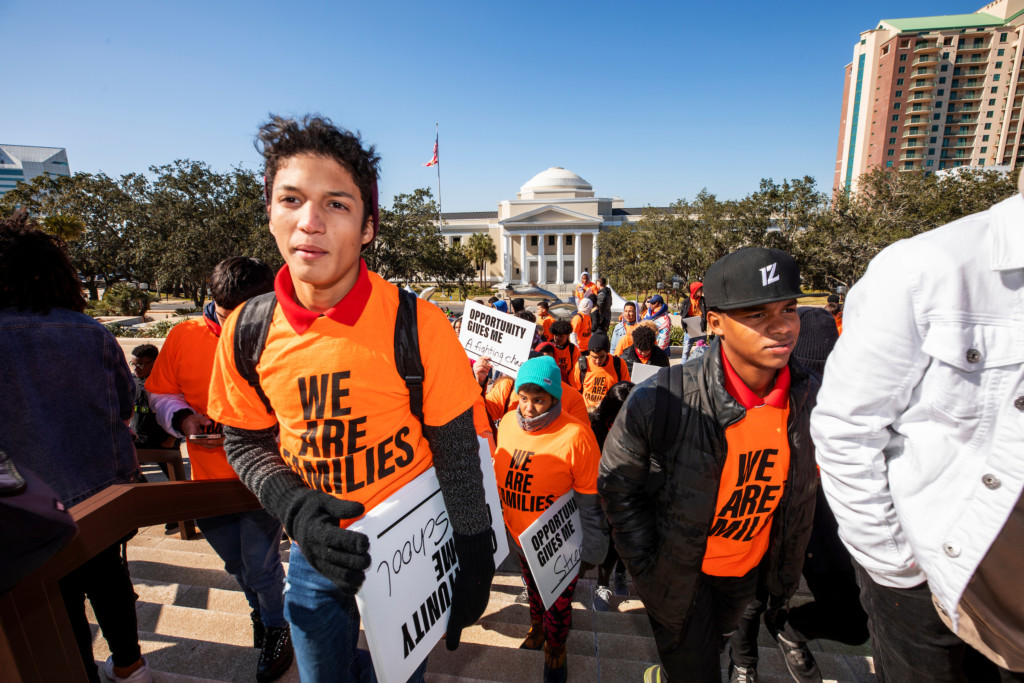
Efforts advanced by parents, educators and students at a rally at the Capitol in January bore fruit today with lawmakers' decision to provide additional funding for the Gardiner Scholarship program. Photo: COLIN HACKLEY
Florida House and Senate members today unanimously approved a $93.2 billion state budget that includes an additional $42 million for the Gardiner Scholarship program, an education savings account for students with unique abilities.
The approval brings the total amount allocated to the program to $189,901,004 and opens the program to more families.
"I am thankful the Florida state lawmakers, even during this time of great uncertainty, are putting the needs of Florida's exceptional and most vulnerable kids at the forefront of their agenda," said Katie Swingle of Winter Haven after learning of the vote. Swingle, whose 12-year-old son, Gregory, receives a Gardiner Scholarship, was among hundreds of parents, teachers and students who attended a January rally at the Capitol to encourage lawmakers to support a funding increase.
Created in 2014, the scholarship currently serves more than 13,000 students. It differs from other state scholarship programs in that it provides an education savings account that parents can use to direct money toward a combination of programs and approved providers. Approved expenses include tuition, therapy, curriculum, technology and a college savings account.
Lawmakers also allocated $7.6 million for the Reading Scholarship Account program, open to public school students in grades 3-5 who experience reading difficulty.
Lawmakers on both sides of the aisle praised the budget as responsible and realistic.
“This is a bipartisan effort,” said Rep. Wengay Newton, D-St. Petersburg. “We’ve got to be looking at ways to survive and work together. I think we’re in a great place.”

