School funding. Gov. Rick Scott proposes to spend $1.2 billion more on public schools next year. Coverage from Tampa Bay Times, South Florida Sun Sentinel, Palm Beach Post, Lakeland Ledger, Associated Press, News Service of Florida, Naples Daily News, StateImpact Florida, Panama City News Herald. More money will prove lawmakers care, writes Tampa Bay Times columnist John Romano.
 Teacher evaluations. Senate President Don Gaetz reiterates his concerns about the new system: "We have to be able to win this debate at the PTO meeting and the school advisory council, and we haven't won the debate." News Service of Florida. Gaetz is right about taking more time with teacher evals and other reforms, editorializes the Panama City News Herald.
Vouchers and creationism. SchoolZone notes a new website: Say No to Creationist Vouchers.
Jeb conspiracy. Exposed!!! Orlando Sentinel. Gradebook. The Answer Sheet. The Nation.
ALEC. Its latest annual report card gives Florida an education policy grade of B+ and a performance rank of 12.
Educator conduct. A former Palm Beach County principal gets 10 years in prison for soliciting sex from a minor, reports the Palm Beach Post and South Florida Sun Sentinel. After a four-year battle, a Palm Beach County teacher accused of harassing and threatening fellow employees may finally be fired, reports the Sun Sentinel. (more…)
Vouchers and testing. A new report from the Fordham Institute finds that mandated testing - and even public reporting of test results - isn't that big a concern for private schools worried about government regs tied to vouchers and tax credit scholarships. Coverage from redefinED, Choice Words, the Cato Institute's Andrew J. Coulson and Gradebook. AEI's Michael McShane says Florida's tax credit scholarship program (which, altogether now, is administered by Step Up For Students, which co-hosts this blog) finds the "sweet spot" with its testing and financial reporting requirements: "These regulations don’t sound too crazy to me; they seem to strike a good balance of accountability for safety, fiscal responsibility, and academic performance without being overly dictatorial in how schools must demonstrate any of those."
Shooting rockets. Senate President Don Gaetz tells the Associated Press that Florida needs to slow down on ed reforms until it rights the new teacher evaluation system and other changes in the works: "We need to quit shooting rockets into the air. We need to give schools and school districts, teachers and parents time to institutionalize the reforms that have already been made. We need about a two-year cooling off period."
Ford Falcons. Schools need competition. EdFly Blog.
School choice. Education Commissioner Tony Bennett says at a National School Choice Week event in Tampa that some Florida districts deserve credit for expanding public school options such as magnets and career academies, reports redefinED. More from Tampa Tribune.
Charter schools. The National Alliance for Public Charter Schools ranks Florida fifth for its charter laws. SchoolZone. Gradebook. South Florida Sun Sentinel. StateImpact Florida. The Pinellas school district postpones a decision on whether to close a long-struggling Imagine school in St. Petersburg, reports the Tampa Bay Times and Tampa Tribune. The Volusia district's decision to shut down a struggling charter in Deland is headed to appeals court, reports the Daytona Beach News Journal. (more…)
Florida’s new education commissioner is known for his zealous support of charter schools and vouchers and other learning options that some critics see as anti-public school.
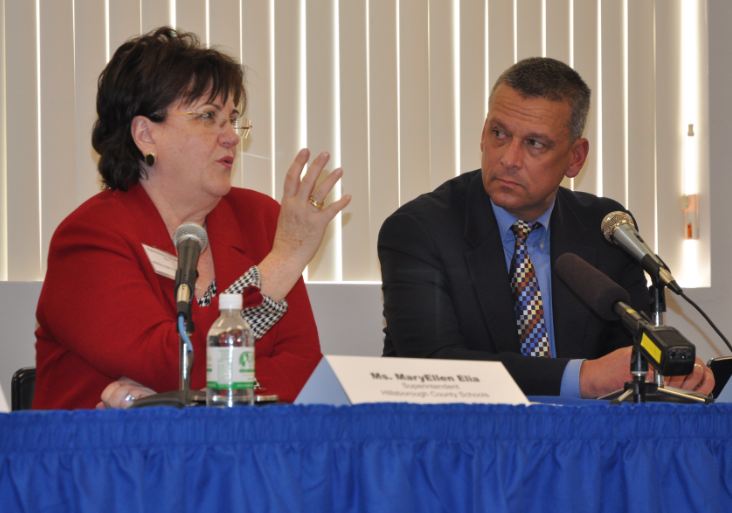
Florida Education Commissioner Tony Bennett and Hillsborough Superintendent MaryEllen Elia were among the panelists at a National School Choice Week event in Tampa. (Photo by Lisa A. Davis/Step Up For Students)
But on Tuesday afternoon, Tony Bennett sat next to Hillsborough County Public Schools Superintendent MaryEllen Elia inside a Tampa magnet school for boys, and praised the growth of choice in district schools across the state.
Florida is transcending the first round of conversations on choice that pit private and charter schools against public schools and virtual schools against “brick and mortar’’ ones, Bennett said during an event marking National School Choice Week. The new conversation, he suggested, isn’t either-or; it’s whatever works to ensure all kids have access to quality choices.
“So we’re now talking about choice – not just private schools and charter schools and virtual schools – we’re talking about public school choice,” he told an audience of about 100 people gathered at the Boys Preparatory Academy. “We’re talking about creative leaders like MaryEllen, like the team here, creating educational opportunities for children within the district - and really going to what we all heard was the purpose of choice to begin with, to provide incubation for innovation for our public schools.”
Tuesday’s event was sponsored by the Florida Alliance for Choices in Education, a coalition that includes a wide swath of school choice groups. Bennett and Elia sat on a panel with representatives from home-schooling, virtual education, magnet schools, career academies, Florida tax credit scholarships and McKay scholarships.
Most were parents who had lived and breathed school choice, starting with their own children. As they shared stories of searching for schools that practiced their faith or fit their child’s academic needs, they offered numbers that shed light on the choice movement’s impact. (more…)
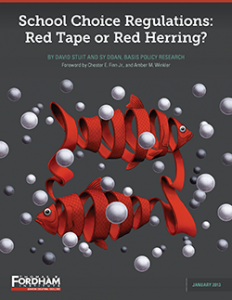 The Fordham Institute may be the closest thing to an honest academic broker in the contentious private school choice arena these days, and its latest report will no doubt enhance that reputation. "Red Tape or Red Herring?", released today, provides strong evidence that private schools are not averse to academic or financial oversight – a finding that runs counter to a longstanding libertarian narrative.
As Fordham president Chester Finn Jr. acknowledged in the forward: “Many proponents of private school choice — both the voucher and tax credit scholarship versions — take for granted that schools won’t participate (or shouldn’t participate) if government asks too much of them, regulates their practices, requires them to reveal closely held information and — above all — demands that they be publicly accountable for student achievement.”
The report looks at the participation rate of private schools in voucher and tax credit scholarship programs in 11 states and surveys from 241 private schools that do and don’t participate, and it finds that testing requirements are not a significant deterrent. Only a quarter of the schools ranked state-required testing as a “very” or “extremely” important factor. Among the schools not participating in voucher or scholarship programs, testing was the fifth most-cited concern – behind such issues as protection of religious activities and admission processes and government paperwork.
This is not to suggest that private schools are eager to embrace more government regulation. The report did find a modest negative correlation between the degree of regulation in a state and the rate of schools participating. But the survey is a reality check on private schools and the educators who run them. Catholic schools remain a major player in the voucher-scholarship market, in part because their mission is to serve poor children, and they also demonstrate remarkable leadership on the issue of testing and academic accountability.
The report echoes similar on-the-ground work in Florida. (more…)
 The Friedman Foundation’s latest “ABCs of School Choice” guide is out, and the numbers go like this: 21 states, 39 programs, 255,000 kids.
The guide offers a state-by-state rundown of the publicly funded, school choice options that are a vital piece of the overall school choice picture. It includes profiles of the students, parents and teachers who benefit from them. And it presents some thought-provoking stats, like how the value of each choice option compares to per-pupil funding in traditional public schools.
In Florida, a tax credit scholarship for low-income students is 34 percent of what’s spent on a traditional public school student, according to the Friedman analysis. Our own back-of-the-envelope calculations would put the percentage slightly higher, but the point is spot on: “voucher” students receive far less for their education than their public school peers. It’s a relevant detail that deserves more attention as the debate unfolds over testing for scholarship students and regulatory accountability measures for the private schools that enroll them.
The Florida section of the guide also includes a mini-profile of Davion Manuel-McKenney, a former tax-credit scholarship student who is now a freshman at Florida State College at Jacksonville. (Full disclosure: the tax-credit program is administered by Step Up For Students, which co-hosts this blog.) The story of Davion and his mother is a moving one. Click here to read more about it.
New Florida Education Commissioner Tony Bennett offered more hints Wednesday that he is not satisfied with the current accountability framework for Florida private schools that accept students with vouchers and tax credit scholarships.
Making his first appearance before the Senate Education Committee, Bennett was asked by Sen. Bill Montford, D-Tallahassee, for his thoughts on “holding everybody accountable that receives tax dollars.” His response:
“I would suggest to you that this is a place where with all candor, sir, that even some of my supporters have been uncomfortable in the past. Because I do believe that schools that receive state funds should be held accountable and I believe that accountability should be just as transparent as what we expect from our traditional public schools.
“So I would share with you that in Indiana, every school that received state funds got a letter grade that was all calculated the same way. A public charter school got its letter grade calculated the same way as the traditional publics. Schools that received vouchers – and we did have the nation’s most expansive voucher program, pure voucher program – they got a letter grade, based on the same measurements as our traditional publics. And that way the public could make an informed choice around school quality.
“Now I know that constitutionally, the voucher situation here isn’t the same was Indiana. And I know there’s that discussion about state funds. So I want to lay that out there. But again, these were all schools that received money from the state budget. And I believe as a steward of the state tax dollars, we have to think about making sure that our citizens know the performance of schools that receive state tax dollars. And our job is to set the expectations for those schools and drive to those expectations.”
Senators also asked Bennett about a wide range of other issues. His biggest priorities, he said: implementing Common Core standards and reviewing SB 736, the far-reaching 2011 law that changes how district teachers are evaluated and paid. (more…)
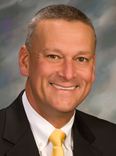
Bennett
In this lengthy exit interview with the Indianapolis Star, new Florida Education Commissioner Tony Bennett adds to a simmering debate, sparked last month by Gov. Rick Scott, about whether students using vouchers and tax credit scholarships to attend private schools in Florida should be required to take the same standardized tests as their public school counterparts.
By law, tax credit scholarship students in Florida are required to take a nationally norm-referenced test approved by the state Department of Education. But Bennett suggests that's not enough:
"I do believe we should assess all students who get state money. I believe that in my heart. I keep having people asking me why I believe that in Florida. For voucher schools, I’ve been asked why can’t we accept just a nationally-normed test? But if IPS said let me choose a test and let me choose a performance level to determine if its schools were any good or not, would I accept that? No. So why should I buy that from them? What makes them more creditable than IPS?"
Bennett was also asked if there's anything about expanding school choice that he fears could "in any way threaten what's good about the traditional public school system." His response:
"No. I think it will enhance it. It never worries me because I believe good schools will flourish regardless, whether they are public, private or charter. I believe it will force schools to get better. I just believe that. It’s never kept me up at night. I just believe in the force that the market creates. We’ve seen it. We’ve seen (Indianapolis Public Schools Superintendent) Dr. (Eugene) White make some pretty innovative changes. I maintain he wouldn’t have done those things."
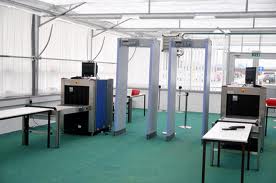
Image from schoolsecurity.org
School safety. Superintendents and lawmakers talk about more funding for more security. Coverage from Gradebook, St. Augustine Record, Sarasota Herald Tribune, Daytona Beach News Journal. Some are worried about “open campuses,” reports SchoolZone. A bill is filed that would require private schools to get safety alerts, just like public schools, from police departments and other emergency response agencies, reports redefinED.
The chairman of the Osceola County School Board, Jay Wheeler, writes in this Orlando Sentinel op-ed that the federal government should tax guns and bullets to pay for school guards: “When 26 students and school staff get killed by a crazed gunman in a public elementary school, it is a sad wake-up call for all of us that we have to do a better job protecting ourselves from our own freedoms.”
In Palm Beach County, mayors plead with the school board to install metal detectors in every school, reports the South Florida Sun Sentinel. More from the Palm Beach Post. In Lee County, deputies begin patrolling elementaries, reports the Fort Myers News Press. More from the Naples Daily News.
Test score limbo. If high school students fall short on the FCAT, he or she can still graduate if they get a high enough score on the ACT or SAT. But the state has yet to set new concordant scores for the other tests since upgrading the FCAT, leaving many students in limbo. Tampa Bay Times.
Charter school laws. SchoolZone notes the Center for Education Reform’s annual report card.
Why grading schools is good. EdFly Blog.
Vouchers and creationism. A Jacksonville school is among those highlighted in this MSNBC op-ed by student activist Zack Kopplin.
Privatization. The Bay County school district moves towards privatizing bus service. Panama City News Herald. (more…)
Count newly-elected Florida Rep. Manny Diaz, Jr. among a number of state lawmakers who are public school district employees. But Diaz, an assistant principal in the Miami-Dade public school district, isn’t just a cheerleader for traditional public schools.
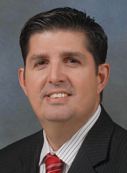
Rep. Diaz
He’s also a huge – and very vocal - advocate for school choice.
“We have an evolving student body – different than what it was five years ago,’’ Diaz, a Republican who represents his hometown of Hialeah, said during a recent telephone interview with redefinED. “I do believe we have to look at all the options.’’
Diaz has been appointed to the House Education Committee, as well as the K-12 and Choice & Innovation subcommittees. Among his goals there: to help guide fellow lawmakers and education leaders toward reform that is “student-centered and parent-centered.’’
To that end, Diaz said he fully supports district programs, such as magnet schools; high-quality charter schools; and other nontraditional options, such as tax credit scholarships.
“I think the competition makes our educational choices better,’’ he said. And better can only be defined by results. “I’m big on the accountability side,’’ Diaz said. “It’s a matter of having the political courage to move forward, to take measures already in the law.’’
If a district school isn’t helping students succeed academically, bring in interventions, he said. If a charter school isn’t operating ethically, shut it down.
Diaz also responded to recent news reports in which Gov. Rick Scott called for private schools that accept tax credit scholarships to give those students the same tests as their public school peers. (more…)
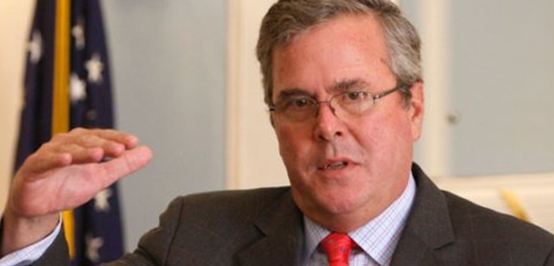 Jeb Bush may or may not seek the presidency in 2016, but those who dismiss his education foundation as a political prop are simply out of touch. What the Foundation for Excellence in Education is showing once again, with its fifth annual national summit, is that it is creating a sense of urgency and national purpose around our most fundamental commitment to each new generation.

