For years, Florida’s online schools have grappled with a logistical challenge: Getting their students to the campuses of brick-and-mortar schools, operated by school districts, to take their standardized tests.
Kevin Chavous, the president of the online learning company Stride, laid out the complications several years ago:
Imagine that a school district notifies parents that they must take their child to a location 60 miles from home for testing. Transportation will not be provided; parents are responsible for ensuring that their children arrive every day at their assigned testing site for up to a week, until all exams are complete. Families with multiple children may need to travel every day for two or three consecutive weeks, depending on the kids’ grade levels and the tests they must take. This may require making hotel arrangements and requesting leave from employers to ensure their child is present each day.
This scenario is, of course, absurd and would never happen in a regular school district. Yet it is reality for students in full-time, statewide online public schools.
One consequence of these and other mundane hurdles has been a raft of “incomplete” A-F grades whenever the state releases its annual school accountability reports.
For the 2022-23 school year, 20 of the 32 public schools that received incomplete grades were online learning institutions. The previous year, online schools accounted for 29 of 40 incompletes.
Virtual students have a harder time showing up for assessments proctored in person, or even knowing where to go or whom to ask. As a result, online schools are more likely to have fewer than 95% of their eligible students submitting test results, which can lead to an incomplete letter grade.
New legislation passed this year could help. A provision of HB 1285, a wide-ranging education bill, would set specific expectations for districts and online schools:
It is the responsibility of the approved virtual instruction program provider or virtual charter school to provide a list of students to be administered statewide assessments and progress monitoring to the school district, including the students' names, Florida Education Identifiers, grade levels, assessments and progress monitoring to be administered, and contact information. Unless an alternative testing site is mutually agreed to by the approved virtual instruction program provider or virtual charter school and the school district, or as specified in the contract under s. 1008.24, all assessments and progress monitoring must be taken at the school to which the student would be assigned according to district school board attendance policies. A school district must provide the student with access to the school's or district's testing facilities and provide the student with the date and time of the administration of each assessment and progress monitoring.
That might not fix all the logistical hassles described by Chavous, but it could help iron out some more run-of-the-mill coordination challenges with getting virtual students into physical campuses for testing.

Recently I reported that Florida’s students with disabilities exceeded multiple states statewide averages for all students on multiple 2022 NAEP exams. This is both encouraging (for Florida) and disturbing for much of the rest of the country. But wait the news gets better (worse) still.
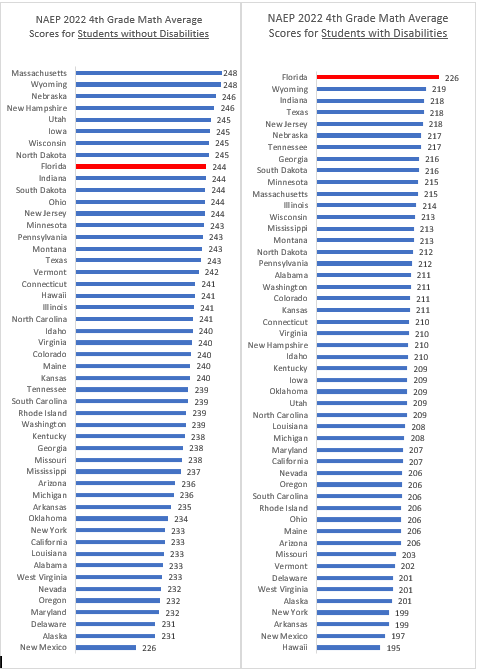
Above are charts showing NAEP fourth grade math scores for both students without disabilities (on the left) and those students with disabilities (on the right). Nationwide the average achievement gap between students without disabilities and students with disabilities was 38 points, and the gap varies between states.
Notice that Florida, marked in red, ranked first for students with disabilities and ninth for students without disabilities. Now look a bit closer. See it yet? Let me help you out:
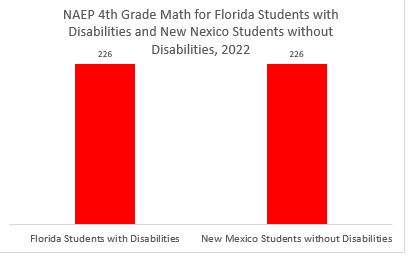
I’ll leave it to you dear reader as to whether you prefer to marvel at the improvement in outcomes for students with disabilities in Florida, lament the outcomes in New Mexico, or both. Put me down for “both” please. Just in case you are tempted to write this off to some kind of COVID-era fluke, it actually happened before in 2005 and very close to happening in 2009, long before the pandemic.
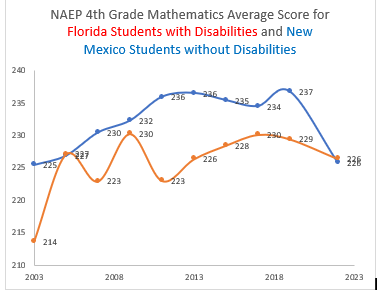
As noted earlier, Florida provides a relatively large amount of choice to both students with disabilities and students generally. Florida has also spent decades of effort in promoting sound reading instruction for all students. New Mexico’s public education system seems much more focused on generating adult salaries and pensions.
Ed summit: A three-day education summit called by Gov. Rick Scott ends with broad guidelines on student testing, school grading and evaluating teachers — but uncertainty about where they will lead. Palm Beach Post. Participants make plenty of promises, but don't offer solutions. Associated Press. The summit did little to quell unrest over Common Core or address other recent controversies, but at least it brought parent groups, teachers, school administrators and legislative leaders together. Sarasota Herald-Tribune. And there's a call to change the school grading system. Tampa Bay Times.
 Common Core: Mary Jane Tappen, deputy chancellor for curriculum and instruction with the Florida Department of Education, will talk with Osceola parents about the new Common Core standards. Orlando Sentinel.
PARCC: Florida’s continued participation in PARCC is in doubt due to the concern that school districts don't have the computers and Internet bandwidth necessary to administer the online tests and that PARCC exams take twice as long as the FCATs they replace. StateImpact Florida.
Drug testing: The Miami-Dade County School Board will consider a random drug-testing policy following the federal probe into whether Biogenesis of America gave performance-enhancing drugs to student athletes. Miami Herald.
Rosh Hashanah: A St. Lucie County sophomore and his parents are upset that the school district won't allow students to take the day off for the Jewish holiday like some other districts. Instead, he has a test. TC Palm.
Class therapy: A therapy dog helps autistic students in Lake Wales focus in the classroom. The Ledger.
Reading buddy: Ann Scott, the governor's wife, visits a Port St. John elementary school to read to kindergarteners. Florida Today.
Afterschool: Many Collier County parents are still upset about the district's changes to afterschool activities. Naples Daily News.
Ed summit: Education leaders from across the state convene for a three-day conference that could shape the future of teaching, testing and a school-grading system. Palm Beach Post. More from the Orlando Sentinel, Associated Press, Tampa Bay Times. Long before the summit, former Education Commissioner Tony Bennett had made it clear he might recommend Florida shift gears and pick a new replacement for FCAT other than PARCC. School Zone. Interim Education Commissioner Pam Stewart tells reporters her goal for the summit is to listen. StateImpact Florida.
Common Core: Tampa Bay Times' columnist Dan DeWitt confirms that Common Core State Standards will not allow the federal government to mine the DNA of unsuspecting students among other criticisms of the new measures.
PTA: A Weston parent-teacher association is reinstated after it was shut down for paying members $10 an hour to volunteer and for keeping shoddy financial records. Sun Sentinel.
Charter schools: The Coalition of Boynton West Residential Associations is not supporting Broward County's proposed construction of Trails charter school because there are too many schools in the area, the group says. Sun Sentinel. Lake Wales Charter Schools grapples with a good thing: an increase in enrollment. The Ledger.
Class size: Duval County has a plan that includes giving teachers extra pay if they choose to teach another class and moving teachers from under-enrolled schools to schools that enrolled more students than anticipated. Florida Times-Union.
School safety: Across Florida and the nation, schools open with more armed security following the Sandy Hook Elementary shooting. Associated Press.
Common Core: StateImpact Florida listens to what readers have to say about the new education standards. The Badass Teachers Association represents a new wave of liberal opposition to the standards with teachers joining forces with tea party groups and libertarians, who want states to slow down efforts to adopt the new benchmarks and corresponding tests. Times-Herald.
Lunch line: Every elementary student in Lake Wales gets a free lunch thanks to a new federal program. The Ledger. New federal lunch rules result in healthier meals for children, more costs for schools. Florida Today.
Summer Slide: Treasure Coast teachers assess students during the first days of school to see if they kept up with learning and reading during the summer. TC Palm.
Reading tests: Most Duval County public school students will take new reading tests this week to pinpoint deficiencies. Florida Times-Union.
Online requirement: Few high school juniors have completed the online course they need to graduate. Fort Myers News-Press.
Charter schools: Nine charter groups have applied to open schools in Sarasota and Manatee counties next fall. Sarasota Herald-Tribune. Visible Men Academy finishes its first week in Manatee County with 74 kindergarten through second-grade students enrolled. Bradenton Herald.
Virtual school: The Pinellas County School District sees a surge in its in-house virtual school programs, prompting school officials to close the application period a week early. Tampa Bay Times.
Charter schools: One of Tallahassee's oldest and most successful charter schools looks to expand, while another that caters to middle school hopes to add an elementary. Tallahassee Democrat. A struggling Palm Beach County charter school agrees to stay closed the entire school year to right its ship and repay about $56,000 in taxpayer funding. Palm Beach Post. Gulf Coast Academy South opens with a waiting list almost as large as its current enrollment. Naples Daily News.
Ed poll: A new education poll looks at standardized testing with just 22 percent of respondents saying the increased use of such tests has helped schools; 36 percent said the testing hurts schools; 41 percent said it made no difference. StateImpact Florida.
Adult ed: Hernando County's adult technical education programs suffer from low enrollment. Tampa Bay Times.
Common Core: StateImpact Florida asks teachers what they think about the new education standards. Sarasota state Rep. Ray Pilon breaks ranks from local Republicans and opposes the standards. "My vote is going to be get rid of it,'' he wrote on Facebook. Sarasota Herald-Tribune. (more…)
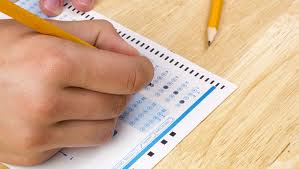 At least 13 private schools that accept the Florida Tax Credit Scholarship have applied to administer the FCAT and end-of-course exams next year.
The schools, mostly faith-based and in South and Central Florida, have submitted their applications to the Florida Department of Education, which will decide in August whether to approve them.
DOE spokeswoman Tiffany Cowie said there may be more schools that made the March 1 deadline, but the department won’t know the final number until the mail is cleared towards the end of the week.
A state law passed in 2012 allows private schools with at least one student receiving the tax credit scholarship to offer the Florida Comprehensive Assessment Test and/or end of course exams, which are required in public schools.
Of the 13 schools that applied, eight signed up only for EOCs.
“The FCAT is a dinosaur,’’ said Principal Sandra Basinger of St. Mary’s Catholic School in Brevard County, where her seventh- and eighth-graders hope to take EOCs in Algebra I and Geometry next spring.
Like a lot of Catholic schools, St. Mary’s administers the Iowa Test of Basic Skills to its students in grades 2-8. The test is as good as if not better than the FCAT, Basinger said. And with Florida phasing out the state assessment for other tests in line with the new Common Core standards, “really, I just don’t think it would be worth it,’’ she said.
James Herzog, associate director of education for the Florida Catholic Conference in Tallahassee, said in an email to redefinED that he has heard the same sentiment from other Catholic schools.
“From a practical standpoint, it would … not make any sense for Catholic schools (or most other nonpublic schools) to offer the FCAT for a year or two only and then have to switch again to something else … ,’’ he said.
Herzog originally anticipated 30 to 40 Catholic schools would apply to give the FCAT.
“Obviously, I was way off,’’ he said. (more…)
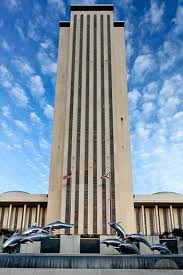 Editor's note: Another year, another legislative session, another stack of school-choice bills in Florida. Here's a roundup of choice legislation that lawmakers will consider in the annual session that begins today.
Career Academies:
SB 1076 by Sen. John Legg, R-Lutz. Expands the "Career and Professional Education Act (CAPE)," revising requirements for high school graduation and accelerated high school graduation, and allowing students to earn and substitute certain industry certifications for certain course credits. Also requires districts to make digital materials available to students and to use the Postsecondary Industry Certification Funding List in determining annual performance funding distributions to school districts and Florida College System institutions, etc.
Charter Schools:
HB 373 by Rep. Joe Saunders, D-Orlando. Provides that a contract for a charter school employee or service provider may not extend beyond the school’s charter contract, and that the employee or service provider is not entitled to compensation after the school’s closure. (Identical to SB 780 by Sen. Geraldine Thompson, D-Orlando.)
HB 453 by Rep. Victor Torres, D-Orlando. Requires the compensation and salary schedules for charter school employees to be based on school district schedules. (Identical to SB 784- Charter Schools by Sen. Geraldine Thompson, D-Orlando.)
SB 744 by Sen. David Simmons, R-Altamonte Springs. Requires charter school applications to demonstrate the applicant is financially qualified to open and maintain a high-quality charter school, requires the charter to set forth detailed reporting of the financial operations of the school to ensure employees are not paid unreasonable compensation, and requires that the term of the charter must provide for cancellation of the charter if the school becomes insolvent, fails to provide a quality education, or does not comply with applicable law. The bill also clarifies that a charter school system shall be designated a LEA solely for the purpose of receiving federal funds if certain criteria are met.
SB 828 by Sen. Rene Garcia, R-Hialeah. Grants school districts the ad valorem tax exemption given to charter schools, and restricts the use of capital outlay funds for property improvements if the property is exempt from ad valorem taxes. It restricts charter schools or technical career centers having financial problems from certain activities, and grants flexibility to high-performing school choice districts.
HB 1001 by Rep. Karen Castor Dentel, D-Maitland. Prohibits charter schools from requiring, soliciting, or accepting certain student information before student's enrollment or attendance. Also requires charter schools to submit attendance plans to the school district for students enrolled in school; provide funding to the school district in event of student transfers; and report to the school district certain student enrollment and wait-list information.
SB 1092 by Sen. Geraldine Thompson, D-Orlando. Requires charter school to submit attendance information for each student to the school district, and requires the charter school to provide a prorated portion of per-student funding to the school district if a student transfers to another public school in the school district before the last day of the school year.
SB 1164 by Sen. Kelli Stargel, R-Lakeland. Revises the eligibility criteria for extracurricular activities to include students in charter schools, and revises the criteria for bylaws, policies, or guidelines adopted by the Florida High School Athletic Association. (Compare to HB 1279 by Rep. Larry Metz, R-Groveland.) (more…)
Florida business leaders put a spotlight Wednesday on the promise and potential pitfalls of Common Core - the tough, new academic standards that are rolling into Florida schools and will help re-shape teaching, learning and testing.
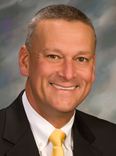
Bennett: "The state should own this initiative."
At a wide-ranging, day-long education summit in Orlando, several participants suggested a public awareness campaign to inform parents about the changes – which may be initially painful when they're implemented in the 2014-15 school year - and to rally broad support in a way that has eluded many of the state’s other, recent education reforms.
“These tend to be Tallahassee conversations. But if we don’t do this right, it becomes a Miami conversation or a Jacksonville conversation” and not in a positive way, Marshall Criser III, president of AT&T Florida and chairman of the Florida Council of 100, told redefinED during a break. “We have an opportunity and responsibility to take this back to our communities ... Because if not us, then who?”
“The state should own this initiative,” Education Commissioner Tony Bennett told attendees, reminding them of the marketing effort a decade ago for Just Read, Florida. “It shouldn’t be teachers against people. It shouldn’t be the state against schools, state against districts. This should be a statewide rollout that says this is important to our children and this is important to the future of our state.”
The Council of 100 sponsored the summit with the Florida Chamber Foundation, the National Chamber Foundation and the Institute for a Competitive Workforce. About 100 people attended, including three lawmakers, two superintendents, Board of Education Chairman Gary Chartrand and Florida Education Association President Andy Ford.
Spurred by the National Governors Association and the Council of Chief State School Officers, the Common Core standards in math and language arts have been adopted by 44 states. They’re well-thought-out and well-vetted. They’re benchmarked against international standards. They’re designed to instill a deeper knowledge than state standards do now. In the long term, supporters say, the higher bar will better prepare students for college and careers and an ever-more-competitive world. In the short term, though, ouch: They’re expected to result in a steep drop in test scores – and all the angst that comes with it.
“That’s a pain point,” Criser said. “But people have to understand that’s good,” he continued, because it’s the first step on a better path.
The discussion around Common Core has centered almost exclusively on public schools. But its gravitational pull is expected to be so strong that the impact will be felt at the private schools, too, to varying degrees. (more…)

