My new year’s resolution is to do a better job explaining myself as a choice supporter. There is apparently a need for this, as evidenced by this recent Tampa Bay Times editorial piece about key players in Tallahassee in 2019. Regarding Florida’s new education commissioner, the Times opined:
Richard Corcoran
The answer to every education conundrum in Florida is not either (a) charter schools or (b) vouchers. In fact, new Education Commissioner Richard Corcoran should remember most students attend traditional public schools, that the state Constitution guarantees a “high quality system of free public schools,” and that his first order of business should be strengthening those schools, not scheming to tear them down or replace them.
This statement could be critiqued in a variety of ways, but today I’ll attempt to demonstrate that expanding educational opportunities however represents a strategy to in fact achieve a “high quality system of free public schools.” Furthermore, it seems to be working.
Florida created the nation’s first choice program for students with disabilities in 1999 with the McKay Scholarship Program. Students with disabilities have had the option of applying for a scholarship to attend a different public or private school statewide since 2001. Rather than representing a scheme to “tear down or replace” public schools, the statewide performance for students with disabilities improved faster than the national average. Florida lawmakers (wisely) further expanded options for students with disabilities in 2015 by creating the Gardiner Scholarship Program-the nation’s second Education Savings Account program.
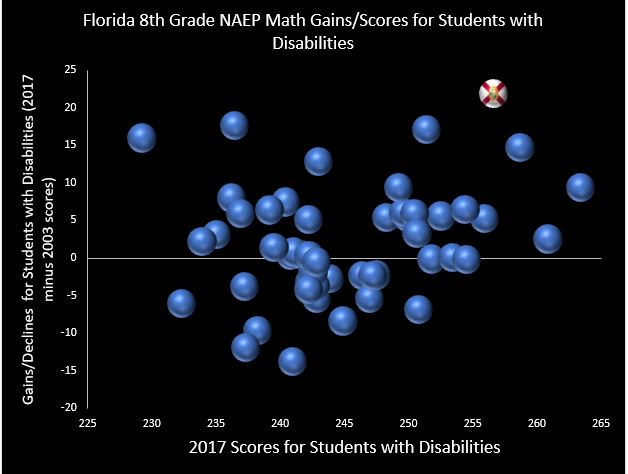
This seems to be working out relatively well for Florida students with disabilities, the vast majority of whom continue to attend district schools. For you incurable skeptics, things pretty much look like Florida and the 49 dwarves when it considering both gains and overall scores for students with disabilities:
And reading:
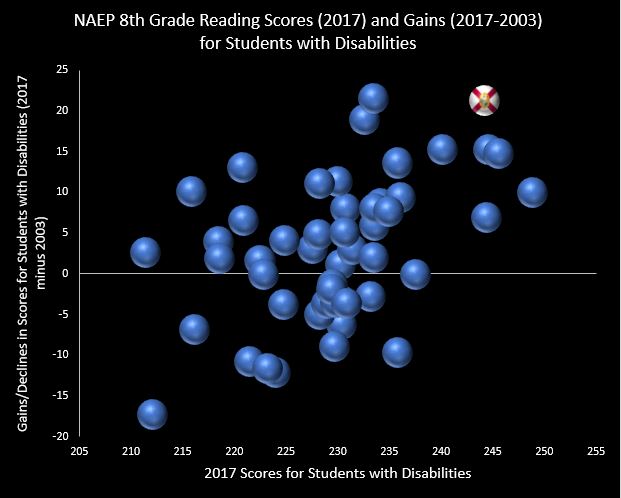
Students with disabilities in Florida public schools have had access to full state funded choice since 2001. Students with disabilities have also had access to the other forms of choice-charter schools, the Florida Virtual School, that all Florida students can access, but in addition to that, they have had the option of attending a private school with the state money following the child. The Florida tax credit program provides opportunities for low-income students but is limited by the amount of funds raised and has a waitlist. Florida’s students with disabilities have had the most robust set of choice options for the longest period.
When we compare the gains of student with disabilities (and the fullest access to choice programs) to students without disabilities on all the NAEP exams given consistently since 2003 it looks like this:
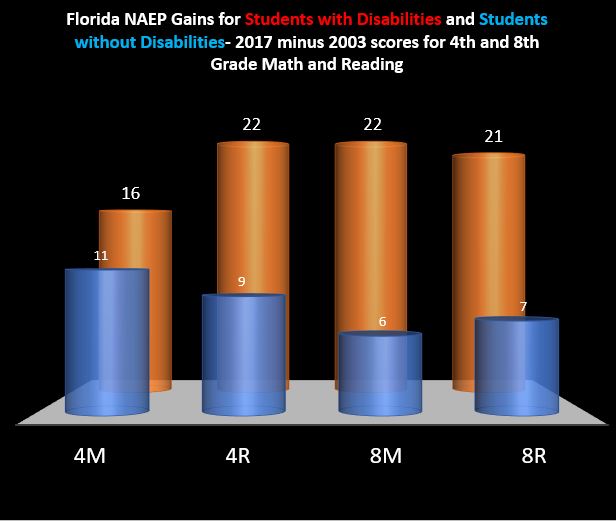
Ten points approximately equals an average grade level worth of progress on these NAEP exams (for instance we’d expect a group of 9th graders to do 10 points better than they had as 8th graders). The technical term to describe those red columns: HUGE! In fact, if Florida’s statewide gains had matched those of students with disabilities since 2003, Florida would have matched or beat NAEP champion Massachusetts on all four NAEP exams in 2017.
Impossible you say? Many would have said those academic gains for students with disabilities were impossible in 2003, nevertheless they happened.
Common Core. To conservatives: "I suggest you give up the bashing of a critically important reform simply because your political enemy endorsed it." EdFly Blog.
 Charter schools. The highly successful Pembroke Pines charter school system says it deserves a share of the Broward school district's capital improvement dollars, reports the Miami Herald. The Pinellas school district will vote yet again Tuesday on whether to shutter the long-troubled Imagine charter school in St. Petersburg, reports the Tampa Bay Times. A Palm Coast charter hopes to bounce back from an F, reports the Daytona Beach News Journal.
Teacher evaluations. Senate President Don Gaetz says the new evals may be too complicated and, combined with other big changes in education, could put the system at risk of imploding, reports the Florida Current. Washington Post ed blogger Valerie Strauss uses Gaetz's comments to tee off on Florida ed reform.
More on teacher pay. Gov. Rick Scott's proposal runs up against competing demands, reports the Tampa Bay Times. It "would provide welcome relief" but doesn't make up for "all of the damage this governor has done to public education," writes the Times editorial board. Cash shows respect, writes Times columnist Dan DeWitt. It'll help show teachers are valued, writes the Pensacola News Journal. Give Scott credit for supporting merit pay and across-the-board raises, writes the Daytona Beach News Journal. His commitment needs to be more than a one-time gimmick, writes the Palm Beach Post. A good thing no matter the motivation, writes the Gainesville Sun. Transparent pandering, writes the Panama City News Herald. "Met with skepticism," reports the Tampa Tribune. Lawmakers should be careful about both teacher raises and a proposal to transform the state retirement system, writes the Ocala Star Banner.
Satanists. They like the school prayer bill Scott signed last year. Really. Coverage from Tallahassee Democrat and Associated Press. (more…)
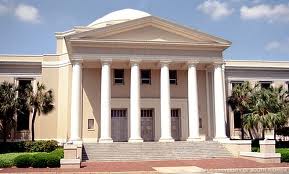 Pension ruling. In a case brought by the state teachers union, the Florida Supreme Court rules 4-3 that it is constitutional for the state to require teachers and other state workers to contribute 3 percent of their pay towards their pensions. Coverage from the Herald/Times Capital Bureau, Palm Beach Post, Lakeland Ledger, Orlando Sentinel, Daytona Beach News Journal, Tallahassee Democrat, Associated Press. StateImpact Florida considers potential impacts on the lawsuit against SB 736.
Teachers in Palm Beach and Broward are “devastated,” reports the South Florida Sun Sentinel. “Bitter disappointment,” writes the Tampa Tribune. “Dashed hopes,” writes the Gainesville Sun. The state should offer modest raises to “lessen the sting,” editorializes the Tampa Bay Times. Gov. Rick Scott should convert the savings into better teacher pay, editorializes the Palm Beach Post.
School safety. Gov. Scott will “listen to ideas” but not push for gun law changes, reports SchoolZone. Some Pinellas schools will consider “buzz-in access,” reports the Tampa Bay Times. Officials in the Hernando district are quietly dropping the issue, the Times also reports. The Palm Beach County district will spend $400,000 on school police aides, with more expenses on the way, reports the Palm Beach Post. Escambia Superintendent Malcolm Thomas wants armed, plainclothes marshals, reports the Pensacola News Journal.
Charter schools. The Clay County School Board shoots down an application for a performing arts academy. Florida Times Union.
Test score limbo followup. State Sen. John Legg says fix the problem with concordant scores, pronto. Tampa Bay Times.
Teacher evals. Pasco officials say in response to a query from Patricia Levesque at the Foundation for Florida’s Future that the district isn’t ready for the new requirements, given the need to develop hundreds of new tests, reports the Tampa Bay Times. (more…)

