Trying to compete with teachers unions for influence. The Miami Herald looks at growing political contributions from charter and virtual school interests, and frames the story this way: “Some observers say the big dollars foreshadow the next chapter of a fierce fight in Tallahassee: the privatization of public education.” Last Friday on redefinED, Doug Tuthill argued that the term “privatization,” as typically used in ed debates, is misleading.
 Florida Supreme Court and vouchers. Two separate columns in recent days cited the Florida Supreme Court’s 2006 decision to overturn vouchers as a reason behind efforts to convince voters to deny the retention of three justices. South Florida Sun-Sentinel columnist Michael Mayo here. UF law professor Joe Little in the Tallahassee Democrat here.
State Board of Education is wrong. So says the Tampa Bay Times, in this editorial about the board’s decision to set race-based achievement goals that include steeper rates of progress for low-income and minority students. More coverage in the Orlando Sentinel here.
Complaints about private school in Pasco. WTSP-Ch. 10 talks to parents who say officials are doctoring tests and report cards at Zephyrhills Christian Academy, a private school that accepts McKay vouchers for disabled students.
Superintendents and tax-credit scholarships. St. Johns County Superintendent Joe Joyner relays his concerns to the Florida Times Union.
New teacher evals cause angst in Pinellas. Tampa Bay Times story here.
Voucher tsunami. (This story from the Topeka Capital-Journal is a couple weeks old, but I didn’t see it until this weekend.) A leading state lawmaker in Kansas, Rep. Marc Rhoades, says vouchers are on their way to the Sunflower State, and he references programs in Milwaukee and Florida: “In my opinion, it’s like a tidal wave that’s coming, and I don’t know that the education establishment can withstand it forever.”
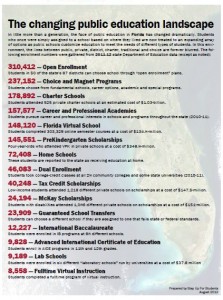 Though we know little about the parents who long have chosen their school through where they decide to live (or to pretend to live), Florida keeps count of those who no longer want their neighborhood school. And here's some data to chew on: In a state known for its breadth of learning options, that number last school year reached 1.2 million.
In other words, using a conservative approach with new 2011-12 enrollment records, 43 of every 100 students in Florida public education opted for something other than their zoned school.
This number is produced largely from state Department of Education surveys required of the 67 school districts and reflects, not surprisingly, surging growth for choice options. Though total public school enrollment grew by only 1 percent last year, reaching 2.7 million, charters grew by almost 16 percent, online by 21 percent, private scholarships for poor children by 17 percent. (See an enrollment compilation of 2011-12 options here.)
Granted, Florida is not like most other states in this regard. A combination of educational, budgetary and political factors, including the gubernatorial tenure of Jeb Bush, has put the Sunshine State on an accelerated path of parental empowerment. That said, it is a diverse, highly populous state with national political significance, and this kind of transformation is central to the new definition of public education.
The national education debate is still absorbed by adults who grew up with a pupil assignment plan built almost entirely on geography. Many of them went to the same schools as their parents and even their grandparents, and it’s natural they would define public education that way. That may help explain why parent activists or groups such as the PTA continue to oblige the teacher unions that pressure them to resist laws giving parents more options. The union message – that traditional public schools are endangered – plays to the parents’ natural fears.
That’s why these numbers are worthy of pause. (more…)
It’s one thing to hear school choice stalwart Jeb Bush or a think tank researcher state the obvious about school choice in Florida – that it’s now a fundamental part of the education landscape. It’s quite another to hear it from the likes of Alberto Carvalho, the well-respected superintendent of the Miami-Dade school district.
A news video shows him saying this to a reporter after a recent education summit (his remarks start at about the 4:30 mark):
Change is going to accelerate. And you need to learn about what the change is, impose your own change just to survive. We are now working in an educational environment that is driven by choice. I believe that is a good thing. We need to actually be engaged in that choice movement. So if you do not ride that wave, you will succumb to it. I choose not to.
It would be noteworthy if any big-district superintendent in Florida – where school choice is both nearly mainstream and perpetually hot button - spoke as refreshingly as Carvalho. But it’s especially significant coming from the Miami-Dade schools chief because 1) no district in Florida has made bigger gains with its students over the past decade, and 2) among the state’s biggest districts, it has among the highest concentrations of enrollment in magnet schools, career academies, charter schools and in private schools via tax credit scholarships.
In other words, the parents in Miami-Dade are seeking out school choice options more than most; the proliferation of options hasn’t hurt student achievement; and the superintendent, rather than feeling besieged, is being proactive.
It would be wrong to suggest Carvalho is alone. Other school leaders in Florida have positively responded to change; sometimes, it even makes headlines. “We have never had to compete before,” Walt Griffin, the new superintendent in Seminole County, Fla., said in a recent story about expanded learning options – public options – in that district. “People who home-school or send their children to private or charter school might not know what we have to offer.”
Without a doubt, there are myriad areas where superintendents and school choice supporters disagree (just like there are plenty of areas where supporters themselves butt heads.) But Carvalho’s comments acknowledge that expanded parental choice is a dynamic that isn’t going away. Indeed, when hundreds of thousands of Florida parents have collectively selected magnet schools, career academies, charter schools, vouchers, virtual schools, etc., how can it? The most pressing debate is how the players involved, including school districts, can continue to expand options in the most efficient and effective ways.
Maybe I'm reading too much into a sound bite, but I think Carvalho’s comments also suggest he doesn’t see the “either/or” that has seeped into so much of the school choice debate. At its core, despite the boilerplate story line, this is really just about giving parents more options.
(Image from asiapac.com.au)