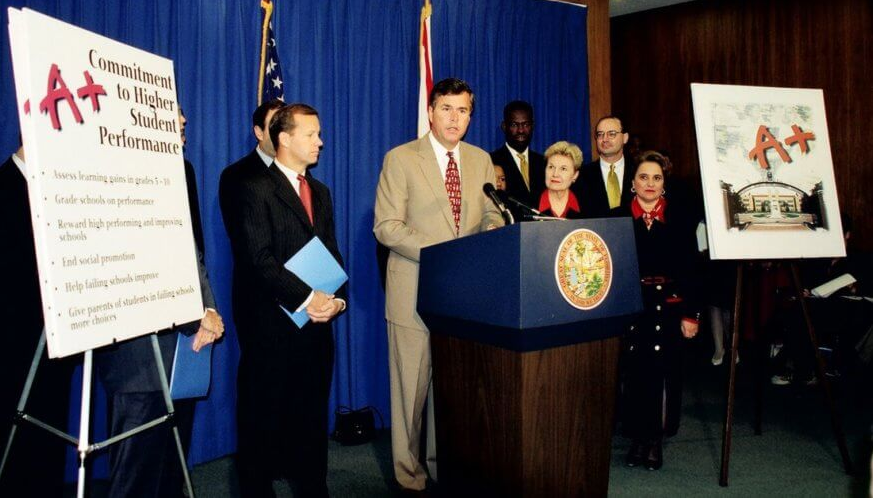
Florida Gov. Jeb Bush signed into law on June 21, 1999, the A+ Plan for education at Raa Middle School in Tallahassee. The comprehensive reform plan called for greater school and teacher accountability, changing the landscape of education statewide.
“I think we’re in for a renaissance in public education.”
With these words, Gov. Jeb Bush signed into law on June 21, 1999, a bill that set in motion his vision for the future of education in Florida.
The A+ Plan, which had been Bush’s top campaign promise when he ran for governor, aimed to toughen standards for teachers, students and schools. It called for the state to assign letter grades to all schools, end social promotion and institute statewide testing in grades 3 through 10.
The plan’s philosophical underpinnings ran deep.
According to testimony Bush delivered before the U.S. House of Representatives three months after the bill-signing, its foundation rested on three fundamental principles: meaningful and undiluted accountability that would allocate different consequences for success and failure; zero tolerance for the latter, which Bush acknowledged could be “extremely difficult and painful”; and the belief that Florida’s education system must be child-centered, not system-centered, or even school-centered.
The most controversial provision of the plan allowed students in failing public schools to obtain vouchers that would pay tuition and fees at participating private schools, including nonsectarian and religious institutions. It was this provision that set off a firestorm of controversy from voucher opponents that resulted in a lawsuit filed on behalf of the Florida Coalition for Public Education, which consisted of 17 organizations including the NAACP, the Florida PTA and the League of Women Voters.
Twenty years later, critics still argue the merits of vouchers. Some continue to argue the merits of the A+ Plan itself. But it’s hard to argue with the fact that, largely as a result of the plan, Florida’s families today enjoy access to one of the country’s most robust sets of education options, including public school choice, public charter schools, virtual learning and homeschooling. Many also have access to private school scholarships for low- and middle-income families, students with disabilities and bullied students.
In an opinion piece published Wednesday in USA Today, Bush reflected on these options, as well as on the upswing in student performance since 1999. He credited the positive turnaround to Florida’s willingness to continue to adopt bold and innovative education policies and expressed optimism that even more success can come in the next 20 years – as long as the state continues to “keep pushing the envelope until each and every child gets the great education they deserve.”
To read a series of stories authored by redefinED contributors commemorating the 20th anniversary of the A+ Plan, click here.

 Editor’s note: Misinformation abounds across the education choice landscape, adding confusion to an already complex issue. The redefinED team is dedicated to shining a light and providing the facts. Today’s post debunks an oft-repeated misconception: Private schools that accept scholarships are not held accountable. You can see more myth busting here, or click the link at the top right-hand corner of this page.
Education choice critics have argued for years that voucher programs divert tax dollars from public schools to “unaccountable” private schools. That misperception has now become a popular talking point for opponents of Florida’s new Family Empowerment Scholarship.
A recent opinion piece in the Orlando Sentinel implies that voucher schools fail to hire qualified teachers, that they are unable to prove they’re educating students, and that they are not transparent with their finances.
The Ocala Star Banner opined that the FES “opened the door” to spending tens of millions of public dollars on schools with “no public accountability, no common testing procedures and generally no teacher certification parameters.”
Meanwhile, the Florida Education Association in a recently released report warns that the state’s new education bill could cause public schools to lose almost $1 billion in the next five years and references an Orlando Sentinel series that “revealed the lack of oversight and accountability over private schools operating in Florida.”
In truth, voucher schools are subject to two forms of accountability: the top-down regulatory model, albeit with a lighter touch than what public schools receive; and the kind you get from the bottom-up through parental choice, something few public schools face.
Florida devotes nearly 12,000 words of regulations governing the Tax Credit Scholarship. Among them: Schools must provide parents information about teacher qualifications; they must test students in grades 3-10 in reading and math on state-approved national norm referenced tests; and they must conduct annual financial reports if the school receives more than $250,000 from any scholarship source.
Schools also are subjected to health, safety, fire and building occupancy inspections. Starting in 2019-20, new participating schools must be inspected by the DOE before accepting any scholarship students. Read more here.
In addition to these external regulations, parents who are dissatisfied with their private schools can vote with their feet and take their scholarship students elsewhere. That ability represents the most immediate and direct form of accountability: If the schools can’t deliver, they lose students and the money that follows them.
That kind of accountability is in short supply in district schools, particularly in low-income areas, where parents generally can’t afford to move to a neighborhood with a better school or pay tuition for a private school.
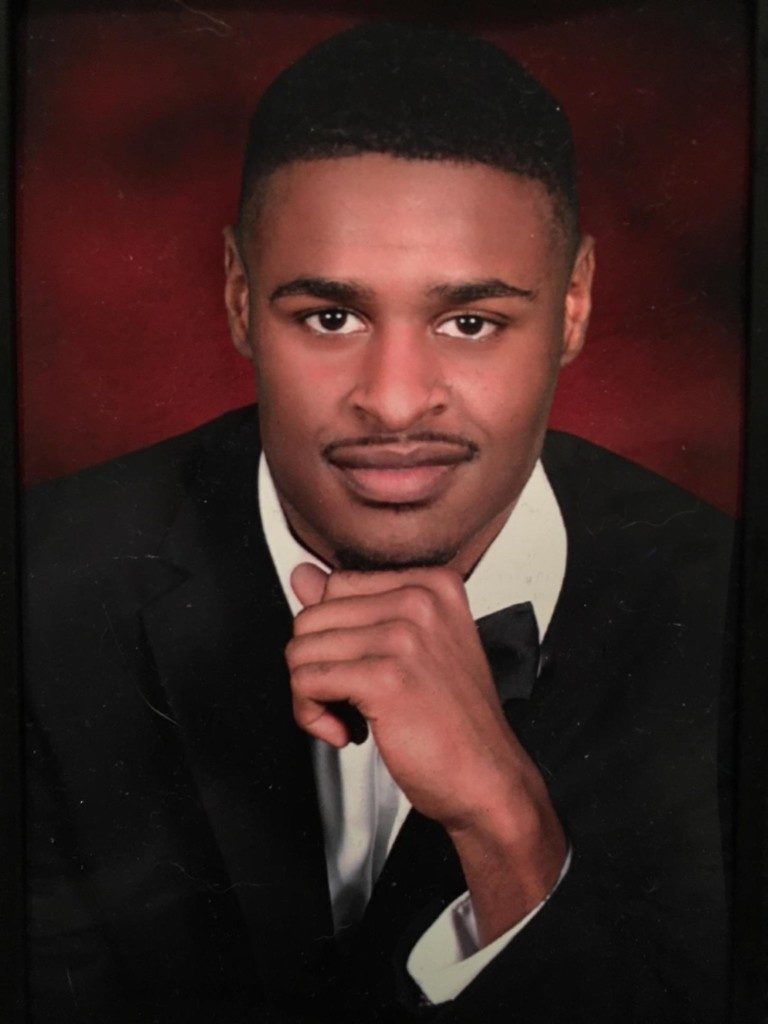
Malik Ferrell turned his life around at The Potter's House Christian Academy in Jacksonville.
Editor’s note: This month, redefinED is revisiting stories that shine a light on extraordinary students. Today’s spotlight, first published in March 2017, tells the story of a Jacksonville youth who overcame great obstacles to get his life on track.
Lost.
That’s where Pamela Howard feared her son, Malik Ferrell, would end up after years of struggles at different schools in Jacksonville.
She couldn’t afford to let that happen. Malik needed a caring environment, especially after he and his family were rocked by the murder of his older brother, Derrell Baker.
Pamela had been searching for the right fit for Malik – four different schools in four years.
Finally a friend told her about the Florida Tax Credit Scholarship, which allowed her to send him to The Potter’s House Christian Academy.
(Step Up For Students publishes this blog, and helps administer the tax credit scholarship program in Florida.)
That’s where Malik’s life unraveled – and where he ultimately put it all back together.
“Having the opportunity to go to a private school helped get him on track,” Pamela said. “I cannot even tell you the difference it made in his life.”
At his neighborhood school, Malik made mostly D’s in second grade, then mostly F’s in third grade, which he had to repeat.
Three years and three schools later, at the age of 11, he got a fresh start at The Potter’s House.
Then the unthinkable happened.
Just weeks after Malik enrolled, Derrell, 17, was killed in a drive-by shooting. Police had no suspects. There were no arrests.
Pamela was working full-time at Blue Cross Blue Shield, taking complaints in the executive department. The grief and stress overwhelmed her, and the mother of five went on disability. She now works part-time doing billing at McKesson.
“Seeing my momma cry and my sisters cry, it was … it was just a lot to deal with,” Malik said. “That was my only big brother, so there was nothing for me to look up to.”
Derrell was everything to Malik – best friend, football hero, protector, disciplinarian, role model.
When he was killed “I really didn’t care about anything,” Malik said. “It messed me up in school. I was getting in trouble almost every day. I was getting in fights for no reason.”
“He would keep a lot of stuff in,” said Lela Johnson, now principal at The Potter’s House. “He wouldn’t talk to people, and I think what he was doing was trying to see who he could trust.”
With great patience, teachers and administrators taught Malik life skills and self-awareness in addition to academics. It took time, but Malik came to trust mentors like the dean, the guidance counselor, the assistant principal (Mrs. Johnson) and the football coach.
With his grades stabilizing to a C average, Malik began playing varsity football in eighth grade. He had natural talent, just like his brother.
Small, quick and athletic, they both played defensive back and played it well. Derrell was nicknamed “Hype,” and after his death, people began calling Malik “Lil’ Hype.”
By the end of 10th grade, Malik was starting to draw offers for college scholarships. He met with Mrs. Johnson, who charted a course for improved grades, test scores, and behavior.
For the first time in his life, Malik had purpose.
“That summer after 10th grade he had it all together,” Pamela said. “I didn’t have to say a word. He just grew up. The child was in his room, he was constantly doing homework, online classes, volunteering … I mean, I didn’t know who he was! He made a huge, huge turnaround.”
Football helped heal Malik’s wounded heart, and in his final two years of high school he maintained a solid B-average with no behavior issues. His senior year became an extended celebration. First, he turned 18. Then came football signing day, when he announced in front of teammates, classmates and family that he was going to Tusculum College in Tennessee. Then came graduation.
Derrell wasn’t able to do any of those things, but he was with Malik the whole time. He was the inspiration.
“Malik was graduating for himself and he was graduating for his big brother,” Pamela said. When he walked across the stage, he said, “Ma, I did it. I did it for both of us.”
Malik didn’t play in his first season at Tusculum, but now halfway through his freshman year he is proud of his grades – some A’s, some B’s and one C. He’s looking forward to spring football and pursuing a career in sports broadcasting.
Pamela said her Malik’s accomplishments would not have been possible without The Potter’s House and the Step Up scholarship.
“It was amazing,” she said. “I felt completely blessed to even have the scholarship. I don’t know what I would have done without it. I was just thankful, because I honestly knew that I could not afford to send my children to private school and have the opportunity to have someone invest in them. These people go above and beyond. They pour themselves into these students and give of themselves off the clock.”
“To see my son just completely turn around, there aren’t even words. That he overcame these struggles and turned out to become the young man that he is, there are no words to even explain how proud I am of him.”
About The Potter’s House Christian Academy
The school opened in Jacksonville in 1996 with five teachers under the direction of Lady Narlene McLaughlin, wife of Bishop Vaughn McLaughlin. It now has two locations – an elementary and a high school – with 45 full-time staffers and 436 K-12 students, including 348 on the Step Up For Students scholarship. The non-denominational school uses a combination of curricula, including A Beka and Bob Jones University Press. It uses the Stanford 10 as its annual assessment test and the Otis-Lennon School Ability Test. Tuition is $3,900 for K3 and K4, $4,650 for K5, $4,910 for grades 1-5, and $5,000 for grades 6-12.
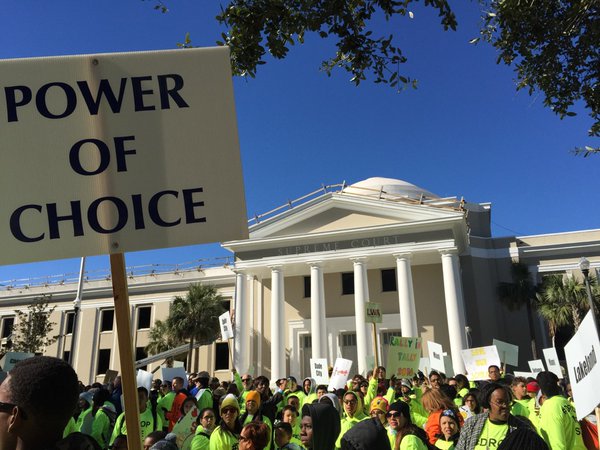
Editor's note: Misinformation abounds across the education choice landscape, adding confusion to an already complex issue. The redefinED team is dedicated to shining a light and providing the facts. Today's post debunks a long-standing misconception: The state constitution says free public schools are the sole means for the state to provide education in Florida. You can see more myth busting here, or click the link at the top right-hand corner of this page.
The primary reason the Florida Opportunity Scholarship program was struck down 13 years ago was noticeably absent from recent news coverage of a potential lawsuit over Florida’s newest voucher program. Instead, discussions focused on issues of regulatory “uniformity,” and “separation of church and state,” the latter of which wasn’t part of the Florida Supreme Court’s ruling at all.
The primary legal reasoning, which is based on the “paramount duty” clause of Article IX Section 1 of the state constitution, isn’t easy to understand. The court had to invent prohibition where none existed, and it did so after misinterpreting another legal case.
Ironically, the Florida Supreme Court initially rejected the “paramount duty” argument before reversing itself five years later in what the Harvard Law Review called an “adventurous reading and strained application” of Florida’s constitution.
In Bush v. Holmes in January 2006, the Florida Supreme Court struck down the Opportunity Scholarship, reasoning it “diverts public dollars into separate private systems parallel to and in competition with the free public schools that are the sole means set out in the Constitution for the state to provide for the education of Florida's children.”
But how did the court determine public schools were the sole means by which the state could provide education?
The court relied on the second and third sentences of Article IX, Section 1(a) of the state constitution:
It is, therefore, a paramount duty of the state to make adequate provision for the education of all children residing within its borders. Adequate provision shall be made by law for a uniform, efficient, safe, secure, and high-quality system of free public schools that allows students to obtain a high quality education…
No one is likely to read the language above and conclude vouchers are unconstitutional.
Most of Article IX, Section 1 was added to the state constitution by Amendment 6 in 1998, which was a response to public school advocates losing a funding adequacy lawsuit. As Justice Kenneth Bell noted in his dissent in Bush v. Holmes, there is no historical evidence the amendment was ever intended to be weaponized against school vouchers.
To justify prohibiting vouchers and declaring public schools the “sole means” of education, the court invoked “expressio unius,” which means, “the expression of one thing implies the exclusion of another.”
According to Irina Manta, writing in the St. Louis University Law Journal, the Florida Supreme Court, “appears to base its entire understanding of expressio unius on a quote from a statement in the 1927 Weinberger v. Board of Public Instruction decision.”
The Weinberger case dealt with constitutional language that specified “any bonds” issued for the purpose of funding public education “shall become payable within thirty years from the date of the issuance.” Similar language still exists today.
But in Weinberger, a school district had issued bonds that matured after the maximum 30-year period prescribed by the constitution. The 1927 court struck down the district’s bonds as unconstitutional, noting that the constitution mandated a maximum date by which bonds must be payable. Anything later than 30 years was thus prohibited.
According to Manta, “the relevant provisions in Holmes contain no prohibitions; in fact, they contain no language whatsoever that even comes close to Weinberger’s ‘any bonds.’”
The prohibition is clear in Weinberger, but not at all clear in Article IX, Section 1.
Justice Bell concluded in his dissent, “The clear purpose behind Article IX is to ensure that every child in Florida has the opportunity to receive a high-quality education and to ensure access to such an education by requiring the Legislature to make adequate provision for a uniform system of free public schools. There is absolutely no evidence before this Court that this mandate is not being fulfilled.”
Sadly, for the nearly 800 students on the Opportunity Scholarship at the time, the Florida Supreme Court invented a prohibition where none existed and did so entirely by misunderstanding a legal case from nearly a century before. Given this, it is easy to see why school choice critics omit the “paramount duty” clause when discussing the constitutionality of vouchers in Florida.
Vouchers: Jewish leaders speak in support of school choice and the expansion of the Florida Tax Credit Scholarship. Jewish Journal. Senate President Don Gaetz's call for more accountability through expanded testing is the right call and a good place to start, writes the Sun Sentinel. Taxpayers fund both public and private schools in Florida, and they deserve accountability from each, writes Russ Kesler for the Orlando Sentinel. A lot of parents complain their children aren't getting that high-quality education right now, and lawmakers could be about to give them the opportunity to make a choice. Bay News 9.
 Common Core: How can two Sarasota County schools - one for the gifted and the other for disabled students - fit in with the standards that 45 states have approved? Sarasota Herald-Tribune.
Ed reform: The 10th annual College Board Report to the Nation ranks Florida once again among the top five states in the percent of high school graduates who have passed an Advanced Placement test with a score of 3 or higher, writes Patricia Levesque. Gainesville Sun.
Teacher evals: Palm Beach teachers score well on the controversial evaluations. Sun Sentinel. The data shows that Broward is among more than three dozen school districts that had lower-than-expected student gains over a one-year period last year, but Miami-Dade and Palm Beach have higher-than-expected student gains. Sun Sentinel. Teachers unions and school districts criticize the release of teacher performance evaluations. Times/Herald. Reactions to the release of Florida's Value-Added Model (VAM) scores for teachers compiled by the Florida Times-Union. School districts reassure teachers. Tampa Bay Times. More from Palm Beach Post, Fort Myers News-Press, Miami Herald, TC Palm and The Tampa Tribune.
Grades: Pinellas school board members consider making honors classes worth less than those in IB and AP. Tampa Bay Times. The student progression plan also could include longer grading periods, and fewer report cards. The Tampa Tribune.
Vouchers: Standardized testing would threaten private-school appeal, writes the Orlando Sentinel. The president of the League of Women Voters of Florida says expanding private scholarships is a further abdication of the state's responsibility to provide a high quality education to Florida's children. Orlando Advocate.
 Fundamental schools: Is St. Petersburg's fundamental school within a school working? Tampa Bay Times.
District schools: Escambia County's Warrington Middle School continues to fail its students - and improving the school will take a community-wide effort that must begin this week, writes the Pensacola News-Journal. Hillsborough County's Brandon High celebrates 100 years. The Tampa Tribune. A Duval County high school hosts a conversation about volunteerism, bridging disparities and the community roll of a historic African-American school. StateImpact Florida.
Teachers: Hundreds of thousands of Florida teacher evaluation scores that measure effectiveness on student learning are released after the Florida Times-Union wins lengthy legal battle. The Department of Education sends teachers a message about the release of records. Florida Times-Union. This Duval County teacher's class is all about goals. Florida Times-Union.
Ed leg: If the Legislature adjourns after its upcoming session without passing a single education-related bill, there will still be big changes coming to Florida classrooms this fall. Tallahassee Democrat. Pop-Tarts law is gun lobbying we don't need at school, writes Sue Carlton for the Tampa Bay Times.
State testing: Florida's students are getting ready to write the final chapter in a 17-year saga known as the FCAT. Sun Sentinel. FCAT season begins this week with a low-stakes writing assessment that over the years has seemed to have little purpose. TC Palm. Sen. John Legg aims to address over-testing in Florida public schools. Tampa Bay Times. This coming week marks the beginning of the end for the four most hated letters in Florida education: FCAT. Palm Beach Post.
Common Core: Why less is more for a rural Florida school preparing students for the new education standards. StateImpact Florida.
School boards: Hillsborough County School Board member April Griffin decides to seek a third term after all, citing issues within the school district’s transportation and special education departments that she believes have not been resolved. The Tampa Tribune. The Black Educators Caucus of Palm Beach County still backs the district superintendent, but wants progress report. Palm Beach Post. For Polk County's assistant superintendent, it's all about the kids. The Ledger.
Vouchers: Three weeks after Florida House Speaker Will Weatherford promised a “massive increase” in school choice scholarships for underprivileged schoolchildren, his chamber releases a 40-page bill. redefinED. The proposal is expected to be one of the most-contentious education battles of the 2014 legislative session. The News Service of Florida. More from CBS Miami.
Charter schools: Hillsborough County charter school operators organize their first school choice fair for parents and students to learn about nontraditional public school offerings. The Tampa Tribune.
Technology: Leon County and other school districts across the state begin to realize the potential of putting a computer in every student’s hands, and the obstacles they will have to clear to make that happen. Tallahassee Democrat. Pasco classrooms are opening up to new technology coaches. Tampa Bay Times.
Rick Scott: As a Florida governor, Rick Scott will never be confused with Jeb Bush. Tampa Bay Times.
School boards: Palm Beach school board members should be careful bypassing the superintendent to deal with district personnel issues, writes the Palm Beach Post.
2014 session: Senate Education Committee Chairman John Legg tells the Gradebook there is no must-pass bill this year. House Democrats say session will be 'class warfare.' The Florida News Current.
Vouchers: Sen. President Don Gaetz says private school scholarship students should be required to take the same state assessments as other public school students, but StateImpact Florida notes the scholarship programs already require students take a national norm-referenced standardized test.
Charter schools: Pasco School Board attorneys craft contract language to satisfy board members who had serious questions about giving Pepin Academies a 15-year charter. Tampa Bay Times.
Private schools: A former Miami Country Day School student, now a sophomore at Barnard College in New York City, is creating an anti-bullying kit for Miami-Dade schools based on a play she wrote in ninth grade. Miami Herald.
Career centers: Students at Hillsborough's South County Career Center paint murals to help tell their school's story. The Tampa Tribune. Manatee Technical Institute and Sarasota County Technical Institute are the future of education, supporters say. Sarasota Herald-Tribune.
Legislators: Expanding pathways out of poverty through education is one of five items Sen. President Don Gaetz and state House Speaker Will Weatherford are emphasizing this session. Northwest Florida Daily News.
Biometrics: A key Senate committee votes to stop public school systems from collecting "biometric" data on students, despite warnings that unplugging the computerized systems will waste money and make it harder to move hundreds of kids through lunchroom lines. The Florida Current.
Common Core: The State Board of Education is expected to approve amendments to Student Performance Standards after reviewing some 19,000 public comments on the standards, known as the Next Generation Sunshine State Standards. Naples Daily News. More from The Tampa Tribune.
Vouchers: Sen. President Don Gaetz says he supports private school vouchers, but that students who participate in the program should be subject to the same or similar standardized tests that public school students take. Miami Herald. More from Orlando Sentinel. School choice is becoming more valuable for parents, who are turning to Step Up For Students and the Florida Tax Credit Scholarship for help in finding the right fit for their children. WEAR TV Channel 3.
Private schools: St. Thomas Episcopal in Miami gets on loan from the National Aeronautics and Space Administration a display of lunar rocks, soil and meteorites. Miami Herald.
Charter schools: Oasis High School, part of the Cape Coral charter school system, win 14 awards at the International Model UN conference hosted by Massachusetts Institute of Technology in Boston. Fort Myers News-Press. In Hillsborough County, more than half of the existing charter schools have banded together to create a choice fair for families to learn about their offerings. Tampa Bay Times. Palm Beach County School District officials are working with two local legislators to introduce a bill that would require new charter schools to put up a $250,000 performance bond before they can open. Palm Beach Post.
Magnet schools: Public school leaders in Miami and elsewhere are refocusing on magnet schools as traditional public schools come under increasing pressure from charter schools and vouchers for private schools. The New York Times.
District schools: Polk County principals work to bring improvement to local schools. The Ledger. With a new writing coach and weekly boot camps, Hernando schools hope to pull up state test scores. Tampa Bay Times.
Collegiate high schools: Sen. John Legg proposes a bill to expand collegiate high schools, and spur community and state colleges to make more of an effort to engage high-schoolers in college-level courses. The Tampa Tribune.
Eric Cantor: GOP House Majority Leader Eric Cantor visits Academy Prep Center of Tampa to stump for school choice. redefinED. The Republican congressman from Virginia said the private middle school, which serves children in low-income families, is an example of how school choice can succeed. The Tampa Tribune. More from the Tampa Bay Times.
School vouchers: House Speaker Will Weatherford is among Republicans looking to expand school choice efforts this year, including beefing up the Florida Tax Credit Scholarship program. Palm Beach Post.
Charter schools: A new state law that requires a "model" contract between school districts and charter operators is not stopping Orange County from requiring new charters to meet performance standards. Orlando Sentinel.
Faith-based schools: Parents are shocked after learning a Palm Beach County Presbyterian church is closing its school. Palm Beach Post. Hundreds of low-income students at Duval County private or parochial schools will likely lose tutoring and other academic help because the federal money paying for it is drying up. Florida Times-Union.
School choice: The city of Hollywood is pushing its public schools to better market themselves this year, in hopes of luring new students — and new families. Sun Sentinel. Pasco County students and parents face a broader array of education options as the district's 2014-15 school choice application window opens. Tampa Bay Times.
Digital learning: A proposed bill to expand school technology could lead to more tablets and computers, more professional development for teachers and more opportunities for K-12 students to take classes in subjects like computer programming. The Tampa Tribune. More from Tampa Bay Times. StateImact Florida asks teachers how they learned to connect technology to learning.
Education budget: While Gov. Rick Scott's suggested a $542 million bump in K-12 funding is no small chunk of change, few people believe it’s anywhere near enough to meet the ever-growing demands of the state’s public schools, writes Rick Christie for the Palm Beach Post.

