The Florida Board of Education on Wednesday overturned the Palm Beach School Board’s rejection of two charter school applications.
The decision followed a recommendation by the Charter School Appeal Commission, which found the School Board did not have good cause to reject the South Palm Beach Charter and Renaissance Charter High School applications. (more…)
Last summer, the Florida Board of Education sought changes at three persistently struggling rural North Florida schools.
It seemed likely at least one, Hamilton County's only high school, would have to become a charter school. Weeks later, the Hamilton school board voted to join other districts challenging a charter-friendly school turnaround law.
Now, though, it looks like a charter conversion may not be in the works. At least not yet.
Hamilton's revised turnaround plan is on the agenda for the state board's meeting next week in Jacksonville. The plan calls for bringing in an external operator to help run the school. (more…)
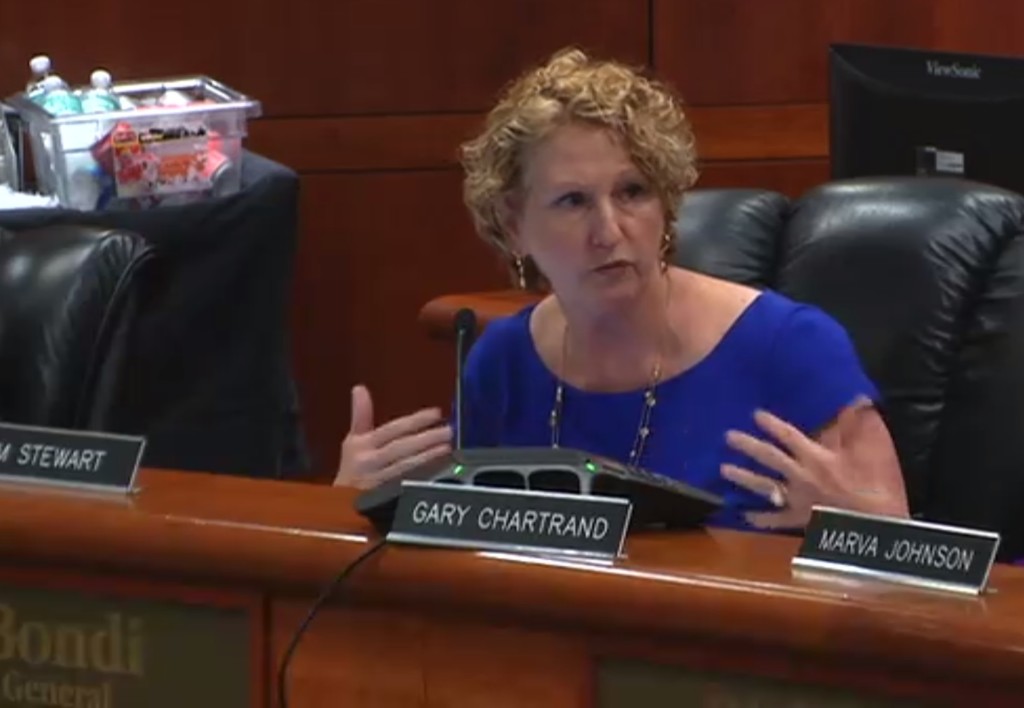
Education Commissioner Pam Stewart addresses the Florida Board of Education during a turnaround discussion Monday.
This spring, Florida's smallest school district launched an unprecedented turnaround effort led by a charter school organization.
But Jefferson County schools may not be alone for long.
On Monday the Florida Board of Education asked three North Florida school districts to revise plans to turn around long-struggling schools. It was the first batch of turnaround efforts the board reviewed under a sweeping new law.
The revised plans could soon bring charter school operators to other high-poverty rural communities.
Gov. Rick Scott signed HB 7069 last month. It overhauls the turnaround options available to schools that earn F's or multiple D's under the state's grading system. Districts now have less time to turn those schools around themselves. If they fall short, they have three options:
Most public schools avoided the new law's consequences. Stewart noted repeatedly that, of 42 schools that presented turnaround plans last year, 71 percent improved to C's or higher.
Monday's state board meeting offered a glimpse of what could be in store for the remaining 29 percent of persistently low-performing schools if they don't improve, quickly.
Charter could be coming to Gadsden (more…)
The Florida Board of Education today declined a North Florida charter school's bid to remain open another school year.
Orange Park Performing Arts Academy earned two consecutive F's under Florida's school grading system.
As a result, it must lose its charter contract unless it can show the school board it outperformed nearby schools with comparable demographics.
Adam Miller, the state's school choice director, presented data showing the charter generally performed "significantly lower" than similar schools. Its lowest-performing students did especially poorly. (more…)
Six charter schools face automatic closure under Florida's "double F" law. But four of them may ask the state Board of Education for an extra year to raise their grades.
The board meets next week in Tallahassee. State law limits its authority to grant charter school appeals. Charters that earn consecutive F's have to show they outperformed nearby public schools. Otherwise, they automatically lose their right to operate.
Orange County's Oasis Preparatory Academy opted to shut down. The Orlando Sentinel reports administrators concluded their appeal would not succeed.
Meanwhile, the board of Learning Path Academy in Palm Beach met the day before the state released A-F grades to consider "voluntary termination." (more…)
A school district in rural North Florida is in dire straits, prompting state education officials to grapple with unprecedented questions. What happens when a school district can no longer operate its own schools?
That possibility came into view Tuesday, when the state Board of Education, for the third time, rejected a plan by the Jefferson County school district to turn around a persistently struggling school.
Jefferson County Elementary School is currently rated a D under the state grading system, and hasn't earned a C since 2009. Citing that grim track record, lingering staff vacancies and an ongoing financial emergency, Education Commissioner Pam Stewart said, "I am truly of the opinion that the district lacks the ability" to turn around the situation on its own.
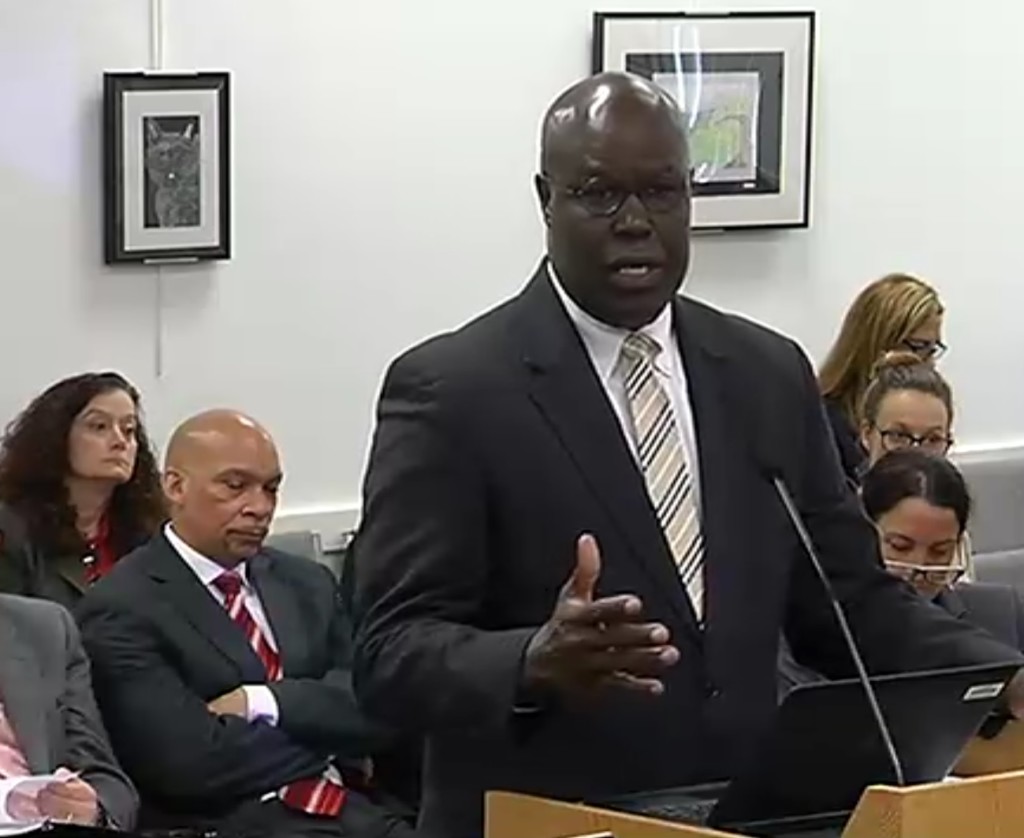
Florida K-12 Schools Chancellor Hershel Lyons explains Jefferson County's struggles to the state Board of Education.
She asked the district to choose a new plan from among three options: Recruit a charter school operator to take over the elementary school, bring in an outside company to operate it, or close the school and send students elsewhere.
"I think when we do one of those three things, our students in Jefferson County will be the beneficiaries, and that is the ultimate goal, and what we are charged with doing," Stewart said.
The district only has one elementary school, so any of those options would take it out of the business of running elementary schools altogether.
The future of Jefferson's combined middle-high school is also in question. The state board previously approved its turnaround plan, but Stewart said she had doubts the district was following through, and that it hadn't hired a principal with bona fide turnaround experience. As a result, she said, the board might consider similar options for Jefferson's secondary students at a future meeting.
Jefferson County is an outlier in many ways. It has the lowest student achievement in the state. Hershel Lyons, the state's chancellor for K-12 schools, said more than half of its high school students had been forced to repeat more than two grades. Jefferson has one of the state's highest poverty rates. Its student population has shrunk by an unparalleled 30 percent in five years. It is now Florida's smallest school district. It has the highest rate of private school enrollment in the state, and other parents have moved their kids to neighboring districts.
Despite having the state's second-highest rate of per-pupil spending, it's pulling itself back from the brink of financial crisis. Its finances are under the supervision of a volunteer emergency board. (more…)
A Florida school district today lost one round in a multi-faceted legal showdown with a major charter school operator, but it's safe to say the fight is just beginning.
The Florida Board of Education ruled the Polk Charter Academy should be allowed to open a new school.
The Polk County School Board had rejected the charter application last fall, arguing, among other things, that it would not "substantially replicate" Winthrop Charter Academy, a high-performing charter school in neighboring Hillsborough County.
A 2011 law allows charter schools to gain "high-performing" status if they maintain clean financial records and earn top marks in the state's A-F grading system. A 2013 law makes it easier for those schools to expand. If a school board rejects one of their applications to "replicate" in a new location, they can bypass the state charter school appeals commission and take their case directly to the state board. That's what happened with Polk Charter Academy.
The Polk school district contends the Florida Charter Educational Foundation, the nonprofit governing board that applied to open Polk Charter Academy, could not possibly replicate Winthrop Charter Academy because that school is overseen by a separate entity known as the Bay Area Charter Foundation.
If the Polk charter does not replicate a high-performing charter, it would have to go before the state appeals commission, and would face a longer legal slog to overturn the school board's rejection.
When the state board heard the appeal today, Wes Bridges, an attorney for the Polk school district, said "we wouldn't be here" if the Bay Area charter group had been the one to submit the charter application. (more…)
 Meetings agenda: School testing and choice will be the focus of next week's legislative education committee meetings. The House committee will meet Tuesday to discuss "closing the opportunity gap" for low-income students, and the Senate committee will meet Wednesday to discuss ways to cut back on testing. Politico Florida.
Education bills: Two bills are filed in the Florida House that are intended to make college more affordable. One would allow students to use their Bright Futures scholarships to cover summer tuition, and the other increases the number of credit-hours an in-state student can take before incurring a 100 percent tuition surcharge. Both were filed by new Rep. Amber Mariano, R-New Port Richey, a 21-year-old University of Central Florida student. Gradebook. Politico Florida.
Out-of-school suspensions: Orange County School District principals must now consult with their bosses before imposing out-of-school suspensions on students for all but the most serious offenses. The new policy is meant to encourage principals to consider other options. About 1 in 15 Orange students were given out-of-schools suspensions in the 2014-2015 school year, which is slightly higher than the state average. For black students, the rate was 1 in 8. Orlando Sentinel.
School elections: The Manatee County School Board is considering a change in how school board members are elected. The current system elects board members to at-large seats, voted on countywide. Board member Charlie Kennedy wants to change that to single-member districts, arguing that would cut campaign costs and the influence of outside money. Making the change would require a countywide referendum. Bradenton Herald. (more…)
School construction: K-12 schools and colleges and universities will be competing for school construction money during the next legislative session, which begins in March. Florida Senate President Joe Negron, R-Stuart, says higher education is a top priority, but it's unclear how much money will be available and how it will be shared. Orlando Sentinel.
Principal program: The Florida Board of Education expects to detail the rules outlining the autonomy principals will be given in turning around struggling schools. The pilot project could be rolled out in seven districts: Miami-Dade, Broward, Palm Beach, Pinellas, Duval, Jefferson, Madison and Seminole counties. The board meets Jan. 17. Gradebook.
Gifted programs expand: In the past three years, the Seminole County School District has doubled the number of black, Hispanic, English-learning and low-income youngsters in its gifted program. Orlando Sentinel.
Middling grades: Florida is given a C grade, slightly below the U.S. average, in the annual Quality Counts report from Education Week's Research Center. Florida's score was 72.5, while the U.S. average was 74.2. The grades are calculated from a success index, spending on education, spending equity across state districts and an achievement index. Massachusetts is the top state with a score of 86.5 and a grade of B. Education Week. (more…)
Two South Florida charter schools are challenging a new state rule that raises the academic bar for state facilities funding.
In a complaint filed this week with the state Division of Administrative Hearings, the Florida Association for Independent Public Schools argues the state overstepped its authority by denying facilities funding to charter schools that received consecutive D grades through the state's A-F accountability system.
Two of the association's members — Aspira Raul Arnaldo Martinez Charter School and the Miami Community Charter Middle School — are joining the complaint. Both received charter school capital outlay funding in the past, including a combined total of more than $200,000 during the 2015-16 school year.
The schools say the state withheld their facilities funding for the 2016-17 school year in anticipation of new rules, approved late last month by the state Board of Education.
Unlike district-run schools, charter schools in Florida rely on annual appropriations by the Florida Legislature to pay for facilities.
Earlier this year, lawmakers overhauled the formula for charter school facilities funding, steering a larger share of money to schools where 75 percent or more children are economically disadvantaged, or 25 percent or more children have special needs. The new law also allows charters to receive facilities funding after two years rather than three. (more…)

