By Lauren May and Ron Matus
Florida continues to be a standout in Catholic school growth. But the latest national data from the National Catholic Educational Association, released Tuesday, shows other states with expansive new school choice programs are gaining steam.
In fact, Florida is no longer the only state in the Top 10 states for Catholic school enrollment to show a net gain over the past decade. This year it’s joined by Indiana. The Hoosier State is now in the plus column thanks to this year’s jump of nearly 4,000 students.
(Indiana, by the way, replaced Missouri in the Top 10. Missouri’s enrollment has been relatively stable for the past five years, but it dipped just enough for Indiana to pull ahead.)
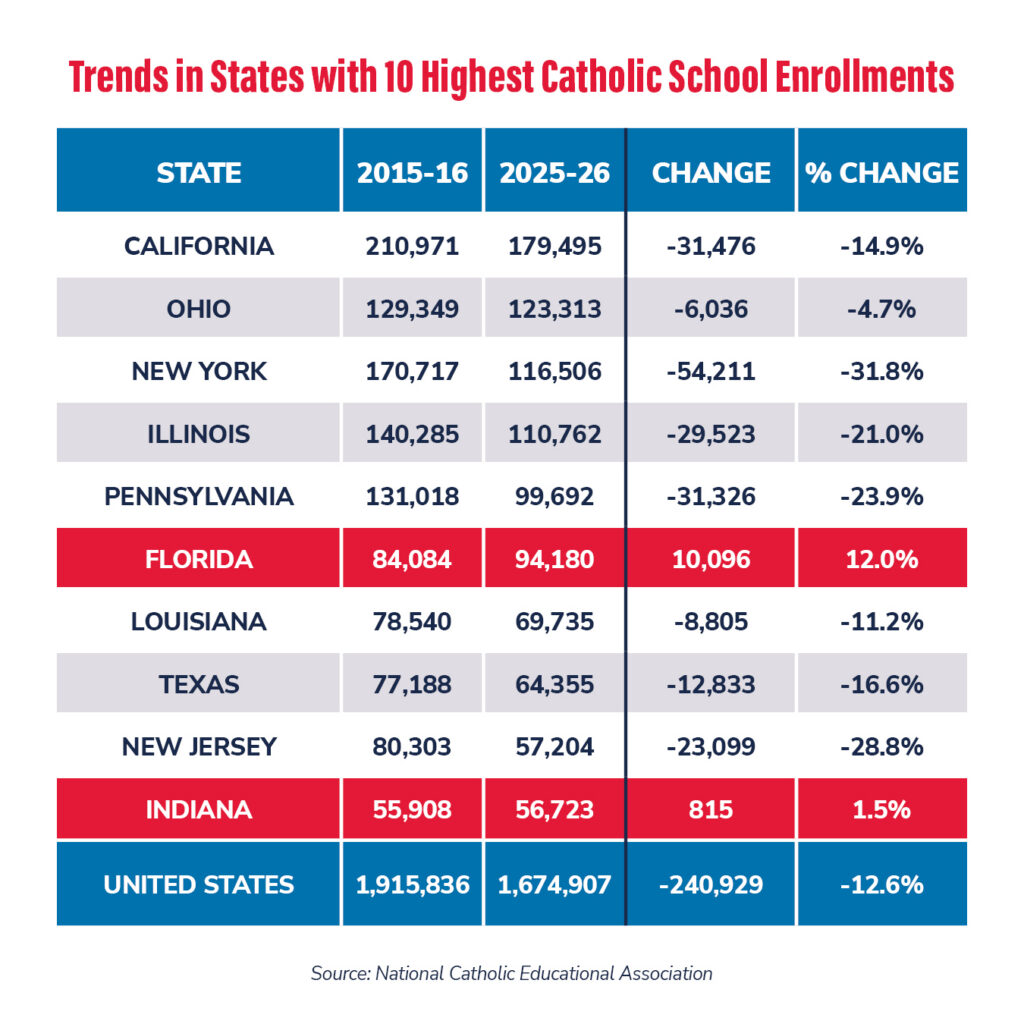
No state had a bigger one-year increase than Indiana, the new report shows. Plenty of others, though, are seeing significant growth, including Ohio, Iowa, and New Hampshire, all states with choice programs that encompass universal eligibility.
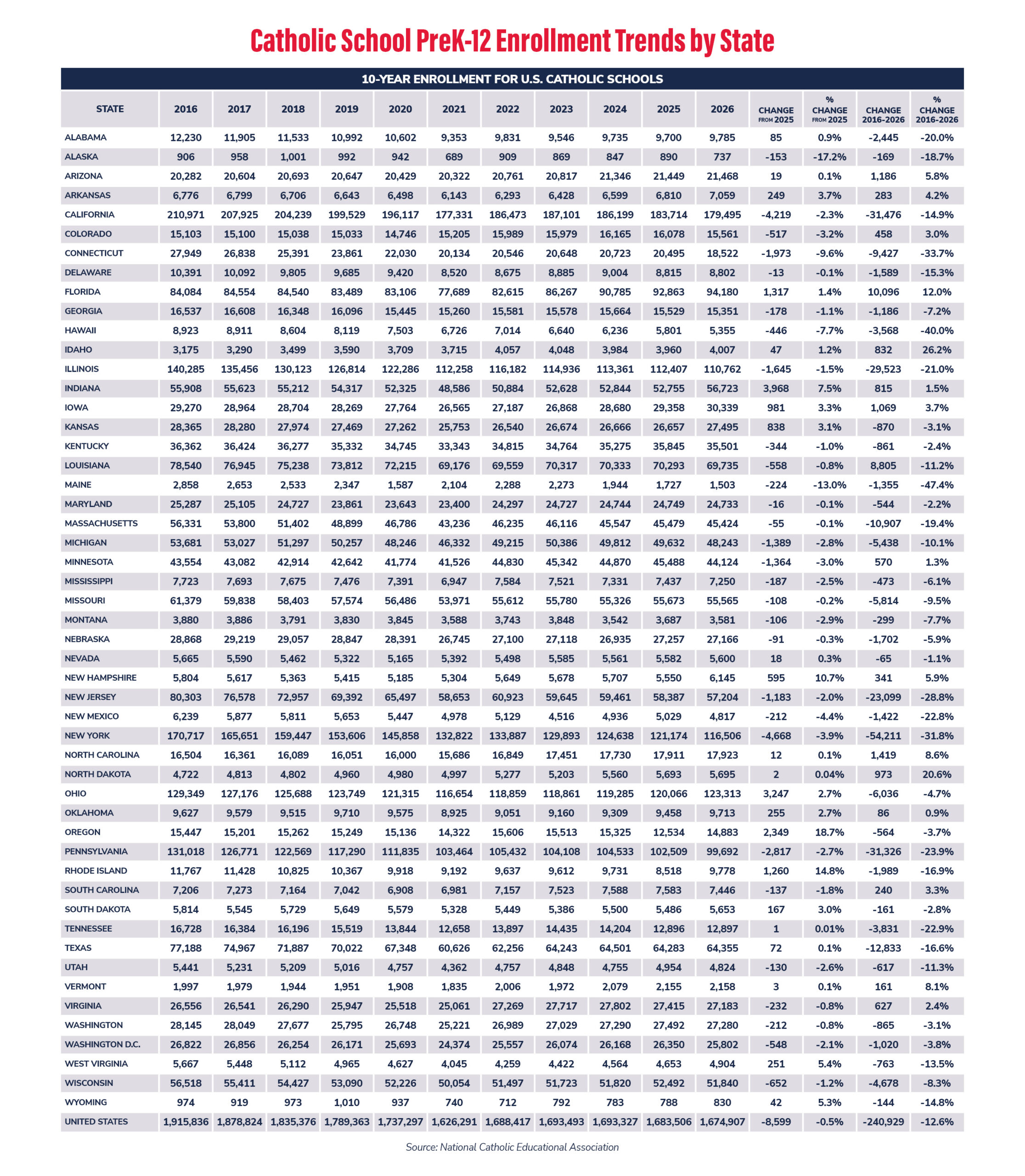
Check out the data for yourself in the chart we put together at the bottom of this post. It includes the NCEA’s year-by-year numbers for all 50 states, going back a decade.
The report isn’t just good news for individual states. Nationally, enrollment stayed pretty steady for a fifth straight year. After decades of falling numbers, that’s encouraging – and supporters of Catholic education, and education pluralism more broadly, should feel the wind at their backs.
Meanwhile, don’t forget about Florida just yet.
Catholic school enrollment down here is up 12% over the past decade, while total K-12 growth ran about 10% over that span.
The Sunshine State’s been the outlier for years, buoyed by the most robust school choice programs in America. It’s for that reason that we issued a special report, “Why Catholic Schools in Florida Are Growing: 5 Things to Know,” in 2023, and followed it up with update briefs in 2024 and 2025.
Stay tuned for the 2026 update soon.
About the authors
Lauren May is Vice President and Head of the Federal Scholarship Tax Credit Program at Step Up For Students and a former Senior Director of Advocacy at Step Up For Students. As a proud graduate of the University of Florida, she received her bachelor’s degree in special education and her master's degree in early childhood education. She then completed another master's degree in educational leadership from Saint Leo University. A former Catholic school teacher, early childhood director, and principal, she was honored with the University of Florida’s “Outstanding Young Alumni” award in 2018. As a believer
that parents are the first and best educators of their children, Lauren loves working with families across the state and beyond to ensure they can find and make use of the best educational options for their children.
Ron Matus is Director, Research & Special Projects, at Step Up For Students. He earned a bachelor's degree in history and English/creative writing from Florida State University and a master's degree in Florida Studies from the University of South Florida. He joined Step Up in 2012 after more than 20 years as an award-winning journalist, including eight years as the state education reporter for the Tampa Bay Times, the state’s biggest and most influential newspaper.
By Lauren May and Ron Matus
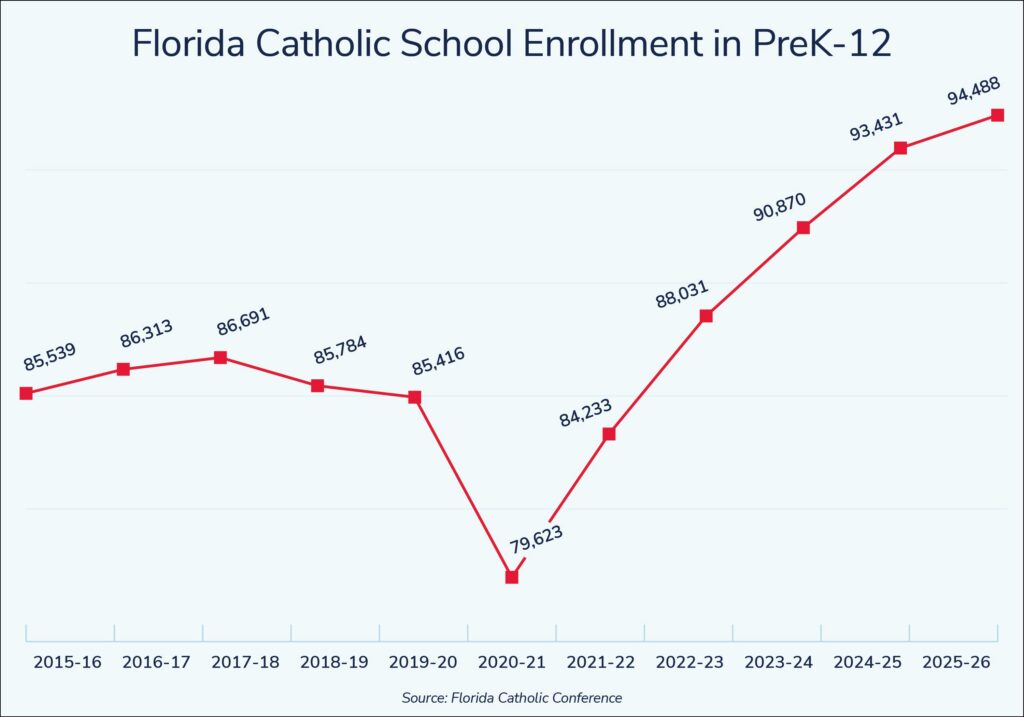
Catholic school enrollment in Florida is up again this year, rising 1.1% to 94,488 students, according to the latest numbers from the Florida Catholic Conference.
The continued growth is likely to bolster Florida’s reputation as the national standout in Catholic schooling. Through last year, Florida Catholic school enrollment was up 12.1% over the past decade. Nationally, it was down 13.2%.
To spotlight the trend lines, we published a special report in 2023, “Why Catholic Schools in Florida Are Growing: 5 Things to Know,” followed by update briefs in 2024 and 2025.
In that spirit, here are five things to know about the 2025-26 numbers:
The trend continues. This year marks five years of consecutive growth. Since 2020-21, when enrollment dipped in the wake of the pandemic, Catholic school enrollment in Florida is up 18.7%.
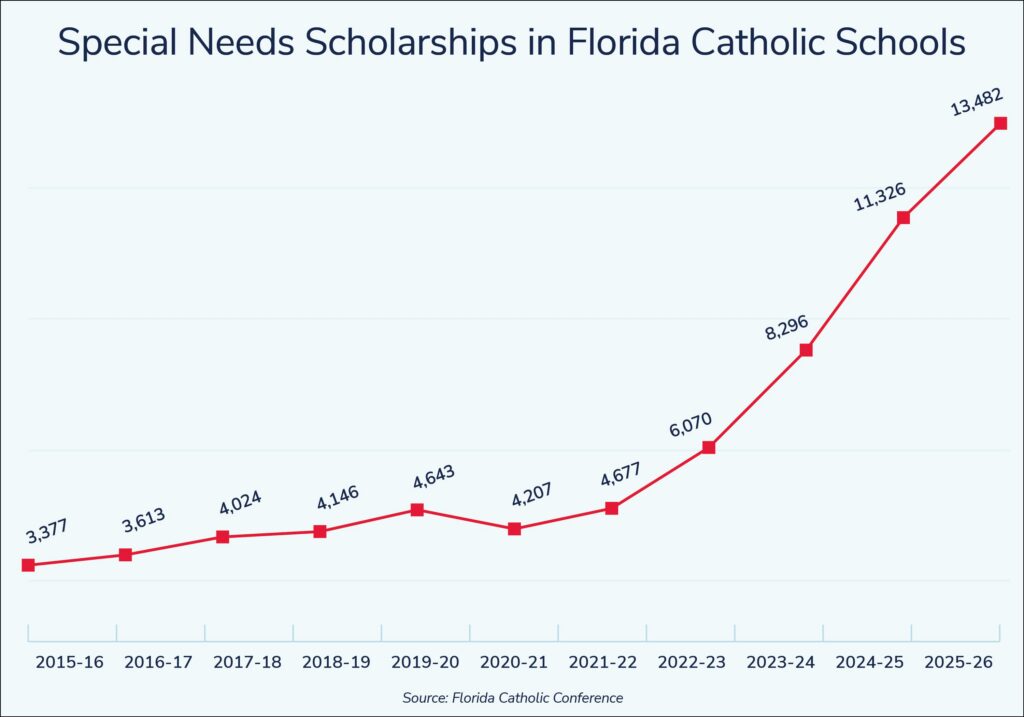
Special needs surge. Students with special needs are a leading factor. This year, Catholic schools in Florida are serving 13,482 students who use the state’s Family Empowerment Scholarship for Students with Unique Abilities. That’s up 19% from last year and triple the number from five years ago. FESUA students now encompass one in seven of all Catholic school students in Florida.
Non-Catholic students. Catholic schools have a long history of serving a diverse array of students. This year, 20% of students in Florida Catholic schools are non-Catholic, up from 14% a decade ago.
Choice scholarships are critical. In 2022-23, the year before choice in Florida became “universal,” 47.2% of all Catholic school students in Florida used choice scholarships. This year, 92.1% use them.
Context for the trend line. This year’s enrollment increase is smaller than any of the past five years. Time will tell whether that’s an anomaly. But it’s worth noting that except for a la carte learning, K-12 enrollment in Florida is slowing all over:
It’s likely that demographic shifts, including falling birth rates and declining immigration, are significant factors here. With private schools, it’s also possible that barriers such as zoning and building codes are preventing supply from better meeting demand. Last year, a Step Up For Students survey of parents who were awarded choice scholarships but didn’t use them found one in three said there were no seats available at the schools they wanted.
One final note: This post, not to mention our reports on Catholic education in Florida, wouldn’t be possible without the Florida Catholic Conference. FCC Director of Accreditation Mary Camp has been carefully tracking the enrollment and scholarship data for years. We are grateful to partner with the FCC and particularly indebted to Mary.
About the authors
Lauren May is Vice President and Head of the Federal Scholarship Tax Credit Program at Step Up for Students and a former Senior Director of Advocacy at Step Up For Students. As a proud graduate
of the University of Florida, she received her bachelor’s degree in special education
and her master's degree in early childhood education. She then completed another
master's degree in educational leadership from Saint Leo University. A former
Catholic school teacher, early childhood director, and principal, she was honored with
University of Florida’s “Outstanding Young Alumni” award in 2018. As a believer
that parents are the first and best educators of their children, Lauren loves working
with families across the state and beyond to ensure they can find and make
use of the best educational options for their children.
Ron Matus is Director, Research & Special Projects, at Step Up For Students. He
joined Step Up in 2012 after more than 20 years as an award-winning journalist,
including eight years as the state education reporter for the Tampa Bay Times, the
state’s biggest and most influential newspaper.
Editor's Note: This story originally ran on Florida Politics.
 The dream, the goal, the answer to many prayers is a three-story building that houses seven classrooms, a chemistry lab, a library – and since school resumed after the Christmas break, 54 students in grades nine through 11.
Welcome to Basilica High School, which sits on the campus of The Basilica School of Saint Mary Star of the Sea, Key West’s lone Catholic school and the only Catholic high school in Monroe County.
The school, which for decades served only PK3-8 students, will be PK3-12 when the first senior class is added during the 2025-26 school year.
“It’s been three years of fear, hope, prayers, and a lot of hard work to get here, and it's amazing now to have the students in the classrooms in the building. It feels like we have a home,” said Angela Wallace, the school’s Advancement Director.
Florida’s education choice scholarship programs were instrumental in making it possible, an achievement worth celebrating during National School Choice Week and Catholic Schools Week, which run concurrently Jan. 26 to Feb. 1.
Key West had a Catholic secondary school for 100 years until Mary Immaculate High School closed in 1986 because of declining enrollment. That meant the nearest Catholic high schools were in Dade County, with the closest being Archbishop Coleman Carroll High School, a mere 145 miles from Key West.
That left few options for parents whose children graduated The Basilica School of Saint Mary Star of the Sea after the eighth grade: send them to Key West High School or one of Key West’s two charter schools or move closer to a Catholic school.
The hope of another Catholic high school always lived among school administrators and parents, and beginning last decade, several factors combined to turn that hope into reality.
First, Catholic school enrollment in Florida continued its steady incline with a 4.4% growth of preK-12 students between 2013-2023. After a COVID-related drop to 77,689 students in 2021, enrollment rebounded to 89,267 students in 2023. Enrollment has continued to rise, from 90,870 in the 2023-24 school year to 93,455 this academic year – a healthy 2.8% year-over-year increase.
Enrollment doubled at The Basilica School of Saint Mary Star of the Sea between 2013 and 2019.
Second, HB1 became law in 2023, which expanded the state’s education choice scholarship programs, making them available to all K-12 students in Florida.
“(HB1 has) been an incredible blessing,” Wallace said. “So much of our operational and economic vitality is because of the scholarship program.”
There are 524 students enrolled at The Basilica School of Saint Mary Star of the Sea during this school year, 450 attending with the help of a scholarship managed by Step Up For Students: the Florida Tax Credit Scholarship, the Family Empowerment Scholarship for Educational Options, which average $8,000 per student, or the Family Empowerment Scholarship for Students with Unique Abilities, which averages $10,000 per student.
The programs have been a boon to families seeking more options in their children’s education, with participation this year passing the 500,000 students milestone for the first time. They also have helped Catholic schools in Florida grow, bucking the national trend of declining enrollments. Last year, 56,192 students used scholarships to attend Catholic schools. This year, that number has jumped to 72,851.
Three years ago, The Basilica School of Saint Mary Star of the Sea conducted a feasibility study to see if adding a high school would work. The results led to a pilot program during the 2021-22 school year when 13 students enrolled in the ninth grade.

Miami Archbishop Thomas Wenski blessed the new high school building during a dedication mass in December. (Photo courtesy of Studio Julie Photography)
“Those students took an enormous risk,” Wallace said. “We basically said we have been approved to offer high school classes for this year, and possibly this year only if we can’t get all the numbers to work. You may be transferring elsewhere for your sophomore year.
“They took the leap, and we have been able to continue.”
A 10th grade was added the following year, which increased the high school’s enrollment to 33. That increased to 54 this year with the three grades. The hope is to have 80 students enrolled in the four grades during the 2025-26 school year.
Until January, those students were “nomads,” according to The Basilica School of Saint Mary Star of the Sea President Robert Wright, as they used classrooms on the elementary school campus. Now they have a home, and Wright said the excitement permeates the entire campus.
“It is one of the greatest blessings in my life to witness the seeds of faith and virtue that have been planted and nurtured in our students during the elementary and middle school years come to fruition as they transition to adulthood,” he said.
The new school building had been an auditorium that was used as a gymnastics studio. It is called The Howley Family Building after Nick and Lorie Howley, who helped fund its transformation.
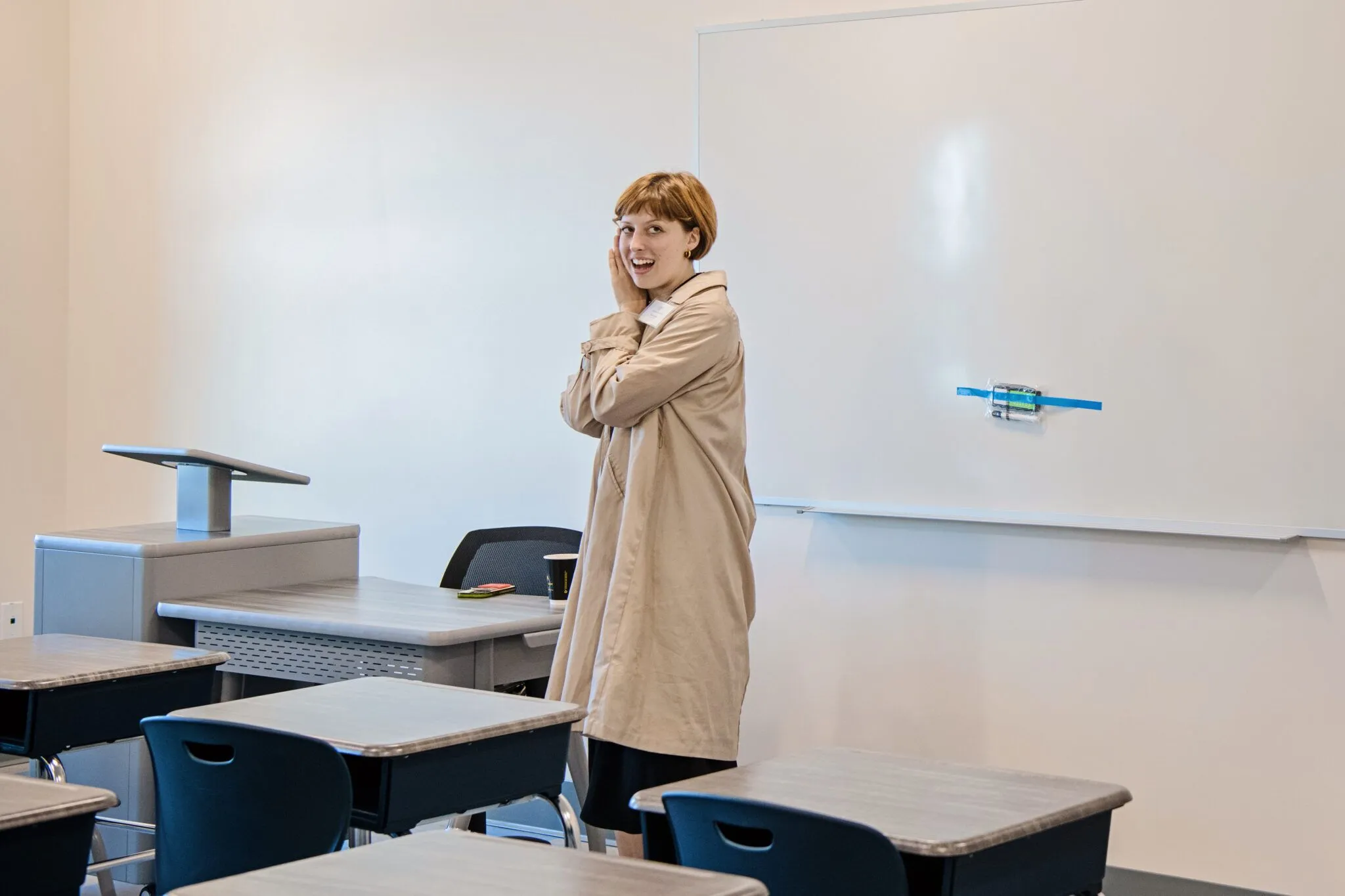
English teacher Anna Coppa reacts after entering her classroom in the new high school building for the first time. (Photo courtesy of Studio Julie Photography)
Riella Sims, whose daughter Kallisto is one of the original 13 ninth-graders, was among the parents lobbying for a high school as their children ascended elementary and middle school.
“I felt it was in Kallisto’s best interest for her to continue on in the Basilica High School, as I believe The Basilica provides a more well-rounded education for the well-being of all the children attending,” she said. “They become more responsive to their community’s needs and others around them.”
Kallisto said she is “proud” to be a member of the first graduating class. She said their legacy will be built on “faith, understanding, a sense of adventure, and the courage to take on challenges,” all the qualities needed to enroll in a high school that might not exist after one year.
“We all feel an immense sense of pride not just in ourselves, but also in our extraordinary teachers, who have worked tirelessly to provide us with an excellent education, from late nights to helping us around the clock with any questions we have,” she said. “This moment is as much a celebration of their dedication as it is of our achievements.”
Hadley Bardoni, a 10th-grader, enrolled at Basilica High School in the ninth grade after visiting all four secondary school options for Key West students.
“Basilica just clicked with us and our daughter, and it's been the best choice that we could have made for her,” said Jennifer Bardoni, Hadley’s mom.
Though not Catholic, Jennifer and her husband Damian wanted a faith-based education for Hadley and her sister Ansley, who is in the eighth grade. It’s a small school with a favorable teacher-to-student ratio and a curriculum based on moral values.
“The students are treated as young adults,” Jennifer said. “It’s a very welcoming, loving community that nurtures education and gives our kids the right values.”
That was the motivation for the push to add a high school. The values taught in grades one through eight will continue through grade 12.
“It’s such a crucial time in their development, that transition from adolescence to being young adults,” Wallace said. “They're able to continue that in an environment where they feel very safe. They know the teachers and they're with the friends and families that they've grown up with.”

Bishop William Wack from the Diocese of Pensacola-Tallahassee joins in on the fun running around with the students at Trinity Catholic School in Tallahassee.
Florida Catholic schools are thriving, and the latest enrollment numbers prove it. Across the state, enrollment rose from 90,870 in the 2023-24 school year to 93,455 – a 2.8% year-over-year increase.
Driving much of this growth is the use of private school scholarships, which rose by 27% this year. Programs like the Family Empowerment Scholarship for Educational Options and the Florida Tax Credit Scholarship provide families with about $8,000 per student to pay for private school, making Catholic education more accessible than ever.  The news comes just as Catholic schools across the United States are celebrating Catholic Schools Week simultaneously with National School Choice Week, which runs from Jan. 26 through Feb. 1.
“(Scholarship) programs are giving more working-class and middle-class Florida families the ability to choose Catholic schools — and more of them are doing just that,” said Bishop Gerald Barbarito of the Diocese of Palm Beach, which has 20 schools in five counties.
National state-by-state figures are not expected to be released until March, but last year’s report offered encouraging news, with Catholic school enrollment in PreK-12 holding steady. In 2023-24, 1,693,327 students were enrolled in Catholic schools across the United States, virtually the same number as the prior year. (Officially, the 2022-23 number was 1,693,493.) In Florida, enrollment climbed to 90,785, up 5.2% from the prior year.
The 2023 passage of House Bill 1, which made every family in Florida eligible for a scholarship, has been a game changer for Catholic schools. Last year, 56,192 students used scholarships to attend Catholic schools. This year, that number has jumped to 72,851. In the Archdiocese of Miami, the number of families using scholarships increased by 45%.
However, Florida was an outlier when it came to Catholic school enrollment growth a decade before Gov. Ron DeSantis signed HB 1 into law.
Between 2013 and 2023, Florida was the only state in America in the Top 10 for Catholic school enrollment that did not see declines in enrollment. While other states saw declines during that span, Florida experienced 4.4% growth, which was credited to the Sunshine State’s already robust school choice scholarship program. The positive trend lines in Florida were the subject of a special report: “Why Catholic schools in Florida are growing: 5 things to know.”
“Over the past few years, we have made an intentional effort to educate families about these programs and encourage them to apply,” said Jim Rigg, archdiocese secretary of education and superintendent. “At this point, over half of our schools are full with a waiting list, so we decided to work closely with families enrolled or interested in schools that were not full.” He feels that their measured and strategic approach helped families understand and apply for the scholarship.
This remarkable growth is not limited to a single region. Schools within the Diocese of Venice in southwest Florida saw the most growth, with a 4.9% increase. Superintendent Father John Belmonte attributes this success to strategic goals set for each school.
“The most important thing that we do is communicate with families and invite them to attend our schools. We do this by sending out 1 million emails and text messages to families across the diocese every year,” he said. Schools are also innovatively addressing capacity challenges in high-demand areas by maximizing classroom space and adopting creative scheduling.
Catholic schools in Florida are also making strides in serving students with unique abilities, as enrollment for these programs increased by 36%. Schools like Holy Family Catholic school in Jacksonville are pioneering innovative ways to serve their students, such as individualized, small-group-focused learning. Similarly, schools like Bishop Larkin Catholic School in the Tampa Bay area have implemented initiatives like Morning Star programs, which provide a low student-to-teacher ratio, tailored curriculum, and dedicated classrooms to help students with learning and developmental challenges succeed academically, socially, and spiritually. Thanks to the Family Empowerment Scholarship for Unique Abilities, families in this program receive scholarship dollars to make specialized education more accessible.
The continued growth has paved the way for exciting school expansions and new facilities. In December, The Basilica School of Saint Mary Star of the Sea in the Florida Keys celebrated the ribbon-cutting of its new high school building. Meanwhile, Donahue Catholic Academy in rural southwest Florida is set to expand with modular classrooms to accommodate 200 students on a wait list. Rigg expressed optimism about the future.
"We are continuing conversations about how to expand the growth of Catholic education in Florida,” he said.
Catholic school enrollment in Florida grew more in the past year than in the previous 10 years combined, while Catholic school enrollment nationally held steady, according to the latest figures from the National Catholic Educational Association.
The longer-term trend lines now show Florida Catholic school enrollment up 9% over the past decade, while it’s down 14% nationally.
In light of the new data, we thought it appropriate to issue this brief update to our paper from August.
“Why Catholic Schools In Florida Are Growing: 5 Things To Know” took a closer look at Florida's upward trends and the leading factors behind them.
Our new brief is meant to supplement that paper. We updated a handful of key charts and graphs using new data from the NCEA and the Florida Catholic Conference, including a year-by-year breakdown of Catholic school enrollment for all 50 states.
We also added a couple of new charts. One highlights the number of students using special needs scholarships in Florida Catholic schools. The other does the same for non-Catholic students. Both are on the rise.
As with the paper, we hope our brief can inspire and inform, and perhaps point to lessons from Florida that might be especially useful to Catholic education supporters in states with new choice programs. Challenges remain, but now the wind is at your back.
Editor's note: Some of the figures in Appendix A in the original update brief were incorrect. The correct version here was put in its place on May 9, 2024.
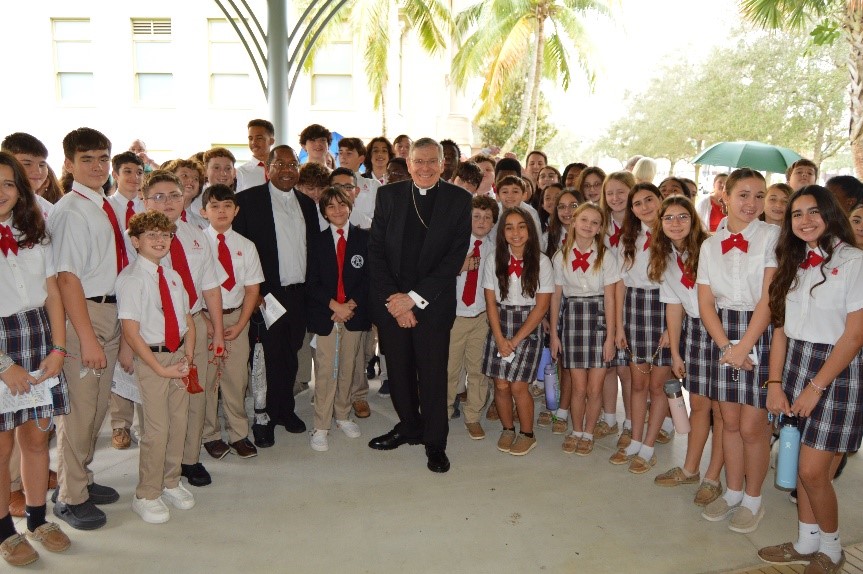
Bishop Barbarito of the Diocese of Palm Beach poses with Reverand Delvard, pastor and students from St. Ann Catholic School in West Palm Beach.
By Ron Matus and Lauren May
The latest national and state-by-state Catholic school enrollment numbers are out – and they amplify the contrast between what’s happening in Florida and most of the rest of America.
Bishop Barbarito of the Diocese of Palm Beach poses with Reverand Delvard, pastor and students from St. Ann Catholic School in West Palm Beach.
Nationally, Catholic school enrollment in PreK-12 held steady, according to the latest annual report from the National Catholic Educational Association, released Wednesday. In 2023-24, 1,693,327 students were enrolled in Catholic schools, virtually the same number as the prior year. (Officially, the 2022-23 number was 1,693,493.)
In Florida, enrollment climbed to 90,785, up 5.2% from the prior year.
The NCEA figures for Florida are slightly different than the numbers NextSteps reported in January. That report was based on enrollment figures from the Florida Conference of Catholic Bishops, which includes a broader group of preschool students in its count.
Either way, Florida continues to be an encouraging outlier.
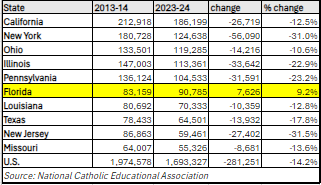
Last August, Step Up For Students published “Why Catholic Schools In Florida Are Growing: 5 Things To Know,” which took a closer look at the Florida numbers and some of the factors behind them.
At that time, Florida was the only state in the Top 10 for Catholic school enrollment to see growth over the past decade – 4.4%. The latest figures show that’s still the case, but strong gains over the past year boost the 10-year increase to 9.2%.
Clearly, Florida’s robust education choice scholarship programs are a difference maker. But it’s also true that in the most competitive educational environment in the country, Florida Catholic schools have found even more ways to stand out to families.
A number of schools have incorporated popular programming, such as IB programs and classical curriculum while keeping Catholic teaching at the core of all that they do. At the same time, some dioceses have embraced – and relentlessly deployed – cutting-edge strategies to raise parental awareness about choice scholarships.
During scholarship application season, the Diocese of Venice, which covers southwest Florida, now sends more than 1 million texts and emails about the scholarships to Catholic families. Not coincidentally, the diocese has the biggest enrollment growth of any diocese in Florida, and all 16 of its schools now have wait lists.
Nationally, Catholic school enrollment is down 14.2% over the past decade, but there are encouraging signs here, too. After a post-COVID dip, the numbers climbed for two years before stabilizing this year. Five of the Top 10 states also showed some year-over-year growth this year. (Florida, Ohio, Pennsylvania, Louisiana, and Texas).
The good news is that there is no reason for Florida to remain the outlier given the growing number of states that have adopted major if not universal choice programs in the past three years. Catholic school supporters across the nation have a golden opportunity to help their schools further flourish and grow.
Ron Matus is Director of Research and Special Projects and Lauren May is Advocacy Director at Step Up For Students, which publishes this blog and administers education choice scholarship programs in Florida.
Editor's note: This story is published in celebration of National Catholic Schools Week, which runs from Jan. 28-Feb. 3.
Visit Guardian Angels Catholic School in Clearwater, and you’ll feel a deep sense of community as soon as you pull up to the entrance. School leaders stand at the curb, waving at parents and greeting each student as they leave their cars. The day starts with a student-run television news show, including announcements about frequent evening social events. Principal Mary Stalzer strolls through each room to ensure everything is running smoothly.
 By mid-morning, the youngest students are running around on the playground. Middle schoolers work in science labs. In another room, students read stories they have written or edit a classmate’s work. Outside, students tend vegetable gardens that are part of the school’s fully certified STREAM program. (STREAM stands for Science, Religion, Technology, Engineering, Arts and Math and is the Catholic school version of a STEAM program.) Teachers link the gardening projects to Jesus’ parable about what can be achieved by having faith the size of a tiny mustard seed.
Where Catholic schools are often tied to a single church, with which they often share a location, Guardian Angels is an inter-parish school, which means it has no specific church. Instead, support is spread across four local parishes. This may help explain why the school's leaders have made building community a priority.
The tree-shrouded campus sits tucked away in a neighborhood of modest homes and apartment complexes, not visible from major highways.
“We are the hidden gem of northern Pinellas County,” said Stalzer, whose career with Catholic schools has spanned a quarter century.
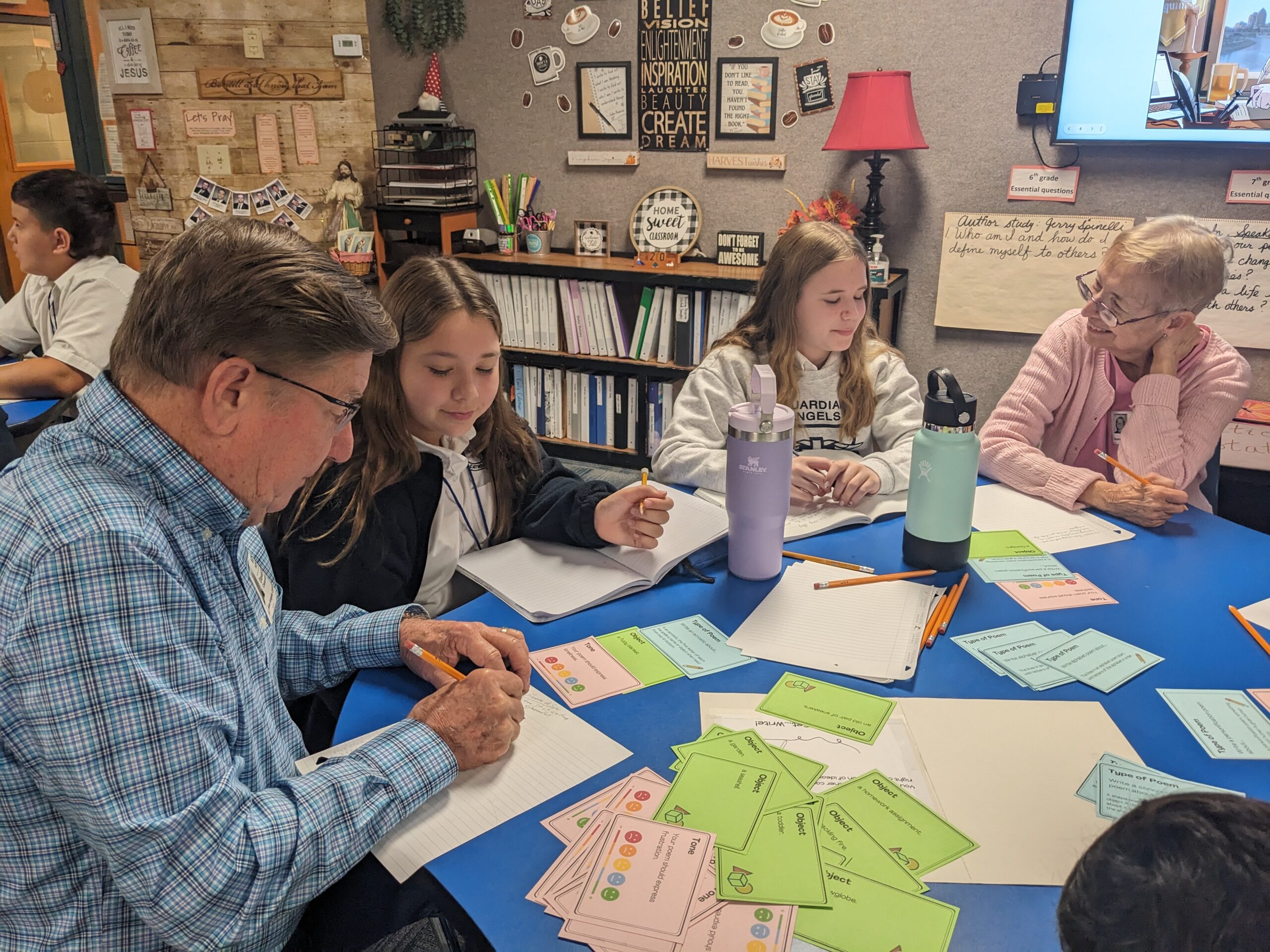
Guardian Angels Catholic School in Clearwater, Florida is known for its deep sense of community, which is fostered by the encouragement of parents and grandparents to be involved in school activities. Photo courtesy of Guardian Angels Catholic School
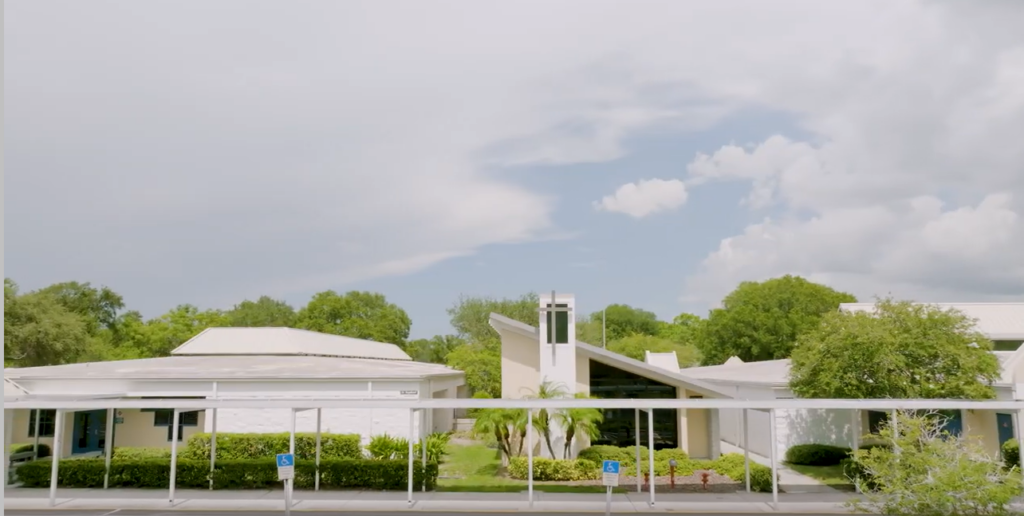
Guardian Angels Catholic School
 Over the years, she has taught elementary school, worked in the library, and served as assistant principal before becoming head of the school. “We are warm and welcoming. We know our students; we know their parents and their grandparents.”
This year, more people have discovered the sparkle of Guardian Angels, where enrollment spiked this school year by 19% after several years of decline due to the pandemic and other nearby schools.
Stalzer attributed the substantial increase to several factors, including a grassroots marketing campaign that included in-person and online meetings, letters, social media posts, and word-of-mouth. However, the primary reason she cited and other school leaders gave for their growth was the Florida Legislature’s passage of House Bill 1, the largest expansion of school choice in United States history.
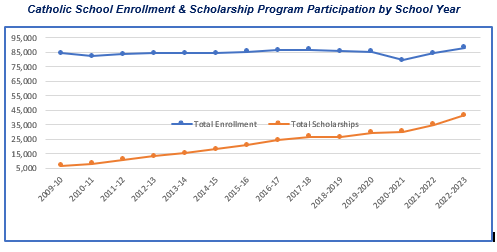
While this year’s growth at Guardian Angels is sure to turn heads, it’s part of a much broader statewide trend. Recent data from the Florida Conference of Catholic Bishops show Catholic school enrollment grew by 4% across the Sunshine State in the 2023-24 school year. That increase is on top of the 4% growth seen over the past decade highlighted in a special report by Step Up For Students.
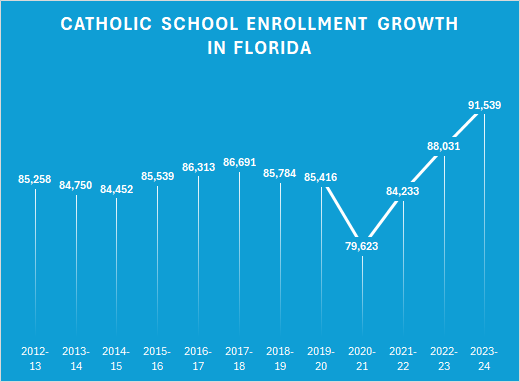
Chart courtesy of Ron Matus
Stalzer and the other Catholic school leaders across the state made every effort to make existing and new families aware of the new law, which extended scholarship eligibility to all Florida students regardless of their family’s income.
“People found it hard to believe that they didn’t have to qualify for it financially,” Stalzer said. “I have heard some families say it’s an answer to their prayers.”
Chris Pastura, superintendent of schools for the Diocese of St. Petersburg, where Guardian Angels is located, said the law helped many families who otherwise would not have been able to afford Catholic schools. The 34 elementary and secondary schools in the diocese, which cover five counties in the greater Tampa Bay area, reported a year-over-year growth rate of 3.8%
“What I found was an immense sense of gratitude from a lot of middle-class families,” Pastura said. Those families might be getting by, he said, but make financial sacrifices to provide their kids with a Catholic education.
“This is a great example of a program helping them at the bottom line,” he said.
With its current enrollment at 191, Guardian Angels still has plenty of room before it reaches what Stalzer called a “comfortable” count of 350 students. Other schools across the state are hitting their maximum capacity, which they attribute to Florida’s rising population and the availability of state school choice scholarships. This year, 78% percent of Florida Catholic school students received them.
“Catholic school enrollment continues to soar in the state of Florida,”’ said Deacon Scott Conway, superintendent of schools for the Diocese of St. Augustine, which reported 4% year over year growth across its 29 schools in 17 northeast Florida counties.
“One of our biggest struggles is not having enough seats for students, which causes us to have to turn many students and families away,” he said. “We are so blessed here in Florida that our legislature has recognized the importance of empowering school choice for families. For most people, there is no choice without the scholarship program.”
One of those schools is Holy Family Catholic in Jacksonville, which serves students in kindergarten through eighth grade. The school recently ramped up its Wildcat D.E.N.S. program to provide personalized tutoring for students struggling in key academic areas and enrichment for students identified as gifted.
This year, for the first time, the school had to start a waitlist for students in kindergarten through fourth grade, assistant principal Amanda Robison said.
Florida’s largest Catholic school region also reported growth of about 4% this year, continuing a trend that began four years ago.
“Enrollment is the largest it has been in over 10 years,” said Jim Rigg, who oversees 64 schools as superintendent of schools for the Archdiocese of Miami, which includes Miami-Dade, Broward and Monroe counties. “Over 50 percent of our schools are filled with waiting lists, and nearly all of the remaining schools are growing.”
Rigg cited the August re-opening of St. Malachy Elementary School in Tamarac, which had closed 14 years earlier due to declining enrollment, along with the addition of a high school to an elementary school in Key West as evidence of rising demand. Cristo Rey Miami High School also opened in 2022, the second Florida location for a national network of high schools that specialize in college preparatory academics and on-the-job work experience for students from financially constrained households.
“Unfortunately, there are now areas of the Archdiocese where we simply do not have open seats in our schools,” he said.
Rigg added that Archdiocese leaders are in “active conversations” about future openings and reopenings to accommodate the demand, which he attributed to Florida’s robust scholarship programs as well as an influx of families from the northern U.S., Latin America and the Caribbean.
“It is important that we do our best to meet the strong and growing demand for Catholic education in South Florida,” he said.
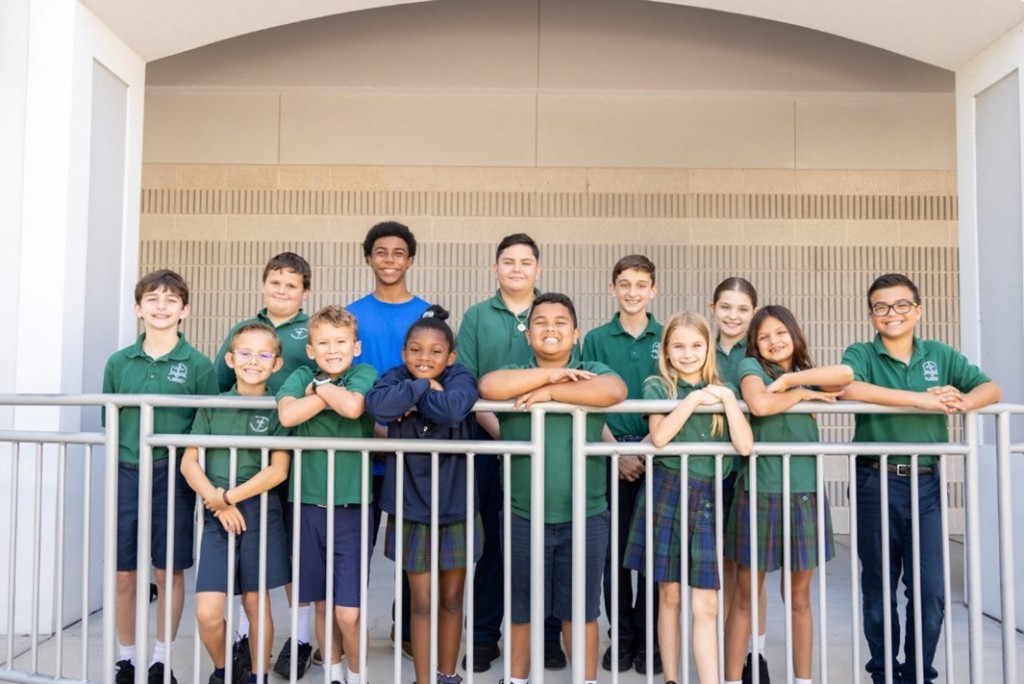
Students at St. Lawrence Catholic School in Tampa brought their bright smiles and are ready to start the school year.
School is back in session for Catholic schools across all seven dioceses in Florida.
This year, each of them is seeing another enrollment increase.
This broad, widespread enrollment growth is part of a longer-term trend that makes Florida stand out on the national landscape.
In a recent report published by Step Up For Students, only 10 states showed growth in Catholic school enrollment over the past decade. Of those 10, Florida is the only state with a significant number of students enrolled in Catholic schools.
These numbers may continue to change as some schools are still enrolling new students, but here is a preliminary look at year-over-year enrollment growth by diocese.
Diocese of Venice – 8%
Diocese of Palm Beach – 6%
Diocese of St. Augustine – 5%
Archdiocese of Miami – 3.5%
Diocese of St. Petersburg – 3.5%
Diocese of Orlando – 3%
Diocese of Pensacola/Tallahassee – 2%
Katie Kervi, Assistant Superintendent for the Diocese of Palm Beach, said that over the last three years enrollment in the diocese’s schools has grown by at least 6%.
“We are excited to see our schools flourishing and look forward to welcoming new students and families into our community,” she said. “Our Catholic schools provide a faith-based education paired with high academic standards. I believe the consistent increases in enrollment can be attributed to these strong foundations and because all families now have the opportunity to choose the educational environment that is best for their children.”
Legislation that went into effect on July 1 made the state’s Family Empowerment Scholarships available to all students who are eligible for K-12 public education.
Alina Mychka’s daughter was awarded a scholarship for the 2023-24 school year by Step Up For Students, which hosts this blog.
Her child started the year at Holy Family Catholic School in Jacksonville, and she says she is thankful she can send her child to a safe environment with a rigorous curriculum that reinforces her values.
Mychka immigrated to America from Ukraine eight years ago. She sends any extra dollars her family can spare back to her relatives in their war-ravaged home country.
Without the scholarship, she says, Catholic school would likely not be an option for her family.
Enrollment in Florida’s Catholic schools, which rebounded slightly last year after a pandemic dip in 2020-21, is now the highest it’s been in more than a decade. Figures released this week by the Florida Conference of Catholic Bishops show total enrollment at 88,031, an increase of 4.5% from last year and 3.1% from pre-pandemic numbers.
The total enrollment is now higher than it was in the 2008-09 school year, though less than its peak of 95,000 in 2005-06.
The rise in Catholic school enrollment also paralleled the Legislature’s $200 million expansion of state education choice scholarships. HB 7045 granted scholarship access to tens of thousands more students.
Billed as the largest expansion of education choice in Florida history, the law merged the state’s two scholarship programs for students with unique abilities and combined them with the Family Empowerment Scholarship program approved in 2019. The law also made it easier for families to qualify by removing the requirement that students must spend the prior year in a district school and expanded eligibility to dependents of active-duty members of the U.S. Armed Forces. Lawmakers followed up in 2022 with laws that granted automatic eligibility to dependents of law enforcement officers regardless of income.