Editor's note: This post was originally published by our partner organization, Step Up, Step Further Scholarship Fund.
Florida Chamber of Commerce aims to raise over $250 million for public schools through partnership with Step Further Scholarship Fund to promote America’s new Education Freedom Tax Credit
The Florida Chamber of Commerce is partnering with the Step Further Scholarship Fund to promote the new Education Freedom Tax Credit, a new federal initiative that will allow taxpayers to redirect a portion of their federal tax liability to fund scholarships for low-income students in Florida public schools.
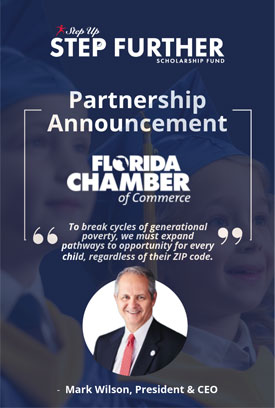
More than 711,000 Florida children live in poverty, making expanded educational opportunity essential to strengthening Florida's future workforce and economic prosperity. Accessing quality education for families stuck in generational poverty is one of the Florida Prosperity Initiatives “ten root causes” of poverty that must be overcome and this new opportunity unlocks huge potential for families.
“The Florida Chamber Foundation’s Prosperity Initiative believes that in order to break cycles of generational poverty, we must expand pathways to opportunity for every child, regardless of their ZIP code,” said Mark Wilson, president and CEO of the Florida Chamber of Commerce. “The brand-new Education Freedom Tax Credit can help connect students to learning environments and resources in Florida’s public schools that support long-term success.”
The partnership was highlighted during the Florida Chamber Foundation’s 2026 Learners to Earners Workforce Solution Summit on June 23 in Tampa, which brought together business, education, nonprofit, and government leaders to discuss workforce development and talent pipeline challenges facing Florida.
Presenters included U.S. Rep. Byron Donalds from Florida’s 19th Congressional District and Republican gubernatorial candidate; Stasi Kamoutsas, Commissioner of Education for the State of Florida; and Henry Mack, assistant U.S. Secretary of Labor.
Executives from AdventHealth, Arthrex, Coca-Cola, PNC Bank, and other leading Florida employers shared their perspectives on these workforce development issues. Additionally, nonprofit leaders served as session panelists, including leaders from Collaboratory, Florida Gulf Coast University, the Florida Philanthropic Network, the Florida Virtual School, and Tampa General Hospital.
“The new federal scholarship aligns perfectly with the mission of the Chamber’s Prosperity Initiative and talent goals,” said John Kirtley, founder and chairman of Step Up For Students. “We are honored to be a sponsor of the summit and grateful for this partnership.”
“The Florida Chamber's statewide network helps connect Florida employers with opportunities to invest in students and strengthen our future workforce,” said Rachel Jones, Senior Director of Fundraising, Step Further Scholarship Fund.
The Education Freedom Tax Credit Explained
Beginning Jan. 1, 2027, individual taxpayers may receive a dollar-for-dollar federal tax credit of up to $1,700 for contributions to eligible Scholarship Granting Organizations, including the Step Further Scholarship Fund. Incredibly, rather than increasing their overall tax burden, participants can redirect a portion of their federal tax liability to support scholarships for low-income public school students in Florida.
Through this initiative, Step Further Scholarship Fund will award scholarships that help students access educational resources and services such as tutoring, technology, therapy, after-school programs, and other learning supports.
An Opportunity for Florida Employers
While there is no cost to Florida employers, they can support the initiative through payroll-giving programs that make participation simple for employees while expanding scholarship opportunities in local communities.
Step Further Scholarship Fund works directly with employers to implement payroll deduction programs, provide technical support and supply employee communications resources, minimizing administrative burden while maximizing participation.
To sign up for the Step Up, Step Further interest list, go here.
TAMPA, Fla. — A half-century ago, John and Cindy Ingram built a strong reputation emphasizing family.
Besides their children, their children’s spouses, and their grandchildren, that definition also includes the thousands of students who have bowed at the door of Ingram’s Karate dojos since 1977.
Each evening, these spaces, which some treat like holy ground, spring to life. Crisp white uniforms snap as students kick, punch, and shout, “kiai!”
Soon, a different type of energy will be seen before dark, when homeschoolers come to sharpen their core academic skills and participate in some “old-fashioned P.E.”
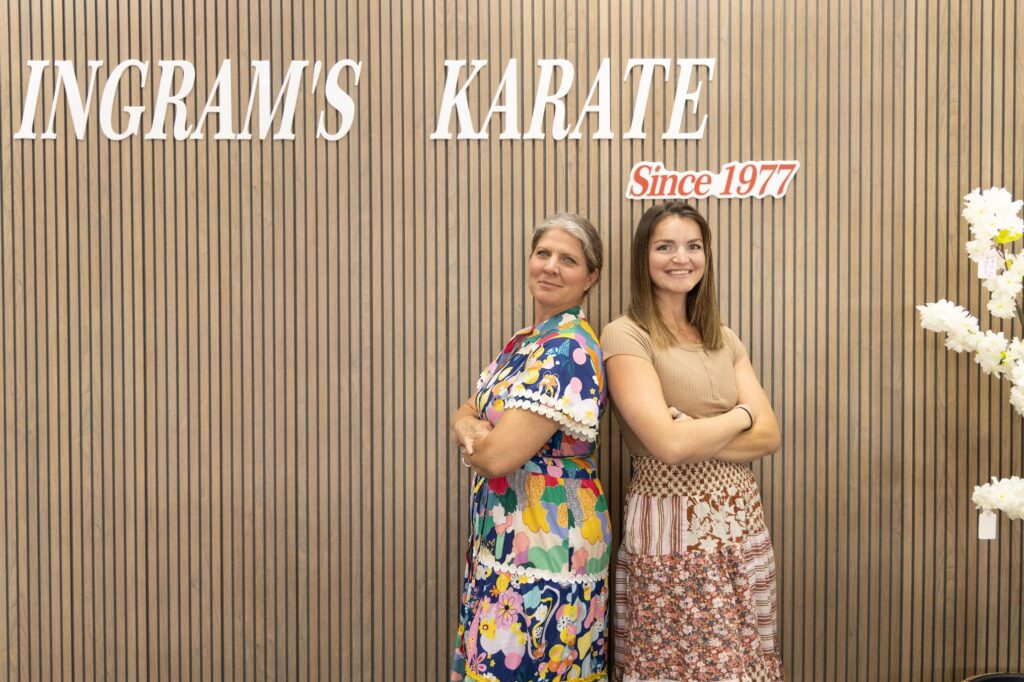
Ingram’s Balanced Path Learning will open in September as a homeschool co-op two days per week at two of its three dojos in the Tampa Bay area.
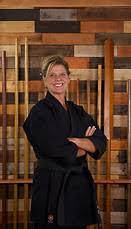
“We have these beautiful facilities that are only used in the evening. It's like everything just lined up,” said Sheri Ingram-Angwin, a former homeschool mom and seventh-degree black belt. A daughter of John and Cindy Ingram, she owns the Carrollwood and New Port Richey dojos. Both accept direct payment for karate fees from education savings accounts administered by Step Up For Students.
“I don’t know how we didn’t think of it for so long.”
According to Step Up For Students, almost 50 martial arts providers across Florida accept direct payment for participation in their programs, either as P.E. or enrichment. That does not include providers for which parents receive reimbursements after up-front, out-of-pocket payments. These providers are part of the state's rapidly growing number of à la carte learning options. In 2024-25, Florida had 4,318 non-school education providers offering à la carte courses, tutoring, extracurriculars, and more, which was more than double the number from the year before.
By opening an academic co-op alongside its karate program, the founders of Balanced Path will take things a step further. Angwin’s daughter-in-law, Leanna Angwin, and sister, Ashley Bache, will teach classes in math, reading, history, and science. Both hold state teaching certificates. Bache and Leanna have teaching experience at a classical charter school and a district middle school.
Most recently an eighth-grade math teacher, Leanna originally studied to become an accountant. But she realized after a couple of internships that “I really didn’t like it.”
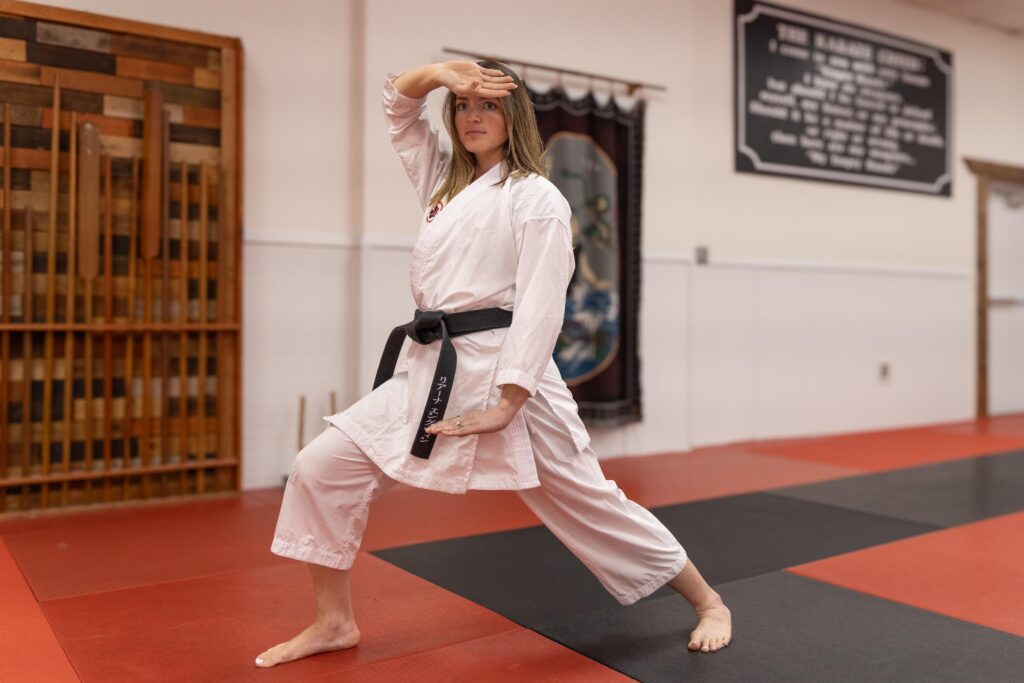
During her search for her true calling, she recalled how she had enjoyed helping people with homework. Now training for her second-degree black belt, Leanna also found fulfillment at the dojo in helping kids learn fundamentals. She joined Ashley, whom she affectionately calls her "aunt-in-law," at the charter school before the two headed to the public school for better pay and state benefits.
After a while, Leanna found herself wanting something that felt more rewarding, like the private tutoring she was doing on the side. She also found herself wanting to homeschool her future children.
“My mom was a stay-at-home mom, and I got to spend a lot of time with her, and my dad worked from home,” she said. “So, I see the importance of kids being at home with their parents.”
For Ashley, a former horse anesthetist, tragedy led her to a career in teaching. A car accident left her husband paralyzed from the neck down. A mother of three young children, Ashley needed a job that offered financial support for her family and the flexibility to care for her husband.
She started as a P.E. aide at the classical charter school before being promoted to run the program. She later became a classroom teacher.
She fell in love, not only with helping the kids, but also with a hands-on teaching style.
“I know I learn better with hands-on,” said Ashley, who will teach math and science at Balanced Path Learning. “It’s so easy to bring in all the manipulatives and the tools for teaching because we already have a lot of them.”
One day after school, Leanna saw a homeschool co-op flyer. They were hiring. During her interview, she found out the positions she was interested in had been filled. Afterward, she headed straight for the dojo to talk with her mother-in-law about possibly starting their own program.

She was like, ‘We should do that,’” Leanna recalled.
They shared their vision with Ashley. She was all in. Balanced Path Learning was born.
The three say it offers students the best of both worlds: the chance to be with family and work with a professional educator who can help keep them on track and accountable.
“I’ve watched how the status quo isn’t necessarily good enough anymore,” said Sheri, who homeschooled her two sons before education savings accounts existed. “All these years, everybody just always thought this is how you have to do it.
“And then COVID really changed that because everyone realized we don’t have to do it the way we’re told; we can do it on our own terms. I feel like there are a lot of parents who want to homeschool their kids. But they’re nervous about it, or maybe they don’t have the time.”
Sheri was one of those parents. In the beginning, she felt overwhelmed by the number of curriculum choices, which at the time seemed like “8 million.”
“I cried the day all the books showed up at my door,” she recalled.
But after becoming acclimated, she began to see and love the benefits.
“When it came time for history, when my kids were little, we went to Savannah, and we learned while we were there, and they learned things and experienced things that you can't really do unless you’re homeschooling,” she said.
At Balanced Path Learning, a typical day for those in kindergarten through fifth grade will start at 9 a.m. with lessons in science or history, depending on the location. Students in middle and high school can attend and work independently during lesson times.
Lesson blocks are 50 minutes long and followed by breaks for movement, which might be a game of freeze tag or learning new dance moves. Students transition to reading and math groups at 10 a.m.
Students take a 10-minute snack break at 10:50 a.m.
Afterward, the groups switch subjects, with those in reading starting math and those who were in math going to reading.
After a second active brain break, they can do optional electives from noon until 1 p.m. when the day ends. Electives include physical education, with fitness drills, relays, and games. Optional karate is also offered one day a week at each location. Students do not have to participate in any karate programs to attend Balanced Path Learning.
Co-op locations are closed on Fridays, with optional field trips offered one Friday a month for an extra fee.
Parents are already signing up. Rachael Martinez said her three kids, who are entering fourth, third, and first grades, will transfer from a charter school to Balanced Path with the help of state education savings accounts.
“I kept begging her to do it,” said Martinez, who said Leanna tutored her oldest child and taught the second one at the charter school.
Small class sizes and the opportunity for self-paced learning drew Martinez to the co-op.
“They’re not rushed to meet somebody else’s standards versus their own needs,” she said.
One is on an individualized education plan for speech issues and thrives with one-on-one instruction. Another gets everything on the first try. The youngest is “a little spitfire,” finishing kindergarten.
“They’re all 100% different,” said Martinez, a preschool teacher.
Leanna, who will teach reading, said she and her partners made a list of the most important things they felt were missing from traditional schools. At the top: Opportunities to be active.
“Collectively, we feel like sometimes they expect too much of kids, to sit still and be quiet for too long.”
That’s the reason for the “active brain breaks.”
Sheri continues to view the project with a sense of awe. She said she has seen things come together and barriers easily fall away, just like the plywood boards that snap in two if students use the proper technique. She calls it “a God thing.”
But she also sees it as very much a family thing, an extension of the dojo her parents opened in 1977.
“We have been working with kids for 50 years, and our family knows how to work with kids and how to make them thrive, and then I have two teachers who are the most beloved teachers in the whole school, and I'm like, why did this take so long to come to us, but it's just perfect.”
Nine days after the state teachers union sued to strip Florida families of the right to choose their children’s education, the pushback began when supporters of state K-12 scholarships and charter schools gathered in Tallahassee on the steps of Old State Capitol to protest.
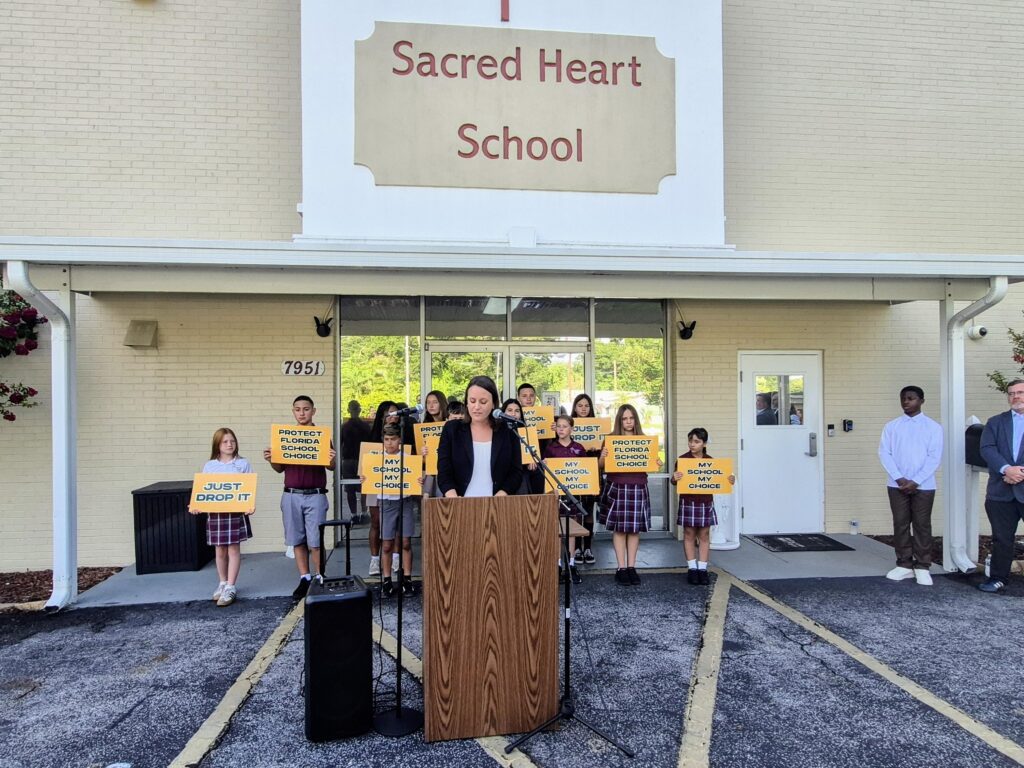
Two weeks later, choice supporters stood outside Sacred Heart Catholic School in the Tampa Bay area holding signs with the slogans, “My Child, My Choice” and “Just Drop It.”
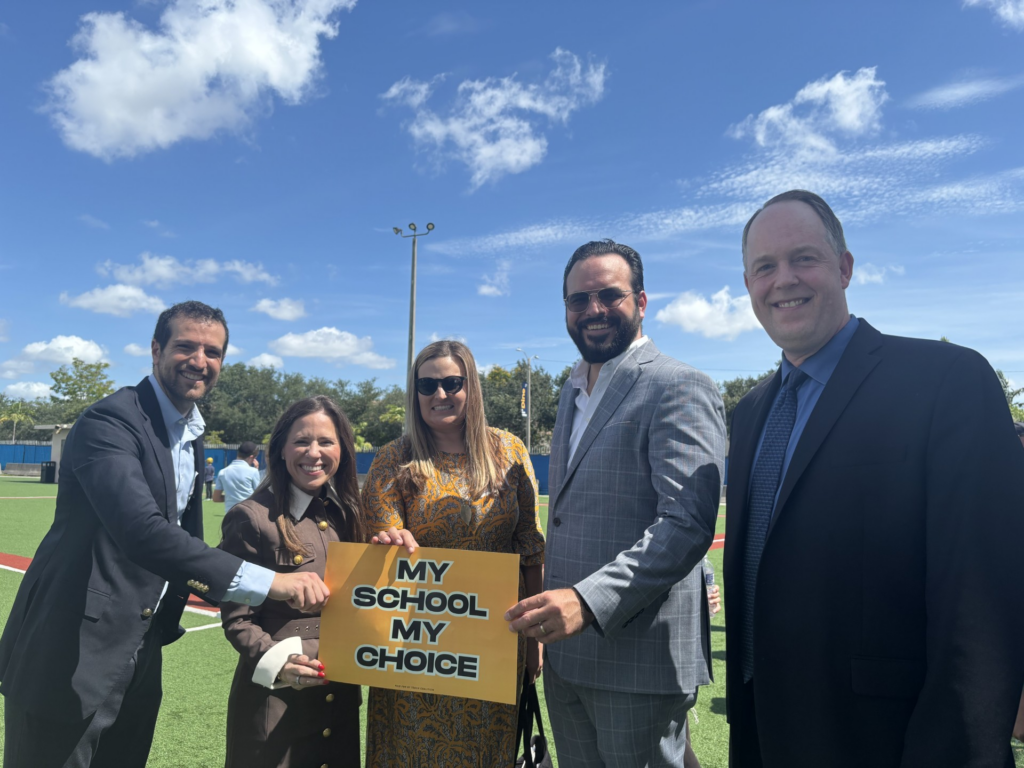
This week, the protests got louder. Students, parents, charter, and private school leaders stood outside Lubavitch Educational Center, the state’s largest Jewish day school, on Thursday and pledged to defend the decades-old policies and programs that have empowered families to choose the best educational fit for their children from a rapidly growing number of options.
“It’s not easy to pay private school tuition,” said Ailyn Weisleder, whose three sons are thriving at a Jewish day school. “But universal school choice has made that possible for our family. It gave us, and thousands of other families across Florida, the ability to choose the education that fits our children, not just the school assigned to us by a ZIP code.”
Audrey Maman Bensoussan said her family can’t afford to give her four children a Jewish education without the scholarships. She said the school feels like “a second home” to her children.

“If this lawsuit succeeds, it will not hurt politicians or special interests. It will hurt families like mine. It will hurt children like mine. It will take opportunities away from parents who simply want the freedom to choose the school that best meets their children's needs.”
Yonah Schwartz, 11, said at the news conference that if the lawsuit succeeds, then he won’t be able to afford to transfer to a school that better suits his learning needs.
“Not every kid learns the same way,” he said. “For me, changing schools means getting the chance to learn in a place that’s a better fit for me.”
The lawsuit, filed May 5, asks a judge to eliminate the state’s education choice scholarship programs based on the Florida Constitution, which says the state “shall make adequate provision for a uniform, efficient, safe, secure, and high-quality system of free public schools.” The lawsuit also seeks to end state funding of charter schools.
Faith leaders, charter school and private school leaders, as well as former Florida Gov. Jeb Bush’s Foundation for Florida’s Future, have supported the news conferences. Step Up For Students, the nation’s largest education choice scholarship funding organization, led the Tampa Bay area event. Teach Florida, a nonprofit school choice advocacy organization for Jewish education, organized and led the Miami event.
“The lawsuit brought by the Florida Education Association threatens everything these programs have made possible,” said Melissa Glaser, Teach Florida’s executive director. “This is about protecting families, protecting opportunity, and protecting a parent’s fundamental right to choose the best educational path for their child.”
She said more than $130 million annually in state scholarship funding helps ensure that Jewish children throughout Florida receive “the education they deserve — in schools that reflect their values and strengthen our communities.”
Their comments echo those made at the previous news conferences, where families described how scholarships had changed their lives. A charter school leader also spoke about how tuition-free charter schools ( which, like district schools, are public) have benefited students, including many from low-income households. Faith leaders also described how their schools uplift communities and welcome students with special needs.
Jim Rigg, superintendent of schools for the Archdiocese of Miami, said the lawsuit could damage “a thriving educational ecosystem in South Florida that attracts people from all over the world.” That includes the 37,000 students who attend Catholic schools in the diocese’s three counties. He said each school is accredited, gives standardized tests, complies with applicable state requirements, and employs highly qualified and certified teachers.
“But at its heart, the issue is not about institutions. It’s about children and families. Everyone wins with meaningful school choice, ultimately making our state the ideal place to raise and educate a child.”
ORLANDO, Fla. — As public education has evolved from a one-size-fits-all system to one where families are empowered to choose the environment that best fits their child, everyone has been a winner: Students, parents, educators, entrepreneurs, and even public school districts.
That was the message of John F. Kirtley, founder and chairman of Step Up For Students, to the roughly 1,000 people who attended the non-profit’s Navigating New Horizons conference this week.
In a closing speech that at the end brought the audience to its feet, Kirtley began by describing the state of education before the 1990s. Everyone paid taxes, and students were assigned to schools by their ZIP codes.
“It was, it could be said, a definition that emphasized ‘uniformity,’” he said, referencing but not naming the state teachers union’s recent lawsuit to eliminate Florida’s robust education choice programs, including all scholarship programs and charter schools.
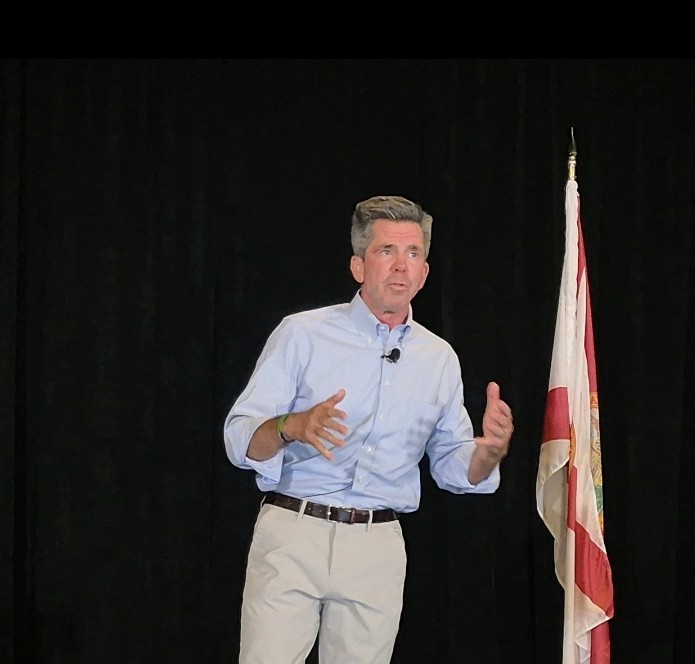
Kirtley said he didn’t realize it at the time, but since overall graduation rates in Florida were, until the mid-1990’s, around 60% overall and less than 40% for black males, it’s likely that many of his friends on the football team who crossed the stage did not get real diplomas. They likely received certificates of completion. The second group probably included a classmate who regularly got in trouble for dozing during early morning courses and was uninspired by classic literature. Yet he could take apart an entire car and rebuild it by himself, when Kirtley couldn’t change his car’s oil.
“But there was no specialized program for him…No, uniformity didn’t serve him well.”
Today, Kirtley said, his classmate could sleep in, take core classes online in his pajamas, then head over to the district automotive technology program in the afternoon, where he would be the star student.
“When he graduated, he’d be hired by the local Mercedes dealer and make over $100,000 two years out of school,” Kirtley said. “So, yeah, he’d be better off.”
Not only are students better off, but so are educators who can start their own schools, including microschools, and even school districts, including many that now offer specialized magnet schools and individual courses to education choice scholarship students who attend school part time.
“I close by saying don’t fear the New Definition. Embrace it. Thrive in it. You can thrive in it whether you are a microschool, an à la carte provider, or one of nation’s largest school districts,” he said. “And when you thrive in the New Definition, all students will thrive along with you. And shouldn’t that really be the ultimate goal?”
His remarks echoed the message given the day before by Gretchen Schoenhaar, Step Up’s chief executive officer, who gave the conference’s opening speech.
“Families today seek learning environments that reflect their children's unique strengths, needs and goals,” Schoenhaar said. “What's really inspiring is how this demand has sparked innovation across the education landscape.”
Schoenhaar said she hoped the two-day event would offer attendees a chance to be “inspired by the conversations you have, encouraged by the stories you hear, and energized by the collective passion in this room.”
Schoenhaar said Florida is home to the nation's largest parent-directed education marketplace today, with more than half of all K-12 students participating in some form of education choice, including many district schools, private schools, charter schools, homeschools, online schooling, or some combination of those.
“The spirit of innovation and possibility is exactly what this conference is all about,” she said.
The event, whose theme is Facing the Future Together, featured nearly 100 session speakers and 100 exhibitors displaying everything from a la carte learning to transportation options, tutoring, and curriculum.
Organizers said this year’s goal was to provide educators with information and resources based on best practices that also reflect the bigger picture. That included information about the rise of microschools and how to use AI efficiently and responsibly.
“Over the next two days, we hope you'll be inspired by new ideas, meaningful connections and innovative strategies that will help shape the future of education,” Paula Nelson, Step Up’s vice president of school and provider services, told the audience during her welcome.
Breakout session topics included school safety, a la carte education, navigating AI, the future of public education, the benefits of applying for the Yass Prize, how public schools are offering individual courses to scholarship students and how to create and sustain microschools. Four sessions on the upcoming federal Education Freedom Tax Credit program drew standing-room-only crowds.
The federal program, which launches in January 2027, allows individual donors to divert up to $1,700 of federal tax liability to support scholarships for students in public and private schools. The federal government is expected to announce rules that cover program specifics soon. Florida Gov. Ron DeSantis is among the governors who have opted their states into the program.
At the end of the conference, Schoenhaar broke some news: The conference will return June 14 and 15 of 2027.
Students at the University of Austin are getting an overview of the nation’s rapidly expanding education choice movement, including its storied history in Florida.
The survey course includes guest lectures delivered by top national researchers and thought leaders, including Ron Matus, director of research and special projects at Step Up For Students. The nonprofit organization is Florida’s and the nation’s largest education choice scholarship funding organization. Matus, who spent 25 years as a journalist and eight years as the state education reporter at the Tampa Bay Times, has authored many white papers on education innovation in Florida for Step Up.
The topic of Matus’s lecture was “Freedom, Pluralism and School Choice: Competing Rationales and Contemporary Practice” and included a special emphasis on education innovation in the Sunshine State.
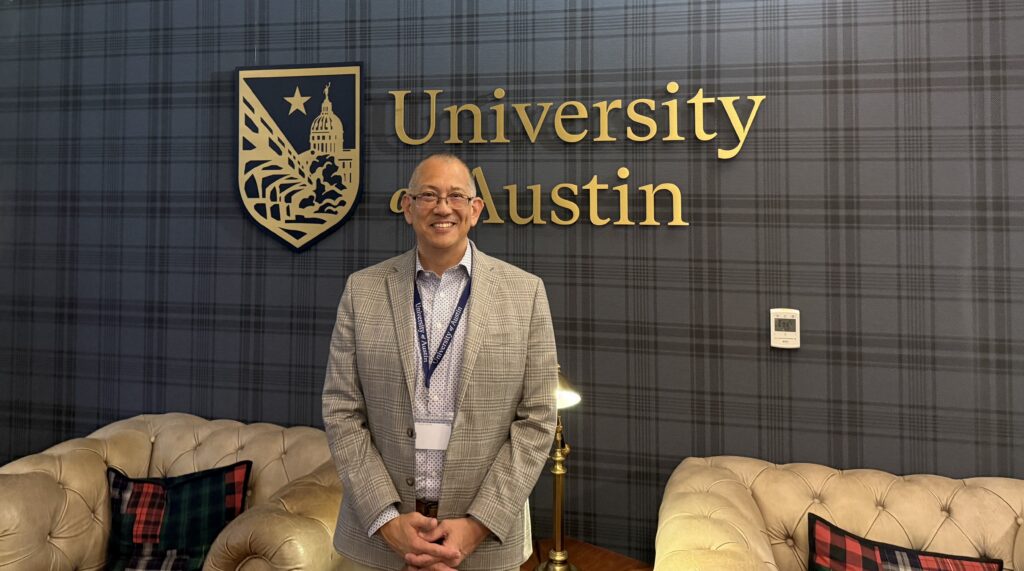
Matus shared the evolution of public education in Florida from its first model of neighborhood zoned district schools to the rise of charter schools, homeschooling, private school scholarships, educational savings accounts, a la carte learning, and even public schools now offering individual courses paid for with education savings accounts. He also described the many learning options now available, from traditional private schools to farm and forest schools to microschools and programs customized by families.
Matus also recommended reading that exposed students to various arguments in favor of education choice, including economist Milton Friedman’s 1955 groundbreaking essay “The Role of Government in Education,” which emphasized free markets and competition, and John E. Coons, a professor emeritus at the University of California, Berkeley, School of Law, who focused on dignity and fairness to all families regardless of income.
Erin Davis Valdez, executive director of the university’s Center for Education and Public Service, developed the course, which followed two K-12 practicums with rotations that began in the fall of 2025 at participating private and charter schools.
She describes the program as being in “the incubator phase,” and hopes to expand it into an academic minor.
“What we’re trying to do every term is offer a course for students interested in education policy as a career or in teaching as a career or something adjacent to it, like entrepreneurship,” she said. “But for now, students can take these as elective classes, and it builds their interest in the field.”
Valdez, who was homeschooled as a young child in Lakeland, Florida, a year before it became legal, said she chose the guest lecturers by looking for the best researchers and thought leaders in the movement. In addition to Matus, the list includes Eric Wearne, an associate professor in the Education Economics Center at Kennesaw State University and director of the Hybrid Schools Project. Wearne, who once described most traditional teacher prep programs as “thinly veiled arms of the HR department of the school district,” spoke on “Design Policy for New School Models.”
Others included Patrick Wolf, Distinguished Professor and 21st Century Chair in School Choice at the University of Arkansas, who spoke about the history of school choice policy, Jay P. Greene, senior fellow at the Defense of Freedom Institute, who spoke on the national responsibility of American universities; Katherine Bathgate, CEO and founder of SchoolForward, who spoke about economic foundations and emerging policy issues I education freedom; Mary K Wells, managing partner at Bellwether, who spoke on the last 30 years of education reform efforts; and Anita Scott, director of public policy for the Texas Home School Coalition, who spoke on connecting policy and practice in the homeschooling community.
Matthew Ladner, a senior adviser for education policy implementation at The Heritage Foundation’s Center for Education Policy and former executive editor of the NextSteps blog, is scheduled to lecture on June 1 about new directions in education choice and the question of accountability. The class will conclude June 8 with a lecture by Robert Pondiscio, a senior fellow at the American Enterprise Institute, whose topic is “The Last Days of Public School.”
TALLAHASSEE, Fla. — Parents, students, and education leaders who gathered at the Florida Capitol on Thursday had a message for the Florida Education Association, the teachers union that filed a lawsuit to end K-12 education choice scholarship programs used by nearly 540,000 children, as well as all charter schools.
Just drop it.
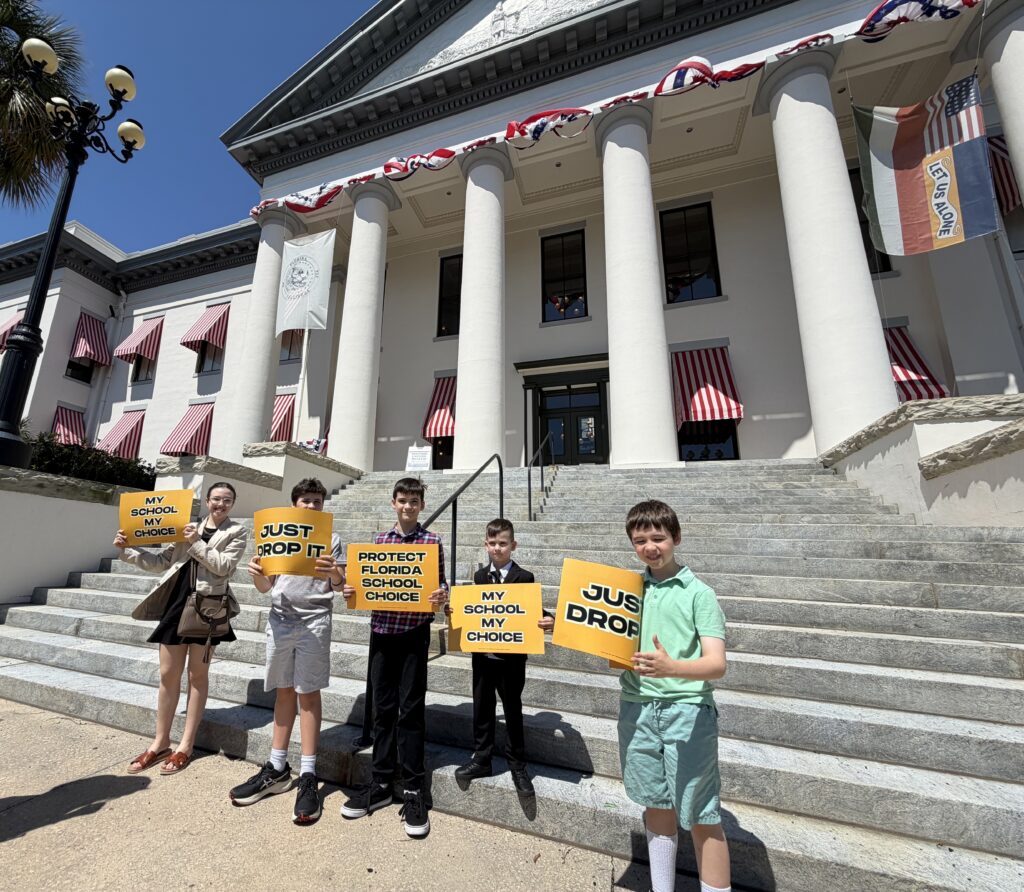
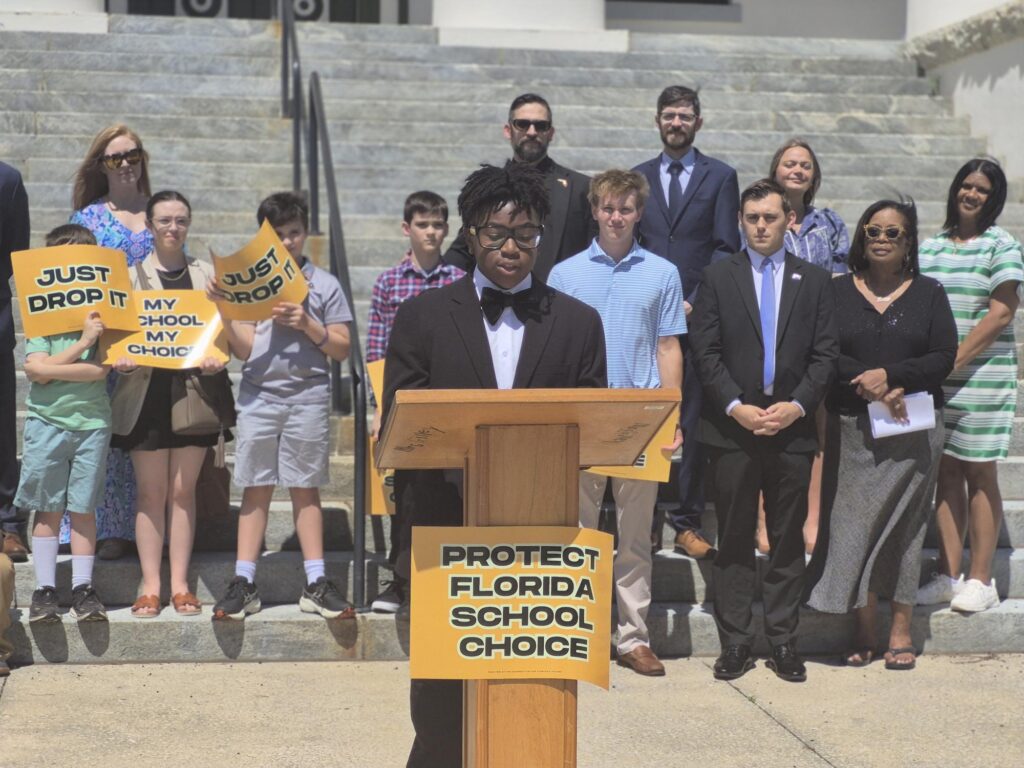
That was just one of the messages on the signs that supporters held up as they stood on the steps of the Old State Capitol building, as advocates proclaimed how education choice scholarships changed lives for the better. “My School My Choice” and “Protect Florida School Choice” could also be seen on the bright yellow signs. Former Gov. Jeb Bush’s Foundation for Florida’s Future organized the news conference. Bush launched the private school choice movement in 1999, right after he became governor.
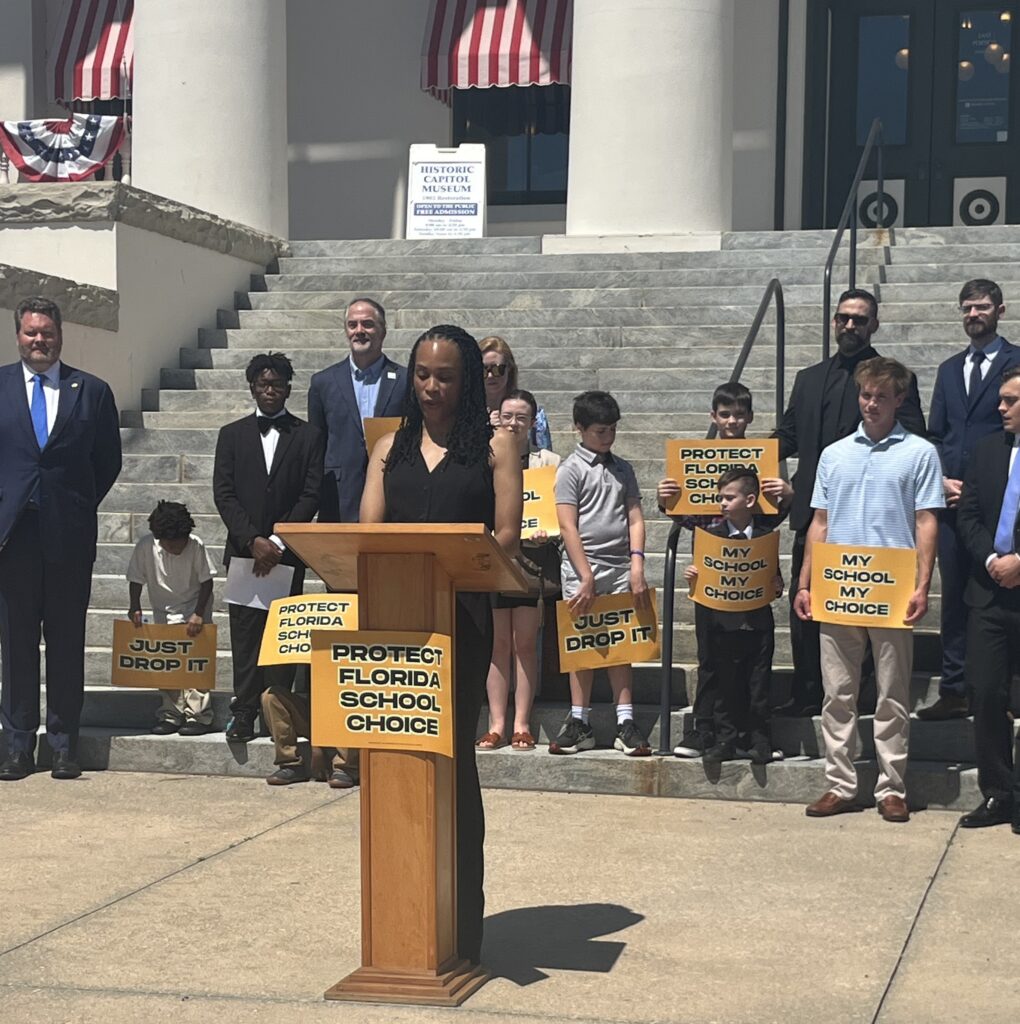
“The scholarships are VERY important to me,” said Kiteka Walker, whose son, Rashad, is in seventh grade at Dixon School for Arts & Sciences in Pensacola. After attending previous schools and homeschooling Rashad, he asked to return to school. She sent him to Dixon because it was the right fit, offering Rashad opportunities to participate in student government, the robotics team, and other enriching activities. The Florida Family Empowerment Scholarship he received made it affordable for him to attend the private school while his two younger brothers attended a private elementary school. If the lawsuit succeeds in eliminating the scholarships, Walker said she would have to homeschool him again because she could not afford private school for three children.
“Parents choose where we send our children to daycare, we choose where to go to college. Why can’t we do the same with K-12 schools?”
Rashad Walker, who traveled to the event with his family, shared how he is thriving at the school his mother chose for him.
“Dixon has been the perfect fit for me. It has a lot of culture and provides a bunch of opportunities in band, art, singing, technology, and media,” he said.
Rashad, who also participates in robotics and serves on the student council, said the school encourages him to try new things, like playing a piano that had been gathering dust at home for years.
“Dixon inspired me to teach myself to play the piano. I practice every day on that piano at home. No more dust,” he said.
Last fall, when he was hospitalized for three weeks following knee surgery, Rashad created craft kits called DUCK bags that help kids combat boredom. He sold the kits at business fairs and is making some to donate to children’s hospitals.
None of that would have happened if it weren’t for Dixon, he said. And Dixon wouldn’t have happened if it weren’t for the scholarship.
“That’s why I don’t understand this lawsuit,” Rashad said. “Why get rid of something that is life-changing for other people? That helps them achieve better things in life?”
Rita Brown can see proof that education choice changes lives every day at Brownsville Preparatory Institute in Tallahassee, a private school she founded more than 20 years ago.
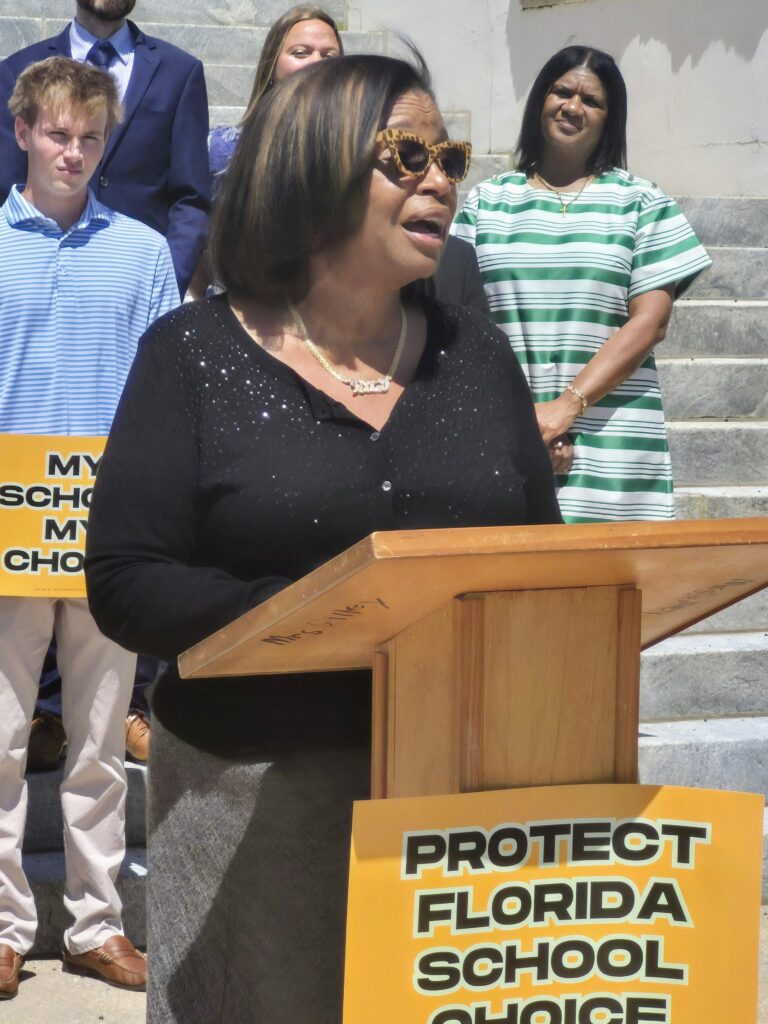
The school began as a pre-kindergarten and now serves 95 students through third grade. Brownsville is in a low-income community. Most parents can’t afford private education after their 4-year-olds complete the state-subsidized pre-kindergarten program.
The scholarships, Brown said, changed that.
It allowed her to add grades. Today, Brownsville students typically learn to read at age 3 and are adding, subtracting, writing, and learning cursive.
“We are the best school in our neighborhood,” she said. “Florida’s education choice scholarships have been a vital part of that.”
If the teachers union wins in court, Brown said, the school would lose most of its school-age children.
“That K-3 program would probably die. It would be devastating for our parents. We have all these students doing amazing things, but they would be forced to go to schools that don’t meet their needs. “
She called the lawsuit “frivolous” and “an attempt to turn back the clock.” But Florida is too embedded in education choice to return to a bygone era.
“At the end of the day, we need to be collaborative in educating all students,” Brown said.
The event inspired a lawmaker to attend to voice his opposition to the lawsuit.
State Sen. Jonathan Martin, R-Fort Myers, said empowering parents to choose the best options for their children does not take away resources from other students and makes America “the light on the hill that Ronald Reagan talked about.”
Florida’s robust scholarship programs have led the way and “will continue to make sure our light stays the brightest, not just in this country but around the world.”
Editor's note: This post is shared by our sister organization, Step Up, Step Further Scholarship Fund, a new federal scholarship program launching in 2027 to support students in public and private schools.
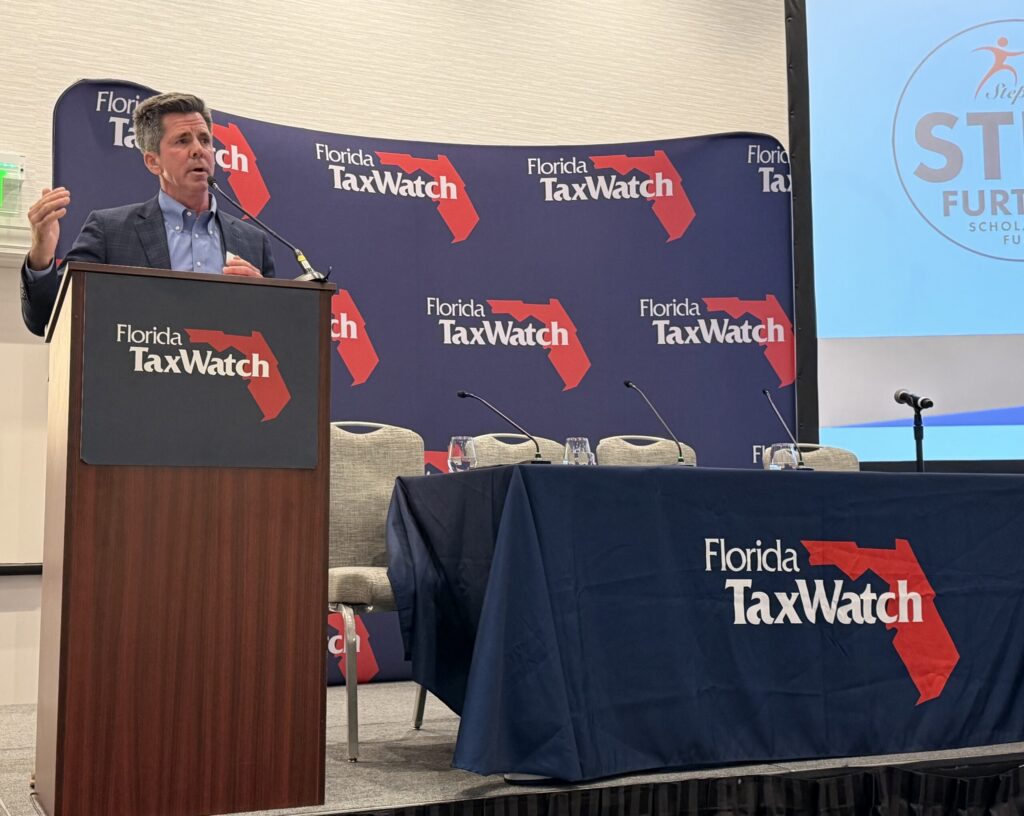
At Florida TaxWatch’s policy forum, Step Up For Students Founder and Chairman John Kirtley shared how the new federal Education Freedom Tax Credit will help expand opportunity for K-12 low income district school students. “The income levels that the federal law allows are, in my opinion, pretty generous,” Kirtley said. “They’re 300% of the area’s median income, which in Florida will be anywhere up to probably $250,000. However, a scholarship organization can set its own income limits.”
The new tax credit will continue to allow Step Up, Step Further, sister organization of Step Up For Students, to focus on serving the lowest-income students in Florida.
Kirtley went on to illustrate how Florida school districts have seen a dramatic increase in graduation rates since 1981, when the graduation rate hovered under 50%. He noted that a statewide push for greater accountability in schools and grading them has resulted in a graduation rate of over 90%.
“That’s an incredible improvement, and we should all be very proud of that. A great example of how the districts have responded is very close to home for me. My high school, Fort Lauderdale High School, when schools were first graded back in 1999, my high school was an ‘F.’ And it was an ‘F’ for several years,” Kirtley said.
Read the full article at Florida Politics > https://floridapolitics.com/archives/791109-john-kirtley-makes-case-for-choice-encouraging-use-of-education-savings-accounts/
When I think about the state of public education in Florida, I recall a song from “The Wiz,” the 1978 film reimagining of “The Wizard of Oz,” where Diana Ross sang, “Can’t you feel a brand new day?”
It’s a brand new day in our state’s educational history. Parents are in the driver’s seat deciding where and how their children are educated, and because the money follows the student, every school and educational institution must compete for the opportunity to serve them.
Public schools are rising to meet that challenge.
For the past year, helping them has been my full-time job.
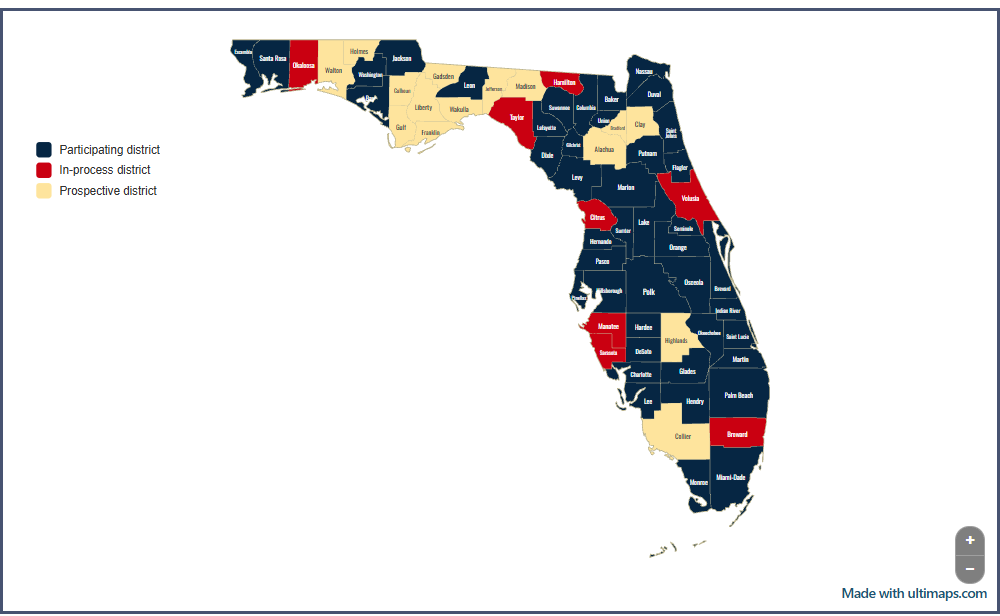
Today, 27 of Florida’s 67 school districts have contracted with Step Up For Students to provide classes and services to scholarship students, and another 10 have applied to do so.
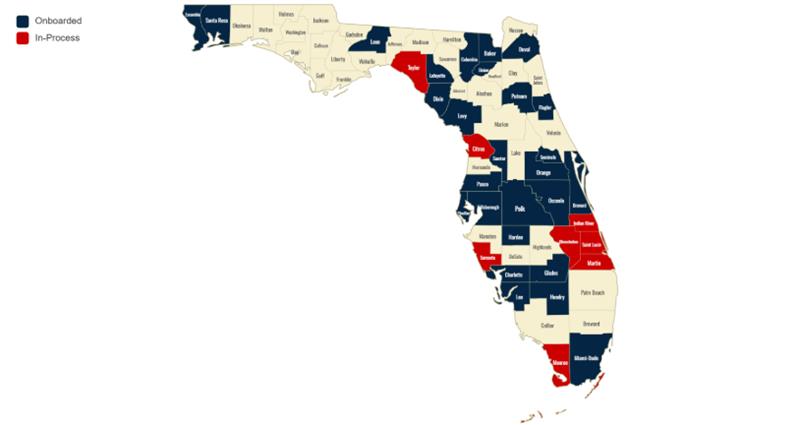
That’s up from a single school district and one lone charter school this time a year ago.
This represents a seismic shift in public education.
For decades, a student’s ZIP code determined which district school he or she attended, limiting options for most families. For decades, Florida slowly chipped away at those boundaries, giving families options beyond their assigned schools.
Then, in 2023, House Bill 1 supercharged the transformation. That legislation made every K-12 student in Florida eligible for a scholarship. It gave parents more flexibility in how they can use their child’s scholarship. It also created the Personalized Education Program (PEP), designed specifically for students not enrolled in school full time.
This year, more than 80,000 PEP students are joining approximately 39,000 Unique Abilities students who are registered homeschoolers. That means nearly 120,000 scholarship students whose families are fully mixing and matching their education.
Families are sending the clear message that they want choices, flexibility, and an education that reflects the unique needs and interests of their children.
Districts have heard that message.
Parents may not want a full-time program at their neighborhood school, but they still want access to the districts’ diverse menu of resources, including AP classes, robotics labs, career education courses, and state assessments. Families can pay for those services directly with their scholarship funds, giving districts a new revenue stream while ensuring students get exactly what they need.
In my conversations with district leaders across the state, they see demand for more flexible options in their communities, and they’re figuring out how to meet it.
For instance, take a family whose child is enthusiastic about robotics. In the past, their choices would have been all-or-nothing. If they chose to use a scholarship, they would gain the ability to customize their child’s education but lose access to the popular robotics course at their local public school. Now, that family can enroll their child in a district robotics course, pay for it with their scholarship, and give their child firsthand technology experience to round out the tutoring, curriculum, online courses and other educational services the family uses their scholarship to access.
Families can log in to their account in Step Up’s EMA system, find providers under marketplace and select their local school district offerings under “contracted public school services.” School districts will get a notification when a scholarship student signs up for one of their classes. From large, urban districts like Miami-Dade to small, rural ones like Lafayette, superintendents are excited to see scholarship students walk through their doors to engage in the “cool stuff” public schools can offer. Whether it’s dual enrollment, performing arts, or career and technical education, districts are learning that when they open their arms to families with choice, those families respond with enthusiasm.
Parents are no longer passive consumers of whatever system they happen to live in. They are empowered, informed, and determined to customize their child’s learning journey.
This is the promise of a brand new day in Florida education. For too long, choice has been framed as a zero-sum game where if a student left the public system, or never even attended in the first place, the district lost. That us-versus-them mentality is quickly going the way of the Wicked Witch of the West. What we are witnessing now is something far more hopeful: a recognition that districts and families can be partners, not adversaries, in building customized learning pathways.
The future of education in Florida is not about one system defeating another. It is about ensuring families have access to as many options as needed, regardless of who delivers them.
As Diana Ross once sang, “Hello world! It’s like a different way of living now.” It has my heart singing so joyfully.
Florida gives parents the ability to direct the education of their children. Today about half of all K-12 students in the state attend a school of choice, and 500,000 students participate in state educational choice scholarship programs.
Gov. Ron DeSantis accelerated these trends in 2023, when he signed HB 1 and made every student eligible for a scholarship. No school can take any student for granted, and state funding follows students to the learning options they choose.
Unfortunately, misleading claims amplified in the media have blamed this expansion of parental choice for school districts’ budget challenges.
Sarasota County Schools, for example, recently estimated that scholarships “siphoned” $45 million from its budget, a figure cited in a WUSF article. In reality, most of the $45 million represents funding for students that Sarasota was never responsible for educating, such as those already in private schools, homeschooling or charter schools. It also does not account for students who return to district schools after using a scholarship. Once those factors are considered, the actual impact is considerably smaller than the headline number suggests.
For the 2024-25 school year, Sarasota County lost just 330 public school students to scholarship programs, but only 245 of those students came from district-run public schools. If those students had stayed, they would have brought the district about $2 million, not $45 million. That figure still does not account for the students who returned to district schools after using a scholarship the prior year, so the real impact would be smaller.
Other districts have been vocal about their budget difficulties, often attributing them solely to growing scholarship demand, such as Leon County Public Schools, which in 2024-25 lost 240 students from district-run schools (0.8% of enrollment), and Duval County Public Schools, which lost 1,237 students (1.2% of enrollment).
Statewide, 32,284 students left public schools in 2024-25 to use a scholarship. That is only 1.1% of all public-school students in Florida, and even that total includes those who previously attended charter schools, university-affiliated lab schools, virtual schools, and other public-school options.
Looking at district-run schools alone, just 24,874 new scholarship students left for scholarship programs in 2024-25. Another 5,507 came from charters, and 1,897 came from virtual schools. In fact, as a percentage of their total enrollment, charter schools lost more students to scholarship programs (1.4%) than district-run schools did (1%).
This means that the expanded scholarship program may be having a bigger impact on charter schools than districts. Charter schools, however, haven’t been as vocal about vouchers, and that is likely because charters continue to grow enrollment while district schools have started to shrink.
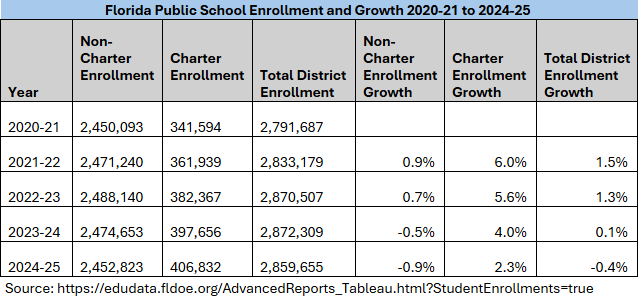
Enrollment declines in some districts have been real, even if the blame on scholarships is misplaced.
Declining enrollment is being driven by parent preferences – but also by shifting demographics and the ebb of the post-Covid population boom. Florida is one of the few states where overall K-12 population is expected to continue growing, but the growth will be uneven, and every school will have to compete for students.
Even as they face intense competition and demographic headwinds, Florida’s charter schools have kept growing. Some innovative district leaders have signaled a willingness to hear the demand signals from parents and create new solutions to meet their needs.
Understanding what parents seek in private and charter schools, and how new public-school models can better meet those demands, would be a good place for districts to start.
Pre-K and Voluntary Pre-Kindergarten (VPK) have also been major feeders for Florida’s scholarship programs. In 2024-25, 53,825 new scholarship students came from pre-K — somewhere between one-third and nearly half of all VPK students statewide.
Public schools have limited Pre-K offerings. Statewide, there are less than one-third as many Pre-K students as kindergartners enrolled in public schools. Private schools, by contrast, have used it as a key pipeline to recruit future students.
Districts have other avenues to respond to changing parent demands. Since 2014, when the Family Empowerment Scholarship for Students with Unique Abilities (FES-UA) was introduced as the Personal Learning Scholarship Accounts, districts have been allowed to offer classes and services to scholarship students.
The passage of HB1 in 2023 transformed every state scholarship into an education savings account. K-12 families now have more flexibility to use scholarships for “a la carte learning,” in which they pick and choose from a variety of educational options. By offering part-time instruction, tutoring, therapy, and other services, districts can win back students and the associated funding. So far, 21 of Florida’s 67 districts have taken advantage of this opportunity, with 10 more in the pipeline.
Florida’s enrollment shifts are real, but data shows the “voucher drain” narrative overstates the impact. The real challenge for districts is not money being “siphoned;” it is families choosing other options. Districts that adapt and compete for students will keep both enrollment and funding – leaving students, families and taxpayers better off.
By Ron Matus and Dava Cherry
Florida’s choice-driven education system is the most dynamic and diverse in America, but it’s facing new tests. This year, 41,000 Florida students were awarded school choice scholarships but never used them.
We wanted to know why, so we surveyed their parents.
The 2,739 who responded had a lot to tell us. Not only about supply-side challenges, but about the extent to which families are migrating between different types of schools, and their expectations for finding just the right ones.
As education choice takes root across America, we thought other states could learn from these parents, which is why we boiled their responses down into a new report, “Going With Plan B.”
We saw three main takeaways:
A third of the respondents (34.7%) said there were no available seats at the school they wanted. This, even though the number of Florida private schools has grown 31% over the past 10 years. Meanwhile, a fifth of the respondents (19.7%) said the scholarship amount wasn’t enough to cover tuition and fees.
Even without scholarships, a third of the respondents (36.5%) switched school types (like going from a traditional public school to a charter school). And between their child’s prior school and the school they ended up in, more experienced a positive rather negative shift in satisfaction (20.4% to 10.5%). We didn’t see that coming.
Two thirds of the respondents said they’d apply for the scholarships again, including 63% of those who switched school types, and 55.5% of those who were satisfied after doing so.
Things got better, it seems, but not better enough.
Perhaps as choice has grown, so too have parents’ expectations.
See the full report here.
Dava Cherry is the former director of enterprise data and research at Step Up For Students, and a former public school teacher.

