 Around the state: School board races heat up, teacher shortages statewide, a boost in spending on school safety in St. Johns, resignations at a high school in Pinellas and new presidents at Saint Leo University and University of North Florida. Here are details about those stories and others from the state’s districts, private schools, and colleges and universities:
Broward: Citing almost a dozen mass shootings that occurred over the Fourth of July holiday, Broward County school teacher and gun violence prevention activist Tracy Merlin said she will use her new role with the Florida Commission on the Status of Women to amplify demands for common sense gun laws. Florida Phoenix.
Palm Beach: Three candidates are vying for the lone school board seat here that's not guarded by an incumbent. Debra Robinson, a school board member for more than 20 years, decided not to run for re-election, opening the door for Edwin Ferguson, Christopher Persaud and Corey Michael Smith. Candidates will face off on Aug. 23 in a primary election. If no one receives 50% of the vote, the top two vote-getters will face off in the general election on Nov. 8. Palm Beach Post.
Pinellas: Four assistant principals resigned from Tarpon Springs High School over the past year, with the latest being a week ago. Three of them began the 2021-22 academic year at the campus. One joined in January as a replacement. In addition, about two dozen teachers departed, including the current Teacher of the Year. Tampa Bay Times.
Duval: The number of teachers entering classrooms in Florida this school year continues to dwindle, including in Duval. A new survey released by the Florida Education Association shows over 9,500 teaching and staffing vacancies statewide. This time last year, the FEA reported about 5,000 shortages. As of this week, Duval County Public Schools reported 529 vacancies for certified teachers, which is up 23% compared to the start of last school year. The vacancies are are almost double the number Duval saw at the beginning of the 2020-21 school year. The Florida Times-Union.
Volusia: There are hundreds of openings here, and the teachers union presidents say with the level of shortage they're facing this close to the start of the school year, there won't be enough teachers for the number of enrolled students. That also means there could be more students this year per classroom. There are currently 365 openings for teachers. The county raised the base pay for new hires to $47,500, but there hasn't been an increase in the state budget for those who are already working. WKMG.
Pasco: The Pasco County School Board has three of its five seats up or consideration. Steve Meisman (District 1), Matt Geiger (District 3) and Charles Touseull (District 5) share talking points on issues that include their opposition to the district's property tax referendum and what they call "woke" curriculum. Two incumbents, Cynthia Armstrong (District 3) and Megan Harding (District 5), are defending their records on the school board. Allen Altman retired after four terms in District 1. Meanwhile, newcomers Al Hernandez and James Washington are vying for Altman's spot. Tampa Bay Times.
Collier: A new high school will be opening in North Naples in 2023. Parents, meanwhile, have been pushing for more information — specifically on zoning. The school district plans to hold meetings for naming the school in September. Naples Daily News.
St. Johns: Officials here are boosting spending on school safety. A plan presented on Tuesday morning to the school board calls for more than $1 million more than last year to be allocated toward protecting schools, which includes increasing pay for armed guards. The increases will cost the school district a total of around $4.7 million. With state assistance, the district only has to pay $1.9 million, officials said. That's a district budget increase of more than $668,000, compared to last year. All 43 schools in St. Johns will have an armed guard on campus when the new school year starts in the fall. Some high schools, when available, will have two guards available. News4Jax.
University and college news: A professor at the University of South Florida is studying whether college students diagnosed with attention-deficit/hyperactivity disorder, or ADHD, can use a technology called "brain painting" to improve attention spans and reduce the need for prescription drugs. Tampa Bay Times. Saint Leo University announced a new president on its website this week. Edward Dadez, formerly the school's provost, was selected by the board of trustees to succeed Jeffrey Senese. Tampa Bay Times. Meanwhile, the University of North Florida has also lined up its next president. The Board of Governors approved Moez Limayem, a former USF business college dean, as University of North Florida's seventh president. Florida Times-Union. For the third year in a row, the University of West Florida led the state in finding success after school. UWF had more combined success at finding additional academic opportunities or employment during their first year out of college than did graduates from any other university within the Florida State University System. More than 72% of the UWF students who graduated at the conclusion of the 2020-21 school year are now furthering their education or are employed. Pensacola News Journal.
Attacks increase: About one in three school leaders noticed an uptick in student fights or physical attacks this past school year that are believed to be brought on by the pandemic and its lingering effects, new federal data shows. Also, more than half of school leaders reported an increase in classroom disruptions from student misconduct for the same reason. Chalkbeat.
Opinions on schools: Defenders of discrimination in education received a well-deserved comeuppance last month. The first was a lesson in constitutional law, while the second was the creation of expansive opportunities for parents to choose how and where their children learn. This combination will define K-12 education for the next century. reimaginED. The Catholic school movement has been advocating for the position that the court finally endorsed in Carson v Makin, which is that you can't exclude a religious school from public benefit programs like school voucher programs because they're religious. There is a long history of Catholic schools seeking public resources and being rebuked both politically and legally. reimaginED.
 Peter Zucker, the creator of the popular South Bronx School blog, has quite the disciplinary record.
At a 2015 arbitration hearing, Zucker was convicted of “neglect of duty; conduct unbecoming his position or conduct prejudicial to the good order, efficiency, or discipline of the service; insubordination; [and] substantial cause rendering him unfit to perform properly his obligations to the service.”
He was suspended without pay for four months.
Most people would find it reasonable to expect that no matter how remorseful Zucker may have felt, his disciplinary mishaps warranted permanent removal from the classroom. Yet, six years later, he is still employed by New York City’s Department of Education.
That’s because the United Federation of Teachers protected him.
UFT’s crusades on behalf of bad teachers have not been limited to Zucker. From 2005 to this past June, UFT pressure ensured the presence of “Rubber Rooms,” which housed more than 700 teachers with disciplinary concerns each year. Residents booked trips, played chess, and practiced ballet while being paid as if they were teaching classrooms full of children.
While New York City contains perhaps the most egregious examples, teacher unions around the country protect and defend bad teachers. A 2016 NPR/Ipsos survey found that more than 60% of teachers, accounting for union membership, agreed that union pressure made it more difficult to fire bad teachers.
Right-to-work laws and collective bargaining bans can help mitigate the power imbalance, but they still leave bad teachers answerable only to the bureaucracy that has long defended them. Only school choice holds teachers accountable to the people that matter most — families.
The proposition makes sense logically. Private and charter schools generally have smaller class-sizes and greater student-teacher interaction. If parents are not satisfied with their child’s instruction, they can ask for a different teacher, or simply take their business elsewhere. If one teacher causes so many problems that they affect the durability of the school, the school can simply fire them and move on.
But the proposition is also backed by data. Whereas it can take more than six years to fire a public school teacher, private and charter school teachers can often be fired extremely quickly. Private schools consistently have higher turnover rates than public schools.
Different salaries and certification requirements drive some of the turnover differential, but the added accountability matters, too.
Furthermore, children and parents aren’t the only ones who benefit from the removal of bad teachers; good teachers are left in a much better position. The tension and animosity between public school teachers and administrators can, at least to a certain extent, be attributed to union pressure.
But in a union-free environment where educational choice is a reality, administrators and good teachers can cultivate a trusting relationship. It leaves room for teachers to pick an employer with whom they share their values and offers opportunities to innovate new learning strategies and energize students.
The only people who believe in the constraining power of corrupt institutions are the ones in charge of those institutions. Families and administrators don’t want bad teachers instructing the next generation, and good teachers don’t want to be held back by those who don’t take their job seriously.
Those who truly want the best for American children (and teachers) should support school choice. It is the only policy change that can truly create happy and healthy classrooms that satisfy all stakeholders.
Otherwise, children will continue to be trapped in classrooms with instructors who don’t belong there, and parents will have little recourse. That simply isn’t fair to anyone.
 News Service Florida
TALLAHASSEE – Saying that “nothing in the emergency order requires any teacher or any student to return to the classroom,” a state appeals court Friday overturned a ruling that said Education Commissioner Richard Corcoran violated the Florida Constitution when he issued a July order aimed at reopening schools amid the COVID-19 pandemic.
A three-judge panel of the 1st District Court of Appeal, in a 31-page decision, flatly rejected the conclusions of Leon County Circuit Judge Charles Dodson, who in August sided with teachers unions that challenged Corcoran’s order. The unions argued, at least in part, that the order violated a constitutional guarantee of “safe” and “secure” public education.
The appeals court said the plaintiffs in the case lacked legal standing and were asking courts to decide “non-justiciable political questions.” Also, the panel said the union’s arguments would require courts to violate the constitutional separation of powers and that they failed to show Corcoran’s order was “arbitrary and capricious.”
In addressing the standing issue, the appeals court said the plaintiffs “have not shown a causal connection between their alleged injury and implementation of the emergency order.”
“Their alleged injury --- being forced to return to the classroom --- stems from decisions made by school districts,” Judge Lori Rowe wrote in a decision joined by Judges Thomas Winokur and Harvey Jay. “School districts decide whether to reopen schools for in-person instruction. School districts assign teachers to classrooms and approve or deny their requested accommodations. And school districts decide whether to offer students the choice of online instruction.”
Rowe also wrote that Dodson’s ruling “reveals the perils of judicial decision-making in this policy-laden arena.”
“To measure whether the public school system is ‘safe’ and ‘secure,’ the trial court would need to identify standards to make that measurement --- beginning by evaluating the risks posed by COVID-19,” Friday’s decision said.
“And even if the trial court were qualified to isolate and weigh the safety risks posed by the virus, whether it is safe enough to reopen schools is not a binary question answered with a simple yes or no based on the latest public health metrics on COVID-19. The court would still need to consider many other factors to determine whether the state met its obligation to provide for safe and secure schools.”
Corcoran issued the order as he and Gov. Ron DeSantis pushed for schools to reopen after being shuttered in March because of the pandemic. Students in the spring were shifted to online learning, but Corcoran and DeSantis argued that students and families should have a choice of in-person or online learning during the 2020-2021 school year.
The Florida Education Association statewide union and other plaintiffs, however, argued that teachers could be placed in unsafe situations if required to return to classrooms. Plaintiffs filed two lawsuits, which were subsequently consolidated, that challenged the constitutionality of the order.
A key issue in the dispute involved part of the order that dealt with the way public schools are funded. The order effectively conditioned a portion of money on school districts submitting reopening plans that included the use of brick-and-mortar classrooms, in addition to offering online alternatives.
In his Aug. 24 ruling granting a temporary injunction, Dodson said the order left school districts with “no meaningful alternative” about reopening classrooms.
“An injunction in this case will allow local school boards to make safety determinations for the reopening of schools without financial penalty,” Dodson wrote. “This is what the local school boards were elected to do. Every witness testified that any decision to reopen schools should be based on local conditions.
Reasoned and data-driven decisions based on local conditions will minimize further community spread of COVID-19, severe illness, and possible death of children, teachers and school staff, their families, and the community at large. Such local decisions unequivocally serve the public interest.”
But Rowe in Friday’s decision wrote that the state “presented multiple rational reasons for reopening schools, including evidence that many students would suffer educational, mental, and physical harms if they were unable to return to the classroom.” Also, the decision backed Corcoran on the financing issue.
“The offer to provide increased state funding to school districts that reopen for in-person instruction is also rational,” Rowe wrote. “Without action by the Legislature or statutory waivers under an executive order, school districts would receive funding under existing statutes and rules that tie funding to student enrollment and offer lower reimbursement for online classes. But because the commissioner exercised his discretion to provide waivers from the funding statutes and rules, school districts were eligible to receive increased funding. Even if student enrollment decreased and the number of students enrolling in online classes increased.”
Amid the legal battle, classrooms have opened at schools throughout the state, while many families have opted to have their children learn online because of the pandemic. The appeals court decision said Corcoran’s order gave school districts discretion about how to handle the situation.
“Nothing in the emergency order disturbs a school district’s discretion to determine when to reopen schools and whether to offer in-person instruction,” Rowe wrote. “In fact, the emergency order does not require school districts to do anything. Rather, school districts retain the discretion to continue to offer students the choice of in-person instruction, to require teachers to report for duty under their contracts, and to determine teaching assignments. And so, whether a school district assigns them to in-person or online instruction is a matter between those teachers and their employing school districts.”
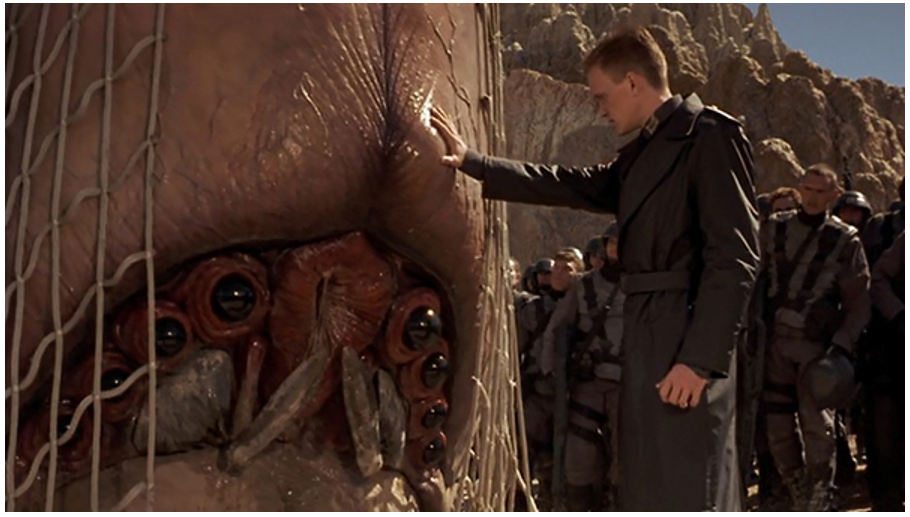
At the conclusion of one of the most criminally underappreciated very bad movies of all time, the 90210 kids-turned-space-marines of “Starship Troopers” capture a “brain bug.”
Neil Patrick Harris as Col. Carl Jenkins uses his mind-reading powers to intuit the thoughts of the hulking killer space roach monster. As luck would have it, this alien from the other side of the galaxy thinks in English.
“It’s afraid…” Jenkins says softly at first. “IT’S AFRAID!!!!” he then exclaims triumphantly to the cheers of the gathered troopers.
(You can watch this masterpiece of cinema here.)
Evidence of pandemic pod fear among the K-12 traditionalist left is everywhere. Listen to this Soho forum debate for instance. Or read this Arizona Republic article that interviews a single parent as representative of a micro-school organization with thousands of parents. This single parent admits being dissatisfied with public and private schools and is a known associate of an anti-choice activist group, a small detail that went unmentioned.
“While pandemic pods may seem relatively harmless, they are part of a growing trend towards education privatization that undermines public education and democracy” another critic asserts.
So, what to take away from this?
If there is a nefarious plot out there to damage public education, one need look no further than the decisions of NEA affiliates like the Florida Education Association to find the most effective practitioners. The FEA has been in court trying to prevent the reopening of schools that a large percentage of Florida families clearly desire.
Any ability of villains such as myself to promote micro-schools simply are dwarfed by the far grander efforts of the Florida Education Association to encourage their adoption. Those of my tribe should simply pull up a couch, eat some popcorn and wonder at the bizarre choices being made by the opponents of educational freedom.
Teachers, after all, have a great deal to gain from this trend. A small but growing number of teachers who didn’t find operating in huge impersonal bureaucracies their personal cup of tea have found joy in running their own small schools. There is a large pool of potential teachers out there unwilling to teach in big-box schools but who might return to the profession if they get to be in charge of their own school.
This trend seems popular among both families and teachers, which I find thrilling, and alas, the education tradionalists find fearful.
“The only good bug is a dead bug!” is a catchphrase from the dystopian, quasi-fascist world of “Starship Troopers.” It is a shame these folks apparently view it as inspiration for what seems to be their guiding philosophy:
“The only good school is a zoned, unionized school!”

