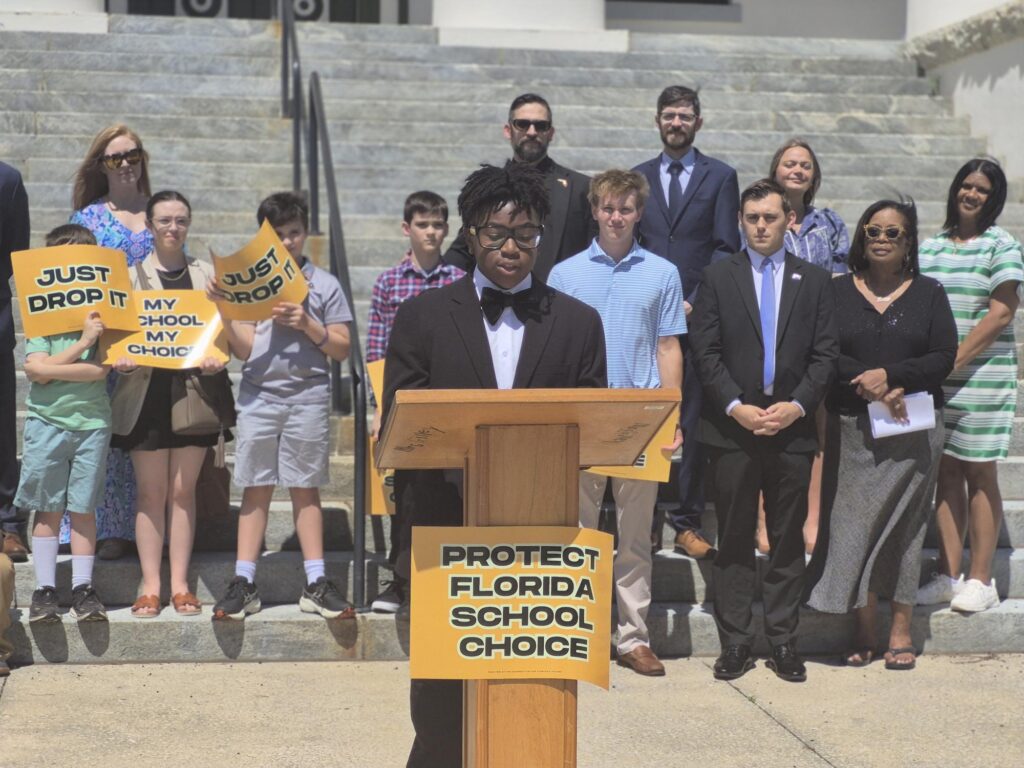
Nine days after the state teachers union sued to strip Florida families of the right to choose their children’s education, the pushback began when supporters of state K-12 scholarships and charter schools gathered in Tallahassee on the steps of Old State Capitol to protest.
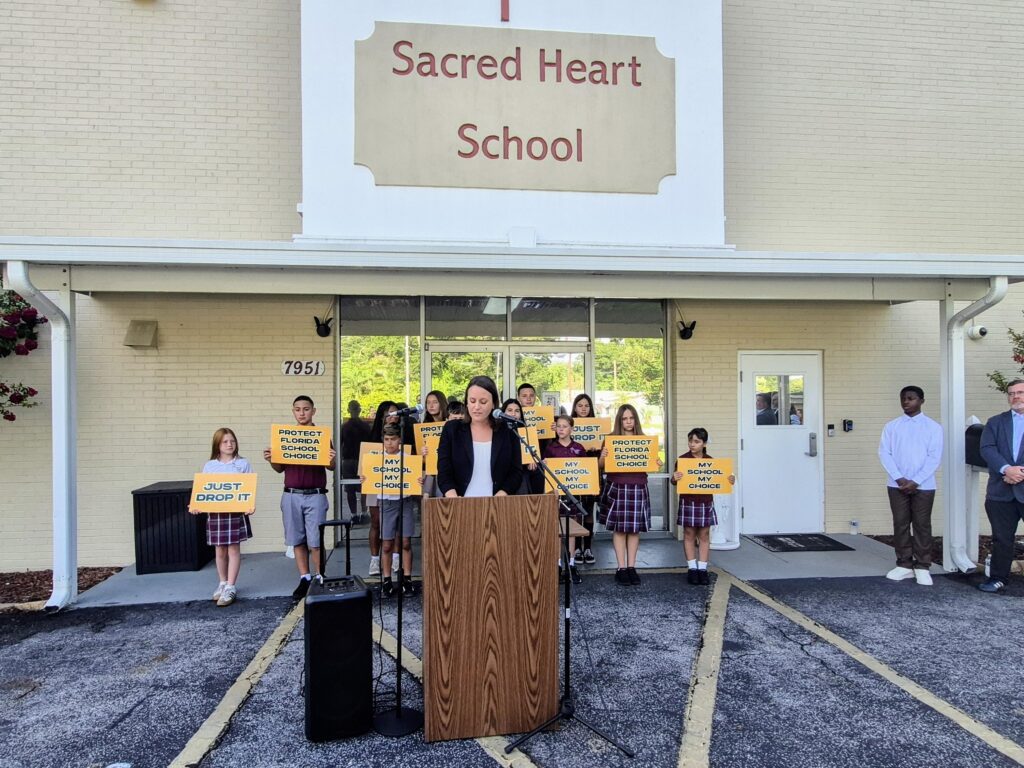
Two weeks later, choice supporters stood outside Sacred Heart Catholic School in the Tampa Bay area holding signs with the slogans, “My Child, My Choice” and “Just Drop It.”
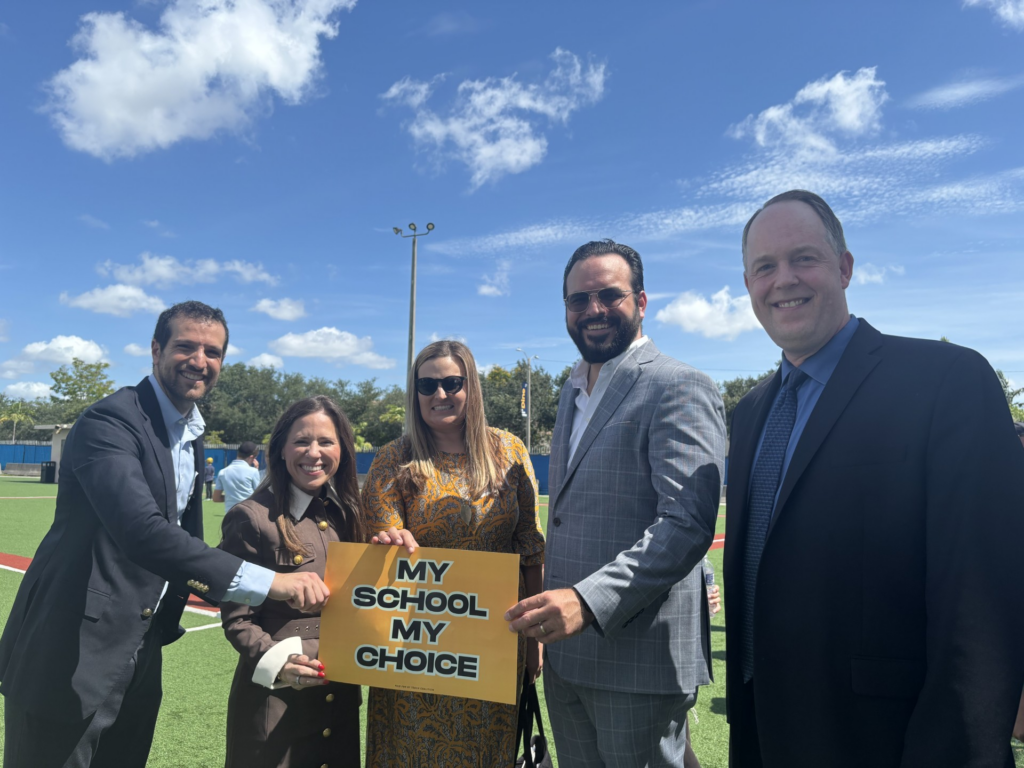
This week, the protests got louder. Students, parents, charter, and private school leaders stood outside Lubavitch Educational Center, the state’s largest Jewish day school, on Thursday and pledged to defend the decades-old policies and programs that have empowered families to choose the best educational fit for their children from a rapidly growing number of options.
“It’s not easy to pay private school tuition,” said Ailyn Weisleder, whose three sons are thriving at a Jewish day school. “But universal school choice has made that possible for our family. It gave us, and thousands of other families across Florida, the ability to choose the education that fits our children, not just the school assigned to us by a ZIP code.”
Audrey Maman Bensoussan said her family can’t afford to give her four children a Jewish education without the scholarships. She said the school feels like “a second home” to her children.

“If this lawsuit succeeds, it will not hurt politicians or special interests. It will hurt families like mine. It will hurt children like mine. It will take opportunities away from parents who simply want the freedom to choose the school that best meets their children's needs.”
Yonah Schwartz, 11, said at the news conference that if the lawsuit succeeds, then he won’t be able to afford to transfer to a school that better suits his learning needs.
“Not every kid learns the same way,” he said. “For me, changing schools means getting the chance to learn in a place that’s a better fit for me.”
The lawsuit, filed May 5, asks a judge to eliminate the state’s education choice scholarship programs based on the Florida Constitution, which says the state “shall make adequate provision for a uniform, efficient, safe, secure, and high-quality system of free public schools.” The lawsuit also seeks to end state funding of charter schools.
Faith leaders, charter school and private school leaders, as well as former Florida Gov. Jeb Bush’s Foundation for Florida’s Future, have supported the news conferences. Step Up For Students, the nation’s largest education choice scholarship funding organization, led the Tampa Bay area event. Teach Florida, a nonprofit school choice advocacy organization for Jewish education, organized and led the Miami event.
“The lawsuit brought by the Florida Education Association threatens everything these programs have made possible,” said Melissa Glaser, Teach Florida’s executive director. “This is about protecting families, protecting opportunity, and protecting a parent’s fundamental right to choose the best educational path for their child.”
She said more than $130 million annually in state scholarship funding helps ensure that Jewish children throughout Florida receive “the education they deserve — in schools that reflect their values and strengthen our communities.”
Their comments echo those made at the previous news conferences, where families described how scholarships had changed their lives. A charter school leader also spoke about how tuition-free charter schools ( which, like district schools, are public) have benefited students, including many from low-income households. Faith leaders also described how their schools uplift communities and welcome students with special needs.
Jim Rigg, superintendent of schools for the Archdiocese of Miami, said the lawsuit could damage “a thriving educational ecosystem in South Florida that attracts people from all over the world.” That includes the 37,000 students who attend Catholic schools in the diocese’s three counties. He said each school is accredited, gives standardized tests, complies with applicable state requirements, and employs highly qualified and certified teachers.
“But at its heart, the issue is not about institutions. It’s about children and families. Everyone wins with meaningful school choice, ultimately making our state the ideal place to raise and educate a child.”
DADE CITY, Fla. – A friend told Sarah Jones a few years ago she should open her new petting zoo to homeschool groups, but Sarah didn’t think that would go over too well. She didn’t know much about homeschoolers, and the stereotypes in her head told her their parents wouldn’t warm to a tattoo-covered building contractor with a salty vocabulary.
But then the friend persuaded Sarah to bring her animals to a fundraiser for mental health programs. Homeschoolers with special needs were in attendance. One little girl, autistic and nonverbal, was smitten by a pony dressed up like a unicorn. She brushed it for hours. And when she got home, according to a note her mother sent to event organizers, she spoke her first words, telling Mom, “I love you.”
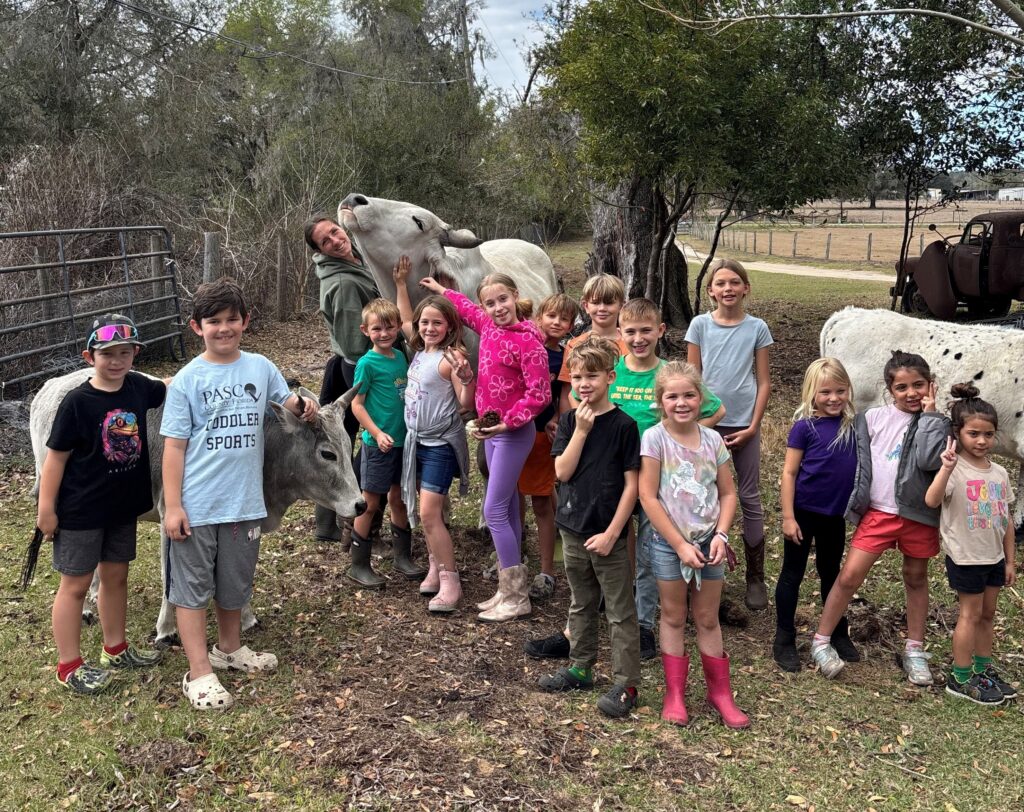
Sarah saw it as another flashing sign in what had become an undeniable string of signs. Her life was headed in a different direction.
Now she runs Florida Farm School, an à la carte learning provider rooted in land and livestock that serves about 50 homeschool students.
Once a week, on Mondays or Thursdays, families bring their pre-school- to middle-school-aged kids to Sarah’s 20-acre spread in the sand hills 45 minutes north of Tampa. Over the course of four hours, they learn how to grow their own food, make their own medicine, build things with their hands, and, more than anything, interact and care for more than 100 animals.
In the process, they learn even deeper lessons. Responsibility. Resilience. Compassion. Curiosity. The value of hard work. The value of teamwork.
Maybe even how to pause and evaluate what really matters.
“When you live in the city, it’s constant noise,” said Sarah, who grew up 60 miles away, in Florida’s most densely populated county. “Go to one of these (Tampa Bay) neighborhoods and tell me if you can hear the birds sing. No wonder we’re all so full of anxiety.”
“Here,” she continued, “the innocence of pure joy every day is infectious.”
Homeschooling on steroids
Florida Farm School is a sweet, quirky story unto itself. But it also represents another big shift in public education in America, with Florida again leading the way.
More than 150,000 students in Florida are now using state support to learn completely outside of full-time schools, up from 8,000 five years ago. Think of it as homeschooling on steroids. Their parents are using flexible state scholarships, aka education savings accounts, to customize their educational programming by mixing and matching from an ever-growing menu of providers. This “à la carte education” is taking shape in more and more states as ESAs gain traction, but nothing on Florida’s scale is happening anywhere else in America.
Sarah Jones would seem to be an unlikely pioneer, except that now, in a state where education choice is the new normal, anybody with a good idea can give it a shot in an education marketplace that gets more vibrant by the day. The number of à la carte providers that aren’t schools now tops 7,000, nearly four times as many as two years ago. Tutors and therapists are the biggest categories, but untold numbers of unconventional providers like Florida Farm School are entering the mix, too.
‘A wildfire of positivity’
Sarah’s background is in business, not education.
She owned a moving company. Then, a residential cleaning company. Then, a construction company. The latter installed cabinets and counters for thousands of new homes all around the Tampa Bay area.
After COVID-19 hit in 2020, things began to change in Sarah’s world. First, little by little. Then, in a revelation.
The way Sarah sees it, “this was my fate,” she said. “I never planned this.”
One day at the baseball field, watching her youngest son play, Sarah spied somebody’s renegade pet rabbit roaming next to the field. She caught it … and took it to a farm she had recently visited … which led to more visits … and to riding horses …
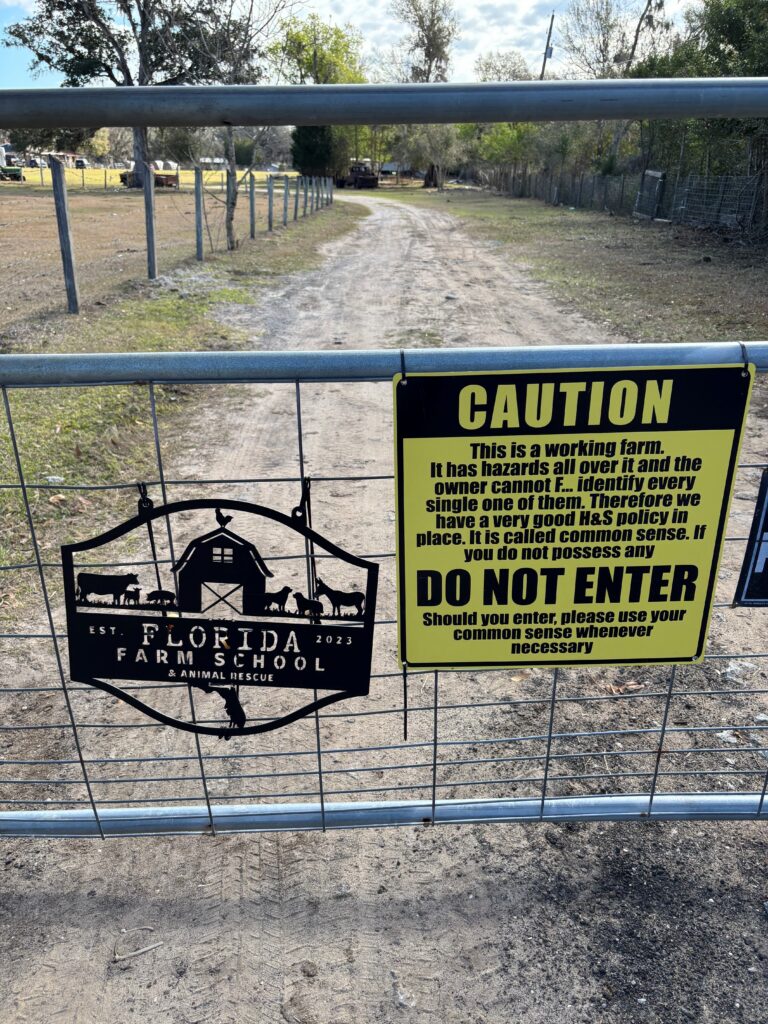
Next thing you know, Sarah and the owner were discussing the possibility of opening an indoor livestock petting zoo, and Sarah began acquiring animals at auction. Ultimately, she decided to go it alone on her land in Dade City, which she had originally bought to develop into ranchettes.
That’s when things started taking a more dramatic turn.
“It’s magic out here,” Sarah said. “I heard the leaves in the trees and birds singing, and it changed me. I couldn’t remember the last time I heard that. I asked myself, ‘How much of this have I missed?’”
Other incidents besides the girl and the pony/unicorn began leaving a deeper impression. Sarah recalled two elderly women who visited the farm, giggling and reminiscing as they sat with baby goats in their laps. Another time, after the farm began serving homeschoolers in 2023, the kids learned how to build herb walls. Then, on their own initiative, some of them went home and taught their neighbors.
What Sarah thought was a simple lesson turned out to be “a wildfire of positivity,” she said.
'No kid is forgotten'
The farm is a multi-dimensional enterprise.
Sarah occasionally takes in farm animals that have been neglected or abandoned. She plans to breed “minis,” little versions of cows, donkeys, and other farm animals that are in growing demand as novelty pets. She also hopes to sell a few acres to a group that wants to cultivate a food forest, a forest-like garden full of edible plants.
A handful of parents help with the learning activities, and in some cases, lead them. As a team, they’ve taught the kids how to make everything from laying boxes for chickens to candles, soap, and ice cream.
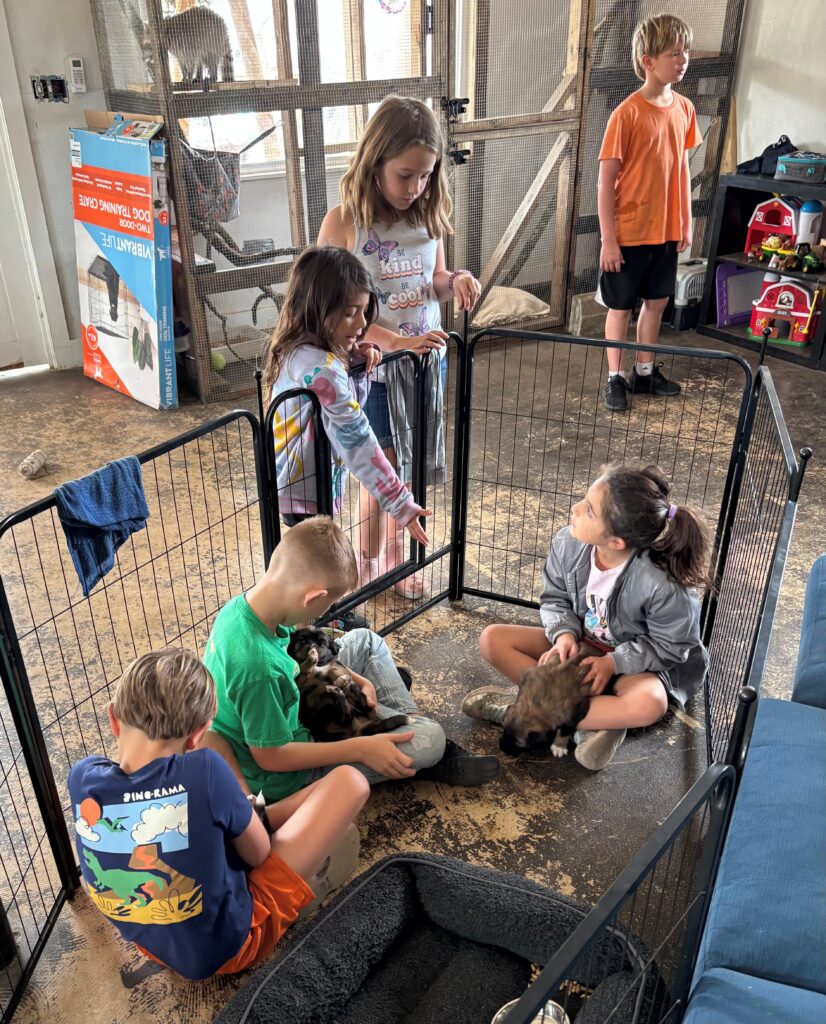
Farm chores are central. The kids muck pens, scrub water buckets, gather eggs. They watch live births and bottle-feed babies. Some of them have taken piglets home and fostered them.
The menagerie in their midst is growing. It now includes at least 50 chickens, 15 turkeys, 15 ducks, 15 cows, 13 pigs, six dogs (not counting a litter of puppies), five donkeys, two goats, two raccoons, and a mule.
The school, though, is the farm’s heart.
The educational offerings are expanding, too. Science activities just kicked off on Fridays, anchored by another à la carte provider, a mobile STEM academy.
Sarah said many of the families served by Florida Farm School are of modest means. They wouldn’t be able to access the school without the choice scholarships.
Andreea Barron said her family is one of them. She’s a former public school teacher. Her husband is in the military.
She said that in six months, the school has been life-changing for her 6-year-old son, Beckham, who uses a scholarship for students with special needs.
Beckham was enrolled in one of the area’s highest rated public schools. Andreea was a teacher there. But while he was excelling academically, he was struggling socially. Andreea decided to homeschool and eventually heard about the farm school.
“He’s blossomed so much,” she said. “The animals are his therapy. The people here and the animals teach him confidence. They make sure no kid is forgotten.”
“You know it in your heart that this is home,” she continued. “I’ll never let go of this.”
Sarah said she won’t either. Once you realize what’s possible when you have “the freedom to explore, and to breathe, and to be you,” she said, you don’t go back.
Maybe public education is learning the same lesson.
PALATKA, Fla. — All Risa Byrd wanted to do was start a little preschool. That’s it. But then the former public school teacher got swept up in one of the most epic education stories in American history. Now her fast-growing school is the latest example of what’s possible when school choice is the new normal.
In 2022, Byrd retired from a 26-year teaching career to start Little Sprouts Learning Center. The goal was modest: Get her granddaughter’s academic journey off on the right foot.
A few months later, though, Florida lawmakers passed, and Gov. Ron DeSantis signed, one of the most sweeping school choice bills of any state, ever. Suddenly, every student in Florida was eligible for a state-supported choice scholarship.
Byrd didn’t realize it at first. But her school had caught a wave.
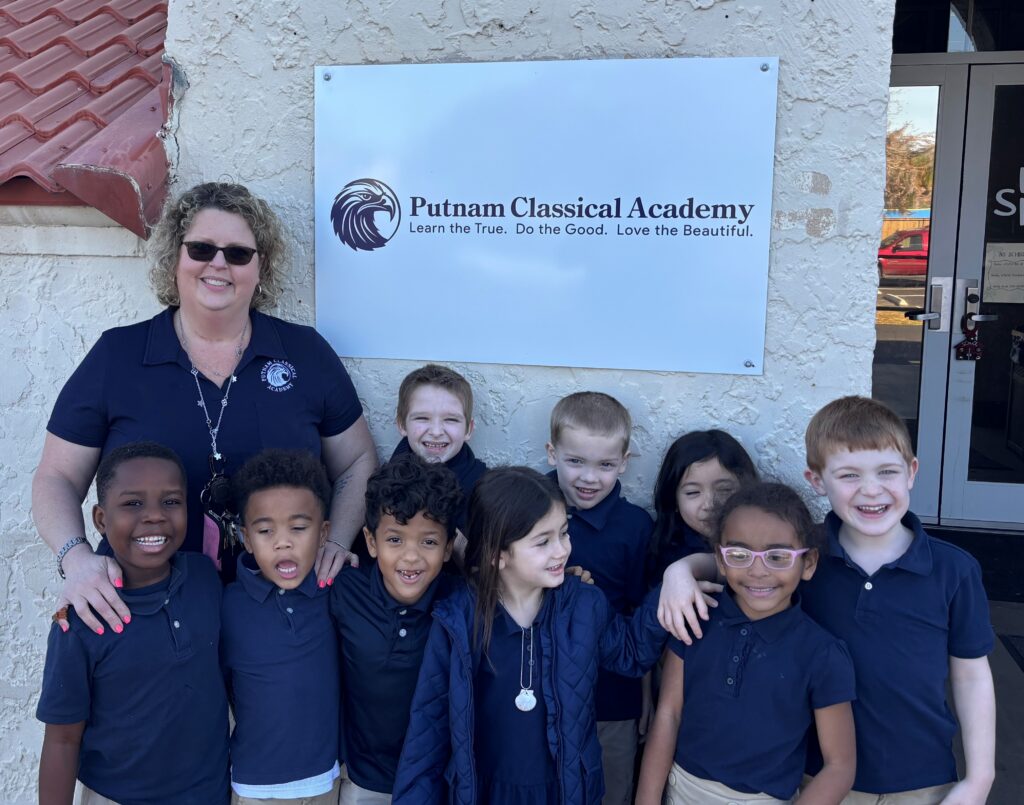
In the fall of 2023, Byrd added kindergarten and first grade, starting with eight students in those grades. She called the school for the higher grades Putnam Classical Academy.
By the fall of 2024, Putnam Classical had 50 students in grades K-5.
By the fall of 2025, it had 234 students in grades K-6, in addition to 60 in preschool.
Now Byrd’s looking for a whole other building to house a separate middle school. When she announced plans via Facebook, 111 students signed up in three days.
“Parents are desperate for their kids to be well educated,” Byrd said, particularly those from underserved communities. “They’ve been written off.”
Byrd is one of hundreds of former public school teachers who have leveraged Florida’s choice scholarships to create their own learning options. They can be found in every corner of the state, even in rural and semi-rural counties like Putnam, where a paper mill is the biggest private employer, the biggest town has 10,000 people, and the best-known landmark may be a blast-from-the-past diner.
The parents driving demand aren’t looking for anything exotic, Byrd said. They just want safe schools with top-quality academics, high expectations, and no drama.
“Parents got the word that we don’t play. That’s the biggest draw,” Byrd said. “They’re fed up. They know kids can’t learn, and teachers can’t teach, if there’s sheer chaos in the classroom.”
Byrd’s story may be a particularly dramatic example of what’s happening in Florida, and particularly symbolic.
More than half of Florida’s 3.4 million students are now enrolled in something other than their zoned neighborhood schools, and more than 1 million are enrolled outside of district schools entirely. Perhaps it’s fitting, then, that Putnam Classical leases a century-old building that once served as the local school district’s headquarters.
Despite the name, Putnam Classical isn’t truly classical yet. Byrd said she and her staff, which includes 20 teachers, will transition to a more recognizable “great books” curriculum within two years.
The first order of business is to establish a higher rate of basic literacy.
A self-described “data nerd,” Byrd is a “science of reading” adherent and a huge fan of Natalie Wexler, author of “The Knowledge Gap” and a leading proponent of using a content-rich curriculum to boost vocabulary and comprehension.
For the early grades, Putnam Classical uses an explicit, evidence-based phonics curriculum developed by the University of Florida. For the higher grades, it uses the highly regarded Core Knowledge curriculum for language arts, science, and social studies.
“If you teach these kids to read, you will change the trajectory of their lives,” Byrd said. “Then they can be an astronaut, a chef, anything they want to be.”
Byrd said as a public school teacher, she earned a reputation for working well with struggling readers, so more and more were sent her way. It became obvious, she said, that many students acted out because they couldn’t read well.
One time, she said, she stopped a 10th grader from disrupting her classroom, then took her out to the hallway to talk. The girl broke down and told her, in between sobs, “I’d rather everyone in that room think I’m a b---- than think I’m stupid.”
In three years, Byrd said she’s expelled two students. The school isn’t orderly because it’s draconian about discipline, she said. It’s orderly because kids are achieving academically and are proud of themselves. “When you learn to read,” Byrd said, “school becomes a lot more fun.”
About half of the students at Putnam Classical are Black or Hispanic; about 75% would be eligible for free- or reduced-price lunch in public school. The school does not charge tuition beyond the amount of the choice scholarship, which averages about $8,000 statewide and is far less than what districts spend.
Most of the students who switched to Putnam Classical were not reading at grade level when they arrived, Byrd said. Some incoming second graders didn’t know their letter sounds.
But now?
Now more than 60% are showing average or better growth compared to their peers nationwide, according to the STAR reading assessment Putnam Classical uses. In other words, students who were previously losing ground in their prior schools are now catching up and starting to get ahead.
Dalton Crews chose Putnam Classical for his 5-year-old, Delilah. He said he attended a private elementary school before moving on to public school and thought it built a good foundation for academics and character. He wanted the same for his daughter, and thankfully, he said, choice made it possible.
“I love the teachers. They communicate really well. They always tell me what’s going on,” said Crews, who installs fire sprinklers for a living. “They tear up when the kids leave. That’s love. They’re good people.”
Shentae Roberts said her 10-year-old granddaughter, Ja’Zyiah, was receiving good grades in her prior school, even though it was obvious to her family that she was struggling with basic material.
Her daughter tried contacting the school to get more information, she said, but never got a response. That’s why, in 2024, her daughter switched Ja’Zyiah and younger brother, Hakiem, to Putnam Classical.
“Best thing she did,” Roberts said.
Roberts said her granddaughter initially struggled at Putnam Classical, too. But the teachers gave her the attention and instruction she needed, she said.
The result: Ja’Zyiah “came back 10 times stronger,” Roberts said. “All the staff get to know the children, and they’re responding to them. They’re pulling the children to the next level.”
Byrd said more good things are ahead, not just for her school.
Even though Florida has been a national leader in private school choice for a quarter century, Byrd said she didn’t know much about it until HB 1, the landmark legislation Gov. DeSantis signed in 2023. Now, though, she realizes the game-changing potential not just for families but for teachers.
“Every public school teacher says, ‘If I were the boss, I would do it this way,’ “ Byrd said.
Well, now’s their chance.
By Lauren May and Ron Matus
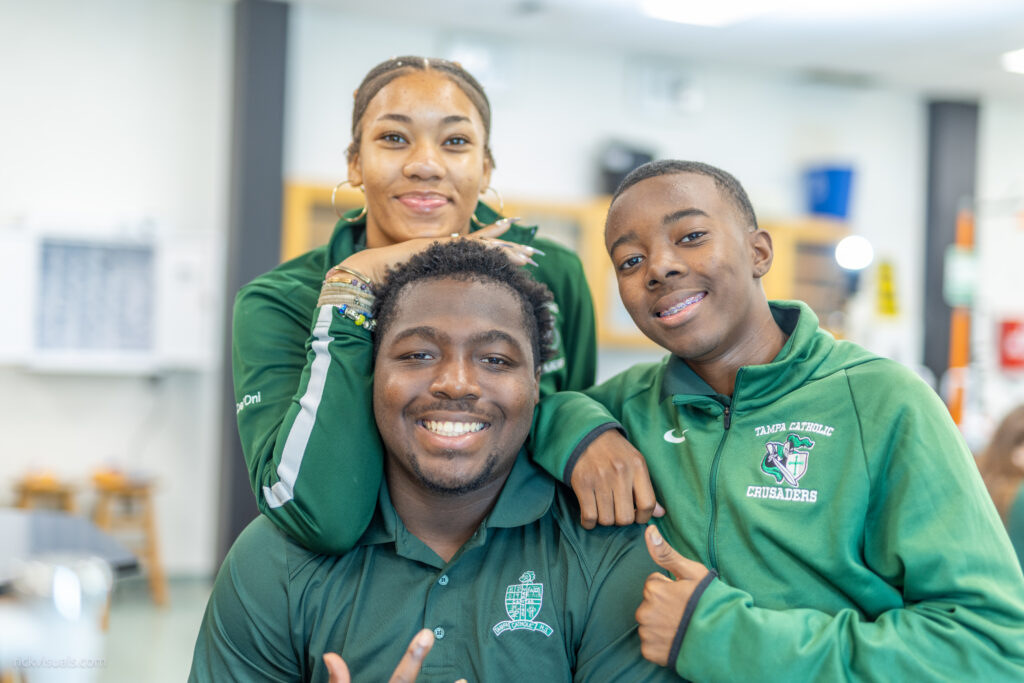
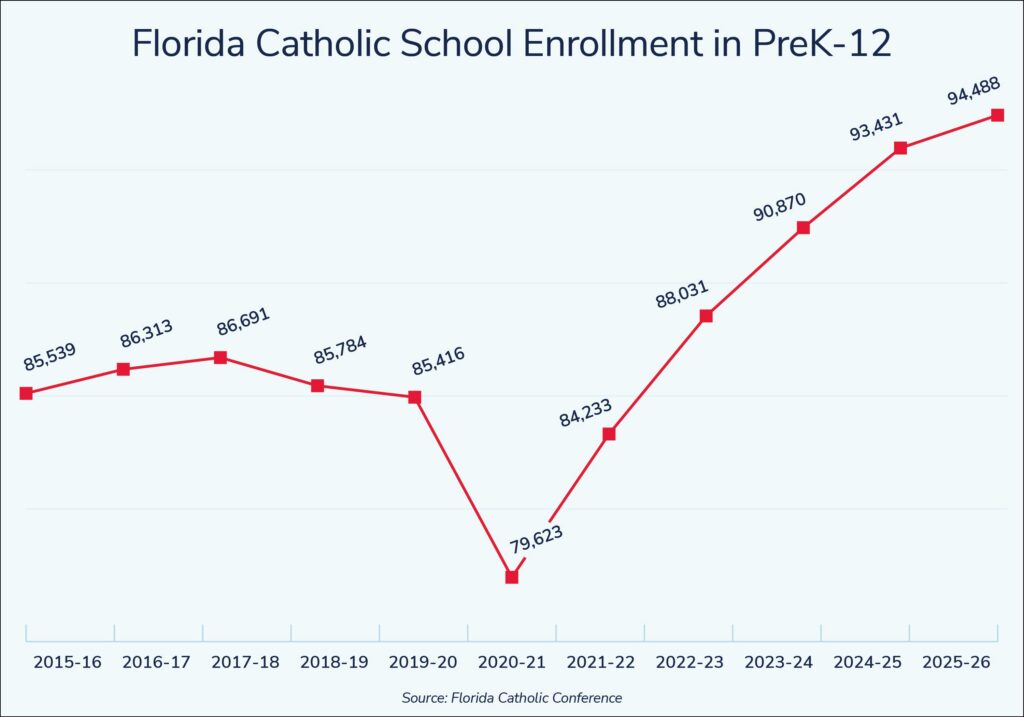
Catholic school enrollment in Florida is up again this year, rising 1.1% to 94,488 students, according to the latest numbers from the Florida Catholic Conference.
The continued growth is likely to bolster Florida’s reputation as the national standout in Catholic schooling. Through last year, Florida Catholic school enrollment was up 12.1% over the past decade. Nationally, it was down 13.2%.
To spotlight the trend lines, we published a special report in 2023, “Why Catholic Schools in Florida Are Growing: 5 Things to Know,” followed by update briefs in 2024 and 2025.
In that spirit, here are five things to know about the 2025-26 numbers:
The trend continues. This year marks five years of consecutive growth. Since 2020-21, when enrollment dipped in the wake of the pandemic, Catholic school enrollment in Florida is up 18.7%.
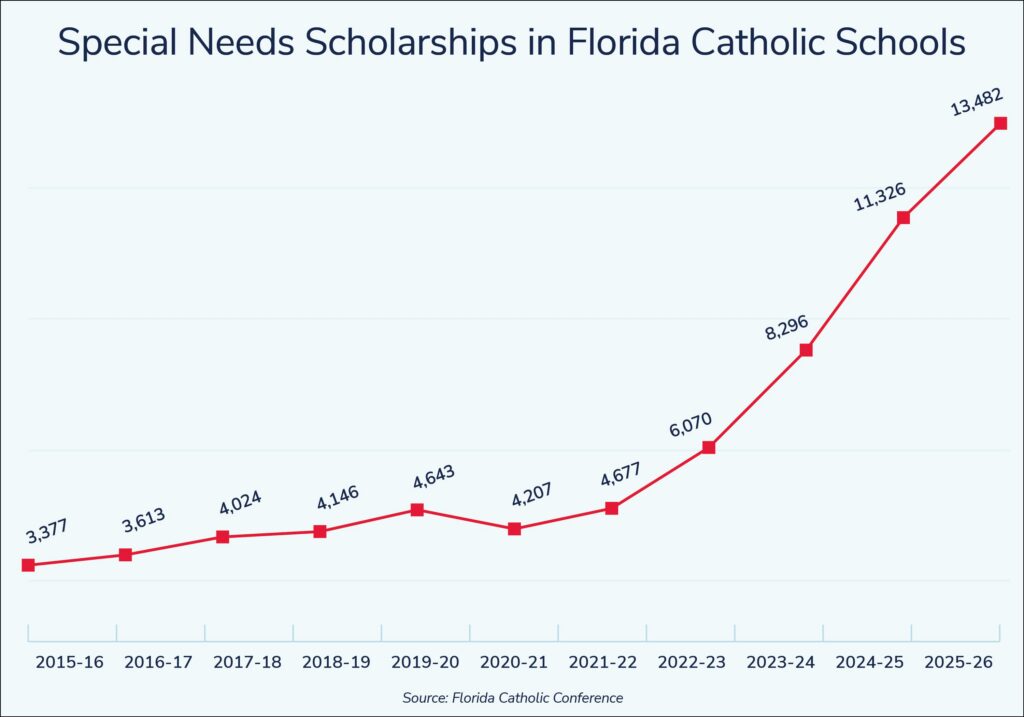
Special needs surge. Students with special needs are a leading factor. This year, Catholic schools in Florida are serving 13,482 students who use the state’s Family Empowerment Scholarship for Students with Unique Abilities. That’s up 19% from last year and triple the number from five years ago. FESUA students now encompass one in seven of all Catholic school students in Florida.
Non-Catholic students. Catholic schools have a long history of serving a diverse array of students. This year, 20% of students in Florida Catholic schools are non-Catholic, up from 14% a decade ago.
Choice scholarships are critical. In 2022-23, the year before choice in Florida became “universal,” 47.2% of all Catholic school students in Florida used choice scholarships. This year, 92.1% use them.
Context for the trend line. This year’s enrollment increase is smaller than any of the past five years. Time will tell whether that’s an anomaly. But it’s worth noting that except for a la carte learning, K-12 enrollment in Florida is slowing all over:
It’s likely that demographic shifts, including falling birth rates and declining immigration, are significant factors here. With private schools, it’s also possible that barriers such as zoning and building codes are preventing supply from better meeting demand. Last year, a Step Up For Students survey of parents who were awarded choice scholarships but didn’t use them found one in three said there were no seats available at the schools they wanted.
One final note: This post, not to mention our reports on Catholic education in Florida, wouldn’t be possible without the Florida Catholic Conference. FCC Director of Accreditation Mary Camp has been carefully tracking the enrollment and scholarship data for years. We are grateful to partner with the FCC and particularly indebted to Mary.
About the authors
Lauren May is Vice President and Head of the Federal Scholarship Tax Credit Program at Step Up for Students and a former Senior Director of Advocacy at Step Up For Students. As a proud graduate
of the University of Florida, she received her bachelor’s degree in special education
and her master's degree in early childhood education. She then completed another
master's degree in educational leadership from Saint Leo University. A former
Catholic school teacher, early childhood director, and principal, she was honored with
University of Florida’s “Outstanding Young Alumni” award in 2018. As a believer
that parents are the first and best educators of their children, Lauren loves working
with families across the state and beyond to ensure they can find and make
use of the best educational options for their children.
Ron Matus is Director, Research & Special Projects, at Step Up For Students. He
joined Step Up in 2012 after more than 20 years as an award-winning journalist,
including eight years as the state education reporter for the Tampa Bay Times, the
state’s biggest and most influential newspaper.
Updated Feb. 27, 2026
Record breaking interest continues with more than 400,000 students who have applied for Florida’s K-12 education choice scholarships for the 2026-27 school year.
Step Up For Students, the nonprofit organization that administers 98% of the state’s scholarships, opened applications for the 2026-27 school year on Feb. 1. A record 200,000 applied during the first three days.
By mid-day Feb. 10, a total of 300,106 students had applied for scholarships, which represents an 11.7% increase over the same 10-day period last year. By Friday morning, Feb. 27, a total of 401,507 students had applied.
Step Up For Students CEO Gretchen Schoenhaar said last week that the organization’s team and systems were ready for the surge of interest. Step Up’s technology systems processed 15% more applications on the first day this year than at the same time last year. Of the families who called for assistance, more than 90% reported being “satisfied” or “very satisfied” with the support they received.
“Another record number of applications on our opening weekend shows that Florida families increasingly value options in their children’s education,” Schoenhaar said. “Step Up For Students smoothly processed the higher demand and is prepared to support families every step of the way.”
During the 25-26 school year, more than 525,000 students have been funded on Florida’s K-12 scholarship programs to access learning options of their choice. If these students were counted as a single school district, it would be the largest in the state and third largest in the country. That makes Florida the national leader in education options.
However, not all students whose families apply end up being awarded or funded.
Step Up is focused on supporting growth. By the end of the year, Step Up expects to process 3 million reimbursements and a total of 3 million MyScholarShop e-commerce transactions.
Current scholarship families have until April 30 to renew their scholarships for the next school year. All families who want a PEP scholarship must also apply by April 30.
Private School and Unique Abilities Scholarship applications will be available through Nov. 15 for families who want a new scholarship.
Applications and more details are available here.
We will continue to update the numbers in this post until applications close.
AVE MARIA, Fla. – Toby and Nicole Mickelson were thinking about moving from Minnesota even before they heard about school choice in Florida. The weather, the politics, and the taxes were all getting to be too much, plus Nicole’s parents had recently become snowbirds with a winter home in southwest Florida.
Still, it wasn’t clear which warmer, less expensive, more conservative state they might move to.
But then a friend in Florida posted praise on Facebook for the state’s private school choice scholarships, which the Florida Legislature and Gov. Ron DeSantis had made available to every single student, beginning in the 2023-24 school year and are administered by Step Up For Students.
Toby and Nicole were stunned.
“I said, ‘Can you believe this even exists?’ Nicole said, “He said, ‘Are you kidding me?’ “
“Once we found out about the Step Up money, it (Florida) was a shoo-in.”
This was in the summer of 2024.
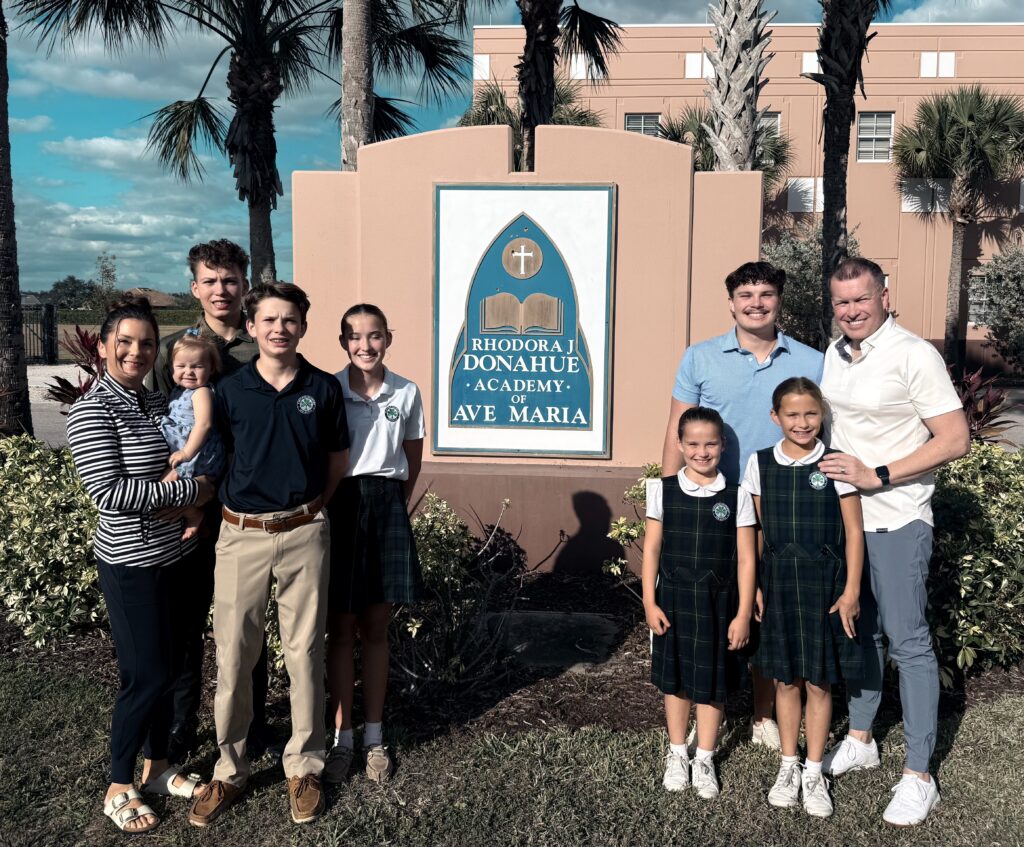
In early 2025, the Mickelsons applied to get their kids into Rhodora J. Donahue Academy, a classical Catholic school in Ave Maria, a predominantly Catholic community about 30 miles from Naples. In April 2025, their kids were accepted.
Incredibly, the family found the perfect house in Ave Maria and sold their home near Minneapolis almost simultaneously. By July, they were Floridians, with a month to spare before school started.
“We pinch ourselves every day,” Nicole said. “We’re so grateful to be here.”
The Mickelsons aren’t alone.
The Sunshine State has become a magnet for a whole new breed of transplants. We don’t have good numbers to quantify the trend, yet, but it’s easy to find families who moved here wholly or in part because 1) Florida offers generous school choice scholarships to every family, and 2) The education landscape is increasingly diverse because of all that choice, with more options for more families all the time.
At one school for students with special needs in Jacksonville, the families of 24 students — 10% of the entire student body — moved to Florida to access the school and the scholarships. At Donahue, according to the Diocese of Venice, at least two dozen students fit that description. Meanwhile, at a school for students with autism in the Tampa Bay area, a half dozen families moved from other countries or Puerto Rico.
The Mickelsons said families in Minnesota who hear about Florida’s choice scholarships initially “don’t believe it,” Nicole said. “They think it’s too good to be true.”
But, as the Mickelsons learned, they’re real.
Toby is an occupational safety manager for a commercial kitchen company and a member of the Air Force Reserves. Nicole is the vice president of sales for her family’s long-distance trucking business.
In Minnesota, they sent their kids to classical Catholic schools. For a big family, that wasn’t a breeze financially. Tuition per child averaged nearly $10,000 a year. “You can’t sustain that,” Nicole said.
Commuting was a challenge, too. One school was 20-30 minutes each way; the other, 30-40 minutes. “We lived in our cars,” Toby said.
The Mickelsons had some familiarity with Florida.
Four years ago, Nicole’s parents bought a home in Fort Myers, where they live for half a year. And three years ago, the Mickelsons visited Ave Maria University while they were checking out colleges with their oldest child. The university is also in the community of Ave Maria.
It was then that they learned about Donahue Academy, which is also a classical school.
Classical schools “teach a lot of classic books, like Dante’s ‘Inferno,’ not New Age-y things,” Toby said. For Donahue to also be a classical school was “icing on the cake.”
At the time the Mickelsons applied, Donahue had 440 students and a long waiting list. The Mickelsons weren’t sure they had a shot. But thankfully, the school was also in the midst of a huge expansion that would allow it to serve 615 students.
Donahue could be the poster child for another Florida-centered education trend, the revival of Catholic schools. Unlike Catholic schools in much of the country, Catholic schools in Florida are growing again. No region of Florida is showing more growth than the Diocese of Venice, which includes the cities of Fort Myers, Naples, Sarasota, and Bradenton.
“My husband said, ‘Let’s apply, let’s do the paperwork. If they get in, that’s our sign to move,'" Nicole said.
After praying and fasting, they got a thumbs up.
The Mickelsons have seven children. The oldest is in college. The next-oldest is homeschooled. Four attend Donahue, in grades 9, 7, 5, and 2, respectively. The youngest is a year old.
Nicole said school choice wasn’t the only reason for the move to Florida, but she put it at the top of the list, followed by politics, taxes, weather, and her parents living nearby. She said Donahue probably wouldn’t have been affordable without the choice scholarships.
In Ave Maria, the Mickelsons no longer worry about the long commutes, either. They live a few blocks from the school, so the kids bike there. “It’s like a dream,” Nicole said.
The plan is for the kids to graduate from Donahue, then attend Ave Maria University.
Nicole and Toby are both able to work remotely. And now that everything in Florida is working out so well, word is getting back to their friends in the Gopher State.
One family recently pulled their kids out of Catholic school because they could no longer afford it. For now, they’re homeschooling. But thanks to school choice, Florida looks mighty enticing.
Said Nicole, “I have a lot of Minnesota friends who want to move to Florida now.”
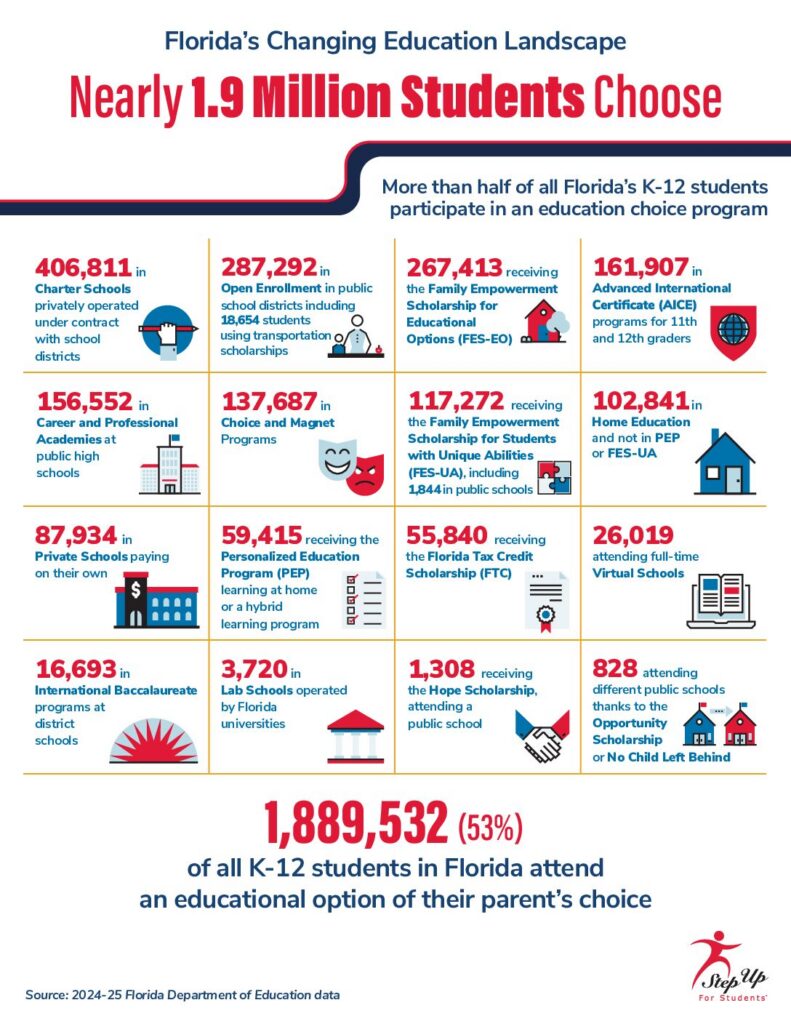
Florida’s K–12 education landscape continues to shift toward choice. During the 2024–25 school year, 53% of all K–12 students — 1,889,532 children — attended a public, private, or home education option of their parents’ or guardians’ choice. Just one year after crossing the 50% threshold for the first time, Florida’s school choice participation grew by nearly 100,000 additional students.
“Each year, Florida families have made it clear that they want more options for their children’s education,” said Gretchen Schoenhaar, CEO of Step Up For Students, the Florida non-profit that administers the state’s education choice scholarship programs.
“Increasingly, parents and guardians are willing to mix and match private and public resources to choose the ones that work best for their family.”
Since the 2008–09 school year, Step Up For Students, in collaboration with the Florida Department of Education, has tracked enrollment across a variety of choice programs. The 2023–24 school year represented a historic milestone: the first time more than half of all K–12 students in the state attended a school of choice. The 2024–25 school year continued that upward trend.
The Changing Landscapes report draws from Florida Department of Education data and removes, where possible, duplicate counts to provide a clearer picture of school choice participation. For example, it adjusts for home education students supported by the Family Empowerment Scholarship for Students with Unique Abilities (FES-UA) and eliminates double-counted students in career and professional programs. It also excludes prekindergarten students in FES-UA and programs such as Voluntary Pre-Kindergarten (VPK), as the report focuses solely on K–12 education.
While many families still choose their neighborhood public schools, Florida’s education system now offers a broad range of options to meet diverse student needs. As in past years, public school choice remains dominant, occupying four of the top five spots in overall enrollment. Charter schools are the most popular single option, followed by district open enrollment programs, the Family Empowerment Scholarship for Educational Options (FES-EO), career and professional academies, and Advanced International Certificate of Education (AICE) programs for upperclassmen.
The largest increases in enrollment occurred in the FES-EO program, which has merged with the Florida Tax Credit Scholarship program, and the Personalized Education Program (PEP), a scholarship that helps fund education at home.
Among public school options, AICE enrollment grew nearly 17%, career and professional academies grew 6.2%, and open enrollment grew 4.6%. While overall district enrollment appeared to decline slightly, these public school choice options still grew more than charter schools (independent public schools), which grew just 2.3%. This may suggest that school districts could benefit from expanding their own menu of diverse school options to better retain families.
Choice remains strong within Florida’s public school system. More than 1.2 million of the state’s 2.9 million public school students attended a school of choice, while another 688,000 students outside the public system enrolled in private schools or home education programs.
A newer option to keep an eye on is district schools offering classes and services to students on an education choice scholarship, paid for with their scholarship funds. Currently 37 of Florida’s 67 districts have been approved as providers with Step Up For Students, and another 11 are in the process of being approved. These arrangements further blur the line between public and private and emphasize that the focus remains on the individual needs of students.
With so many options available, Florida’s education system has entered a new phase. Choice is no longer an alternative; it is the norm. Families routinely evaluate multiple pathways, and whether they select a different option or remain in their assigned public school, they are making an active choice. The result is an education landscape in which public, private, and home education options coexist and evolve together, reflecting the reality that students and families have different needs, and that those differences matter.
The time has come when we officially recognize National School Choice Week. However, we at Step Up For Students like to say that every week is National School Choice Week.
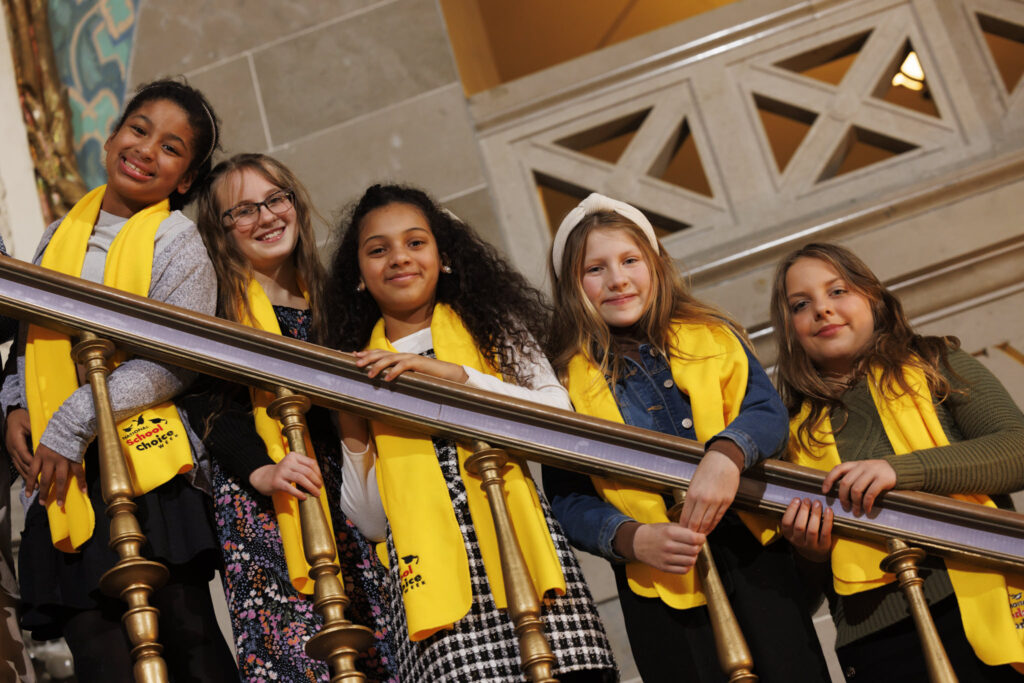
We are proud that Florida is the national leader in empowering parents to choose the best educational fit for their children. More than half of the state's K12 students used some form of education choice in the 2023-24 school year, according to the Florida Department of Education.
Parents’ ability to direct their children’s education has always been important, but even more so in the past 100 years, when the U.S. Supreme Court ruling in Pierce v. Society of Sisters (1925) gave parents the right to choose between public and private options.
“The child is not a mere creature of the state,” Justice James C. McReynolds wrote in the unanimous decision that the government cannot compel children to attend only public schools.
Catholic schools, which were the target of the law the high court struck down, cheered.
Fittingly, Catholic Schools Week, which we also recognize, is running concurrently this year with National School Choice Week. With its robust statewide choice scholarships, Florida is also a national leader in Catholic school enrollment growth.
National School Choice Week is a non-partisan celebration that encompasses all forms of choice: Traditional district schools, public magnet schools and charter schools, virtual schools, private schools, both religious and secular, microschools, home education and customized learning powered by education savings accounts that can include a mix of public and private programs.
Events are happening across the nation, from capitol rallies to school choice fairs to students in signature yellow scarves performing the official National School Choice Week dance in their classrooms or homes.
Throughout the week, NextSteps will share stories of students and families who have benefited from Florida’s many educational options. You will meet a young hockey player whose Personalized Education Program scholarship has allowed him to travel with his team to compete in international tournaments while keeping up with his schoolwork and educational goals. Ron Matus, Step Up’s director of research & special projects, will share his memories of a former student who was among the state’s first recipients of Florida Opportunity Scholarships pioneered by former Gov. Jeb Bush. A couple of years in a Catholic school were enough to put him on a path to a better life.
We will also bring you a story by a Tampa Bay FOX affiliate of a single parent who was able to send her son, who struggled in other schools with his autism, to a school where he is thriving, with dreams of going to college.
We will cap off the week at the festivities Thursday in Tallahassee, where Step Up representatives will have information about the Feb. 1 season open for 2026-27 scholarship applications.
Even if you aren’t at the rally, you can still learn about the scholarships and apply at www.stepupforstudents.org.
We can’t wait until next week. And the week after. And the week after that.
Because we serve Florida, where choice is the norm for all public education.
By Ron Matus and Julisse Levy
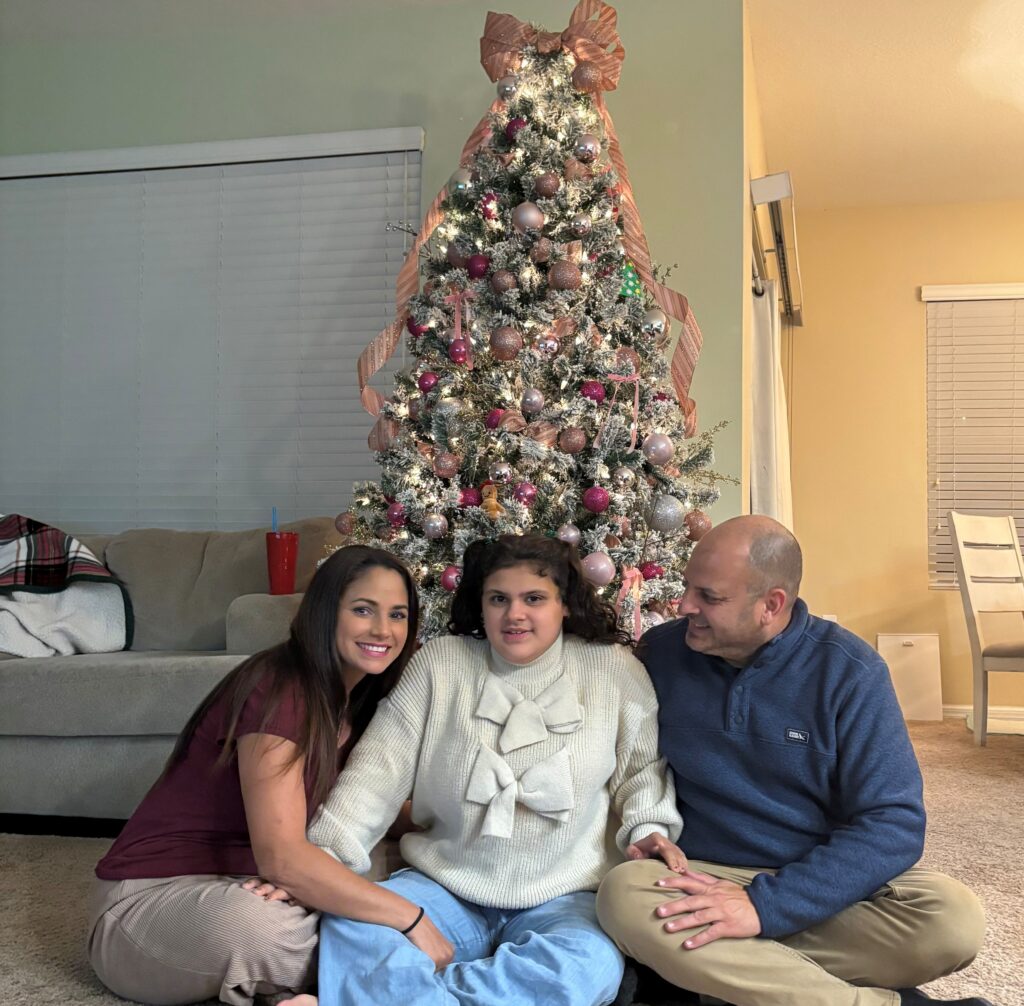
HUDSON, Fla. – In 2022, Joel Hernandez and his wife, Norma Torres, had to find a new school for their then-9-year-old daughter, Fabiola. In their part of Puerto Rico, they felt their options were, at best, limited.
Fabiola is on the autism spectrum. Over the years, her parents visited and/or researched every public and private school in the area that served students with special needs. It was not a pretty picture.
In some, up to 30 students with vastly different learning and support needs were crammed together in the same classrooms. In one, students with a wide range of ages and special needs were grouped in a room that doubled as storage for desks, tables, and other equipment. Yet another was so lacking in security that Hernandez walked from the entrance to the classroom without anybody asking who he was or what he was doing.
In the end, the couple settled on a school that looked good on paper. But it turned out to be a bust, too. It never delivered on promises of regular speech and occupational therapy.
Fighting for Fabiola left the couple drained. Their daughter needed every opportunity to gain skills that would allow her to live as independently as possible as an adult, and it wasn’t happening.
“We spent nights crying,” Hernandez said. “We looked at each other every day and said, ‘What are we going to do?’ “
As things grew desperate, the couple began to consider moving to the states for better educational opportunities, and more specifically, to Florida, where they had enjoyed time on vacation. When they began researching schools in the Sunshine State that served students with autism, one immediately jumped out.
It had Hope in its name.
'I knew it was meant to be'
Hope Ranch Learning Academy is a K-12 school with 250 students an hour north of Tampa.
From the school website, the couple could see a campus awash in moss-draped oaks. To them, it looked calming. The school featured equine therapy, which Fabiola experienced in Puerto Rico and loved. It was also a Christian school, which was very important to the family.
Incredibly, Hernandez and Torres also saw a familiar face on the website, a girl who had been Fabiola’s friend years prior.
“God intervened,” Hernandez said. “I knew it was meant to be.”
The couple contacted the girl’s family, who referred them to a school administrator. The woman told them that Hope Ranch had a long waitlist — it’s now more than 80 students — and they had to be Florida residents to get on it. She asked, “Do you really want to move because of the school?”
“That was the a-ha moment,” Hernandez said. “We said, ‘In Puerto Rico, we have nothing for our daughter. We have to move.’”
Private school boom, scholarships, draw families
Families are moving to Florida because of its schools and school choice.
It’s not just the abundance of state choice scholarships, which average $8,000 or $10,000 each and are now available to every family. It’s the entire, choice-driven system. Florida’s education landscape is becoming more diverse and dynamic by the day, as the families of 500,000 students using scholarships (and growing) shape it with their preferences.
In the past 10 years alone, the number of private schools in Florida has grown by a third. That’s a net gain of more than 700 private schools, which is more than 39 states each have, period. And what’s more impressive than the number is the variety.
Schools like Hope Ranch, which was a semi-finalist for the Yass Prize in education innovation, are not anomalies. High-quality schools serving students with special needs have emerged in every corner of the state, and some are now drawing families from out of state. At the North Florida School of Special Education, for example, the families of 24 students moved from out of state, including this family from Maryland.
At Hope Ranch, a half-dozen families have even moved from other countries or Puerto Rico.
Equine therapy and transition program set Hope Ranch apart
In Puerto Rico, Hernandez taught marketing at a college and sold beauty supplies. Torres worked as a nail technician. Moving to the States obviously would mean leaving friends and family and starting over with new jobs, a new house, everything. But Fabiola’s future depended on it.
In November 2023, the family and their three dogs moved into their new home, 12 miles from Hope.
Since Fabiola couldn’t attend the private school right away, her parents enrolled her in the neighborhood public school. It turned out to be excellent. One teacher in particular paid extra attention to Fabiola and made sure she got the help she needed, including a full-time, 1-on-1 assistant.
“There’s always an angel over Fabiola,” Hernandez said.
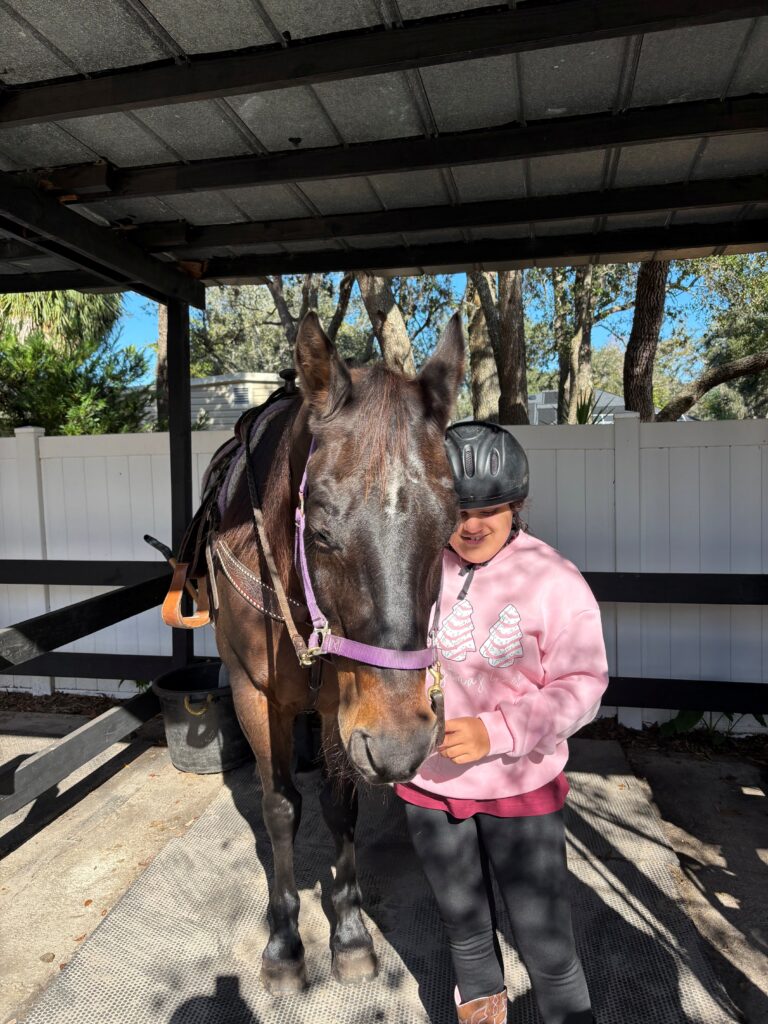
Hope Ranch, though, remained ideal. Besides the equine therapy program, the school operates a highly regarded transition program that prepares students for independent living as adults. In December, the Yass Prize awarded Hope founders Jose and Ampy Suarez an alumni grant, so they could build a separate high school campus and expand the transition program.
Hernandez periodically checked in with Hope to see how much the waitlist was shrinking. Finally, in June 2025, the administrators invited the family to the school so they could share the good news in person.
Fabiola was in.
Family credits school choice scholarship for making Hope Ranch affordable
Classes started in August. Just a few months later, Hernandez said the change in Fabiola has been “astronomical.”
Fabiola smiles more. She’s happy when she wakes up. She’s happy on the way to school.
She’s more independent, confident, communicative. She doesn’t cover her face as much as she used to. She tries to verbalize more. She makes eye contact more often.
“She wants to play with other children now,” Torres said. “She feels included. They grab her hand and say, ‘Come with us.’ “
Last month, Fabiola and the other Hope Ranch students performed a stage version of “The Little Drummer Boy” for students at a nearby high school. Fabiola was on stage for an hour.
“I know she has to progress more,” Hernandez said, “but we feel very good.”
None of this would have been possible without Florida’s choice scholarship, he said. The family couldn’t afford Hope Ranch without it.
The school told the family about the scholarship. But Hernandez couldn’t believe how easy it was to get.
In Puerto Rico, he and Torres were accustomed to filing all kinds of education requests on Fabiola’s behalf and waiting long stretches for answers. With the scholarship, they got the award notice within 24 hours of applying. “I thought I was going to have a heart attack,” Hernandez joked.
“We had this in our dreams, but we didn’t know it could come true. Florida and Hope were a dream come true,” Hernandez said as he started to cry.
“I’m sorry I have to cry, but it’s very emotional,” he continued. “In Puerto Rico, all we had were problems” with Fabiola’s education. “Here we have solutions.”
Some quotes in this story were translated from Spanish to English with the assistance of Julisse Levy, director, head of business Initiatives, Federal Scholarship Tax Credit, at Step Up For Students.

By David Heroux and Ron Matus
In the blink of an eye, à la carte learning in Florida has become one of the fastest-growing education choice options in America.
This school year, 140,000 Florida students will participate in à la carte learning via state-supported education savings accounts, up from 8,465 five years ago. Their parents will spend more than $1 billion in ESA funds.
These families are at the forefront of epic change in public education. Completely outside of full-time schools, they’re assembling their own educational programming, mixing and matching from an ever-expanding menu of providers.
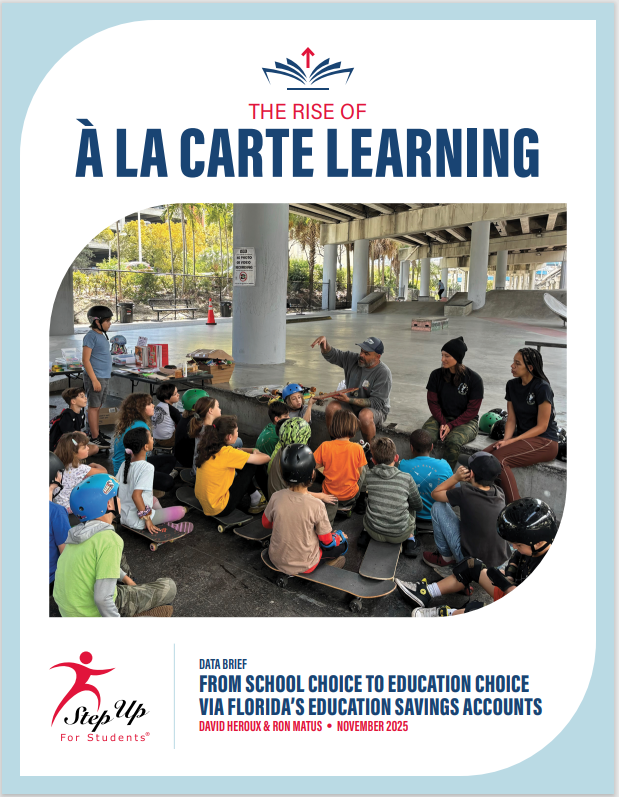
Nothing on this scale is happening anywhere else in America.
To give policymakers, philanthropists, and choice advocates a snapshot, we produced this new data brief. In broad strokes, it shows a more diverse and dynamic system where true customization is within reach for any family who wants it.
ESAs shift what’s possible from school choice to education choice. They give more families access not only to private schools, but tutors, therapists, curriculum, and other goods and services.
Adoption of these more flexible choice scholarships has been booming nationwide; 18 states now have them. But nowhere is their full potential more fully on display than in Florida.
Last year, 4,318 à la carte providers in Florida received ESA funding, more than double the year prior. Many of them are tutors and therapists, but a growing number offer more specialized and innovative services, as we highlighted in our first report on à la carte learning. Former public school teachers are also a driving force in creating them, just as they’ve been with microschools.
How far and fast à la carte learning will grow remains to be seen. For now, check out our brief to get a glimpse of what’s ahead.

