JACKSONVILLE, Fla. – Four years ago, Phil and Cathy Watson were distressed and desperate. Their daughter Mikayla, then 12, was born with a rare genetic condition that led to physical and cognitive delays. With her school situation getting worse by the day, they needed options, now.
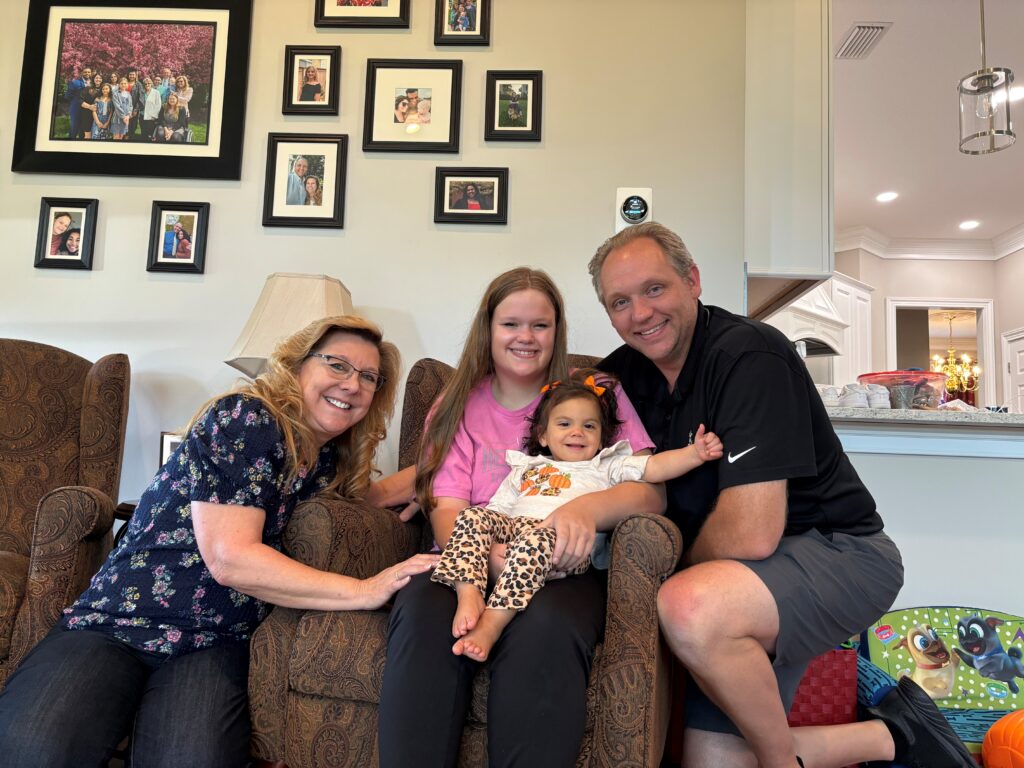
The Watsons were open to private schools. But they couldn’t find a single one near their home in metro D.C. that met Mikayla’s needs. They even looked in neighboring states. Nothing.
One day, though, Phil varied his keyword search slightly, and something new popped up:
A school for students with special needs that had low student-to-staff ratios, transition programs to help students live independently, even an equine therapy program.
The Watsons feared it was too good to be true. Even if it wasn’t, it was 700 miles away.
A destination for education
Florida has always been a magnet for transplants. It’s tough to beat sunshine, low taxes, and hundreds of miles of beach. But as Florida has cemented its reputation as the national leader in school choice, the ability to have exactly the school you want for your kids is making Florida a destination, too.
In South Florida, Jewish families are flocking from states like New York to a Jewish schools sector that has nearly doubled in 15 years. But they’re not alone. Families of students with special needs are making a beeline for specialized schools, too. The one the Watsons stumbled on has 24 students whose families moved from other states – about 10% of total enrollment.
The common denominator is the most diverse and dynamic private school sector in America, energized by 500,000 students using education choice scholarships.
According to the most recent federal data, the number of private schools in Maryland shrank by 7% between 2011-12 and 2021-22. In Florida, it grew by 40%.
“What Florida is offering is just mind blowing compared to Maryland,” Phil said. “If a story like this ran on the national news, people would be beating the door down.”
‘The kid who never spoke’
Phil and Cathy Watson have six children, all adopted. They range in age from 1 to 39. All have special challenges.
“God picked out the six kids we have,” said Cathy, who, like Phil, is the child of a pastor. “We feel very strongly that we were called to do what we do. Our heart says we have love to give and knowledge to share. These kids need that, so it’s a match.”
Mikayla is their fourth child. She was born with hereditary spastic paraplegia, a condition that causes progressive damage to the nervous system.
She didn’t begin walking until she was 18 months old. Even then, her gait continued to be heavy-footed, and she was prone to falling. Her speech was also, in Phil’s description, “mushy,” and until she was 12, she didn’t talk much.
In many ways, Mikayla is a typical teen. She loves steak and sushi and Fuego Takis. Her favorite books are “The Baby-Sitters Club” series, and her favorite movies include “Beauty and the Beast” and “Beverly Hills Chihuahua.” Many of her former classmates, though, probably had no idea.
In school, Mikayla was “the kid who never spoke.”
Checking a box
As Mikayla got older, she and her parents grew increasingly frustrated with what was happening in the classroom. “She was being pushed aside,” Phil said.
Teachers would tell her to read in a corner. Between the physical pain from her condition and the emotional turmoil of being isolated, she was crushed. Sometimes, Phil said, she’d come home and “unleash this fury on my wife and I.”
The pandemic made things worse. In sixth grade, Mikayla was online with 65 other students. Then, three days before the start of seventh grade, the district said it no longer had the resources to support her with extra staff. Instead, she could be mainstreamed without the supports; enroll in a private school; or do a “hospital homebound” program.
The Watsons chose the latter. Three days a week, a district employee sat with Mikayla, going over worksheets that Phil said were “way over her head.”
“All it was,” he said, “was checking a box.”
Just in the nick of time, the school search turned up a hit.
Florida, the land of sunshine and learning options
What surfaced was the North Florida School of Special Education.
“From just the pictures, I’m thinking, ‘This looks legit,’ “ Phil said. “Both of us are like, ‘Wow.’ “
When the Watsons called NFSSE, as it’s called for short, an administrator answered every question in detail. This was not the experience they had with some of the other private schools they called.
At the time, Phil owned a home building company, and Cathy worked for a counseling ministry. They lived comfortably. But they were also paying tuition for another daughter in college.
Thankfully, the administrator told them Florida had school choice scholarships. For students with special needs, they provided $10,000 or more a year.
The Watsons couldn’t believe it. They were familiar with the concept of school choice but didn’t know the details. Maryland does not have a comparable program.
The administrator also told them NFSSE had a wait list. But the Watsons had heard enough.
A fortuitous phone call
A few weeks later, they were touring the school.
The facilities were stellar. Even better, the administrator leading their tour knew the name of every student they passed in the hallways. “We were blown away,” Phil said. “They truly care. “
At some point, the staff ushered Mikayla into a classroom. As her parents watched from behind one-way glass, another student greeted Mikayla with a flower made of LEGO bricks.
For years, Mikayla had been withdrawn around other students. Not here. The shift was immediate. She and the other students were using tablets to play an interactive academic game, and “you could see her turn and laugh with the kids next to her,” Phil said.
Minutes later, he and Cathy were in the administrator’s office, “bawling our eyes out.”
“We said, ‘We’re all in. We have to be here. We’ll be here next week if that’s what we have to do.’”
Days later, the Watsons were at Disney World when NFSSE called. Unexpectedly, the family of a longtime student was moving. The school had an opening.
New friends, improved skills and boosted confidence
Even without the choice scholarship, the Watsons would have moved. At the same time, the scholarship was invaluable. The cost was not sustainable in the long run, Phil said, especially because he had to re-start his business.
The Watsons rented a long-term Airbnb and then an apartment before buying a house in Jacksonville. They uprooted themselves completely from Maryland, including selling their dream home.
“That was hard,” Cathy said. “You’re leaving everything you love.”
Mikayla’s turnaround, though, has made it all worthwhile.
Mikayla was reading at a first-grade level when she arrived at NFSSE; now she’s at a seventh-grade level. She loves the new graphic design class. She won an award for completing 1,000 math problems. “When she got here, she couldn’t add two plus two,” Phil said.
Her verbal skills have blossomed. She eventually told her parents something she didn’t have the ability to tell them before: In her prior school, she didn’t talk because other students laughed at her.
At NFSSE, the “kid who never spoke” speaks quite a bit.
One day, she served as “teacher for the day” in her personal economics class, delivering a lesson on how to make change.
Mikayla is kind and quick to smile. She is surrounded by friends and admirers. “Mikayla is my best friend,” said a chatty girl with pigtails who waited by her side in the hallway.

One boy held the door for Mikayla as she headed to her next class. A second hung her backpack on the back of her wheelchair. A third walked her to P.E.
Mikayla’s confidence is growing outside of school, too.
In the past, she wouldn’t say hi or order in a restaurant. But at Walmart the other day, Phil needed a card for a friend’s retirement, so Mikayla went to find a clerk. She came back and told him, “Aisle 9.”
Mikayla has a bank account and a debit card. She tracks the money she earns from chores. She routinely uses the notes app on her phone to mitigate challenges with short-term memory.
NFSSE, Cathy said, is constantly reinforcing skills and strategies to foster independence. It “pushes for potential,” just like the families do.
Mikayla “sees that potential now; she’s excited now,” she said.
Before NFSSE, the Watsons didn’t think Mikayla could live independently. Now they do.
The school and the scholarship, Phil said, have “given Mikayla an opportunity for her life that we didn’t know existed.”
He credited the state of Florida, too, for creating an education system where more schools like NFSSE can thrive.
If only every state did that.
JACKSONVILLE, Fla. – The diagnosis was Entamoeba histolytica, which is an infection caused by ingesting an amoeba that produces fatigue, abdominal pain, weight loss, and a few more symptoms you don’t want to have when you are more than 9,000 miles from home.
That’s where Christopher Trinidad happened to be during a visit to his parents’ homeland in the Philippines the summer before the eighth grade.
Born and raised in Jacksonville, Christopher’s immune system was not accustomed to some of the pathogens found in the local food. He had not built up a resistance like residents have. Lying in a hospital bed in the city of Bacolod, while the antibiotics did their thing, Christopher had this thought: “This has to be my science fair project.”
And so it was.
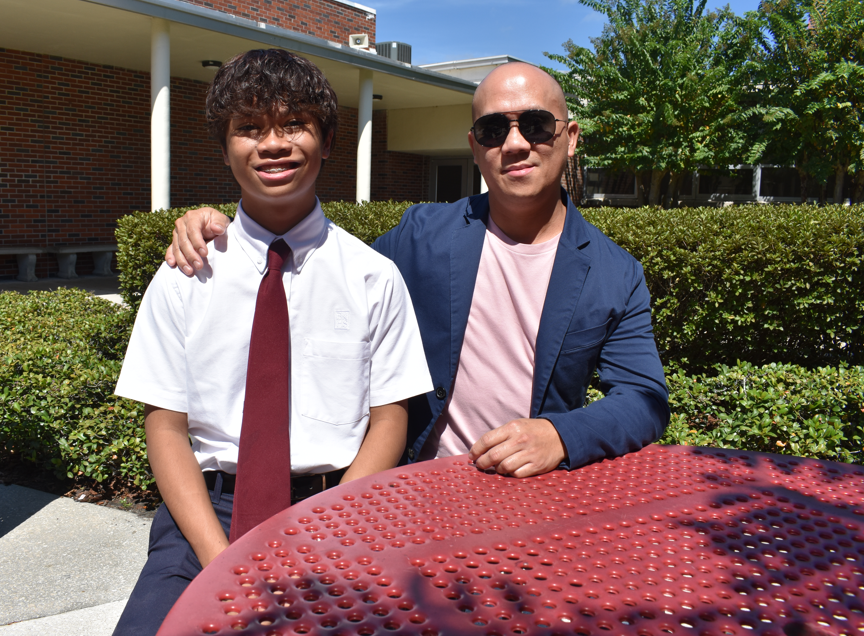
After returning home, Christopher ordered microorganisms online. “Safer organisms,” he said, than the one that waylaid him a few weeks earlier. He experimented with various items found in the kitchen pantry – ginger and garlic – mixed them with water and other ingredients and developed a solution that killed the organisms.
“What if,” Christopher thought, “we use these solutions on the actual thing? This can help so many people.”
His project finished first at a regional science fair.
“Impressive, right? Wait until you hear what he did his freshman year,” said Carla Chin, director of marketing and communications at Bishop Kenny High School in Jacksonville.
Christopher, a sophomore, attends the parochial Catholic school on a Florida education choice scholarship managed by Step Up For Students.
He sat in a chair inside Chin’s office. His father, Greg, sat in another and proudly listened as his son, with a mixture of pride and modesty, described the project that earned first place at a regional science fair and then a bronze medal at the Genius Olympiad and a $15,000 scholarship to the Rochester Institute of Technology at a global competition held in Rochester, New York.
Using an electroencephalogram (EEG), which measures electrical activity in the brain, artificial intelligence, virtual reality, and violin music, Christopher was able to predict the moods and emotions of stroke victims who are unable to speak, thus creating a line of communication with doctors.
“By using brain waves, doctors can know what their patients are feeling, which would lead to better decision-making,” he said.
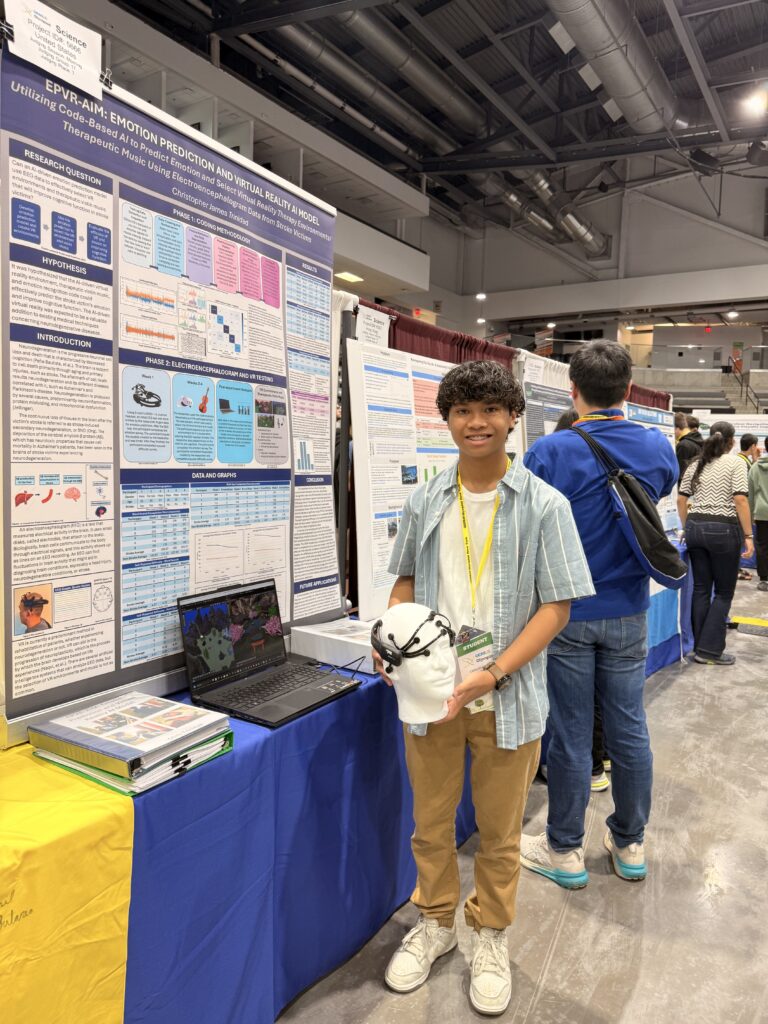
Michael Broach is the Vice Principal at Bishop Kenny and the Director of Mission Integration, as well as the AP Capstone Department chair. He was responsible for approving Christopher’s science project.
“That was one of the most sophisticated projects, I think, that I've seen in my years of being here,” Broach said. “And just the way his mind works is well above his peers. Well above what you would expect of somebody of his age.”
Christopher is 15.
He wants to be a neurosurgeon.
“I’ve always been fascinated with the brain since I was little,” Christopher said. “It controls everything in our body. It’s really interesting, and going into surgery, fixing people's brains is really complex, and that's what I love about it.”
His parents – Greg and Shiela – are both nurses, so Christopher was raised around medical science. Their house is filled with textbooks related to their careers. Christopher has read them all.
The valedictorian of his middle school, Christopher has a 4.3 weighted GPA at Bishop Kenny. He chose to attend the Catholic high school because it aligns with his faith and has a high academic standard.
“It challenges me,” he said. “I know there are other people here I can talk to, and it gives me a greater experience.”
He’s not the only student at Bishop Kenny who knows what an electroencephalogram is and how it works.
While he spends a considerable amount of time working on his science fair projects (keep reading to learn about what his plans are for this year’s project), he’s very active at school. Christopher is a member of the Science Club, Medical Career Club, St. Vincent de Paul Society, campus ministry, and the Brain Brawl. He plays the piano at the monthly mass. He’s also first violin for the Jacksonville Symphony Youth Orchestra.
Listening to his son talk, Greg had one feeling. “Blessed,” he said. “He has a humble heart. We try to remind him always what’s hard.”
Greg understands hard.
Raised in a small town an hour’s plane ride from Manila, Greg’s childhood was humble at best. He went through elementary school with only two pairs of shoes. He caught rides to school on trucks headed to the sugarcane fields on days when his mom couldn’t afford bus fare.
“I didn’t have the opportunity to join the Boy Scouts,” Greg said. “My mom didn’t have the money.”
Greg understood the power of an education and where it could lead him. He became a teacher until, at age 26, he immigrated to the United States in search of the American Dream.
He worked odd jobs and became a certified nursing assistant. From there, he attended nursing school in St. Augustine. He now works as a traveling nurse in the cardiac catheterization labs in hospitals around North Florida. He became a traveling nurse for the pay because he and Sheila support three family members in the Philippines.
That’s why Christopher traveled to the Philippines the summer before eighth grade, to see where his parents’ stories began.
“I wanted him to see and feel the difference of being here in this world compared to a third-world country,” Greg said.
The lesson wasn’t lost on his son.
“I just feel really lucky that I'm here in America and I have more opportunities than some kids have in the Philippines, and I’m not going to let this go to waste,” Christopher said.
Greg said he is grateful for the Florida education choice scholarship that helps pay Christopher’s tuition at Kenny.
“In the Philippines,” he said, “if you don’t have money, you don’t go to school.
“He has this opportunity of having this scholarship, and I'm telling him, you're way more blessed than what other people have in other states. We're so thankful that all these opportunities are coming for our son.”
Christopher’s next opportunity is this year’s science fair, where he will take last year’s project a step further.
“I'm planning to build a rehabilitative exoskeleton so it can help people with movement disabilities,” he said. “I can also use an EEG in that, so they can think about what they're going to do with their exoskeleton, which basically helps them move. It would correlate to their actual thoughts. So, if they wanted to walk, they would be able to think it, then the exoskeleton would help them walk.”
TAMPA, Fla. — Amelia Ramos recalls her oldest child’s first school experience after moving to the Grant Park neighborhood in 2018.
“It was not a good fit,” she said. “She lasted about four months.”
In addition to academics, Ramos cited safety as a big concern.
“You couldn’t even ride a bicycle down the street,” she said.
Ramos found hope after learning about Grant Park Christian Academy, a private school affiliated with the Faith Action Ministry Alliance. The nonprofit organization’s stated mission is “to strengthen neighborhoods through meaningful engagement, collaboration, and strategic partnerships.”

Grant Park Christian Academy prides itself on its record of providing strong academics and spiritually based character development. Ramos learned from the school’s principal about a state education choice K-12 scholarship program administered by Step Up For Students that would help cover the tuition.
With that, Ramos was sold.
Her daughter thrived at Grant Park and now attends a district high school. Her son and twin daughters now attend the private school, which serves 70 students in grades K-8.
“We love the school and the staff,” she said, adding that she appreciates the assurance of knowing that her children are safe when she leaves them at Grant Park Christian Academy.
“If only they had a high school,” she said.
Although there are no plans to add a high school, an expansion will soon more than double the school's capacity, located inside a gated property owned by a non-denominational church.
The project is just one example of a broader statewide trend resulting from the Florida Legislature’s passage of HB 1 in 2023. The landmark legislation made all K-12 students eligible for education choice scholarships regardless of their household income and gave families more flexibility in how they spend their students’ funds.
Putting parents in the driver’s seat supercharged the demand for more learning options.
In the 2023-24 school year, after Gov. Ron DeSantis signed HB 1, Florida saw the largest single-year expansion of education choice scholarships in U.S. history. That growth continued in 2024-25. Recent figures from the Florida Department of Education show that more than 500,000 Florida students were using some type of education savings account.
The expansions at Grant Park Christian Academy and other schools across the state, such as Jupiter Christian School in Palm Beach County, couldn’t come at a better time. The latest figures from Step Up For Students show that the number of approved private schools has surpassed 2,500. That figure doesn’t include a la carte options, including those now being offered by public schools. State figures show 41,000 parents received scholarships in 2024-25 but never used them. According to a survey by Step Up For Students, a third of the 2,739 parents who responded said there were no available seats at the schools they wanted.
The Rev. Alfred Johnson, who founded the ministry alliance and Grant Park Christian Academy in 2014, said the school is just one of the ways the ministry works to support and improve the neighborhood. A look outside the window once a month will show teams of alliance volunteers in neon yellow vests cleaning up roadside trash. Johnson estimates that over the past three years, the group has cleared 70 tons of garbage, including old mattresses, furniture, and household appliances.
Johnson and his volunteers regularly knock on doors and survey residents and business owners about community needs. They also host events; the annual Fall Fest offers families a safe and fun alternative to Halloween trick-or-treating.
“I know what they do to really make a change in this community,” said Hillsborough County Commissioner Donna Cameron Cepeda, a Republican who represents District 5 and the county at large. She said she had known Johnson for years before she ran for office. “You can see the lives, how they have been changed because of the environment they are able to be in now.”
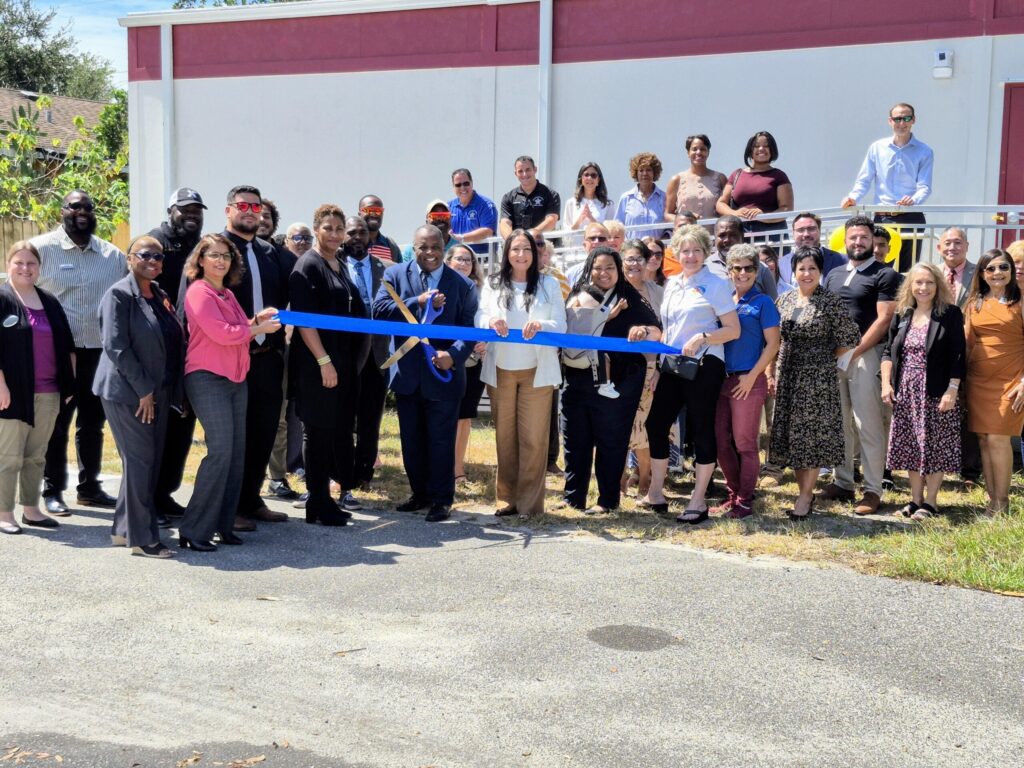
She was among a group of 50 community members at a recent ribbon-cutting ceremony for a new 2,660-square-foot modular building that will open after crews add the finishing touches.
Those attending the event represented a broad swath of community leaders, from local law enforcement officers to staffers at the Temple Terrace Uptown Chamber of Commerce, who brought the ceremonial oversized scissors. A representative of the Hillsborough County Clerk’s Office also attended. So did a group of leaders and students from Cristo Rey Tampa Salesian High School, which has some Grant Park Christian Academy alums.
Hillsborough County Commissioner Gwen Myers, a Democrat whose district includes Grant Park, joined her Republican colleague in praising the alliance and the school. The two commissioners also presented Johnson with a commendation honoring his contributions to the community.
“Our children are our future leaders, and when we can give them the basic foundation of education, they are going somewhere,” Myers said. “Just remember where they got their start, right here in Grant Park. What you’re doing is being a true public servant. Thank you for your vision.”

A husband, father of six, and grandfather of 12, Johnson refers to the students at Grant Park as “our babies” and describes the school as a haven of safety and peace.
“We hardly ever have any fights here,” he said. The school day starts at 7:30 a.m. After-school care is available until 5 p.m. Grant Park also offers summer camp, tutoring, mentoring and career preparation programs for the community, where the median household income stands at $32,216, and 72% of households make less than $50,000 per year. About 20% of the population did not graduate from high school. Although the area still has crime, Johnson said it has decreased over the past five years. Educational opportunities such as Grant Park Christian Academy and adult education and training play a role in improving the area’s quality of life, he said.
Johnson said he has seen many students turn their lives around. He told guests about a boy who was put outside the room for disrupting class on his first day.
“I don’t like this school,” he snarled.
“Give us a chance,” Johnson replied. He encouraged the boy to focus on his studies and respect his teachers. “You’re going to be a great leader and a great man.”
By the second year, the boy’s attitude completely changed. Test results that year showed he had the highest reading score in the school.
“That’s just one of the stories,” he said. “We have a plethora of them.”
Markala was Marlena and John Roland’s first child, and there were more on the way – four more, in all. And Markala was 5, so the Roland children were going to reach school age in quick succession.
This presented a dilemma.
“We wanted our kids in private school, but we didn’t have the money,” Marlena said.
But there was hope.
The year was 2005, and Marlena, a teacher at a private school near their Coral Springs home at the time, learned about a private school scholarship that had been established a few years earlier and was managed by Step Up For Students.

For nearly 20 years, a member of the Roland family attended a private school with the help of a scholarship managed by Step Up For Students.
She applied and was accepted, and for nearly all of the next 20 years, at least one of the Roland children attended a private school with the help of a Step Up scholarship. The exception was the two years the family lived in Georgia.
“It was a blessing for us,” John said. “The best thing we did was give them that education foundation.”
“None of that would have been possible without the scholarship,” Markala said.
Marlena was a teacher at ALCA when the kids began school. Even with the employee discount, she said the cost of tuition would strain the family’s finances. Still, she wanted her children to benefit from ALCA’s educational setting just like the students she was teaching.
“We wanted to set the bar high, to create good study skills and habits. We wanted them to be well-rounded,” said Marlena, who also taught at The Randazzo School for nearly 10 years, including the time Marcia attended.

Marcia, who graduated last May from The Randazzo School, was the last of the Roland children to use a scholarship managed by Step Up For Students.
It was by design that the Roland children split their education between private and district schools. Some were sports-related, but mostly, John wanted their children to experience both educational settings.
“John said, ‘Let’s put them in public school for a little bit and see how it goes,’” Marlena said. “He said they need to have both, and that will build character and build them as individuals.”
And it worked.
The private school experience helped the children excel at their district schools.
“It laid a really good foundation for us,” Markala said. “Just getting us excited to be in the classroom, to learn new things, to collaborate with others.
“I had friends (in high school) ask me, ‘Where did you learn this? Why are you thinking that way?’ All I could say was, ‘Thanks to my teachers at ALCA and Westminster.’ They really set us apart and prepared us for what was coming next. We were leaps and bounds ahead of our peers.”
John credited the private school education his children received but also gave credit to the emphasis he and Marlena placed on education at home.
“When I dropped them off at school, I told them we’ll add to it when you get home,” he said.
“They didn’t play with that,” Markala said. “That was non-negotiable in our house.”
She remembers a time when John sold the family pickup truck to help meet the expenses of her attending Westminster that the scholarship didn’t cover.
“As a kid, you see them doing that, and I'm like, ‘Don't we need that car to get places?’ They really valued education. That was what was important,” she said. “I see that now as an adult, the things that they're willing to do to make sure that we had a good education, putting us into spaces where we could learn and grow have been tremendous to me, even now that I’m in the workforce.”
NAPLES, Fla. – Owen Phypers’ commute from his new home to his new high school took about 15 minutes. Meanwhile, his parents were driving 90 minutes one way to their old jobs near their old home so their son could have the opportunity to attend a private high school with high academic standards and a top-flight baseball program. Their sacrifice did not go unnoticed.
“It made me realize I can't mess around,” Owen said. “I have to make this worth it.”
Not that Owen messed around at his district school in his hometown of Lake Placid. He was a top student, a member of the National Honor Society, and captain of the baseball team. Yet, he felt he wasn’t reaching his potential in the classroom and on the diamond.
Neither did his parents, Brittany and Drew.

So, last year, the Phypers moved to Bonita Springs, and with the help of a Family Empowerment Scholarship for Educational Options (FES-EO), administered by Step Up For Students, Owen enrolled at St. John Neumann Catholic School in Naples as a junior.
Was it worth it?
Well, as graduation nears, Owen is ranked fourth in the senior class. He is captain of his house (one of four that form Neumann’s student government) and captain of the baseball team. In June, he begins Plebe Summer at the United States Naval Academy, where he will major in engineering and continue his baseball career.
“This school has brought me to where I am now,” Owen said. “I honestly think so.”
Neumann’s baseball program was a big attraction for Owen. Its state-of-the-art facilities, respected coaching staff, and on-field success against some of the top programs in the state draw the attention of Division I-A coaches and Major League Baseball scouts. The Celtics fit what Owen was looking for as a means towards earning a Division I-A scholarship.
A right-handed pitcher, Owen noticed an improvement in every aspect of his game within a month of joining the program.
“I got better at everything,” he said.
His motivation to continue improving increased when a teammate committed to Division I-A power Florida State shortly after Owen enrolled.
“I saw that and said, ‘I want to be that guy,’” he said.
But, as his mom, Brittany said, “Owen loves baseball. But he’s not all baseball.”
Owen grew up on the family farm in Lake Placid, amid cattle pastures, citrus orchards, and caladiums. Lots of caladiums. Lake Placid bills itself as the caladium capital of the world.
But after 52 years, the farm was dissolving, and Drew needed a new line of work. He helped shut down the farm last year before landing a job as a project manager for a construction company in Collier County. Brittany, a teacher, finished the year at the district high school in Lake Placid before taking a teaching position at Neumann this school year.
Hence, the long commutes.
“Owen knew it was a sacrifice for us, both time-consuming and financially, but we were ready to make that sacrifice for him,” Brittany said.
The FES-EO scholarship, managed by Step Up For Students, helped ease some of the financial burden.
“Without a scholarship, we wouldn't have been able to afford to come here,” Brittany said. “It's just been life-changing for us. For everyone to be able to apply for it and have that opportunity is wonderful. It gives you an opportunity, and then it's up to you.”
It wasn’t long after Owen enrolled at Neumann when Brittany knew he would make the best of his opportunity.
“Coming here has just opened his eyes to the fact that there are students that are like him,” Brittany said. “They want to do well in class and have the same moral code and Christian values.
Owen found the academics at his new school just as challenging as the athletics and that inspired him.
“There’s a lot more homework, and classes are a lot harder, and that pushed me,” Owen said. “It really caused me to grow.
“It’s an environment where all the kids want to be here. People want to become better. People grow in their faith, in every aspect of life.”

Neumann is designed to prepare high school students for college.
“It's not if you go to college, it's where you're going to college,” said Neumann Principal Sister Patricia Roche. “That's the attitude of everyone. This is not the end but the beginning.”
Owen knew he would attend college. The question was, where?
Two years ago, he wasn’t sure if he would garner the attention or develop the skills necessary to play NCAA Division I baseball. Whatever future he had in the game, he certainly didn’t think it would be at the Naval Academy. But the Navy coaches showed an interest in him, and once Owen gave it serious thought, it began to make sense.
He enjoys math, so a career in engineering was always attractive. He considers himself a leader, and the Naval Academy is filled with leaders.
“The main focus of Neumann is getting involved, helping others, which in turn, helps yourself,” Owen said. “I like to lead others, I feel confident leading others, and I saw at the Naval Academy the opportunity to grow as a leader and to support my country in any way.”
Also, Owen added, “I have a couple buddies who are playing baseball in college, and they play baseball, and that's kind of the only reason they’re there.”
He decided he wasn’t going to be just a baseball player. If he was going to major in engineering, he was going to do it at one of the top engineering colleges in the country.
“For my husband and I, this seems like the natural fit for him,” Brittany said. “He wanted to go somewhere where he was going to play and not sit on the bench, but he also felt like he had worked so hard his whole academic career to make really good grades and test scores, so he wanted to go somewhere that was going to be challenging as well. The value of that education has to be a payoff.”
The Celtic Ball, Neumann’s annual fundraiser, was held in January. Owen was one of the seniors picked to speak in front of the school’s alumni and donors.
“He represents the school well,” Sister Patricia said. “He's very articulate, and he's a role model among his peers. He's a leader, which is good. It's nice to have athletes who are on the right track.”
Owen spoke about his journey to Neumann and how it led to his journey to the Naval Academy.
And, with a nod toward the tradition that awaits him, he closed the speech with this:
“Go Navy!
Beat Army!”
This school year, Florida is empowering half a million students to direct funding to education options of their family’s choice.
In the 2023-24 school year, after Gov. Ron DeSantis signed HB 1, Florida saw the largest single-year expansion of education choice scholarships in U.S. history. That growth continued in 2024-25.
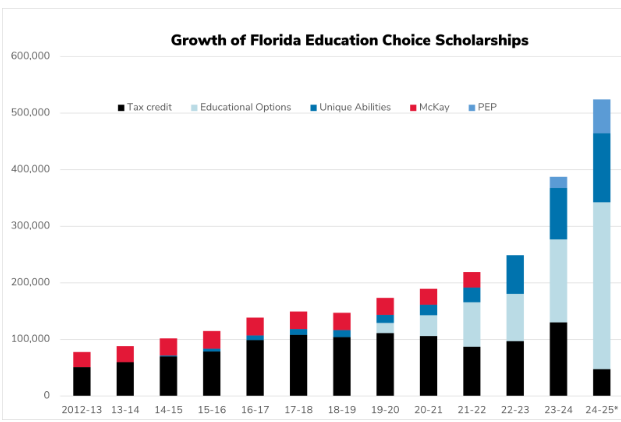
Florida’s education choice scholarship programs have grown steadily over the past decade. *Numbers for the 2024-25 school years are preliminary. In 2022, the McKay Scholarship and Unique abilities programs merged.
The numbers look like this:
With more than 500,000 K-12 students participating in some type of full-time education savings account, Florida is home to nearly 7 of every 10 students using such programs nationwide.
If the students using these programs in Florida counted as a school district, it would be the largest in the state and third-largest in the country, trailing only New York and Los Angeles.
Add it all up, and half a million Florida students will direct funding from a state-supported program to access a learning option of their family’s choice. This is a milestone 25 years in the making.

