By Lauren May and Ron Matus
Florida continues to be a standout in Catholic school growth. But the latest national data from the National Catholic Educational Association, released Tuesday, shows other states with expansive new school choice programs are gaining steam.
In fact, Florida is no longer the only state in the Top 10 states for Catholic school enrollment to show a net gain over the past decade. This year it’s joined by Indiana. The Hoosier State is now in the plus column thanks to this year’s jump of nearly 4,000 students.
(Indiana, by the way, replaced Missouri in the Top 10. Missouri’s enrollment has been relatively stable for the past five years, but it dipped just enough for Indiana to pull ahead.)
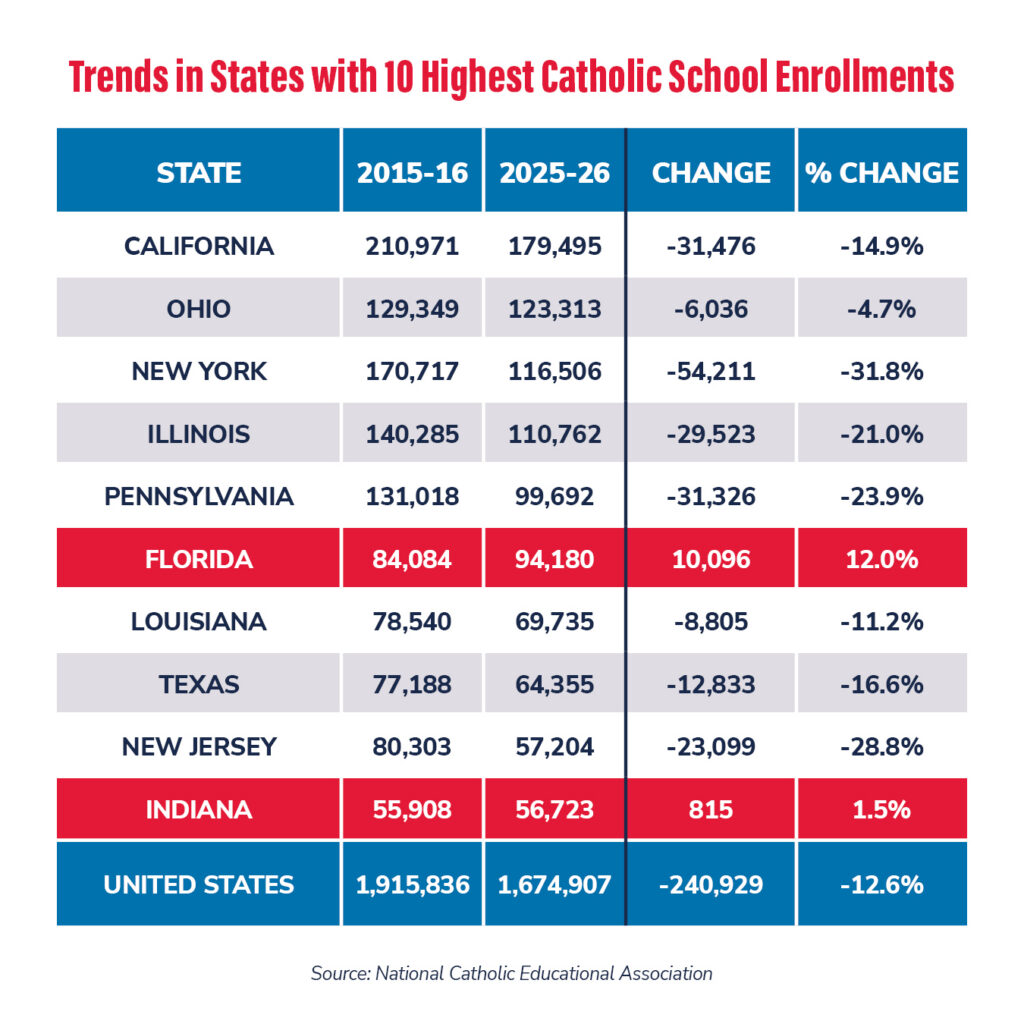
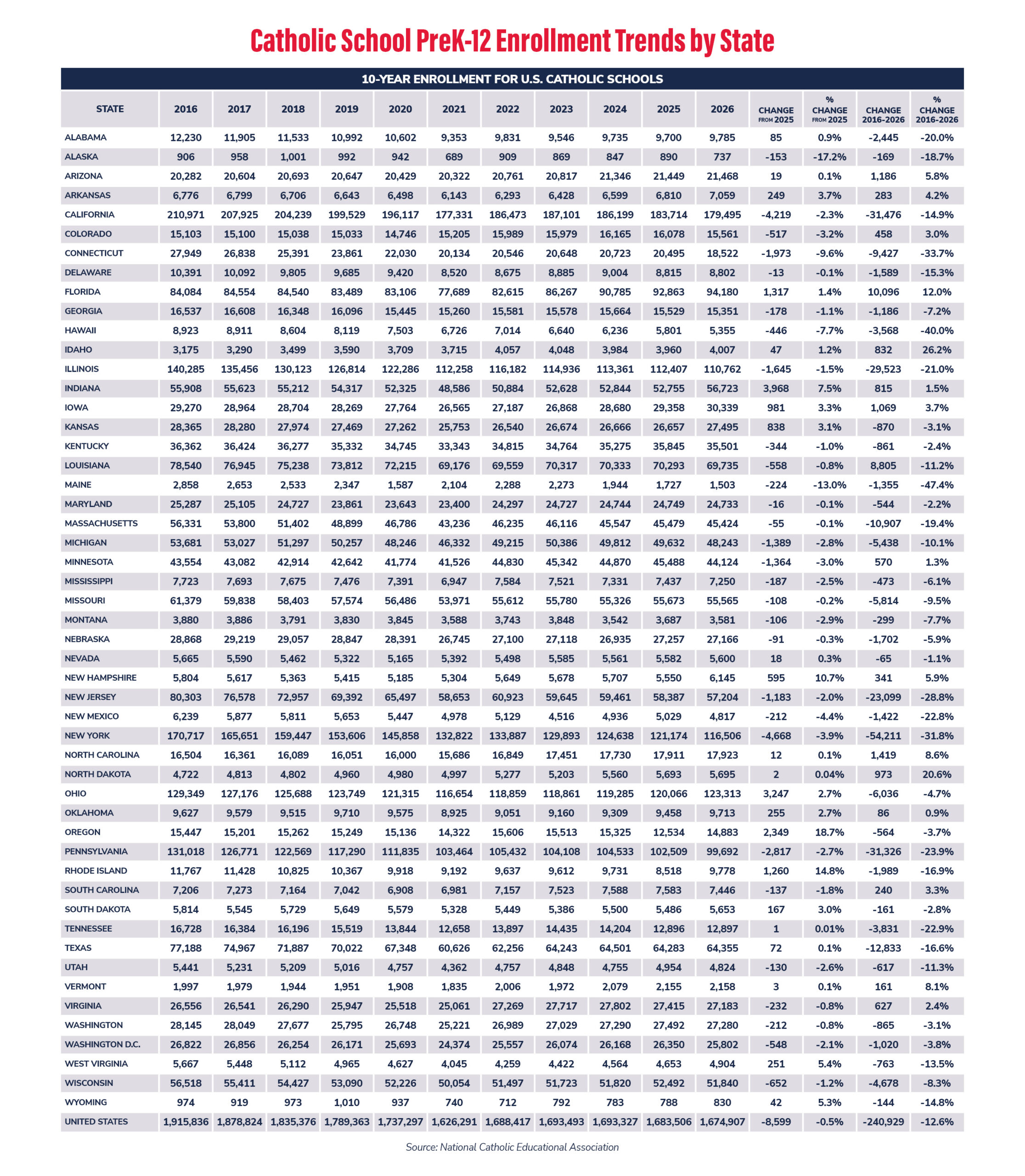
No state had a bigger one-year increase than Indiana, the new report shows. Plenty of others, though, are seeing significant growth, including Ohio, Iowa, and New Hampshire, all states with choice programs that encompass universal eligibility.
Check out the data for yourself in the chart we put together at the bottom of this post. It includes the NCEA’s year-by-year numbers for all 50 states, going back a decade.
The report isn’t just good news for individual states. Nationally, enrollment stayed pretty steady for a fifth straight year. After decades of falling numbers, that’s encouraging – and supporters of Catholic education, and education pluralism more broadly, should feel the wind at their backs.
Meanwhile, don’t forget about Florida just yet.
Catholic school enrollment down here is up 12% over the past decade, while total K-12 growth ran about 10% over that span.
The Sunshine State’s been the outlier for years, buoyed by the most robust school choice programs in America. It’s for that reason that we issued a special report, “Why Catholic Schools in Florida Are Growing: 5 Things to Know,” in 2023, and followed it up with update briefs in 2024 and 2025.
Stay tuned for the 2026 update soon.
About the authors
Lauren May is Vice President and Head of the Federal Scholarship Tax Credit Program at Step Up For Students and a former Senior Director of Advocacy at Step Up For Students. As a proud graduate of the University of Florida, she received her bachelor’s degree in special education and her master's degree in early childhood education. She then completed another master's degree in educational leadership from Saint Leo University. A former Catholic school teacher, early childhood director, and principal, she was honored with the University of Florida’s “Outstanding Young Alumni” award in 2018. As a believer
that parents are the first and best educators of their children, Lauren loves working with families across the state and beyond to ensure they can find and make use of the best educational options for their children.
Ron Matus is Director, Research & Special Projects, at Step Up For Students. He earned a bachelor's degree in history and English/creative writing from Florida State University and a master's degree in Florida Studies from the University of South Florida. He joined Step Up in 2012 after more than 20 years as an award-winning journalist, including eight years as the state education reporter for the Tampa Bay Times, the state’s biggest and most influential newspaper.
TAMPA, Fla. – Shuli Goldenberg didn’t need to see Tampa Torah Academy to know it would be just right for her now 12-year-old son, Yanky. After talking on the phone with a rabbi who co-founded the school, she was sure it was “perfection.”
Still, she had persuaded her husband, Yisroel Aron, to move 1,200 miles from the Catskills in upstate New York; to leave family behind; to start life anew in the Sunshine State – all for a school they’d never seen.
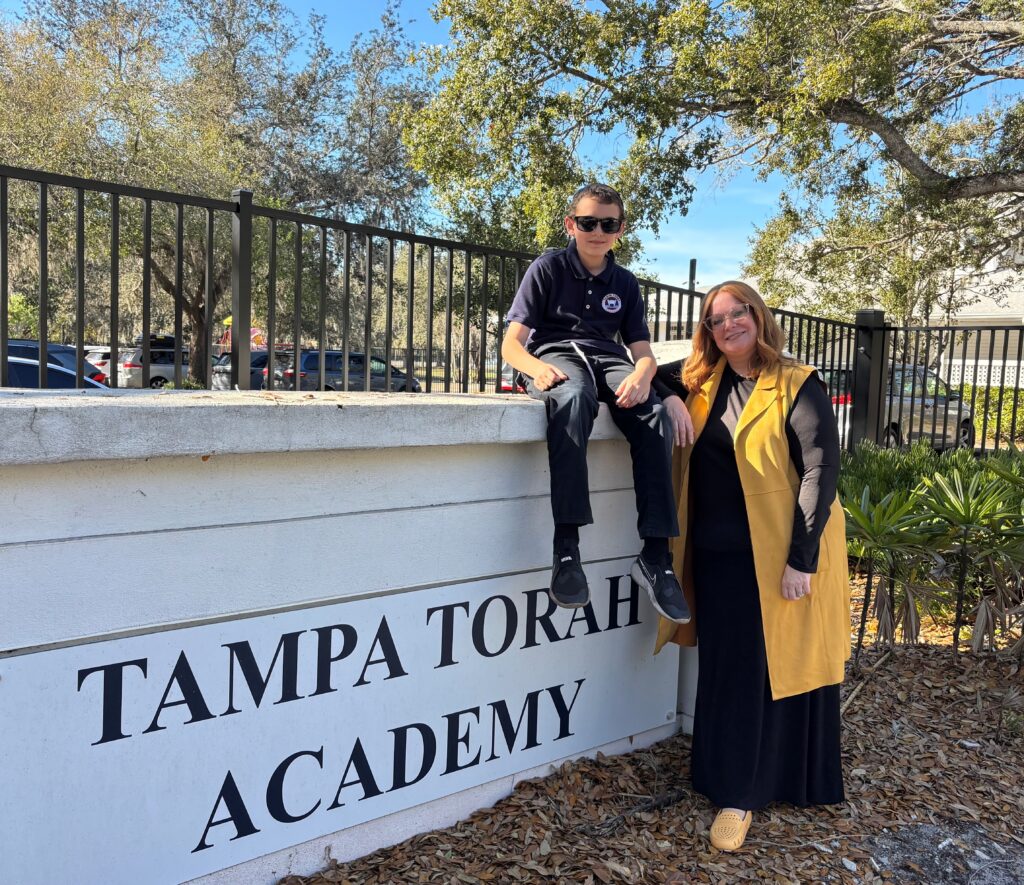
So, when she finally got to see it in person, a few days after the family moved down …
“I stood there with tears in my eyes thinking, ‘I’m home,’ ” Mrs. Goldenberg said. “It was like magic. It was exactly the school I wanted and exactly the school I knew my son would thrive in.”
The Goldenbergs are yet another example of a family drawn to Florida by educational opportunity (see others here, here, and here).
In their case, they represent what is likely the biggest group of “school choice transplants.” Hundreds if not thousands of Jewish families have moved to Florida in recent years, motivated at least in part by booming Jewish schools and the universal availability of state school choice scholarships.
The result: Between 2007-08 and 2022-23, the number of students in Florida’s Jewish schools grew 58%, to 13,379, and the number of Jewish day schools and yeshivas nearly doubled, from 40 to 74.
The Destination Florida pipeline is especially strong from New York to South Florida. But there are growing pockets of Jewish schools emerging in other parts of Florida too, like Tampa.
The why is obvious, said Rabbi Ariel Wohlfarth, co-founder of Tampa Torah Academy.
“School vouchers, no income tax, nice weather; why would you be any place else?” he said.
Tampa Torah Academy occupies a former preschool in a polished suburb. The school and its dormer windows and wraparound porch are framed by stately oaks and towering palms, next to a pond with a fountain whose streams arc outward in a circle, like the petals of a giant aquatic flower. An aerial view is the first thing people see when they visit the school website, along with the words, “Experience the Warmth of a Jewish Connection.”
Tampa Torah Academy opened in 2022 with 10 families, eight of whom relocated from New York. In the three years since, it’s tripled in size, from 33 students in grades K-7 to nearly 100 in K-12.
Every student uses a choice scholarship, which averages $8,000 or $10,000 a year, depending on the scholarship type. As of 2023, they’re available to every student in the state.
In New York, Yanky attended Jewish schools before Mrs. Goldenberg pulled him after a bullying incident.
She tried to homeschool him, but it wasn’t easy. She worried he wasn’t proficient enough in some subjects, like math, because of her own academic shortcomings, and that he wasn’t hanging out enough with other kids.
There were a few other Jewish schools in the area. But they were too expensive, too far away, or too big. Yanky, she said, “would have been lost and miserable.”
Thankfully, in the summer of 2022, Mrs. Goldenberg said, a miracle happened.
As word spread about a wave of Orthodox Jewish people leaving New York for schools in Florida, Mrs. Goldenberg got a fundraising pitch for Tampa Torah Academy. She donated, then called, then had a long conversation with one of the co-founders, Rabbi Yirmiyahu Rubenstein.
She was amazed by what she heard. The school promised solid instruction in both secular and religious studies; small class sizes; and teachers who would know each student’s strengths and weaknesses and adjust accordingly.
Everything “was like perfection,” Mrs. Goldenberg said. “I hung up the phone, I went across the house to my husband, and I said, ‘We’re moving to Tampa.’ “
Mr. Goldenberg is a retired businessman who worked in real estate. Mrs. Goldenberg is a former English teacher. Both had familiarity with Florida, having lived near Miami before things, for them, got too congested and hectic.
Neither knew the Tampa Bay area. But seven months after the call with Rabbi Rubenstein, they settled in Wimauma, a suburb 30 miles south of Tampa where a Jewish community is growing and former pastures are sprouting subdivisions.
“I thought Florida had flamingos, but we have cows next door,” Mrs. Goldenberg said.
Odds are high that more out-of-state families will be joining the Goldenbergs soon.
Tampa Torah Academy has room for 170 students – and it’s actively informing families in other states about what’s available in sunny Florida. Families in New York, New Jersey, and California, all states without private school choice programs, are among them.
As one indicator of the interest level, Rabbi Wohlfarth pointed to a recent, online “community fair” that connected Jewish communities nationwide to Jewish families interested in moving. Nearly 150 families visited the Tampa booth; more than 30 indicated serious interest.
The choice scholarships, Rabbi Wohlfarth said, are a powerful draw.
Jewish families are generally familiar with private school choice programs, “but they don’t know the amounts,” Rabbi Wohlfarth continued. When they hear what Florida provides, their ears perk up, he said. “They’re like, ‘I didn’t realize it was that much.’ “
Even without the scholarships, tuition at Tampa Torah Academy was more reasonable than similar schools up North, Mrs. Goldenberg said. The scholarship made it better still.
Without it, she said, paying for the school “would have been an enormous amount of stress.”
Tampa Torah Academy provides Yanky everything he needs to be successful, she said. It’s strong in both general academic subjects, what Orthodox families call “English,” and Jewish religious studies, often called “Judaics.”
“I wanted him to have both. That’s very important,” Mrs. Goldenberg said. “At Tampa Torah Academy, they also have a high school division now, so they can prepare to send the kids to the best colleges.”
Yanky said he’s happy with his new school and state. For top Florida amenities, he listed 1) “It’s not cold,” 2) theme parks, 3) Top Golf.
Mrs. Goldenberg said the only downside is the family’s two older children – a son and a daughter and their four grandchildren – are still in New York.
Otherwise? The people of Tampa Bay are “lovely,” she said, and the pace of life just right: “not as rush-y” as South Florida but more energizing than the Catskills. “There’s always something to do,” she said.
The cherry on top is the school, and the tight-knit community that revolves around it.
“Oh my God I love it. I feel like all of us are thriving,” she said. Meanwhile, friends up North are “buried under 27 inches of snow.”
By Lauren May and Ron Matus
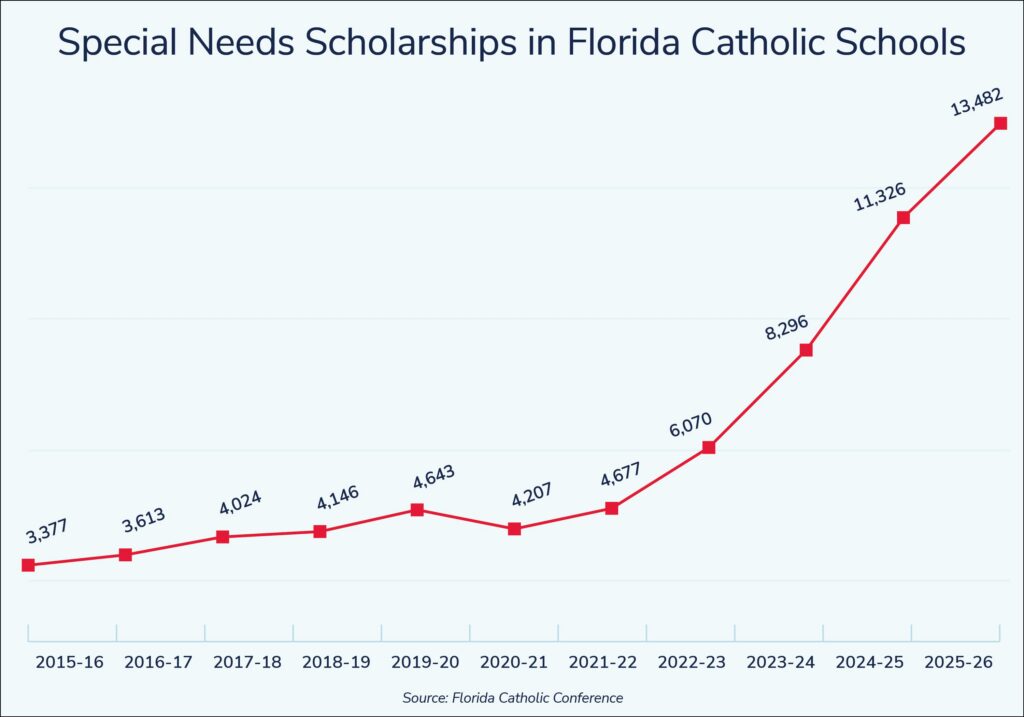
Catholic school enrollment in Florida is up again this year, rising 1.1% to 94,488 students, according to the latest numbers from the Florida Catholic Conference.
The continued growth is likely to bolster Florida’s reputation as the national standout in Catholic schooling. Through last year, Florida Catholic school enrollment was up 12.1% over the past decade. Nationally, it was down 13.2%.
To spotlight the trend lines, we published a special report in 2023, “Why Catholic Schools in Florida Are Growing: 5 Things to Know,” followed by update briefs in 2024 and 2025.
In that spirit, here are five things to know about the 2025-26 numbers:
The trend continues. This year marks five years of consecutive growth. Since 2020-21, when enrollment dipped in the wake of the pandemic, Catholic school enrollment in Florida is up 18.7%.
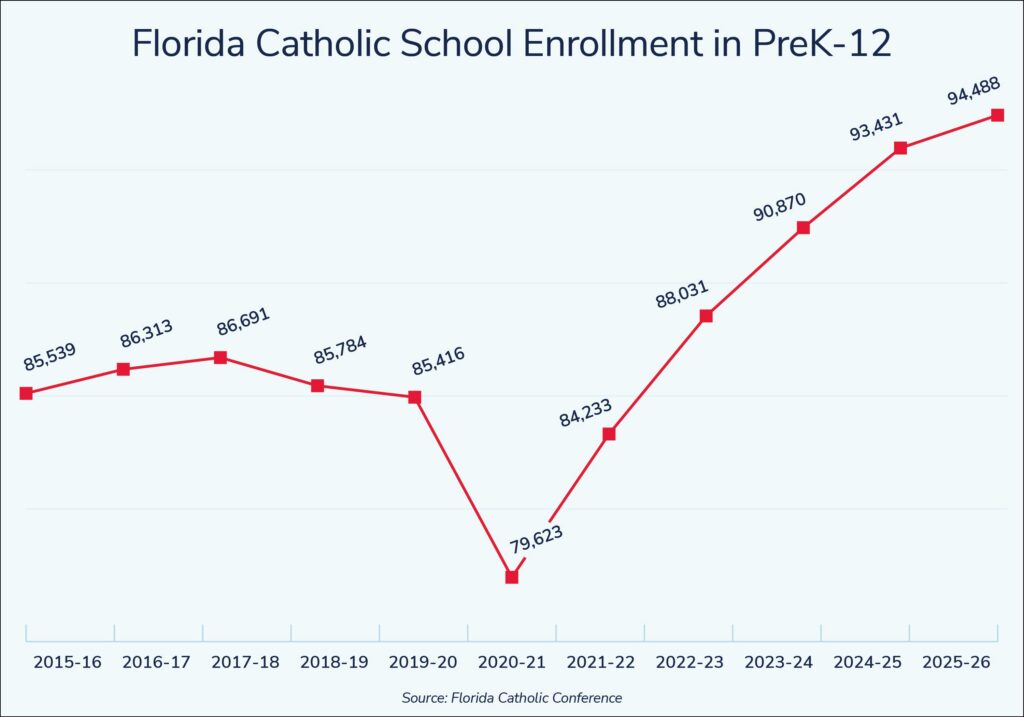
Special needs surge. Students with special needs are a leading factor. This year, Catholic schools in Florida are serving 13,482 students who use the state’s Family Empowerment Scholarship for Students with Unique Abilities. That’s up 19% from last year and triple the number from five years ago. FESUA students now encompass one in seven of all Catholic school students in Florida.
Non-Catholic students. Catholic schools have a long history of serving a diverse array of students. This year, 20% of students in Florida Catholic schools are non-Catholic, up from 14% a decade ago.
Choice scholarships are critical. In 2022-23, the year before choice in Florida became “universal,” 47.2% of all Catholic school students in Florida used choice scholarships. This year, 92.1% use them.
Context for the trend line. This year’s enrollment increase is smaller than any of the past five years. Time will tell whether that’s an anomaly. But it’s worth noting that except for a la carte learning, K-12 enrollment in Florida is slowing all over:
It’s likely that demographic shifts, including falling birth rates and declining immigration, are significant factors here. With private schools, it’s also possible that barriers such as zoning and building codes are preventing supply from better meeting demand. Last year, a Step Up For Students survey of parents who were awarded choice scholarships but didn’t use them found one in three said there were no seats available at the schools they wanted.
One final note: This post, not to mention our reports on Catholic education in Florida, wouldn’t be possible without the Florida Catholic Conference. FCC Director of Accreditation Mary Camp has been carefully tracking the enrollment and scholarship data for years. We are grateful to partner with the FCC and particularly indebted to Mary.
About the authors
Lauren May is Vice President and Head of the Federal Scholarship Tax Credit Program at Step Up for Students and a former Senior Director of Advocacy at Step Up For Students. As a proud graduate
of the University of Florida, she received her bachelor’s degree in special education
and her master's degree in early childhood education. She then completed another
master's degree in educational leadership from Saint Leo University. A former
Catholic school teacher, early childhood director, and principal, she was honored with
University of Florida’s “Outstanding Young Alumni” award in 2018. As a believer
that parents are the first and best educators of their children, Lauren loves working
with families across the state and beyond to ensure they can find and make
use of the best educational options for their children.
Ron Matus is Director, Research & Special Projects, at Step Up For Students. He
joined Step Up in 2012 after more than 20 years as an award-winning journalist,
including eight years as the state education reporter for the Tampa Bay Times, the
state’s biggest and most influential newspaper.
Editor's note: This story is part of our series marking National School Choice Week. We also recognize Catholic Schools Week, which runs concurrently. The scholarship application season opens on Feb. 1. Visit Step Up For Students to learn more and apply.
In 1999, the former school choice scholarship student was 10 years old and living in the Deep South Navy town of Pensacola, Florida. He was being raised by a single mom who worked as a cashier; growing up in a tough neighborhood; and going downhill in a tough public school.

Then, all of a sudden, he was a student at Little Flower Catholic School.
Experiencing the school for the first time, he told me 20 years later, “felt like going to Disney.”
The cathedral was towering. The statue of St. Therese, exotic. Even the classrooms smelled different. “Like Glade,” he said.
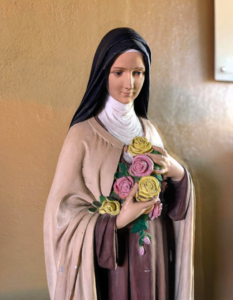
The former student didn’t know anything about the scholarship that allowed him to attend. He didn’t know why his mom enrolled him. He just knew that one day he was in third grade at a “bottom of the bottom” school, and then he and his too-big backpack were in fourth grade across town.
Just like that, he said, he went from playing dice and fearing he’d be called a “doofus” for studying, to collecting Pokémon cards and competing academically with the children of doctors and lawyers. For the next two years, the entire community at his new school — the teachers, the other kids, the other families — embraced him.
Two years, it turns out, was long enough for him to affix himself to a path no one else in his family had taken. To high school graduation. To a four-year college. To a good-paying job.
Without this little Catholic school, he said, none of it would have happened.
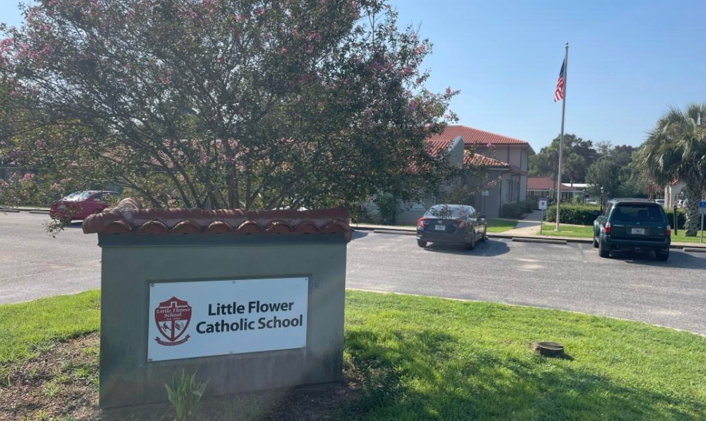
I met the former student in 2019. That was the 20th anniversary of Florida’s Opportunity Scholarship, the first, modern, statewide voucher program in America. I had set out to find some of the first “voucher kids” and see what happened to them.
Ultimately, I wrote about one of them, but not the kid from Little Flower. His story, though, seared into my brain.
It was uncanny how he so clearly described how this one, brief education intervention so radically changed the arc of his life. He said Little Flower showed him what school was supposed to be like, and, more importantly, what a family was supposed to be like.
A few years later, I would think of the student when choice opponents tried to demagogue scholarship programs because some low-income students use the scholarships only for a short time. They insinuated short-term use proved the poor quality of available private schools, rather than reflect student transience tied to income.
I continue to think about the former student today, as I continue trying to understand why some schools are so much more effective for low-income students. For half a century, we’ve known Catholic schools are among them. It’s another reason I’m grateful Catholic schools in Florida are growing again, and excited about the potential of school choice to reverse the trend lines in other states, too.
The “Catholic school advantage” has made the American Dream a reality for millions of working-class kids, usually at far less cost than public schools. But why?
“Catholic Schools and the Common Good” sought to answer that question. A classic in education research, it was published in 1993, just a few years before Florida launched its first scholarship program. It’s jarring how many school characteristics identified as central to Catholic school effectiveness are so basic.
An orderly environment. High expectations for every student. A focus on academics and character. And above all, pervasive warmth and hope, grounded in a faith that extended a “genuine sense of human caring” to every kid.
Why is it so hard to get more of that?
…
The kid was assigned to his neighborhood school. He and the school struggled. The man he grew up to be described the school and its outcomes this way:
The kids who went there, many of them are either dead or in jail or not successful. It was the bottom of the bottom in a sense. Kids who’ve been generation after generation in a certain mindset. The same cycle. Generational curse. Broken homes. A lost generation of kids with no fathers.
In first grade, he was held back.
“I don’t know if it was because he was slow at that time, or if the teacher didn’t take the time out to teach right,” his mom told me. “I went to school a couple times and asked, ‘What’s going on?’ They said, ‘He’s a good kid. He behaves. He’s trying.’”
But as time went on, the kid began hanging with tougher students. In hindsight, he said, he was “starting to go to a dark place.”
Just in the nick of time, the stars lined up.
Students were eligible for the Opportunity Scholarship if they attended a public school that earned two F grades in four years. The student in Pensacola attended one of those schools.
…
The kid’s mom couldn’t drive him to Little Flower every day. It was a long haul. Her car was unreliable. Her elderly friends volunteered to give her son rides.
They didn’t have much money, but sometimes they’d hand him a dollar for lunch. They told him he had an opportunity other kids didn’t have.
Study hard, they told him. … Stay away from the street … Make your mama proud.
The kid started at a second-grade level academically, even though he was in fourth grade. He said many of his classmates were already doing middle school work. But no one at Little Flower ever made him feel inadequate, he said. His teachers simply gave him more 1-on-1 attention so he could catch up.
Gratitude fueled him. He didn’t want to let down his mom. Or the “old heads” who gave him rides. Or a former teacher from his prior school, who sometimes took him to church and told him, “There’s something special in you.”
Competition fueled him, too. He knew he was behind many of his classmates but was determined not to stay there. Everything about the school, he said, told him he was just as capable.
The former student said he loved the diversity at Little Flower. Working class, middle class, upper class. Mostly white, but with a growing number of Asian students and, thanks to the choice scholarships, more Black students. Increasingly diverse, yet united as a community.
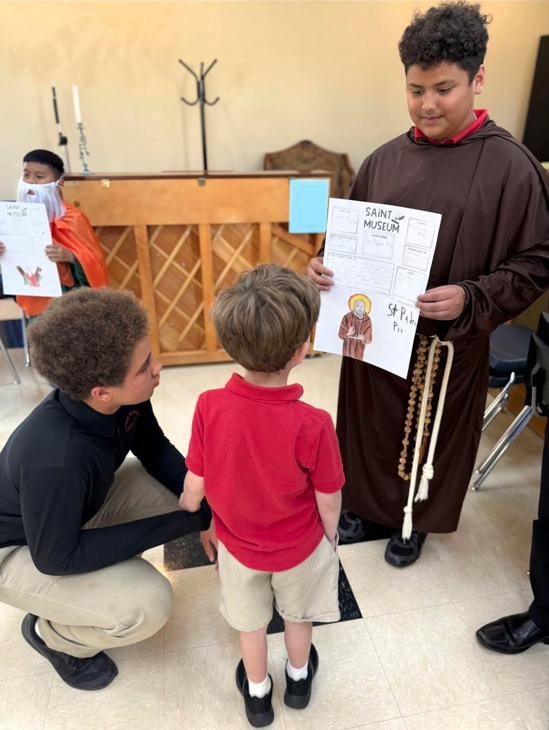
The kid said his new friends invited him into their lives, where he glimpsed a world he’d never seen. Comfortable homes. Nice things. Moms and dads.
“It opened up my mind to think different,” he said, “to understand that just because you come from a certain area, you don’t have to follow that line.”
…
The kid returned to his zoned school for middle school. He didn’t know why. His mom couldn’t remember.
But the lessons from Little Flower stuck with him.
He graduated from high school, attended a four-year college, and earned a bachelor’s degree. He said he loved college, and not just for academics. He was surrounded, he said, by students with “concrete families.”
Just like he was at Little Flower.
“I got to see what a family was,” he said. “A functional family. A healthy family. This is what a family feels like. It gives you spirit … inspiration … warmth … “
Today, the former scholarship kid has a good-paying job. He’s married with kids. He told me his “biggest mission in life is to raise a healthy family.”
Little Flower taught him that, he said, without ever having to say it.
By Ron Matus and Julisse Levy
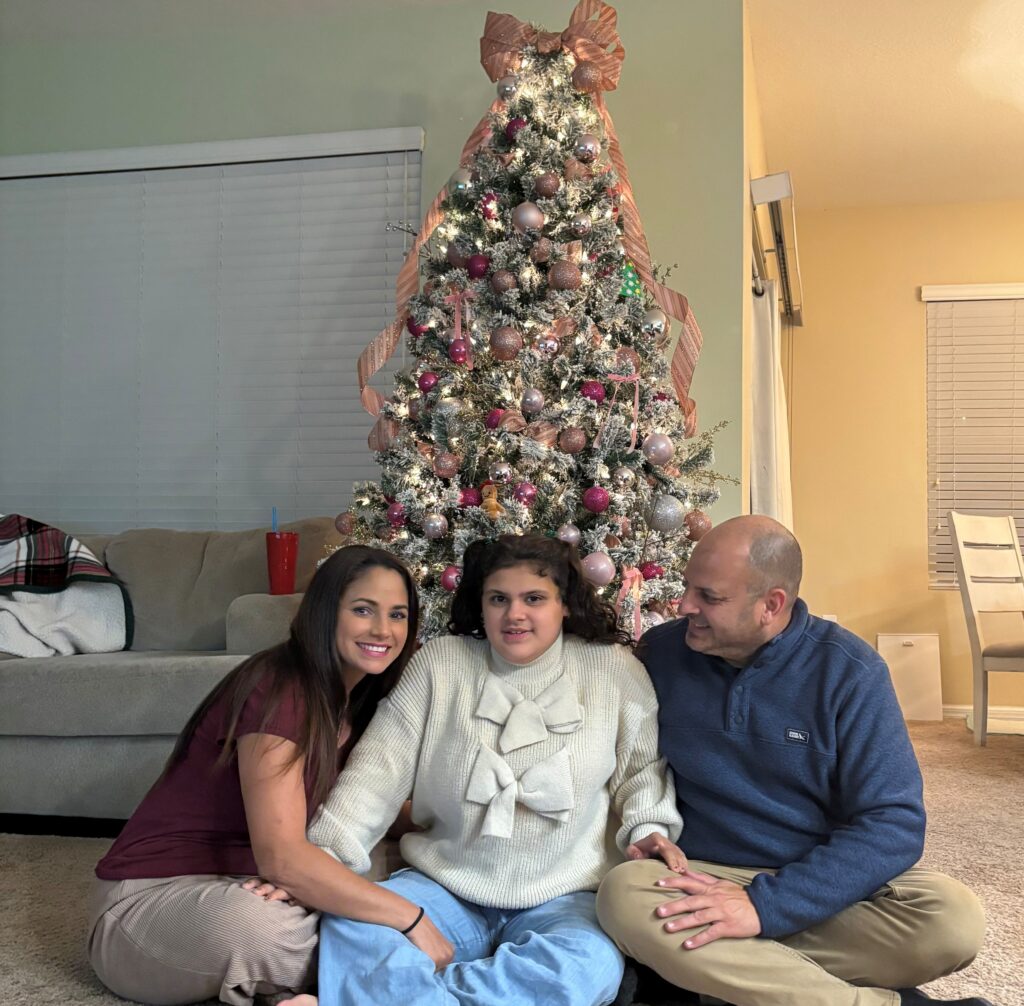
HUDSON, Fla. – In 2022, Joel Hernandez and his wife, Norma Torres, had to find a new school for their then-9-year-old daughter, Fabiola. In their part of Puerto Rico, they felt their options were, at best, limited.
Fabiola is on the autism spectrum. Over the years, her parents visited and/or researched every public and private school in the area that served students with special needs. It was not a pretty picture.
In some, up to 30 students with vastly different learning and support needs were crammed together in the same classrooms. In one, students with a wide range of ages and special needs were grouped in a room that doubled as storage for desks, tables, and other equipment. Yet another was so lacking in security that Hernandez walked from the entrance to the classroom without anybody asking who he was or what he was doing.
In the end, the couple settled on a school that looked good on paper. But it turned out to be a bust, too. It never delivered on promises of regular speech and occupational therapy.
Fighting for Fabiola left the couple drained. Their daughter needed every opportunity to gain skills that would allow her to live as independently as possible as an adult, and it wasn’t happening.
“We spent nights crying,” Hernandez said. “We looked at each other every day and said, ‘What are we going to do?’ “
As things grew desperate, the couple began to consider moving to the states for better educational opportunities, and more specifically, to Florida, where they had enjoyed time on vacation. When they began researching schools in the Sunshine State that served students with autism, one immediately jumped out.
It had Hope in its name.
'I knew it was meant to be'
Hope Ranch Learning Academy is a K-12 school with 250 students an hour north of Tampa.
From the school website, the couple could see a campus awash in moss-draped oaks. To them, it looked calming. The school featured equine therapy, which Fabiola experienced in Puerto Rico and loved. It was also a Christian school, which was very important to the family.
Incredibly, Hernandez and Torres also saw a familiar face on the website, a girl who had been Fabiola’s friend years prior.
“God intervened,” Hernandez said. “I knew it was meant to be.”
The couple contacted the girl’s family, who referred them to a school administrator. The woman told them that Hope Ranch had a long waitlist — it’s now more than 80 students — and they had to be Florida residents to get on it. She asked, “Do you really want to move because of the school?”
“That was the a-ha moment,” Hernandez said. “We said, ‘In Puerto Rico, we have nothing for our daughter. We have to move.’”
Private school boom, scholarships, draw families
Families are moving to Florida because of its schools and school choice.
It’s not just the abundance of state choice scholarships, which average $8,000 or $10,000 each and are now available to every family. It’s the entire, choice-driven system. Florida’s education landscape is becoming more diverse and dynamic by the day, as the families of 500,000 students using scholarships (and growing) shape it with their preferences.
In the past 10 years alone, the number of private schools in Florida has grown by a third. That’s a net gain of more than 700 private schools, which is more than 39 states each have, period. And what’s more impressive than the number is the variety.
Schools like Hope Ranch, which was a semi-finalist for the Yass Prize in education innovation, are not anomalies. High-quality schools serving students with special needs have emerged in every corner of the state, and some are now drawing families from out of state. At the North Florida School of Special Education, for example, the families of 24 students moved from out of state, including this family from Maryland.
At Hope Ranch, a half-dozen families have even moved from other countries or Puerto Rico.
Equine therapy and transition program set Hope Ranch apart
In Puerto Rico, Hernandez taught marketing at a college and sold beauty supplies. Torres worked as a nail technician. Moving to the States obviously would mean leaving friends and family and starting over with new jobs, a new house, everything. But Fabiola’s future depended on it.
In November 2023, the family and their three dogs moved into their new home, 12 miles from Hope.
Since Fabiola couldn’t attend the private school right away, her parents enrolled her in the neighborhood public school. It turned out to be excellent. One teacher in particular paid extra attention to Fabiola and made sure she got the help she needed, including a full-time, 1-on-1 assistant.
“There’s always an angel over Fabiola,” Hernandez said.
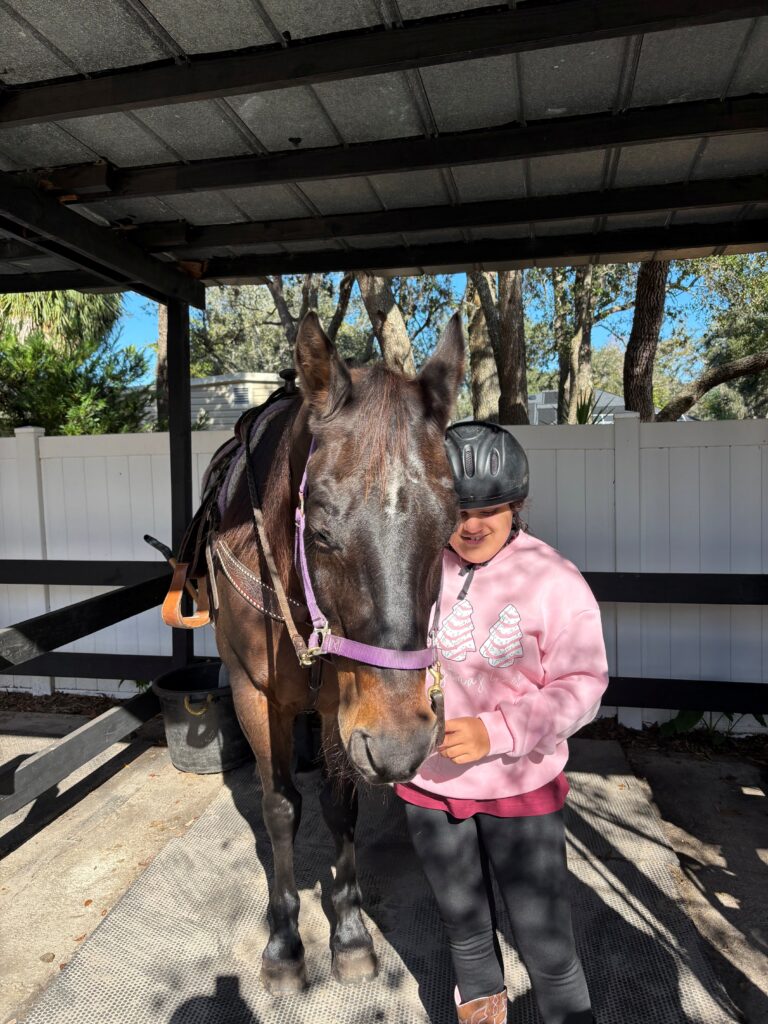
Hope Ranch, though, remained ideal. Besides the equine therapy program, the school operates a highly regarded transition program that prepares students for independent living as adults. In December, the Yass Prize awarded Hope founders Jose and Ampy Suarez an alumni grant, so they could build a separate high school campus and expand the transition program.
Hernandez periodically checked in with Hope to see how much the waitlist was shrinking. Finally, in June 2025, the administrators invited the family to the school so they could share the good news in person.
Fabiola was in.
Family credits school choice scholarship for making Hope Ranch affordable
Classes started in August. Just a few months later, Hernandez said the change in Fabiola has been “astronomical.”
Fabiola smiles more. She’s happy when she wakes up. She’s happy on the way to school.
She’s more independent, confident, communicative. She doesn’t cover her face as much as she used to. She tries to verbalize more. She makes eye contact more often.
“She wants to play with other children now,” Torres said. “She feels included. They grab her hand and say, ‘Come with us.’ “
Last month, Fabiola and the other Hope Ranch students performed a stage version of “The Little Drummer Boy” for students at a nearby high school. Fabiola was on stage for an hour.
“I know she has to progress more,” Hernandez said, “but we feel very good.”
None of this would have been possible without Florida’s choice scholarship, he said. The family couldn’t afford Hope Ranch without it.
The school told the family about the scholarship. But Hernandez couldn’t believe how easy it was to get.
In Puerto Rico, he and Torres were accustomed to filing all kinds of education requests on Fabiola’s behalf and waiting long stretches for answers. With the scholarship, they got the award notice within 24 hours of applying. “I thought I was going to have a heart attack,” Hernandez joked.
“We had this in our dreams, but we didn’t know it could come true. Florida and Hope were a dream come true,” Hernandez said as he started to cry.
“I’m sorry I have to cry, but it’s very emotional,” he continued. “In Puerto Rico, all we had were problems” with Fabiola’s education. “Here we have solutions.”
Some quotes in this story were translated from Spanish to English with the assistance of Julisse Levy, director, head of business Initiatives, Federal Scholarship Tax Credit, at Step Up For Students.
The category is “Lifelong dreams.”
These are the clues.
Many find this experience fun, exciting, and a little scary.
What is being on “Jeopardy!”?
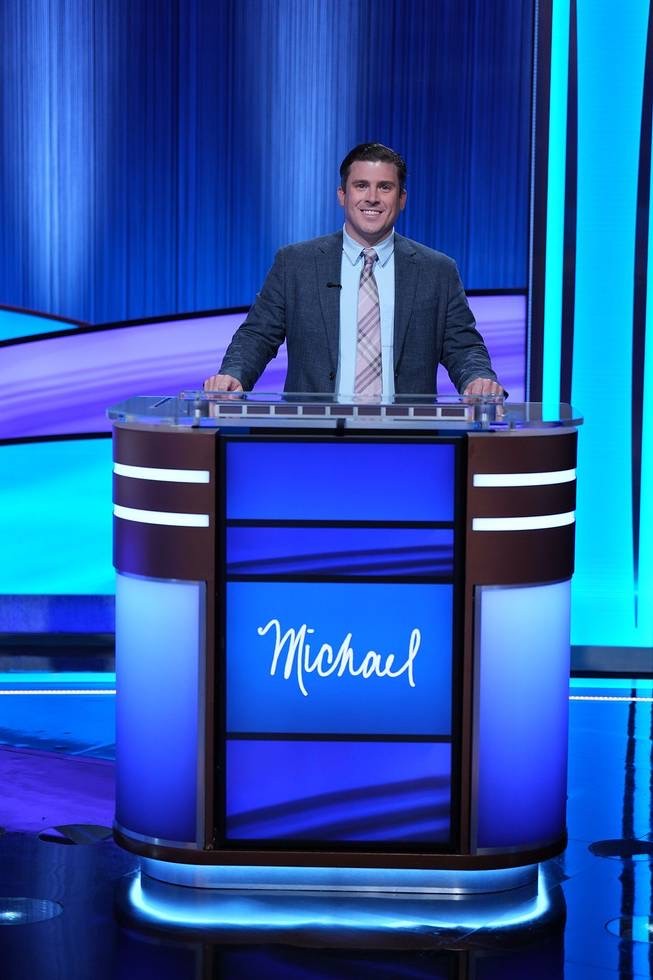
The answer is correct if you’re Michael Kavanagh, principal at Holy Family Catholic School, a K-8 parochial school in Jacksonville.
For as long as Michael can remember, he wanted to appear on “Jeopardy!,” the game show where the answers are given, and the contestants guess the questions. A dream that became a goal when Michael reached high school became a reality when he appeared on the show that aired on Nov. 24.
Michael placed second among the three contestants. He was a perfect 12-for-12 in his answers, including “Final Jeopardy!,” when he was the only one to successfully answer the question. He earned $12,600.
“To be able to say that I accomplished something that I've wanted to do since I was a kid, to be able to actually pull it off and get on the show, that was really just a dream for me,” Michael said.
All but a handful of Holy Family’s students attend the school with the help of a Florida education choice scholarship managed by Step Up For Students. Many watched their principal live out his dream, which made Michael the big man on campus when school resumed after the Thanksgiving break.
And maybe a role model.
“Step Up exists to give children opportunities, to give children a chance to go to a great school and get a great education,” Michael said.
And with that education, well, they too can someday be on “Jeopardy!,” if that’s a goal they want to chase.
“That's what I hope our students see the value in,” Michael said. “I didn't use my athletic abilities. I didn't use my strength or anything like that. I was fortunate enough to go to great schools and learn from great teachers, and I used that knowledge to pursue something that I really loved.
“I think it just shows you that when you have an opportunity, and when you have a dream, and you want to follow it, all these things are possible. So, I do hope that maybe being a role model for someone as a ‘Jeopardy!’ contestant, that's maybe a little bit of a nerdy thing to do, but I do hope it shows the kids that there's value in learning and there’s value in pursuing your dreams.
“It's good to be smart.”
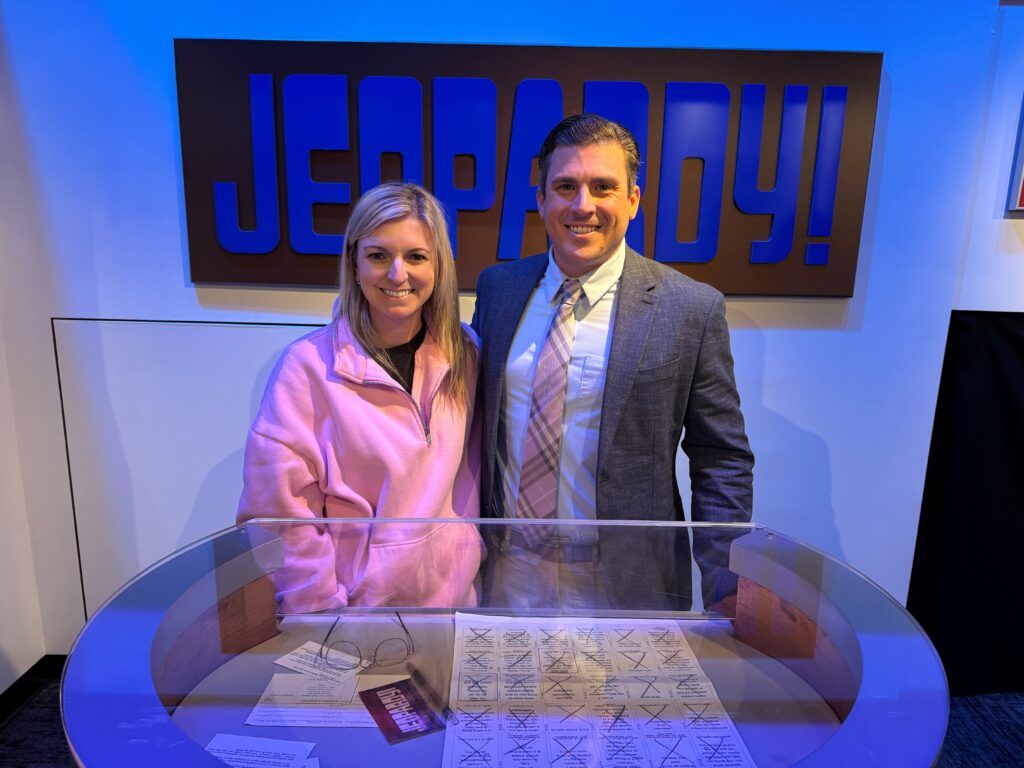
To be selected for “Jeopardy!,” Michael had to pass an online test, then an interview. He had taken the test several times, but this was the first time he was interviewed. In September, he received the call. He would be on the show that was taped Oct. 21.
What is ecstatic?
Michael was told by the show’s producers that 70,000 people take the test each year, but only 450 make it to the show.
“Just being there, you’re in pretty elite territory,” he said.
Michael and his wife, Allison, flew to Los Angeles for a three-day trip. They had to keep the results to themselves until after the show aired.
While Michael didn’t win -- Harrison Whittaker from Terre Haute, Indiana, extended his winning streak to 10 games that day – he was the only one who answered every question correctly.
Other than reviewing the names of Shakespeare characters, U.S. vice presidents, and capitals of foreign countries, Michael said he didn’t study for his big moment. It’s nearly impossible when the show’s producers can pick from a nearly endless list of categories, or, as they did that day, create one where the contestants were given two words and had to change the last letters to form another word.
Michael entered with the random facts accrued over a lifetime of being curious.
“It was just stuff that I've picked up over 40 years of listening, and reading, and studying,” he said. “I'm very blessed with a mind that is always curious and remembers facts that I find interesting. For me, I think everything is interesting.”
It was a combination of facts that led him to the correct answer to “Final Jeopardy!,” the last question of the show and the one that often determines the winner.
The clues:
He wasn't yet a U.S. citizen when he was named an All-American and won two Olympic gold medals for the country.
Michael had 30 seconds to answer.
“I didn’t actually know the answer,” Michael said.
But he knew Jim Thorpe was a Native American, and he knew Thorpe was an Olympic champion, and knowing what he does about American history, he figured Native Americans were probably not considered American citizens at that time.
Who is Jim Thorpe?
“I was able to piece together all of those little bits of information to come up with a really confident guess as to what the answer was,” Michael said. “So, it was a lot of problem-solving, too. A lot of ‘Jeopardy!’ is not, ‘Do you know facts?’ It's, ‘Do you know this fact, and can you use it to lead you to something else?’ ”
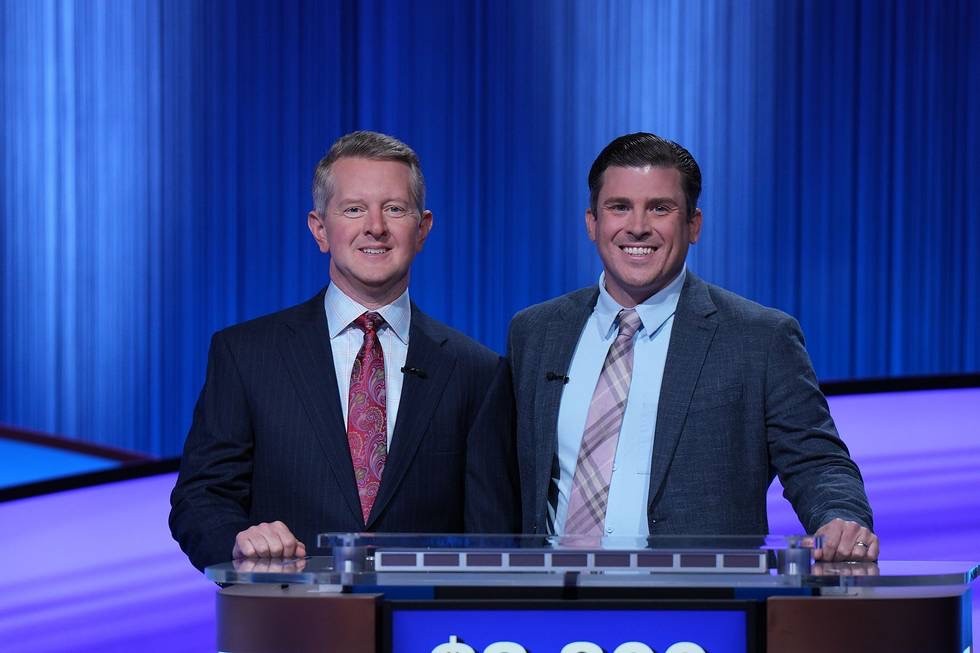
“Jeopardy!” tapes a week's worth of shows on Mondays. Michael’s show was the first one that was taped. Afterward, he sat in the audience with Allison and watched two more shows.
Each show is 30 minutes, but because of commercials, contestants are on air for only 22 minutes. Add a few practice questions before taping began, the excitement of being on the iconic “Jeopardy!” set, and the mental energy needed to come up with answers in a split second, and Michael was a little worn out when it was over.
“It’s a competition,” he said. “It's not athletic, but you definitely feel like your body has gone through something. Your brain was spinning, and your heart was racing, and then it's over, and you take a deep breath, and you realize that's it. I'm done. And that was incredible.
“Honestly, it's more like riding a roller coaster, and you get off, and you think, ‘Well, that was fun and exciting and a little scary.’”
MIRAMAR, Fla. — William Ivins moved his family to South Florida ahead of his retirement from the United States Marine Corps and enrolled his children at Mother of Our Redeemer Catholic School, hoping they would reap the same rewards as he did from a faith-based education.
But, as William and his wife, Claudia, would soon learn, that was easier said than done.
A lawyer for much of his 20-year career in the Marines, William needed to pass the Florida Bar Exam before he could enter the private sector. It was a long process that left him unemployed for 19 months.
“It was a struggle,” he said. “My retirement income was not enough to pay for the cost of living and tuition for my children.”
The Ivins' faced a few choices: continue with the financial struggle, homeschool their children, send them to their district school, or move out of state. None were appealing to the Ivins, and fortunately, they didn’t have to act on any.

Florida's education choice scholarships managed by Step Up For Students allow his four children to attend Mother of Our Redeemer, a private K-8 Catholic school near the family’s Miramar home.
“It was a perfect storm of having to retire from the Marines and not really having a job lined up,” William said. “The transition was more difficult than I thought it would be. The income just was not available for us to continue our kids’ education in the way we wanted. Had the scholarship not been there, we would have been forced to move out of state or homeschool them or move them to (their district) school.”
In July 2020, the Ivins moved to South Florida from Jacksonville, N.C., where William had been stationed at Camp Lejeune. William contacted Denise Torres, the registrar and ESE coordinator at Mother of Redeemer, before making the move. She told William the school would hold spaces for his children. She later told him about the education choice scholarships managed by Step Up For Students.
“That was a big relief for him,” Torres said.
At his mother’s urging, William began attending Catholic school in high school.
“That was a life-changer for me,” he said.
He converted to Catholicism and vowed if he ever had children, he would send them to Catholic school for the religious and academic benefits.
Rebekah graduated in May from Mother of Our Redeemer. She had been an honor roll student since she stepped on campus three years ago.
“Rebekah likes to be challenged in school, and she was challenged here,” Claudia said.
Rebekah, who received the High Achieving Student Award in April 2022 at Step Up’s annual Rising Stars Awards event, is in the excelsior honors program as a sophomore at Archbishop McCarthy High School.
“She's an amazing, amazing student,” Torres said. “It’s incredible the way she takes care of her brothers. She's very nurturing. Every single teacher has something positive to say about her.”
Rebekah’s brothers, Joseph (seventh grade) and Lucas (fourth grade), do well academically and are active in Mother of Redeemer’s sports scene, running cross-country and track. Nicholas, the youngest of the Ivins children, is in second grade. He was allowed to run with the cross-country team while in kindergarten, which helped build his confidence.

William had been in the Marines for 20 years, eight months. He served as a Judge Advocate and was deployed to Kuwait in 2003 for Operation Iraqi Freedom, to Japan in 2004, and then to Afghanistan in 2012 for Operation Enduring Freedom.
He retired in May 2021 but didn’t find employment until December 2022. The Florida Bar Exam is considered one of the more challenging bar exams in the United States. He took the exam in July 2021 and didn’t learn he passed until September. It took William more than a year before he landed a position with a small law firm in Pembrook Pines.
Claudia, who has a background in finance, works in that department at Mother of Our Redeemer Catholic Church, located next to the school.
“They have really become part of our community,” Principal Ana Casariego said. “The parents are very involved and are big supporters of our school and church.”
In Mother of Our Redeemer Catholic School and Church, Willian and Claudia found the educational and faith setting they wanted for their children.
“It is a small community environment where you know all the teachers and staff by first name,” William said. “My kids have received a wonderful education in an environment where they don’t have to worry about bullying, and they can really strive to grow and do their best academically.
“The scholarship kept us in the state and kept our kids in the school system that we wanted them to be in. It’s been a great blessing to us.”
JACKSONVILLE, Fla. – The diagnosis was Entamoeba histolytica, which is an infection caused by ingesting an amoeba that produces fatigue, abdominal pain, weight loss, and a few more symptoms you don’t want to have when you are more than 9,000 miles from home.
That’s where Christopher Trinidad happened to be during a visit to his parents’ homeland in the Philippines the summer before the eighth grade.
Born and raised in Jacksonville, Christopher’s immune system was not accustomed to some of the pathogens found in the local food. He had not built up a resistance like residents have. Lying in a hospital bed in the city of Bacolod, while the antibiotics did their thing, Christopher had this thought: “This has to be my science fair project.”
And so it was.
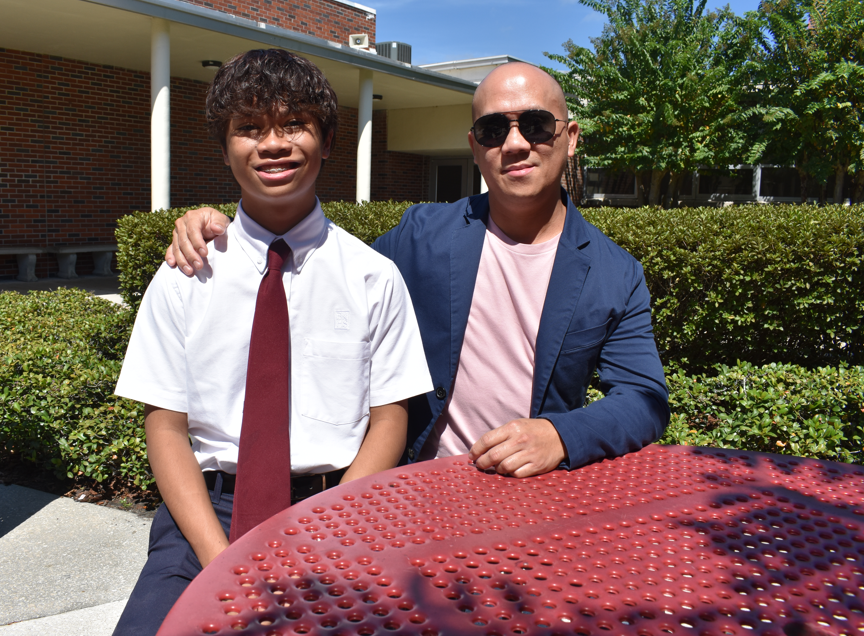
After returning home, Christopher ordered microorganisms online. “Safer organisms,” he said, than the one that waylaid him a few weeks earlier. He experimented with various items found in the kitchen pantry – ginger and garlic – mixed them with water and other ingredients and developed a solution that killed the organisms.
“What if,” Christopher thought, “we use these solutions on the actual thing? This can help so many people.”
His project finished first at a regional science fair.
“Impressive, right? Wait until you hear what he did his freshman year,” said Carla Chin, director of marketing and communications at Bishop Kenny High School in Jacksonville.
Christopher, a sophomore, attends the parochial Catholic school on a Florida education choice scholarship managed by Step Up For Students.
He sat in a chair inside Chin’s office. His father, Greg, sat in another and proudly listened as his son, with a mixture of pride and modesty, described the project that earned first place at a regional science fair and then a bronze medal at the Genius Olympiad and a $15,000 scholarship to the Rochester Institute of Technology at a global competition held in Rochester, New York.
Using an electroencephalogram (EEG), which measures electrical activity in the brain, artificial intelligence, virtual reality, and violin music, Christopher was able to predict the moods and emotions of stroke victims who are unable to speak, thus creating a line of communication with doctors.
“By using brain waves, doctors can know what their patients are feeling, which would lead to better decision-making,” he said.
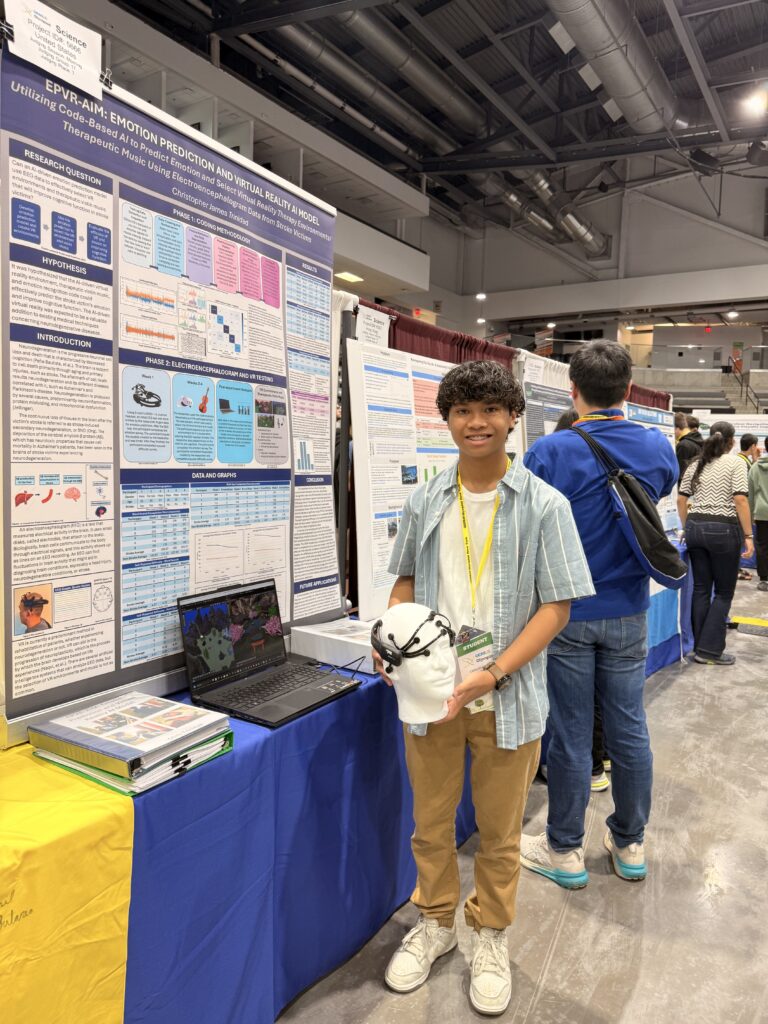
Michael Broach is the Vice Principal at Bishop Kenny and the Director of Mission Integration, as well as the AP Capstone Department chair. He was responsible for approving Christopher’s science project.
“That was one of the most sophisticated projects, I think, that I've seen in my years of being here,” Broach said. “And just the way his mind works is well above his peers. Well above what you would expect of somebody of his age.”
Christopher is 15.
He wants to be a neurosurgeon.
“I’ve always been fascinated with the brain since I was little,” Christopher said. “It controls everything in our body. It’s really interesting, and going into surgery, fixing people's brains is really complex, and that's what I love about it.”
His parents – Greg and Shiela – are both nurses, so Christopher was raised around medical science. Their house is filled with textbooks related to their careers. Christopher has read them all.
The valedictorian of his middle school, Christopher has a 4.3 weighted GPA at Bishop Kenny. He chose to attend the Catholic high school because it aligns with his faith and has a high academic standard.
“It challenges me,” he said. “I know there are other people here I can talk to, and it gives me a greater experience.”
He’s not the only student at Bishop Kenny who knows what an electroencephalogram is and how it works.
While he spends a considerable amount of time working on his science fair projects (keep reading to learn about what his plans are for this year’s project), he’s very active at school. Christopher is a member of the Science Club, Medical Career Club, St. Vincent de Paul Society, campus ministry, and the Brain Brawl. He plays the piano at the monthly mass. He’s also first violin for the Jacksonville Symphony Youth Orchestra.
Listening to his son talk, Greg had one feeling. “Blessed,” he said. “He has a humble heart. We try to remind him always what’s hard.”
Greg understands hard.
Raised in a small town an hour’s plane ride from Manila, Greg’s childhood was humble at best. He went through elementary school with only two pairs of shoes. He caught rides to school on trucks headed to the sugarcane fields on days when his mom couldn’t afford bus fare.
“I didn’t have the opportunity to join the Boy Scouts,” Greg said. “My mom didn’t have the money.”
Greg understood the power of an education and where it could lead him. He became a teacher until, at age 26, he immigrated to the United States in search of the American Dream.
He worked odd jobs and became a certified nursing assistant. From there, he attended nursing school in St. Augustine. He now works as a traveling nurse in the cardiac catheterization labs in hospitals around North Florida. He became a traveling nurse for the pay because he and Sheila support three family members in the Philippines.
That’s why Christopher traveled to the Philippines the summer before eighth grade, to see where his parents’ stories began.
“I wanted him to see and feel the difference of being here in this world compared to a third-world country,” Greg said.
The lesson wasn’t lost on his son.
“I just feel really lucky that I'm here in America and I have more opportunities than some kids have in the Philippines, and I’m not going to let this go to waste,” Christopher said.
Greg said he is grateful for the Florida education choice scholarship that helps pay Christopher’s tuition at Kenny.
“In the Philippines,” he said, “if you don’t have money, you don’t go to school.
“He has this opportunity of having this scholarship, and I'm telling him, you're way more blessed than what other people have in other states. We're so thankful that all these opportunities are coming for our son.”
Christopher’s next opportunity is this year’s science fair, where he will take last year’s project a step further.
“I'm planning to build a rehabilitative exoskeleton so it can help people with movement disabilities,” he said. “I can also use an EEG in that, so they can think about what they're going to do with their exoskeleton, which basically helps them move. It would correlate to their actual thoughts. So, if they wanted to walk, they would be able to think it, then the exoskeleton would help them walk.”
SAFETY HARBOR, Fla. – Edelweiss Szymanski turns 10 on a Friday in December. She will celebrate the milestone by running a 5-kilometer race in Daytona Beach. The next day, she’s scheduled to compete in a triathlon.
No pizza party. No theme park.
How many 10-year-olds want to run three miles on their birthday, then swim, bike, and run some more the day after?
“This one does,” Lacey Szymanski said, pointing to her daughter with both index fingers.
Meet Edelweiss, a young triathlete on the rise who’s as tough as the flower she’s named after. Meet her brother, Spartacus, too, 14 months younger and just as tenacious.
The SkiSibs, as they are known throughout Florida’s triathlon community.

The SkiSibs: Spartacus and Edelweiss. (Photo by Roger Mooney)
Their bedrooms are filled with trophies, medals, and plaques – the spoils of reaching the podiums (finishing in the top three) at triathlons, road and bicycle races. The garage of their Safety Harbor home is packed with bicycles.
“We are an active family,” Lacey said.
Lacey and her husband, Jacek, have participated in triathlon relays.
Some mornings, Jacek and the kids can be found riding the bike trails around Pinellas County, waking as early as 3 a.m. so Jacek can get in a long ride before heading to his job as a sergeant with the Pinellas County Sheriff's Office.
If they time it right, and they usually do, the trio will stop along the overlook on the Courtney Campbell Causeway and snack on peanut butter and jelly sandwiches while they watch the sun rise over Tampa Bay.
“We really like watching the sunrise,” Edelweiss said.
She and Spartacus receive Florida education choice scholarships for students with unique abilities managed by Step Up For Students. Edelweiss is dyslexic. Spartacus has attention deficit hyperactivity disorder (ADHD). They are home educated by Lacey, who taught in a private school for 10 years before the family adopted this educational format.
Edelweiss benefits from one-on-one instruction with her mom, while Spartacus is not required to sit at a desk and complete his assignments, something that was an issue when he attended a brick-and-mortar school.
“The scholarship has been a game-changer. It’s awesome that Florida offers this,” Lacey said. “I have my doctorate in education, so I'm really happy that I'm able to help them in the ways that I can and create a curriculum that is specialized to their individual needs, as well.”
The scholarship covers Spartacus’s occupational therapy, as well as art class and piano lessons for Edelweiss. And learning at home allows for flexible schedules. It’s not unusual for Spartacus, an early riser, to complete his math assignments before the sun is up.

Biking is the favorite part of a triathlon for Edelweiss. (Photo by Roger Mooney)
The family home borders a wetland, which is ideal for interactive science lessons. It also provided the sticks the kids used to carve their own forks, and the twigs Edelweiss used to create a bird’s nest.
“Her art style isn't cut and dry, like paint a picture of this penguin. It's more abstract,” Lacey said. “That’s the way her brain works. Music, art, and athletics are a lot easier for her. When dyslexia held her back from other things, she kind of poured herself into those things.”
Lacey was pregnant with her daughter, and she and Jacek had yet to settle on a name when she came across a music box she bought during a trip to Germany. It played the song “Edelweiss” from the movie “The Sound of Music.” An edelweiss is a stout flower that grows in the rugged high-altitude terrain of the Alps and the Carpathian mountain ranges in Europe and blooms in the winter.
“I thought, ‘That’s what I want to name my daughter,’” Lacey said.
She and her husband believe that people can become the personification of their names. That holds true with Edelweiss.
“She is very hearty, and it aligns with being a triathlete. She can endure a lot and has a high tolerance for the sport,” Lacey said. “And at the same time, it’s a very beautiful flower. It doesn't look like your normal flower. It's very different and unique, which is what she is.”
And Spartacus? Well, he was making a fist in his first ultrasound.
Jacek said he looked like Spartacus, the ex-slave who became a gladiator and led a rebellion against the Roman Republic in 71 BC.
“He said his name is going to be Spartacus, and I said, ‘Yeah, right. There's no way I would name my son Spartacus.’ And here we are,” Lacey said.
“We do get odd looks when we call his name at a triathlon,” Jacek said. “I’m not saying it’s like yelling ‘Fire!’ in a crowd, but almost.”
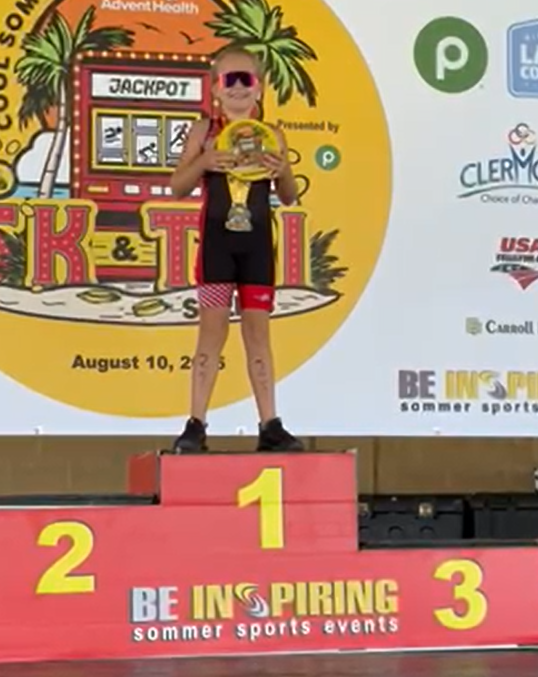
You will often find Edelweiss on top of the podium on race day. (Photo courtesy of the Szymanski family)
Edelweiss competed in her first triathlon when she was 5. The family belonged to a local YMCA, and Lacey saw a post about the race on the morning of the event. So, she woke Edelweiss and asked her if she wanted to give it a try. Edelweiss said yes.
“It gave me something to do,” she said.
The race consisted of one lap in the 25-meter pool, a half-mile bike ride, and a quarter-mile run. Competing on a bike that had pom-poms and a basket on the handlebars, Edelweiss won her age group.
She had one question for her mom when she finished.
“When can we do this again?”
The answer? As often as possible.
She and Spartacus have moved up to sprint triathlons – 400-yard swim, 8.1-mile bike ride, and a 5K run.
The hardest leg for Edelweiss is the run. The best part, she said, is crossing the finish line.
“Because I don’t have to run anymore,” she said.
She’s been known to finish a race in her socks. Once, when she developed blisters and tossed her shoes halfway through the race, and another time when she was having trouble getting them on during the transition from the bike to the run and didn’t want to waste more time.
Jacek was born in Poland and immigrated to the United States at 19. He was an avid cycler in his native country and passed that love on to his children.
Edelweiss and Spartacus also compete in long-distance cycling races, where they are often the top finishers in their 7-11 age group.
“They goof around when they’re going for a ride with dad,” Jacek said. “But something switches when they are in the competitive world. They put on their game face.”
Before being immersed in the world of triathlons, Edelweiss was all about her ballet lessons.
“She was very into ballet, but now she doesn’t want to go back,” Lacey said. “It’s not the same adrenaline rush.”
Their weekends are loaded with triathlons across the state and cycling races as far north as Virginia. Lacey keeps track of the schedule.
“It’s our lifestyle now,” Lacey said. “We’re always in the water or on bikes, doing something like that. Edelweiss doesn’t feel like she’s actually competing. She’s doing what she loves. Spartacus is a ball of fire, too. Both of them together just constantly amazes me about what they're capable of and the grit that they have to compete.”

Jordan Glen School started in 1974 on 20 acres of woods in the small town of Archer near Gainesville. Owner Jeff Davis, a former public school teacher, moved to Florida from Michigan to start a school that allowed students more freedom. Today it continues to thrive, thanks in part to education choice scholarships. Photo by Ron Matus
ARCHER, Fla. – Archer is a crossroads community of 1,100 people 15 minutes from the college town of Gainesville, but far enough away to have its own quirky identity. It’s surrounded by live oak-studded ranch land but calling it a “farm town” doesn’t ring right. When railroads ruled the Earth, Archer was a whistle stop on the first line connecting the Atlantic to the Gulf. In the late 1800s, T. Gilbert Pearson, co-founder of the National Audubon Society, roamed the woods here as a kid, skipping school to hunt for bird eggs. A century later, rock ‘n roll icon Bo Diddley spent his golden years on the outskirts.
So, let’s just say Archer is a neat little town. And maybe it’s fitting that for half a century, it has been home to a neat little private school that doesn’t fit into any boxes, either.
Jordan Glen School got its start in 1974, when former public school teacher Jeff Davis moved down from Michigan. In the late 1960s, Davis became disillusioned with teaching in traditional schools. In his view, students were respected too little and labeled too much.
“Back in the day, I would have been labeled ADHD. I hated school,” he said. “I never met a teacher that took a personal interest in me.”
As a teacher, he saw a system that was “too constricting.”
“There was just a general distrust of children, like they were going to do something bad,” he said. Education “doesn’t have to be rammed down your throat.”
Davis migrated to what was, more or less, a “free school,” with 50 students on a farm near Detroit. Today we’d call it a microschool.
In the 1960s, hundreds of these DIY schools emerged across America, propelled by an upbeat vision of education freedom inspired by the counterculture. Davis said the Upland Hills Farm School was a free school, more or less, because while its teachers were “long-haired” and “hippie-ish,” the school had more structure and rigor than free school stereotypes would suggest.
Davis thought the Gainesville area would be a good place to start a similar school. It had a critical mass of like-minded folks. So, in 1973, he and his family bought 20 acres of woods off a dirt road in Archer. Not long afterward, they invited a little school called Lotus Land School, then operating out of a community center in Gainesville, to move to their patch in the country. Today we’d call Lotus Land a microschool, too.
It was also, more or less, a free school. Davis described the teachers and families as “love children” and “free spirits,” but in many ways, their approach to teaching and learning was mainstream. A decade later, he changed the name. “I thought people would think it was a hippie dippy school, and I knew it was more than that,” he said.
Lotus Land became Jordan Glen. The school was named after the River Jordan, after some parents and teachers suggested it, and after basketball legend Michael Jordan, because Davis was a fan.
Fast forward a few more decades, and Jordan Glen School is thriving more than ever.
It now serves more than 100 students in grades PreK-8, some of whom are the second generation to attend. Nearly all use Florida’s education choice scholarships. Actor Joaquin Phoenix is among Jordan Glen’s alums. So is CNN reporter and anchor Sara Sidner.
Jordan Glen is yet more proof that education freedom offers something for everyone and that its roots are deep and diverse. Ultimately, the expansion of learning options gives more people from all walks of life more opportunity to educate their children in line with their visions and values.
“There is something about joy and happiness that makes people uneasy and a bit insecure,” Davis wrote in a 2005 column for the local newspaper, entitled “Joyful Learning is the Most Valuable Kind.” “If children are enjoying school so much, they must not be doing enough ‘work’ there.”
“Children at our school,” he wrote, “love life.”

A peacock, one of two dozen that roam the Jordan Glen School campus, watches students at play. Photo by Ron Matus
The Jordan Glen campus includes a handful of modest buildings. It’s still graced by a dirt road and towering trees. It’s also home to two dozen, free-roaming peacocks. They’re the descendants of a pair Davis bought in 1975 because they were beautiful and would eat a lot of bugs.
Given that backdrop, it’s not surprising that many families describe Jordan Glen as “magical.”
Alexis Hamlin-Vogler prefers “whimsical.” She and her husband decided to enroll their children, Atticus, 14, and Ellie, 8, in the wake of the pandemic.
“They’re definitely outside a lot,” she said of the students. “They’re climbing trees. They’re picking oranges.” When it rained the other day, her daughter and some of the other students, already outside for a sports class, got a green light to play in it and get muddy.
Another parent, Ilia Morrows, called Jordan Glen a “little unicorn of a school.”
Like Hamlin-Vogler, Morrows enrolled her kids, 11-year-old twins Breck and Lucas, following the Covid-connected school closures. She thought they’d stay a year, then return to public school. But after a year, they didn’t want to go back. “They had a taste of freedom,” she said.
For many parents, Jordan Glen hits a sweet spot between traditional and alternative.
On the traditional side, Jordan Glen students are immersed in core academics. They take tests, including standardized tests. They get grades and report cards. They play sports like soccer and tennis, and they’re good enough at the latter to win the county’s middle school championship. Many of them move on to the area’s top academic high schools.
But Jordan Glen also does a lot differently.

Students spend a lot of time outdoors at Jordan Glen School. Activities include archery, gardening and sports. Photo by Ron Matus
The students are grouped into multi-age and multi-grade classrooms. They choose from an ever-changing menu of electives. Many of those classes are taught by teachers, but some are taught by parents (like archery, gardening, and fishing), and some by the students themselves (like soccer, dance, and book club). The youngest students also do a “forest school” class once a week.
The school also emphasizes character education.
The older students serve as mentors for the younger students. They’re taught peer mediation so they can settle disputes. Every afternoon, they clean the school, working as crew leaders with teams of younger students. Their “Senior Class Guide” stresses nothing is more important than “caring about others.”
“The way the older kids take care of the younger kids, it’s very noticeable. They are genuinely caring,” Morrows said. At Jordan Glen, “they teach community. They teach being a good human.”
“My favorite thing is that most kids really get a good sense of self and self-confidence at this school,” Hamlin-Vogler said. “Some people say, ‘Oh, that’s the hippie school.’ But the students have a lot of expectations and personal accountability put on them.”
Hamlin-Vogler said without the education choice scholarships, she and her husband wouldn’t be able to afford the school. Hamlin-Vogler is a hairdresser. Her husband is a music producer. Before Florida made every student eligible for scholarships in 2023, they missed the income eligibility threshold by $1,000. Her parents were able to assist with tuition in the short term, but that would not have been sustainable.
Her family harbors no animus toward public schools. Atticus attended them prior to Jordan Glen, and he’s likely to be at a public high school next fall. Ellie, meanwhile, thinks she might want to try the neighborhood school even though she loves Jordan Glen in every way, and Hamlin-Vogler said that would be fine.
After Ellie described how much fun she had playing in the rain, though, Hamlin-Vogler had to remind her, “You might not get to do that at another school.”

