 Retention rules: Manatee County school officials say they will not consider a student's portfolio to justify a promotion to fourth grade if the student has not taken the Florida Standards Assessments test or a state-approved alternative. They say the state Department of Education supports their position. Bradenton Herald. Even while school districts are threatening third-graders with retention because they didn't take the state testing or an alternative, Florida law allows the use of a portfolio as an exemption to testing. Gradebook. Parents in the opt-out movement are headed for a showdown with Manatee County school administrators. Bradenton Times.
Legal fees rapped: The state spent $3.7 million for outside counsel to defend against the lawsuit that alleged Florida failed its constitutional mandate to provide a quality education for all public school students. A circuit judge dismissed the suit. Now one of those groups bringing it, Fund Education Now, is criticizing the state for that expense. The Florida Senate and House split the legal fees because the suit named Senate President Andy Gardiner and House Speaker Steve Crisafulli, as well as the state board and Education Commissioner Pam Stewart. A Gardiner aide says the Orlando Republican is “certainly comfortable with this investment of taxpayer dollars.” Politico Florida.
School crowding: If the courts rule that the Florida Tax Credit Scholarships are unconstitutional, as the Florida Education Association alleges, the state's already crowded schools might have to quickly absorb another 78,000 students. That could cause problems in some districts. Step Up For Students, which hosts this blog, administers the program. Tampa Bay Times.
Construction costs: School districts spend more on buildings using the construction manager-at risk approach than the traditional method of design-bid-build, according to a study by Clemson University researchers. The cost per square meter was $192 for the construction manager approach, and $148 with design-bid-build. The conclusion is based on a study of 137 school projects in Florida, Georgia, North Carolina and South Carolina. Engineering News-Record.
New schools planned: The Orange County School District is planning to spend up to $3 billion to build 16 schools in the next nine years to accommodate growth in the student population. Orlando Sentinel. The Palm Beach County School District is applying for a grant that could lead to the creation of an arts middle school in Boynton Beach and several other magnet programs at other schools. The grant from the U.S. Department of Education is worth $12 million over three years. Five schools would share the money. Palm Beach Post. (more…)
 A Florida House committee debate this morning about a new Tax Credit Scholarship bill included some fair questions, obvious skepticism and dueling numbers about how many students want in. One reason for the confusion might be this little-known fact: Step Up For Students, the nonprofit that processes the applications, has stopped keeping waiting lists.
That may sound like an alarming development, but the reason is not what you might think. The people who process applications at Step Up, which publishes this blog, have become so overwhelmed in recent years that they no longer wanted to give low-income families false hope. They concluded that the main reason for the waiting list was mostly for show, and they wanted no part of that.
So when we are asked by lawmakers or reporters or state officials about a waiting list, we try our best to respond by describing the accelerated pace of applications. That trend is clear.
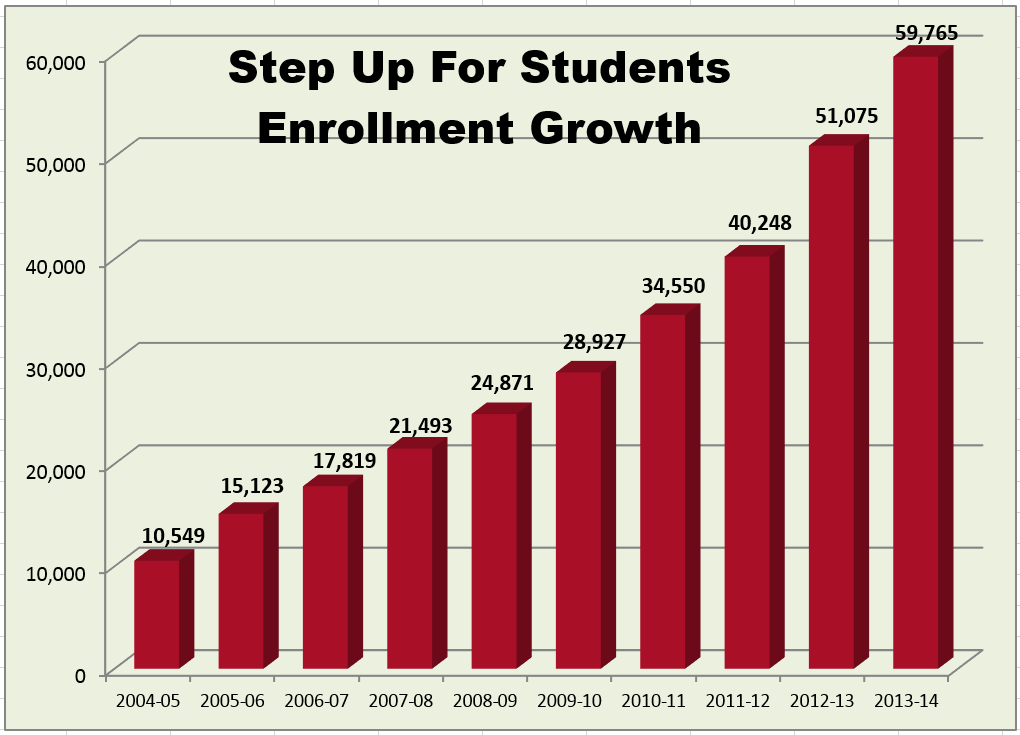
In 2012-13, the cap limit of $229 million allowed Step Up to serve 51,075 students. That year, it was receiving so many applications that it shut off newcomers beginning on Aug. 3, a couple of weeks before school started. And it’s worth noting here that scholarship parents are no different than the adults who are being asked to get health insurance under the Affordable Care Act: they often wait until the last minute. Even so, 87,540 students had already started an application.
For the current school year, 2013-14, the cap limit of $286 million has allowed Step Up to serve 59,765 low-income students. But applications were coming in so fast last spring that the processing team decided to stop taking them on June 28, about as month-and-a-half before school started. Even so, 94,104 students had already started.
That number from June is the origin of the 34,000 “waiting list” that has been asserted many times during the current debate. In reality, it’s not a waiting list, but it’s a powerful indication of demand.
A more compelling gauge, though, may be the applications that are being received right now. A new school year starts in less than five months, applications are in full swing, and the current cap limit of $358 million should allow Step Up to serve about 68,000 students. As of today, 79,915 students have already started an application. So unless there is a precipitous drop in applications, Step Up will shut it down early again – maybe earlier than last year – so as not to create false hope among those who waited too long.
This trend suggests that tens of thousands of students will again be shut out.
The extreme skeptics will question whether Step Up is reporting these numbers faithfully and accurately. But one outside check is enrollment itself. The state Department of Education verifies and reports student enrollment in every quarter and year-end, and the chart attached to this post is pointed distinctly upward. It shows that enrollment is increasing precisely as fast as the caps allow, which is an independent source of data that reinforces what Step Up is reporting in applications.
 The public release of test scores for low-income students on Florida Tax Credit Scholarships received remarkably little attention in the news media this year, leaving bloggers the freedom to interpret serious academic analysis with what amounted mostly to potshots.
Not surprisingly, Diane Ravitch weighed in to wag her finger at the straw men who have touted vouchers as “a panacea.” But at least she didn’t challenge the credentials of the state-contracted researcher, whose national reputation for thorough independent-minded critical analysis didn’t prevent two lesser-known Florida bloggers from doing so. She also didn’t snipe at a respected education writer for the state’s largest newspaper, branding her reporting on the test results as “propaganda,” as several online commenters did.
This kind of noise is usually best regulated by shutting the door, but those who have genuine concerns about whether a private learning option can help struggling, underprivileged schoolchildren deserve straight answers. I certainly cannot be viewed as an unbiased observer, but my work for the nonprofit that oversees the scholarship at least makes me an informed one.
So let’s start with Dr. Ravitch, who to her credit recited three direct paragraphs from the 41-page report. She also said that “students in voucher schools made academic gains similar to their peers in public schools,” which is a generally correct statement. But rather than read more deeply, she tried to minimize the significance through unsupported and unimportant claims that Florida tax credit scholarship supporters promised miracles.
The test scores and associated research do not speak to academic miracles, but they are encouraging. To repeat some portions of our previous post, two findings are critical for context.
First: For five consecutive years, the state researcher has determined that students who choose the scholarship are among the lowest performers in the public schools they leave behind. (more…)

