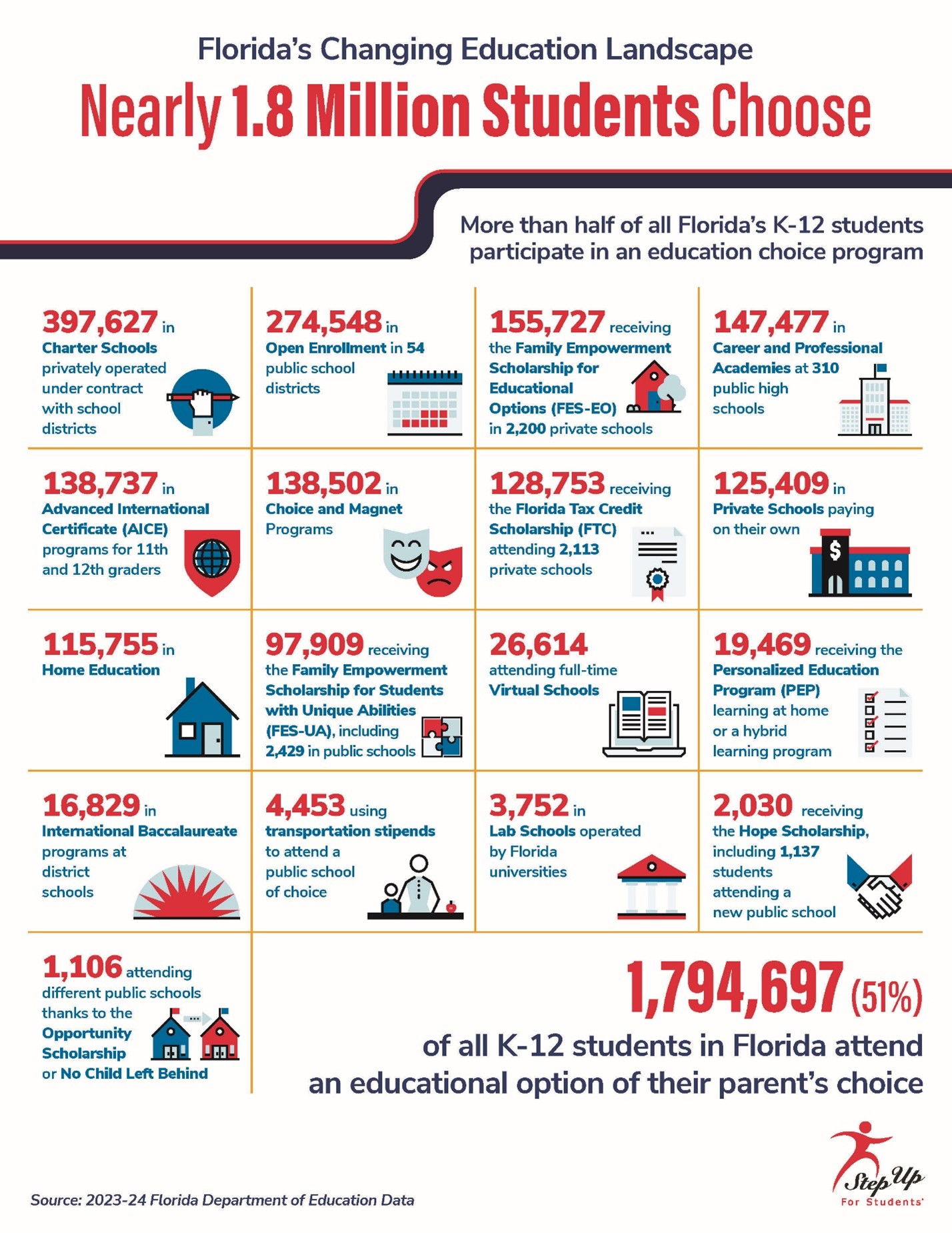
 For the first time in Florida’s history, more than half of all K-12 students are enrolled in an educational option of choice. During the 2023–24 school year, 1,794,697 students, out of the state’s approximately 3.5 million K-12 population, attended schools outside their zoned neighborhood assignment.
Since the 2008–09 school year, Step Up For Students, in collaboration with the Florida Department of Education, has tracked enrollment across a variety of choice programs. While methods and program structures have evolved, 2023–24 marks a milestone: more than 50% of Florida’s students are now learning in environments selected by their families.
The Changing Landscapes report draws from Florida Department of Education data and removes, where possible, duplicate counts to provide a clearer picture of school choice participation. For example, it adjusts for home education students supported by the Family Empowerment Scholarship for Students with Unique Abilities (FES-UA) and eliminates double-counted students in career and professional programs. It also excludes prekindergarten students in FES-UA and programs like Voluntary Pre-Kindergarten (VPK), as the report focuses solely on K–12 education.
While many families still choose their neighborhood public schools, Florida’s education system now offers a broad range of options to meet diverse student needs. Public school choice remains dominant, occupying four of the top five spots in overall enrollment. Charter schools are the most popular option, followed by district open enrollment programs, career and professional academies, and Advanced International Certificate of Education (AICE) programs for upperclassmen.
On the private side, the 2023–24 school year marked a historic shift: For the first time, a single scholarship program now serves more students than all private school families who pay tuition out of pocket.
In total, over 116,000 additional students enrolled in choice programs compared to the prior year. The Family Empowerment Scholarship for Educational Options (FES-EO) and the Florida Tax Credit Scholarship (FTC) saw the greatest growth, along with AICE and FES-UA. Altogether, scholarships for private and home education increased by approximately 142,000 students, while private-pay and non-scholarship home education enrollment declined, likely due to the expanded availability of financial aid.
Among public-school options, magnet and district choice programs saw slight declines, with 28,000 and 8,447 fewer students, respectively. Still, public-school choice remains strong: 1.1 million of Florida’s 2.9 million public school students (40%) are enrolled in a choice-based public option.
Altogether, nearly 1.8 million students attend a school chosen by their parents or guardians. This shift reflects a fundamental transformation in Florida’s educational landscape—one where families are increasingly empowered to find the best fit for their children.
But with so many students opting for alternatives to their zoned public schools, it raises an interesting question: What about those who stay? If families are surrounded by options and still choose their assigned public school, isn’t that a choice, too? In that light, Florida may already have a 100% choice system, because staying is just as much a decision as leaving.
Rather than a battle between public and private education, Florida is showing how both sectors can coexist and thrive, working together to provide high quality learning opportunities for all students. The future of education isn’t one-size-fits-all; it’s about ensuring every family has access to an option that fits their child’s unique needs. In Florida, that future is already here.
 Charter donations: Charter school companies have donated heavily to statewide candidates over the past 20 years. Now, increasingly, the donations are trickling down to the school board level. That development is causing concern for some in educational circles, while others see the money flow as a counterbalance to donations from teachers unions. Florida Times-Union.
School budgeting: The Hillsborough County School Board approves a tentative $2.8 billion budget that includes a drop in the tax millage rate. Increasing property values will more than offset the drop. Tampa Bay Times. The 3 percent pay raises Pasco school officials wanted to hand out this year are down to 2.6 or 2.7 percent, School Superintendent Kurt Browning says. The $1.2 billion budget could continue to change until its final approval next month. Gradebook. The Leon County School Board approves a tentative $498 million budget that includes money to put an armed resource officer at every elementary school. Tallahassee Democrat. The St. Johns County School Board approves a tentative budget that calls for per-pupil spending of $7,008.93. St. Augustine Record. The Florida Cabinet agrees to borrow $285 million to build and maintain facilities for schools at all levels. It's the first time the state will borrow money for educational infrastructure since the 2010-2011 budget year. News Service of Florida. WFOR.
Bathroom policy: The Sarasota County School Board again declines to set a districtwide policiy that would, among other things, allow transgender students to use restrooms corresponding with their gender identities. Sarasota Herald-Tribune.
Gifted plan delayed: The Duval County School Board delays a vote on adding gifted programs to more elementary and middle schools. The board wants even more gifted programs spread throughout the county. Superintendent Nikolai Vitti says some schools don't have enough gifted students to justify a fulltime program. Florida Times-Union. (more…)

