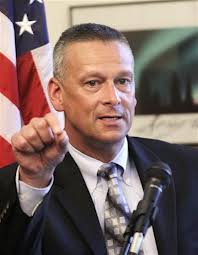
Indiana State Superintendent Tony Bennett
Indiana: The race for state superintendent is a referendum on the direction of education reform, including expanded school choice (Associated Press).
Florida: The state's teachers unions are among the weakest in the nation, according to a new Fordham Institute report (Orlando Sentinel). The Duval County school district agrees to settle with a proposed virtual charter school, run by online provider K12, that it had initially opposed (State Impact Florida).
Washington: Education leaders from around the state sign a letter saying they oppose the charter school initiative on Tuesday's ballot (Seattle Times).
Tennessee: Education Commissioner Kevin Huffman, also a member of Jeb Bush's Chiefs For Change, urges parents to use his state's latest education report card to ask questions and consider options (The Tennessean). Groups pushing for education reform and school choice spend heavily in campaign contributions (The Tennessean).
Michigan: Critics question the state's decision to okay new charters from companies whose existing schools are not performing well (Detroit News).
Wisconsin: One school district hopes to stem declining enrollment by expanding online offerings (Oshkosh Northwestern).
Maine: Five proposed charter schools apply to open next year (Kennebec Journal).
Georgia: A lawsuit claims language in the proposed charter school amendment is purposely misleading (Athens Banner Herald). Students from historically black colleges in Atlanta rally for the amendment (Atlanta Journal Constitution.)
The half-million-dollar payout to the principal of a failing charter school in Orlando has sparked far-ranging criticism of Florida charter schools and the laws that govern them. But over at the Fordham Institute's Choice Words blog today, Adam Emerson offers a different take. After doing some independent reporting, Emerson (the founding editor at redefinED before moving on to Fordham) says the Orange County School District should have responded earlier to obvious warning signs, including information contained in independent audits.
"It’s true that the charter school’s own board seemed absent in its required oversight of NorthStar, and it behaved (at best) irresponsibly in signing off on the outsize compensation for its principal," he wrote. "But the school district is responsible for overseeing the charters it authorizes, and that responsibility became more critical when audits highlighted conflicts of interest and other red flags." Read his full post here.
Florida reforms make an impression. They’re a model for other states and influenced the Obama administration, writes The Guardian.
Still working. A teacher who lost his job in the Pasco school district after sending inappropriate text messages to a female student lands in the Hillsborough district, where he has been put on leave for undisclosed reasons, the Tampa Bay Times reports.
More outrage over Orange County charter school. Tampa Bay Times columnist John Romano links the $500,000 payment to a failing charter schools’ principal to other issues with charters and suggests state leaders are hypocrites and fools for not offering more oversight. Charter school supporters are also upset by what happened, redefinED reports.
Revisit new teacher evals. Editorializes the Tampa Bay Times.
Rick Scott’s ed plan has merit. Editorializes the Daytona Beach New Journal.
School choice politics. Surfaces over a school board election flyer in Duval County (Florida Times Union), in a key state senate race in South Florida (South Florida Sun-Sentinel), in this piece about campaign spending by education interest groups (Orlando Sentinel).
School board splits on public school choice in Lee County. From Fox 4.
Florida’s teachers unions among the weakest. According to a new report from the Fordham Institute.
Florida charter schools, management companies and leaders are represented by at least two statewide organizations. But for years, charter school parents “were the lost group,’’ said Henry A. Rose, a longtime charter school advocate.
Rose decided to do something about it.
With help from the Florida Consortium of Public Charter Schools, the Fort Lauderdale-based nonprofit that counts about 400 charters as members, he and other parents formed Parents For Charter Schools in 2009.
Many charter school parents were involved with their local schools, but few knew the impact they could have in Tallahassee. The group, an arm of the consortium, now represents 4,000 to 5,000 members.
“I think a lot of them were surprised to learn, ‘Wow! We can make a difference,’ ’’ said Lynn Norman-Teck, the consortium’s spokeswoman.
Parents For Charters serves as a resource on schools, rules and legislation, and school choice issues. Kind of like a PTA, said Rose, a marketing and media consultant in Pembroke Pines.
Rose serves as co-chairman of Parents For Charter Schools and once led the Broward County public school district’s 250-school Parent Advisory Council. Though his children are grown now, his daughter taught in a Washington, D.C. charter school and his wife teaches at Franklin Academy Charter School in Pembroke Pines.
Like his family, Parents For Charter Schools members tend to be independent thinkers, Rose said. His job is to unite them for causes, such as proposed legislation, polls and conferences.
The latest example: Costco, the national grocery warehouse, sent a mass survey in its August magazine asking readers if charter schools were a good idea or a bad one. (more…)
Oh how the blog gods have smiled down upon redefinED.
The 2012 Republican National Convention will be held in downtown Tampa this month – six blocks from the building that houses Step Up for Students and our humble blog. I received press credentials to cover the convention. And next week, as a lead-up to the event, we’ll be posting essays from some of the leading voices in school choice and education reform.
Here’s the line up: former U.S. Secretary of Education Margaret Spellings; Chester E. Finn, Jr., president of the Thomas B. Fordham Institute; Robert C. Enlow, president and CEO of the Friedman Foundation for Educational Choice; Joe Williams, executive director of Democrats for Education Reform; Michael B. Horn, executive director for education at the Innosight Institute; and Eva S. Moskowitz, founder and CEO of Success Academy Charter Schools.
With the RNC and November elections as a backdrop, we asked our contributors what – if anything – the federal government can do to promote school choice. It goes without saying that the responses are thoughtful, insightful and informative. They’re also diverse. They’ll give you plenty to think about – and even a few things to laugh at.
First up Monday: Secretary Spellings.
The word is out. This blog’s talented editor and creator, Adam Emerson, is headed off to the respected Fordham Institute to become its first-ever “School Choice Czar.” This is good news for the cause that is at the heart of redefinED, even if it makes me wince.
We asked Adam more than a year ago to create a blog that was thought-provoking yet civil; to create an alternative to some of the more hyperbolic and polarizing discourse that consumes much of the school choice debate.
Obviously, Adam has delivered. His most recent move, to form a partnership with the American Center for School Choice, has brought to redefinED some distinguished voices who represent a bipartisan, centrist, social justice approach to choice. Given the considerable increase in traffic over the past few months, readers seem to be as impressed as we are.
Adam has set the bar high, where it should be, and we’re committed to building on what he has started. But for now, we take a moment to offer a salute.
In his new position as Fordham’s director of parental choice, Adam will “coordinate the Institute’s school choice-related research projects, policy analyses and commentaries on issues including vouchers, charter schools, homeschooling, and digital learning.” He’ll also keep his voice alive through a new blog, Choice Words, at Fordham. We encourage you to keep plugged in to what he has to say, because Adam is a rising star whose voice is helping redefine the contours of public education.
The tantrum Cleveland Cavaliers owner Dan Gilbert has thrown over the departure of NBA league MVP LeBron James was part of the subplot Thursday night as 7-million viewers watched James return to Cleveland in a Miami Heat uniform. But it is also a reminder that not all unions exist merely to protect an employee’s tenure.
In professional sports unions, free agency is the Holy Grail. Through free agency, individuals can sell their services to the highest bidder. All the sports unions have fought — and continue to fight – bitter battles with team owners for the right to free agency. Teacher unions, on the other hand, have historically fought against free agency. They oppose teachers having the ability to sell their services to the highest bidder, but this opposition is illogical in this emerging new public education system.
Customization may someday force teachers to adopt a new unionism that includes some form of free agency. As public education moves away from the one-size-fits-all assembly line and towards customization, teacher unions will lose market share to schools that aren’t easily covered by a master collective bargaining agreement. So they might be forced to consider other models, and pro sports unions are one. Whereas teacher unions use their collective power to disempower individuals, pro sports unions use their collective power to empower individuals.
The 1930s model of industrial unionism teachers embraced in the 1960s and 70s is obsolete and no longer serves teachers well. A new teacher unionism is inevitable – a topic I’ll write more about in future posts.

