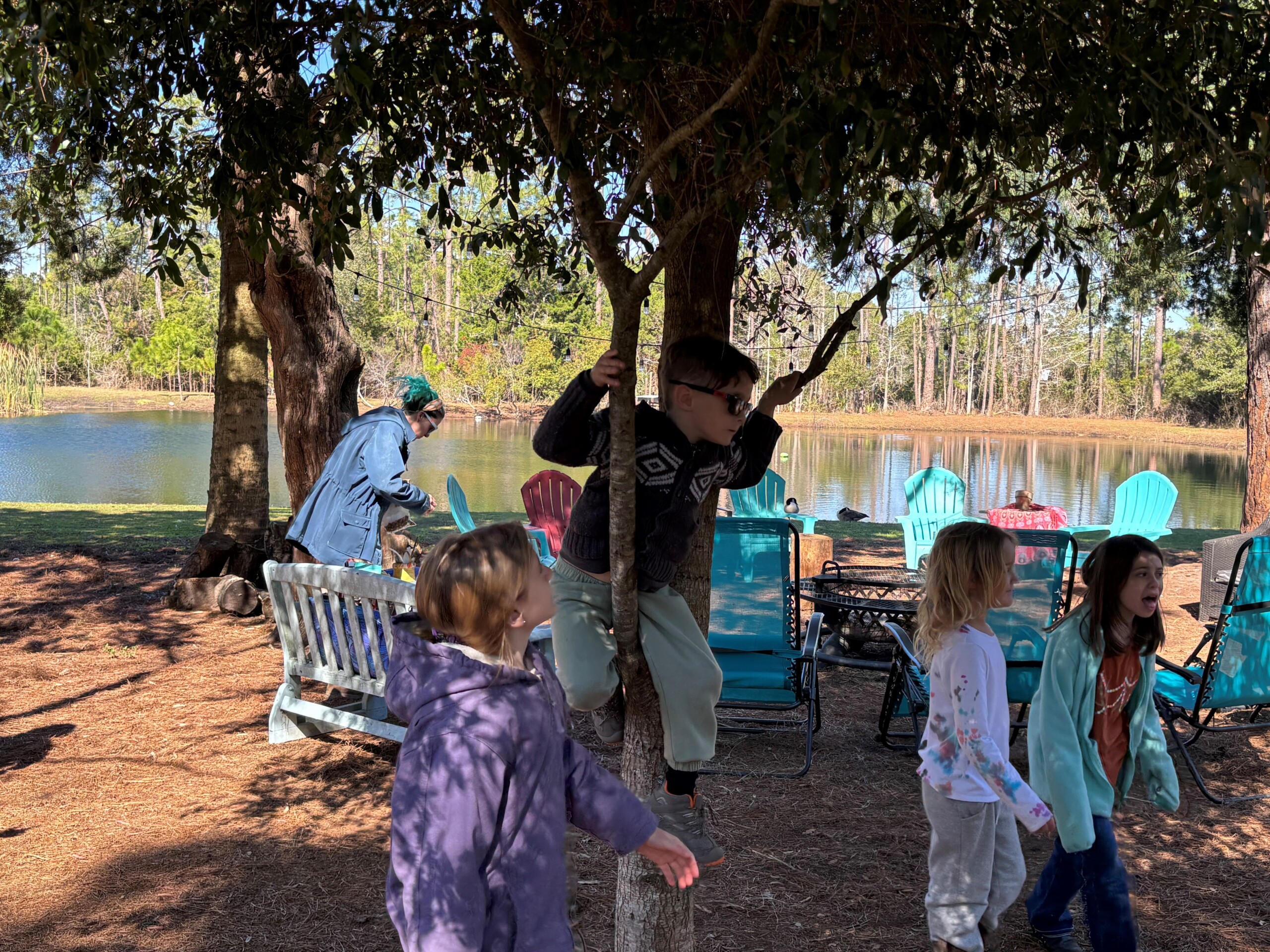
Climbing trees and playing in the rain are integral parts of the day at Wild Oaks Explorers, a nature-based program that focuses on student-directed learning.
FERNANDINA BEACH, Fla. – Millions of students in American public schools are lucky if they get 30 minutes of recess a day. But the students at Wild Oak Explorers spend hours at a time roaming an 8-acre oasis of pines, ponds, and trails not far from the Georgia line.
On a recent, typical day, they surveyed the property to make maps, picked apart pinecones for make-believe tea, fed wax myrtle to a herd of goats – and did whatever else their imaginations spurred them to.
“This is their playground,” said Wild Oak founder Stacey Tappan.
Tappan is a certified forest teacher who started Wild Oak in 2019. It’s technically an enrichment provider, not a school. It serves students who are homeschooled, or those doing parent-directed education, outside of full-time schools, with flexible, state-supported choice scholarships.
Students attend two or four days a week, for four hours at a time. They range in age from toddlers to teens.
Tappan and her fellow teachers organize some educational activities for the students, like the land survey. There are also some daily rituals, like morning “sit spots,” where the students start the day quietly observing their surroundings.
But most of the learning is directed by the students themselves. If the students want to climb trees, they climb trees.
“And if it rains,” Tappan said, “they play in it.”
Tappan began gravitating to nature as a classroom 12 years ago.
She saw benefits for neurodivergent children, including her now-14-year-old daughter, Jacqueline. For many students, the freedom to move – to stand, to wiggle, to take a walk – can reduce anxiety and recast behavior that might be viewed as problematic in a typical classroom, Tappan said.
She also saw benefits for all children – a natural way, literally, to foster everything from character, curiosity, and creativity, to problem solving and social skills.
Just as important, Tappan saw learning outdoors as fundamental to cultivating a healthy environmental consciousness – and, by extension, a healthier, more sustainable planet. “We teach respect for all living beings,” says the school’s website, “and how to minimize our impact on the earth.”
For most people, Tappan said, “Nature has become a backdrop. You’re moving from x to y to z and not actually paying attention. That’s the purpose of the sit spots.”
“If kids don’t learn to love nature, who’s going to save it?”
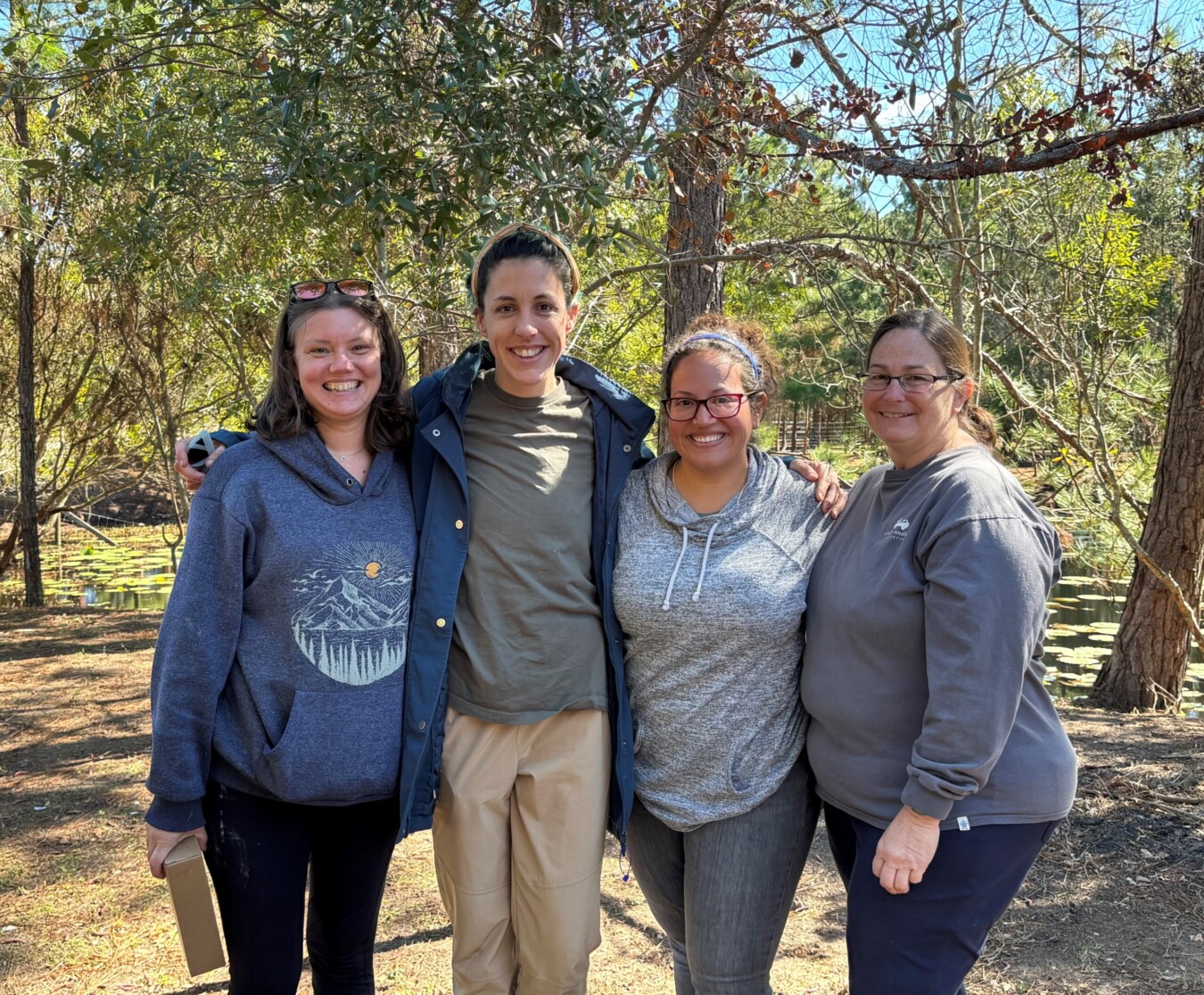
From left to right, Ashley Murphy, forest families guide; Nicky Newton, art curiosity guide; Vanessa Munshower, curiosity guide; and Stacey Tappan, founder/facilitator.
Tappan and Wild Oak are not anomalies, even if narratives about “school choice” fueled by choice opponents seek to erase them.
The Natural Start Alliance reports the number of forest school pre-schools more than doubled between 2017 and 2022, to about 800. I don’t know if anybody is keeping official tabs on the broader group of “green schools.” But this nature school founder and writer has a pretty good handle on them, judging by the 1,000+ schools she lists in the U.S., including 40 in the Sunshine State.
Nature schools like this one, this one, and this one have long been part of the private school landscape in Florida. And as education choice has expanded, so have they. (See here, here, and here.)
Tappan started with five students from three families. Now she’s serving 29 students from 20 families. Virtually all of them use choice scholarships.
“Being outside is so important to me,” said Dru Clark, who has two children at Wild Oak using the Personalized Education Program scholarship. “I want them to get the health benefits. I want them to connect with nature and learn about it.”
Tappan wanted the same for her children.
She grew up across the street from one of the Jacksonville area’s biggest malls, yet still spent endless hours catching “crawdads” in nearby creeks.
She knew today’s kids rarely had such experiences, so when she couldn’t find a school that opened the door to those activities – stop me if you’ve heard this before – she created it. At the time, Tappan had spent more than a decade in health care management.
“I tell parents all the time, ‘If you don’t see the school you want, create your own,’ “ Tappan said.
Wild Oak Explorers is based at Jaybird Hammock Farm, 45 minutes north of Jacksonville. Most of the property is wooded and home to wild animals endemic to North Florida. But there’s also a menagerie of farm animals, including chickens, turkeys, ducks, two donkeys, one mule (a diva named Buttercup) and at least 15 friendly goats.
Tappan and the other teachers joyfully use all of it for their programming.
For the Great Backyard Bird Count, the students relied on binoculars and field guides to identify bird species, then drew or painted them in nature journals. Over the next few weeks, an official with a local 4-H group will lead lessons in embryology, using eggs from the farm. A wildlife rehabber is also set to visit soon – and to bring a partially paralyzed raccoon she rescued.
None of this, though, holds a candle to Wild Oak’s central feature: Long stretches of free play.
With play comes learning – and way out here, some of the lessons are especially valuable, as Wild Oak parents will be the first to tell you.
 “There’s strength in risky play like climbing trees,” said Katie Ernst, whose 5-year-old daughter Rayah also uses a PEP scholarship at Wild Oak. “They learn their own strengths, their own bodies, what they can and can’t do. They learn how to trust themselves. They gain confidence.”
Wild Oak represents other important trend lines that are especially pronounced in Florida, which leads the country in education choice.
Again, it’s not a school. In fact, Wild Oak is now one of more than 14,000 providers outside of schools that are part of public education in Florida.
As tens of thousands of families flock to a la carte learning, they’re accessing providers like Wild Oak, but as only one piece of a program they custom build themselves. Both Clark and Ernst, for example, use their PEP scholarships for multiple programs and providers.
Wild Oak is also another distinctive example of how the expansion of choice in Florida offers something for everybody. The families, educators, schools, providers, and communities who are embracing choice are incredibly diverse along multiple dimensions – and becoming more so every day.
“I know this program isn’t for everybody,” Tappan said. “That’s okay.”
But for those who want it, it’s there.
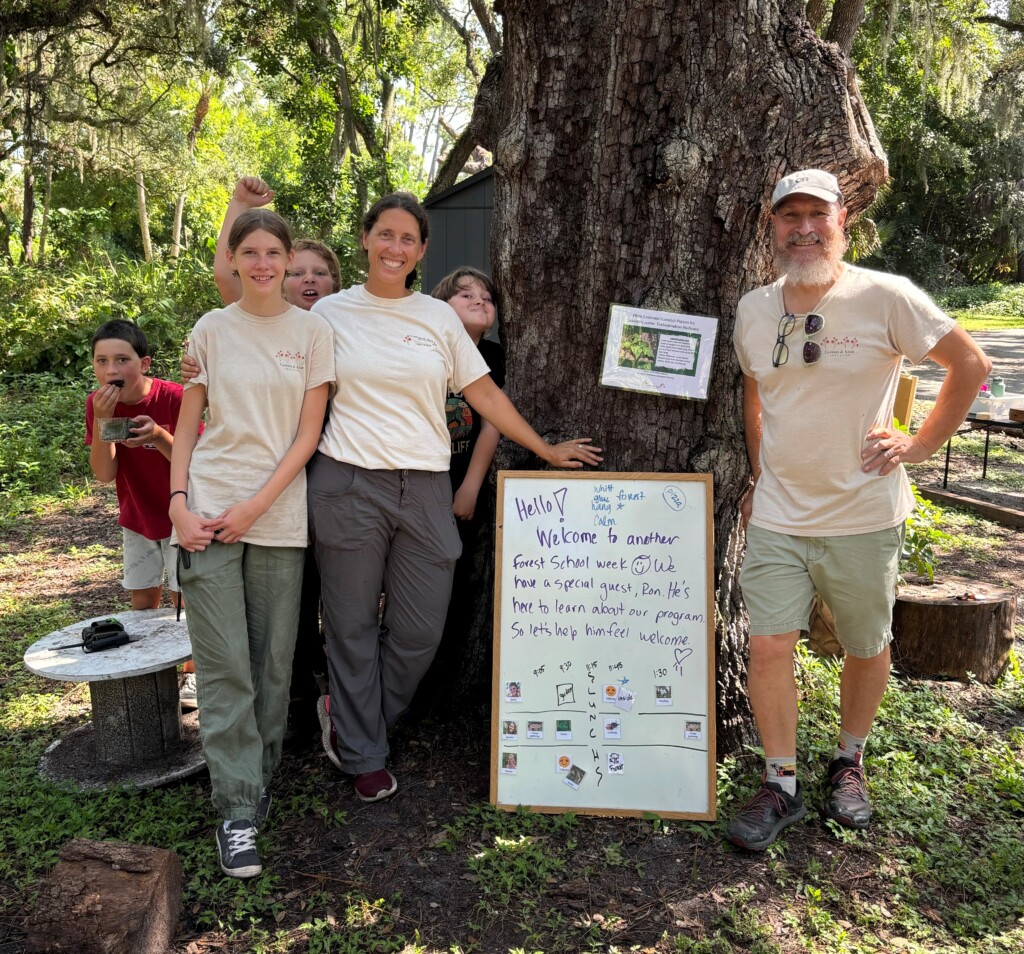
Justine Wilson, front row, center, and her husband, Chris Trammel, right, established Curious and Kind as a forest school for part-time, student-directed learning.
SARASOTA, Fla. – After 18 years as an educator in public and private schools, Justine Wilson decided to make a change. She was excellent at her job. In fact, she had just been offered a top administrative position at a top private school. But she didn’t believe mainstream approaches to teaching and learning were the best ones for many students, or for herself.
“I was saying things and doing things that weren’t who I actually was as an educator. I kept getting more and more away from my core beliefs,” Wilson said. “I just wanted to be authentic.”
Wilson wanted:
With the help of Florida’s education choice programs, Wilson did what more and more former traditional educators are doing: She created her own option: a nature-based, student-directed, hybrid homeschool called Curious and Kind Education.
“I love offering something that brings me the most joy,” Wilson said. “Which is being outside with the kids and partnering with their families.”
Curious and Kind offers different programs for different age groups, from toddlers to teenagers. Depending on the program, families can enroll their “explorers” one, two, or three days a week.
Plenty of families love this approach. Curious and Kind started last year with 25 students. This year, it has 90. Nearly all of them use choice scholarships, particularly the Personalized Education Program (PEP) scholarship, an education savings account (ESA) in its second year of existence.
Curious and Kind rents space from a church, but its heart is out back: a two-acre patch of unruly, urban forest, next to a creek that flows from a nature park across the street.
One day last month, 20 explorers ages 5 to 12 took seats on a set of cut logs, arranged in a circle beneath oaks, pines, and palms. Then they got down to business, discussing what they’d like to do over the next few hours. Crochet. Whittle. Make a pizza. Whatever the idea, Wilson and other “facilitators” gently offered suggestions on tools and timing and possible collaborations.
“Our philosophy is ‘Yes. And how do we make it happen?’ “Wilson said.
By early afternoon, most of the explorers had circled back to what they wanted to work on. (Because Curious and Kind didn’t have the ingredients on hand, the pizza had to wait until later in the week.) But first, it was time to play in the woods.
Within minutes, the explorers were building tree forts, making “tea” in a mud kitchen, and trying to identify a species of pseudo-scorpion they found on a slash pine.
At Curious and Kind, play routinely leads to projects.
When the creek was a bit too high for wading, somebody suggested the explorers build little boats instead. (It’s not clear if the idea came from an explorer or a facilitator. “It could have been anybody,” Wilson said. “It’s very democratic.”)
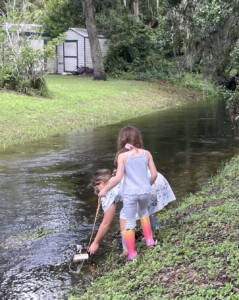
Students try out their homemade boats.
Ice pop sticks and masking tape were on hand. So were twigs and leaves and pine straw. The explorers gave it their best shot, and the initial results were … meh. They pulled their boats from the water to tweak their designs.
The next day, they tried again. This time, they incorporated wine corks that one of the facilitators brought in, plus sturdier and more water-resistant packing tape. This time, they found more success.
“This is what children do when they’re left to their own devices. Humans do this innately,” Wilson said. “They were failing forward, because it was fun.”
The project was also fun because it was theirs.
Agency matters. In one of the classrooms, explorers established their own mini mall. One of them set up a face-painting booth. Another created a line of glittery fingernails. Another manufactured mystery gift boxes, each with its own origami surprise. They even created their own bank, currency, and credit cards.
Wilson quickly suggested the students host a community fair, but “They were like, ‘Why would we want to do that?’ It wasn’t the right time.”
A few weeks later, Wilson pitched the idea again, this time because the Children’s Entrepreneur Market was coming to Sarasota. This time, the students were pumped.
In Florida, the state that’s leading the nation in reimagining public education, Curious and Kind is “school,” too.
It bills itself as a blend of the forest school and Agile Learning Center models. That may not be “traditional” education to some folks, but it has deep roots in thoughtful, alternative approaches.
“We believe in recognizing the innate curiosity of kids and fostering that,” said Chris Trammel, who is Justine’s husband, the director of operations at Curious and Kind, and likewise a longtime educator in public and private schools. “If you’re following your passions, you’re going to take ownership of your learning.”
Curious and Kind represents a number of other choice-driven trend lines.
The “hybrid” schedule is catching on. Florida’s homeschooling population has skyrocketed in recent years, as it has across the country, and more homeschooling families are opting for part-time schools.
Curious and Kind is on the cutting edge of “a la carte learning,” too. Thanks to the flexibility of ESAs, —which can be used for a range of educational expenses, not just private school tuition — more and more parents are choosing from multiple providers.
 In Florida, the primary vehicle for that, the PEP scholarship, can serve up to 60,000 students this year, up from 20,000 last year. Thousands of students are also using another Florida ESA, the Family Empowerment Scholarship for Students with Unique Abilities, in a similar fashion.
Carolina King’s daughters, Camila, 11, and Giuliana, 9, are among them. Both have special needs that would make it more challenging for them to thrive in traditional schools, said King, who writes a popular blog about parenting and child development.
King believes the student-directed approach is ideal for instilling a lifelong love for learning. Before the family moved to Florida in 2021, Camila and Giuliana attended a Montessori school. When a similar school didn’t pan out after the move, King turned to homeschooling and soon found Curious and Kind.
“They love it there. When the school year was over, they were so sad,” King said. “They said they never want to do summer again.”
King said features big and small make Curious and Kind special. The kids eat and use the restroom whenever they want. Different ages interact with each other. There’s no bullying. More than anything, King can see her daughters pursuing what excites them and learning deeply in the process.
Last year, Camila helped write a Halloween play that the kids performed for each other. She came up with the original idea. Other kids contributed to the script. Still more took on acting roles. Some were so engaged, they worked on the project at home.
“A lot of what happens is a snowball effect,” King said. “The kids feed off each other.”
Curious and Kind and similar alternatives might not be right for every family. But as choice in Florida has expanded, more and more have been flocking to them.
“People have a diversity of interests,” Wilson said. “We should have a diversity of options.”

