A lawsuit aimed at the country's largest private school choice program could have effects beyond the tens of thousands of students who receive tax credit scholarships, and the private schools they attend.
In a guest column published last week in the Tampa Bay Times and Florida Times-Union, state Board of Education member Gary Chartrand writes that if the lawsuit challenging the program succeeds, it could also affect public schools' finances.
After adding 38,469 new students last year, Florida public schools are projected to grow by another 100,000 over the next five. Now, imagine returning 78,000 scholarship students in one fell swoop.
Building new schools to handle all these scholarship children would cost $2.6 billion. Even if school districts had enough spare room to absorb half these students in existing classrooms, the tab would exceed $1.3 billion.
That’s not all. The scholarship is worth only 80 percent of what the state and districts spend per public school student in operating costs, which means they would have to come up with $111-million more every year to make up that difference.
Read more here or here. (more…)
 Education reform. State Board of Education chairman Gary Chartrand champions reforms, and sometimes draws critics, in Jacksonville and beyond. Florida Times-Union. Pensacola outlets, including WUWF and Pensacola Today, look at the past 15 years of education reform in Northwest Florida.
School boards. A cadre of school board members around the state forms an alternative to the Florida School Boards Association. Pensacola News-Journal. Fort Myers News-Press.
Lawsuits. WFSU looks at the legal battle over tax credit scholarships. The program is administered by organizations like Step Up For Students, which co-hosts this blog and employs the author of this post. The scholarships help students, and the legal challenge is more complicated than the program's critics claim, Step Up's Jon East writes in the St. Augustine Record.
Community schools. Grant applications aim to turn a Pensacola middle school into a community school with wraparound services. Pensacola News-Journal.
Testing. Are Florida's schools ready for computerized testing? Tampa Bay Times. Recess reductions may be helping to fuel the testing backlash. Sarasota Herald-Tribune.
STEM. A Sarasota high school retools its science classrooms. Sarasota Herald-Tribune. A state college invites elementary school students onto its campus for science experiments and more. Orlando Sentinel. Some parents are baffled by new math homework. Florida Today. A conference promotes STEM fields for girls. Naples Daily News.
GED. Fewer students are receiving the alternative credential, and tougher tests may help explain why. Tampa Tribune.
Class size. Recent comments by former Gov. Jeb Bush rekindle a debate over Florida's class size amendment. Sarasota Herald-Tribune.
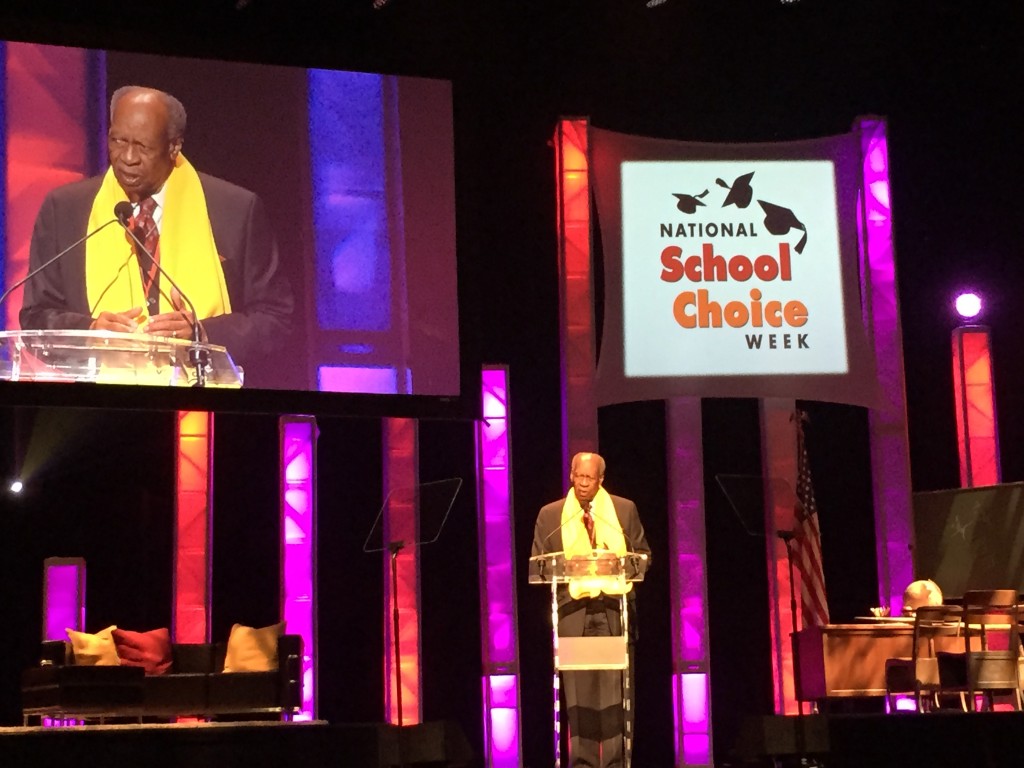
Rev. HK Matthews of Pensacola talks school choice and civil rights at a National School Choice Week kickoff rally in Jacksonville.
Nearly 2,000 students and parents packed Jacksonville's Florida Theatre to start the largest-ever week-long celebration of school choice.
National School Choice Week officially starts Jan. 25, but Friday's rally was part of the first round of more than 11,000 planned events. The events aim for a celebratory tone, with music, dancing, celebrity guests and tributes to the range of educational options: district, charter, private, virtual and home education.
Desmond Howard, a former Jacksonville Jaguar and Heisman Trophy winner, told the capacity crowd that some students benefit from options beyond the schools that are assigned to them.
"I don't believe your potential should be limited because of your ZIP code, because of your assigned school, because of an antiquated system that limits families from accessing quality schools," he said. "As a parent, I know this first hand. Every child is unique."
Denisha Merriweather, who grew up in Jacksonville and has become a prominent advocate for school choice, helped set the stage for figures like Duval County School Board member Jason Fischer, state Board of Education member Gary Chartrand and Jeanne Allen of the Center for Education Reform. Others, like U.S. Sen. Marco Rubio, made video appearances.
Merriweather attended Esprit de Corps Center for Learning with the help of a scholarship funded by Step Up For Students, the non-profit that administers the scholarship program and co-hosts this blog.
Public school options — especially those that emphasize the arts — got a shout out from Florida's Teacher of Year, Christie Bassett, who leads the art department at Highlands Grove Elementary in Polk County.
"When parents have more say in where their children go to school, everybody wins," she said, adding: "We love having choices in every area of our lives. Education should be no different."
Step Up For Students Chief Storyteller Lisa Davis contributed reporting and photos to this post.
Tom Majdanics tells the story of KIPP Impact Middle School in Jacksonville, Fla., in a pair of video clips. In the first, the school's first class of fifth-graders sits in the band room, instruments at the ready, poised to play their first note.
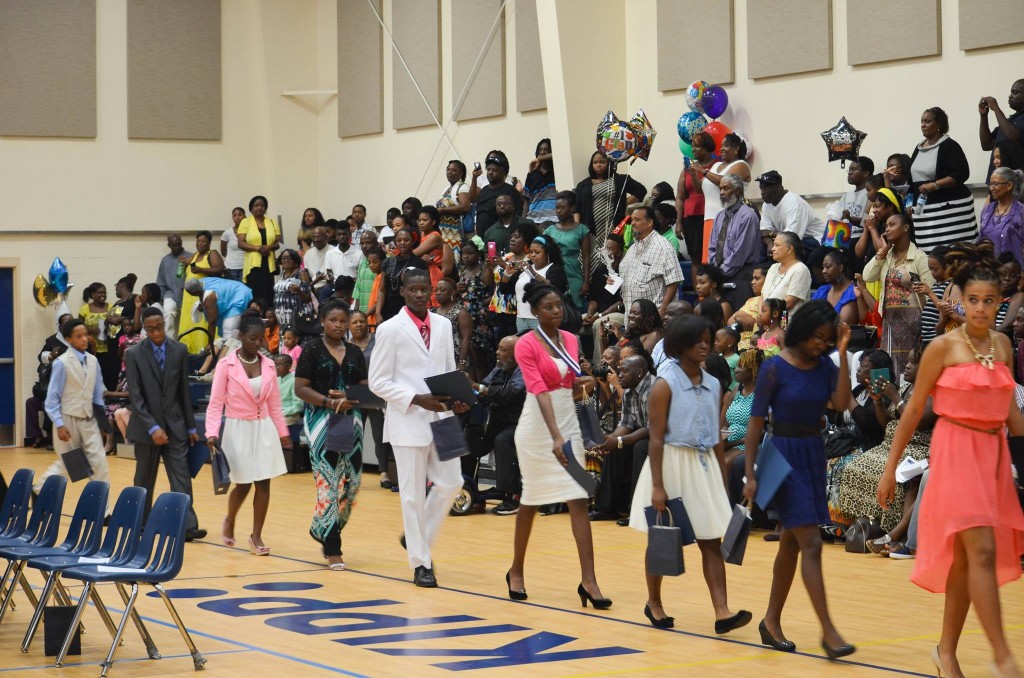
KIPP Impact Middle School graduated its first class of eight-graders earlier this year. Photo via KIPP Jacksonville.
"One, two, three, four," the conductor says. The instruments emit a warbly burst of noise. The screen fades to black.
The second clip shows the same students four years later, an orchestra of eighth-graders rocking a concert with a pitch-perfect rendition of Outkast's "Hey Ya."
Florida's first effort to bring a high-impact charter school to a high-needs neighborhood had its share of early stumbles, but it's starting to hit the right notes.
A recently approved expansion will allow KIPP to keep growing in Jacksonville. It raised its state letter grade again this year, and its students posted some of the strongest learning gains in Duval County. Meanwhile, KIPP's developing elementary school is expected to further boost the middle school, and it's hoping to work more closely with the local district to spread its impact.
Majdanics, KIPP Jacksonville's executive director, said the schools are still years from their goals, but this year more than ever, "the green shoots are unmistakable."
The effort is worth watching from across Florida and beyond, because state policymakers are looking to duplicate it.
Gary Chartrand, a state Board of Education member, is also a board member and early supporter of the KIPP Jacksonville foundation. He's pushing efforts to launch similar schools in other Florida cities - efforts that are set to get a boost from a new state grant program and might find additional support this year in the Legislature.
"What we're building with KIPP in Jacksonville should be a model, I think, for other urban areas throughout Florida," Chartrand said.
Need in Northwest Jacksonville
KIPP Jacksonville gives admissions preference to students in seven ZIP codes, a P-shaped area dotted with D and F schools.
At first, grades at KIPP's Impact Middle School languished too, with an F in its first year and a roller-coaster ride in the years that followed. But that's starting to change.
This year, its students boasted the second-highest learning gains in math among Duval's middle schools. The only school that performed better had about 20 percent of its students qualify for free- and reduced-price lunches, compared to 71 percent at KIPP Impact. (more…)

Gary Chartrand
On Tuesday, when the Florida Board of Education somewhat grudgingly approved turnaround plans for dozens of D- and F-rated public schools, several board members said they want to explore ways to revamp the process for transforming schools that are struggling academically.
One suggestion from board chairman Gary Chartrand: Parents at those schools need to know what other choices are available.
Chartrand has been a backer of philanthropic efforts to improve education options in inner-city Jacksonville. He was an early supporter of the effort to bring KIPP to the city, and sits on its board.
Parents often face barriers to true school choice, and one of the most basic is a lack of information, he said. If they're in a school where student achievement lags, it's especially important that they know about their options.
"It can get complicated for parents to know what all their choices are, and I particularly get concerned about the lack of choice for those that are the most undeserved, because they don't have the flexibility to move," he said in a brief interview after the meeting. "When you don't offer other choices for that child, then we're not doing our job."
by Ron Matus and Travis Pillow
A chorus of Florida lawmakers, education leaders and others began urging the Florida School Boards Association Wednesday to drop a lawsuit it plans to file against the state's tax credit scholarship program for low-income students.
Chartrand
The suit, which sources said could be filed as early as Thursday, could potentially limit school choice options for nearly 70,000 low-income parents, saddle school districts and taxpayers with hefty financial costs and entangle the nation’s largest school choice program in litigation for years.
"I believe in choice and in freedom especially for those children that have limited mobility and limited financial resources," said Florida Board of Education Chairman Gary Chartrand in a written statement. "The Florida tax credit scholarships provide this freedom for our most underserved population to choose a school that best serves their needs."
The FSBA "is acting without consideration for this population by filing a law suit against this program," Chartrand continued. "This is surprising and disheartening, and I call on them to rethink their position and withdraw the lawsuit."
Added Florida House Speaker-Designate Steve Crisafulli: "This proven, popular program is essential for preparing children for success in college and the workforce. I hope School Board members will reconsider their actions and put the needs of children first."
The FSBA board of directors voted June 11 to move forward with a suit challenging the constitutionality of the scholarship program, which the Legislature created in 2001.
FSBA Executive Director Wayne Blanton could not be reached for comment Wednesday. But Juhan Mixon, executive director of the Florida Association of School Administrators, which is supporting the suit, said it was in part spurred by the program's rapid growth. (more…)
Study after study after study has looked at charter schools run by the Knowledge is Power Program and come to the same conclusion: KIPP schools significantly improve achievement among disadvantaged students.
A new study by researchers at Mathematica Policy Research goes a step further, addressing some of doubts raised by skeptics — specifically the idea that, in the authors' words, "these improvements reflect advantageous enrollment patterns at KIPP that are not possible at traditional public schools."
The findings, published in this fall's edition of Education Next, show KIPP schools attract students who face similar disadvantages to those in surrounding schools, and that their increased achievement cannot be explained by weaker students dropping out or stronger students transferring in.
The researchers looked at 19 of the network's older middle schools, all of which opened in 2005 or earlier (before KIPP opened its first school in Florida). Using detailed student-level data, they compared the KIPP students to those in the surrounding school districts, as well as a smaller group of nearby middle schools that draw students from the same elementary schools. Then they looked at students who leave the schools and those who transfer into the schools part way through middle school.
We find that, on average, KIPP middle schools admit students who are similar to those in other local schools, and patterns of student attrition are typically no different at KIPP than at nearby public middle schools. In both groups of schools, students who leave before completing middle school are substantially lower-achieving than those who remain. KIPP schools replace fewer of these students in the last two years of middle school, however, and, compared to district schools, KIPP schools tend to replace those who leave with higher-achieving students. Nonetheless, while this difference in replacement patterns is noteworthy, it cannot account for KIPP’s overall impact on student achievement. In particular, the literature on peer effects suggests that KIPP’s student replacement pattern could produce only a small fraction of KIPP’s actual impact on student achievement.
In short, the schools' positive effects on student achievement hold up even after accounting for student attrition and other "peer effects" examined by the study. (more…)
From the News Service of Florida:
Commissioner Stewart
The State Board of Education voted unanimously Tuesday to go forward with dozens of changes to the Common Core State Standards, a move that seemed unlikely to quell the grass-roots furor over the educational benchmarks.
The approval followed a raucous public hearing that seemed to indicate that passionate opposition to the benchmarks remains despite a concerted effort by Gov. Rick Scott and the Florida Department of Education to tamp down conservative anger over the standards.
Education Commissioner Pam Stewart has argued that the changes, which include reinserting creative writing into the standards and explicitly including calculus guidelines, as well as the fact that the state has science and social studies standards that aren't part of the Common Core, justify renaming the initiative as the "Florida Standards."
Stewart told reporters after the vote that it made the state's standards clear.
"The vote that the board took today certainly does lay to rest where we're headed, the direction we're going with our standards, and this is the right move," she said.
But dozens of activists slammed the standards during a lengthy public hearing before the vote, portraying Common Core as a federal plot to take over education and blaming it for a variety of ills. While the benchmarks were spearheaded by a coalition of state officials, they have since been encouraged by the U.S. Department of Education.
"I do not want a watered-down, world-class system; I want a school system that promotes American exceptionalism," said Chris Quackenbush, a leader of the anti-Common Core movement. (more…)
Chartrand
The wild debate about Common Core veered into unexpected territory Tuesday, with the board that governs education in the nation's fourth largest state having a lengthy debate about whether to actually use the term.
In response to mostly-Tea Party-driven objections, Florida Gov. Rick Scott directed the Florida Department of Education to take public input on the standards, both on its website and at three public forums. But the DOE doesn't refer to them as Common Core State Standards, instead describing them on the site as "Florida’s currently adopted English language arts and mathematics standards."
That's technically true. The Florida Board of Education adopted the standards in 2010. But board member Kathleen Shanahan raised objections to the term "Florida standards," saying it could create confusion with the public and "disenfranchise" thousands of Florida teachers who are already teaching Common Core State Standards.
At one point, Shanahan asked the department's communications director if DOE was going to use the term Common Core State Standards in its communications efforts. When she indicated she wasn't satisfied with the answer - "Is that a yes or a no?" - Commissioner Pam Stewart offered that until the department is finished getting public input and making recommendations to the board, "I don't know that we know what we're going to call it."
Shanahan, who has close ties to former Gov. Jeb Bush, continued to object: "We have instructional people in classrooms teaching (CCSS) and we're all of a sudden going to walk it back and be sort of mushy about it until we get more input."
Stewart then explained that technically, teachers in grades K-2 were teaching Common Core this year, but teachers in other grades were still teaching a blend of Common Core and the previous state standards.
Board Chair Gary Chartrand weighed in next: It's okay to say Common Core State Standards.
"We're doing the right thing" by getting public input, he said. "But until such time, I believe Common Core State Standards is not a dirty word. It's something people understand. And it is a lightning rod. I understand. There's a lot of emotion around it. But let's not back away from it."
How can Florida attract highly regarded charter schools outfits like Rocketship and Yes Prep? Some of the state’s top education leaders hope to figure that out as they begin looking more closely at why those high-impact schools aren’t in Florida now.
“We need to do a better job, in my opinion as the state Board of Education chair, of serving our neediest children,’’ Gary Chartrand told redefinED Tuesday. “We need charter school operators that are really serious, cause-minded folks ready to do the hard, hard work of working in the toughest neighborhoods.”
Chartrand joined Gov. Rick Scott and Florida’s school choice director, Mike Kooi, in Orlando on Friday for a meeting with five of the country’s leading charter school operators (KIPP, Yes Prep, The Seed Foundation, Rocketship Education and Scholar Academies) and five superintendents from the state’s largest school districts (Orange, Miami-Dade, Duval, Hillsborough and Pinellas counties).
The group also included representatives from the Walton Family Foundation and the Florida Philanthropic Network, which includes the Helios Education Foundation and the Bill & Melinda Gates Foundation, Chartrand said.
The goal: identify the roadblocks for such schools and work toward solutions. There are a lot of variables, including per-pupil funding, which Chartrand said presents a significant challenge.
Florida ranks near the bottom nationwide, with an average of $9,572 spent per pupil, according to a recent Education Week analysis. By comparison, Vermont spends $18,924 per pupil and Utah $7,042.
“It does cost more to serve the highest-needs areas,’’ Chartrand said.
Chartrand helped bring KIPP to Florida and serves on the board of directors for the Jacksonville school (Chartrand donated $1 million toward the middle school and helped raise $9 million from the local business community). KIPP offers a longer school day and year, after-school programs and highly-qualified instructors to teach an academic program that focuses on college prep and character development.
Since KIPP was founded in 1994, more than 90 percent of its students have graduated high school and more than 80 percent have attended college. Of those, 40 percent have obtained college degrees.
The state wants to lure similar schools “by making long-term sustainability … a reality,’’ Chartrand said.
That might mean reducing startup costs, he said, perhaps by giving the schools access to the state’s Charter School Growth Fund. The fund is a $30 million reservoir created by federal Race to the Top dollars and philanthropic groups to benefit high-performing charters serving low-income students.
Another way to help is to streamline the charter school authorization process, Chartrand said.
In Florida, where there is no state authorizer, charter school operators apply through individual districts. But the process could go smoother if districts, state school choice officials and charter operators collaborate more closely on the front end, he said.

