 Quality Counts. Florida ranks No. 6 this year in Education Week’s annual report. Coverage from redefinED, Associated Press, Miami Herald, Gradebook, Orlando Sentinel, StateImpact Florida, Fort Myers News Press, Naples Daily News, WCTV, News4Jax. More from Huffington Post.
Charter school access. SchoolZone takes a critical look at the first policy paper from the Center for School Options, a new think tank chaired by former Education Commissioner Jim Horne. It grades the 10 biggest districts in the state on charter school access. The Fort Myers News Press writes up Lee County's top grade.
Charter school attendance. Palm Beach district officials suggest tighter controls are needed after a Mavericks charter school overstated its attendance and received $160,000 more in per-pupil funding. Palm Beach Post.
Career and technical. Tampa Bay school officials are headed to Germany to learn more about programs there. Tampa Bay Times.
Suspension and grad rates. A Johns Hopkins University study of Florida ninth graders finds much higher graduation rates for those who were never suspended as freshmen versus those who were suspended even once or twice.Education Week.
Rick Scott. Visits Fort Lauderdale High School. South Florida Sun Sentinel.
Superintendent searches. Interim education commissioner Pam Stewart applies for the superintendent’s opening in Manatee County, reports Gradebook. St. Lucie County gears up to replace retiring Superintendent Michael Lannon, reports TCPalm.com.
School security. Hillsborough is going too far, editorializes the Tampa Bay Times. So is a Lake County School Board member who wants to arm teachers and principals, writes Orlando Sentinel columnist Lauren Ritchie.
Rezoning angst in Seminole. Orlando Sentinel.
For the fifth year in a row, Florida’s public school system ranks among the best in the country, according to the latest annual analysis by Education Week.
Released this morning, the highly anticipated “Quality Counts” report puts Florida at No. 6 among states this year, trailing only Maryland, Massachusetts, New York, Virginia and Arkansas. In the previous four years, Florida came in at No. 11, No. 8, No. 5 and No. 11, respectively.
"For Florida to be a global leader in job creation and economic growth, we have to provide our students with a quality education," Gov. Rick Scott said in a written statement. "Today's news that Florida has moved into the top ten in the nation for overall quality of education reinforces that we're taking the steps needed to ensure our students succeed."
The consistently strong showing is at odds with public perception and with steady criticism from those opposed to a series of far-reaching education changes spurred by former Gov. Jeb Bush. To be sure, it’s tough to determine which factors – including a heady expansion of parental school choice - have had the most impact. But the EdWeek reports are another credible sign that Florida students and teachers are no longer cramping at the back of the pack.
They’re also another sign that nobody should be satisfied. Florida earned a B- overall in the latest report. And in the category that matters the most – student achievement – it managed a C-.
Quality Counts looks at policy and performance in six broad categories with multiple indicators. Each year, the researchers behind the report update three of them. This year, they updated the school finance and “transitions and alignment” categories, and something called the Chance-for-Success Index.
Florida’s rank on the index is unchanged from 2011, coming in at No. 34. On transitions, it climbed from No. 14 to No. 4. On finance, it fell from No. 31 to 39 (and from C- to a D+). The reason for the latter: historic cuts in education spending that had yet to be tempered by 2010, which is the data year EdWeek uses for the new report. (more…)
Charter school performance. StateImpact Florida gives more ink to University of Central Florida Professor Stanley Smith. His latest analysis finds little difference in academic performance between charter schools and district schools in Florida.
 Grad rates. The new, tougher federal formula could backfire if states ease up on their graduation requirements, writes the EdFly Blog. Declining rates in Citrus County are “a black eye for schools, but a gut punch for the community,” editorializes the Citrus County Chronicle.
Guidance counselors. Most of the state’s public schools would be required to hire more under a bill filed by Sen. Nancy Detert, R-Venice, reports the Tallahassee Democrat.
Tony Bennett’s contract. Gradebook.
School security. Tampa Bay Times. Tampa Tribune. South Florida Sun Sentinel. Gainesville Sun.
Principal misconduct. A Duval principal is demoted over testing issues. Florida Times Union.
“Peaceful coexistence.” Sometimes there is tension when schools share campuses. Lakeland Ledger.
by Fawn Spady
School choice has encountered greater travails in few venues besides Washington State. Before they narrowly approved a new charter law this November, voters rejected charter initiatives in 1996 and 2000 and repealed a charter law enacted by the legislature in 2004. Washington State is in fact the only state where charter schools have ever faced voters directly. Now, opponents including the Washington State teachers union and the state superintendent of schools are threatening to sue to try to have the law held unconstitutional.
But you can’t keep a good idea down, as we saw last week at the Washington Charter School Resource Center conference. My husband Jim and I started the center in 2000. We hosted 160 interested people, 80 percent of them educators, at a forum on how to start a charter school successfully. Many hope to open a school next fall.
We are frustrated that the opposition remains so intense when the need for new approaches and frankly, for empowering parents with more educational options, is so obvious. Not even half of our fourth- and eighth-graders were proficient on national reading and math tests in 2011. Although we are fortunate in Washington State to have fewer low-income families than the national average, we rank only 37th in high school completion. Our graduation rate was 73.7 percent in 2011, and it was just 56.5 percent for Native Americans, 65.4 percent for African Americans and 64.5 percent for Hispanics. This is simply unacceptable.
Thankfully, we heard the imperative for change from those attending our forum. A principal told us he was tired of doing the same thing over and over and expecting a different outcome. A parent said she just knows there is a better choice for her special needs children. A retired teacher said public charter schools give her the desire to return to public education. A former school board member declared charters a way to engage parents in schools.
Particularly encouraging for us is the wealth of expertise eager to assist us in moving forward. (more…)
 Tony Bennett has a tough, tough job ahead, and the way education in Florida is covered is not going to make it any easier. The big news last week is a case in point.
Besides Bennett’s selection as the state’s new education commissioner, the top story was how Florida fourth-graders scored on a respected international test called PIRLS , which stands for the Progress in International Reading Literacy Study. In case you missed it, Florida students ranked second in reading, behind only their peers in Hong Kong. Virtually none of the state’s major daily newspapers (the Orlando Sentinel being a notable exception) covered this development, but CNN did. It interviewed interim Education Commissioner Pam Stewart live, next to an all-caps headline that read, “FLORIDA STUDENTS SCORE BIG.”
This wasn’t a one-time oversight. Over the past 10 to 15 years, Florida students and teachers – its public school students and teachers - have made impressive academic gains, whether it’s on national math and reading tests, or on college-caliber Advanced Placement tests, or in graduation rates as determined by credible, independent experts. For four years running, Education Week, looking at both performance and progress, has ranked Florida among the leading states in K-12 achievement (to be specific, at No. 7, No. 7, No. 6 and No. 12 over that span). And yet, flattering reports about Florida’s progress rarely get more than passing mention, while those who oppose the state’s accountability and school choice initiatives are often allowed to deny that such progress even exists. Even stranger, the more outrageous their statements get, the more often they seem to get quoted. (more…)
 He’s in.
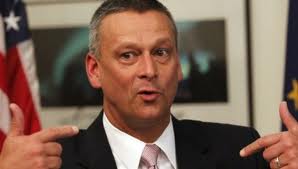
Tony Bennett, the hard-charging Hoosier with a rock-star rep, is the new face of Florida’s school system and its full-throttle reforms.
As expected, the Florida Board of Education voted unanimously Wednesday morning to select Bennett, the former state superintendent in Indiana, over two finalists with lower profiles. In doing so, they opted to give a new and bigger stage to a former science teacher and basketball coach who lost re-election last month, in a shocking upset, after championing school vouchers, school grades and other Florida-style initiatives.
Immediately after the vote, Bennett told reporters that even though his dream job was in Indiana, "there's only one state I believe is better than that, and that's Florida. This state is so vitally important to the national education discussion."
"I look forward to the great things ahead," he told the board.
Bennett's salary and start date are subject to negotiation, but the last two commissioners made $275,000 per year. Bennett said he expected to start work in mid January.
Board members discussed Bennett and the other two finalists for four minutes before the vote.
"His ability to get up to speed quickly would be very important for the state of Florida," said board member John Padget. And his willingness to travel the state to meet with teachers and other stakeholders "will be absolutely necessary," said member A.K. Desai.
“Tony has a great record of achievement in Indiana and I am confident he will be a tireless advocate for Florida’s students," Gov. Rick Scott said in a prepared statement.
As commissioner, Bennett will help oversee one of the biggest and most dynamic school systems in the country. Florida has 2.6 million students, with 40 percent of them attending something other than their zoned school. That's not by coincidence.
Since Jeb Bush was elected governor in 1998, the Sunshine State has been the nation’s leading lab for the transformation of public education. School grades, school vouchers, third-grade retention, merit pay for teachers – if it was controversial, it seems, it was either tried in Florida first or rolled out here in bigger, bolder fashion. Pressure to improve outcomes is coming from both a tough accountability system and, increasingly, from parent-driven school choice.
Bennett, the fourth commissioner in less than six years, faces even bigger challenges than his predecessors did. (more…)
Financial irregularities. Eighty-five percent of district schools in Palm Beach County show financial irregularities, an audit finds, with some cases involving “thousands of missing dollars, spotty tracking of fundraising cash and outstanding deficits in school funds,” reports the South Florida Sun Sentinel.
 Teacher turnover. The Pasco district knows it must find ways to slow the revolving door in high-needs schools. Tampa Bay Times.
Inconvenient truths. Florida Voices columnist Rick Outzen says it’s an “inconvenient truth” that Florida’s grad rates are so low. (It’s also an inconvenient truth, not mentioned in the column, that they’re among the fastest-rising in the country.)
Construction money. Supporters of traditional public schools say charter school funding is leaving them in a bigger bind, reports the St. Augustine Record. Says Colleen Wood with 50th No More (and Save Duval Schools): “It seems to be the idea that parental choice is the guiding principal (for charter schools) as opposed to (students getting) the best education possible.”
Rubio and tax credit scholarships. Florida offers a model for a federal program proposed by U.S. Sen. Marco Rubio, writes the Choice Words blog. (Step Up For Students, which co-hosts this blog, administers the Florida program.)
Evals. The ones for administrators came out last week, too. StateImpact Florida. But there's a disconnect between the new evals and school grades, writes Naples Daily News columnist Brett Batten.
Early learning funding formula. Gov. Rick Scott says the state won’t change it this year, drawing praise from early learning coalitions, reports Gradebook.
Stuck in the '70s. In an editorial about the three finalists for ed commish, the Tampa Bay Times likens the DOE to "an old pinball machine" and asks: "At what point does the privatization of the public school system go too far? And what will you do move the focus off of vouchers and back to the heart of Florida's future - its traditional public schools?" Orlando Sentinel columnist Beth Kassab says go with Tony Bennett.
Tony Bennett. He’s in the mix for Florida education commissioner. Coverage from Orlando Sentinel, Indianapolis Star, StateImpact Florida. A list of all candidates on Gradebook here.

Vitti
Welcoming competition. New Duval Superintendent Nikolai Vitti is recommending the school board approve 12 of 14 charter school applications up for a vote today, reports the Florida Times Union. He also tells the board the district has to compete and “dominate the market” so “when a charter school tries to set up shop they will find themselves unable to compete with us because we are that dynamic and innovative.”
More on grad rates. Orlando Sentinel. AP. The Ledger.
More on remediation. StateImpact Florida.
Cherry picking. EdFly Blog calls out Reuters for last week’s story about Florida’s academic gains.
Union news. Karen Aronowitz won’t seek another term as president of United Teachers of Dade, reports the Miami Herald.
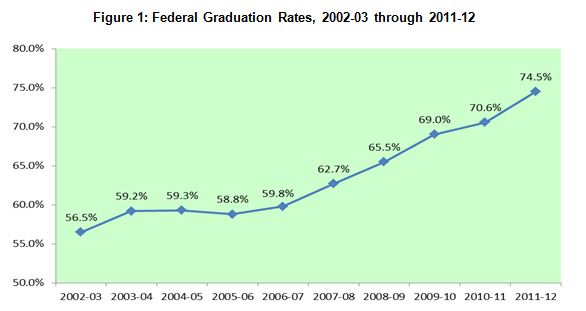
Grad rates rising: Florida’s grad rate jumped nearly 4 percentage points in 2012, to 74.5 percent, the biggest one-year jump since 2003, the Orlando Sentinel reports. Full DOE report for districts and individual schools here. The DOE press release announcing the news was sent out at 5:42 p.m. Friday and that, unfortunately, may have limited coverage. Coverage from Gradebook here and here. Sherman Dorn’s take here.
College remediation rates still too high. StateImpact Florida, first in a series.
That charter school again. NorthStar High School, the same failing Orange County charter school that gave its principal more than $500,000 as it was closing its doors, also paid her husband more than $460,000 over a five-year period, the Orlando Sentinel reports.
Praise for Florida’s reforms. And bipartisanship. Julia Johnson, a former state Board of Education member, writes on both in USA Today.
Zoning woes in Palm Beach. One parent upset about proposed boundary changes for a popular elementary schools tells the Palm Beach Post: “We moved specifically to put our daughter into a better school.” A school board member who represents the school, meanwhile, says dozens of parents are “faking” their addresses so their children can attend.
More Jeb Bush summit. Checker Finn’s a fan. EdWeek writes up Arne Duncan’s speech. More from Bloomberg, Stateline, the Getting Smart blog.
Sen. Legg
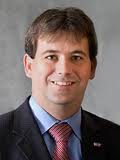
New ed leadership. John Legg, the former state rep and new state senator from Pasco is the new chair of the Senate K-20 Education Policy Committee, reports Gradebook. (The post also includes a listing of all committee members.)
Weeding out low-performing charters. EdWeek. StateImpact Florida.
Per-pupil spending by state. A new federal report shows Florida at No. 42, at $8,863 per student in the 2009-10 school year, reports the Orlando Sentinel School Zone blog.
More on $10,000 degrees. The Daytona Beach News-Journal editorial board likes Gov. Rick Scott's idea. The Sentinel's Beth Kassab does not. More from the Lakeland Ledger.
More on low grad rates. Palm Beach Post.
Voucher accountability. A problem private school in Manatee County should prompt more oversight from the state, editorializes the Bradenton Herald.

