 Around the state: A job fair will be held in Okaloosa, lobsters were donated by the Florida Fish and Wildlife Conservation Commission for research by schools in the Keys and a doctoral student at Florida State University started a company to help solve a research problem. Here are details about those stories and other developments from the state’s districts, private schools, and colleges and universities:
Broward: Schools Superintendent Peter Licata has taken the helm of the school district here after the Board approved a three-year contract. Licata's philosophy is student-centered, teacher-supported and principal-led. Licata, a Broward native who has been a longtime educator, recently took on the role of the country's sixth-largest school district. “We are a very good district. There are some things that people want to talk about way too long about the past,” Licata said. CBS Miami. WPLG. A Broward County Sheriff's Office deputy named Christopher Krickovich who was arrested in 2019 and later fired after being accused of slamming a high school student's head into pavement during an arrest is being allowed to return to work with full back pay. WSVN.
Palm Beach: Whether students will be able to check out the Bible at Palm Beach County school libraries will be decided next week when school board members weigh in on a local rabbi's challenge should succeed. Civil rights advocate Barry Silver filed an objection in April to the Bible's availability at Olympic Heights High School in Boca Raton, where his son was a senior. Silver attached a petition for its removal that was signed by about 50 people, arguing that a Charles Darwin book should replace the Bible on school shelves. The Palm Beach Post.
Okaloosa: The school district here will host a job fair on July 25 for positions that include bus drivers, substitute teachers, food service workers and other jobs. NWF Daily News.
Levy: The school board here recently announced its policy for serving meals to students under the School Breakfast Program and National School Lunch Program for the upcoming school year. The good news: All students will be served free breakfast and lunch at particular sites. Levy Citizen.
House Bill 1: The Florida Department of Education seeks input on House Bill 1, signed earlier this year by Gov. Ron DeSantis. Under HB 1, all students in Florida are now eligible for taxpayer-financed vouchers for up to $8,500 to attend private schools. Suggestions can be submitted until Aug. 15, and will be taken into account when policy recommendations are introduced during the 2024 legislative session. NWF Daily News.
Lobster donation: Florida Fish and Wildlife Conservation Commission lobster biologists came up with an educational solution to a unique issue: What to do with dozens of spiny lobsters caught in the waters of the Florida Keys that are used for research by the FWC. To solve the problem, the FWC partnered with local Keys high schools to support lobster research and high school science and culinary courses. Lobsters went to Key West High School and Marathon High School, and were used by both marine science and culinary classes. "The kids really learned a lot," said science teacher Shannon Duffy. "It was amazing. It was a really cool experience for them. The kids were so into it, because it was hands-on." Keys News.
Karate competition: Local teen Kyandra Valle was chosen to join the AAU/USA Karate National Team, which is made up of 125 people from across the country. They are competing in the 11th WUKF World Karate Championships in Scotland this week. Valle has been practicing karate since she was 6 years old. ABC Action News.
Reading report: In the past five years, 30 states around the country have passed laws that require educators to teach young children how to read based on what educators know from science about effective literacy instruction. The most recent scores from the National Assessment of Educational Progress found that only a third of fourth graders are proficient readers, which is significantly less than before the pandemic. The 74th.
University and college news: Elena Brandt, a doctoral student at Florida State University, has always been shocked at the behavioral science research she sees conducted by American scientists due to the lack of diversity among participants in international experiments and surveys. So, she decided to do something about it by founding Besample, a research firm that provides researchers a quick and cost-efficient way to access diverse research respondents in 42 countries around the world. Brandt is a mother of three who moved to the U.S. six years ago. Tallahassee Democrat.
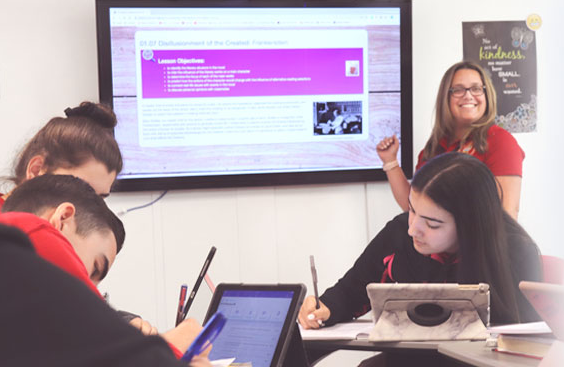
Archdiocese of Miami Virtual School, owned and operated by the Archdiocese of Miami, offers full- and part-time enrollment, introducing students to Catholic virtues and principles while enhancing learning for participants across the country.
When Florida Gov. Ron DeSantis signed HB 1 into law, he praised it as “the largest expansion of education choice not only in this state but in the history of these United States.” During committee hearings, lawmakers called it “transformational.”
The sweeping legislation extended eligibility for the Sunshine State’s 20-year-old school choice program to every student regardless of income. It also gave parents more control over their children’s education by converting traditional scholarships to education savings accounts.
The accounts, called ESAs, allow funds to be spent on pre-approved uses such as curriculum, digital materials, and tutoring programs in addition to private school tuition and fees.
But despite the greater opportunities for customization, one thing was not included: religious virtual schools. Under the new law, students may use funds to attend non-sectarian virtual schools, such as Florida Virtual School, and traditional in-person religious schools, but not a combination of the two.
That language means that schools such as Archdiocese of Miami Virtual Catholic School and Families of Faith Christian Academy International, which offers a private virtual school option, are excluded from participating in the state’s K-12 education choice scholarship programs. However, families who are using personalized education plans under HB 1 are allowed to use ESA funds to buy curriculum from ADOM Virtual Catholic School, even though they can't use the money to enroll at the school.
The Lakeland-based school is working on passing inspections for a campus on property owned by Epic Church, according to its website. Students who attend the in-person campus full time will be able to use scholarships. Before the pandemic, the school offered a blend of traditional and home-based instruction for homeschool families.
However, when Covid-19 made online education more popular, the school focused more on its virtual offerings.
Jim Lawson, the administrator at Families of Faith, hopes that closing the loophole will be on the lawmakers’ list when the 2024 session begins.
“With all the good that is included in HB 1, which we support, the Florida Legislature has continued to limit a wide range of high-quality educational options,” said Lawson, administrator for Families of Faith, who co-founded the school in 1994 with several other homeschool families.
“Parents can choose a high-quality campus-based program that aligns with the academic needs of their students while not conflicting with their faith. But they are not given the same choice to choose a high-quality accredited virtual program for a faith-based private school. The foundational principle of school choice is to have the same menu of options that families who choose the public school system, which includes FLVS, available to them from the private sector.”
Jim Rigg, superintendent of schools for the Archdiocese of Miami, which has a virtual Catholic school that offers full- and part-time programs, has a similar perspective.
“We favor efforts that maximize the ability of families to choose the school that best fits their child’s needs,” Rigg said. “This would include faith-based virtual schools, such as the ADOM Virtual School used by hundreds of students throughout Florida and across the world.”
Some say the language puts HB 1 in conflict with the First Amendment’s free exercise clause cited in recent U.S. Supreme Court decisions Espinoza v. Montana and Carson v. Makin, which forbade Maine and other states from discriminating against religious schools in state education choice scholarship programs.
In Espinoza, the high court ruled that a state “need not subsidize private education” but that once it “decides to do so, it cannot disqualify some private schools solely because they are religious.”
In Carson, the high court ruled that states could not ban faith-based schools from participating in state scholarship programs because the schools engage in religious activities. The case involved town tuition programs offered in some Northeastern states that offer students in rural areas funding to attend private schools where there are no district high schools.
“Likewise, a state need not subsidize families choosing virtual learning, but once it decides to do so, it cannot disqualify some virtual learning providers solely because they are religious,” Jason Bedrick, a research fellow at the Heritage Foundation’s Center for Education Policy, wrote in a recent analysis.
Shawn Peterson, president of Catholic Education Partners, a national organization that promotes greater access to Catholic education, agreed, saying that although he applauds the passage of HB 1 and welcomes the wealth of options it offers, he hopes to see some changes.
“We hope that lawmakers om the Sunshine State will fix the legislation to ensure that all providers to ensure that all providers can participate in the new program,” he said.
Bedrick urged lawmakers to tweak the bill by inserting language clarifying that notwithstanding any other provision in Florida statute, families using education savings accounts may choose virtual providers that offer religious or secular instruction, and that the language should specify that virtual learning counts toward regular attendance regardless of whether students are enrolled in brick-and-mortar schools.
“Florida has an opportunity to reclaim its mantle as the leading state for education freedom and choice,” Bedrick wrote. “With just a few small but important tweaks, the Sunshine State could adopt a policy on universal education choice that will be a shining example for other states to follow.
Any tweaks will have to wait until the 2024 legislative session, which begins Jan. 9.
 Editor’s note: This article appeared Monday on floridadaily.com.
With the signing of a universal school choice bill last week, Gov. Ron DeSantis and the state are receiving praise from school choice advocacy groups.
“This legislation is nothing short of transformational,” said Danny Aqua, executive director of Teach Florida. “Every student in Florida will soon have the opportunity to experience an education that works for them thanks to Gov. Ron DeSantis.”
In a legislative session loaded with major policy proposals, one focal point has been a school choice proposal that would expand eligibility for scholarships to all K-12 students in Florida.
DeSantis signed the bill into law last week, which creates one of the largest expansions of school choice in the country. The legislation was also a top priority of Florida House Speaker Paul Renner, R-Palm Coast.
“The state of Florida is number one when it comes to education freedom and education choice,” said DeSantis at the bill signing. “Today’s bill signing cements us in that number one position. We’ll be signing legislation that represents the largest expansion of education choice, not only in the history of this state, but in the history of these United States.”
Under the new law, education funding will directly benefit families in the form of Education Savings Accounts that will provide opportunities for Florida students to attend a school of their choice. The money will be used as parents see fit to further their children’s education, such as for public, private, charter, or magnet schools, whether online, in-person, or a hybrid of the two.
Critics of the proposal argue that this legislation will divert resources away from public schools and toward private schools. However, supporters of the legislation assert that funding will now follow the student.
To continue reading, click here.
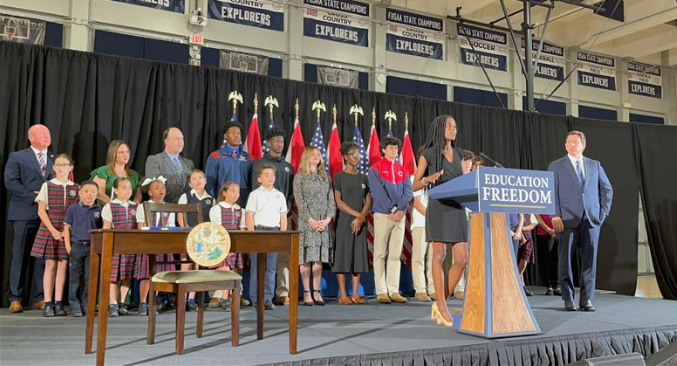
Hera Varmah, who benefited from Florida’s state scholarship program, testified Monday that tax credit scholarships allowed her and nine of her 12 siblings the opportunity to attend a private school.
Editor’s note: This article, which features the voices of families and former students who have benefited from education choice, appeared Monday on flvoicenews.com.
Scholarship recipients and their families praised Gov. Ron DeSantis and lawmakers for passing “historic” school choice legislation that will give families more options in their children’s education.
The legislation will expand school choice vouchers to all students in the state, among other school related measures.
During DeSantis’ press conference Monday, one scholarship recipient, Hera Varmah, gave testimony that her family grew up poor, and out of 12 siblings, she received a scholarship with nine of her brothers and sisters.
“The tax credit scholarship allowed them to send us to schools that gave us the best opportunity to learn and grow and succeed,” Varmah said.
Varmah said her family now has four college graduates with a chemical engineer, a mechanical engineer, and one that went on to medical school.
“When people say school choice doesn’t work, I simply show them my family. This is the power of giving a child an education that fits their needs,” Varmah said. “Scholarships like these change the entire trajectory of my life, and of so many families. This is the power of school choice and I’m so happy to be a part of this monumental bill and be a part of the one of the Florida stories.”
A mother of a scholarship recipient, Aimee Uriarte, said Florida’s scholarship programs have been a “true lifesaver” for her two sons.
“Governor, you have this mother’s eternal gratitude for allowing my boy’s future to be as promising in a school like Columbus High School,” Uriarte said.
Rachel Hayon Sabbah, a Fort Lauderdale mother, gave testimony on her daughters, two of which receive scholarships at the Jewish Cooperative School.
To continue reading, click here.
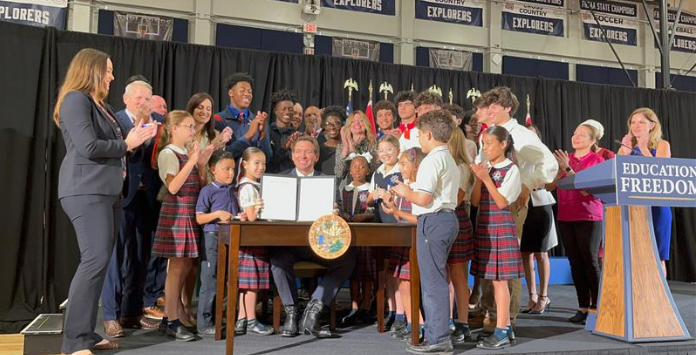 Editor’s note: Florida Gov. Ron DeSantis on Monday signed into law House Bill 1, sponsored in the Senate by Sen. Corey Simon (R-Tallahassee). HB 1 contains a comprehensive package of innovations that promote parental involvement and customized K-12 education in Florida, empowering parents to guide their children’s education by providing for an education savings account. The bill also takes a first step toward reducing onerous and excessive regulations on public schools. Here is what education choice advocates had to say in the aftermath of the bill signing.
You can watch video coverage of Monday’s historic bill signing here.
Sen. Corey Simon (R-Tallahassee), Chair of the Senate Committee on Education Pre-K-12
This legislation is a transformational opportunity to make it clear that the money follows the child, and parents have a right to guide their child’s education as they see fit. We recognize that parents are a child’s first and best teachers. A street address or level of income should never replace the vital and irreplaceable role of a parent to decide what academic experience best fits the needs of their child.
This bill is about access and opportunity for all students and every family in our state. I am thankful and blessed that my mother worked so hard and made many sacrifices to make certain I had the opportunity to attend a good school. Not all students are so lucky, but that changes today, and it changes because here in the free state of Florida, with the visionary leadership of Gov. DeSantis, we are going to stop funding systems and start funding students.
Kathleen Passidomo, Florida Senate President
The goal of making school choice a reality for every child across our great state has been a long time coming, and with the steadfast resolve and leadership of Gov. DeSantis, Speaker Renner, Sen. Simon, Rep. Tuck, and many others, today is the day school choice is here for every Florida family.
Additionally, this bill reduces some of the outdated, unnecessary, and quite frankly, burdensome regulations public schools have to abide by. By reducing red tape that burdens our traditional public schools, these institutions, which have served our communities for generations, will have a meaningful chance to compete right alongside other school choice options.
House Speaker Paul Renner
We don’t want your child to go to a school where their values are mocked.
Mark Wilson, president, Florida Chamber of Commerce
With only 53 percent of Florida third graders reading at or above grade level, it is clear Florida families and students need support and flexibility, and this bill empowers them to have tailored educational experiences rather than the current one-size fits all approach.
Skylar Zander, state director, Americans for Prosperity
Today marks the beginning of meaningful education choice for parents across the state, which will result in even brighter futures for Florida's children. By signing this transformative legislation, Gov. DeSantis has dramatically boosted the opportunity for every child in the state to receive an education carefully tailored to their individual needs.
Under this new law, all Florida children will receive a quality education that reflects their unique abilities, paving the way to an even more prosperous future for all. Thanks to the tireless efforts of House Speaker Paul Renner, Senate President Kathleen Passidomo, and bill sponsors Rep. Kaylee Tuck and Sen. Corey Simon, Florida's parents will have the freedom to choose an education that fits the individual needs of their children.
Michael Sheedy, executive director, Florida Conference of Catholic Bishops
Catholic schools look forward to working with the Florida Department of Education and scholarship funding organizations to implement the provisions of this historic law that will transform K-12 education in Florida. This marks he accomplishment of a long-standing goal of so many stakeholders to bring educational choice to every family in Florida.
Maury Litwack, Teach Coalition founder and managing director of public affairs at the Orthodox Union
The historic achievement of universal scholarships in Florida is just the beginning. Teach Coalition and our partners are working in several states to bring about transformational programs. Florida is paving the way and our activists are eager to take this momentum and truly make education affordable for all students.
Robert Enlow, president, EdChoice
Importantly, Florida lawmakers show that even states with existing school choice programs in operation shouldn’t rest until those opportunities are available for all.
Former Florida Gov. Jeb Bush
Historic day in the #SunshineState! Thank you @GovRonDeSantis, @Paul_Renner, @Kathleen4SWFL for making Florida the #1 state for educational freedom. #HB1 gives families and students unprecedented choice, transforms education.
Patricia Levesque, CEO, Foundation for Excellence in Education and executive director, ExcelinEd in Action
Florida is the nation’s leader for #schoolchoice. Thank you @GovRonDeSantis, @Paul_Renner, @Kathleen4SWFL for ensuring ALL families and students have opportunity, regardless of income, zip code. #HB1.
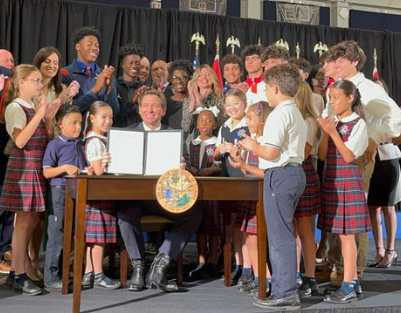
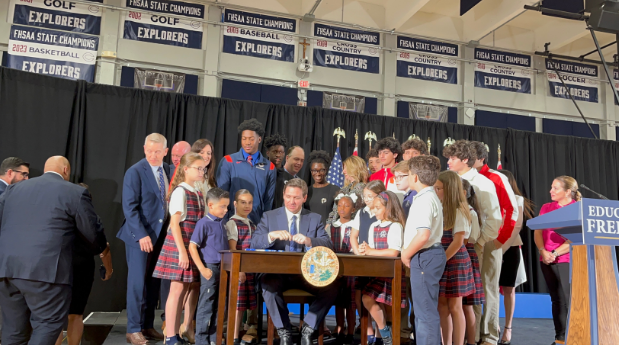 Surrounded by a group of students, Florida Gov. Ron DeSantis made history as he signed a bill into law that grants universal eligibility for K-12 education choice scholarships.
“This bill is a major game changer,” DeSantis said just before he sat at a small wooden desk set up in the Christopher Columbus High School gym in Miami to sign HB 1, which passed the Legislature last week.
Girls dressed in plaid jumpers and boys in khakis and white school polos clustered around the desk in hopes of getting one of the prized ceremonial pens DeSantis used to sign the landmark legislation.
“The state of Florida is No. 1 when it comes to education freedom and education choice," DeSantis said, "and today, this bill signing cements us in that No. 1 position because we’ll be signing legislation that represents the largest expansion of education choice not only in this state but in the history of these United States.”
House Speaker Paul Renner, who made education choice his top legislative priority to the point of naming the bill HB 1, recapped how Florida went from nearly worst to first over the past quarter century, when then-Gov. Jeb Bush began advocating for policies that allowed students to leave failing district schools.
“Twenty-five years ago, our schools were at the bottom in terms of our scores,” he said, comparing the system to the Eagles’ hit song “Hotel California,” about a sinister hotel from which guests could never escape.
“You could go into the school that matched your ZIP code, but you could never leave,” he said.
Renner said in addition to families having their choice of schools, they also needed flexibility to customize each child’s education to their needs.
“Even brothers and sisters within a family learn differently,” he said.
Sponsored in the House by Rep. Kaylee Tuck, R-Lake Placid, and in the Senate by Sen. Corey Simon, R-Tallahassee, HB 1 makes all the state’s K-12 students eligible for the Family Empowerment Scholarship.
Unlike in the original law that established the Family Empowerment Scholarship program in 2019, the program is now open to all students to apply regardless of income. However, families who currently receive scholarships and whose incomes fall below 185% of the federal poverty line will receive first priority, followed by those with incomes up to 400% above the federal poverty line.
Those with incomes above the 400% threshold will be last in line to receive any remaining funding.
DeSantis pointed out that while the law will give preference to low and middle income families, “at the end of the day, we believe the money should follow the student.”
Another provision in HB 1 requires that funding for the formerly income-based scholarships must come from private tax credit donations that were used to fund the Florida Tax Credit Scholarship program before receiving money from state education funds.
In addition to expanding eligibility, HB 1 converts traditional scholarship programs into education savings accounts. Such accounts take funds that would have been directed to an institution and allow parents to use them to customize their child’s education.
Under the new law, the funds, expected to be around $8,000 per student depending on residency, can be spent on approved instructional costs, tutoring and fees for various exams in addition to private school tuition.
In addition, the law also extends eligibility to homeschooled students, who would be classified separately from those whose families choose not to participate. Participating families would be under a “personalized education program” and would have to submit to an annual “sworn compliance statement” that would include various requirements such as taking a nationally norm-referenced exam or statewide assessment and report the results to the school choice funding organization.
(Step Up For Students, which manages the majority of state education choice scholarship programs, hosts this blog.)
The law removes the cap on growth for the Family Empowerment Scholarship for students with Unique Abilities and increases funding to eliminate the wait list, which currently stands at more than 9,000. That means a lot of parents having to tell their kids, ‘No,” Renner said.
“We will never have a parent have to say that ever again,” he said Monday.
Renner also said parents have the right to send their children to a school that represents their values.
“We don’t want your child to go to a school where their values are mocked and held up in derision,” he said during his remarks.
Tuck and Simon both praised the new law for empowering parents to control their children’s education.
Tuck said Florida has always “put parents in the driver’s seat.”
“But today, we keep parents in the driver’s seat by making sure that every family and every student is empowered to receive the education choice they deserve.”
Simon said of the 25 or so bills he filed this legislative session, HB 1 meant the most to him personally. He shared his personal story about how while growing up in a poor area of Pompano Beach before education choice was possible, his mother exercised it by using her work address in order to get Simon into a high-performing district school.
“That’s the story I’ve told; that’s the live I’ve lived; that’s the passion that I approached this bill with,” he said. “I wanted to ensure that every family has the same opportunities regardless of what ZIP code they lived in.”
Students and families also shared their stories about the role education choice played in their lives and thanks the governor and legislature for making it a priority.
“When people say school choice doesn’t work, I simply show them my family,” said Hera Varmah, who with nine of her 11 siblings received Florida Tax Credit scholarships. She two of her siblings became engineers, and she became an advocate for the American Federation for Children, a national nonprofit education choice organization. “This is the power of giving a child an education that fits their needs.
Aimee Uriarte, a single mom whose two sons attend Columbus High on state scholarships, and Rachel Hayon-Sabbah, who has two of four daughters on the unique abilities scholarship program, thanked DeSantis and legislative leaders for expanding program eligibility to all Florida families.
“This legislation will cause the Unique Abilities waitlist to vanish and allow nearly 10,000 special needs families to get the funding they need,” Hayon-Sabbah said. “And families in the Tax Credit and Education Options scholarships will now have the ability to spend their program funds in ways that they can better tailor their children’s education to fit their individual needs.”
Besides expanding options for students, the law also helps public school districts by relaxing some regulations identified by the Florida Association of District School Superintendents.
For example, it reduces hurdles to a five-year temporary teacher certification for anyone with a bachelor’s degree and for those with two years of effective or highly effective service. It also provides flexibility to school districts in setting salary schedules.
The law repeals the requirement that public school students have one online credit to graduate from high school, which is not currently required in private schools. In addition, the law also offers districts flexibility in facility costs for new construction and allows school districts to transport students in large vans as opposed to school buses if needed, which is expected to help school districts struggling with bus driver shortages.
“Universal choice means every school has a chance to compete for students, and parents can decide the best fit,” Senate President Kathleen Passidomo said. “That means also public schools can complete. The bill takes the first steps to make that happen. That’s a little part of the bill that should not go unnoticed.”
As part of the new law, Florida Education Commissioner Manny Diaz Jr. and the state Department of Education will meet with public school leaders to revise the state education code and target which rules should be eliminated or changed.
Funding for the new law, which takes effect July 1,is expected to be worked out in the state budget as each chamber works to reconcile differences in their own versions.
Diaz said HB 1 shouldn’t be viewed as Florida, which adopted education choice policies years before most states did, as regaining the lead in that area.
“We never lost the lead,” he said. “We’re the reigning champs.”
|
 By a vote of 26-12, the Florida Senate passed House Bill 1. This is a fantastic achievement and a capstone achievement to a great many people both inside and outside the Florida Legislature.
The signature of Gov. Ron DeSantis will dispel any confusion whatsoever regarding which year stands as the most productive in the history of the choice movement. It’s not yet April, and 2023 already has earned the crown.
The addition of Florida will almost double the total number of students eligible to participate in a broadly available education savings account program. The total eligibility pool will move over 6 million students and constitute just over 12% of students nationwide.
To paraphrase Curly from the movie City Slickers: “The 2023 legislative session ain’t over yet.”

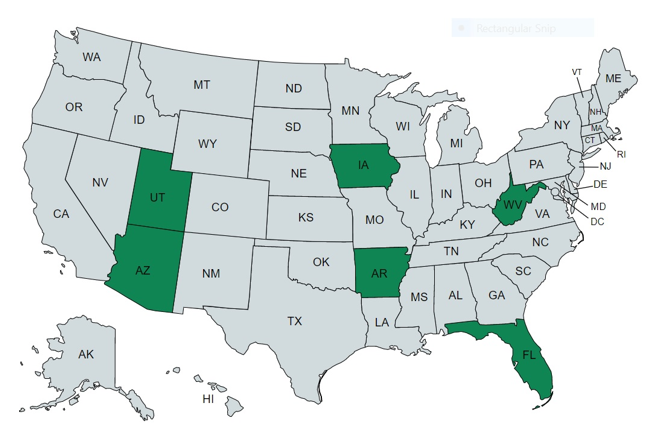
As things stand, Florida and West Virginia are holding down the East Coast, Iowa and Arkansas in the geographic center of the country, and Arizona and Utah out west. A number of far-reaching choice bills have votes pending in multiple states.
Giddy up!
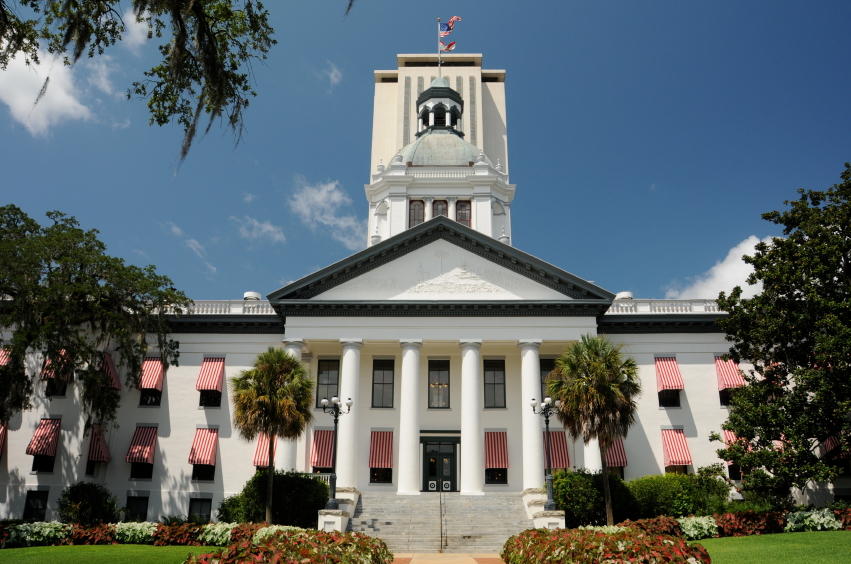
A bill that would grant education choice scholarship eligibility to all K-12 Florida students which state Senate President Kathleen Passidomo called the “one of the most transformative bills in the history of the state,” won final legislative approval today and heads to Gov. Ron DeSantis for possible signature.
HB 1, which the Florida House passed last week, also won final approval in the full Senate by 26-12 vote along party lines with Republicans in support. House Speaker Paul Renner, who made the bill a priority, came to the Senate chamber to watch the vote.
Despite the partisan vote, “this is not a Democratic or Republican issue,” bill sponsor Sen. Corey Simon, R-Tallahassee, said in his closing remarks. “We are funding students in this state. The parents have spoken.”
Opponents expressed concerns about cost, which the Senate fiscal analysis calculated at $646 million, and the House calculated at nearly $210 million due to differing methodologies. The Senate’s proposed budget has set aside $2.2 billion for the program, with $350 million in reserve, according to state Sen. Keith Perry, R-Gainesville, chairman of the Senate Appropriations Committee on Education.
That money would be issued by the state rather than be passed through the state’s school districts.
Like its Senate companion, which senators shelved on Wednesday to consider the House bill, HB 1, sponsored by Rep. Kaylee Tuck, R-Lake Placid, would make all the state’s students eligible for the Family Empowerment Scholarship.
Unlike in the original law that established the Family Empowerment Scholarship program in 2019, the program as outlined in HB 1 would be open to all students regardless of income. However, families who currently receive scholarships and whose incomes fall below 185% of the federal poverty line would receive first priority, followed by those with incomes up to 400% above the federal poverty line.
Those with incomes above the 400% threshold would be last in line to receive any remaining funding.
Another provision in HB 1 requires that funding for the formerly income-based scholarships would first have to come from private tax credit donations that were previously used to fund the Florida Tax Credit Scholarship program before receiving money from state education funds.
In addition to expanding eligibility, HB 1 would convert traditional scholarship programs into education savings accounts. Such accounts take funds that would have been directed to an institution and allow parents to use them to customize their child’s education.
Under the bill, the funds, expected to be around $8,000 per student depending on residency, can be spent on approved instructional costs, tutoring and fees for various exams in addition to private school tuition.
In addition, HB 1 also extends eligibility to homeschooled students, who would be classified separately from those whose families choose not to participate. Participating families would be under a “personalized education program” and would have to submit to an annual “sworn compliance statement” that would include various requirements such as taking a nationally norm-referenced exam or statewide assessment and report the results to the school choice funding organization.
(Step Up For Students, which manages the majority of state education choice scholarship programs, hosts this blog.)
The bill also would increase funding for the Family Empowerment Scholarship for students with Unique Abilities to eliminate the wait list, which currently stands at more than 9,000.
Besides expanding options for students, the bill also would relax some district school regulations identified by the Florida Association of District School Superintendents.
For example, the bill reduces hurdles to a five-year temporary teacher certification for anyone with a bachelor’s degree and for those with two years of effective or highly effective service. The bill provides flexibility to school districts in setting salary schedules.
The bill repeals the requirement that public school students have one online credit to graduate from high school, which is not currently required in private schools. The bill also offers districts flexibility in facility costs for new construction and allows school districts to transport students in large vans as opposed to school buses if needed.
Simon said it’s important to remember how the bill benefits public schools.
“We are funding our public schools,” said Simon, whose wife teaches at a Title 1 public school. “My Democratic colleagues would not have a problem if this bill were $650 million or $6 billion if it were going to the public schools What they have a problem with is that this is the choice of the parent. That’s what they have a problem with. It’s not okay.”
Simon, who said his mother moved him to another public school so he could have a better education, called the bill “a passion” and noted that some lawmakers who oppose it have their children in private schools.
“That’s problematic,” he said. “What we’re seeing is my colleagues saying, ‘we know what’s best for your kids’ … What this bill does is we put that back in the parents’ hands.”
Simon recalled the history of education choice in Florida, which Gov. Jeb Bush led more than 20 years ago.
“How did we get here? Well, I can tell you,” he said. “We got here because for a time, we were okay with poor kids in poor neighborhoods staying in poor schools. And then we started to smarten up a little bit, and we said well, maybe we could help a little bit; maybe we should do something for those poor kids in their poor neighborhoods in those poor schools …
“Now is not the time to stop. We’re going to put our foot on the pedal, and we’re going to continue to push forward as we start the process of re-envisioning the education of our kids. And who’s going to be driving the bus?
“Our parents.”
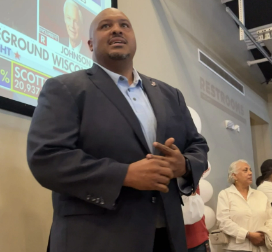
Florida Sen. Corey Simon expressed that the new legislation will increase options for families to choose the best options for their children.
Landmark legislation that would expand education choice eligibility to all Florida’s K-12 students and add spending flexibility to all state choice scholarship programs headed toward its final journey on Wednesday before being signed into law.
Sen. Corey Simon, R-Tallahassee, the sponsor of SB 202, introduced the bill but then agreed to substitute a committee version of HB 1, the House version that won final approve in that chamber last week.
Like its Senate companion, the House bill, sponsored by Rep. Kaylee Tuck, R-Lake Placid, would make all the state’s students eligible for the Family Empowerment Scholarship.
“This is about increasing options for families to choose the best for their students and options for school districts,” Simon said in introducing the bill.
Unlike in the original law approved in 2019, the program as outlined in HB 1 would be open to all students regardless of income. However, families whose incomes fall below 185% of the federal poverty line would receive first priority, followed by those with incomes up to 400% above the federal poverty line. Those with incomes above the 400% threshold would be last in line to receive any remaining funding.
Another provision in HB 1 requires that funding for the formerly income-based scholarships would first have to come from private tax credit donations that were previously used to fund the Florida Tax Credit Scholarship program before receiving money from state education funds.
In addition to expanding eligibility, HB 1 would convert traditional scholarship programs into education savings accounts. Such accounts take funds that would have been directed to an institution and allow parents to use them to customize their child’s education.
Under the bill, the funds, expected to be around $8,000 per student depending on where the family lives, can be spent on approved instructional costs, tutoring and fees for various exams in addition to private school tuition.
In addition, HB 1 also extends eligibility to homeschooled students, who would be classified separately from those whose families choose not to participate. Participating families would be under a “personalized education program” and would have to submit to an annual “sworn compliance statement” that would include various requirements such as taking a nationally norm-referenced exam or statewide assessment and report the results to the school choice funding organization.
(Step Up For Students, which manages the majority of state education choice scholarship programs, hosts this blog.)
Besides expanding options for students, the bill also would relax some district school regulations identified by the Florida Association of District School Superintendents.
For example, the bill reduces hurdles to a five-year temporary teacher certification for anyone with a bachelor’s degree and for those with two years of effective or highly effective service. The bill provides flexibility to school districts in setting salary schedules. The bill repeals the requirement that public school students have one online credit to graduate from high school, which is not currently required in private schools. The bill also offers districts flexibility in facility costs for new construction, and allows school districts to transport students in large vans as opposed to school buses if needed.
During the full Senate proceedings, opponents questioning the logistics of the bill and the cost, which Senate and House analysists had calculated differently. They also asked whether money for the scholarships would be taken out of the state’s education funding formula for public schools.
The answer, Sen. Keith Perry, R-Gainesville, said is no, although “you’ll see a big increase in that fund as well.”
Perry, who chairs the Senate Appropriations Committee on Education, said the state has separately allocated $2.2 billion for the scholarship program, with an extra $350 million in a reserve fund. Also, money from the Florida Tax Credit program will be used to pay for scholarships.
HB 1 is set for vote in the full Senate, which begins its session at 1:30 p.m. today.


 The American Federation for Children, the nation’s voice for educational choice, applauds the Florida Legislature for extending eligibility for the Family Empowerment Scholarship Program to all Florida families and converting all the awards to education savings accounts.