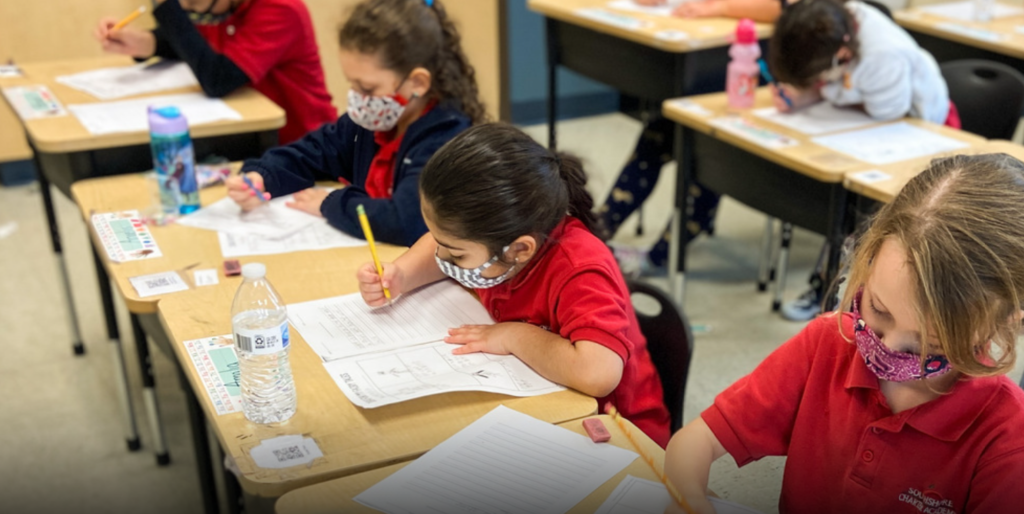
Southshore Charter Academy in Riverview is one of four charter schools whose renewals were denied by the Hillsborough County School Board.
After compelling testimony and much debate, the Hillsborough County School Board voted 6-1 in a special session this morning to reverse its previous decision and approve charter school renewals for Kid’s Community College Charter High School, Pivot Charter School, Southshore Charter Academy and Woodmont Charter School.
Among those who spoke in favor of the reversal were parents, teachers and students, several of whom called the board’s refusal disruptive and politically motivated.
Florida education officials on July 14 ordered the board to reverse its rejection of renewal applications for the four charter schools. State board members unanimously approved an order drafted by Education Commissioner Richard Corcoran giving the Hillsborough County School District until July 26 to “document compliance with the law” regarding their renewal requests.
Like all charter schools in the state, these schools are public schools that operate with taxpayer funds but are privately managed.
Dre Graham, executive director of independent education and parental choice at the Florida Department of Education, commented at that meeting that any decision ultimately must be based on what’s best for students.
“Our responsibility is to provide an equitable educational experience for students in order for them to become the best versions of themselves,” Graham said.
All four schools serve high percentages of minority students. Woodmont is classified as a Title I school because 100% of its students are economically disadvantaged. Two of the schools had been operating for 10 years, and the other two had been operating for five years. Southshore and Woodmont earned B grades from the state, while the other two earned C’s.
District staff, after conducting a comprehensive review of the charter schools and finding no grounds for rejecting the applications, had recommended all four contracts be renewed for another five years.
Southshore Charter Academy principal Amy Sams and Woodmont Charter School principal Cuwana Lawson, in a commentary published on tampabay.com, questioned the motives of the board in denying the charter applications.
“This group, which has nothing visible to gain or lose by having charter schools that outperform similar district schools in their neighborhoods, claims to be in support of all public school students,” they wrote. “Here’s a fact that they’ve overlooked. Charter school students are public school students too.”
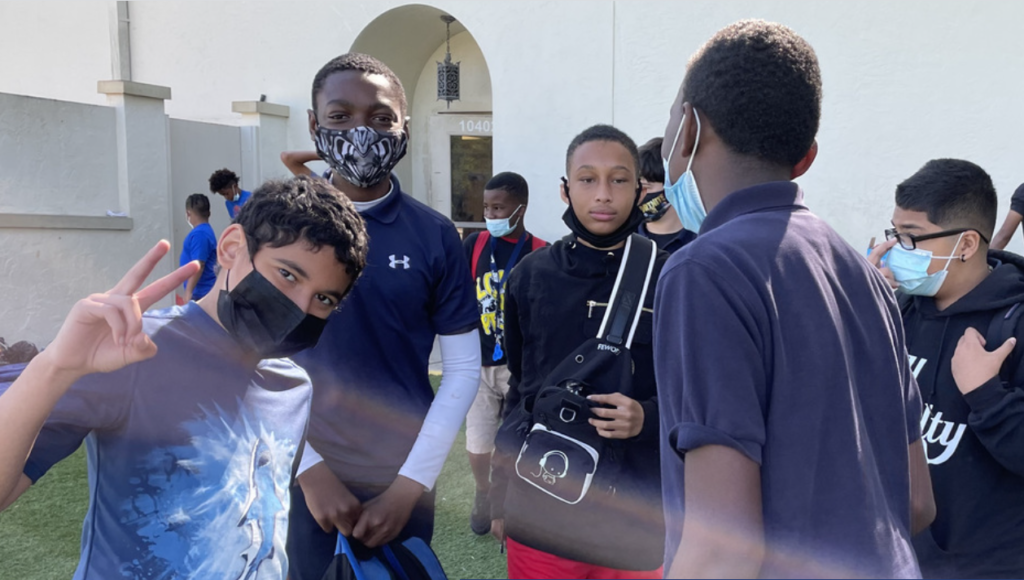
Woodmont Charter School is one of four schools whose renewal applications were denied by the Hillsborough County School Board.
Editor’s note: This opinion piece from Amy Sams, principal of Southshore Charter Academy, and Cuwana Lawson, principal of Woodmont Charter School, appeared Friday on tampabay.com.
As the principals of two high-achieving charter schools in Hillsborough County, we along with thousands of students and their families, are appalled at the Hillsborough County School Board’s disregard for parental choice when they voted to deny renewal of our charters.
While we are confident in our legal ability to continue to serve some of our county’s most vulnerable students and are grateful to Florida Education Commissioner Richard Corcoran for his support of all public school students, we must address some of the misinformation that an organized group of anti-charter school activists continue to spread at Hillsborough School Board meetings.
This group, which has nothing visible to gain or lose by having charter schools that outperform similar district schools in their neighborhoods, claims to be in support of all public school students. Here’s a fact that they’ve overlooked.
Charter school students are public school students too. They cite incorrect information to further their cause. What is their motive?
We would like to defend our schools based on true information that we can back up with facts and documentation.
Woodmont Charter School is the highest-graded school in Temple Terrace with a “B” rating. It serves 90% minority students with 97.6% being economically disadvantaged. It is the highest-performing local school in 2019 on the Federal Accountability Index for all students, white, Black, Hispanic, Asian, multi-racial, economically disadvantaged and English Learner students.
To continue reading, click here.

The IDEA Victory campus is one of two state-sanctioned “schools of hope” slated to open this fall in Hillsborough County.
As school board members in one Florida county face state consequences for pushing back on charter school contract renewals, two of the state-sanctioned “schools of hope” are joyously preparing for openings next month in the same region.
IDEA Public Schools is opening its Hope and Victory campuses on Aug. 10 to students in grades K-2 and 6. The schools plan to add grades each year, eventually providing a K-12 education.
“We’re getting ready to welcome our teachers in a couple of weeks,” said Emily Carlisle, one of two founding principals of IDEA Hope, which is opening in a new building at 5050 E. 10th Ave. near Ybor City. “It really feels like school is about to start.”
Carlisle, who heads the Hope college preparatory school, and Latoya McGhee, founding principal of the academy for the lower grades at IDEA Victory-Vinik campus near the intersection of Nebraska and Fowler avenues, have spent months with their respective teams sharing the story and philosophy of IDEA with their communities, where assigned district schools are among 39 countywide the state has classified as “persistently low performing.”
Both principals have partnered with businesses such as ZooTampa at Lowry Park and University Mall as well as the Hilton Embassy Suites to host informational meetings. They also have hosted online giveaways to generate excitement about the school openings.
Carlisle said being the new kid on the block can be challenging, but the IDEA team is willing to do whatever it takes.
“We’ve been organizing and working hard, canvassing door to door,” she said.
Their efforts have paid off, with kindergarten slots filled at the Hope campus. A handful of slots remain for first, second and sixth grades.
“If anyone is looking for an option for their children, we encourage them to check us out,” Carlisle said.
This year marks IDEA’s first foray into Florida. The Texas-based charter network is best known for a program that has resulted in 100% of its students accepted into college. The latest rankings of the most challenging high schools in the nation by the Jay Mathews Challenge Index published in the Washington Post placed all 15 eligible IDEA college preparatory schools in the top 1%.
The company plans to open a school in Jacksonville in 2022 as well as a third campus in Tampa.
Schools of Hope are charter schools that are designated by the state as “high performing schools.” They serve students from “persistently low-performing schools” or within a 5-mile radius of such a school, and students residing in impoverished communities. In addition to IDEA Public Schools, others with the designation include Mater Academy, Democracy Prep Public Schools, Inc., KIPP New Jersey, and Somerset Academy, Inc.
On the Hope campus, homerooms are named after colleges and universities, from Ivy Leagues to historically black colleges and universities and regional colleges to keep the goal front and center for students.
Carlisle describes the experience as full of “rigor and joy” with high expectations set for students from mainly low-income households.
That joy was on full display in a recent Facebook Live “table talk” video done from the Victory-Vinik campus with McGhee, who heads the academy or lower school, and Kendrah Underwood, principal of the college preparatory school.
“I can’t wait til my babies get here!” McGhee said.
The pair shared information on everything from uniforms to after school programs to transportation, which they described as being “like a limo ride to your school.” During a tour of the building, their excitement had them dancing in their offices.
“This building is coming alive,” Underwood said. “Look at the lights, look at the paint, look at the floor. It is smelling and looking and feeling like a brand new, state-of-the-art school.”
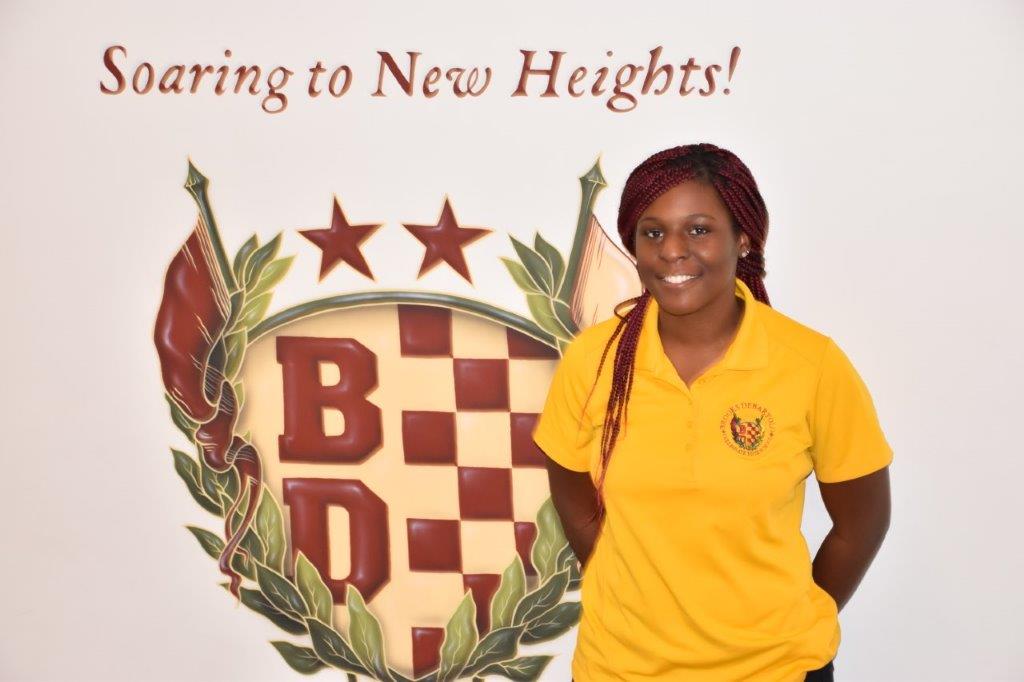
Once a struggling student with anger issues, Jo’Keal Sweed has thrived at Brooks Debartolo Collegiate High School in Tampa. She now hopes to attend Florida Agriculutural and Mechanical University and join the U.S. Army.
Jo’Keal Sweed has a quick mind, polite nature and gentle voice.
You can’t immediately tell she’s been through hell.
A senior at Brooks DeBartolo Collegiate High School in Tampa, Jo’Keal can’t remember ever seeing her father, although he occasionally emails her from a Michigan prison.
Nor does she have any memories of her mother. She doesn’t even know if she’s alive.
She was adopted as a baby, and the family soon moved from her native Flint, Michigan, to Tampa. While the weather was much warmer, life was turbulent.
In Tampa, her adopted mother, along with five adopted siblings, moved often. Jo’Keal attended seven elementary and middle schools, never staying at one for more than two consecutive years. She struggled academically, especially with reading, and socially, often fighting with other students – and not just girls.
Although family discord would continue, her academic life flourished at Brooks DeBartolo, an independent charter school where she started ninth grade. She maintains a 3.27 GPA and is on track to graduate on time.
Jo’Keal now has confidence for a future that once seemed to hold little promise. She wants to attend Florida Agricultural and Mechanical University (FAMU), a historically black college in Tallahassee, next year. She wants to join its ROTC program and eventually enlist in the U.S. Army.
“I like the military benefits and just want to get outside Tampa,” Jo’Keal said. “When I was growing up, the Army recruiters were always coming to my schools to talk about it.”
She credits Brooks DeBartolo’s inclusive, nurturing environment and its teachers, who offer individual attention to students who need it – for helping her navigate circumstances that might have overwhelmed other people.
Jo’Keal was 5 when her adopted mother died, which forced her to live with a much older adopted sister.
That arrangement lasted until June.
“My adopted sister kicked me out, gave me a list of bills to pay,” Jo’Keal said. “Over the summer, she gave me until June 1 to get a job or she’d evict me. I applied all over the place, but I couldn’t find a job. So, on June 1, she came to my room and said, ‘Pack your stuff.’”
If not for the benevolence of a friend’s mother, she could now be living on the streets – or worse. The family ensures that Jo’Keal gets to and from school every day from central Pasco County, a roughly 45-minute one-way trip. Her friend does not attend Brooks DeBartolo.
Asked where she would be if not for the family’s help, Jo’Keal offered a sad smile and a shrug.
“I really don’t know,” she said. “Other friends offered to take me in at their house, but I’m not sure any of that really could have worked out.”
Bonnie Peirano, who teaches personal, career and school development at Brooks DeBartolo, said the latest challenge in Jo’Keal’s life happened just as she seemed to find her academic stride.
“What I noticed about Jo’Keal in 10th grade is that she wasn’t very engaged,” she said. “She did not seem terribly interested in where she would go next or what she would do. But last year, I started to see a change. She kind of suddenly went out of her way in terms of her commitment to my class. She’d even just come by to say hi. She was way more personal.
“This year, she has been extremely focused and very engaged in class, always listening and watching me. That light switch went off and she started taking control of her life. She’s not about merely graduating from high school. She’s putting in the effort and that’s what makes people stand behind you and push you as far as you can go.”
Brooks DeBartolo, an A-rated school for nine consecutive years, has offered that push.
The school was started in 2007 by former Tampa Bay Buccaneers linebacker and NFL Hall of Famer Derrick Brooks and the family of Edward J. DeBartolo Jr., who was a former owner of the San Francisco 49ers.
There are 600 students enrolled at the school, with 600 more on a lottery-style waiting list. Students come from not only Tampa and surrounding towns, but also from neighboring Pasco and Pinellas counties.
“It’s a college- and career-prep focus,” Principal Kristine Bennett said. “We see where each student is at academically and figure out what track they want to go for. We have a wide variety of courses and opportunities to see what they need and want, and we work with them individually to help get them there. Our teachers are our No. 1 resource and make the magic happen. It’s a safe, caring environment.”
When Jo’Keal started at the school, Bennett said she was “academically very guarded and not very open.”
“She had a little bit of an attitude, but she eventually developed trusting relationships with the teachers and started gaining confidence,” Bennett said.
Besides playing on the girls basketball and flag football teams, Jo’Keal has joined the Brooks Bunch Business Boot Camp, a financial literacy after-school program, where students learn to create a budget, manage credit cards and stay out of debt. In recent years the group has traveled to Philadelphia and Detroit to help with community service projects. This year, the group is going to Chicago.
Jo’Keal doesn’t like to think about what her future might look like had she not enrolled at Brooks DeBartolo, which she learned about from a friend.
“The teachers actually care about you,” she said. “If I’m having a bad day, they can tell by my face and they help. Everybody’s great here. They treat me really well.”
Peirano said Jo’Keal’s story has inspired her classmates, as well as her educators.
“She’s a perfect example of someone who, despite all odds, is going to really do something with her life,” Peirano said.
For their project, Gussie Lorenzo-Luaces and three classmates at Deer Park Elementary in Tampa, Fla., wanted to find out what kind of paper allows a paper airplane to fly the farthest. After five trial runs, they determined copy paper, with its smooth surface and stable weight, worked best.
Gussie Lorenzo-Luaces, a third-grader at Deer Park Elementary School in Tampa, was one of more than 2,000 students participating in the 33rd annual Hillsborough Regional STEM Fair last week.
The boys’ exhibit was among more than 1,800 presented at last week’s 33rd annual Hillsborough Regional STEM Fair, which featured 2,000 students from district schools, charter and private schools, and home schools.
That diversity was a big plus for Gussie’s mom, Susie, who was curious where other students in the county registered on the science track.
“I just feel they don’t need separation,’’ she said. “I like seeing them all together.’’
Increasingly, though, Hillsborough students are not all together in academic competitions.
In the past year, district officials have begun excluding charter schools from some districtwide contests, including Battle of the Books, a reading competition, and the Math Bowl and Math League for elementary and middle school students.
The reasons for the splintering are not clear. But everything from cost, to fear of competition, to a desire for charter schools to be more independent, has been suggested. At the least, the move points to potential pitfalls as school choice options mushroom across the landscape – even in a district with a choice-friendly reputation like Hillsborough.
“They’re all our children,” said Lillia Stroud of King’s Kids Academy of Health Science, a new charter in Tampa. Stroud said she can relate to the district’s concerns, but “separation at any level is disheartening.” (more…)
With 43 schools and seven more expected to open in the fall, the charter school community in Hillsborough County, Fla. has grown to the size of a small school district.
Which is why members of Charter School Leaders of Florida say having a local group to represent them is so important.
“We do feel as an organization … that now more than ever, we need to work as a group,’’ said the group’s treasurer, Mark Haggett, who also directs Academies of RCMA, elementary and middle school charters in Wimauma.
The group’s name suggests it might serve the whole state, but for now it’s limited to Hillsborough. It began informally, nearly a decade ago, as a way for charter school principals to regularly meet – like traditional public school principals – and talk about best practices, training, assessments and funding. It also was a safe place for members to vent frustrations about the district and the Florida Department of Education.
In 2007, the principals formed a nonprofit and shifted focus.
“Our main goal was to work with the superintendent and really forge a true partnership between the schools and the district,’’ said Gary Hocevar, former principal of the charter, Terrace Community Middle School, and the leadership group’s past president.
The group also organized to help lobby on behalf of charter schools for more funding – “not just for charter schools, but funding for all education,’’ Hocevar said.
The group, now headed by Cametra Edwards, principal of Village of Excellence Academy in east Tampa, represents about 35 charters. It’s among a handful of such groups in the state.
“Such organizations are definitely something we want to encourage as a state and we have already discussed some ways in which we could help that along,’’ said Mike Kooi, who oversees the office of school choice for the Florida Department of Education. (more…)
 More than 100 school districts in the U.S. now have 10 percent or more of their students in charter schools, and eight Florida districts are among them, according to a report released Wednesday.
The Lee County School District leads Florida districts with 14 percent, says the report from the National Alliance for Public Charter Schools, which is based on enrollment figures for the 2011-12 school year. It’s followed by Broward, Lake, Miami-Dade, Polk and Sarasota (all at 12 percent), Indian River (at 11 percent) and Osceola (at 10 percent).
New Orleans tops all districts with 76 percent, followed by Detroit (41 percent), Washington D.C. (41 percent), Kansas City, Mo. (37 percent) and Flint, Mich. (33 percent).
Two Florida districts are among the 10 fastest-growing for charters. Between 2010-11 and 2011-12, charter enrollment rose from 6,207 to 9,452 in Hillsborough County, a 52 percent increase that put it at No. 2 nationally over that span. Broward County showed a 26 percent increase, putting it at No. 6.
Eight Florida school districts are also among the Top 50 in total number of charter students, but that has a lot to do with how huge Florida districts tend to be. Miami-Dade leads all Florida districts and is No. 6 nationally with 41,767 charter students last year.
For more about the report, see New York Times here and Huffington Post here.

