From the beginning, when my children were barely out of pull-ups, I was a school-choice mom. Living in a rural area, surrounded by cows and NASCAR flags, I insisted on driving 45 minutes one way, every day, so my kids could attend a Jewish preschool. Despite massive headaches caused by northern drivers on vacation, I knew the learning environment provided by the JCC was best for my kids, building a strong foundation to support lifelong learning.
 As preschool graduation neared, my husband and I chose an excellent, traditional public school for them to attend for their elementary years. This school was not located in our neighborhood and we couldn’t afford to move. But, because I was a teacher in that same district, I applied for the choice program and my children were accepted. It meant I had to transfer closer to home and still drive a half-hour out of my way, but I felt fortunate to place my children in a school that would meet their needs.
After leaving the teaching profession, I once again exercised my right to choose. We moved the kids into a private Jewish school for the rest of their elementary education. My husband and I had to live in a simpler neighborhood and forgo little luxuries, like fashionable shoes and date nights, to make it work, but our boys excelled in their new learning environment.
For middle school, our family moved yet again, prompting jokes that compared us to nomadic ancestors, and we applied for a magnet program. Once more, we were lucky. Our sons won the lottery and were accepted into a dynamic, academically rigorous program.
Who knows where we’ll end up for high school?
During these public school years, I’ve been a consistent PTSA member. Joining this organization seemed the best way to be involved in my children’s school. PTSA volunteers are dedicated parents, teachers, and students committed to helping schools raise needed funds that enhance learning opportunities. I joined to show my support for those who were educating my children, and to act as an important presence among teachers and administrators.
Over the years, though, I sadly watched the PTSA take positions that alienated moms like me, moms who choose. Sure, the organization is a presence at my sons’ middle school – they sell magnets for cars and snacks at sporting events. The PTSA agrees that magnets are a valid choice, but parents who choose other options are not represented by the PTSA and, worse yet, are regularly dismissed in alerts and agendas. I would often read PTSA literature and wonder out loud:
“Why is a parenting organization working against so many parents?”
But I’m not one to give up easily. (more…)
From Religion News Service:
Since Florida became the first state to try them in 1996, virtual public schools have enjoyed dramatic growth, with at least some of it coming from religious families. Like home-schooling parents, parents of virtual public school students like having their children home so they can integrate religion and values into the school day.
In the 2011-2012 school year, 275,000 students were enrolled in online K-12 programs, up from 50,000 a decade ago, according to “Keeping Pace with Online and Blended Learning: A Guide to Policy and Practice 2012,” a report from the Colorado-based Evergreen Education Group. Currently, 32 states and the District of Columbia offer virtual public schools.
A growing number of private religious schools are also seeking religious course developers to develop virtual courses for them.
“There’s a lot of interest about online learning in the faith community,” said Matthew Wicks, chief operating officer for the International Association for K-12 Online Learning. Full story here.
In the factory’s tiny lobby, a dozen middle-school-aged boys and a handful of parents stood shoulder to shoulder in front of the company president, a soft-spoken man with a pen in his shirt pocket. He held up one precision-crafted, metallic piece after another and explained how angles and radiuses, aluminum and titanium, came together through man and machine to create amazing things. This gizmo goes on a Black Hawk helicopter, he said. This one, on a Javelin missile. And this one?
“You all saw the Curiosity land on Mars?” he asked. Heads nodded. Well, he said, his company made some of the parts for the rockets that got it there.
Inside the boys’ heads, gears turned.
For some of them, this was their third trip to a manufacturing plant in the past month. For kids their age, that would be extraordinary in just about any school, public or private. But in their case, it’s even more unique: They’re home-schooled.
The Trinity Homeschool Academy in Tampa, Fla. emphasizes science, technology, engineering and math – the so-called STEM fields. Director Tonya Walters designed it that way. The mother of three created the all-grade-level network two years ago, aiming to fill an open niche in the home-school community and a gap between what kids don’t learn, in too many settings, and what high-tech, high-wage jobs need them to know.
Especially with the tough economy, “you realize all these college kids with liberal arts degrees can’t get jobs,” Walters said. “I thought, ‘How can I get my kids from point A to point B?’ ”
The academy now serves about 200 students and contracts with 15 teachers. Home school parents pick-and-choose classes in a system Walters calls “a la carte.”
In many ways, Trinity academy is in sync with the new definition of education. Practical, flexible, whatever works. The STEM emphasis defies home-school stereotypes, though the academy does proudly tout a Christian worldview and, in biology, offers some faith-based teachings that would make many scientists pause. At the same time, the academy shows how evolving options beyond traditional public schools are finding ways to bring kids up to speed on skills and knowledge many consider vital. (more…)
 Florida: The state's top education official offers a strong pitch for continued expansion of school choice options despite recent scrutiny of charter schools. (redefinED) The state Board of Education overrules several school districts that opposed new charter schools. (Orlando Sentinel)
Louisiana: One local school district plans to open a virtual school to compete for home schoolers. (Baton Rouge Advocate) Meanwhile, this district seeks to opt out of the state's new voucher program. (Baton Rouge Advocate) So does this one. (Monroe News Star) Charter schools get a thumbs up from Democratic U.S. Sen. Mary Landrieu. (Baton Rouge Advocate)
Alabama: Charter schools bill, watered down after vigorous opposition from state teachers union, is dead. (Montgomery Advertiser)
Massachusetts: State lifts temporary moratorium on new charter schools. (Boston Globe) (more…)
Some of us at redefinED will be at the American Federation for Children summit tomorrow and Friday, where there will be lots of discussion about school choice and education reform. As good a time as any, we thought, to offer a snapshot of where Florida stands. Check out these numbers, which Doug Tuthill, the president of Step Up for Students and a redefinED host, shared last week with business leaders at a Leadership Florida event:
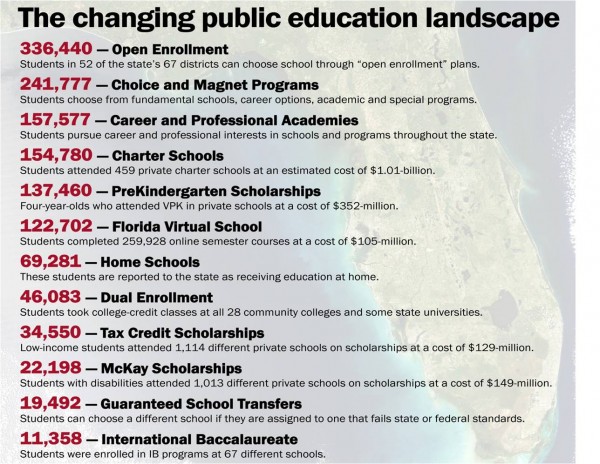
The numbers (carefully compiled by Jon East, vice president for policy & public affairs at Step Up) are from 2010-11 and we know in many cases the current figures are even higher. Charter school enrollment, for example, topped 175,000 this year, and the tax credit scholarship program serves more than 39,000 students. Altogether, the numbers underscore two things we emphasize at redefinED: School choice - the kind that allows parents to go beyond their neighborhood school - is becoming mainstream in Florida. And the lines between "public" and "private" are more blurred here than in any other state.
The AFC conference agenda includes Louisiana Gov. Bobby Jindal, New Jersey Gov. Chris Christie, Newark Mayor Cory Booker and an all-star line up of choice experts and advocates. We're hoping to have a little time to update you on what's going on with blog posts and tweets. For the latter, follow us at @redefinEDonline.

