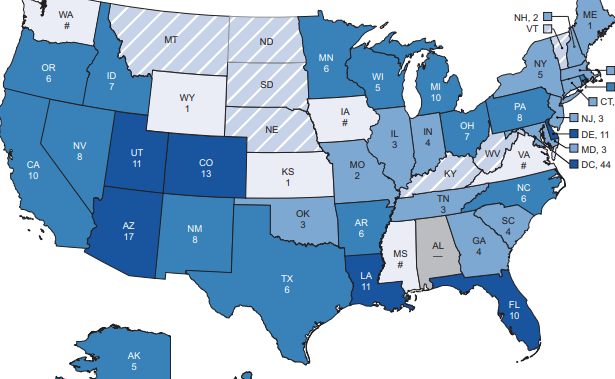
Charter schools and home schooling are experiencing major growth. Meanwhile, there were no significant differences between students in charter schools and traditional public schools in average reading and mathematics scores on national tests in 2017.
Those are two of the key findings in the U.S. Department of Education’s (USDOE) latest report, “School Choice in the United States,” which updates the national changing landscape for school choice with changes in enrollment data, academic performance updates, and parental satisfaction surveys. Nationally, charter public schools and district schools increased enrollment while private schools declined.
Overall, there were around 57.8 million K-12 students in the United States, up from 53.8 million in 1999. Based on figures from the USDOE, the market share of district schools fell from 87 percent of all students in 1999 to 81.8 percent of students by 2016.
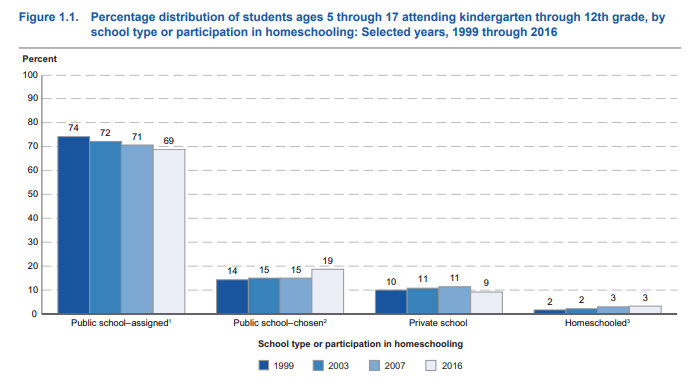
From 1999 to 2016 the share of students attending their assigned neighborhood public schools dropped from 74 percent to 69 percent. Public school choice option, including charter schools, magnet schools and open enrollment programs, grew from 14 percent of the student body in 1999 to 19 percent. Charter schools alone grew a staggering 571 percent from 2000 to 2016, enrolling over 3 million students by 2016.
Private school options fell from 10 percent to 9 percent, while home education grew from 2 percent to 3 percent by 2016.
Unlike most of the nation, however, Florida has seen private school enrollment bounce back. In 2000, 348,000 students enrolled in nonpublic schools, comprising 12.5 percent of the total PK-12 student body. Thanks to the help of several private school programs, including the Florida Tax Credit Scholarship, private schools in the Sunshine State continue to grow. In 2018-19, the latest data available, 380,000 students enrolled in nonpublic schools, though the market share has declined to 11.8 percent of Florida’s total PK-12 student population.
Catholic schools remain the top choice among private school parents, enrolling more than 2 million students in 2016, more than double any other denomination.
District schools enrolled 94 percent of all public school students, with charters enrolling the other 6 percent. District schools were more likely to enroll white students, and less likely to enroll black or Hispanic students, than charters. According to the USDOE, 57 percent of public schools were 50 percent or more white, while just 33 percent of charters were. Charters were more likely to be 50 percent or higher black or Hispanic, however.
Enrollment in charter options varies greatly among states, though one important pattern emerges just in time for the Democratic presidential primaries: Important swing states Florida, Arizona and Michigan have large charter school populations.
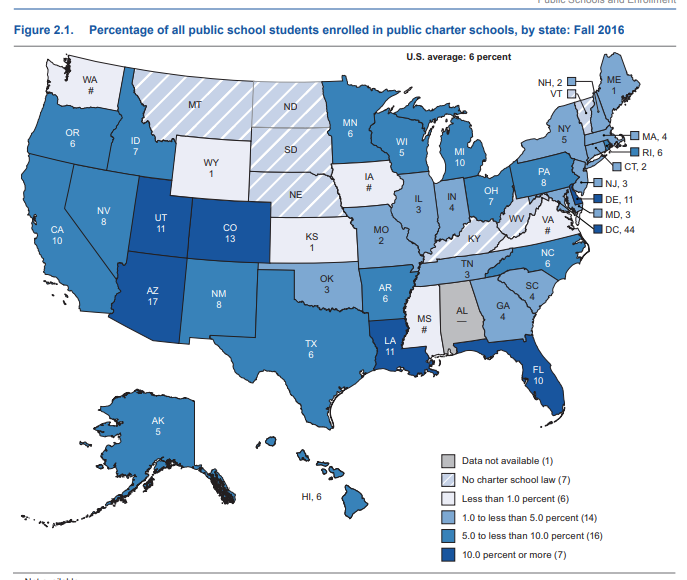
Meanwhile, the USDOE reports “no measurable difference” between the average district students and charter school students on the National Assessment of Educational Progress (NAEP) exams in reading in math in 2017.
Charter school students, including black, Hispanic and free and reduced-price lunch students, saw higher raw NAEP scores in fourth-grade reading than in traditional public schools, and were no different on eighth-grade reading. White, black and Hispanic students attending charters also saw higher raw scores on eighth-grade math, and were no different on fourth-grade math.
According to the report, 1.7 million students attended a home school setting in 2016. Home school students were more likely to live in a rural setting or small town than be urban or suburban. Homeschooling was also more common in the South and West than in the Northeast.
Home school parents had various reasons for choosing the option, according to the USDOE. About 34 percent of home education parents chose home schooling over public schools due to concerns about a school’s environment such as safety, drugs or negative peer pressure. Seventeen percent were dissatisfied with instruction, and 16 percent wanted to provide religious instruction.
Choice also played a significant role in parental satisfaction. Sixty percent of parents choosing a public school option were satisfied with the school, compared to 54 percent of parents with students at assigned public schools. Seventy-seven percent of parents enrolling children in private schools reported being satisfied with the school. A similar pattern emerges regarding satisfaction for academic standards, school discipline and regarding interaction between staff and parents.
Each of Ana Garcia’s home education students has a personalized education plan, which she’s aligned with the state of Florida’s education standards. Garcia worked in public schools for 12 years as a middle school English teacher, curriculum specialist and school-level director for accountability and instruction.
The American film classic Aliens features a group of futuristic Marines who bite off more than they can chew when a distant colony they’re exploring turns out to be a lair of deadly space monsters. Private Hudson, played by the late, great Bill Paxton, melts down in a panic. Sigourney Weaver’s Ripley reminds him that a young girl they had rescued, Newt, had survived for weeks on the space station with no weapons and no training, prompting Hudson’s memorable question: “Why don’t you put her in charge?”
Well, why not indeed? As the film continues, it becomes increasingly clear that Newt was far savvier than any of the Marines, Hudson in particular.
 redefinED author Ron Matus recently reported from Miami, a K-12 education frontier, on former public schoolteacher Ana Garcia. “Miss Ana” rediscovered her calling by providing a group of special needs students with the education they need – in her home. An educator with a special needs son, she realized the system wasn’t working well for her as a teacher or as a mother.
Garcia is far from alone on either front.
She loved teaching in district schools. But over the course of a decade, her passion ebbed. Too many mandates. Too much violence. Too little help, in her view, for students with disabilities.
Her experience resounds throughout the research on public school teacher retention.
For years, teachers have cited working conditions as the primary reason for leaving the profession, outpacing compensation. Garcia didn’t lose her ability to serve children with disabilities, but she lost her willingness to operate in a broken and frustrating system. Her experience also is consistent with teacher shortage research. A universe of veteran teachers who love to teach have lost their willingness to function as a cog in a bureaucratic machine.
Garcia’s experience as the parent of a special needs child, sadly, also is not unique. Matus writes:
Frustrations began to mount for Garcia the mom, too.
In Pre-K, Kevin was happy and learning in his neighborhood school, in a class with five kids and two teachers. But for kindergarten, he was assigned to an inclusion class with 25 kids, one teacher and one “floating” teacher who toggled between multiple classrooms. Garcia said Kevin’s clothes weren’t being changed when he soiled himself. He wasn’t being fed.
Then Kevin began escaping from class and, somehow, running all the way to a parking lot before being stopped. The first time, Garcia was frightened. The second time, shocked. The third time, angry.
In 2014, after 12 years as a middle school English teacher, curriculum specialist and school-level director for accountability and instruction, Garcia called it quits.
An old expression holds that if you want something done right, you do it yourself. The Gardiner Scholarship has empowered Ana Garcia to educate not only her son, but other students as well.
Miss Ana is back, and this time, she’s the one in charge. Matus continues:
Off the grid, homeschoolers are DIYing into increasingly sophisticated co-ops and enrichment programs. Micro-schools, whether mini-chains or one-offs, are pushing the limits of what’s possible. In Florida, choice scholarships are giving a more diverse mix of parents the opportunity to go small or go home.
Garcia envisions a micro-school that can also serve home education students who want part-time services, combined with a center for Applied Behavioral Analysis. In the meantime, she’s the mutineer at the heart of her cluster, connected to a blooming constellation of other clusters.
A few months ago, I posed the question: How are Florida policymakers planning to provide the human and physical capital to deal with a large projected increase in the student population, Baby Boom teacher retirement and increased facility needs, and increased Medicaid and pension demands all at the same time. Is the plan to somehow money-whip potential public schoolteachers into actual public schoolteachers when the state lacks the money for whipping, and teacher exit surveys show other issues, some listed above, loom even larger than pay? If so, the state might need a new plan.
Florida, like every other state, can’t hire enough special education teachers for public schools, even as it spends $400 million on space for 14,500 children – which looks like about $27,500 per space by my Texas public school math. Garcia sounds like a fantastic special education teacher, and she teaches in her own home. Right about now, I’m hearing a psychic scream from a frightened person with somewhat reactionary K-12 policy preferences: “How are we going to hold her accountable?” Answer: Families will rate her online and other families with have access to the ratings. Elegant and delightfully lacking in bureaucracy.
Ana Garcia offers a solution that families need. Florida has many more potential solutions in the form of teachers who got fed up like Miss Ana. Why don’t you put her in charge by giving more families the ability to lure her back into education – this time as the leader of her own school?
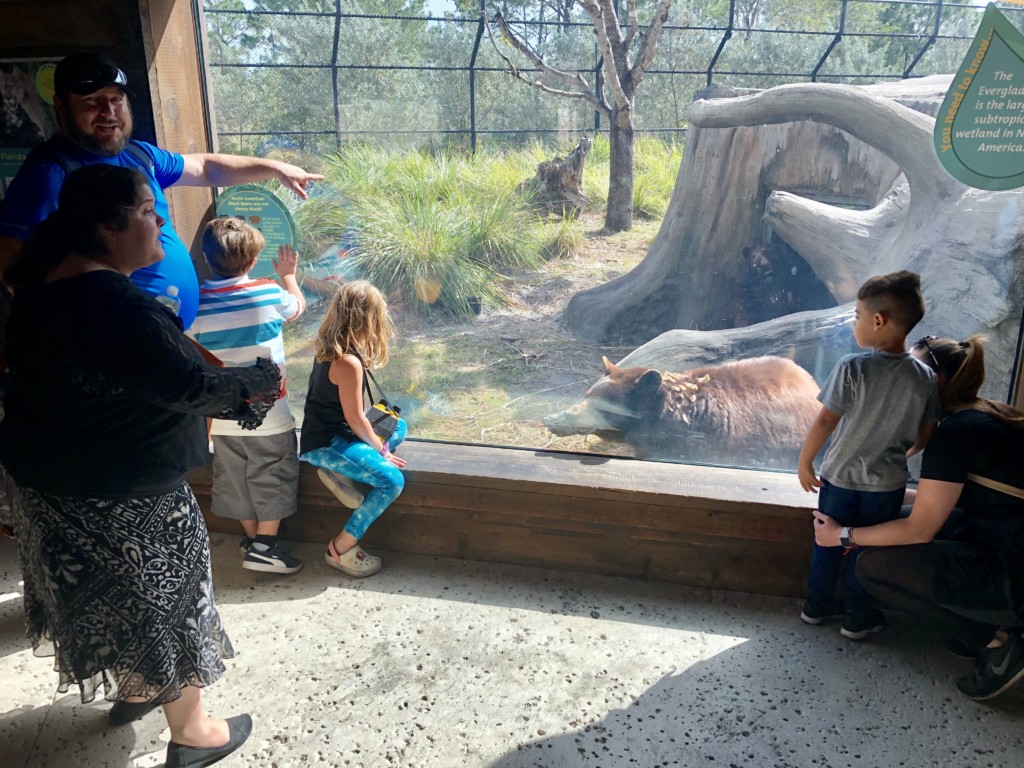
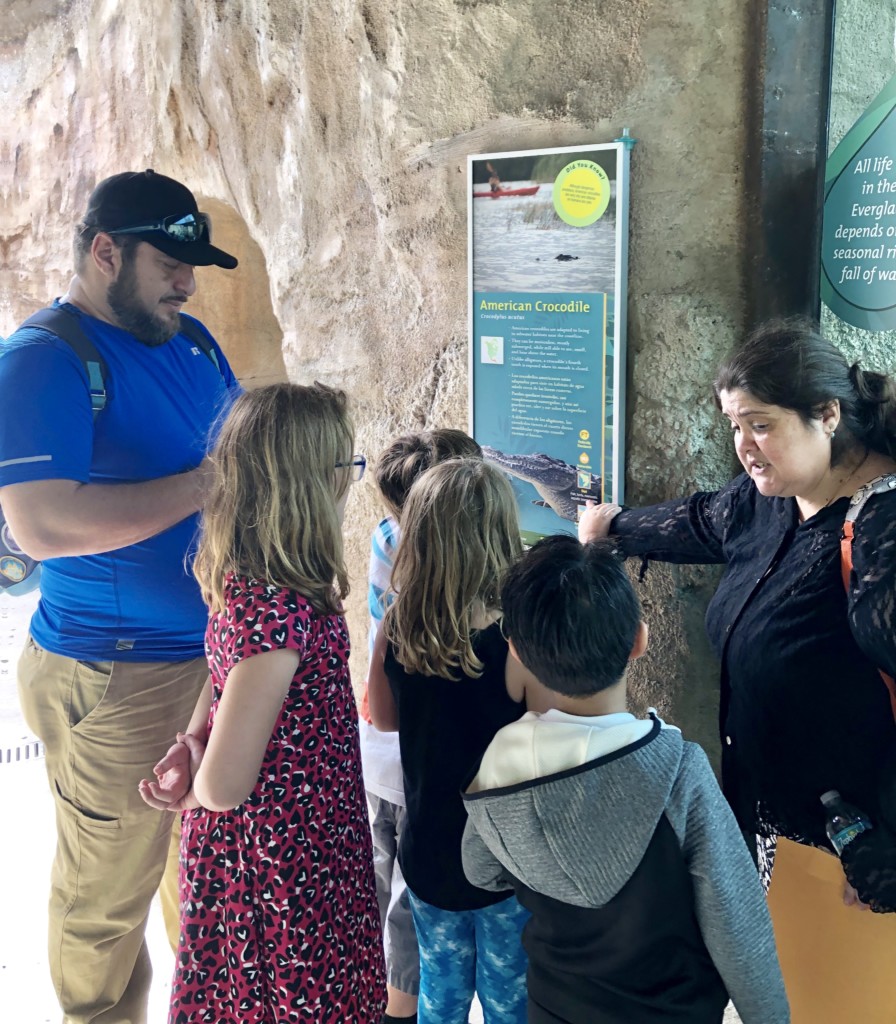
Ana Garcia’s home education cluster includes a total of seven students, including five with autism who use the Gardiner Scholarship, an education savings account in Florida for students with special needs. Joining Garcia (at front left) on a field trip to Zoo Miami last month was, from left to right, her husband Daniel; her son Kevin, 9; her daughter Khloe, 7; Angelo, 6; and Briana, a paraprofessional.
MIAMI – “Guys! Choo-choo formation!” At Ana Garcia’s command, a loose knot of people near the turnstiles at Zoo Miami – three adults, five kids – lined up, put their hands on the back shoulders of the person in front of them, and merged into something less locomotive than caterpillar. Sixteen feet proceeded on a motley ramble. Crocodiles awaited in the Everglades section, along with plenty of carefully guided learning.
So it goes on the education frontier.
Over the next few hours, Garcia, a public-school teacher turned pioneer, subtly steered her students toward goals in their personalized education plans. Project-based learning for one. Ecology for another. Speech therapy for another. She put special focus on the three with autism, including her 9-year-old son, Kevin.
Those students, and two others not in attendance, benefit from a learning option that is revolutionary but under the radar: a state-funded education savings account. It’s ESAs that make Garcia’s home education cluster – and perhaps, someday, a never-ending array of other clusters – possible. Without them, the landscapers, Uber drivers and Dollar Tree clerks who’ve entrusted Garcia with the education of their children would be limited to schools that don’t work for their children.
Garcia knows what that’s like. She endured a nightmare school experience with Kevin before getting an ESA for students with special needs. She says it changed his life – and hers.
“Parents don’t have to fear any more that they only have one choice,” Garcia said.
Neither do teachers.
* * *
Ana Garcia has a little Mary Poppins about her, no-nonsense but upbeat, with a drive to stoke curiosity that borders on fantastic. Walt Disney is her hero. Some saw swamp; he saw magic kingdom. Garcia feels that about the landscape in education. Her great-grandmother was a teacher in Cuba. Her aunts were teachers. As a kid, her playroom was furnished with a blackboard and old textbooks, and her dolls were her class. Now when she switches into teacher mode, she decelerates her … rapid … fire … speech … until she’s sure her student is catching on.
“My favorite thing to hear,” she said, “is, ‘Wow miss, no one has ever taught me the way you have, or explained things the way you do.’ “
Garcia loved teaching in district schools. But over the course of a decade, the passion ebbed. Too many mandates. Too much violence. Too little help, in her view, for students with disabilities.
Frustrations began to mount for Garcia the mom, too.
In Pre-K, Kevin was happy and learning in his neighborhood school, in a class with five kids and two teachers. But for kindergarten, he was assigned to an inclusion class with 25 kids, one teacher and one “floating” teacher who toggled between multiple classrooms. Garcia said Kevin’s clothes weren’t being changed when he soiled himself. He wasn’t being fed.
Then Kevin began escaping from class and, somehow, running all the way to a parking lot before being stopped. The first time, Garcia was frightened. The second time, shocked. The third time, angry.
In 2014, after 12 years as a middle school English teacher, curriculum specialist and school-level director for accountability and instruction, Garcia called it quits.
* * *
But this is a story about education in Florida. So that’s not where it ends.
Each of Ana Garcia’s home education students has a personalized education plan, which she’s aligned with the state of Florida’s education standards. Garcia worked in public schools for 12 years as a middle school English teacher, curriculum specialist and school-level director for accountability and instruction.
At the zoo, Garcia’s 11-year-old, Gabriella, took photos of black bears and gopher tortoises so she could create a brochure. Her 7-year-old, Khloe, immersed herself in geography. Kevin collected data from exhibit signs, focusing on adaptive traits like bioluminescence.
Garcia knows where each student stands with their learning plans, which she has aligned with Florida education standards. She nudged each towards their targets.
At the Gator Hole, she shifted attention to Angelo, who is 6 and mostly non-verbal. She pointed to a blue crayfish. “What is that Angelo?” she said.
“A crab,” he said.
Not quite, but close enough. And another step for a boy whose gentle face belies a kid once prone to fighting and biting.
Garcia left the district, but she didn’t leave teaching. She just joined the mutiny.
Her cluster isn’t quite sustainable yet, but education savings accounts gives her hope it can be. The main one in Florida (and biggest in the country) is the Gardiner Scholarship. Created by the Florida Legislature in 2014, it now serves 11,276 students with special needs such as autism and Down syndrome, with nearly 1,900 more on a waiting list. (It’s administered by nonprofits like Step Up For Students, which hosts this blog.) Each scholarship is worth about $10,000 a year, and parents can use it for a wide variety of programs and services, including tuition, therapies, tutors, technology, curriculum – whatever a la carte combination they think best.
Angelo’s mom, Vilma Moran, considered several schools. But all wanted to place him in self-contained special education classes where she didn’t think he’d learn. When Angelo started with Miss Ana, he wasn’t talking, didn’t seem to recognize his mom and dad, and showed no emotion.
Now, Angelo loves dinosaurs and laughs at funny videos. Now he greets people by name.
“When we go somewhere, like the zoo, he’ll say, ‘Let’s go see the elephants,’ ” said Moran, who installs fences for a living. “He wasn’t like that two years ago.”
* * *
Kevin is terrified of thunder.
But as Garcia described in The 74, she used the ESA to ease his anxiety – and learn science in the process.
She worked with Kevin’s therapists and tutor to develop lesson plans around the subject of thunder and lightning. The therapists showed him pictures and videos of lightning, taught him calming techniques, and worked with him on articulating why he was scared. The tutor taught him how clouds form and what causes thunder. Knowledge reduced his fear.
“Sometimes, things need to be micro,” Garcia said. In a school district, “you can’t possibly tailor everything to every child. There needs to be a middle ground somewhere. There needs to be a hybrid.”
Or lots of hybrids.
Off the grid, homeschoolers are DIYing into increasingly sophisticated co-ops and enrichment programs. Micro-schools, whether mini-chains or one-offs, are pushing the limits of what’s possible. In Florida, choice scholarships are giving a more diverse mix of parents the opportunity to go small or go home.
Garcia envisions a micro-school that can also serve home education students who want part-time services, combined with a center for Applied Behavioral Analysis. In the meantime, she’s the mutineer at the heart of her cluster, connected to a blooming constellation of other clusters.
For example, a paraprofessional, training to becoming a registered behavioral therapist, joined Garcia and Garcia’s husband on the zoo trip. The five autistic students in Garcia’s orbit all go to the same ABA center, but each is served by different speech, occupational and physical therapists. Kevin has his own tutor, a certified teacher who executes a plan Garcia designed. But the tutor also works with other students in other settings. Once education is de-coupled from school, the potential matches of students and teachers becomes infinite.
Garcia arranged swimming lessons at the Y for some of her students, biscuit-making at Red Lobster for others. Music and martial arts classes are on tap, along with lessons in table manners at Cracker Barrel.
So it goes on the frontier.
* * *
The Miami-Dade school district has 350,456 students, counting 68,487 in charter schools. Throw in private schools, and Miami-Dade has 425,000 students. Competition between sectors may be the most intense in America. And if test scores and grad rates are any indication, students are benefitting.
But none of those schools, so good for so many, were good for Kevin and Angelo. Garcia’s micro-cluster is.
Will it last? Garcia thinks it can work financially with a few more students. But it’s complicated on the edge, and there is no trail. She said she’ll keep pressing to figure it out, and more pioneers every day will do the same.
“If it’s not me,” she said, “it’ll be somebody else.”
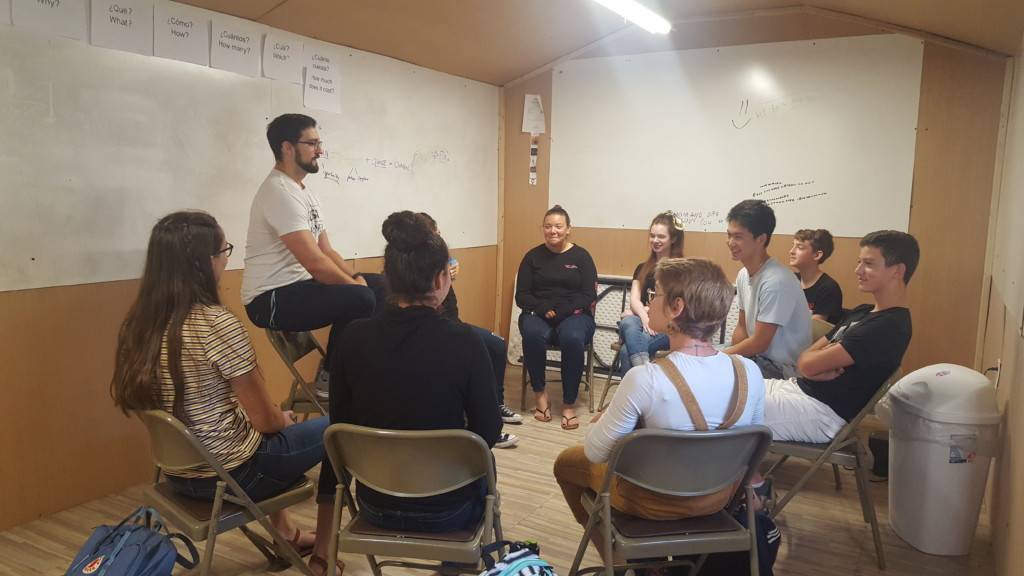
Jason Crawford leads his Pathfinding class at Class Source. The class teaches students life skills and personal development
The idea that pain can lead to a positive change in one’s life left students seeking more answers in Jason Crawford’s class.
One student sat laughing in disbelief. “How could this be?” she asked with amazement.
“Because pain leads to awareness and awareness plus choice equals action,” said Crawford, donning glasses and sporting a beard, as he wrote the formula on the wipe board. “Action turns into habits.”
This was not your typical classroom. Crawford is not your typical teacher. He is a marketing consultant who has a master’s in counseling.
Pathfinding is just one of more than 50 courses students can take at Class Source, a nonprofit enrichment program for home education students in Lutz. The list includes core offerings such as English, Math and Social studies. But it also includes classes that are not normally offered in a traditional school setting, such as life skills and novel writing. Families also find a community at the classes. While students take classes, parents receive mentoring and support from one another.
As the education landscape in Florida continues to shift toward customization, homeschooling is itself becoming more customized for families through a growing network of support and tools. In addition to programs that offer curriculum and instructors, there are mentoring groups for parents. Class Source is one of 10 such programs in the state. Homeschool families have been building networks to support one another and offer classes where students can find what interests them most.
“It gives a child a chance,” said Dina Fox, who founded Class Source in 2007 after observing the inconsistency of co-ops. “If they have a passion, they can log onto that passion. You can take that passion and put it into other areas to help them learn.” (more…)
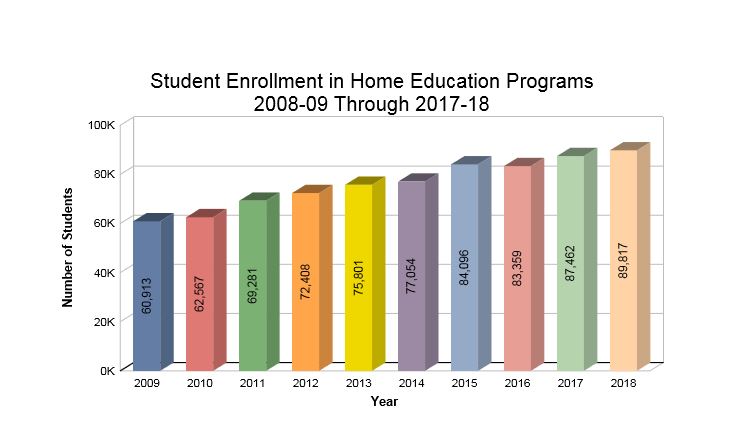
Over the past decade, home education program enrollment has increased nearly by half.
The number of home education students in Florida grew by 2.7 percent last year, continuing a steady upward trend over the past decade, according to the latest annual report released by the state Department of Education.
In the 2017-18 school year, 89,817 students participated in home education programs, an increase of 2,355 from the previous year. Over the past decade, enrollment has increased nearly by half, from 60,913, with increases in nine of the 10 years.
Brenda Dickinson, a lobbyist with the Home Education Foundation, said the home option is becoming more mainstream and accessible to parents.
“There are more programs where parents can just plug in and get the curriculum and support they need so they don’t feel like they are on their own,” she said.
One other contributor to the increase, Dickinson said, is the Gardiner Scholarship, which helps to pay for therapies and other educational services for students with severe special needs who stay at home for their education. Step Up For Students, which publishes this blog, helps administer the program.
“I think the Gardiner Scholarship has drawn more parents of children with disabilities because home education gives them the ability to customize the education for their students,” Dickinson said.
The counties with the largest number of homeschoolers include Duval, Hillsborough, Orange, Palm Beach and Broward. Duval also had the highest percentage in the state, at 7.6 percent.
The counties with the fewest number of homeschoolers were Hamilton, Franklin, Calhoun, Glades, Liberty, Lafayette and Gadsden. Home education declined for the second year in a row in Brevard County, at 3,708, a drop of 337 from the previous year.
Nationally, the U.S. Department of Education reported in 2017 that the number of students homeschooled in the nation remains flat at 1.7 million, representing 3.4 percent of the school population.
Charter schools. What happened to the Ben Gamla charter school in Pinellas is a "study in bad charter school governance." Choice Words. Parents try to figure out what to do now that a struggling charter school in Deland is closing. Daytona Beach News Journal. Ditto for the parents of a charter school in Lutz. Tampa Tribune. After 22 years in traditional public schools, a local principal is hired to lead the city of Cape Coral charter school system. Fort Myers News Press.
 Homeschooling. The Palm Beach Post takes a look at Space of Mind, a pricey but fascinating home-school school that insists it's not a school.
Tax credit scholarships. The number of parents seeking them grows in Highlands and beyond. Highlands Today.
School grades. Education Commissioner Tony Bennett is recommending another year of a "safety net" provision so grades don't drop more than one letter grade. Tampa Bay Times, Miami Herald, Palm Beach Post, Orlando Sentinel, Florida Times Union, Tampa Tribune, TCPalm.com, Associated Press. Other states are watching the goings-on. Miami Herald. Another story on how everyone is expecting grades to drop. Sarasota Herald Tribune.
VPK. Needs to be more focus on pre-K for poor kids. Pensacola News Journal.
Common Core. The Tallahassee Democrat offers an overview of the big challenges and potential payoffs ahead. (more…)
Bullying. Gov. Rick Scott signs the anti-bullying bill into law. Gradebook.
Teacher conduct. A private school teacher in West Delray is under investigation for allegations of sex with a student, reports the South Florida Sun Sentinel. State officials are investigating whether a Collier County teacher verbally abused students, reports the NBC-2. A fired Duval teacher appeals, claiming age discrimination, reports the Florida Times Union.
Gays and lesbians. A federal judge rules in favor of a Lake County middle school student who wants to create a Gay Straight Alliance at her school. Orlando Sentinel.
K-8 schools. Orange County is going to create more of them. StateImpact Florida.
Spelling bee. A home school student from South Florida makes it to the semifinals, reports the Miami Herald. The winner, Arvind Mahankali of New York, is the sixth straight Indian-American to win and the 11th in the last 15 years. (more…)
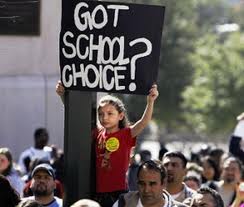
About 1,000 people are expected for the rally in Tally.
"Where are the parents who support school choice?"
"Where are the parents who support parental empowerment?"
"Where are the parents whose children benefit from education reform?"
These are typical questions from traditional parenting groups, groups that sometimes say they represent Florida parents in all educational matters. They have to ask the whereabouts of moms and dads of more than 1.5 million schoolchildren of choice, because such parents don’t tend to be in their membership files.
To the extent these choice parents are low-income and single moms who choose options such as the tax credit scholarship, they do indeed tend to be less visible in the political sphere.
Get ready, because that’s changing.
Early Wednesday morning, families from all over Florida, from Miami’s inner city neighborhoods to rural Pasco County, will board buses with their children and teachers and travel five to 10 hours to get to Tallahassee for School Choice Day. Organizers expect more than a thousand participants to gather and show lawmakers, traditional parenting groups, and everyone else the real face of parental school choice.
They won’t look like right-wing corporations. There’s a good bet they will be racially and economically diverse. In other words, they will probably look like you and me. (more…)
Indiana: The state supreme court rules vouchers constitutional (Indianapolis Star). The decision could set a precedent for other states with Blaine amendments (ABC News). More coverage from StateImpact Indiana, Fort Wayne Journal Gazette, Associated Press, Christian Science Monitor, Huffington Post. In the ruling's aftermath, the Senate Education Committee approves a proposal to expand the program in one way (RTV6), but not as far as originally proposed (Indianapolis Star). Republicans are split over how to grow the program (Evansville Courier & Press).
 Tennessee: Anti-Muslim sentiment surfaces in the Tennessee voucher debate (Murfreesboro Post).
Georgia: Lawmakers increase the cap on the state's tax credit scholarship program (Atlanta Journal Constitution).
Texas: Education Commissioner Michael Williams says more school choice won't mean a mass exodus from Texas public schools (Associated Press). Lawmakers consider speeding up the parent trigger (Texas Tribune). Once an outcast education sector, home-schooling is on the rise (Amarillo Globe-News).
Louisiana: Voucher applications are up 20 percent despite legal uncertainty (Baton Rouge Advocate). More from the New Orleans Times Picayune. (more…)
Two years ago, we launched redefinED in an attempt to help opinion leaders, the public and the mainstream media understand how public education is being transformed and redefined. So the following lead in yesterday’s New York Times was, even if by mere coincidence, gratifying to read: “A growing number of lawmakers across the country are taking steps to redefine public education … legislators and some governors are headed toward funneling public money directly to families, who would be free to choose the kind of schooling they believe is best for their children, be it public, charter, private, religious, online or at home.”
We are still early in this transition from a one-size-fits-all assembly-line model of public education to an approach that stresses empowerment, diversity and customization, but this shift to expanded school choice is accelerating and it’s inevitable. And as these changes unfold, redefinED will continue to aspire to be a place where thoughtful people can - with civility and mutual respect - discuss how best to address all the challenges this transformation is producing.
In the 1980s and '90s, when the National Education Association was a leader in trying to improve public education, we use to say change is inevitable but improvement is optional. This is especially true today, which is why the dialogue we’re having at redefinED is so important.
Thanks for staying with us.

