Washington: The new Charter School Commission is attracting candidates from across the state and beyond, including Liz Finne, a lawyer and director of the Center for Education Reform at the Washington Policy Center. The governor and other leaders expect to choose nine volunteers by March 6 (Associated Press). A coalition of educators and community groups filed a legal challenge that questions the constitutionality of Washington's new charter schools law (Associated Press). More from Education Week.
Colorado: With more than 80,000 students enrolled in 190 charter schools, charter leaders try to clear up misconceptions about the school choice option (Reporter-Herald). Douglas County's Choice Scholarship Program does not violate the state Constitution, rules an appeals court. The outcome could have wide-ranging implications for whether vouchers can be used statewide (Associated Press).
 Alabama: Legislators approve tax credit scholarships for students attending failing public schools (Associated Press). More about the "legislative bombshell'' that Republicans called historic and Democrats said was a sleazy "bait and switch,'' at AL.com. And the site offers a primer on the Alabama Accountability Act.
Idaho: Khan Academy will provide math, physics and history classes in 47 public, private and charter schools this fall, making Idaho the nation's first proving ground for statewide implementation of the free online educational content and teaching model (Associated Press).
Michigan: A report measuring charter school performance statewide calls the Eastern Michigan University-authorized schools the second worst system in the state. EMU says the report doesn't take into account that the schools serve some of the state's toughest communities (Ann Arbor.com)
Indiana: Republican lawmakers scale back a proposal to eliminate a requirement that students attend public schools for one year before becoming eligible for a private school voucher (Associated Press). They pass it mostly along party lines in the House (Associated Press). They're advancing a proposal to switch administration of the voucher program away from newly elected Superintendent Glenda Ritz (Associated Press). They're also considering a Democratic proposal to give school districts with more than 50 percent of their students in charter schools the ability to approve new charters (Post Tribune).
 New Hampshire: The state House votes to repeal the tax credit scholarship program passed into law last year over Gov. John Lynch's vote (New Hampshire Public Radio).
Iowa: The state's Catholic bishops push for vouchers (Iowa Radio).
Texas: Senate Education Committee Chairman Dan Patrick, R-Houston, files legislation to lift the cap on charter schools and create a new body to authorize them (Texas Tribune). More from the Austin American Statesman and the News-Journal. Patrick's proposal for tax credit scholarships isn't getting a warm reception from fellow lawmakers (San Antonio Express News). Thousands of people turn out for a Save Our Schools rally to restore education funding, reduce standardized testing and oppose vouchers and charter schools (KVUE.com)
Alaska: A debate over a proposed constitutional amendment that could open the door to private school vouchers is heating up (Anchorage Daily News). The chair of the Senate Education Committee says his committee will still hold hearings on vouchers even though it will no longer be considering a bill on the proposed amendment (Alaska Public Radio News).
California: The race for three seats on the L0s Angeles Unified School Board has drawn national interest - and financial support - due to three candidates who favor parental choice, charter growth and data-based teacher evaluations (Los Angeles Daily News).
Idaho: Lawmakers propose measures to allot charter schools $1.4 million in facilities funding and allow colleges, universities and nonprofit groups to authorize charter schools (Idaho State Journal). More from Idaho Education News.
Georgia: Amid the debate on parent trigger laws and charter schools, one education advocate ponders: Whose responsibility is it to educate a child — society’s or the parent’s? (Atlanta Journal Constitution). The Georgia Legislature considers an expansion of the tax-credit scholarship program (Rome News Tribune). (more…)
I am grateful to Rebecca Sibilia and Sean Gill for their thoughtful response to my blog post encouraging Michelle Rhee to replace her failing schools model of school choice with an approach based on equal opportunity.
Rebecca and Sean defended StudentsFirst’s support of the failing schools model on pragmatic grounds. They wrote: “When state resources are limited or the existing supply of desirable private schools is limited, it also makes sense to prioritize vouchers or scholarships for those low-income children attending a low-performing school or living in low-performing school districts.”
Every community suffers from an insufficient supply of effective schools for low-income students. But in Florida we’ve learned that increasing demand - not limiting demand - is the best way to increase supply.
Access to Florida’s tax credit scholarship program for low-income students, which I help administer, is limited by a state-imposed cap. But our demand is not limited, so it often exceeds supply. This excess demand has not had a negative effect on students or the program. Instead, it has generated political pressure on the state Legislature to allow our cap to rise to meet this additional demand.
In 2010, as a result of excessive demand, the Florida Legislature voted to allow our program to grow 25 percent every year the demand hits or exceeds 90 percent of supply. The result has been extraordinary growth of supply and demand. While we have been awarding scholarships since 2002, 34 percent of our growth has occurred in just the last two years. This school year we added 10,000 more students to the program and had more than 12,000 students add their names to our waiting list after we hit our cap.
We’ve also been adding about 100 new private schools per year to the program, and some have started to expand their physical capacity to serve more students. Had we adopted the StudentsFirst approach of limiting demand when faced with limited supply, this extraordinary growth would not have occurred.
Today, more than 43 percent of Florida’s preK-12 students attend a school other than their assigned district school. Charter schools, magnet schools, virtual schools, career academies, dual enrollment and homeschooling are all growing dramatically. Private schools are already struggling to maintain their market share given all these choices. If we were to limit our scholarships to low-income students in state-designated failing schools, then many private schools serving low-income students might be forced to close - to everyone’s detriment. (more…)
Tennessee: Gov. Bill Haslam proposes a voucher that's limited to low-income students in low-performing schools, with additional state funding for those schools to boot (KnoxNews). More from timesfreepress.com and Nashville Public Radio. Haslam reiterates that his proposal won't affect funding for public schools (Nooga.com). Both supporters and opponents find details to criticize (KnoxNews). Haslam's administration is also backing a bill that would cap enrollment at a virtual charter school run by K12 Inc, reports timesfreepress.com.

Florida: At a National School Choice Week event, new Florida Education Commissioner Tony Bennett gives some school districts credit for expanding public options such as magnet schools and career academies (redefinED).
Louisiana: The teachers union in New Orleans asks for the names of teachers in the city's charter schools in the hopes of organizing them (The Lens).
Arkansas: Former Florida Gov. Jeb Bush makes an appearance during National School Choice Week, urging lawmakers to expand charter schools and other choice options and calling education reform both the civil rights and economic issue of our time (Associated Press). More from the Arkansas Press-Gazette.
Virginia: Democratic lawmakers kill a charter school bill and snub their party's national platform in the process (Watchdog.org). More from the Associated Press. A bill to allow home-schoolers to play sports in public schools - a so-called "Tebow" bill - passes the House but must still clear the Senate (Associated Press).
Georgia: The state charter schools commission holds its first meeting since being revived by passage of a constitutional amendment (Atlanta Journal Constitution). More than 1,000 charter school supporters gather to celebrate the amendment's passage (Atlanta Journal Constitution).
South Carolina: State Superintendent of Education Mick Zais says at a National School Choice Week event that he supports a legislative proposal for tax credit scholarships (SCNow.com).
North Carolina: An expansion of charter schools brings debate about quality (Durham Herald Sun).
Mississippi: A bill backed by Gov. Phil Bryant to create a tax credit scholarship program clears the Senate education committee (Associated Press).
Texas: A charter school chief executive testifies in a trial about education funding that low state spending is hurting charters too (San Antonio Express News). The Amarillo school district joins others in supporting an anti-voucher resolution (NewsChannel 10). Gov. Rick Perry backs expansion of charter schools and a proposal for tax credit scholarships (Dallas Morning News). (more…)
Florida’s new education commissioner is known for his zealous support of charter schools and vouchers and other learning options that some critics see as anti-public school.
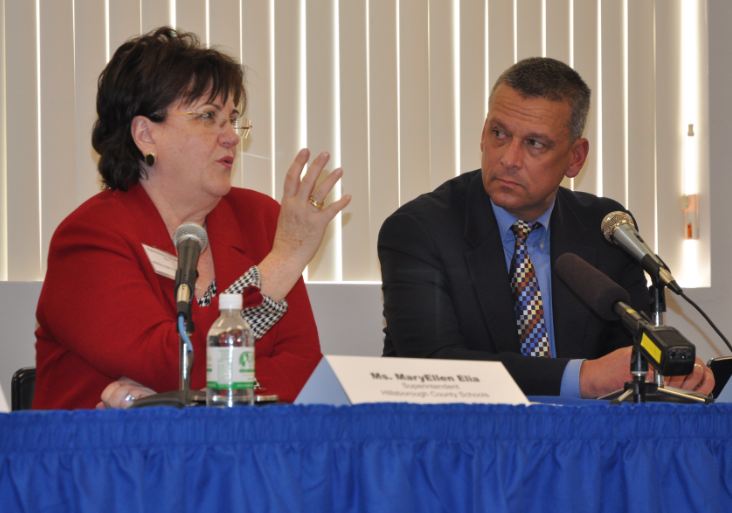
Florida Education Commissioner Tony Bennett and Hillsborough Superintendent MaryEllen Elia were among the panelists at a National School Choice Week event in Tampa. (Photo by Lisa A. Davis/Step Up For Students)
But on Tuesday afternoon, Tony Bennett sat next to Hillsborough County Public Schools Superintendent MaryEllen Elia inside a Tampa magnet school for boys, and praised the growth of choice in district schools across the state.
Florida is transcending the first round of conversations on choice that pit private and charter schools against public schools and virtual schools against “brick and mortar’’ ones, Bennett said during an event marking National School Choice Week. The new conversation, he suggested, isn’t either-or; it’s whatever works to ensure all kids have access to quality choices.
“So we’re now talking about choice – not just private schools and charter schools and virtual schools – we’re talking about public school choice,” he told an audience of about 100 people gathered at the Boys Preparatory Academy. “We’re talking about creative leaders like MaryEllen, like the team here, creating educational opportunities for children within the district - and really going to what we all heard was the purpose of choice to begin with, to provide incubation for innovation for our public schools.”
Tuesday’s event was sponsored by the Florida Alliance for Choices in Education, a coalition that includes a wide swath of school choice groups. Bennett and Elia sat on a panel with representatives from home-schooling, virtual education, magnet schools, career academies, Florida tax credit scholarships and McKay scholarships.
Most were parents who had lived and breathed school choice, starting with their own children. As they shared stories of searching for schools that practiced their faith or fit their child’s academic needs, they offered numbers that shed light on the choice movement’s impact. (more…)
 It’s only fitting: Florida, a trailblazer in expanding school choice, will be among the busiest states during National School Choice Week.
This year’s celebration, which officially begins Sunday, is by far the largest ever, with more than 3,500 events in 50 states, up from 406 last year. Florida has at least 134 events on the schedule.
One of the highlights will be here in Tampa - a panel discussion featuring two nationally recognized education leaders. One is new Education Commissioner Tony Bennett. The other is MaryEllen Elia, superintendent of Hillsborough County Public Schools, the third largest school district in Florida and eighth largest in the country.
The pair will join other panelists representing the charter, magnet, private, virtual and home-schooling sectors. The event is set for Tuesday at 3:30 p.m., at the Boys Preparatory Academy at Franklin Middle Magnet School, one of the state’s first single-gendered public middle schools.
Other speakers include selected students, parents and teachers who will talk about the need to provide all children with more access to educational options. The event is sponsored by the Florida Alliance for Choices in Education, a group of school choice advocates that includes Step Up For Students, the nonprofit that oversees Florida’s tax credit scholarship program and co-hosts this blog.
Organizers are calling this year’s National School Choice Week “the world’s largest celebration of education reform.” The idea behind it is to raise awareness about the value of school choice, the need for more of it and the broad coalition that backs it.
“A quality education can be the ticket to the American dream for children across America,” Andrew Campanella, president of National School Choice Week, said in a prepared statement. “We must fight to ensure that every child has the ability to go to a great school.”
From Religion News Service:
Since Florida became the first state to try them in 1996, virtual public schools have enjoyed dramatic growth, with at least some of it coming from religious families. Like home-schooling parents, parents of virtual public school students like having their children home so they can integrate religion and values into the school day.
In the 2011-2012 school year, 275,000 students were enrolled in online K-12 programs, up from 50,000 a decade ago, according to “Keeping Pace with Online and Blended Learning: A Guide to Policy and Practice 2012,” a report from the Colorado-based Evergreen Education Group. Currently, 32 states and the District of Columbia offer virtual public schools.
A growing number of private religious schools are also seeking religious course developers to develop virtual courses for them.
“There’s a lot of interest about online learning in the faith community,” said Matthew Wicks, chief operating officer for the International Association for K-12 Online Learning. Full story here.
 Words such as voucher, privatization, profit and corporation are often used as weapons by individuals and groups who oppose parental empowerment and school choice. Using words as weapons is especially common during periods of significant social change - we all do it - but the practice undermines civic discourse and makes finding common ground more difficult.
“Market” is another term school choice opponents use to connote evil, but our way of life is largely based on markets, and public education is increasingly embracing market processes as customized teaching and learning become more common. Our challenge moving forward is regulating public education markets in ways that maximizes their effectiveness and efficiency.
People access products and services in one of two ways. Either their government assigns them, or they choose for themselves. In the United States, we have historically allowed citizens to choose, and this system of provider and consumer choice is a “market.”
In a goods and services market, providers decide which goods and services they want to sell, and consumers choose those they want to buy. Markets, when implemented properly, are preferable to assignment systems because they better utilize people’s knowledge, skills and motivation. Citizens are allowed to use their own experiences and judgments when making selling and purchasing decisions, and this citizen empowerment maximizes the universe of ideas from which improvement and innovation derive.
When governments assign products and services to their citizens, they rely on a small group of people to decide what to offer. This top-down approach is less open, transparent and effective than the decision-making that occurs in markets, and it discourages creativity. This is why most improvements in goods and services emerge from market systems rather than government assignment systems.
Markets allow providers to learn from consumers. When governments dictate to consumers what goods and services they may have, their citizens’ true wants and needs are not fully considered. The voice of the customer is silent. But when consumers are empowered to choose for themselves, providers learn from these choices and adjust accordingly. In markets, this necessity to meet customers’ needs drives innovation and continuous improvement. (more…)
School funding. Gov. Rick Scott wants to spend additional revenue on public schools, reports the Florida Current. Funding and other education issues are woven through a mid-term progress report on Scott from the Tampa Bay Times.
 Rezoning. The Seminole school district is swamped with proposals, reports Orlando Sentinel. Affluent parents respond with “snobbery,” writes Sentinel columnist Beth Kassab. (Image from coolsprings.com)
Florida gets a B- for ed reform policies, according to a StudentsFirst report out today, the New York Times reports. That ties it with Louisiana for the top grade. A dozen states get F’s.
Best year ever. 2012 was a year of unprecedented accomplishments for the Miami-Dade school district, writes Superintendent Alberto Carvalho in the Miami Herald.
Career and technical. The Manatee school districts spends $44 million on a new main campus for Manatee Technical Institute. Bradenton Herald.
School grading. Poor grades for Polk high schools should be taken seriously. Lakeland Ledger.
School security. Editorials from Tampa Bay Times, Tampa Tribune, Palm Beach Post. More coverage from the Tribune and South Florida Sun Sentinel.
School enrollment. It's up in public schools by 30,000 statewide, in part because of declines in private schools. Palm Beach Post. A district audit finds a Palm Springs charter school overstated its enrollment, resulting in a $160,000 overpayment, the Palm Beach Post also reports.
Home schooling. Enough with the stereotypes, writes Mike Thomas at the EdFly Blog. (more…)
Vouchers and accountability. Gov. Rick Scott’s call for “voucher” students to take the same standardized tests as public school students is long overdue, editorializes the Tampa Bay Times: “Voucher proponents can't have it both ways,” it concludes. “They can't claim they are a good bargain for taxpayers but then be unwilling to prove it.”
Weatherford
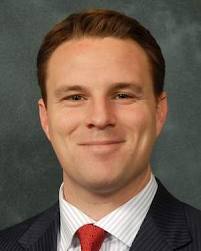
“Yes we are!” House Speaker Will Weatherford gives Tony Bennett a thumbs up on Twitter after a critical Tampa Bay Times column says the selection shows the state is doubling down on Jeb Bush ed reforms. Gradebook. A look at Bennett’s re-election upset in Indiana. Tampa Bay Times.
Home-schooled or truant? A Flagler County dad faces a criminal charge after not following requirements for home-schooling, reports the Daytona Beach News Herald.
Sex abuse lawsuits. Involving a former middle school teacher. Miami Herald.

