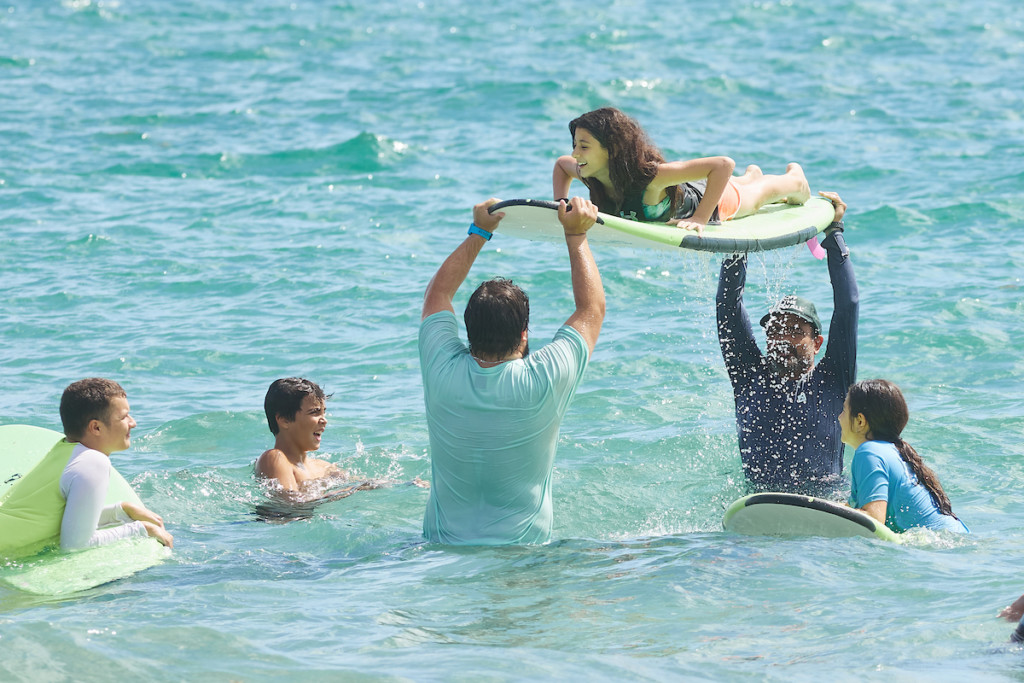
Organizations like Surf Skate Science pioneering new approaches to collaboration in public education. Photo credit: Chris Aluka Berry AlukaStorytellingPhotography.com
Despite calls for reform and waves of attempted transformation, key features of American schools have been remarkably stable for more than a century.
Students spend six or so hours a day, five days a week, sitting in rows of desks with other children about the same age, receiving instruction from their teachers in specific subjects: language arts, math, science and social studies. At the end of the year, they advance to the next grade. In high school, they socialize while standing next to banks of lockers, and the varsity football teams play on Friday nights.
These conventions persist despite their flaws. Students are frequently passed along to the next grade despite gaps in their academic foundations, leading them to graduate unprepared for life after school and few opportunities to close those gaps. If political leaders decide new knowledge or skills will be essential for students to thrive as adults — computer science, say, or financial literacy —cramming new subjects into the existing curriculum is a major headache.
The more time students spend in conventional schools, the more bored and disengaged they become. Some of the most engaging parts of schools have been relegated to the periphery—career academies, extracurriculars, sports, drama or music programs— where common schooling conventions hold the least sway. These are the places where students form deep relationships, develop lasting memories, and hone skills like creativity or teamwork.
So why do these conventions persist? Innovation researchers at the Clayton Christiansen Institute coined a term for one set of hidden forces that can keep an existing system in place despite pressure for change: A value network.
Textbook publishers and education technology companies design their products for conventional schools. Construction firms specialize in building them. Colleges train teachers to work in them. Complex webs of afterschool programs, summer camps, tutoring centers, and youth sports leagues all design their programs around conventional assumptions about when students will be in school. Parents and employers design the workweek around it.
These interdependent forces pose huge hurdles for any innovative educator who wants to break from convention. So, Christiansen's Thomas Arnett argues it’s best not to try within the confines of the existing system.
Instead, he advocates creating not just new learning experiences for children, but entirely new value networks that can allow new assumptions to take shape.
In Florida, and in in pockets all over the country, this is starting to happen. Here are two promising places to look for the value networks of the future.
Homeschool parents and community institutions
Some of the most valuable learning assets in most communities lie wholly or partially dormant during school hours. Museums. Parks. Zoos. Community centers. Science centers. Aquariums. Libraries. Performing arts theaters.
Their role in the value network of a conventional school system is relegated to the periphery: Hosting field trips, afterschool programs, or summer camps.
This is a huge missed opportunity. A single day a student spends at a place like this can often be the highlight of their school year. And while field trips are often rare and logistically complicated, there is evidence they not only help boost students’ academic learning, but help them develop character skills such as empathy and conscientiousness.
One group of students gets to experience these places more frequently, a way that is more central to their learning experience: Homeschoolers.
A growing number of community institutions, like libraries and science centers and museums, now offer dedicated programs for homeschool students.
If a trip to the aquarium could be the highlight of a student’s year, why not take them every month, or every week? Show them behind the scenes. Let them go deep learning about specific sea creatures or oceanic habitats and how they change over time. Offering learning opportunities of this sort would squarely align with an aquarium’s mission of increasing public understanding and appreciation of aquatic ecosystems.
Homeschool families are partnering with these community institutions (many of them public, by the way) to create new value networks that don’t relegate community assets to the periphery, and instead make them a central part of more children’s learning experiences. Over time, more children may benefit from these pioneering efforts.
Schools that partner by design
Right now, if an innovative educator creates a new way to teach chemistry through cooking, or math through music, or electrical engineering specifically for girls, they have three main options to find an audience for their idea: Start a whole new school, figure out how to sell their program to schools and districts, or create an option on the periphery—designing an afterschool program or summer camp and marketing it to families who pay out of pocket.
Each of these options is daunting. The existing education value network stifles the creativity of would-be entrepreneurs and keeps potential contributions of countless community members on the sidelines.
But here again, the efforts of a few pioneers have begun giving rise to new value networks, in this case by launching learning that are more inter-operable with other partners than conventional schools.
Like an old ship that creates a new home for coral, some of the earliest microschools and homeschool co-ops in South Florida have given rise to entire ecosystems of educators who create specific offerings and partner with smaller, more flexible learning environments to deliver them to students, as my colleague Ron Matus has documented.
The value network of the future
Other societal forces are creating pressure for new value networks in education. More parents than ever are working remote and flexible jobs. Scholarship programs allow more public education funding to follow students to whatever learning environment they choose. Information, which was scarce for most of human history, is now abundant.
If existing conventional schools find a way to adapt to these realities, it will likely be because they find ways to connect to entirely new value networks created by entrepreneurs working outside it.
Perun, the rock star of Australian defense economists doing awesome hour-plus hour PowerPoint presentations on YouTube, recently did two such presentations on “game-changing” weapon systems in the ongoing Ukraine-Russian war. Perun observed:
It seems like every time a new weapon system, be it Russian or Western, is sent to Ukraine, there are always going to be at least some voices in the media that amp this thing up as the next great game-changer, the system that will finally change the dynamics of this long and bloody war. For some systems the hype dies out, whereas for others it builds and builds until eventually the system arrives in Ukraine, and reality and expectations finally collide.
Some get to Ukraine and turn out to be utter disappointments. Others turn out to be solid, useful performers that do the job they were intended to do, but don’t exactly quickly or efficiently move the needle. And others swing in like a damn wrecking ball and on their first day of operations wreck two Russian airfields and deal the Russian aerospace forces their worst single day defeat since they were the Soviet Air Forces during the Second World War.
Inspired by the great Perun, we will here rank policy interventions designed to increase family options in K-12:
Magnet Schools: Introduced in the 1970s in the hopes of reducing racial segregation in public schools. Below is a placement of every magnet school in the nation with data included in the Stanford Educational Opportunity Project on Grades 3-8 academic growth:
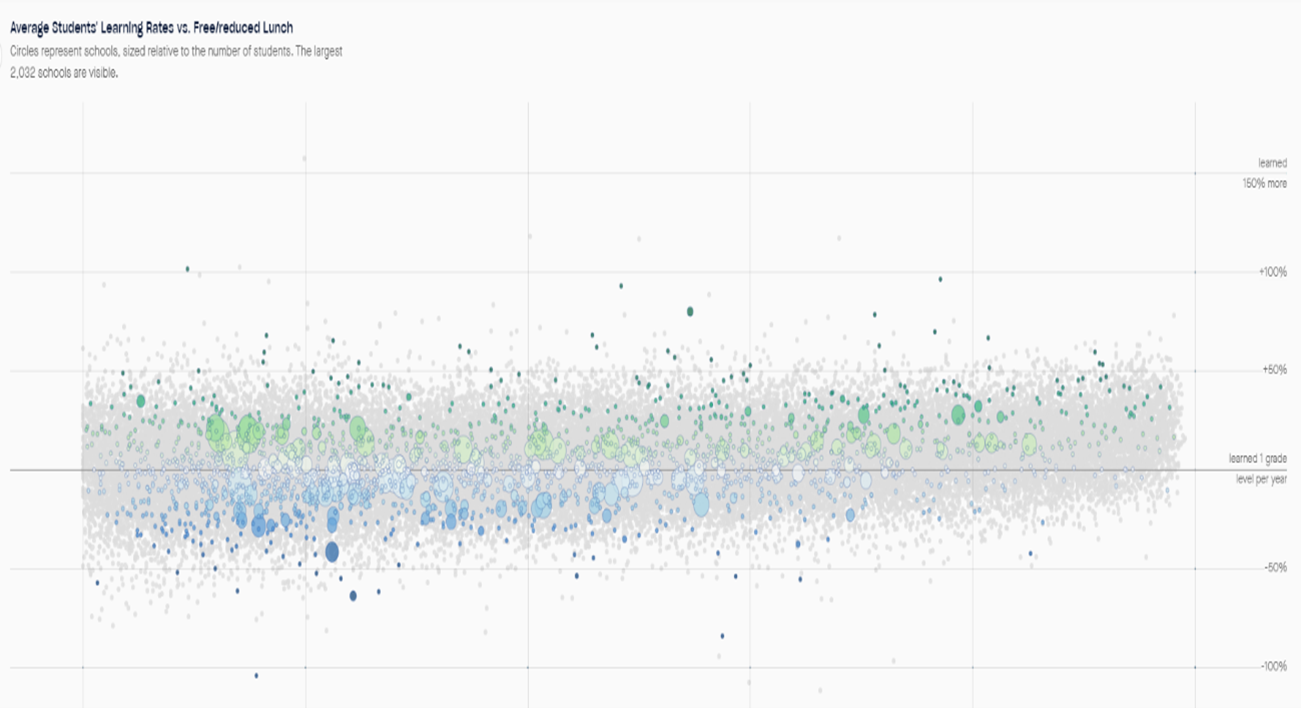
That’s a lot of schools, but their average rate of academic growth is approximately equal to the nation as a whole (half above and half below the “learned one grade level in one year” line. There are many fantastic magnet schools, but the system suffers from a fatal flaw: the schools are ultimately under the control of elected school boards. Many magnet schools have waitlists of students, but districts, for the most part, do not replicate or scale high-demand schools. Unless someone can demonstrate otherwise, let’s assume that Political Science 101 is controlling here and the people working in other district schools don’t want to scale high-demand magnet schools for the same reason they dislike other forms of choice: they view it as a threat. RANKING: TAME HOUSE PET
Charter Schools Introduced in the early 1990s by Minnesota lawmakers, charter schools eventually overtook magnet schools in numbers of schools, as you can see in the same chart as above for charters nationally:
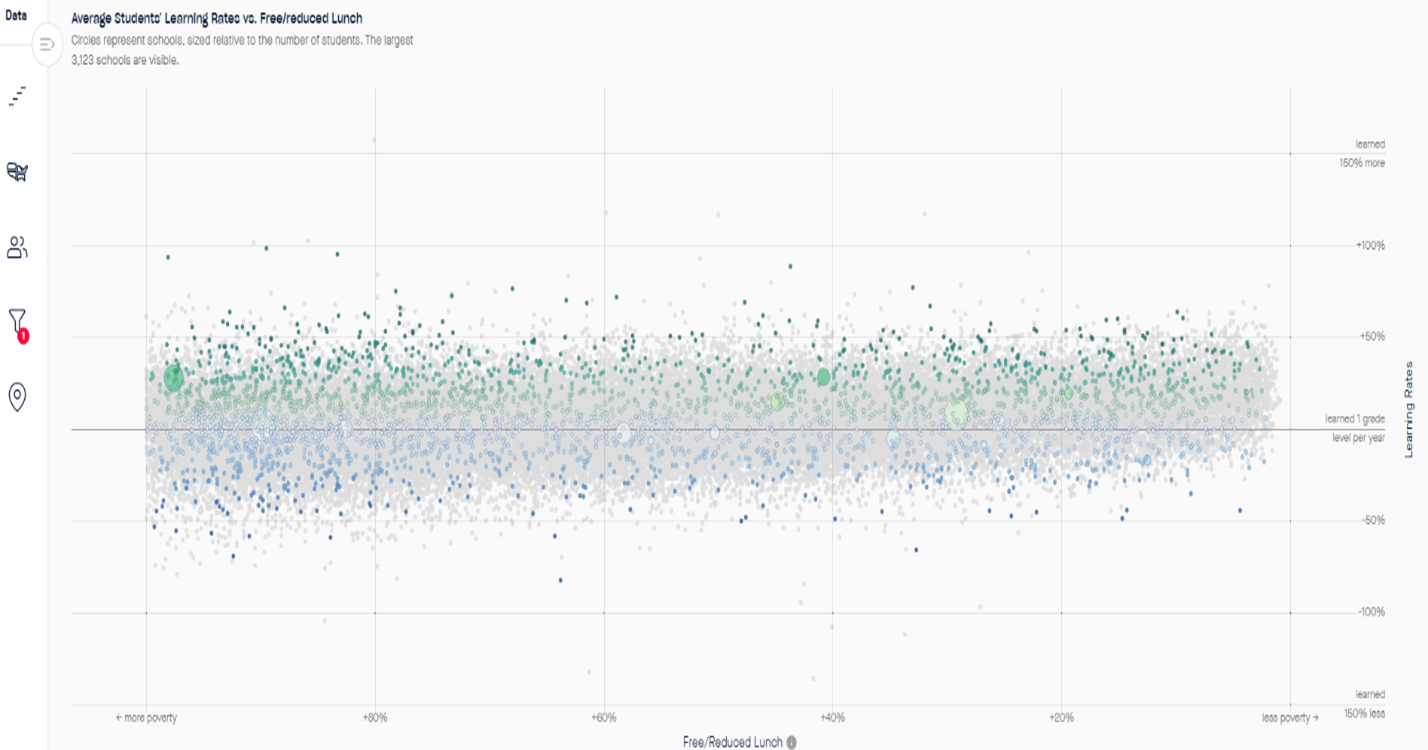
Charters were the leading form of choice for years after their debut, but more recently, it has become sadly clear that they suffer from a problem not terribly dissimilar from magnet schools: a political veto on their opening. Sometimes this veto is delivered by the same districts that fail to replicate high-demand magnet schools, in other instances, it happens because of Baptist and Bootlegger coalitions controlling state charter boards. What the Baptist and Bootleggers started, higher interest rates, building supply chain issues and the death of bipartisan education reform seems to have finished. RANKING: Varies by state but mostly TAME HOUSE PET
District Open Enrollment: Potentially an immensely powerful form of choice, but one which only realizes that potential if other forms of choice create the necessary incentives to get districts to participate. In most places, it looks far too much like this:
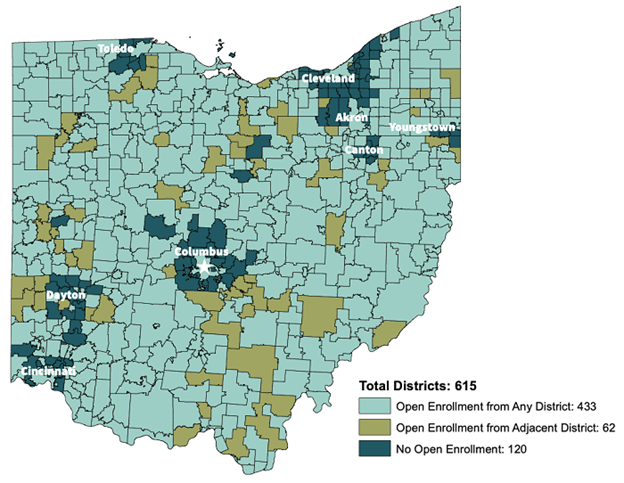
See any fancy suburbs willing to take urban kids in this map? Me neither. RANKING: Varies by state but mostly TAME HOUSE PET, could grow to become much, much more
School Vouchers/Scholarship Tax Credit: The modern private choice movement debuted in Wisconsin in 1990, the year before the first charter school law passed in 1991. Voucher adoption proceeded more slowly than charter school laws, and one of the accomplishments of the voucher movement may indeed have been to make charter schools seem safe by comparison. Scholarship tax credits, first passed in Arizona in 1997, expanded around the country more quickly than vouchers. While lawmakers passed several voucher and scholarship tax credit programs, few of them were sufficiently robust to perform critical tasks such as spurring increased private school supply, which requires either formula funding or regular increases in tax credit funding.
Scholars performed a tremendous amount of research on voucher and tax credit programs, and those programs led directly to the creation of education savings accounts (discussed next). Overall, however, these programs did not in and of themselves move the needle, although at times, the deployment of strong private and charter school programs did move the needle. RANKING: Vital Intermediate Step
Education Savings Accounts: First passed by Arizona lawmakers in 2011 and going universal only in Arizona and West Virginia in 2022, ESA programs remain a work in progress. The flexibility of accounts contains the prospect of a less supply-constrained form of choice, less dependent upon the creation of one-stop shopping bundles known as “schools.” The largest first-year private choice programs have all been recently passed ESA programs, which seems promising. ESAs, however, have yet to become a teenager, and the technologies necessary to administer them at scale remain an evolving work in progress. RANKING: Promising but To Be Determined
Barely Off the DRAWING BOARD PLATFORM
Personal Use Refundable Tax Credits: Older but tiny programs exist that deliver small amounts of money and accomplish little. Oklahoma passed a more robust program of this type last year, but it remains far too early to draw any conclusions. RANKING: Totally TBD
Homeschooling:
The homeschool movement has grown quickly is sufficiently organized to make lawmakers think long and hard before starting a quarrel with its supporters and has become more accessible with the advent of homeschool co-ops, which provides a measure of custodial care. RANKING: Wrecked two Russian airfields on the first day of deployment, unclear how high the ceiling will reach.
Conclusion: You should be seeking a combined arms operation in your state rather than a panacea-like super-weapon system that will deliver instant victory. You will know you are winning when your fancy, suburban districts start taking open-enrollment students. You will never achieve this with means-tested or geographically restricted private or charter school programs.
Kate Streets wants to be Jane Goodall when she grows up.
“I have always wanted to work with animals that you can actually touch and play with and have a variety of interactions with,” said Kate, a homeschooled 13-year-old from Fleming Island who receives the Family Empowerment Scholarship for students with Unique Abilities.
Kate said Goodall, the legendary primatologist known for her long-term studies of chimpanzees in Tanzania, has served as a role model, and her work has inspired her dreams of someday moving to Australia and working for a zoo.
“They have a good variety (of chimpanzees) there,” she said. “It’s really fascinating how their brains work like ours. They can use tools; they use a stick to put into an anthill to get their ants. I like learning how they think, play with each other, and have their social groups.”
To prepare for her ideal career, Kate goes to Jacksonville Zoo and Gardens, which has a variety of programs for students. In addition to summer zoo camp, she attended Homeschool Zoocademy, a program for homeschool students ages 5 through 12. The program operates during the school year, with students attending three-hour sessions each month to examine fossils, observe behind the scenes and hear from professionals who work with the animals.
Florida lawmakers passed the Family Empowerment for students with Unique Abilities program in 2014. Formerly known as the Gardiner Scholarship, it provides an education savings account that functions like a restricted-use bank account from which parents direct funds to pay for private school tuition and fees, approved homeschooling expenses, therapies, tutoring and other education-related expenses. Step Up For Students, which hosts this blog, is an administrator of the program and recently published a purchasing guide for families.
Because the zoo is a state-approved vendor, Kate’s mom, Danyse, can use funds from her account to pay the fees, which run about $200 per year. It’s one of several ways Streets uses her daughter’s scholarship to customize learning for Kate, who has dyslexia, dyscalculia and dysgraphia. Students with these conditions have difficulties in reading, math and writing.
Streets said she suspected something was different about Kate as early as pre-kindergarten because she lagged her classmates in learning letter names and sounds. Suspecting a maturity issue, Streets had Kate repeat pre-kindergarten, a practice often called “academic redshirting,” which allows students more time to develop skills. When that approach failed and with kindergarten set to begin, administrators at the private school Kate attended told Streets that her daughter would have to leave the school next year if she couldn’t learn to a certain level.
Streets enrolled her at another private school. When the coronavirus pandemic hit in 2020, she chose homeschooling. A small-group tutor also helped Kate make strides in core academic subjects. She attends three days a week with six other girls in grades four through eight, all of whom have learning differences.
“They get along well and help each other,” Streets said.
Streets paid for all Kate’s schooling out of pocket until 2021, when lawmakers expanded eligibility for unique abilities education savings accounts to include students with dyslexia. Streets signed up.
Since then, she has found more creative ways to design the best learning plan for Kate. Though the bulk of her account pays for the private tutor, the remainder pays for zoo school and Kate’s monthly dues and tournament fees for a private school swim team, which serves as physical education.
Recently, Streets used about $60 of Kate’s account to pay for a month of crocheting lessons at a local arts studio. Though the lessons allowed her to learn an art, Kate quickly turned it into a business opportunity by selling purses she learned to make in class.
“It’s a nice little side hustle for someone who wants a lot of things and doesn’t have any money,” Streets said.
Kate used the proceeds from the bag sales to buy a sewing machine. Her mother will use about $200 from her ESA to pay for sewing lessons.
“She’s excited about being able to make her own clothes,” Streets said.
Kate’s education is unconventional, but increasingly, it’s not unusual. Research shows that family spending patterns change the longer they use flexible education scholarships. As families become more familiar with the program, they begin to spend more money on expenses other than school tuition and fees, representing a desire to further customize their child’s education. Such changes can help create a virtuous cycle by encouraging more mold-breaking providers to offer services, which attracts more families to the program.
Streets, a former assistant principal who left her district school to start a tutoring and special education advocacy company called Bridging the Reading Gap, says the flexibility the ESA provides has helped Kate thrive academically, socially and athletically. She dropped 16 seconds off her previous finishing time in the 100-meter breaststroke at a recent swim meet.

“We’ve tried to stretch the funds as much as possible,” Streets said. “I think we’ve used the money wisely.”
Kate says she wants to learn sign language as soon as possible so she can use it to communicate with the chimpanzees she hopes to make a career out of studying someday.
“In the future, our scientists are going to learn much more about these animals, and when I get older, there will be so much more potentially we can learn about them.”
For now, though, she’ll settle for being a summer camp counselor and conservationist with Jacksonville Zoo and Gardens ZooTeens! Program.
For the past several years, the story of American homeschooling has been a narrative sorely lacking reliable numbers.
Last week, The Washington Post filled the void with the first carefully assembled nationwide look at state and local administrative data.
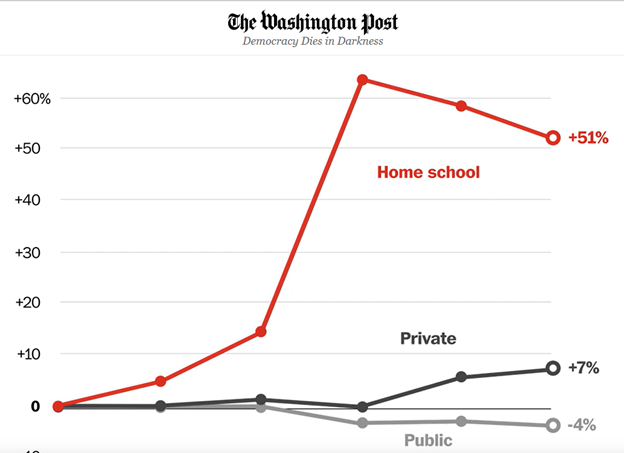
It found that in the states where comparable data exist, homeschooling is up 51% during a six-year period that includes the pandemic and years since.
That's a seismic shift in American public education, but it's still poorly understood. Here's the full picture in a nutshell:
Homeschooling jumped, dramatically, during the Covid-19 pandemic.
Some of that increase was sticky. Parents left schools and decided they liked it.
Some of it wasn't. Parents who tried their hand at homeschooling during the pandemic quickly returned to schools once they reopened.
There is regional variation. The trend appears stickier in parts of Florida than in, say, the DC suburb of Fairfax County, Virginia.
Homeschooling is down from its pandemic-era peak. But it's way up from the pre-pandemic status quo. And it's continuing a trend the predates the pandemic: the increase in families taking more control of their children's learning. This can take the form of homeschooling. It can also take the form of new education options that blur the lines between school and homeschool.
Up or down?
The Post caught the attention of skeptics, like writer and researcher Chad Aldeman, who himself opted to homeschool at the height of the pandemic, only to return once schools reopened. The homeschooling trends in his own county suggest hundreds of other parents made similar choices at the height of school closures.
Aldeman errs in implying that his county, a D.C. suburb where the median household income is nearly twice the national average, typifies the national trend. It doesn't.
The overall homeschooling increase in Fairfax is smaller, and the pandemic-era spike and subsequent decline more pronounced, than in the Post's multistate average.
There are several plausible reasons Fairfax stands out.
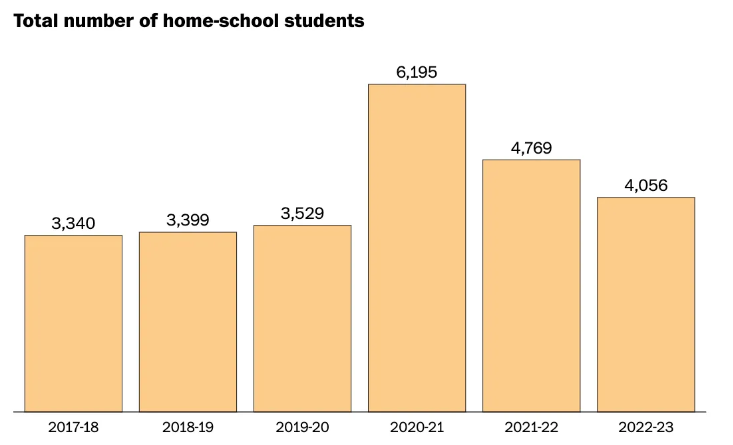
Fairfax County homeschooling numbers crashed back to Earth once schools reopened. Source: Washington Post
Compared to school systems in most of the country, Fairfax's pandemic-era school closures were notoriously long-lived and ineptly managed. This may have pushed more members of its highly educated population to take teaching into their own hands. Its high incomes also created a high opportunity cost for parents to continue homeschooling once schools reopened. The typical Fairfax parent who chose to remain out of work to support the homeschooling of their children would have foregone more money, and more potential wealth-building, than the typical American family.
Ultimately, Aldeman and the Post are both right. Homeschooling is way up from pre-pandemic levels. And it appears to be declining in many places right now. But it's still significantly higher than pre-pandemic levels, on average, and in some places, like Florida, the numbers are still going up.
Big or small?
Skeptics also pooh-pooh the magnitude of the rise of homeschooling. A 51% increase in homeschooling represents a shift from about 3% of American K-12 students to about 4.5%. Is that a big deal?
For one thing, 1.5% of American schoolchildren equals about 750,000 students. People can disagree whether a fundamental change in the learning arrangements for that many young people is a big deal.
But that number understates what's actually going on.
In Florida, two scholarship programs (the Unique Abilities scholarship and the Personalized Education Program, or PEP) allow families to pay for fully unbundled education. Combined, they're serving more than 100,000 students. Some students in the latter program may register as homeschoolers. Others don't. And students using PEP scholarships are explicitly legally distinct from homeschoolers.
In other words, many of them won't show up as homeschoolers in administrative data. However, all of them have the opportunity to engage in homeschool-like behavior. They might enroll in schools. They might not. Their parents have taken responsibility for assembling the educational program for their children. Other families have enrolled in hybrid schools, microschools or online schools. They won't show up as homeschoolers in administrative data, but they're blurring the lines between schooling and homeschooling.
Pandemic blip or permanent shift?
A useful analogy to help put the rise and decline of homeschooling in perspective is grocery delivery.
Instacart stated in 2012 with what may have seemed like a niche business. Then it suddenly exploded during the pandemic as people eschewed in-person shopping. It's since come back to earth, but the business is still far larger than before the pandemic and recently made a healthy stock market debut.
As a company, its future is uncertain, and turbulence lies ahead. But the zooming in on the trajectory of one grocery delivery company obscures a larger, more undeniable trend: online delivery is eating the retail business. Fresh meat and produce might be more resistant to this shift than, say, books or shoes. But Americans are getting more goods delivered to their doorsteps and buying less in physical stores. The trend is moving in one direction.
The same pattern applies to homeschooling or individual microschool and online learning providers. Individual options will have their ups and downs. But larger shifts are harder to ignore.
Public trust in institutions is declining. Anxious millennial parents want more transparency and communication from their schools. Remote work and flexible hours give them more opportunities to co-produce education with their children. They know each of their children is different, and they want learning experiences that accommodate these individual differences.
Homeschooling is one response to these larger shifts. Many of the distinct motivations for homeschooling captured in recent parent surveys by EdChoice boil down to trust. The No. 1 concern of homeschooling families, safety, can also be seen as a lack of trust that schools will provide children with a safe environment.
But there are obvious forces limiting the growth potential of homeschooling, strictly defined. An earlier Washington Post survey showed homeschool families typically rely on one parent, almost always the mother, remaining out of the workforce to take charge of educating their children.
At the same time, the profile of the typical homeschooler is changing. Homeschooling is becoming more diverse, as well as less conservative and traditionally religious. Many of these newer homeschoolers aren't ideologically opposed to public education. It stands to reason that if public education finds ways to earn these parents' trust and support their individual needs, it might yet find ways to keep them, much in the same way Wal-Mart and Amazon are devising ways to fend off the challenge from Instacart.
Homeschooling numbers, in other words, are best understood as leading indicators of larger shifts that public education ignores at its peril.
The number of Florida families choosing home education jumped nearly nine percent last school year.
The new numbers, based on registration data kept by districts and reported this summer by the state Department of Education, suggest that while the dramatic jump in homeschooling at the height of the pandemic appears to have slowed, the trend is still moving in one direction: up.
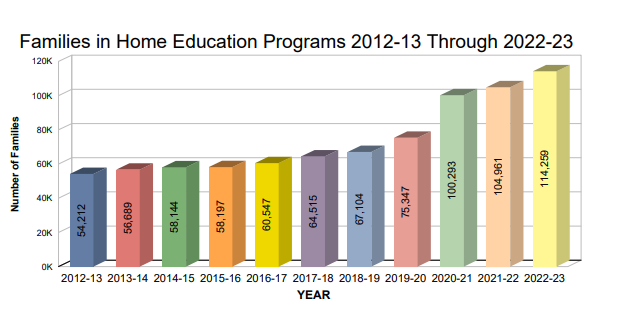 Reliable estimates of homeschooling participation are notoriously difficult to come by. These numbers are based on the number of families who registered with their districts as homeschoolers, as required by Florida law.
There is one quirk in the data. While the number of families choosing to homeschool jumped at a relatively high rate, the number of participating students leveled off, growing by just 1.4 percent. 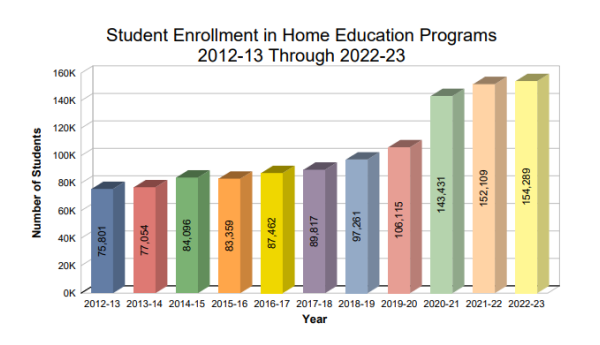
Reasonable people can debate whether the number of families choosing to homeschool or the number of students participating is the more relevant data point. If you have thoughts, please send them my way.
Some learning options that look or feel like homeschooling may not be reflected in these numbers. They do not include students who enroll full time in online public schools or students who enroll in private schools that support learning at home.
Next school year, students will have the option to enroll part time with their local school districts. And students receiving state educational choice scholarships will have the option to enroll in "personalized education programs" that allow them to mix and match different learning options without attending a single school full time.
It's a safe bet that in the coming years, new options will mimic some flexibilities of homeschooling, while remaining legally distinct. Many traditional homeschoolers prefer to keep it that way.
This blurring of the lines means homeschoolers' impact on the overall education landscape may be growing faster than homeschooling itself, as measured by official statistics.
Was pandemic learning loss a necessary evil to create a more just society?
One teachers union representative from Richmond, Virginia seems to think so. In an interview with ProPublica, Melvin Hostman, who serves on the Richmond Education Association’s executive board, remarked that “the whole thing about learning loss I found funny is that, if everyone was out of school, and everyone had learning loss, then aren’t we all equal? We all have a deficit.”
When confronted with evidence that learning loss disproportionately affected already-disadvantaged populations, Hostman doubled down, pinning the blame on American society’s intrinsic inequities. “Now people are saying, ‘We’re going back to the way things were before,’” Hostman added. “But we didn’t like the way things were before.”
It’s worth noting that Hostman’s position is extreme and uncommon. The vast majority of educators — including those affiliated with prominent unions — are not only worried about learning loss, but also support traditional methods (like extra instructional time and targeted tutoring) of overcoming it.
However, a disturbing number of union representatives and advocacy groups see the pandemic’s aftermath as an opportunity for social and educational re-engineering. In other words, terms like “learning loss” and merit” are now considered old-fashioned at best and something far more sinister at worst.
If union representatives like Hostman want an honest conversation about reform, they have to stop trying to put lipstick on a pig. School closures were incredibly harmful — particularly for disadvantaged students who needed in-person education the most.
More specifically, learning loss, at least in the 2020-2021 school year, was by no means an inevitability. Kids didn’t fall behind because of structural inequities in the American educational system; kids fell behind because many states and districts made a conscious decision to keep them out of school for extended periods of time.
Salt Lake City didn’t even start reopening their schools until February 2021. Students in other places endured even greater turmoil — for New York City, Washington DC, and many school districts in states like California and Illinois, full reopening wouldn’t come until the 2021-2022 school year.
As a result, private schools, which were much more likely to be open for in-person instruction, saw an influx of students. The greater awareness of alternatives helped fuel parents' demand for more choices and led many states to establish or expand education choice programs.
The results speak for themselves. A Harvard study released last year, which analyzed data from more than 2.1 million students, found that school districts that employed remote learning for longer suffered a higher degree of learning loss. In contrast, students in states like Texas and Florida, which resumed in-person learning as quickly as possible, “lost relatively little ground.”
“Interestingly, gaps in math achievement by race and school poverty did not widen in school districts in states such as Texas and Florida and elsewhere that remained largely in-person,” said Thomas Kane, one of the study’s authors, in an interview with the Harvard Gazette. “Where schools remained in-person, gaps did not widen…where schools shifted to remote learning, gaps widened sharply.”
Taken to their logical end, Kane’s comments directly contradict Hostman’s claim, and confirm that America’s children’s experiences were not “all equal.” Children, many from already disadvantaged backgrounds, were kept out of school unnecessarily and suffered disproportionate learning loss as a result.
I’m not about to claim that the chaos was intentional. I’m sure most school closures were done in good faith, even though the scientific research overwhelmingly backed reopening. However, all policy choices have consequences, and these consequences were particularly severe.
Simply put, Hostman’s claim was just plain wrong. Any debate regarding what to do next must start there.
Garion Frankel is an incoming doctoral student in PK-12 education administration at Texas A&M University. He is a Young Voices contributor, and frequently writes about education policy and American political thought.
 Editor’s note: This commentary from Colleen Hroncich, a policy analyst with Cato's Center for Educational Freedom, appeared Sunday on the center's website.
My oldest child is graduating from college tomorrow, so it has me thinking about our educational journey—which could best be described as eclectic. At various times, we used private school, district school, and cyber charter school. But we ultimately landed on homeschooling.
That doesn’t mean they were literally learning at home every day. My kids participated in co‐ops, hybrid classes, dual enrollment, athletics, and more. This gave them access to experts and plenty of social time.
It can be scary taking charge of your children’s education—I remember feeling very relieved when my oldest received her first college acceptance. But today there are more resources than you can imagine to help you create the best education plan for your children’s individual needs and interests. And with the growth of education entrepreneurship, the situation is getting even better.
For starters, you don’t have to go it alone. The growth of microschools and hybrid schools means there are flexible learning options in many areas that previously had none. One goal of the Friday Feature is to help parents see the diversity of educational options that exist. To see what’s available in your area, you can search online, check with friends and neighbors, or connect with a local homeschool group.
If you don’t find what you’re looking for, the good news is that there’s also more support for people looking to start new learning entities.
The National Microschooling Center is a great starting place if you’re considering creating your own microschool. The National Hybrid Schools Project at Kennesaw State University is also a tremendous resource. There are businesses—like Microschool Builders and Teacher, Let Your Light Shine—whose focus is helping people navigate the path to education entrepreneurship. And grant opportunities, like VELA and Yass Prize, can help with funding.
We were fortunate to be in an area with a strong homeschool community and therefore had plenty of activities to choose from. But I’m still a bit jealous when I speak to parents and teachers each week and hear about the amazing educational environments they’ve created.
There’s also an abundance of online resources available, from full online schools to à la carte classes in every subject imaginable. If you like online classes but want an in‐person component, KaiPod Learning might be just the ticket. These are flexible learning centers where kids can bring whatever curriculum they’re using and work with support from a KaiPod learning coach. There are daily enrichment activities, like art, music, and coding, as well as social time.
One of the best parts of taking charge of your children’s education is that it puts you in the driver’s seat. If your children are advanced in particular subjects, they can push forward at their own pace. In areas where they struggle, they can take their time and be sure they understand before moving ahead. (One potential downside is that this takes extra discipline and can be challenging. But it’s tremendously beneficial overall.)
These nonconventional learning paths can be great for kids who don’t want to go to college, too. Flexible schedules free up time to pursue a trade, music, performing arts, sports, agriculture, and more. As kids get older, they can increasingly take charge of their own education. This lends itself to developing an entrepreneurial outlook, which is vitally important in a world where technology and public policy are constantly changing the workforce and economic landscapes.
“One size doesn’t fit all” is a common saying among school choice supporters. But this is more than just a slogan. It’s an acknowledgement that children are unique and should have access to learning environments that work for them. Public policy is catching up to this understanding—six states have passed some version of a universal education savings account that will let parents fund multiple education options.
If you’ve considered taking the reins when it comes to your children’s education, it’s a great time to act on it. Whether you choose a full‐time, in‐person option, a hybrid schedule, or full homeschooling, you’ll be able to customize a learning plan that works best for your kids and your family.
And you may even become an education entrepreneur yourself and end up with a fulfilling career that you never expected.
 Editor’s note: This commentary appeared last week on Utah’s kslnewsradio.com
A freshly minted Utah law gives a $6,000 raise to every public schoolteacher, but it also provides parents $8,000 per student per year in state funds to attend a private school or use the money for homeschooling.
As a homeschooled student, Anna Ressie, a co-worker at KSL, joined Dave and Dujanovic to share her experience as a home-schooled student. Recsiek said she was allergic to chalk dust so her mother kept her home. The school sent homework along to her.
“I was able to churn through it really rapidly,” she said. “My mom was like, ‘Oh, please give her more, and the teachers [said], ‘That’s about all we do … she’s doing a good job.”
Recsiek said homeschooling gave her siblings flexibility in the pace of their learning, with individual assistance from Mom.
“For some of my siblings, maybe a slower approach to helping them grow without some of the peer pressures that public schools have,” she said. “If we were struggling, maybe she’d spend some more time with one child or another.”
Her mother encouraged the kids to race each other to finish their homework and to read out loud because she would be in another room folding laundry and could not monitor them as closely.
“Other times we were at the kitchen table — all of us learning about the same subjects and sharing with each other what we learned,” Recsiek said.
She said she would learn about animals, then take a family field trip to a zoo or study art, then visit a museum.
“We would go to the park. When it was a nice day, we could sit at the picnic tables and … enjoy being outside in a different environment. My mother really thought that variety spurred that creative side and really made learning not ever boring,” Recsiek said. “I don’t ever remember being bored.”
To continue reading, click here.

Samantha Cook and Andy Calkins, in their own ways, have been interestingly prophetic in predicting the future of education.
Silicon Valley homeschool mom Samantha Cook had this to say to Wired magazine in 2015:
“The world is changing. It’s looking for people who are creative and entrepreneurial, and that’s not going to happen in a system that tells kids what to do all day … So how do you do that? Well, if the system won’t allow it, (and) as the saying goes, if you want something done right, do it yourself.”
Her take was prescient considering the subsequent rise in home-schooling in her area. Silicon Valley.
A follow-up and spot-on K-12 prediction came two years later from Andy Calkins of Next Generation Learning Challenge published in Education Next, who spoke of the pent-up demand for innovative educational opportunities.
“It wouldn’t surprise me if, five to 10 years from now, everyone looks at this and thinks, ‘That grew a whole lot faster than I thought it could.’ There is a slice of the market that is not being served by public education. They’re saying, ‘The public schools don’t work, [and] I can’t get into the charter schools.’ ”
Today, we are on the lower end of five to 10 years later, and the “that grew a whole lot faster than I thought it could” is indeed a thing.
If we unpack the statement a bit, we see that the “I can’t get into the charter schools” sentiment reflected a broad inability of the charter movement to match demand for seats with supply, resulting in waitlists. The problem has gotten worse rather than better since 2017.
It also is worth noting that private choice programs did not merit mention in the statement at all, an implicit indictment of their limited scale.
America’s reactionary K-12 preferences community successfully multi-tasked for 30-plus years, undermining state accountability systems while simultaneously keeping choice programs largely contained. Most states passed charter and/or private choice programs but only rarely, even in combination, did those programs prove even moderately disruptive to the status-quo.
The demand for choice exceeded the willingness of the political system to provide choice, resulting in ubiquitous waitlists. Families, as Cook and Calkins both noted, began making their plans accordingly with a do-it-yourself spirit.
In 2023, limited choice programs are “out” and universal programs are “in.” Lawmakers obviously have gotten the memo that their constituents want choice, and they want it now. As Samantha Cook sagely noted, the world has changed, and our system of education must adapt.
You don’t need to be gifted with prophetic powers to surmise where things are going next.
 Editor’s note: This commentary from Ben DeGrow, a policy director for education choice at ExcelinEd, appeared Monday on the organization’s website.
Education savings accounts offer parents state funds to craft educational experiences that fit their children’s unique needs. For most families, these programs are a lifeline. But for some families, they can spark skepticism or apprehension.
In fact, some homeschooling families and organizations are vocal critics of ESAs, in part because they believe government funds carry strings that may infringe upon parental rights. Their objections may threaten support for ESAs. But these programs can enhance educational freedom while protecting the autonomy others already enjoy.
The growing popularity of homeschooling is undeniable, even if it’s hard to tell how many homeschoolers there are nationwide. Best available estimates place the figure above 3 million. Whatever the number, many more families opted for home education after COVID-19 turned their schooling experiences upside down.
It was no coincidence that ESAs also gained traction during the pandemic. Frustrations with virtual schooling and other pandemic-related policies inspired some lawmakers to give families access to state-supervised education spending.
The five (mostly small) ESA programs that existed in 2019 doubled to ten by 2021. Combined, ESA programs across the country now serve more than 100,000 students. And momentum isn’t slowing, as several more states (including Florida) are considering ESA legislation this year.
To continue reading, click here.

