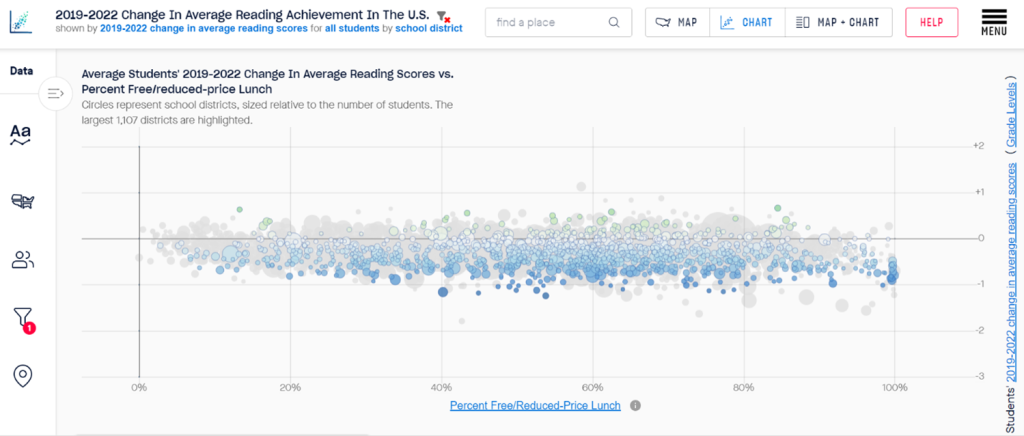
American K-12 education was doing quite poorly before the advent of the COVID-19 pandemic. In comparisons to other nations on international exams, American schools spent lavishly but scored poorly. Now matters are worse. The Stanford Educational Opportunity Project recently measured change in reading scores by school district between 2019 and 2022. The below chart plots reading achievement, green is good, blue is bad, and blue dominates green, and the mathematics chart is even worse:
America’s shambolic public health response to the COVID-19 pandemic greatly increased demand for education options outside the districts. Tyton Partners measured which sectors met how much increased demand:
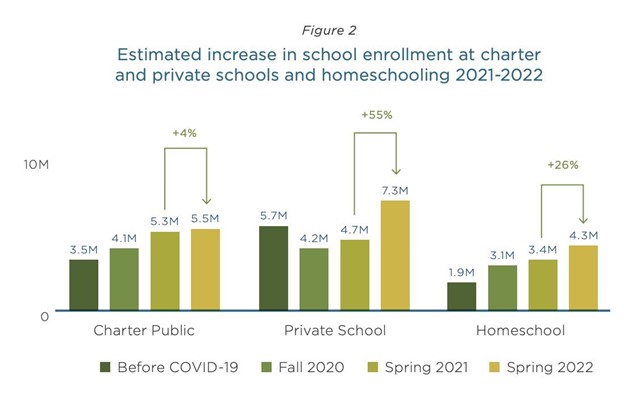
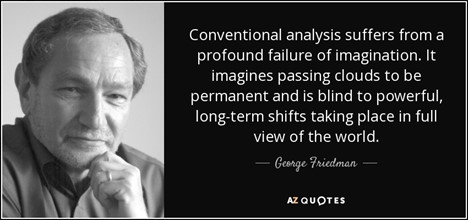
Tyton Partners estimate that between the Spring of 2021 and the Spring of 2022, charter schools increased enrollment by 200,000 students, private schools by 2.5 million students and home schools by 900,000 students. Charter schools have led the way with enrollment growth for decades, raising the question: Is this trend a passing cloud or a long-term shift?
I’m placing my bet on a long-term shift.
Charter schools face a variety of practical and political challenges. Practical difficulties include increased interest rates, building supply chain issues, and construction labor shortages. Political difficulties include increased general political polarization and a Baptist and Bootlegger self-own. Circumstances will vary considerably by state, but if you add it all up, the outlook looks challenging for charter school growth.
Private and home schools by contrast require little in the way of permission by public authorities when compared to charter schools. No statutes create caps for the number of private or home schools; no boards decide which schools may open or which must close. When a pandemic-fueled demand shock came, permissionless education systems answered the call.
The COVID-19 pandemic popularized a Do It Yourself (DIY) education movement. Americans take cues on schooling from friends, families, and social networks. More people doing DIY recently seems likely to lead to still more DIY in the future.
Stay tuned to this space in 2023, and we’ll explore further the long-term shifts taking place in full view of the world. Happy holidays!

SailFuture, a private high school, started as a mentoring program for at-risk youth by teaching them maritime skills through sailing adventures. It recently was named as one of 32 semifinalists for the $1 million Yass Prize to be awarded in December.
Consulting firm Tyton Partners, in collaboration with the Walton Family Foundation and Stand Together Trust, today released a new report, Choose to Learn 2022, that looks at data collected from more than 3,000 K-12 parents and more than 150 K-12 suppliers across all 50 states in the United States.
The report finds that 52% of parents now prefer to direct and curate their child’s education rather than rely on their local school system, and 79% of parents believe learning can and should happen everywhere as opposed to in school alone. Data shows that parents want experiences that make their child happy, above all else, by reflecting their child’s interests and providing individual academic support. However, despite all parents reporting similar goals for their children, regardless of demographics, the study reveals gaps in program participation across income and race. For example, children from underserved backgrounds are nearly two times less likely to participate in learning outside of school than their peers.
Choose to Learn 2022 explores the variety of K-12 options now available to families – inclusive of both in- and out-of-school educational offerings – and how this ecosystem can better reflect families’ broader aspirations for their children. The publication follows recent findings from Tyton Partners’ School Disrupted 2022 series, which highlighted the near 10-percent decline in district public school enrollment due to the lasting impact of the COVID-19 pandemic.
“In viewing K-12 through a broad lens, we set out to better understand the issues impacting every family, including more than forty million parents who send their children to public school,” according to Christian Lehr, Senior Principal at Tyton Partners and the lead author of Choose to Learn 2022. “Relative to issues of equity and access, our local public districts play a crucial role for K-12 families. At the same time, families crave a wide variety of learning experiences. It is in this spirit that we examined parents’ aspirations at the intersection of in- and out-of-school learning, and ask: How can the K-12 sector deliver a stronger union of academic, extracurricular, and personal outcomes for all families, regardless of life or economic circumstances?”
Based on these findings and more identified in this study, it is clear now more than ever that parents want an education centered on the needs of their child, yet there is continued work that needs to be done to bridge the gap between aspiration and reality. It is incumbent upon the K-12 system of policymakers, system leaders, and suppliers to introduce new experiences, choices, and outcomes into local school districts and catalyze the growth of programs outside of school and across all demographics.
Choose to Learn 2022 underscores the need for the K-12 system to move towards a more student-centric future and helps readers understand how to:
“We are honored to have the opportunity to drive this pivotal conversation forward, alongside our partners, the Walton Family Foundation and Stand Together Trust,” according to Adam Newman, Founder and Managing Partner at Tyton Partners. “There is a clear call for us to collectively build towards a more student-centered future in K-12 education.”
To view the findings and learn more about this study, download Choose to Learn 2022 on the Tyton Partners website.
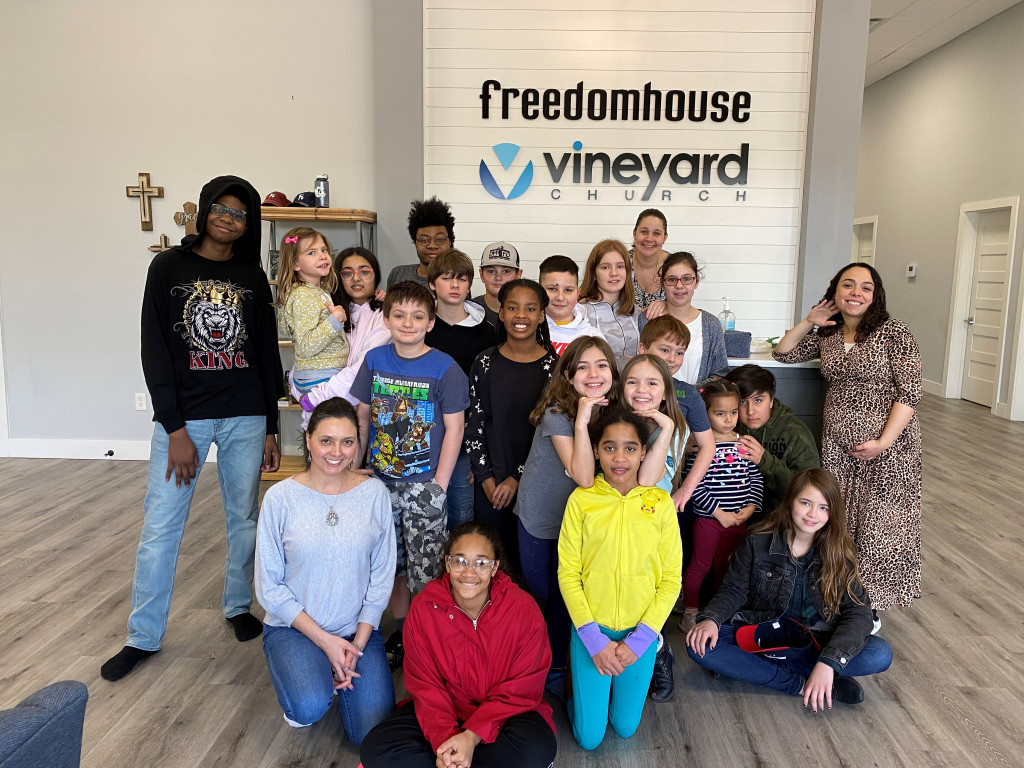
Melody Bolduc, (left, kneeling) with her students and staff. Bolduc founded KEYS Educational Resource Center to supplement homeschoolers' educational experience. Photo courtesy of Melody Bolduc
On this episode, reimaginED senior writer Lisa Buie talks with Melody Bolduc, a homeschooling mother of two daughters and founder of KEYS Educational Resource Center, a faith-based tutoring center for homeschoolers in Jacksonville, Florida.
Bolduc says how she wanted to be a teacher as early as first grade, when she and her friends would play school most afternoons. Bolduc felt drawn to teaching because she perceived teachers as having autonomy in their jobs. Bolduc went on to tutor classmates, including a girl she later realized had special needs that caused her to struggle with spelling. After working in district schools, Bolduc opened KEYS Educational Resource Center after becoming a mom so she could better fulfill family responsibilities. She started KEYS after a couple of friends asked her to tutor their homeschooled children.
“I would go over to (my friend’s) house once a week, and we would practice on a little chalkboard. We would practice, and practice and practice. I remember the first time she passed the spelling test, and I loved that I was able to teach her something.”
https://nextstepsblog.org/wp-content/uploads/2022/10/Reimagined.bolduc_mixdown-final.mp3
EPISODE DETAILS:
RELEVANT LINKS
Bolduc’s presentation at the 2022 Liberation of Education Conference
https://www.youtube.com/watch?v=dRDNUNZRkyU&list=PLT5UPtq10X0xnK6yFs5FgRPDOh8-EM843&index=7
KEYS Educational Resource Center
https://www.keyserc.org/
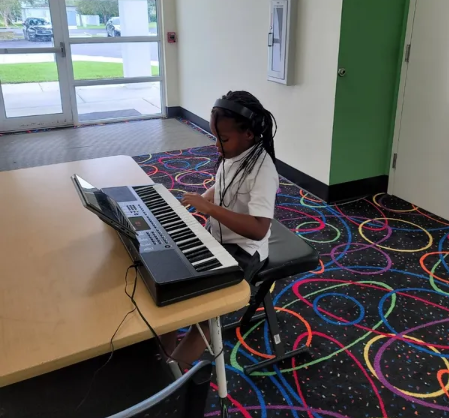
Permission To Succeed Education Center partners with families to provide self-paced in-person, hybrid and remote learning to students in Broward County, Florida, as well as students across the globe. Offerings include one-to-one teaching, independent study, and academic/lie coaching for students who need flexibility to learn in whatever way benefits them most.
Editor’s note: This commentary from Kerry McDonald, an education policy fellow at State Policy Network and senior education fellow at the Foundation for Economic Education, appeared Tuesday on forbes.com.
Nestled in a warm and colorful classroom space in a sprawling Salvation Army building in Ft. Lauderdale is Permission To Succeed Education Center, one of more than two dozen private microschools and similarly small, multi-age, co-learning communities in South Florida.
Felicia Rattray decided to launch Permission To Succeed in the summer of 2020 after schools shut down due to the pandemic and the shift to remote schooling gave her an up-close look at her nephew’s classroom.
Her sister had died in a car accident when Rattray’s nephew was just 8 days old and he then lived for several years with his grandmother until she grew too frail. Rattray and her husband, Amnon, assumed care of the boy, who was a third grader in a nearby public school.
A certified teacher, Rattray had been working as a social studies teacher and school counselor in public and charter schools in Florida since 2007. She knew her nephew was behind in school, and she had worked with him one on one during the afternoons and weekends to help him catch up. But Covid changed everything.
“During the pandemic, that’s when I saw just how behind he was,” said Rattray. “The spotlight was on it enough for me to see just how much he was suffering in the classroom.”
Rattray decided to create a microschool that would help students like her nephew, whom she discovered was working at a kindergarten grade level, to have a more personalized, mastery-based learning environment.
“The public schools can’t slow down the curriculum enough for the kids to catch up,” she said. “I’ve always had the desire to marry school counseling and education my way, my non-traditional way. In our microschool, each one of our students has a different curriculum that’s customized. I purchase different math curriculum, different reading curriculum depending on what is right for each child.”
To continue reading, click here.
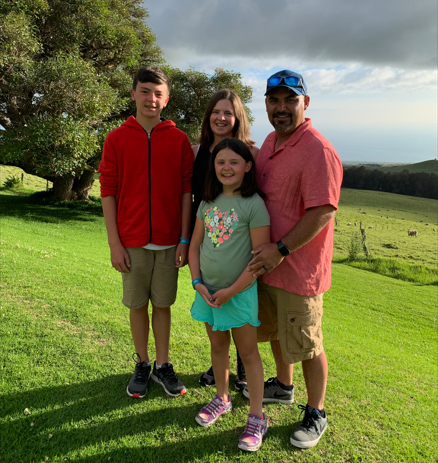
The Guerra family: parents Ashley and Keith and children Caden and Emma
On this episode, reimaginED senior writer Lisa Buie talks with Ashley Guerra, a New Mexico parent who for years has customized the education of her two children, Caden, 12, and Emma, 10. New Mexico, while offering robust public school choice, does not have a private school choice option.
Guerra and her husband, Keith, began by observing their children’s learning styles, making notes on how they absorb material. Then they modeled an education program based on Caden and Emma’s strengths.
https://nextstepsblog.org/wp-content/uploads/2022/10/reimagined.guerra_mixdown-final.mp3
“We … are constantly open to changing arrangements as we see them evolve in their educational journey. We really engage them in regular discussion so we can see how they feel they are doing. We want our children to feel fully invested in their education. We want them to take ownership, so their educational experience remains a complete reflection of themselves, their desires, and their areas of interests.”
EPISODE DETAILS:
In the expanding world of interactive video learning, New Jersey-based Shooting for the Stars employs creative tutors located in Florida and Texas who instruct students hundreds, if not thousands, of miles away.
School choice is plenty of things, and most of them involve helping students find the manner of instruction that suits them best.
If that were all school choice was about, it would be sufficient. But wait. There’s more.
School choice, it turns out, also presents opportunities for teachers, opportunities that are limited only by their imaginations, resolve, entrepreneurial spirits, and, occasionally, their ability to weather a punch.
Christina Jones effervesces with all these remarkable qualities, plus at least two more that, it seems, are not unrelated: She is a second-degree black belt in Tai Kwan Do, which, at least in part, helped her win the heart of a web-design genius. (More on that in a moment.)
Six years out of West Virginia University with a master’s degree in elementary education and a bachelor’s in special education, Jones found herself stretched to the brink of despair by the shifting demands of a private school in Mountain Lakes, N.J.
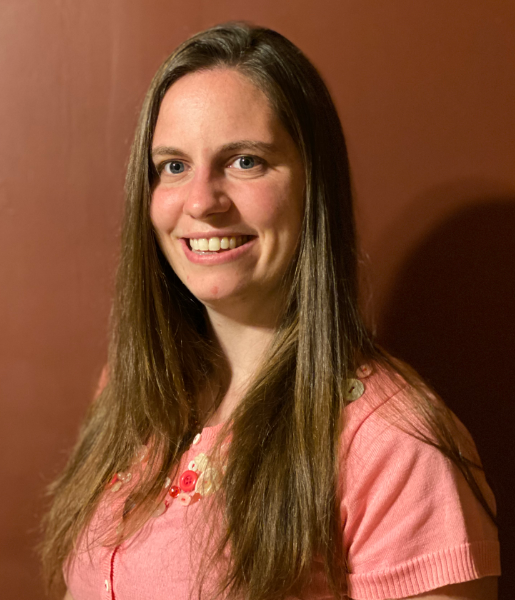
Christina Jones
“I taught third through eighth grade, multiple subjects, and I just kind of ... I was spread very thin,” Jones says.
But a one-on-one summer tutoring gig sparked a torch that illuminated a new course. Jones advertised and picked up a handful of student clients, prompting further inquiries. This, she began to think, could work.
Jones launched Shooting for the Stars Tutoring in 2018, determined to be a maker of differences.
Beyond the practical — earn enough to stay out of poverty — her goals were twofold: teach only in those areas where she was certified and recruit like-minded instructors to be part of the Shoot for the Stars team.
Jones reasoned she couldn’t be the only teacher out there who was dissatisfied with the unpredictability of her role from one year to the next, was nudged by administrators into subjects beyond their expertise, or whose carefully crafted lesson plans were made obsolete by shifting demands.
Then again, others might simply want to earn more or stretch their wings.
Steven Craw, who teaches engineering at Western High School in Davie, Fla., finds himself among the latter — an instructor looking to add to his bottom line while dipping deeper into his bag of certificates.
With Shooting for the Stars, Craw coaches high-level mathematics and physics … to students in New Jersey. The best part: Jones finds clients for him.
“I’m not looking to the customers who deal with websites; I’m not dealing with Facebook,” Craw says. “I’m not a social media guy. I don’t post anywhere, so Christina does that, and it helps me.”
So, about that.
While Shooting for the Stars continues to do most of its marketing via Facebook, there is a totally cool, professional website in the works, thanks to her new husband, Istanbul-born and New Jersey Institute of Technology-trained Arif Gencosmanoglu.
The pair met in a Morristown, N.J., gym (Jones also teaches Tai Kwan Do), and it wasn’t long before Arif discovered Christina’s love language: “I’m a software engineer with a can-do attitude, and I can build for you a world-class website.” (It sounds more romantic if you imagine the line delivered by Turkish actor Can Yaman.)
Shooting for the Stars understandably thrived through the pandemic shutdown that saw an eruption of homeschooling and learning pods. Jones herself added a full year of teaching third graders in a pod.
When the schools reopened and most of the kids headed back to traditional classrooms, Jones returned to the business of building her business.
“I persevere,” she says. “The Wright Brothers never gave up when they had failures; they kept going, and that’s me, too. You have to prove to me that I can’t make something work.”
It’s not like she’s operating in the friendliest environment, either.
New Jersey offers limited school-choice options. Some districts allow students to choose among public schools. The state also offers charter schools and STEM magnets, as well as a starchy homeschool alternative.
However, the Garden State is a laggard in at least two areas. New Jersey lacks a free online full-time school option. And there’s no public funding for students seeking alternatives to public schools, even though the average private school tuition — $14,322 for elementary schools, $19,522 for high schools — is lower than the state’s third-in-the-nation per-pupil spending ($20,021).
Jones notes those restrictions playing out at the local level.
“I did see a lot of fighting with the [Morris County] school district,” Jones says. “There were kids who had lawsuits … against the school district because [the district wasn’t] going to pay for the kid to go to the private school.
“Most of the kids I’ve seen seem to have some type of learning issue where their needs are not being met in the public school, and private school is expensive.”
Jones and her Shooting for the Stars team attempt to fill that gap. “A lot of the kids that are seeking our tutoring is because the school is not meeting their needs,” she says.
Homeschoolers, too, provide target-rich environments. But scoring those clients brings challenges of its own, chiefly making sure she has instructors qualified to make the students’ experiences worthwhile.
“I’m looking for tutors as well,” she says.
In this age of interactive video learning, location doesn’t matter. Shooting for the Stars already has tutors located in aforementioned Florida, as well as Texas, who instruct students hundreds, if not thousands, of miles away.
What she hopes to assemble is a team of tutors “who can address every single different need — but not so many that we lose the feeling of having a family orientation to the business.
“If I have a parent reach out to me, I don’t want to turn them away. … I always want to be able to say, ‘Hey, I have a tutor for you!’ ”
After all, if you’re shooting for the stars, you can’t afford to say no.
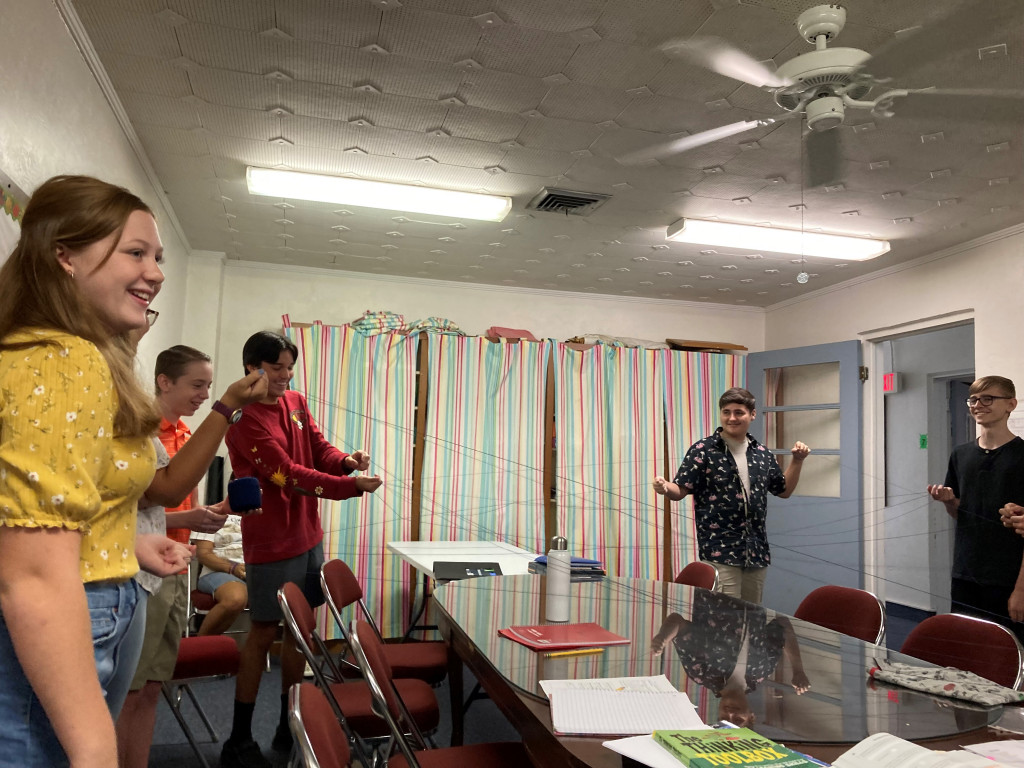
Students who are part of the new Hardee Cooperative Learning Center in Wauchula, Florida, participate in an exercise designed by co-op co-founder and director Sandra Shoffner to give them confidence speaking in public while exploring how much they have in common with each other.
WAUCHULA, Fla. – Sandra Shoffner dreamed of starting a homeschool co-op, but she never imagined the reception it would get when it finally happened.
Dozens of parents attended the first open house last month. They enrolled more than 50 kids for the first semester. And so many signed up for the second semester, there’s a waiting list.
“That night, I was just in awe. I’m still in awe,” said Shoffner, a mother of four with degrees in education. “It was surreal and fantastic. I was up there with the mic, literally shaking.”
“The turnout told me the need was insane.”
Home education was on the rise before the pandemic, then skyrocketed because of it. And it’s clear from the new Hardee Cooperative Learning Center in Wauchula, population 4,990, that the movement isn’t limited to cities and suburbs.
Hardee County, 70 miles from Tampa, is a patchwork of citrus groves, cattle ranches and phosphate mines.
A decade ago, it had 118 homeschoolers. Last year, it had 290.
Parents in the co-op say it’s even more important for rural communities to have learning options, because there are so few traditional schools, public or private. The expansion of co-ops, high-quality virtual providers and state-funded education savings accounts (ESAs) – which are more flexible than traditional school choice scholarships – are helping to make home education in rural areas even more viable.
“Bigger communities have a lot of options,” said parent Chelsea Green, who lives in another sprawling rural county next to Hardee. “We don’t.”
Green said she decided to homeschool her children, Tenley, 8, and Railan, 7, after realizing during the pandemic that she could actually do it. Tenley, who has ADHD, chafed under the rigid structure of a neighborhood school.
“It’s more like a rat race,” said Green, a former paraprofessional for district schools. “You have this time to do this, and this time to do that. My daughter isn’t good with a time schedule like that.”
With homeschooling, Tenley is less stressed and more engaged. She no longer needs as much of the ADHD medication that Green has never been comfortable giving her.
Wauchula isn’t an outlier.
Interest in the Hardee Cooperative Learning Center has exceeded expectations of co-founder and director Sandra Shoffner. More than 50 families signed up for the first semester and there’s a waiting list for the second semester.
The number of homeschool students in Florida’s 30 rural counties rose from 6,201 in 2011-12 to 10,207 last year. The sector keeps growing despite an explosion in school choice options, even in rural areas, and without the state support that’s helping those other options.
In raw numbers, homeschooling growth in rural Florida outpaces the growth in charter schools (from 2,673 students to 5,356 students in those counties over that same span) and it’s neck-in-neck with private schools (6,450 to 10,965). As but one manifestation of the trend, it’s easy to find other new co-ops that are thriving off the beaten path, like this one and this one.
Homeschooling would get another boost if Florida’s traditional school choice scholarships offered more flexibility like its ESAs. ESAs can be used for private schools or home schooling, but at present only students with special needs are eligible. In Florida’s rural counties last year, 791 students used them. (The ESAs are officially called the Family Empowerment Scholarship for Students with Unique Abilities. They’re administered by nonprofits like Step Up For Students, which hosts this blog.)
Shoffner’s son Elliott, who is 7 and on the autism spectrum, is one of those ESA students.
Shoffner works part time as executive director of the Hardee County Friends of the Library, and has degrees in elementary education and special education. She began homeschooling almost a decade ago with her two oldest children.
The dream of a co-op followed.
“It’s important for the adults as much as the kids,” Shoffner said. “I wanted that community with other adults with similar interests.”
Shoffner knew homeschool parents could feel a little isolated, especially in a small town. She knew they’d appreciate connecting with other parents while their kids got opportunities to learn from other teachers. So, a few months ago, she and a handful of other DIY homeschool moms decided to give it a go.
The Hardee Cooperative Learning Center is using space in a church. It’s offering 16 classes one day a week for students ages 3 to 19. Seven teachers, all of them parents, are teaching everything from geography and elementary engineering to creative writing and arts and crafts. Shoffner teaches four classes, including Plants 101 and Debate.
One recent Monday, she went over the difference between fact and opinion to the eight teens in her debate class, and explained “red herring” and “ad hominem attack.” She also led an exercise where the students took turns holding a ball of yarn and listing things they liked until another student said, “Me too.” Then they held the thread while tossing the yarn to the other student, who repeated the drill. The point was to 1) practice speaking in public, and 2) to see, as the yarn formed a web, how much everyone had in common.
For homework, Shoffner asked the students to find a partner and choose from one of two topics: The death penalty or legalizing marijuana. She gave them a week to prepare to debate either the pros or cons.
Where the new co-op heads is up to the participating families.
More classes? Different classes? More and/or different days of the week? How about a seasoned math instructor?
The beauty of the co-op is its flexibility and responsiveness.
“What the parents want is absolutely going to shape where this goes,” Shoffner said. “We’re parent led.”
Shoffner said the Hardee Cooperative Learning Center is not faith-based, to distinguish it from other co-ops in the area, although it does offer some Bible-based classes.
It’s also committed to including any family that wants in.
Shoffner said she has been a lifelong advocate for inclusion for persons with special needs, stemming from a sister who is severely intellectually disabled.
“I don’t know how I can fight for inclusion for kids with special needs, then tell someone else I won’t include them,” she said.
Homeschool parents are grateful for the new co-op.
Lisa Dickey said her son, Laremy, 11, was in neighborhood schools through third grade. He struggled academically after several emotional events, including a fire that destroyed the family’s house and led them to move to a different part of the county and a different zoned school.
Dickey is a stay-at-home mom whose husband works for the Mosaic phosphate company. She said she wasn’t sure, at first, if she could homeschool adequately. But Laremy is taking his core academic classes through Florida Virtual School – which he loves – and she found support from other homeschool families.
The co-op is a nice complement, she said. The team building and character building classes are especially good, she said. And the co-op gives Laremy an opportunity to interact and have fun with other students.
“If he had stayed in public school, he would have fallen further behind,” Dickey said. “It’s good to have that choice.”
Especially, Shoffner said, in a rural area.
“We’ve had one option, one way, for so long,” Shoffner said. “Now we have many options. And people want them.”
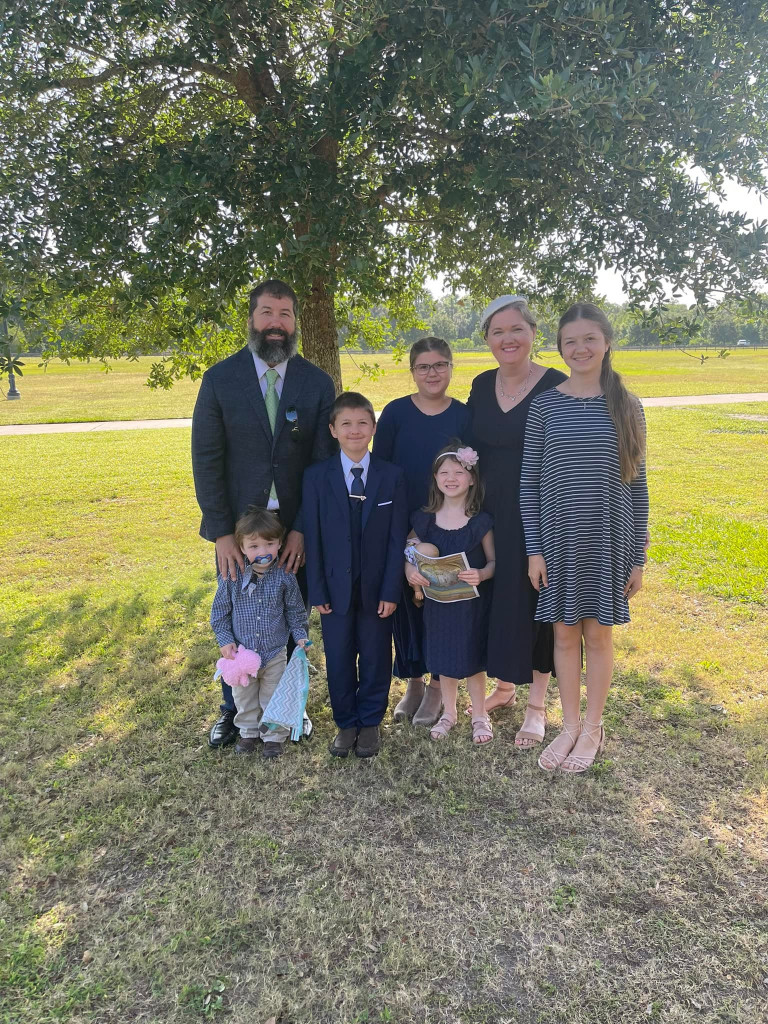
The Bradica family, from rural central Florida, participates in various forms of education choice.
On this episode, reimaginED senior writer Lisa Buie talks with Nicole Bradica, a mother of five ranging in age from 14 to 2 years old. The family lives in Chuluota, Florida, a small town of 2,532 residents near Orlando.
Bradica, who has been homeschooling her children for 11 years, this year received a Florida Tax Credit Scholarship for her oldest daughter to attend Chesterton Academy, a new classical high school that describes itself as “grounded in the Catholic faith” and is based on the “three pillars of formation,” namely, intellect, character formation, and spirituality.
Meanwhile, Bradica’s son Joshua has been diagnosed with precocious puberty, a rare genetic disorder that causes a child’s body to begin changing into that of an adult too soon. She is exploring how he may qualify for a Family Empowerment Scholarship for Students with Unique Abilities.
Overall, she sees the possibilities inherent in universal education savings accounts and how that model could help families like hers broaden their children’s education by making available more enrichment opportunities.
“I can see (ESAs) being a huge blessing. We have Joshua in scouts and P.E., and he does karate, so we’ve added in different extracurriculars each year as he got older, and those physical needs have become more demanding for him. When our children hit fourth grade, I sat down with them and asked what their strengths are, what their interest are. It’s always fascinating to me to learn what they are gravitating to and what they want to learn more about.”
EPISODE DETAILS:
RELEVANT LINKS:
https://chestertonorlando.com/
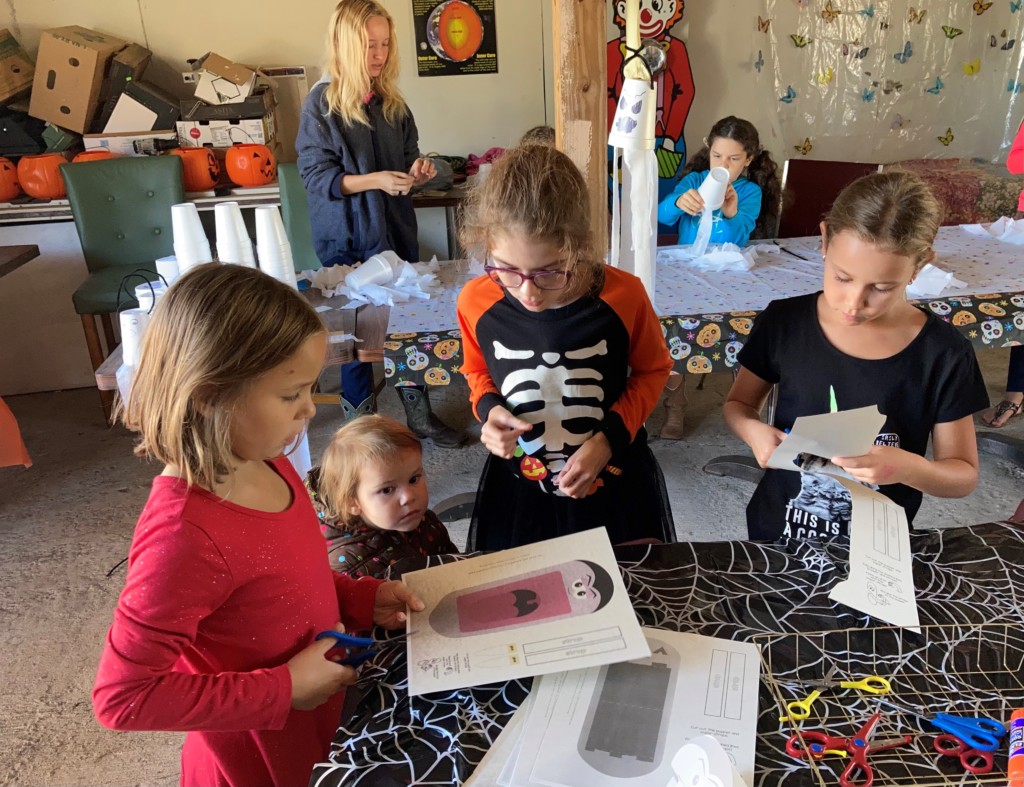
Kirby Family Farm launched as a homeschool co-op nearly three years ago with 10 students. More than 40 students, most of them elementary and middle school aged, attended during the past school year. More than half came from public schools.
Editor’s note: This article appeared Thursday on chronicleonline.com. You can read a reimaginED post about a homeschool co-op in North Central Florida here.
While students are returning to school this week, not all are going to be in a classroom.
According to the Florida Department of Education, there were 152,109 homeschool students in the state for the 2021-22 academic year and an increase of 69% in the last five years. Numbers rise every year across the country, especially following the school shutdowns during the pandemic.
Parents who choose to homeschool do not have to go through it alone, with online courses, resources, and local groups. The kids are not alone, either, as many join co-ops or other programs.
Sherri Boggess Brice has been leading the Williston Christian Homeschool Group for 19 years. It currently has more than 90 members of all grade levels. The members share information and resources, as well as doing group parties and field trips.
Last year’s excursions included the Endangered Animal Rescue Sanctuary, Hoggetown Medieval Faire, Kanapaha Botanical Gardens and Cedar Key Historical Society, all geared toward older group members. The students also get together to do team sports and holiday parties.
“In my 23 years of homeschool adventures, homeschool kids still go to prom, participate in a graduation ceremony and receive a diploma,” Brice said. “My four daughters entered college straight from my homeschool program. Dual enrollment, college scholarships and Bright Futures all played a part in my children’s education at the upper level.”
“Homeschooling is one of the best alternatives for your child’s education,” she said. “Your child will learn life skills as well as the typical school subjects.”
To continue reading, click here.
 On this episode, reimaginED senior writer Lisa Buie talks with Brian Ray, a co-founder and president of the National Home Education Research Institute, a national nonprofit that conducts and collects research about home-based education and publishes the Home School Researcher.
The institute has hundreds of works documented and cataloged on homeschooling, many of which are staff produced. Additionally, Ray publishes research and testifies in hearings about his research.
“Home-based education was the norm over the past millennia. Nobody bothered asking parents 300 years ago, ‘What about socialization?’ Simply because most of us today experienced institutional schooling, we think the norm is best and we think the norm brings the best results, but that is fallacious thinking. The norm does not necessarily give you the best.”
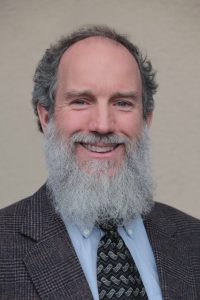
Brian Ray
EPISODE DETAILS:
RELEVANT LINK:

